
The Law of Sines is a basic law of trigonometry that defines the relation between the sides and the angles of the triangle.
- It is also known as the Sine Law, Sine Rule, or Sine Formula.
- The Law of Sines is versatile and can be applied in various fields such as navigation, surveying, and engineering.
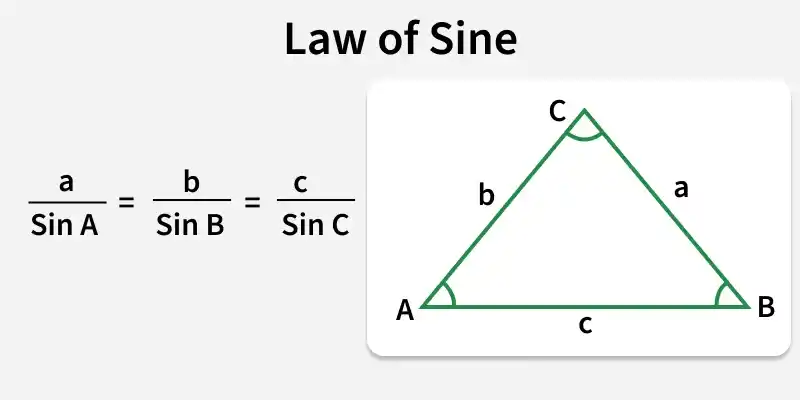
Ratio of the side length to the sine of the opposite angle. For a triangle with sides a, b, and c with respective angles, ∠A, ∠B, and ∠C, the sine law states that,
\frac{a}{sin A} = \frac{b}{sin B} = \frac{c}{sin C}
It is commonly used when:
- Two angles and one side (AAS or ASA) are known.
- Two sides and a non-included angle (SSA) are known.
Proof of the Law of Sines
The area of a triangle can be expressed using any two sides and their included angle.
Let the area of triangle ABC be Δ.
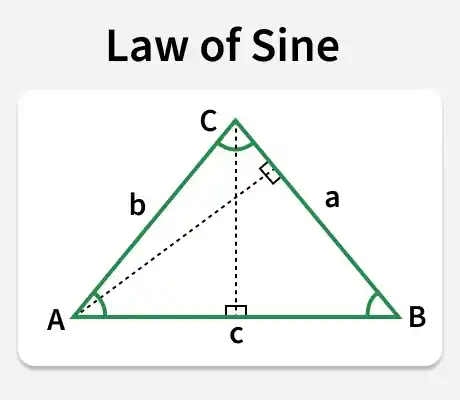
- Using sides b and c: Δ = 1/2*bc*sinA
- Using sides a and c: Δ = 1/2*ac*sinB
Since both expressions represent the same area, 1/2*bc*sinA = 1/2*ac*sinB
Multiplying both sides by 2 and dividing by c:
b*sinA = a*sinB
Dividing by sinAsinB: a/sinA = b/sinB ------(1)
Similarly,
a/sinA = c/sinC -------(2)
By combining equation (1) and (2) above,
\frac{a}{sin A} = \frac{b}{sin B} = \frac{c}{sin C}
The is Law of Sine formula.
Relations Derived from the Law of Sines
From the Law of Sines, the sides of a triangle are proportional to the sines of their opposite angles:
a:b:c=\sin A:\sin B:\sin C
Comparing any two sides gives:
\frac{a}{b}=\frac{\sin A}{\sin B}\\[3pts]\frac{b}{c}=\frac{\sin B}{\sin C}\\[3pts]\frac{a}{c}=\frac{\sin A}{\sin C}
These relationships are useful for finding unknown sides or angles in a triangle.
Solved Examples
Example 1: It is given for a triangle ABC, a = 20 units, c = 25 units, and ∠C = 30°. Find ∠A of the triangle.
Given,
- a = 20 units
- c = 25 units
- ∠C = 30°
Using Sine Formula
a/sin A = c/sin C
20/sin A = 25/sin 30
sin A = 0.40
A = 23.5°
Example 2: It is given for a triangle ABC, b = 15 units, c = 20 units, and ∠C = 60°. Find ∠B of the triangle.
Given,
- b = 15 units
- c = 20 units
- ∠C = 60°
Using Sine Formula
b/sin B = c/sin C
15/sin B = 20/sin 60
sin B = 0.649448
B = 40.5°
Example 3: It is given for a triangle ABC, b = 30 units, c = 40 units, and ∠C = 30º. Find ∠B of a triangle.
Given,
- b = 30 units
- c = 10 units
- ∠C = 30°
Using Sine Formula
b/sin B = c/sin C
30/sin B = 40/sin 30
sin B = 0.374607
B = 22°
Example 4: It is given for a triangle ABC, a = 15 units, b = 20 units, and ∠C = 45°. Find ∠A of the triangle.
Given,
a = 15 units
b = 20 units
∠C = 45°
Using Sine Formula
a/sin A = b/sin B
15/sin A = 20/sin 45
sin A = 0.75
A = 48.6°
Example 5: It is given for a triangle ABC, a = 10 units, b = 14 units, and ∠A = 30°. Find ∠B of the triangle.
Given,
a = 10 units
b = 14 units
∠A = 30°
Using Sine Formula
a/sin A = b/sin B
10/sin 30 = 14/sin B
sin B = 0.7
B = 44.4°
Practice Problems
1. If in a triangle with sides, a = 8, b = 7, and angle ∠A = 120° are given. Find the corresponding value of ∠B.
2. In a triangle with sides, a = 12, b = 9, and angle ∠A = 90° are given. Find the corresponding value of ∠B.
3. For a triangle of sides a = 6, b = 4, and angle ∠A = 60° are given. Find the corresponding value of ∠B.
4. In a triangle of sides, a = 18, b = 12, and angle ∠A = 30° are given. Find the corresponding value of ∠B.
5. It is given for a triangle ABC, a = 9 units, c = 11 units, and ∠C = 80°. Find ∠A of the triangle.
Related Articles
