
Chapter 13 of the Class 8 NCERT Mathematics textbook, titled "Introduction to Graphs," introduces students to the concept of graphs and their applications. Exercise 13.2 focuses on the interpretation and plotting of various types of graphs, such as line graphs and bar graphs, enabling students to visualize data effectively.
NCERT Solutions for Class 8 - Mathematics - Chapter 13 Introduction to Graphs - Exercise 13.2
This section provides step-by-step solutions for the problems in Exercise 13.2 of Chapter 13. The exercise involves plotting points on a graph, interpreting given data, and understanding the relationship between different variables through graphical representation.
Question 1: Draw the graphs for the following tables of values, with suitable scales on the axes.
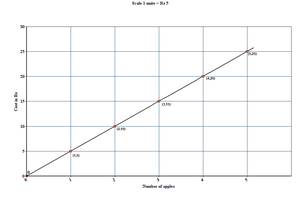
(a) Cost of apples
| Number of apples | 1 | 2 | 3 | 4 | 5 |
| Cost (in ₹) | 5 | 10 | 15 | 20 | 25 |
(b) Distance traveled by car
| Time (in hours) | 6 a.m. | 7 a.m. | 8 a.m. | 9 a.m. |
| Distances (in km) | 40 | 80 | 120 | 160 |
(i) How much distance did the car cover during the period 7.30 a.m. to 8 a.m.?
(ii) What was the time when the car had covered a distance of 100 km since its start?
(c) Interest on deposits for a year.
| Deposit (in ₹) | 1000 | 2000 | 3000 | 4000 | 5000 |
| Simple Interest (in ₹) | 80 | 160 | 240 | 320 | 400 |
(i) Does the graph pass through the origin?
(ii) Use the graph to find the interest on Rs 2500 for a year.
(iii) To get an interest of Rs. 280 per year, how much money should be deposited?
Solution:
(a) Represent the "Number of apples" as X-axis and "Cost in Rs" as Y-axis
(b) Represent the "Times (in hrs)" as X-axis and "Distance (in km)" as Y-axis
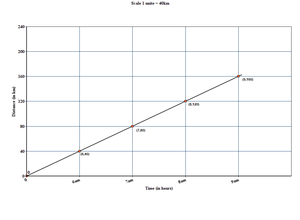
(i) The car covered 20 km distance during the period 7.30 a.m. to 8 a.m.
(ii) It was 7.30 am, when the car covered a distance of 100 km since it’s start.
(c) Represent the “Simple Interest (in Rs)” on x-axis and “Deposit (in Rs)” on y-axis.
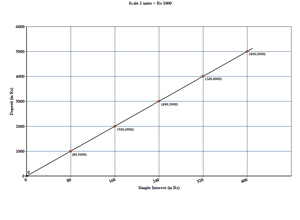
(i) Yes, the graph passes through origin.
(ii) The interest on Rs. 2500 is Rs. 200 for a year.
(iii) Rs. 3500 should be deposited for interest of Rs. 280 per year.
Question 2: Draw a graph for the following
(i)
| Side of the square(in cm) | 2 | 3 | 3.5 | 5 | 6 |
| Perimeter(in cm) | 8 | 12 | 14 | 20 | 24 |
Is it linear graph?
(ii)
| Side of the square(in cm) | 2 | 3 | 4 | 5 | 6 |
| Area(in cm2) | 4 | 9 | 16 | 25 | 36 |
Is it linear graph?
Solution:
(i) Represent the “Side of square(in cm)” on x-axis and “Perimeter(in cm)” on y-axis.
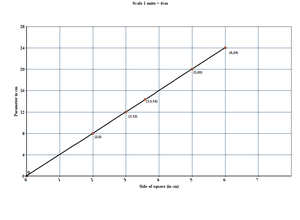
Yes, the graph is a linear graph.
(ii) Represent the “Side of square(in cm)” on x-axis and “Area(in cm2)” on y-axis.
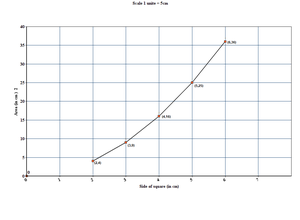
No, the graph is not a linear graph because the graph does not provide a straight line.
Summary
In Exercise 13.2 of Chapter 13 "Introduction to Graphs," students practice plotting and interpreting different types of graphs. The exercise helps in understanding the importance of graphical representation in data analysis, such as line graphs for showing trends over time and bar graphs for comparing quantities. By working through this exercise, students gain skills in accurately plotting data points and interpreting the information that graphs convey.
