
NCERT Solutions for Class 9 Maths Chapter 11 Constructions- The team of subject matter experts at GFG have curated NCERT Solutions for Class 9 Maths Chapter 11 Constructions to make sure that every student can understand how to solve Construction problems in a stepwise manner. This article provides solutions to all the problems asked in Class 9 Maths Chapter 11 Constructions of your NCERT textbook in a step-by-step manner as per the latest CBSE Syllabus 2023-24 and guidelines.
NCERT Class 9 Maths Chapter 11 Constructions is a foundational chapter in the learning of constructions. Understanding the methods for creating various types of triangles for various criteria has been made easier by the detailed NCERT Solutions For Class 9 Maths Chapter 11 Constructions provided in this article.
NCERT Class 9 Maths Chapter 11 Constructions covers topics such as:
Solutions to all the exercises in the NCERT Class 9 Maths Chapter 11 Constructions have been collectively covered in NCERT Solutions for Class 9 Maths. They are regularly revised to check errors and updated according to the latest CBSE Syllabus 2023-24 and guidelines.
Class 9 Maths NCERT Solutions Chapter 11 Constructions Exercises |
|---|
| Class 9 NCERT Solutions- Chapter 11 Constructions – Exercise 11.1 – 5 Questions (2 Short Answers, 2 Long Answer, 1 Very Long Answer) |
| Class 9 NCERT Solutions- Chapter 11 Constructions – Exercise 11.2 - 5 Questions (5 Very Long Answers) |
NCERT Solutions for Class 9 Maths Chapter 11 Constructions : Exercise 11.1
Question 1. Construct an angle of 90° at the initial point of a given ray and justify the construction.
Solution:
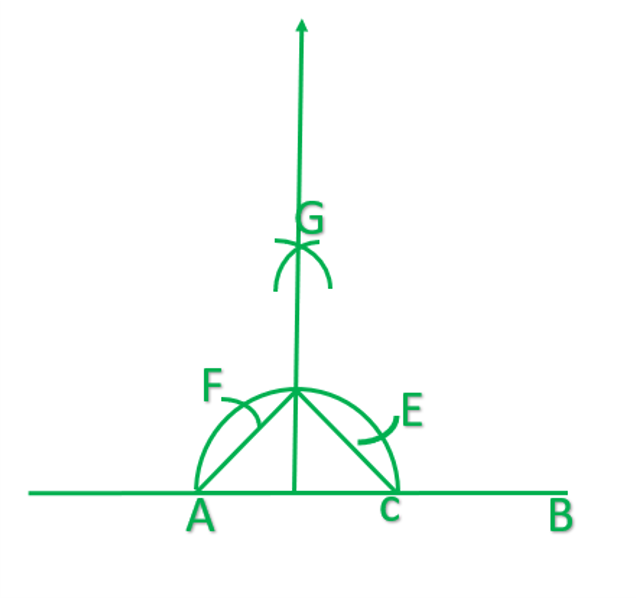
Steps of construction
- Take a ray with initial point A.
- Taking care center and same radius draw an Arc of a circle which intersect AB at C.
- With C as Centre and the same radius, draw an arc intersecting the previous arc at E.
- With E as Centre and the same radius draw an arc which intersects the arc drawn in step 2 at F.
- With E as Centre and the same radius, draw another arc, intersecting the previous arc at G.
- Draw the ray AG.
- Then ∠BAG is the required angle 90°
Justification:
Join AE, CE, EF and AE, AF
AC = CE = AE [ by construction]
∴ ACE is an equilateral Triangle
⇒ ∠CAE = 60° -----------------1
Similarly, AE = EF = AF
∴Triangle AEF is an equilateral Triangle
⇒ ∠EAF = 60°
Because AG bisects ⇒ ∠EAF
∴∠GAE = 1\2 = 30° = 30°------------2
1+2
∴∠CAE + ∠GAE = 60°+30°
∠GAB=30°
Question 2. Construct an angle of 45° at the initial point of a given ray and justify the construction.
Solution:
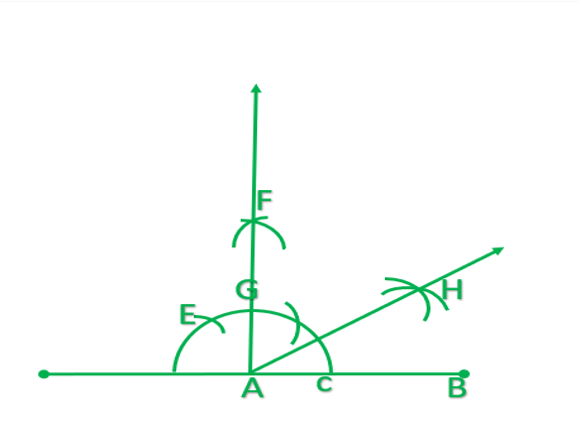
Step of Construction:
- Take a ray AB with initial point A
- Draw ∠BAF=90°
- Taking C as Centre and radius more than draw an arc.
- Taking G as Centre and the same radius as before, draw another arc.
- Taking G as Centre and the same radius as before, draw another arc. Intersecting previous arc at H.
- Draw the ray AH.
- Then ∠BAH is the required angle of 45°
Justification:
Join GH and HC (construct)
In ∆ AHG and ∆ AHC
HG=HC…………….[arc of equal radii]
AG=AC……………..[radii of same arc]
AH=AH………………[common]
AHG≅AHC [S.S.S]
∠HAG=∠HAC [C.P.C.T]
But ∠HAG+∠HAC=90
∠HAG=∠HAC=90\2=45
∴∠BAH=45
Question 3. Draw the angles of the following measurement
i) 30°
Solution:
Step of construction
- Draw a ray AB with initial point A.
- With A as centre, draw an arc intersecting AB at c.
- With c as centre and the same radius, draw another arc, intersecting the previously drawn arc at D.
- Taking C and D as centre and with the radius more than 1\2 DC draws arcs to intersect each other at E.
- Draw ray AE. ∠EAB is the required angle of 30.
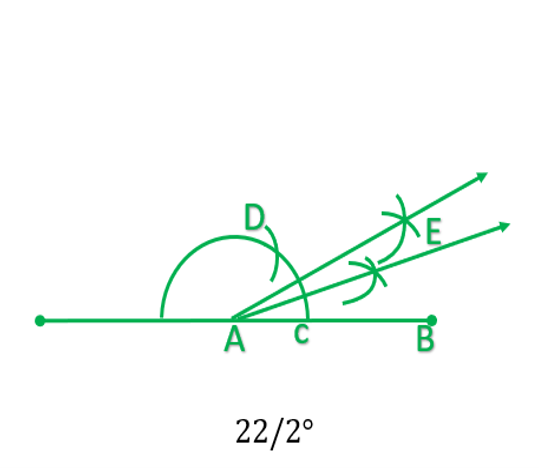
ii) 22 ½°
Solution:
Steps of construction
- Take a ray AB
- Draw an angle ∠AB=90° on point A.
- Bisect ∠CAB and draw ∠DAB=45°
- Bisect ∠DAB and draw ∠EAB
- ∠EAB is required angle of 22 ½°
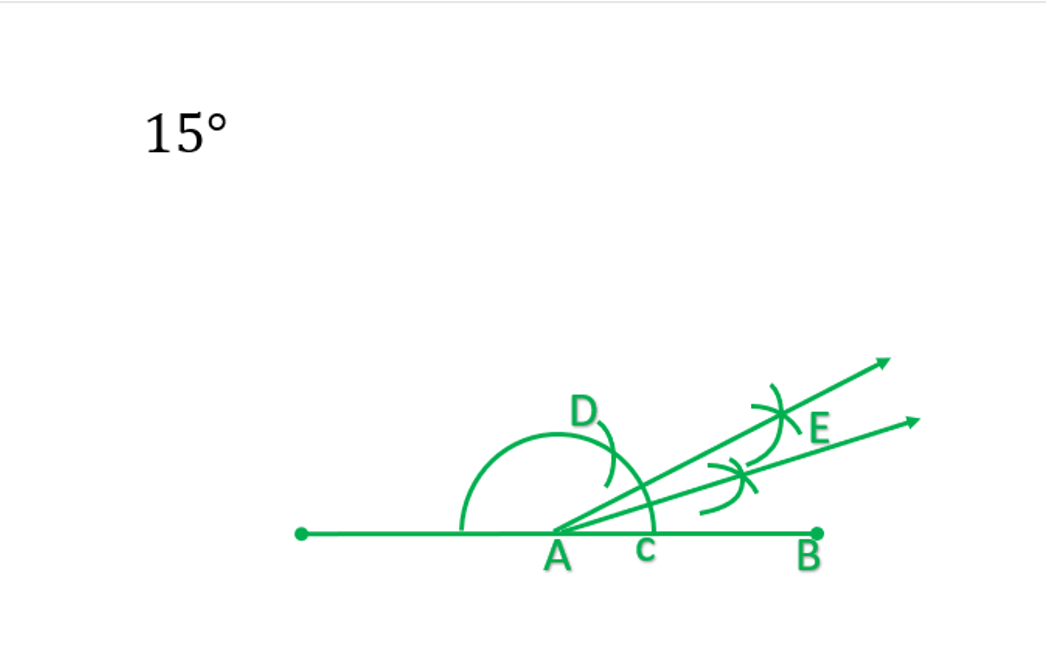
iii) 15°
Solution:
Steps of construction
- Take a ray AB.
- Draw an arc on AB, by taking A a center, which intersect AB at c.
- From C with the same radius draw another re which intersect the previous arc at D.
- Join DA.
- ∠DAB =60°
- Bisect ∠DAB and draw angle EAB=30°
- Bisect ∠EAB and draw ∠FAB
- ∠FAB is the required angle.
Question 4. Construct the following angles and verify by measuring them by a protractor
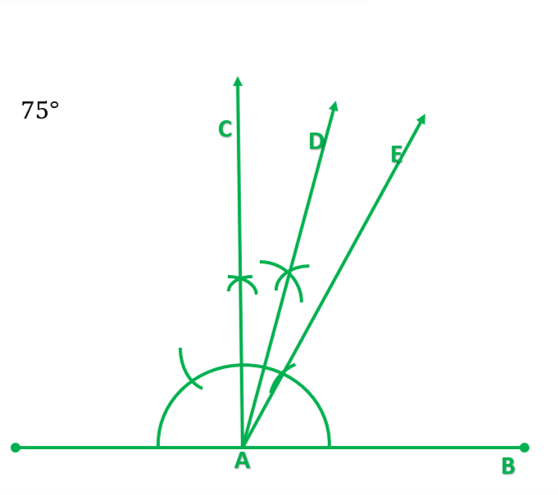
(i) 75°
Solution:
Steps of construction
- Draw a ray AB with initial point A.
- At point A draw an angle ∠CAB=90°
- At point A draw ∠DAB=60°
- Bisect ∠CAD, now ∠EAD=15°
- ∠EAB=75° {∠EAB=∠EAD+∠DAB=15°+60°=75°}
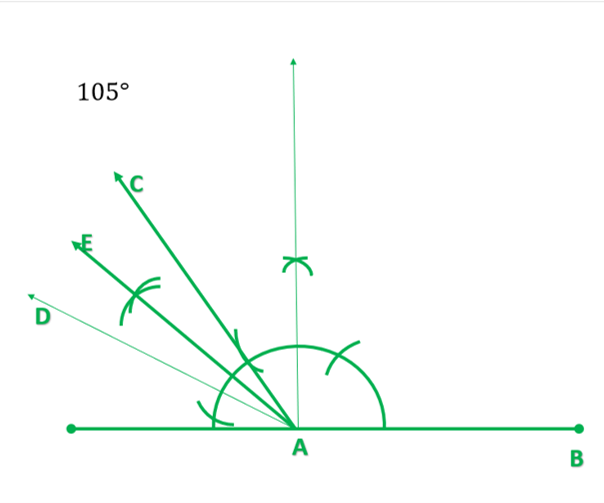
(ii) 105°
Solution:
Steps of construction
- Draw a ray AB with initial point A.
- At point A draw an angle ∠CAB=90°
- At point A draw ∠DAB=120°
- Bisect ∠CAD, now ∠EAD=15°
- ∠EAB=75° {∠EAB=∠EAC+∠CAB=15°+90°=105°}
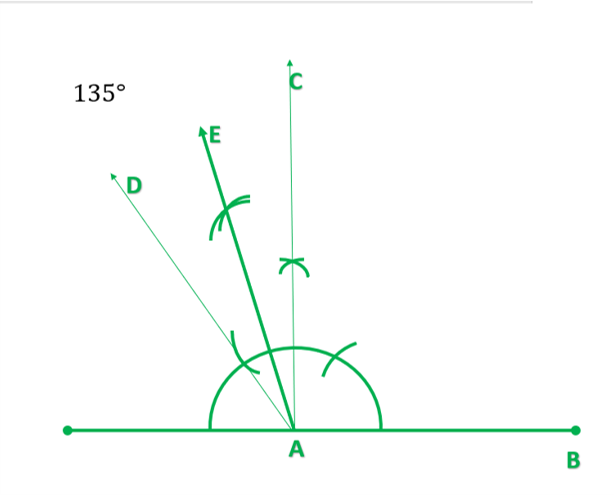
(iii) 135°
Solution:
Steps of construction
- Draw a ray AB with initial point A.
- At point A draw an angle ∠CAB=120°
- At point A draw ∠DAB=150°
- Bisect ∠CAD, now ∠EAC=15°
- ∠EAB=135° {∠EAB=∠EAC+∠CAB=15°+120°=135°}
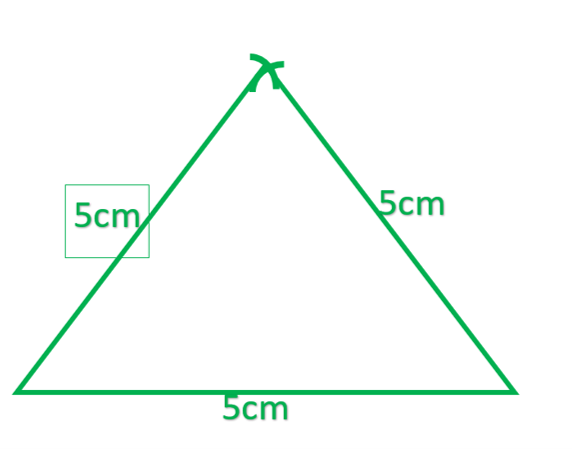
Question 5. Construct an equilateral triangle, given its side and justify the construction.
Solution:
Steps of construction
- Draw a line segment of AB of a given length.
- With A and B as centre and radius equal to AB draw arcs to intersect each other at c.
- Join AC and BC.
Then ABC is the required equilateral triangle.
Justification:
AB=AC ……………. [by construction]
AB=BC ……………..[by construction]
AB=AC=BC
Hence, ∆ABC is required equilateral triangle.
NCERT Solutions for Class 9 Maths Chapter 11 Constructions: Exercise 11.2
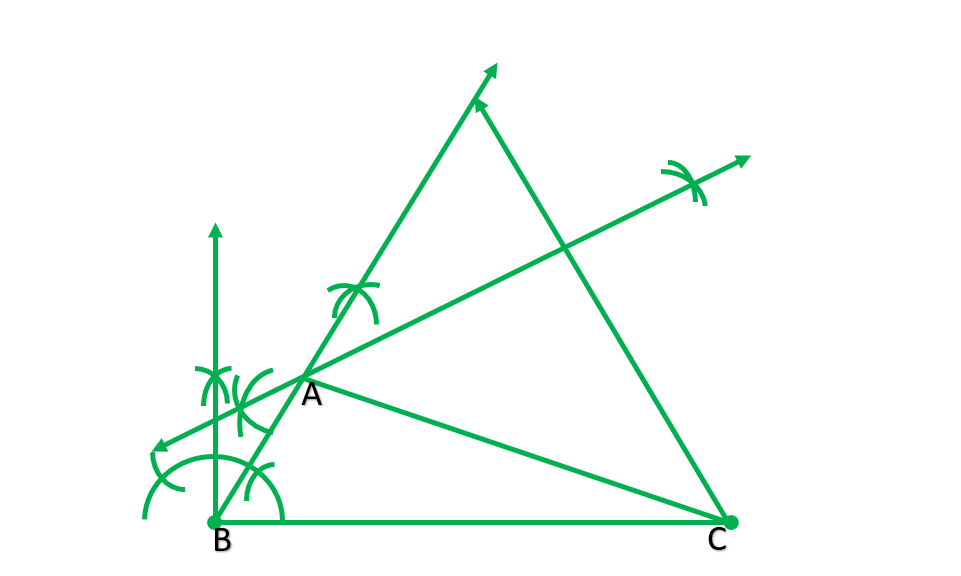
Question 1. Construct a ∆ ABC in which BC = 7 cm, ∠B = 75° and AB + AC = 13 cm.
Solution:
Steps of construction:
- Draw a line segment BC base of cm is drawn.
- At point B draw an angle of 75°.
- Cut BD =13cm from BY.
- Join ∠D which intersect BD at A.
- Join AC. Now triangle ABC is the required triangle
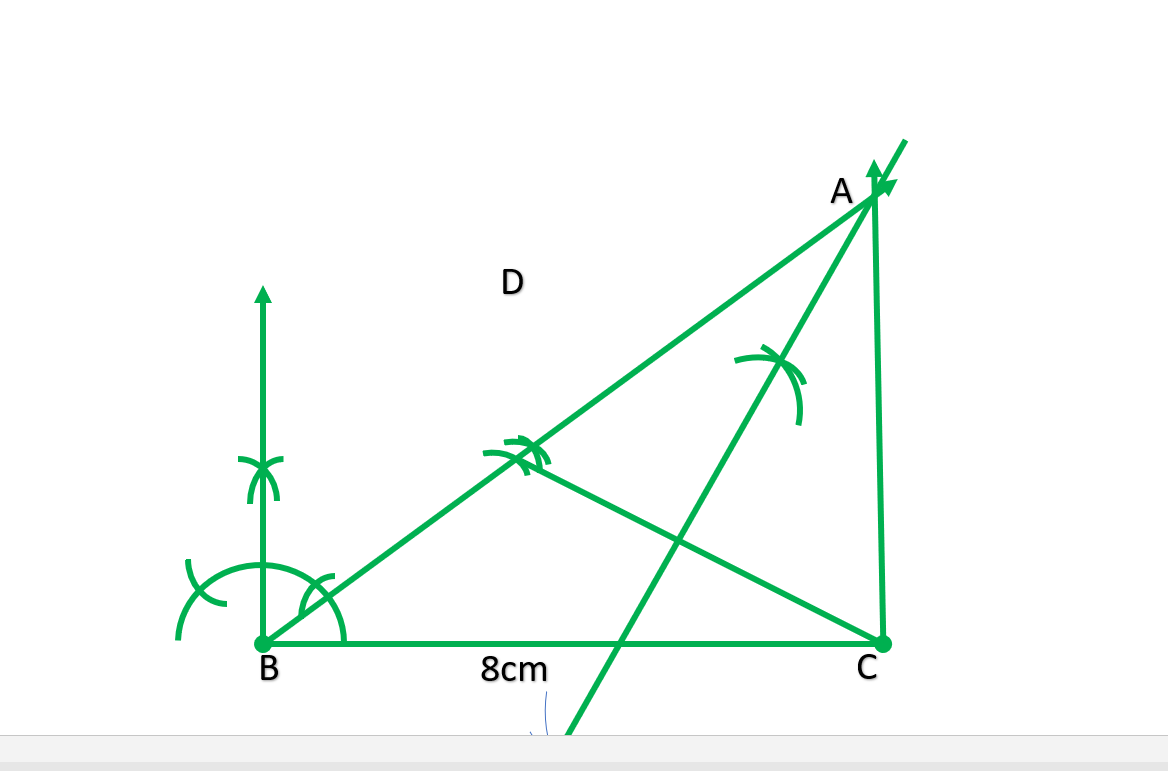
Question 2. Construct a ABC in which BC = 8 cm, ∠B = 45° and AB – AC = 35 cm.
Solution:
Steps of construction:
- Draw a line segment BC=8cm.
- At point B, draw angle 45°.
- Cut BD=3.5 from BY.
- Join CD.
- Draw perpendicular bisector of CD, which construct BY at A.
- Join AC. NOW, ABC is the required triangle.
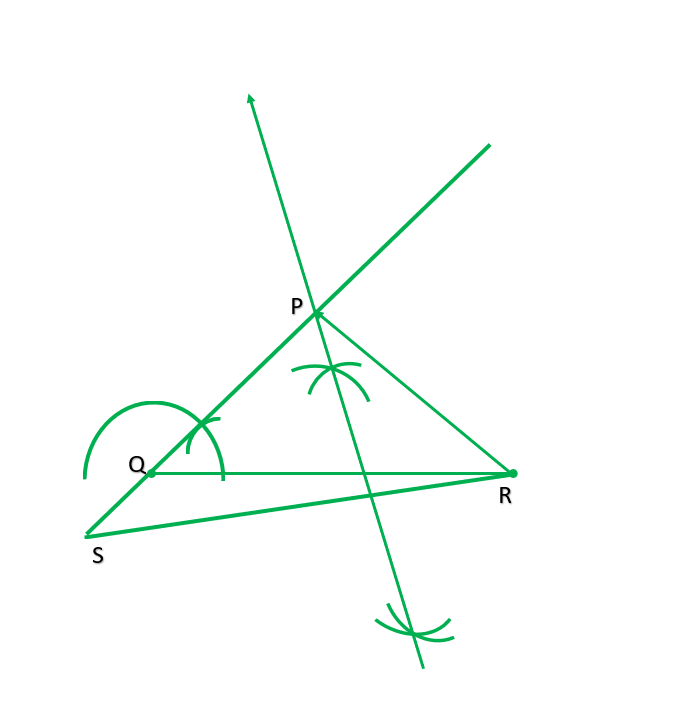
Question 3. Construct a ∆ ABC in which QR = 6 cm, ∠Q = 60° and PR – PQ = 2 cm.
Solution:
Steps of construction:
- Draw a line segment QR=6cm.
- At point Q draw angle 60°.
- Extend PQ to Y’.
- Cut QS =2cm from QY’.
- Join RS.
- Draw perpendicular bisector of RS which intersect QY at P.
- Join PR. Now, PQR is the required triangle.
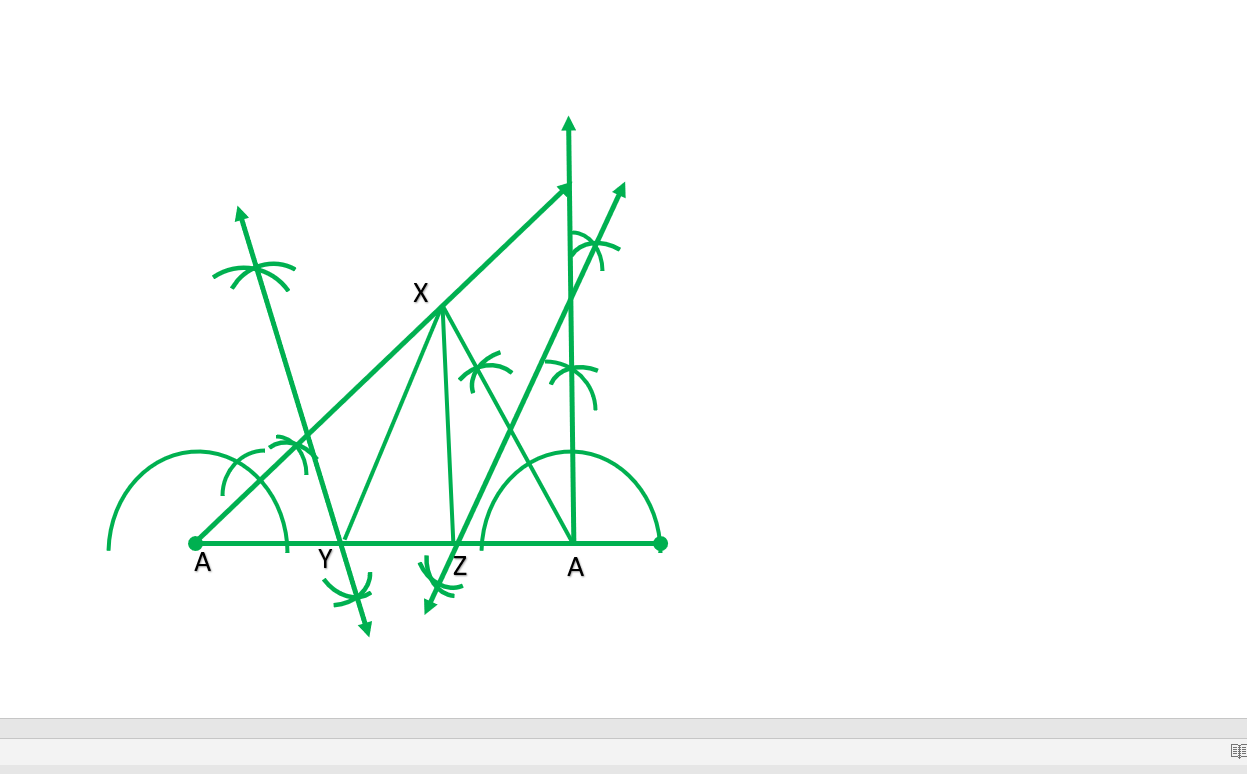
Question 4. Construct a ∆ XYZ in which ∠Y = 30°, ∠Y = 90° and XY + YZ + ZX = 11 cm.
Solution:
Steps of construction:
- Draw a line segment AB=11cm.
- At point A draw ∠BAP=30°.
- At point B draw angle 90°.
- Draw the bisector of ∠BAP and ∠ABR which intersect each other at X.
- Join AX and BX.
- Draw perpendicular bisector of AX and BX which intersect AB on Y and Z respectively.
- Join XY and XZ. Then XYZ is the required triangle.
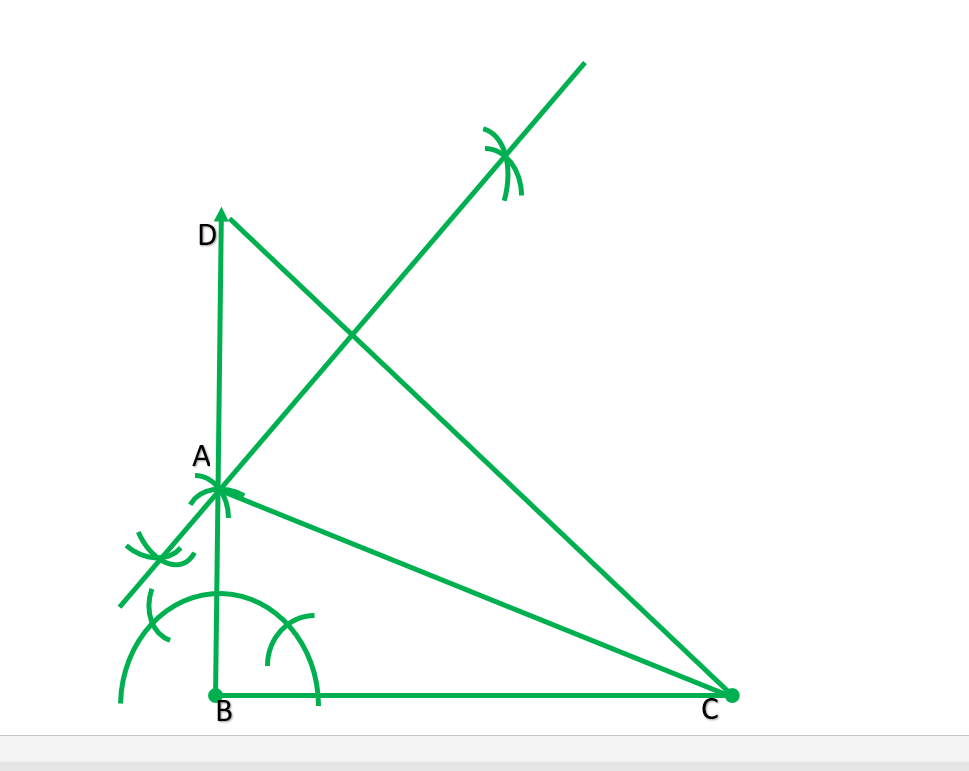
Question 5. Construct a right triangle whose base is 12 cm and sum of its hypotenuse and other side is 18 cm.
Solution:
Steps of construction:
- Draw a line segment of BC=12cm.
- At point B draw angle b=90°
- Cut BD =18cm.
- Join CD.
- Draw perpendicular bisector of CD which intersect BD at point A.
- Join AC. Now ABC is the required triangle.
Key Features of NCERT Solutions for Class 9 Maths Chapter 11 Constructions
- NCERT Solutions provides accurate and complete solutions for problems given in NCERT textbooks.
- NCERT solutions are developed by the GfG team, with a focus on students' benefit and for all the chapters of class 9 including Construction.
- These solutions are very accurate and comprehensive, which can help students prepare for any academic as well as competitive exam.
