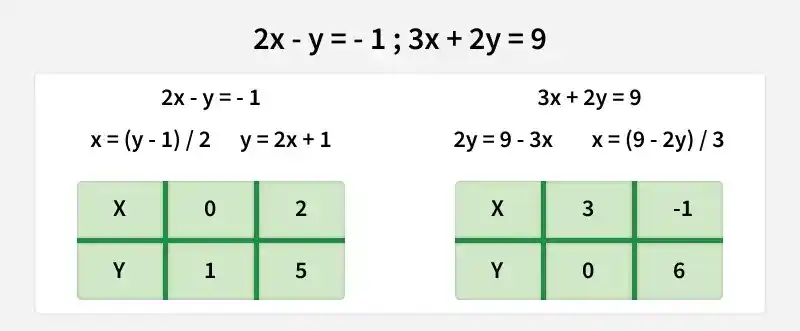
A pair of linear equations in two variables consists of two equations with the same two variables (usually x and y), where the highest power of each variable is 1.
The general form is: a1 x + b1 y + c1 = 0 and a2 x + b2 + c2 = 0
Pair of linear equations in two variables
The solution of a pair of linear equations is the value of x and y that satisfies both equations simultaneously.
For the above example: x = 1, y = 3; because both values satisfy both equations.
Note: A pair of linear equations in two variables means two straight-line equations involving the same two variables, solved together to find a common solution.
Graphical Representation
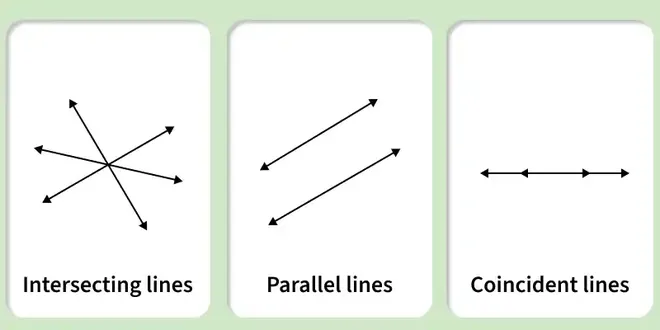
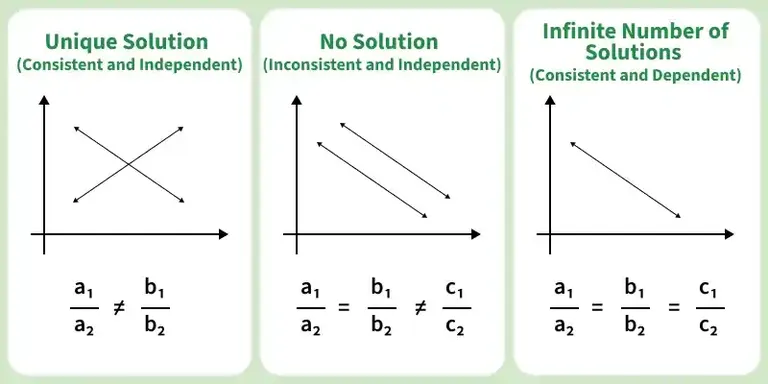
Graphically, a pair of linear equations represents two straight lines, which can be:
Intersecting lines– The lines meet at one point, giving one unique solution.
Coincident lines– Both lines lie on each other, giving infinitely many solutions.
Forms of Linear Equations in Two Variables
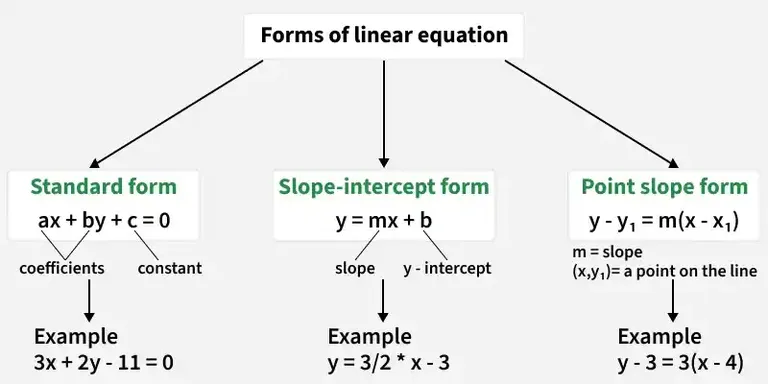
A linear equation in two variables can be written in different forms depending on how the variables and constants are arranged. The three common forms are standard form, slope–intercept form, and point–slope form.
A system of linear equations is a collection of two or more linear equations with the same variables, also called simultaneous linear equations. These equations are solved together to find the values of the variables.
Solving Pairs of Linear Equations in Two Variables
A pair of linear equations in two variables can be solved using different methods to find the values of the variables that satisfy both equations. The common methods used to solve them are:
Graphical Method
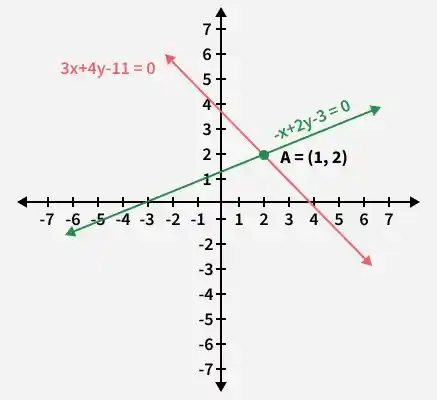
The graphical Method solves a pair of linear equations by plotting both equations on a graph. The point where the two lines intersect represents the solution of the system.
Steps to Solve Graphically
Convert each equation into the form y = mx + b (if required).
Choose values of x and find the corresponding values of y.
Plot the points and draw the straight lines for both equations.
Find the point where the two lines intersect.
The coordinates of the intersection point give the solution of the system.
Example: Solve the following equations graphically:
-x + 2y − 3 = 0
3x + 4y − 11 = 0
From the graph, the two lines intersect at (1, 2). Therefore, the solution of the system is x = 1 and y = 2.
Types of Solutions (Graphically)
When two linear equations are represented graphically, three situations are possible:
Unique Solution (Consistent and Independent): Lines intersect at one point.
No Solution (Inconsistent System): Lines are parallel and never intersect.
Infinitely Many Solutions (Consistent and Dependent): Lines coincide with each other.
Substitution Method
The substitution method is used to solve a pair of linear equations by expressing one variable in terms of the other and then substituting that expression into the second equation.
Steps to Solve by the Substitution Method
Solve one of the equations for one variable (x or y).
Substitute this value into the other equation to obtain an equation with one variable.
Solve the resulting equation to find the value of that variable.
Substitute this value back into any of the original equations to find the other variable.
Example: Solve the following system of equations using the substitution method:
x + y − 5 = 0 2x − y − 1 = 0
Solution:
From the first equation: x + y − 5 = 0 ⇒ y = 5 − x
Therefore, the solution of the given system is x = 2 and y = 3
Cross Multiplication Method
The cross multiplicationmethod is used to solve a pair of linear equations by comparing the coefficients of the variables and constants.
Consider two linear equations:
a₁x + b₁y + c₁ = 0 a₂x + b₂y + c₂ = 0
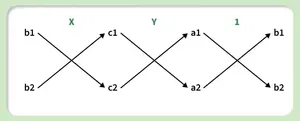
Using the cross multiplication rule:
x / (b₁c₂ − b₂c₁) = y / (c₁a₂ − c₂a₁) = 1 / (a₁b₂ − a₂b₁)
From this relation, the values of x and y can be obtained as:
x = (b₁c₂ − b₂c₁) / (a₁b₂ − a₂b₁)
y = (c₁a₂ − c₂a₁) / (a₁b₂ − a₂b₁)
Thus, by applying cross-multiplication to the coefficients of the equations, we can directly find the values of x and y, giving the solution to the pair of linear equations.
Elimination Method
The elimination method solves a pair of linear equations by eliminating one variable through the addition or subtraction of the equations.
Steps to Solve by the Elimination Method
Write both equations in the standard form: ax + by = c or ax + by + c = 0.
Check if any variable can be eliminated by adding or subtracting the equations.
If not, multiply one or both equations by suitable numbers so that the coefficients of one variable become equal.
Add or subtract the equations to eliminate one variable.
Solve the resulting equation and substitute the value in any original equation to find the other variable.
Example: Solve the following system using the elimination method:
x + 2y = 8 3x + 2y = 12
Solution:
Subtract the first equation from the second:
3x + 2y = 12 −(x + 2y = 8)
⇒ 2x = 4 ⇒ x = 2
Substitute x = 2 into the first equation:
x + 2y = 8 ⇒ 2 + 2y = 8 ⇒ 2y = 6 ⇒ y = 3
Therefore, the solution of the system is x = 2 and y = 3
Cramer’s Rule
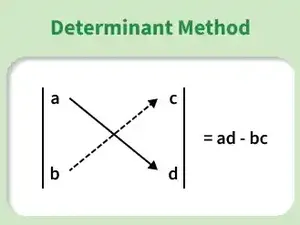
The determinant method (a.k.a Cramer’s Rule) is used to solve a pair of linear equations using the determinants of matrices.
Consider the system of equations:
a₁x + b₁y = c₁ a₂x + b₂y = c₂
Consider the system of equations:
a₁x + b₁y = c₁ a₂x + b₂y = c₂
Steps to Solve by Determinant Method
Find the determinant of the coefficients of x and y. Δ = a₁b₂ − a₂b₁
Find Δx by replacing the coefficients of x with the constants. Δx = c₁b₂ − c₂b₁
Find Δy by replacing the coefficients of y with the constants. Δy = a₁c₂ − a₂c₁
Solution Formula:
x = Δx / Δ y = Δy / Δ
Thus, the values of x and y obtained from these formulas give the solution of the pair of linear equations.
Solved Examples
Example 1: Solve the following pair of equations graphically:
2x + 3y = 46
3x + 5y = 74
Solution:
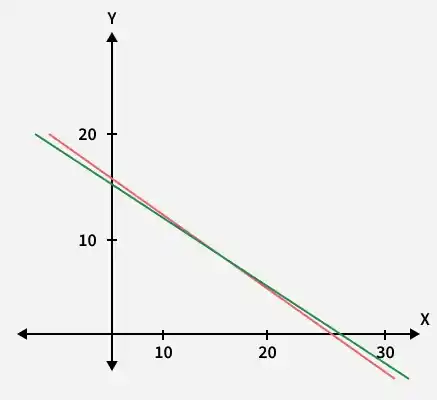
We need to plot them of graph separately and then look at their intersection.
This graph intersects are (10,8).
Example 2: Solve the following pair of linear equations with the substitution method.
5x + 4y = 20
x + 2y = 4
Solution:
We have to solve these two equations
5x + 4y = 20
x + 2y = 4
Let's we pick the second equation,
x = 4 - 2y
Now substituting the value of x in the other equation.
5(4 - 2y) + 4y = 20
20 - 10y + 4y = 20
-6y = 0
y = 0
Finding out the value of x by substituting the value of y in the equation,
x = 4 - 2y
x = 4
(4, 0) is the solution to this pair of linear equations.
Example 3: Solve the following equations with the elimination method.
4x + 5y = 20
8x + 2y = 5
Solution:
Let the equations be,
4x + 5y = 20 ........(1)
8x + 2y = 5 ..... (2)
We need to eliminate one of the variables here from these two equations,
Multiply equation (1) with 2 and subtract it with (2).
2 x(1) -(2)
8x + 10y = 40 ..... 2 x(1)
8x + 2y = 5 .....(2)
Subtracting both of these,
8y = 35
y = 35/8
Substituting this value in equation (1)
4x+5(35/8)=20 = 4x+175/8=20
4x = 20 –175/8
4x = −15/8
x = −15/32
Practice Questions
Solve the pair of equations: x − 2y = 5 and 2x + y = 4.
Find the solution to the system of equations: 4x + 3y = 10 and 2x − y = 3.
Determine whether the equations 5x − 2y = 8 and 10x − 4y = 16 have a unique solution, infinitely many solutions, or no solution.
Solve the system of equations: 3x + 2y = 7 and 2x − 3y = 1.
Find the values of x and y that satisfy the equations: 2x + 5y = 17 and 3x − y = 5.