Parametric equations are a method of representing curves and geometric shapes using one or more parameters.
Instead of expressing one variable directly in terms of another, both coordinates are expressed as functions of a parameter.
This approach is especially useful for describing motion, trajectories, circles, ellipses, and other curves that may be difficult to represent using a single equation.
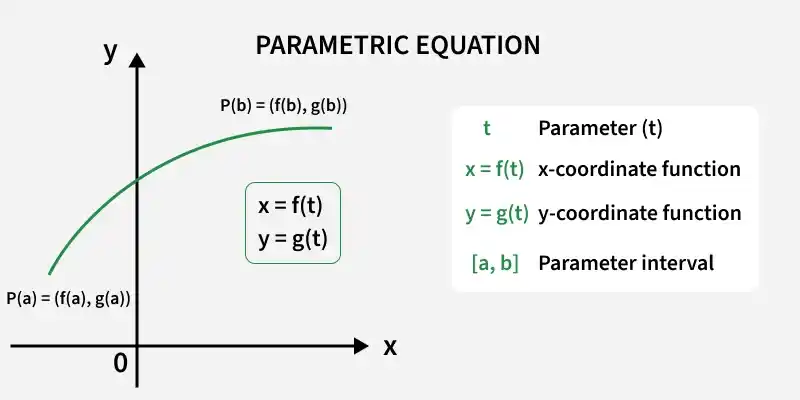
A parametric equation represents a curve by expressing the coordinates x and y (or x,y,z) as functions of a third variable called a parameter, usually denoted by t.
It is written as: x = f(t) and y = g(t), where t varies over a given interval.
Example: A line passing through (1,2) with direction vector (3,4) can be written as: x=1+3t and y=2+4t, where t is the parameter.
Components of a Parametric Equation
A parametric equation consists of:
Parameter (t) – an independent variable that controls movement along the curve.
x-coordinate function – x = f(t)
y-coordinate function – y = g(t)
Parameter interval – the range of values assigned to ttt.
Together, these define a parametric curve.
Types of Parametric Equations
There are many types of parametric equations, each describing different types of curves and shapes. Some common types of parametric equations are:
Linear Parametric Equations: These equations represent straight lines in the form x(t) = at + b and y(t) = ct + d, where a,b,c,d are constants
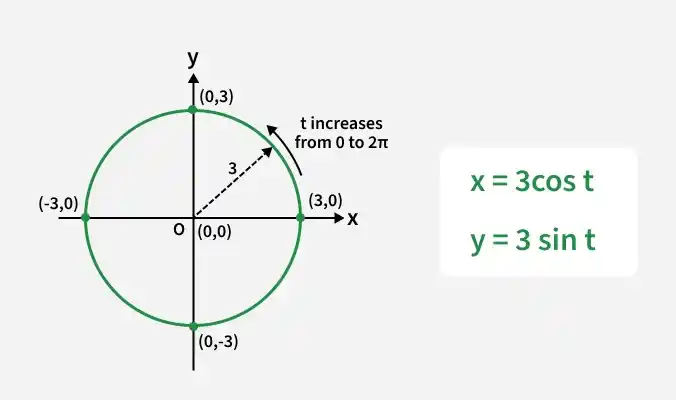
Circular Parametric Equations: These equations represent circles in the form x(t) = r⋅cos(t) and y(t) = r⋅sin(t), where r is the radius of the circle.
Elliptical Parametric Equations: These equations represents ellipses in the form x(t) = a⋅cos(t) and y(t) = b⋅sin(t), where a and b are the lengths of the semi-major and semi-minor axes.
Polar Parametric Equations: These equations represents curves in polar coordinates, often used for curves like cardioids, roses, and spirals, expressed as r(t) = f(θ) and θ(t) = g(t), where f(θ) and g(t) are functions of the angle θ.
Graphs of Parametric Equation
The graph of a parametric equation shows the path traced by a point as the parameter changes.
The steps to create a graph of a parametric equation:
Step 1 : Select a range for the parameter t. This range determines the curve you want to plot.
Step 2: Substitute different values of t into the parametric equations to calculate corresponding x and y coordinates.
Step 3: Plot each set of x and y coordinates on a coordinate plane.
Step 4: Connect the plotted points with a smooth curve to see the shape of the parametric curve.
Example: consider the parametric equations x(t) = 3cos(t) and y(t) = 3sin(t) for 0 ≤ t ≤ 2π.
These equations generate a circle of radius 3 centered at the origin.
Converting Parametric Equations to Cartesian Form
Converting a parametric equation to Cartesian form involves eliminating the parameter and expressing the relationship directly between xxx and yyy. This allows the curve to be represented as a standard equation in the Cartesian coordinate system.
Example: Consider the parametric equations: x=t+1 and y=2t−3
From the first equation: t=x−1
Substitute this value of t into the second equation: y=2(x−1)−3 = 2x−5
Therefore, the Cartesian equation is: y=2x−5
This equation represents the same line as the original parametric equations.
Applications
Parametric equations find applications in various fields. Some real-life applications where parametric equations are used are:
Projectile Motion: Parametric equations are used to describe the motion of projectiles such as missiles, rockets, and thrown objects.
Robotic Arm Movement: Parametric equations are used to control the movement of robotic arms in manufacturing and assembly processes.
Animation: Parametric equations are employed in computer graphics to create animations of moving objects.
Orbital Motion: Parametric equations are applied to describe the motion of celestial bodies such as planets, moons, and comets.
MRI and CT Scan Reconstruction: Parametric equations are used in medical imaging to reconstruct three-dimensional images from multiple two-dimensional scans.
Solved Examples
Example 1: Find the coordinates corresponding to t=2 for the parametric equations x=t+1 and y=2t−3.
Substitute t=2 into the equations: x=2+1=3 and y=2(2)−3=1
Therefore, the coordinates are: (3,1)
Example 2: Convert the parametric equations x=t+2 and y=3t−1 into Cartesian form.
From the first equation: t=x−2
Substitute into the second equation: y=3(x−2)−1 => y=3x−7
Therefore, the Cartesian equation is: y=3x−7
Example 3: Determine the curve represented by x=4cost and y=4sint.
Using the identity: sin2t+cos2t=1
(x/4)2+(y/4)2=1
x2+y2=16
Therefore, the curve is a circle of radius 4 centered at the origin.
Example 4: Find the coordinates on the ellipse x=5cost, y=3sint when t=π/2.
Substitute t=π/2: x=5cos(π/2)=0 and y=3sin(π/2)=3
Therefore, the coordinates are: (0,3)
Example 5: Find the Cartesian equation of x=t2 and y=t+1.
From the second equation: t=y−1
Substitute into the first equation: x=(y−1)2
Therefore, the Cartesian equation is: x=(y−1)2
Practice Problems
Find the coordinates corresponding to t = 3 for the parametric equations x = 2t + 1 and y = t − 4.
Convert the parametric equations x = t − 2 and y = 4t + 1 into Cartesian form.
Determine the Cartesian equation of the curve represented by x = 3cost and y = 3sint.
Find the coordinates on the ellipse x = 6cost, y = 2sint when t = 0.
Convert the parametric equations x = t2+1 and y = t into Cartesian form.