
In geometry, circles frequently appear in problems involving tangents, secants, and chords. The Power of a Point theorem helps analyze these relationships by assigning a numerical value that depends on the point’s distance from the circle’s center and the circle’s radius. This theorem establishes key connections between line segments interacting with the circle, making it a useful tool for solving geometry problems.
For any point in relation to a circle with center and radius, the power of the point is given by:
Power(P) = OP2 - R2
This value determines the point’s interaction with the circle. Based on its location, different segment relationships hold:
- Point Outside the Circle: If a point is outside the circle, secants drawn from it satisfy a special product rule.
- Point Inside the Circle: If a point is inside the circle, intersecting chords follow a product rule.
- Point on the Circle: If the point lies on the circle, the power is zero.
Table of Content
Secant-Secant Theorem (Point Outside the Circle)
When a point lies outside a circle, two secant lines can be drawn that intersect the circle at two points each. The Power of a Point theorem states that the product of the segment lengths of one secant is equal to the product of the segment lengths of the other secant.
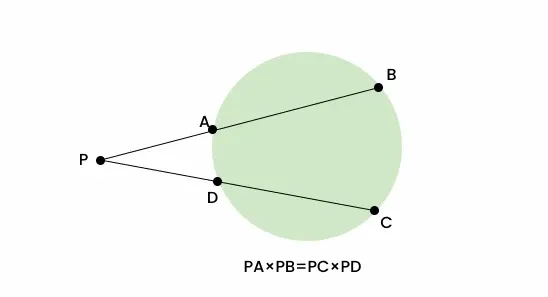
- Step 1: Choose a point P outside a circle.
- Step 2: Draw two secants from P that intersect the circle at points A, B, and C, D.
- Step 3: The Power of P is given by:
PA × PB = PC × PD
Example: A point P is located outside a circle. Two secants are drawn from point P: one intersects the circle at points A and B, and the other at points C and D. Find PD.
Solution:
Given that- PA = 6 , PB = 4 , PC = 3
PA × PB = PC × PD
6 × 4 = 3 × PD
PD × 3 = 24
PD = 24/3
PD = 8
Chord-Chord Theorem (Point Inside the Circle)
The chord of a circle is defined as the line segment joining any two points on the circumference of the circle. It should be noted that the diameter is the longest chord of a circle that passes through the center of the circle.
When a point lies inside a circle, two chords that intersect follow a specific relationship.
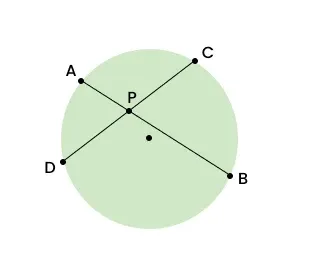
- Step 1: Choose a point P inside a circle.
- Step 2: Draw two chords that intersect at P, forming segments PA, PB, PC, and PD.
- Step 3: The Power of P is given by:
PA × PB = PC × PD
Example: Two chords AB and CD intersect at point P inside a circle. Given PA = 2, PB = 6, and PC = 3, find PD.
Solution:
Apply PA × PB = PC × PD:
2 × 6 = 3 × PD
12 = 3 × PD
PD = 12/3 = 4.
Tangent-Secant Theorem (Point Outside the Circle with a Tangent)
If a tangent and a secant are drawn from a point outside a circle, the square of the tangent’s length equals the product of the lengths of the secant’s segments.
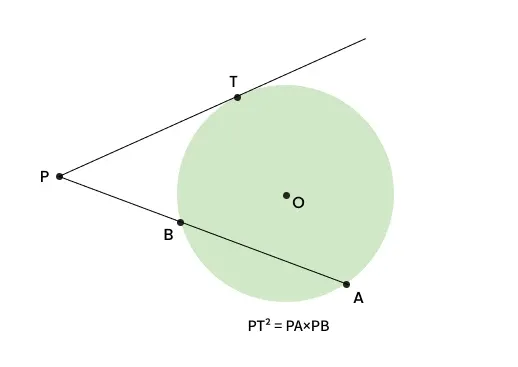
- Step 1: Choose a point P outside a circle.
- Step 2: Draw a tangent from P that touches the circle at T.
- Step 3: Draw a secant from P that intersects the circle at points A and B.
- Step 4: The Power of P is given by:
PT2 = PA × PB
Example: A tangent PT and PAB a secant are drawn from an external point P. If PT = 5, PA = 4, and PB is unknown, find PB.
Solution:
Given that: PT = 5 , PA = 4
PT2 = PA × PB
52 = 4 × PB
PB = 25/4
PB = 6.25
Solved Question on the Power of a Point
Question 1: A point P is located outside a circle with center O and radius 5. If the distance from P to the center O is 13, find the power of the point P.
Solution:
The power of a point P with respect to a circle is given by the formula:
Power (P) = OP2 - R2
where OP = 13 and R = 5
Power (P) = 132 - 52
Power (P) = 169 - 25 = 144
Question 2: A point P outside a circle is connected by two secants PAB and PCD that intersect the circle at points A, B, C, and D. If PA = 8, PB = 2, and PC = 5, find PD.
Solution:
Given that- PA = 8 , PB = 2 , PC = 5 .
PA × PB = PC × PD
8 × 2 = 5 × PD
PD × 5 = 16
PD = 16/5
PD = 3.2
Question 3: Two chords AB and CD intersect inside a circle at point P. Given that AP = 4, PB = 6, and CP = 3, find PD.
Solution:
Given that- AP = 4 , PB = 6 , CP = 3.
AP × PB = CP × PD
4 × 6 = 3 × PD
PD × 3 = 24
PD = 24/3
PD = 8
Question 4: A point P outside a circle has a tangent PT and a secant PAB where PA = 6 and PB = 12. Find the length of PT.
Solution:
Given that - PA = 6 , PB = 12
PT2 = PA × PB
PT2 = 6 × 12
PT2= 72
PT = √72
PT = 6√2
Related Reads:
Unsolved Question on the Power of a Point
- Question 1: A point P is located outside a circle with center O and radius 7. If the distance from P to the center O is 25, find the power of the point P.
- Question 2: A point P outside a circle is connected by two secants PAB and PCD that intersect the circle at points A, B, C, and D. If PA = 9, PB = 3, and PC = 7, find PD.
- Question 3: Two chords AB and CD intersect inside a circle at point P. Given that AP = 5, PB = 3, and CP = 4, find PD.
- Question 4: A point P outside a circle has a tangent PT and a secant PAB where PA = 10 and PB = 15. Find the length of PT.
