
The following are some important properties of matrix multiplication:
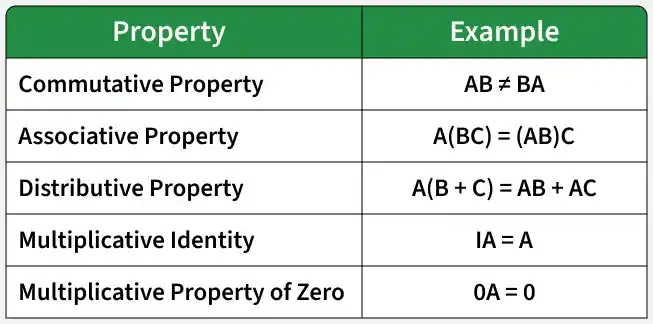
Commutative Property
The matrix multiplication is usually not commutative, i.e., the multiplication of the first matrix with the second matrix is not similar to the multiplication of the second matrix with the first.
If A and B are two matrices, then AB ≠ BA.
Associative Property
The matrix multiplication is associative in nature. If A, B, and C are three matrices, then
A(BC) = (AB)C
This property holds true if the products A(BC) and (AB)C are defined.
Distributive Property
The Distributive property also holds true for matrix multiplication. If A, B, and C are three matrices, then by applying the distributive property, we get.
A (B + C) = AB + AC
(B + C) A = BA + CANote: This property is only true if and only if A, B, and C are compatible.
Multiplicative Identity Property
Matrix multiplication has an identity property that states that, if we multiply a matrix A by an Identity matrix of the same order, then it results in the same matrix.
A·I = I · A = A
Transpose Property
The transpose property also holds true for matrix multiplication. If A and B are two matrices, then by applying the transpose property.
(AB)T = BTAT
Note: This property is only true if the product AB is defined.
Multiplicative Property of Zero
Matrix multiplication has the property of zero, which states that if a matrix is multiplied by a zero matrix, then the resultant matrix is a zero matrix(O).
A · O = O · A = O
Also, the product of any two non-zero matrices may result in a zero matrix, i.e.,
AB = O
Then that doesn't mean that A = O or B = O.
Product with a Scalar
If A and B are two matrices and AB is defined, then the product of the matrix with the scalar (k) is defined as,
k(AB) = (kA)B = A(Bk)
