
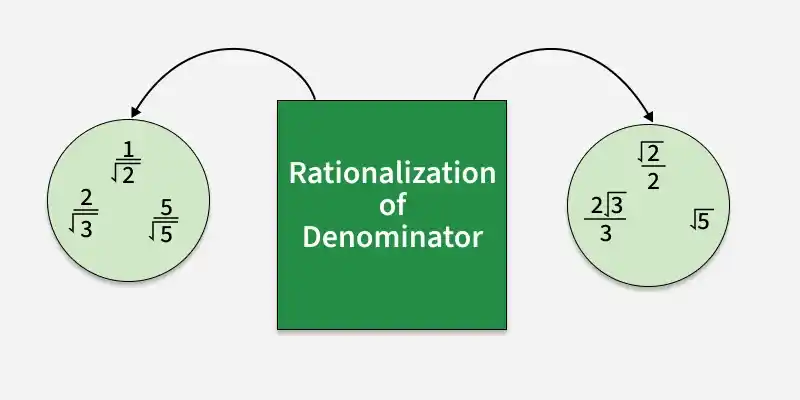
As the name suggests, rationalization is a process to make a fraction rational. Rationalization is a process by which radicals in the denominator of a fraction are removed by multiplying it with an irrational number, generally a conjugate or a similar radical. Rationalization makes the denominator free from radicals like square roots or cube roots.
Rationalizing Factor
The number or expression by which the denominator is multiplied to convert it into rational is called the rationalizing factor. Some of the rationalizing factors are tabulated below:
Denominator Form | Rationalizing Factor |
|---|---|
| √x | √x |
| a + √b | a - √b |
| a - √b | a + √b |
| √a + √b | √a - √b |
| √a - √b | √a + √b |
| p√a + q√b | p√a - q√b |
| p√a - q√b | p√a + q√b |
How to Rationalize the Denominator?
As different forms of irrational denominators need different methods to rationalize. Thus, all the various methods to rationalize the denominator are as follows:
1. Rationalizing Single-Term Denominator
To rationalize a monomial square or cube root, say
In other words, to rationalize a monomial square or cube root, we multiply the numerator and denominator by the same factor as the denominator. i.e., if we have
Example: Let us rationalize 1/√5
Solution:
1/√5 is the given expression,
So, multiple both numerator and denominator by√5
= 1/√5 × √5/√5
= √5/5
Example: Rationalize
Solution:
\frac{2}{\sqrt[3]{6}} is the given expression,So, multiple both numerator and denominator by
\sqrt[3]{6^2}
= \frac{2}{\sqrt[3]{6}} \times \frac{\sqrt[3]{6^2}}{\sqrt[3]{6^2}}
= \frac{2\sqrt[3]{6^2}}{\sqrt[3]{6^3}} = \frac{2\sqrt[3]{6^2}}{{6}}
=\frac{\sqrt[3]{6^2}}{{3}}
2. Rationalizing Two Terms Denominator
If the denominator is linear and is of the form a + √b or a + i√b, then the method of rationalization of the denominator comprises multiplying both the numerator and the denominator by the algebraic conjugate a - √b or a - i√b.
Due to the result of the algebraic identity (a+b)(a-b) = a2 - b2, the denominator of the form a + √b or a + i√b can always be rationalized using this method.
Example: Let us rationalize 1/(1 + √5).
Solution:
Given expression is 1/(1 +√5).
So, multiple both numerator and denominator by 1 - √5
=
\frac{1}{1+√5} \times\frac{1-√5}{1-√5} =
\frac{1 - √5}{(1)^1 - (√5)^2} [Using identity (a+b)(a-b) = a2 - b2]=
\frac{1 - √5}{(1 - 5)} =
\frac{√5 - 1}{4}
3. Rationalizing Three Terms Denominator
If the denominator is a trinomial, like a±√b±√c (± represents all the possibilities), then it's a little more complicated to rationalize its denominator than the method of rationalization of a fraction with a binomial radical as its denominator. In this case, take two terms as a single term and the third term as a second term of the rationalizing factor and then rationalize.
If irrational terms are not eliminated completely after the first process of rationalization, then rationalize the obtained result again with the term that remained irrational in the first rationalization process.
Let's take 1/(1+√2-√3) for example.
Step 1: Choose any of the two given radicals to make it look like a binomial radical and multiply the fraction with its conjugate,
1/(1+√2-√3) × (1+√2+√3)/(1+√2+√3)
Note: if you choose (1+√2)-√3, then multiply the denominator and numerator with (1+√2)+√3 and if you choose (1-√3)+√2, then multiply the denominator and numerator with (1-√3)-√2.
Step 2: Simplify.
(1+√2+√3)/[(1+√2)2-(√3)2]
(1+√2+√3)/(3+2√2-3)
(1+√2+√3)/2√2
Step 3: Multiply again with √2 in numerator and denominator,
(1+√2+√3)/2√2 × √2/√2
Step 4: Simplify the result in Step 3.
(√2+2+√6)/4
Related Articles
Solved Questions on Rationalization of Denominators
Problem 1: What is the interpretation of 1/√3 on a number line?
Solution:
Since the denominator has square root in the denominator, it is a bit difficult to understand. As we can not divide anything is √3 parts as it is an irrational number and it exact location on the number line depends on the number of digits taken into consideration at a time.
Let us write an equivalent expression where the denominator is a rational number using the method of rationalization.
Multiply and divide the given expression by √3.
= 1/√3 × √3/√3
= √3/3
Thus, 1/√3 =√3/3 means a point which is at one third distance from 0 to √3.
So, we can interpret the meaning of 1/√3 as a point which lies at one third distance from 0 to √3.
Problem 2: Rationalize the denominator (3 + √7)/√7.
Solution:
As given expression is (3 +√7)/√7.
Multiply and divide the given expression by √7.
= (3 + √7)/√7 × (√7/√7)
= ((3 + √7)×√7 )/√7×√7
= (3√7 + 7)/7
Problem 3: Find the value of a and b. If 1/(5 + 6√3) = a√3 + b.
Solution:
Given: 1/(5 + 6√3) = a√3 + b.
Taking LHS = 1/(5 + 6√3)
Multiply and divide the given expression by 5 - 6√3 to rationalize it.
⇒ LHS ={1/(5 + 6√3)} * {(5 - 6√3)/(5 - 6√3}
⇒ LHS= {1 ×(5 - 6√3)}/{(5 + 6√3)(5 - 6√3)}
Using the identity (a + b)(a - b) = a2 - b2
⇒ LHS = (5 - 6√3)/{52 - (6√3)2}
⇒ LHS =(5 - 6√3)/ 25 - 108
⇒ LHS= (5 - 6√3)/ -83
⇒ LHS = (6√3 - 5)/83
Given that 1/(5 + 6√3) = a√3 + b
⇒ (6√3 - 5)/83 = a√3 + b
⇒ a = 6/83, b = -5/83
Problem 4: Given that √5 = 2.236. Find the value of 3/√5.
Solution:
As given expression is 3/√5 .
Multiply and divide the given expression by √5
=(3/√5) × (√5 /√5)
= 3 √5 /5
= (3/5) ×√5
= 0.6 × 2.236 [ Given √5 = 2.236]
= 1.3416
Thus, 3/√5 = 1.3416
Problem 5: Rationalize the denominator of 8/(√5 - √ 3)
Solution:
As given Expression is 8/(√5 - √3)
Multiply and divide the given expression by √5 + √3
= (8 ×(√5 + √3))/((√5 - √3)√5 + √3))
Using the identity (a + b)(a - b) = a2 - b2
= (8√5 + 8√3)/(√52 - √32)
= 8√5 + 8√3/(5 - 3)
= 8√5 + 8√3/2
= 4√5 + 4√3
Problem 6: Simplify: (2√2 + √6 - √3)/(√2 - √3 + √6)
Solution:
As given expression if (2√2 + √6 - √3)/(√2 - √3 + √6).
To rationalize this expression, multiply the numerator and denominator by (√2 + √6 + √3).
= [(2√2 + √6 - √3)/(√2 - √6 + √3)] × [(√2 + √6+ √3)/(√2 + √6 + √3)]
= [2√2(√2 + √6 + √3) + √6(√2 + √6 + √3) - √3(√2 + √6 + √3)]/[√2(√2 + √6 + √3) - √3(√2 + √6 + √3) + √6(√2 + √6 + √3)]
Simplifying the numerator and denominator:
[(4√2 + 2√6 - √3√2 - √3√3 - √3√6)/(2 - 3 + 6)] × (√2 + √3 + √6)
Simplifying the first part of the expression:
[4√2 + 2√6 - √6 - √9 - √18]/5
[4√2 + 2√6 - √6 - 3√2 - 3√2]/5
[√2 - √6]/5
So, the simplified expression is (√2 - √6)/5.
Practice Problems
Question 1: Rationalize the denominator:
Question 2: Rationalize the denominator:
Question 3: Simplify: \frac{3}{\sqrt{8}
Question 4: Rationalize: \frac{6}{\sqrt{11}
