
Fractions are numbers that show a part of a whole or a group. They can also be classified by how they are written. Based on this, fractions are divided into simple fractions and complex fractions.
Simple Fractions
A simple fraction (also known as a common fraction or a proper fraction) consists of two parts: a numerator and a denominator. In a simple fraction, the numerator is smaller than the denominator.
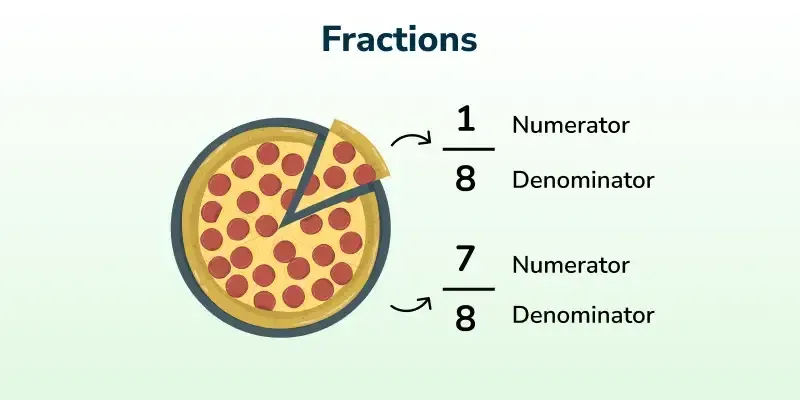
Example of Simple Fractions:
- 1/2: This fraction means "1 part out of 2 equal parts."
- 3/4: This means "3 parts out of 4 equal parts."
- 5/8: This means "5 parts out of 8 equal parts."
In these examples, the numerator (top part) is smaller than the denominator (bottom part), which defines them as proper or simple fractions.
Complex Fractions
A complex fraction is a fraction where either the numerator, the denominator, or both are themselves fractions. In other words, it is a fraction of a fraction.
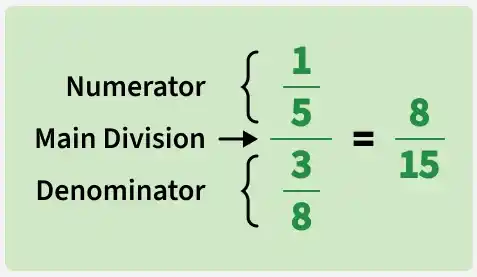
Example of Complex Fractions
- (1/2)/(3/4): Here, both the numerator and denominator are fractions. You can simplify this by multiplying the numerator by the reciprocal of the denominator: (1/2) ÷ (3/4) = (1/2) × (4/3) = 4/6 = 2/3
- (5/6)/3: The numerator is a fraction, while the denominator is a whole number. To simplify, divide the numerator by 3 (or multiply by the reciprocal of 3): (5/6) ÷ 3 = (5/6) × (1/3) = 5/18
- 2/(1/5): The denominator is a fraction, and the numerator is a whole number. To simplify, multiply the numerator by the reciprocal of the denominator: 2 ÷ (1/5) = 2 × 5 = 10
Simplifying Complex Fractions
To simplify complex fractions, we can rewrite them in terms of simple fractions. For example (2/3)/(4/5).
\frac{\frac{2}{3}}{\frac{4}{5}} = \frac{2}{3} \div \frac{4}{5} = \frac{2}{3} \times \frac{5}{4} = \frac{10}{12} = \frac{5}{6}
