
A multi-step linear equation is an algebraic equation that contains a variable and requires more than one step to solve.
- It involves performing a sequence of operations such as addition, subtraction, multiplication, and division to isolate the variable on one side of the equation.
- These equations may also include brackets, fractions, or like terms that need to be simplified before solving.
- The main goal is to rearrange the equation step by step until the value of the variable is found.
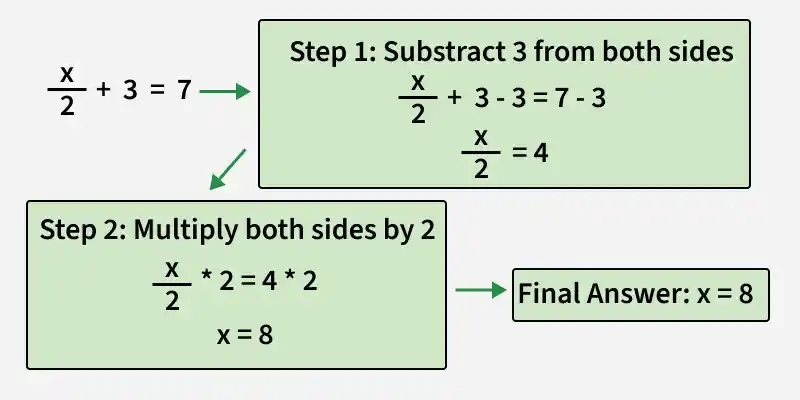
Steps to solve
Step 1: Simplify the Fractions: Ensure all fractions are in their simplest form. For example, reduce
Step 2: Determine the Least Common Denominator (LCD): Identify the LCD of all the fractions in the equation. The LCD is the smallest number that all denominators can divide into evenly.
Step 3: Clear the Fractions: Multiply every term in the equation by the LCD to eliminate the fractions. For example, in the equation
Multiply every term by 12:
Step 4: Solve the Simplified Equation: Solve the resulting linear equation using standard algebraic methods. For example:
Example- Consider the equation
Step 1: Find the least common denominator (LCD) of fractions, i.e. 30.
Step 2: Multiply each term by 30 to clear the fractions:
30(3x/5) - 30(2/3) = 30(1/2)
Step 3: Simplify: 18x - 20 = 15
Step 4: Isolate the variable x by adding 20 to both sides: 18x = 35
Step 5: Finally, divide by 18 to solve for x: x = 35/18
Solved Examples
Example 1: Solve
Find the Least Common Denominator (LCD) of 5, 3, and 2, which is equal to 30.
Multiply through by 30:
30(\frac{3x}{5}) - 30(\frac{2}{3}) = 30(\frac{1}{2}) 18x − 20 = 15 18x=35 x = \frac{35}{18}
Example 2: Solve
Find the LCD of 7, 6, and 2, which is equal to 42.
Multiply through by 42:
42(\frac{4x}{7}) + 42(\frac{5}{6}) = 42(\frac{3}{2}) 24x+35=63 24x=28 x = \frac{28}{24} = \frac{7}{6}
Example 3: Solve
Find Least Common Denominator (LCD): The LCD of 3, 4, and 6 is 12
Multiply every term by 12:
12 \cdot \frac{2x}{3} + 12 \cdot \frac{1}{4} = 12 \cdot \frac{5}{6} Simplifies to:
8x + 3 = 10
Subtract 3 from both sides:
8x = 7
x = 7/8
Example 4: Solve
LCD of 7, 5, and 2 is 70.
Multiply every term by 70
70 \cdot \frac{4x}{7} - 70 \cdot \frac{3}{5} = 70 \cdot \frac{1}{2} Simplifies to:
40x - 42 = 35
Add 42 to both sides:
40x = 77
x = 77/40
Example 5: Solve
Cross-Multiply:
3(2x-3) = 4 \cdot 5 Simplifies to:
6x - 9 = 20
Add 9 to both sides
6x = 29
x = 29/6
Example 6: Solve
Cross-Multiply:
4(7x - 1) = 3(2x+5) Simplifies to:
28x - 4 = 6x + 15
Combine Like Terms: Subtract 6x from both sides:
22x - 4 = 15
Add 4 to both sides:
22x = 19
x = 19/22
Example 7: Solve
Cross-Multiply:
6(3x + 2) = 5 \cdot 4 Simplifies to:
18x + 12 = 20
Subtract 12 from both sides:
18x = 8
x = 8/18 = 4/9
Example 8: Solve
Cross-Multiply:
4(6x+1) = 2(3x-4) Simplifies to:
24x+4 = 6x-8
Combine Like Terms: Subtract 6x from both side:
18x+4 = -8
Subtract 4 from both sides:
18x = -12
x = -12/18 = -2/3
Example 9: Solve
Cross-Multiply:
3(3x-2) = 7\cdot5 Simplifies to:
9x-6 = 35
Add 6 to both sides:
9x = 41
x = 41/9
Example 10: Solve
Cross-Multiply:
3(4x + 3) = 2(5x - 1) Simplifies to:
12x + 9 = 10x -2
Combine Like Terms: Subtract 10x from both side :
2x + 9 = -11
Subtract 9 from both sides:
2x = -11
x = -11/2
Practice Problems
Problem 1: Solve:
Problem 2: Solve:
Problem 3: Solve:
Problem 4: Solve:
Problem 5: Solve:
Problem 6: Solve:
Problem 7: Solve:
Problem 8: Solve:
Problem 9: Solve:
Problem 10: Solve:
