
A sphere is a three-dimensional round-shaped object. All the points on its surface are at the same distance from a fixed point called the center. A sphere does not have any edges or vertices and has only one curved surface.
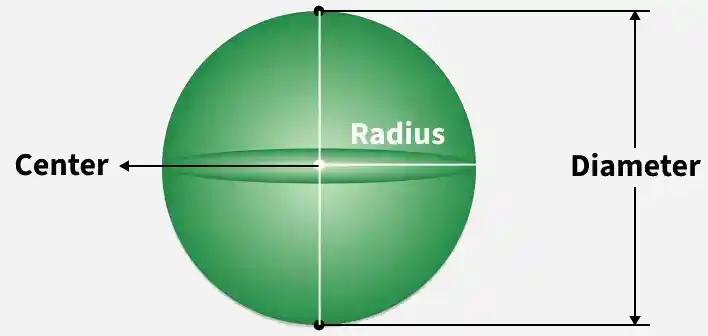
In geometry, a sphere is formed by a set of points in three dimensions that are equally distant from the center. Common examples of spherical objects include a ball, globe, soap bubble, and tennis ball.
Key characteristics of a Sphere
- Radius: The distance from the center of the sphere to any point on its surface.
- Diameter: The distance between two opposite points on the surface, passing through the center. It is twice the radius.
- Circumference: The length of the great circle of the sphere, formed by a circular cross-section passing through the center.
- Volume: The amount of space occupied by the sphere. It is measured in cubic units.
- Surface Area: The total area of the curved surface of the sphere. It is measured in square units.
Surface Area of a Sphere
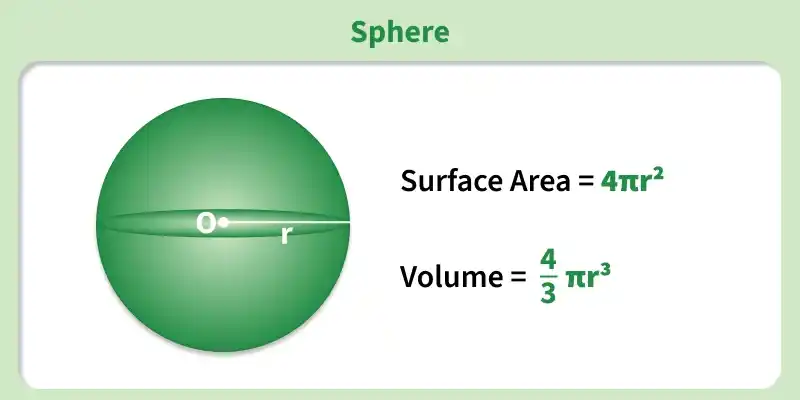
The surface area of a sphere is the total area of its outer curved surface. Since a sphere has no flat faces, its curved surface area is equal to its total surface area.
The formula for the surface area of a sphere is:
Surface Area of Sphere = 4πr
Volume of a Sphere
The volume of a sphere is the amount of space it occupies. It is measured in cubic units such as cubic meters, cubic centimeters, or cubic inches. The volume of a sphere depends on its radius.
The formula for the volume of a sphere is:
Volume of a sphere = 4/3 πr³
Sphere Equation in 3D
The equation for a sphere in three-dimensional space is given by:
(x - h)2 + (y - k)2 + (z - l)2 = r2
- (x, y, z) are the coordinates of a point in three-dimensional space.
- (h, k, l) are the coordinates of the center of the sphere.
- r is the radius of the sphere.
This equation describes all the points (x, y, z) that are at a distance r from the center (h, k, l) in three-dimensional space. The squared terms on the left side of the equation ensure that the distance calculation is always positive.
Hemisphere
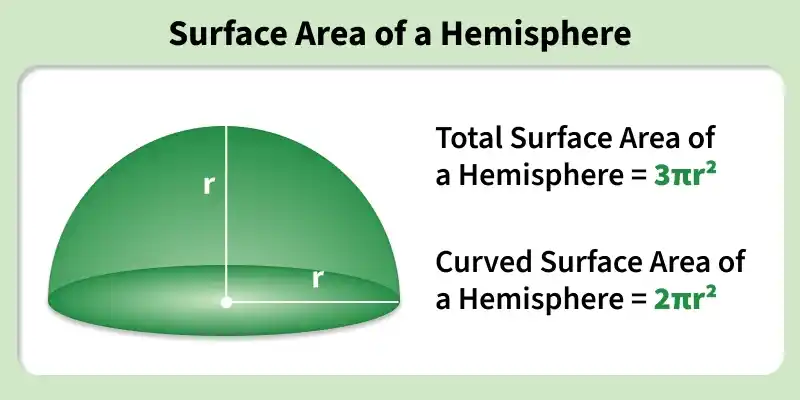
A hemisphere is a three-dimensional shape that is exactly half of a sphere. It is formed when a sphere is cut into two equal parts through its center. A hemisphere has one flat circular face and one curved surface.
Surface Area of Hemisphere
Curved surface area of a hemisphere = 2πr²
Total surface area of a hemisphere = 3πr²
- π is a mathematical constant (π = 3.142).
- r is the radius of the hemisphere.
Volume of Hemisphere
Volume of Hemisphere = (2πr³)/3
- π is a mathematical constant (π = 3.142).
- r is the radius of the hemisphere.
Hollow Sphere
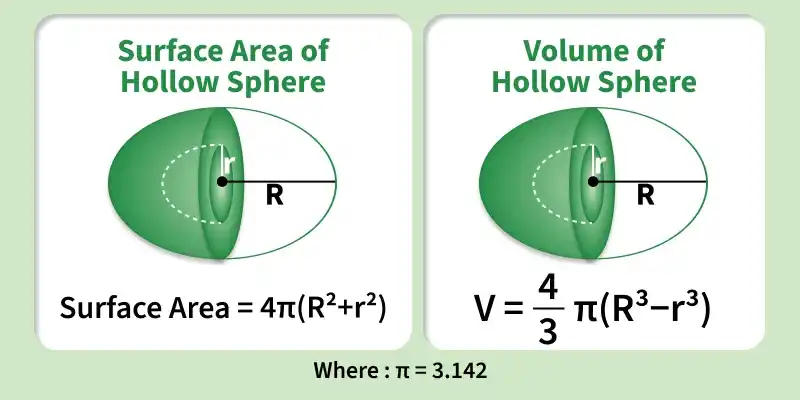
A hollow sphere is a three-dimensional spherical shape with an empty interior. It has two radii: an outer radius R and an inner radius r, where R is greater than r.
Surface Area of Hollow Sphere
The surface area of a hollow sphere is given by:
Surface Area of hollow sphere = 4π(R² + r²)
Volume of a Hollow Sphere
The volume of a hollow sphere is found by subtracting the volume of the inner sphere from the outer sphere and is given by:
Volume of hollow sphere = (4/3)π(R³ − r³)
Calculation of Spheres with Diameter
Calculation of a sphere using diameter means finding the surface area and volume of a sphere when its diameter is known. Since the radius is half of the diameter, sphere formulas can be written directly in terms of the diameter to make calculations easier.
Volume of Sphere using Diameter
The volume of a sphere using diameter is given by:
Volume of a sphere = (πd³)/6
Here, d is the diameter of the sphere and π is a mathematical constant (π = 3.142).
Surface Area of Sphere using Diameter
The surface area of a sphere using diameter is given by:
Surface area of a sphere = πd²
Here, d is the diameter of the sphere and π is a mathematical constant (π = 3.142).
Solved Examples
Example 1: Find the curved surface area of a sphere with a radius of 8 cm, using π as 22/7.
Solution:
Given,
Radius = 8cm
Total Surface Area= 4πr2Curved Surface Area = 4 × 22/7 × 8 × 8
CSA = 804.57cm2
Example 2:Determine the total cost needed to paint a spherical ball with a radius of 9 cm. The cost of painting the ball is INR 7.5 per square cm, and you can use π as 22/7.
Solution:
Given,
Radius = 9cmTotal Surface Area= 4πr2
Curved Surface Area = 4 × 22/7 × 9 × 9
Curved surface area = 1018.28cm2Cost of painting the ball = 1018.28 × 7.5 = 7637.1
Cost of painting the ball is Rs. 7637.1
Example 3: What is the value of a sphere if its diameter is 42 cm?
Solution:
Given,
Diameter = 42 cm
Radius = 21 cmVolume of Sphere(V) = 4/3.π.(r)3
V = 4/3.22/7.(21)3 = 38792 cm3
