
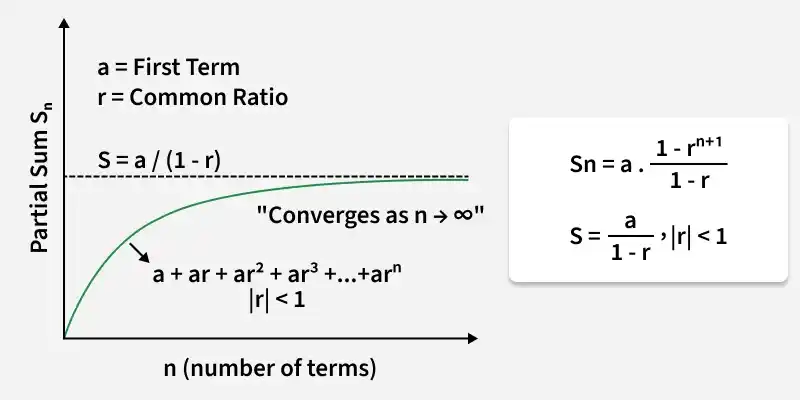
An infinite geometric series is a geometric series that continues indefinitely, where each term is obtained by multiplying the previous term by a fixed constant called the common ratio.
a + ar + ar^2 + ar^3 + ........
- a = first term
- r = common ratio
Sum of an Infinite Geometric Series
If the absolute value of the common ratio is less than 1, the infinite geometric series converges, and its sum is given by:
S=\frac{a}{1-r} , where | r |< 1
Condition for Convergence
- The series should be in geometric progression.
- The absolute value of the common ratio should be less than 1, i.e., |r| < 1
Derivation of the Formula
Let's consider a = first term of the geometric series and r = common ratio, where -1 < r < 1
Let us consider the sum of the geometric progression to be S.
Then we can write,
S = a + ar + ar2+ ar3 + . . . ---(i)
Multiplying both sides of the equation by r, we get,
Sr = ar + ar2 + ar3 + ar4 + . . . ---(ii)
Subtracting Eq. (ii) from Eq. (i), we get
S - Sr = (a + ar + ar2+ ar3) + . . . - (ar + ar2 + ar3 + ar4 + . . . )
S(1 - r) = a
S = \frac{a}{1-r}
Hence, the sum of infinite series of a geometric progression is a/(1 - r)
If the absolute value of the common ratio 'r' is greater than 1, then the sum will not converge.
Thus, the absolute value of the sum will tend to infinity. Thus, if r > 1,
| S | = | a + ar + ar2 + ar3 + ... | = ∞
Applications of Infinite Geometric Series
- Converting recurring decimals into fractions.
- Financial calculations involving perpetual payments.
- Signal processing and control systems.
- Population growth and decay models.
- Computer graphics and animation.
Solved Example
Question 1. Find the sum of the infinite series with first term 4 and common ratio 1/2.
Given, the first term a = 4
The common ratio r = 1/2
Thus, we can write the series as,
S = 4 + 4 × (1/2) + 4 × (1/2)2 + ...
So, the sum will stand as S = 4/(1 - (1 / 2)) = 4/(1/2) = 4 × 2 = 8
S = 8So, the sum of the series is equal to 8.
Question 2. Find the sum of the infinite series 1 + (1/2) + (1/2)2 + (1/2)3 + ...
Given, the first term of the series a = 1, common ratio is r = 1/2.
Since the absolute value of the common ratio is less than 1, we can apply the general formula.
So, the sum is, S = 1/(1 - (1/2)) = 2
So, the sum of the given infinite series is 2.
Question 3. Evaluate the sum 2 + 4 + 8 + 16 + ...
We can write the sum of the given series as,
S = 2 + 22 + 23 + 24 + ...
We can observe that it is a geometric progression with infinite terms and first term equal to 2 and common ratio equals 2.
Thus, r = 2.
Since, the value of r > 1, the sum will not converge and tend to infinity. Thus,
S = + ∞
Question 4. Find the sum of the series 2 - 1/5 + 1 - 1/25 + 1/2 - 1/125 + ...
We can write the sum of the series as the difference of two infinite series as:
S = (2 + 1 + 1/2 + 1/22 + . . . ) - (1/5 + 1/25 + 1/125 + ... )
⇒ S = (2 + 1 + 1/2 + 1/22 + . . . ) - (1/5 + 1/52 + 1/53 + ...)Let S = S1 - S2
Where,
- S1 = 2 + 1 + 1/2 + 1/22 + . . .
- S2 = 1/5 + 1/52 + 1/53 + . . .
Here, we can see both S1 and S2 are infinite summation of geometric series, where,
- a1 = 2, r1 = 1/2
- a2 = 1/5, r2 = 1/5
Thus, we can write,
- S1 = 2/(1 - (1/2)) = 2/(1/2) = 4
- S2 = (1/5)/(1 - (1/5)) = (1/5) / (4/5) = 1/4
So, the summation S stands as,
S = S1 - S2 = 4 - 1/4 = (16 - 1)/4 = 15/4 = 3.75
⇒ S = 3.75Thus, the sum of the given series is 3.75 .
