
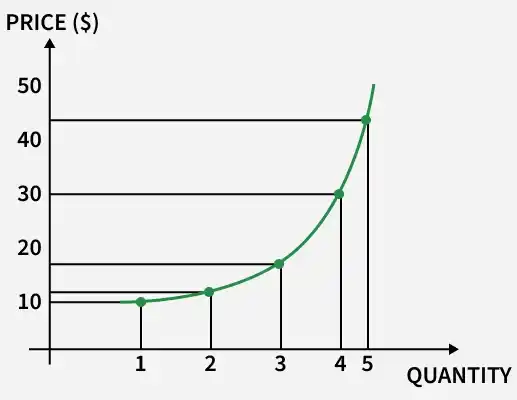
A supply curve is a graphical representation that shows the relationship between the price of a good and the quantity supplied by producers, assuming other factors remain constant Price is shown on the vertical axis (Y-axis), Quantity supplied is shown on the horizontal axis (X-axis).Typically, the supply curve slopes upward from left to right, indicating that as price increases, the quantity supplied also increases.
How it Work
- The supply curve will move upward from left to right, illustrating the law of supply: As the price of a given commodity increases, the quantity supplied will increase (all else being equal). Note that this formulation implies that price is the independent variable, and quantity is the dependent variable.
- In most disciplines, the independent variable appears on the horizontal or x-axis, but economics is an exception to this rule. If a factor besides price or quantity changes, a new supply curve needs to be drawn.
- For example, say that more soybean farmers enter the market, clearing forests and increasing the amount of land devoted to soybean cultivation.
- In this scenario, more soybeans will be produced even if the price remains the same, meaning that the supply curve itself shifts to the right (S2) in the graph below. In other words, supply will increase.
- Other factors can shift the supply curve as well, such as a change in the price of production. If a drought causes water prices to spike, the curve will shift to the left (S3). If the price of a substitute crop such as corn increases, farmers will shift to growing that instead, and the supply of soybeans will decrease (S3).
- If a new technology, such as a pest-resistant seed, increases yields, the supply curve will shift right (S2). If the future price of soybeans is higher than the current price, the supply will temporarily shift to the left (S3), since producers have an incentive to wait to sell.
Supply Curve Example:
- Should the price of soybeans rise, farmers will have an incentive to plant less corn and more soybeans, and the total quantity of soybeans on the market will increase.
- The degree to which rising prices translate into rising quantity is called supply elasticity or price elasticity of supply. If a 50% rise in soybean prices causes the number of soybeans produced to rise by 50%, the supply elasticity of soybeans is 1.
- On the other hand, if a 50% rise in soybean prices only increases the quantity supplied by 10%, the supply elasticity is 0.2.
- The supply curve is shallower (closer to horizontal) for products with more elastic supply and steeper (closer to vertical) for products with less elastic supply.
Important rule:
- The terminology surrounding supply can be confusing. "Quantity" or "quantity supplied" refers to the amount of the product or service, such as tons of soybeans, bushels of tomatoes, available hotel rooms, or hours of labour.
- In everyday usage, this might be called the "supply," but in economic theory, "supply" refers to the curve shown above denoting the relationship between quantity supplied and price per unit.
- Other factors can also cause changes in the supply curve, such as technology. Any advances that increase production and make it more efficient can cause a shift to the right in the supply curve. Similarly, market expectations and the number of sellers (or competition) can affect the curve as well.
Reasons for the Law of Supply
- Profit motive – Higher prices mean higher profits for producers.
- New producers enter the market – Rising prices attract more firms.
- Better utilization of resources – Firms increase production to take advantage of higher prices.
