
Buffering and caching are related to storage and then access of data, but some key difference makes them different. Buffer is a memory space that stores the input data and passes it on to the system where as Caching is storing data in a separate disk. In this article, we will see what both these terms mean, and after that, we will see the differences.
Buffering
Buffering is used when the speed of receiving data is different from the speed of processing it. A buffer is a temporary memory area that stores incoming data and sends it to the system at the required speed, preventing the input device from waiting. Buffers can be hardware or software, but software buffers are widely used due to fast RAM, buffering is commonly seen while playing or downloading videos, where data is temporarily stored to avoid interruptions, and is also used in tasks like printing, where input is fast but processing is slow.
Key Points
- Stores data temporarily when input and processing speeds differ.
- Prevents input devices from waiting for processing to finish.
- Usually implemented using software buffers due to fast RAM.
- Seen in video streaming or downloading when data loads slowly.
- Used in printer spoolers, where printing is slower than data input.
Example - In printer spoolers, we can pass many pages to print as input, but the processing/printing is slow. Here buffering is used.
Advantages of Buffering
- The disk access of buffering is uniform.
- It enhances the performance of input and output operations.
- It reduces the no. of system calls that impact the overall performance of the system.
Disadvantages of Buffering
- If there is a large buffer size in that case it reduces the performance of the system.
- They have a Synchronization issue.
Caching
Caching is the process of storing frequently used data in a high-speed storage area so it can be accessed faster than fetching it from a slower hard disk. By keeping recently or repeatedly used data in the cache, the system avoids unnecessary time delays. For example, when a website is opened for the first time, it loads slowly, but caching stores important data so that the next time the same website is opened, it loads much faster.
Key Points
- Stores frequently used data in a fast storage area.
- Reduces time wasted in accessing data from a slower hard disk.
- Provides quick access to recently used information.
- Makes websites and applications load faster on repeated use.
- Helps improve overall system performance.
Example - Cache is used in the system to speed up the access of data frequently used.
Advantages of Caching
- It is faster for accessing the data as compared to RAM.
- It enhances the performance of the application.
- It reduces the Server load.
Disadvantages of Caching
- Data is lost when the system is turned off.
- The cost is high as compared to other memory.
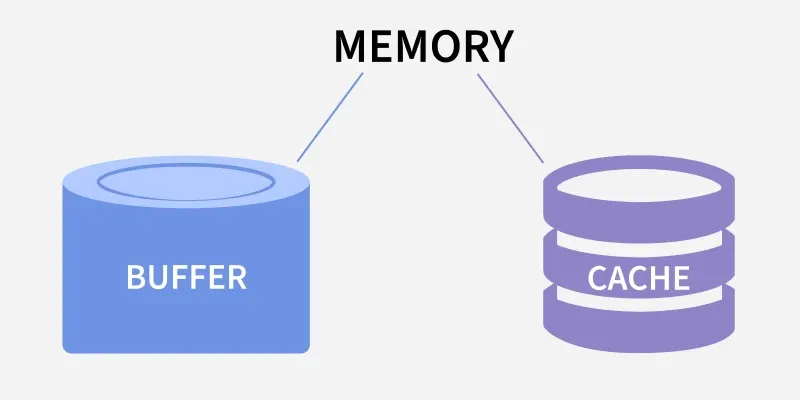
Difference Between Buffering and Caching
| BASIS | BUFFERING | CACHING |
|---|---|---|
| Definition | Buffering is a process of temporarily holding data in memory or a buffer before writing it to a permanent storage location. | Caching is a process of temporarily storing data in memory for quick access or retrieval. |
| Basic | Buffer stores data till it is processed | Caching fastens the data access speed of repeatedly used data |
| Storage | Buffer stores original data | Cache stores copy of the data. |
| Location | Buffer is a memory space in ram | Cache is in processor, and can be also implemented with ram and disk. |
| Type | Buffer can be hardware as well as software buffer. | Cache is a fast disk and hence it is hardware. |
| Policy | First in First out | Least recently used |
| Behavior | Buffer is in block sizes like 4, 8, 16 so on, i.e, reading a single character will be same as reading the whole block | Read and write is same as the normal storage |
| Use | Used for input/output process. | Used for reading and writing processes from the disk. |
| Purpose | The purpose of buffering is to ensure smooth and continuous data flow between input/output devices and storage devices. | The purpose of caching is to improve system performance by reducing the time needed to access data from slower storage devices such as hard disks or network drives. |
| Typical use | Buffering is typically used in situations where data is being transferred between devices or applications with different speeds or data processing rates. | Caching is typically used to store frequently accessed data to reduce the time needed to access it. |
| Occurrence of level | Buffering can occur at various levels, such as application buffering, system buffering, or hardware buffering. | Caching can occur at different levels, such as client-side caching, server-side caching, or network caching. |
| Cause | Buffering can cause delays and additional memory usage, particularly if the buffer is too small or if the data transfer rate is high. | Caching can also cause additional memory usage, particularly if the cache is too large or if the data being cached is not properly managed. |
