
Basically we want the programs and data to reside in main memory permanently.
This arrangement is usually not possible for the following two reasons:
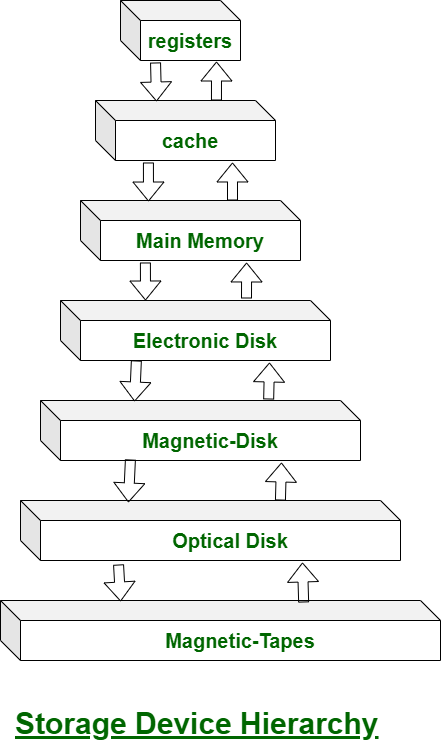 In this hierarchy all the storage devices are arranged according to speed and cost. The higher levels are expensive, but they are fast. As we move down the hierarchy, the cost per bit generally decreases, where as the access time generally increases.
The storage systems above the Electronic disk are Volatile, where as those below are Non-Volatile.
An Electronic disk can be either designed to be either Volatile or Non-Volatile. During normal operation, the electronic disk stores data in a large DRAM array, which is Volatile. But many electronic disk devices contain a hidden magnetic hard disk and a battery for backup power. If external power is interrupted, the electronic disk controller copies the data from RAM to the magnetic disk. When external power is restored, the controller copies the data back into the RAM.
The design of a complete memory system must balance all the factors. It must use only as much expensive memory as necessary while providing as much inexpensive, Non-Volatile memory as possible. Caches can be installed to improve performance where a large access-time or transfer-rate disparity exists between two components.
In this hierarchy all the storage devices are arranged according to speed and cost. The higher levels are expensive, but they are fast. As we move down the hierarchy, the cost per bit generally decreases, where as the access time generally increases.
The storage systems above the Electronic disk are Volatile, where as those below are Non-Volatile.
An Electronic disk can be either designed to be either Volatile or Non-Volatile. During normal operation, the electronic disk stores data in a large DRAM array, which is Volatile. But many electronic disk devices contain a hidden magnetic hard disk and a battery for backup power. If external power is interrupted, the electronic disk controller copies the data from RAM to the magnetic disk. When external power is restored, the controller copies the data back into the RAM.
The design of a complete memory system must balance all the factors. It must use only as much expensive memory as necessary while providing as much inexpensive, Non-Volatile memory as possible. Caches can be installed to improve performance where a large access-time or transfer-rate disparity exists between two components.
- Main memory is usually too small to store all needed programs and data permanently.
- Main memory is a volatile storage device that loses its contents when power is turned off or otherwise lost.
- Volatile Storage Device - It loses its contents when the power of the device is removed.
- Non-Volatile Storage device – It does not loses its contents when the power is removed. It holds all the data when the power is removed.
In this hierarchy all the storage devices are arranged according to speed and cost. The higher levels are expensive, but they are fast. As we move down the hierarchy, the cost per bit generally decreases, where as the access time generally increases.
The storage systems above the Electronic disk are Volatile, where as those below are Non-Volatile.
An Electronic disk can be either designed to be either Volatile or Non-Volatile. During normal operation, the electronic disk stores data in a large DRAM array, which is Volatile. But many electronic disk devices contain a hidden magnetic hard disk and a battery for backup power. If external power is interrupted, the electronic disk controller copies the data from RAM to the magnetic disk. When external power is restored, the controller copies the data back into the RAM.
The design of a complete memory system must balance all the factors. It must use only as much expensive memory as necessary while providing as much inexpensive, Non-Volatile memory as possible. Caches can be installed to improve performance where a large access-time or transfer-rate disparity exists between two components.