
The Opportunity Solution Tree (OST) is a visual framework that helps teams map user problems to potential solutions in a structured way. It keeps product discovery focused on real user needs, preventing teams from pursuing ideas that lack meaningful impact.
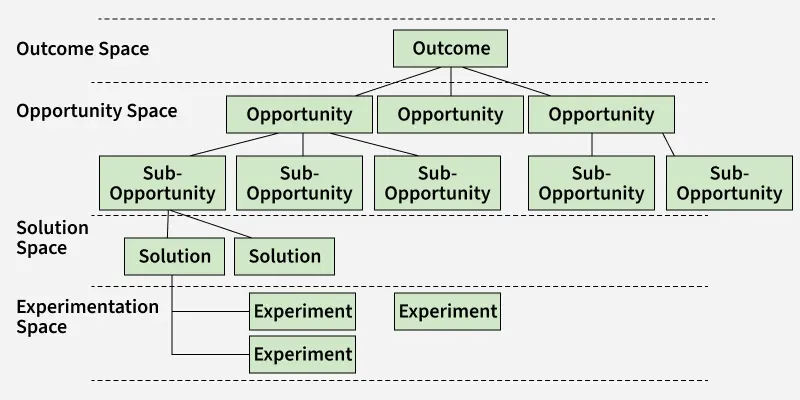
Key Components of the OST:
- Opportunities: User pain points or challenges identified through research (e.g., a lengthy registration process).
- Solutions: Possible ways to address each opportunity, encouraging multiple solution ideas.
- Experiments: Validation methods such as prototypes, A/B tests, or user feedback to test whether solutions work.
Benefits of Using an Opportunity Solution Tree
- Focused Ideation: Keeps brainstorming and solution development centered on real user problems, helping teams avoid building unnecessary or low-impact features.
- Better Prioritization: Visual mapping of opportunities and solutions makes it easier to identify what to work on first based on impact and effort.
- Evidence-Based Decision Making: Encourages experimentation and validation, ensuring decisions are driven by data rather than assumptions.
- Stronger Collaboration: Brings together cross-functional perspectives from design, engineering, and marketing, leading to more practical and effective solutions.
Building an Opportunity Solution Tree
Creating an Opportunity Solution Tree involves a structured, iterative approach to solving user problems.
- Start with a Goal: Define a clear outcome or metric you want to improve, such as increasing registration completion rates.
- Identify Opportunities: Use user research to uncover pain points and unmet needs within the experience you’re improving.
- Ideate Solutions: Brainstorm solutions that directly address each opportunity, focusing on user value rather than assumptions.
- Design Experiments: Plan experiments such as prototypes or A/B tests to validate whether the solutions work.
- Iterate Continuously: Treat the OST as a living artifact, updating it based on learnings, feedback, and validated results.
Common Pitfalls and Tips for Success
- Continuous Iteration: One common mistake is treating the OST as a one-time exercise. In reality, it should be regularly updated based on new insights and data.
- Collaboration is Key: Involve a diverse group of team members in the brainstorming and solution-finding process. Engineers, for example, can provide valuable input on the feasibility of proposed solutions.
- Don’t Get Attached to Ideas: Be willing to discard solutions that don’t work, even if they seem promising. The goal is to solve the user problem, not to implement a particular solution.
- Prioritize Learning: The main objective of the OST is to learn more about user needs and how to address them. Keep this goal in mind throughout the process.
