
Given a string S, the task is to design a Deterministic Finite Automata (DFA) for accepting the language L = C (A + B)+. If the given string is accepted by DFA, then print "Yes". Otherwise, print "No".
Examples:
Input: S = "CABABABAB"
Output: Yes
Explanation: The given string is of the form C(A + B)+ as the first character is C and it is followed by A or B.Input: S = "ABAB"
Output: No
Approach: The idea is to interpret the given language L = C (A + B)+ and for the regular expression of the form C(A + B)+, the following is the DFA State Transition Diagram:
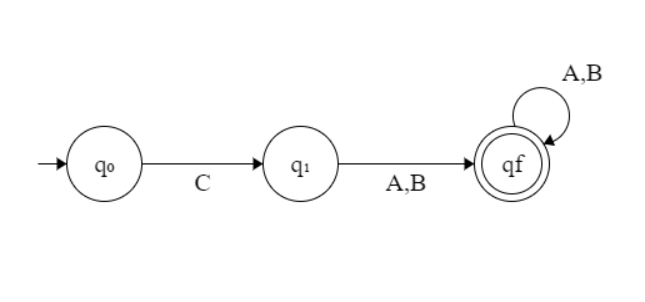
Follow the steps below to solve the problem:
- If the given string is of length less than equal to 1, then print "No".
- If the first character is always C, then traverse the remaining string and check if any of the characters is A or B.
- If there exists any character other than A or B while traversing in the above step, then print "No".
- Otherwise, print "Yes".
Below is the implementation of the above approach:
// C++ program for the above approach

#include <bits/stdc++.h>
using namespace std;

// Function to find whether the given
// string is Accepted by the DFA
void DFA(string str, int N)
{
    // If n <= 1, then print No
    if (N <= 1) {
        cout << "No";
        return;
    }

    // To count the matched characters
    int count = 0;

    // Check if the first character is C
    if (str[0] == 'C') {
        count++;

        // Traverse the rest of string
        for (int i = 1; i < N; i++) {

            // If character is A or B,
            // increment count by 1
            if (str[i] == 'A' || str[i] == 'B')
                count++;
            else
                break;
        }
    }
    else {

        // If the first character
        // is not C, print -1
        cout << "No";
        return;
    }

    // If all characters matches
    if (count == N)
        cout << "Yes";
    else
        cout << "No";
}

// Driver Code
int main()
{
    string str = "CAABBAAB";
    int N = str.size();
    DFA(str, N);

    return 0;
}
// Java program for the above approach
import java.util.*;
class GFG
{

  // Function to find whether the given
  // String is Accepted by the DFA
  static void DFA(String str, int N)
  {

    // If n <= 1, then print No
    if (N <= 1)
    {
      System.out.print("No");
      return;
    }

    // To count the matched characters
    int count = 0;

    // Check if the first character is C
    if (str.charAt(0) == 'C')
    {
      count++;

      // Traverse the rest of String
      for (int i = 1; i < N; i++)
      {

        // If character is A or B,
        // increment count by 1
        if (str.charAt(i) == 'A' ||
            str.charAt(i) == 'B')
          count++;
        else
          break;
      }
    }
    else
    {

      // If the first character
      // is not C, print -1
      System.out.print("No");
      return;
    }

    // If all characters matches
    if (count == N)
      System.out.print("Yes");
    else
      System.out.print("No");
  }

  // Driver Code
  public static void main(String[] args)
  {
    String str = "CAABBAAB";
    int N = str.length();
    DFA(str, N);
  }
}

// This code is contributed by 29AjayKumar
# Python3 program for the above approach

# Function to find whether the given
# is Accepted by the DFA
def DFA(str, N):

    # If n <= 1, then print No
    if (N <= 1):
        print("No")
        return

    # To count the matched characters
    count = 0

    # Check if the first character is C
    if (str[0] == 'C'):
        count += 1

        # Traverse the rest of string
        for i in range(1, N):

            # If character is A or B,
            # increment count by 1
            if (str[i] == 'A' or str[i] == 'B'):
                count += 1
            else:
                break
    else:
        # If the first character
        # is not C, print -1
        print("No")
        return

    # If all characters matches
    if (count == N):
        print("Yes")
    else:
        print("No")

# Driver Code
if __name__ == '__main__':
    str = "CAABBAAB"
    N = len(str)
    DFA(str, N)

# This code is contributed by mohit kumar 29.
// C# program for the above approach
using System;
class GFG
{

  // Function to find whether the given
  // String is Accepted by the DFA
  static void DFA(string str, int N)
  {

    // If n <= 1, then print No
    if (N <= 1)
    {
      Console.Write("No");
      return;
    }

    // To count the matched characters
    int count = 0;

    // Check if the first character is C
    if (str[0] == 'C') {
      count++;

      // Traverse the rest of String
      for (int i = 1; i < N; i++) {

        // If character is A or B,
        // increment count by 1
        if (str[i] == 'A'
            || str[i] == 'B')
          count++;
        else
          break;
      }
    }
    else {

      // If the first character
      // is not C, print -1
      Console.Write("No");
      return;
    }

    // If all characters matches
    if (count == N)
      Console.Write("Yes");
    else
      Console.Write("No");
  }

  // Driver Code
  static public void Main()
  {

    string str = "CAABBAAB";
    int N = str.Length;
    DFA(str, N);
  }
}

// This code is contributed by Dharanendra L V
<script>
    // Javascript program for the above approach

      // Function to find whether the given
      // String is Accepted by the DFA
function  DFA(str,N) {
    // If n <= 1, then print No
    if (N <= 1)
    {
          document.write("No");
          return;
    }

    // To count the matched characters
    let count = 0;

    // Check if the first character is C
    if (str[0] == 'C')
    {
      count++;

      // Traverse the rest of String
      for (let i = 1; i < N; i++)
      {

        // If character is A or B,
        // increment count by 1
        if (str[i] == 'A' ||
            str[i] == 'B')
          count++;
        else
          break;
      }
    }
    else
    {

      // If the first character
      // is not C, print -1
      document.write("No");
      return;
    }

    // If all characters matches
    if (count == N)
      document.write("Yes");
    else
      document.write("No");
}


    // Driver Code
    let str = "CAABBAAB";
    let N = str.length;
    DFA(str, N);


// This code is contributed by patel2127
</script>
Output:
Yes
Time Complexity: O(N)
Auxiliary Space: O(1)
