
Pandas is widely used for data manipulation and analysis in Python. The map() and apply() methods allow users to transform data, but they differ in scope, behaviour and use cases. The output of each method depends on both the input object and the function provided.
apply() method
The apply() method can be applied both to series and Dataframes where a function can be applied to both series and individual elements based on the type of function provided.
1. Using DataFrame
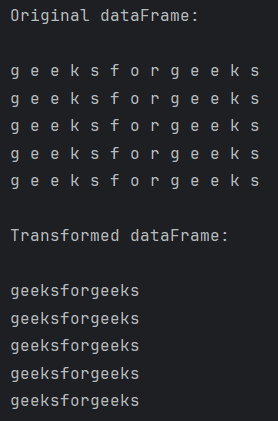
This method can be used on both a pandas Dataframe and series. The function passed as an argument typically works on rows/columns. The code below illustrates how apply() method works on Pandas Dataframe.
import pandas as pd
s = 'geeksforgeeks'
df = pd.DataFrame([list(s)] * 5)

print("Original dataFrame:\n")
print(df.to_string(index=False, header=False))

new_df = df.apply(lambda x: ''.join(x), axis=1)

print("\nTransformed dataFrame:\n")
print('\n'.join(new_df.tolist()))
Output
2. Using Series
The below Code illustrates how to apply() method to the Pandas series:
import pandas as pd
s = pd.Series(list("geeksforgeeks"))

print("Original series:\n")
print('\n'.join(s.tolist()))

new_s = s.apply(str.upper)

print("\nTransformed series:\n")
print('\n'.join(new_s.tolist()))
Output:
Original series: g e e k s f o r g e e k s
Transformed series: G E E K S F O R G E E K S
map() method
The map() method is used to transform values by applying a function, dictionary, or Series mapping. In recent Pandas versions, map() works on both Series and DataFrame, making it a unified alternative for element-wise operations.
1. Using DataFrame
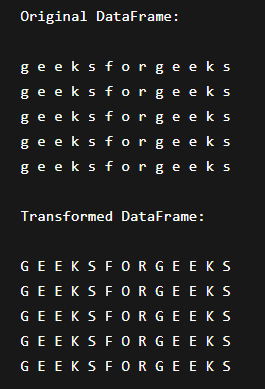
When used with a DataFrame, map() applies the given function to each individual element, similar to the earlier applymap() method.
import pandas as pd

df = pd.DataFrame([list("geeksforgeeks")] * 5)
print("Original DataFrame:\n")
print(df.to_string(index=False, header=False))

new_df = df.map(str.upper)

print("\nTransformed DataFrame:\n")
print(new_df.to_string(index=False, header=False))
Output
2. Using Series
When used with a Series, map() applies the function or mapping element-wise and is commonly used for value transformation or replacement.
import pandas as pd

s = pd.Series(list("geeksforgeeks"))
print("Original series:\n")
print('\n'.join(s.tolist()))

new_s = s.map(str.upper)

print("\nTransformed series:\n")
print('\n'.join(new_s.tolist()))
Output
Original series: g e e k s f o r g e e k s
Transformed series: G E E K S F O R G E E K S
Comparison Table
| Feature | map() | apply() |
|---|---|---|
| Works On | Series and DataFrame | Series and DataFrame |
| Operation Level | Element-wise | Row-wise / Column-wise (DataFrame) or element-wise (Series) |
| Accepts | function, dict or Series | function only |
| Best Use Case | Simple value mapping or replacement | Complex operations, aggregations, or custom row/column logic |
