
Python is renowned for its simplicity and versatility, making it a popular choice among developers across various domains. However, Python's performance can sometimes be a bottleneck when it comes to computationally intensive tasks. This is where Cython comes into play—a powerful tool that allows Python code to be compiled into C, significantly boosting performance.
In this article, we'll explore optimising Python code using Cython, covering the fundamentals, key benefits, and practical examples. Whether working with complex algorithms, large-scale data processing, or any performance-critical applications, mastering Cython can be a transformative addition to our Python development toolkit.
What is Cython?
Cython is a programming language that serves as a superset of Python, enabling Python code to be compiled into C. This approach bridges the gap between the ease of Python and the speed of C, allowing developers to write Python-like code that is translated into efficient C extensions.
Why Use Cython?
Cython offers several compelling advantages:
- Performance: Cython can significantly accelerate our Python code, often bringing it close to the speed of native C.
- Seamless Integration: Cython code integrates effortlessly with existing Python code, allowing us to optimize performance-critical sections without rewriting entire applications.
- Static Typing: By incorporating static type declarations, Cython can further enhance performance, making our code even faster.
Getting Started with Cython
To begin using Cython, we first need to install it. This can be done easily with pip:
pip install cythonBasic Cython Usage
Let's walk through a simple example to illustrate the process of using Cython. We'll start by creating a function that calculates Fibonacci numbers.
Create a Cython file: Save the following code in a file named example.pyx (note the .pyx extension):
def fibonacci(int n):
    if n <= 1:
        return n
    return fibonacci(n-1) + fibonacci(n-2)
Set up the build configuration:
To use the Cython code, we need to compile it first. For that create a setup.py file and add the following code in it.
from setuptools import setup
from Cython.Build import cythonize

setup(
    ext_modules = cythonize("example.pyx")
)

For any related to setup tools we can fix that using the following command.
pip install setuptoolsCompile the Cython code:
Now, we need to comply the Cython code. Run the following command to compile our Cython module:
python setup.py build_ext --inplaceUse the compiled module:
Once the compilation is done we can easily use the module and its function in our regular Python code.
import example

result = example.fibonacci(35)
print('Result: ', result)
Output
Result: 9227465We can import the whole module or a function from it.
from example import fibonacci

result = fibonacci(35)
print(result)
Output
Result: 9227465Comparing Python and Cython: Understanding the Speed Difference
One of the most significant advantages of using Cython is the substantial speed improvement it can offer over standard Python. This speed difference becomes particularly evident when dealing with computationally intensive tasks, where Python's interpreted nature can lead to performance bottlenecks. Let's delve into how and why Cython can accelerate our code.
Python's Performance Limitations
Python is an interpreted language, which means that its code is executed line-by-line by the Python interpreter. While this makes Python highly flexible and easy to use, it also introduces overhead that can slow down execution, especially in loops, recursive functions, and numerical computations.
For example, consider a recursive function calculating Fibonacci numbers in pure Python:
def fibonacci(n):
    if n <= 1:
        return n
    return fibonacci(n-1) + fibonacci(n-2)
Although this code is simple and readable, its performance suffers due to the repetitive function calls and the lack of optimization for integer arithmetic.
How Cython Enhances Speed
Cython improves performance by compiling Python code into C, eliminating much of the overhead associated with Python's interpreted execution. In Cython, we can also add static type declarations, which allows the compiler to generate more efficient C code.
Here's the same Fibonacci function written in Cython with type annotations:
def fibonacci(int n):
    if n <= 1:
        return n
    return fibonacci(n-1) + fibonacci(n-2)
By declaring the variable n as an integer (int), Cython generates optimized C code that can be executed much faster than its Python equivalent.
Benchmarking Python vs. Cython
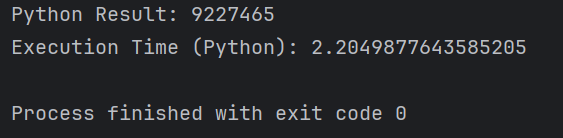
To illustrate the speed difference, let's consider a simple benchmark. We'll measure the time it takes to compute the 30th Fibonacci number using both pure Python and Cython:
Pure Python Implementation:
import time

def fibonacci(n):
    if n <= 1:
        return n
    return fibonacci(n-1) + fibonacci(n-2)

start = time.time()
result = fibonacci(35)
end = time.time()

print("Python Result:", result)
print("Execution Time (Python):", end - start)
Cython Implementation:
After compiling the Cython code as described earlier, we would use a similar timing mechanism:
import time
import example  # This is the compiled Cython module

start = time.time()
result = example.fibonacci(35)
end = time.time()

print("Cython Result:", result)
print("Execution Time (Cython):", end - start)
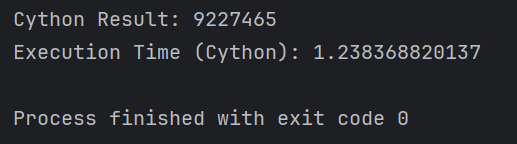
In typical cases, the Cython version will run several times faster than the pure Python version. The exact speedup can vary depending on the complexity of the function and the nature of the operations involved, but it's not uncommon to see performance improvements ranging from 2x to over 100x.
Factors Influencing Speed Gains
The speedup achieved by Cython depends on several factors:
- Static Typing: Adding type annotations allows Cython to generate more optimized C code, significantly improving performance.
- Algorithm Complexity: The more complex the algorithm (e.g., heavy recursion, large loops), the greater the potential speedup when compiled with Cython.
- Interaction with C Libraries: Cython can directly call C functions and libraries, allowing we to leverage highly optimized C code from within our Python programs.
Conclusion
Cython is a robust tool for optimizing Python code, enabling developers to achieve performance levels close to native C while maintaining the simplicity and readability of Python. By strategically applying Cython to performance-critical parts of our code, we can substantially enhance the efficiency of our Python applications, particularly in scenarios involving numerical computations or other CPU-intensive tasks.
By integrating Cython into our development process, we can overcome Python's performance limitations and unlock the full potential of our applications.
