
Python is a beginner-friendly programming language that makes coding easy and fun for kids. With simple and readable syntax, kids can quickly start writing programs and building exciting projects while learning important programming concepts step by step.
Interesting Facts About Python
- The name 'Python' came from the comedy show Monty Python's Flying Circus and not from the snake.
- It is used to build games, websites, robots, apps and even AI projects.
- Popular platforms like YouTube, Netflix and Instagram use it in different parts of their systems.
Getting Started
This section covers how to install Python, write their first program and understand basic concepts like indentation and simple syntax. We will also explore why learning coding can be fun and where it is used in real life.
- Download and Installation
- Why Kids Should Learn Python
- Introduction
- Applications and Advantages
- Indentation
After installing Python and learning the indentation rules, it's time to write your first Python program. The print() function is used to display messages on the screen.
print("Hello, Kids!")
Output
Hello, Kids!
Basics
In this section, kids will learn the basic building blocks of Python programming like to take input from users, store data using variables, perform calculations with operators and understand different types of data used in programs.
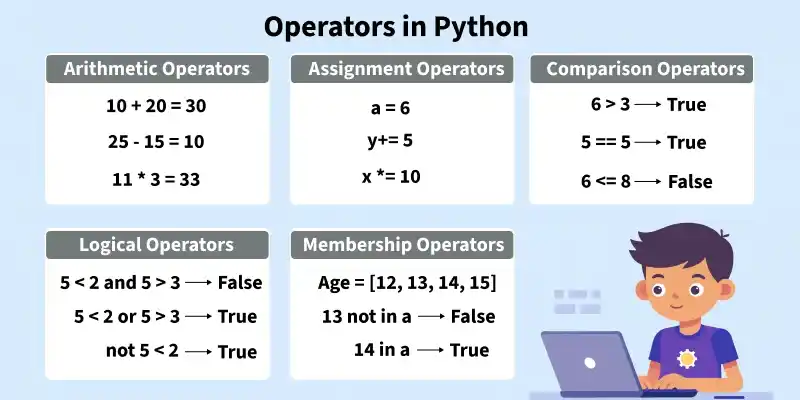
Control Flow
Here, kids will learn how programs make decisions and repeat tasks using conditions and loops to create smarter and more interactive programs.

When you want to repeat the same task multiple times without writing the code again and again use loops.
for i in range(4):
    print("Hello!")
Output
Hello!
Hello!
Hello!
Hello!
Functions
Functions help us organize code into small reusable blocks so we do not have to write the same code again and again. Here, we will learn how functions work, how values are passed and how variables behave inside and outside functions.
Example: Imagine making a pizza by following different steps one by one. Instead of writing everything together, each step can be created as a separate function.
- prepare_dough() - This function prepares the pizza dough.
- add_toppings() - This function adds various toppings to the pizza.
- bake_pizza() - This function bakes the pizza in the oven.
This makes the program cleaner and easier to understand.
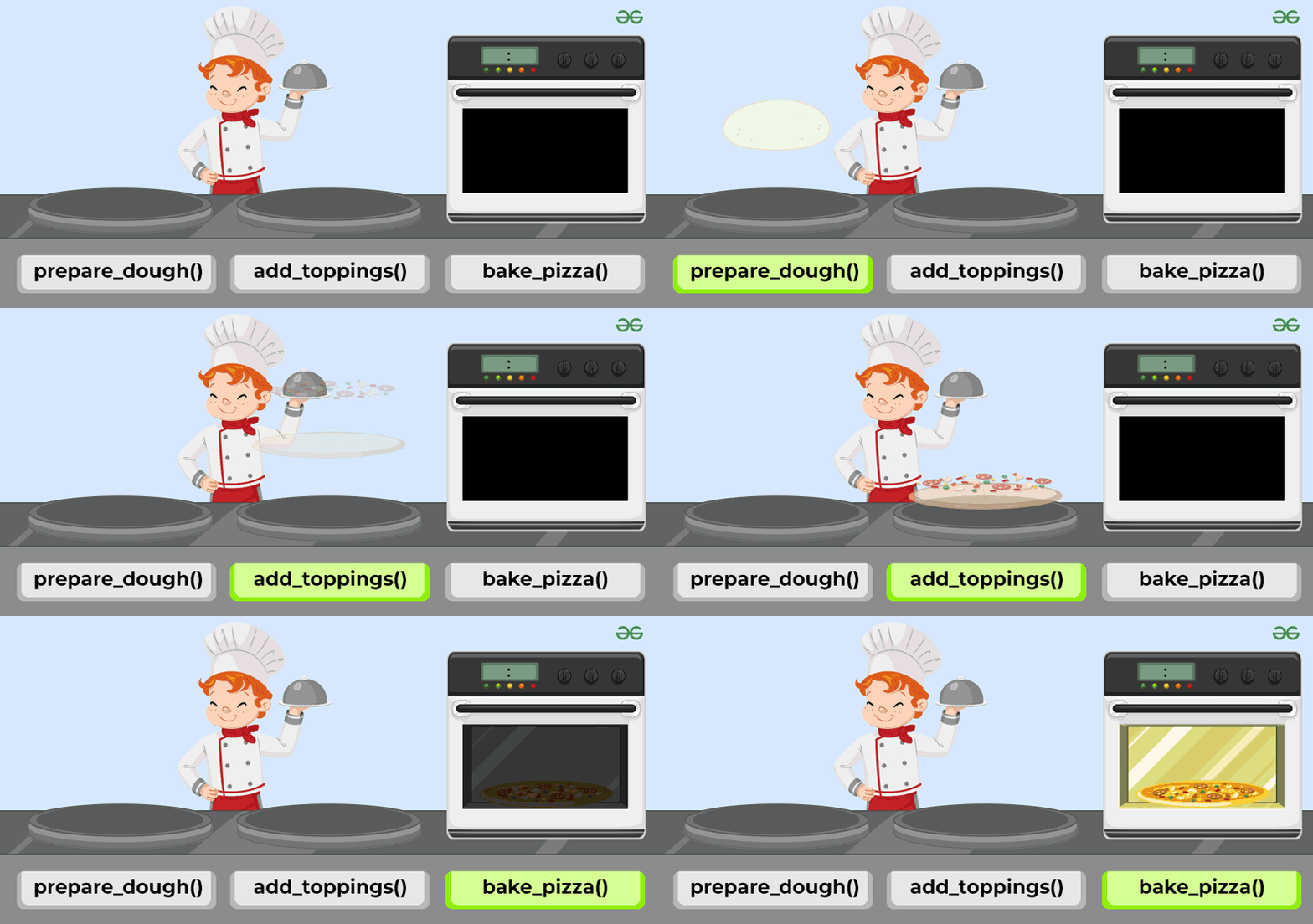
Now, let’s see how the same pizza-making example can be written in Python using functions.
def prepare_dough():
    print("Preparing the dough...")

def add_toppings():
    print("Adding toppings...")

def bake_pizza():
    print("Baking the pizza...")

prepare_dough()
add_toppings()
bake_pizza()
Output
Preparing the dough...
Adding toppings...
Baking the pizza...
Modules and Packages
Python provides ready-made tools that help us perform tasks without writing all the code ourselves. These tools make programming faster and easier.
Example: Think of a recipe book as a module. Each recipe in the book is written in a separate file and each file contains steps to make a different type of pizza.
- recipe1.py - This module contains the functions for making a Margherita pizza.
- recipe2.py - This module contains the functions for making a Pepperoni pizza.
- recipe3.py - This module contains the functions for making a Veggie Supreme pizza.
Now, whenever you want to make a specific pizza, you simply import the required file (module) and use its functions.

For example, if you want a Margherita pizza, import recipe1.py and call its functions to prepare the dough, add toppings and bake the pizza.
import recipe1

recipe1.prepare_dough()
recipe1.add_toppings()
recipe1.bake_pizza()
Output
Preparing the dough...
Adding toppings...
Baking the pizza...
Exception and File Handling
Here, you will learn how to handle errors in programs and work with files in Python. We will see how to read information from files, write new content and create files.
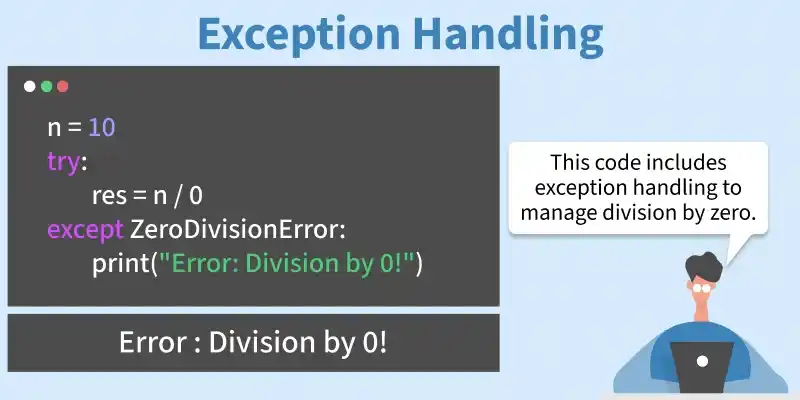
While running a program, errors can occur. Exception handling helps us handle these errors properly. Below is a simple example of a ZeroDivisionError.
Projects
To make learning Python more exciting, here are a few projects to create using the concept you have learned so far.
