scipy.stats.halflogistic() is an Half-logistic continuous random variable that is defined with a standard format and some shape parameters to complete its specification.

Python3
Output :
Python3
Output :
Python3
Output :
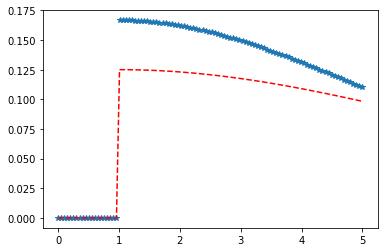
 Code #4 : Varying Positional Arguments
Python3
Parameters : -> q : lower and upper tail probability -> x : quantiles -> loc : [optional]location parameter. Default = 0 -> scale : [optional]scale parameter. Default = 1 -> size : [tuple of ints, optional] shape or random variates. -> moments : [optional] composed of letters [‘mvsk’]; 'm' = mean, 'v' = variance, 's' = Fisher's skew and 'k' = Fisher's kurtosis. (default = 'mv'). Results : Half-logistic continuous random variableCode #1 : Creating Half-logistic continuous random variable
from scipy.stats import halflogistic

numargs = halflogistic  .numargs
[] = [0.7, ] * numargs
rv = halflogistic ()

print ("RV : \n", rv)
RV :
 <scipy.stats._distn_infrastructure.rv_frozen object at 0x000001E39A2EA7B8>
Code #2 : Half-logistic random variates and probability distribution
import numpy as np
quantile = np.arange (0.01, 1, 0.1)

# Random Variates
R = halflogistic .rvs(scale = 2,  size = 10)
print ("Random Variates : \n", R)

# PDF
R = halflogistic .pdf(quantile, loc = 0, scale = 1)
print ("\nProbability Distribution : \n", R)
Random Variates :
 [1.51677656 4.2051329  3.00947016 5.00828865 8.23514322 0.46379571
 1.75794767 2.84948119 0.31392647 1.36186056]

Probability Distribution :
 [0.4999875  0.49849054 0.49452777 0.48817731 0.47956248 0.46884669
 0.45622704 0.44192689 0.42618788 0.40926186]
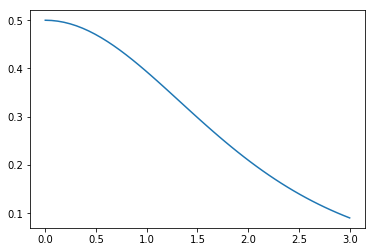
Code #3 : Graphical Representation.
import numpy as np
import matplotlib.pyplot as plt

distribution = np.linspace(0, np.minimum(rv.dist.b, 3))
print("Distribution : \n", distribution)

plot = plt.plot(distribution, rv.pdf(distribution))
Distribution :
 [0.         0.06122449 0.12244898 0.18367347 0.24489796 0.30612245
 0.36734694 0.42857143 0.48979592 0.55102041 0.6122449  0.67346939
 0.73469388 0.79591837 0.85714286 0.91836735 0.97959184 1.04081633
 1.10204082 1.16326531 1.2244898  1.28571429 1.34693878 1.40816327
 1.46938776 1.53061224 1.59183673 1.65306122 1.71428571 1.7755102
 1.83673469 1.89795918 1.95918367 2.02040816 2.08163265 2.14285714
 2.20408163 2.26530612 2.32653061 2.3877551  2.44897959 2.51020408
 2.57142857 2.63265306 2.69387755 2.75510204 2.81632653 2.87755102
 2.93877551 3.        ]
Code #4 : Varying Positional Arguments
import matplotlib.pyplot as plt
import numpy as np

x = np.linspace(0, 5, 100)

# Varying positional arguments
y1 = halflogistic .pdf(x, 1, 3)
y2 = halflogistic .pdf(x, 1, 4)
plt.plot(x, y1, "*", x, y2, "r--")
Output :