
- Courses
- Tutorials
- Interview Prep
Concurrency & Synchronization GATE CS PYQ Quiz
Question 1
Fetch_And_Add(X,i) is an atomic Read-Modify-Write instruction that reads the value of memory location X, increments it by the value i, and returns the old value of X. It is used in the pseudocode shown below to implement a busy-wait lock. L is an unsigned integer shared variable initialized to 0. The value of 0 corresponds to lock being available, while any non-zero value corresponds to the lock being not available.
  AcquireLock(L){
         while (Fetch_And_Add(L,1))
               L = 1;
   }
  ReleaseLock(L){
         L = 0;
   }
This implementation
fails as L can overflow
fails as L can take on a non-zero value when the lock is actually available
works correctly but may starve some processes
works correctly without starvation
Question 2
Two processes, P1 and P2, need to access a critical section of code. Consider the following synchronization construct used by the processes:Here, wants1 and wants2 are shared variables, which are initialized to false. Which one of the following statements is TRUE about the above construct?v
  /* P1 */
while (true) {
  wants1 = true;
  while (wants2 == true);
  /* Critical
    Section */
  wants1=false;
}
/* Remainder section */


/* P2 */
while (true) {
  wants2 = true;
  while (wants1==true);
  /* Critical
    Section */
  wants2 = false;
}
/* Remainder section */
It does not ensure mutual exclusion.
It does not ensure bounded waiting.
It requires that processes enter the critical section in strict alternation.
It does not prevent deadlocks, but ensures mutual exclusion.
Question 3
Consider the procedure below for the Producer-Consumer problem which uses semaphores: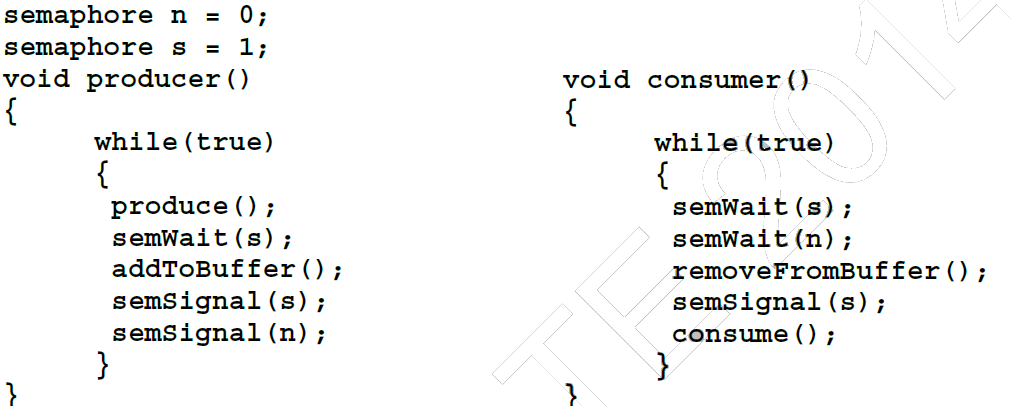
Which one of the following is TRUE?
The producer will be able to add an item to the buffer, but the consumer can never consume it.
The consumer will remove no more than one item from the buffer.
Deadlock occurs if the consumer succeeds in acquiring semaphore s when the buffer is empty.
The starting value for the semaphore n must be 1 and not 0 for deadlock-free operation.
Question 4
The atomic fetch-and-set x, y instruction unconditionally sets the memory location x to 1 and fetches the old value of x n y without allowing any intervening access to the memory location x. consider the following implementation of P and V functions on a binary semaphore S.
void P (binary_semaphore *s)
{
    unsigned y;
    unsigned *x = &(s->value);
    do
    {
        fetch-and-set x, y;
    }
    while (y);
}
void V (binary_semaphore *s)
{
    S->value = 0;
}
Which one of the following is true?
The implementation may not work if context switching is disabled in P
Instead of using fetch-and –set, a pair of normal load/store can be used
The implementation of V is wrong
The code does not implement a binary semaphore
Question 5
Barrier is a synchronization construct where a set of processes synchronizes globally i.e. each process in the set arrives at the barrier and waits for all others to arrive and then all processes leave the barrier. Let the number of processes in the set be three and S be a binary semaphore with the usual P and V functions. Consider the following C implementation of a barrier with line numbers shown on left.
void barrier (void) {
1:   P(S);
2:   process_arrived++;
3.   V(S);
4:   while (process_arrived !=3);
5:   P(S);
6:   process_left++;
7:   if (process_left==3) {
8:      process_arrived = 0;
9:      process_left = 0;
10:  }
11:  V(S);
}
The variables process_arrived and process_left are shared among all processes and are initialized to zero. In a concurrent program all the three processes call the barrier function when they need to synchronize globally. The above implementation of barrier is incorrect. Which one of the following is true?
The barrier implementation is wrong due to the use of binary semaphore S
The barrier implementation may lead to a deadlock if two barrier in invocations are used in immediate succession.
Lines 6 to 10 need not be inside a critical section
The barrier implementation is correct if there are only two processes instead of three.
Question 6
Barrier is a synchronization construct where a set of processes synchronizes globally i.e. each process in the set arrives at the barrier and waits for all others to arrive and then all processes leave the barrier. Let the number of processes in the set be three and S be a binary semaphore with the usual P and V functions. Consider the following C implementation of a barrier with line numbers shown on left.
void barrier (void) {
1:   P(S);
2:   process_arrived++;
3.   V(S);
4:   while (process_arrived !=3);
5:   P(S);
6:   process_left++;
7:   if (process_left==3) {
8:      process_arrived = 0;
9:      process_left = 0;
10:  }
11:  V(S);
}
The variables process_arrived and process_left are shared among all processes and are initialized to zero. In a concurrent program all the three processes call the barrier function when they need to synchronize globally. Which one of the following rectifies the problem in the implementation?
Lines 6 to 10 are simply replaced by process_arrived--
At the beginning of the barrier the first process to enter the barrier waits until process_arrived becomes zero before proceeding to execute P(S).
Context switch is disabled at the beginning of the barrier and re-enabled at the end.
The variable process_left is made private instead of shared
Question 7
Consider two processes P1 and P2 accessing the shared variables X and Y protected by two binary semaphores SX and SY respectively, both initialized to 1. P and V denote the usual semaphore operators, where P decrements the semaphore value, and V increments the semaphore value. The pseudo-code of P1 and P2 is as follows : P1 :
 While true do {
   L1 : ................
   L2 : ................
   X = X + 1;
   Y = Y - 1;
   V(SX);
   V(SY);
 }
P2 :
 While true do {
   L3 : ................
   L4 : ................
   Y = Y + 1;
   X = Y - 1;
   V(SY);
   V(SX);
}
In order to avoid deadlock, the correct operators at L1, L2, L3 and L4 are respectively
P(SY), P(SX); P(SX), P(SY)
P(SX), P(SY); P(SY), P(SX)
P(SX), P(SX); P(SY), P(SY)
P(SX), P(SY); P(SX), P(SY)
Question 8
Suppose we want to synchronize two concurrent processes P and Q using binary semaphores S and T. The code for the processes P and Q is shown below.
Process P:
while (1) {
W:
   print '0';
   print '0';
X:
}

Process Q:
while (1) {
Y:
   print '1';
   print '1';
Z:
}
Synchronization statements can be inserted only at points W, X, Y and Z.
Which of the following will always lead to an output starting with '001100110011' ?
P(S) at W, V(S) at X, P(T) at Y, V(T) at Z, S and T initially 1
P(S) at W, V(T) at X, P(T) at Y, V(S) at Z, S initially 1, and T initially 0
P(S) at W, V(T) at X, P(T) at Y, V(S) at Z, S and T initially 1
P(S) at W, V(S) at X, P(T) at Y, V(T) at Z, S initially 1, and T initially 0
Question 9
Suppose we want to synchronize two concurrent processes P and Q using binary semaphores S and T. The code for the processes P and Q is shown below.
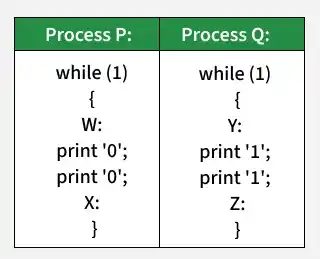
Synchronization statements can be inserted only at points W, X, Y and Z Which of the following will ensure that the output string never contains a substring of the form 01^n0 or 10^n1 where n is odd?
P(S) at W, V(S) at X, P(T) at Y, V(T) at Z, S and T initially 1
P(S) at W, V(T) at X, P(T) at Y, V(S) at Z, S and T initially 1
P(S) at W, V(S) at X, P(S) at Y, V(S) at Z, S initially 1
V(S) at W, V(T) at X, P(S) at Y, P(T) at Z, S and T initially 1
Question 10
Two processes X and Y need to access a critical section. Consider the following synchronization construct used by both the processes.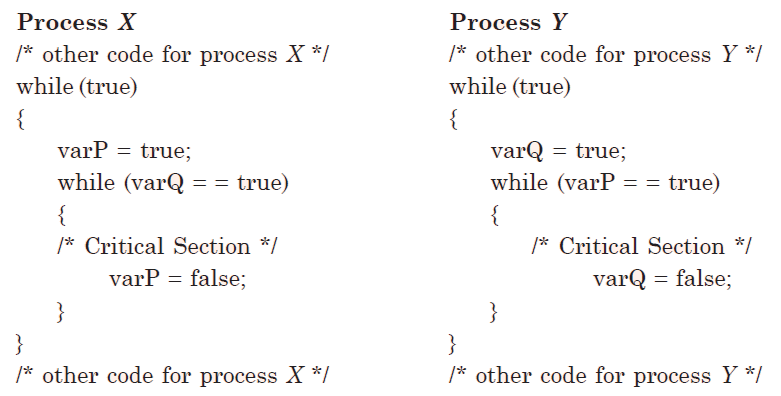
Here, varP and varQ are shared variables and both are initialized to false. Which one of the following statements is true?
The proposed solution prevents deadlock but fails to guarantee mutual exclusion
The proposed solution guarantees mutual exclusion but fails to prevent deadlock
The proposed solution guarantees mutual exclusion and prevents deadlock
The proposed solution fails to prevent deadlock and fails to guarantee mutual exclusion
There are 30 questions to complete.
