
- Courses
- Tutorials
- Interview Prep
GATE EC || SIGNALS & SYSTEMS || CONVOLUTION || PYQs (2000-2025)
Question 1
Two systems with impulse responses, h1(t) and h2(t) are connected in cascade. Then the overall impulse response of the cascaded system is given by
(GATE 2013 || EC || PYQ || MCQ || 1 MARKS)
product of h1(t) and h2(t).
sum of h1(t) and h2(t).
convolution of h1(t) and h2(t).
subtraction of h2(t) from h1(t).
Question 2
The output y[n] of a discrete-time system for an input x[n] is [Tex]y[n] = \max_{-\infty < k \leq n} |x[k]|[/Tex]. The unit impulse response of the system is
(GATE 2020 || EC || PYQ || NAT || 1 MARKS)
0 for all n
unit impulse signal δ [n]
unit step signal u[n]
1 for all n
Question 3
Consider the parallel combination of two LTI system shown in the figure.
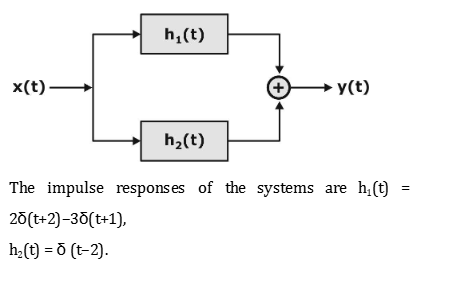
If the input x(t) is a unit step signal, then the energy of y(t) is ……….
(GATE 2017 || EC || PYQ || NAT || 2 MARKS)
7
Question 4
Two discrete-time signals x[n] and h[n] are both non-zero only for n = 0, 1, 2 and zero otherwise. It is given that
x[0] = 1, x[1] = 2, x[2] = 1, h[0] = 1.
Let y[n] be the linear convolution of x[n] and h[n]. Given that y[1] = 3 and y[2] = 4, the value of the expression (10y[3] + y[4] is ………
(GATE 2016 || EC || PYQ || NAT || 2 MARKS)
31
Question 5
A network consisting of a finite number of linear resistor (R), inducer (L), and capacitor (C) elements, connected all in series or all in parallel, is excited with a source of the form [Tex]\sum_{k=1}^{3} a_k \cos(k\omega_0 t), \qquad a_k \neq 0,\ \omega_0 \neq 0[/Tex]
The source has nonzero impedance. Which one of the following is a possible form of the output measured across a resistor in the network?
(GATE 2016 || EC || PYQ || MCQ || 2 MARKS)
[Tex]\sum_{k=1}^{3} b_k \cos(k\omega_0 t+\phi_k), \qquad b_k \neq a_k,\ \forall k[/Tex]
[Tex]\sum_{k=1}^{3} b_k \cos(k\omega_0 t+\phi_k), \qquad b_k \neq 0,\ \forall k[/Tex]
[Tex]\sum_{k=1}^{3} a_k \cos(k\omega_0 t+\phi_k)[/Tex]
[Tex]\sum_{k=1}^{2} a_k \cos(k\omega_0 t+\phi_k)[/Tex]
Question 6
Which one of the following is an Eigen function of the class of all continuous-time, linear, time-invariant system (u(t) denotes the unit-step function)?
(GATE 2016 || EC || PYQ || MCQ || 1 MARKS)
[Tex]e^{j\omega_0 t}u(t)[/Tex]
[Tex]\cos(\omega_0 t)[/Tex]
[Tex]e^{j\omega_0 t}[/Tex]
[Tex]\sin(\omega_0 t)[/Tex]
Question 7
The impulse response of an LTI system can be obtained by
(GATE 2015 || EC || PYQ || MCQ || 1 MARKS)
differentiating the unit ramp response.
differentiating the unit step response.
integrating the unit ramp response.
integrating the unit step response.
Question 8
The result of the convolution [Tex]x(-t) * \delta(-t-t_0)[/Tex] is:
(GATE 2015 || EC || PYQ || NAT || 1 MARKS)
x(t + t0)
x(t – t0)
x(–t +t0)
x(–t – t0)
Question 9
Consider a discrete-time signal

If y[n] is the convolution of x[n] with itself, the value of y[4] is …………..
(GATE 2014 || EC || PYQ || NAT || 2 MARKS)
10
Question 10
A continuous, linear time-invariant filter has an impulse response h(t) described by

When a constant input of value 5 is applied to this filter, the steady state output is _______.
(GATE 2013 || EC || PYQ || NAT || 1 MARKS)
45
There are 23 questions to complete.
