
- Courses
- Tutorials
- Interview Prep
GATE EC || SIGNALS & SYSTEMS ||LAPLACE & Z TRANSFORM ||PYQS(2000-2025)
Question 1
Given that
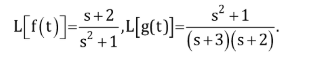
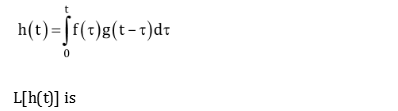


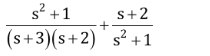

Question 2
A linear time invariant system has an impulse response e2t, for t > 0. If initial conditions are 0 and the input is e3t, the output for t > 0 is
(GATE 2000 || EC || MCQ || 2 MARKS)
e3t – e2t
e5t
e3t + e2t
None of these
Question 3
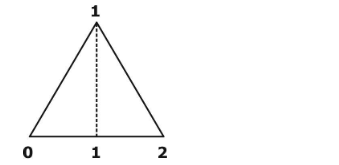
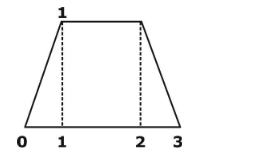
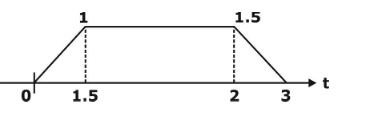
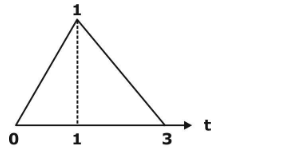
Let u(t) be the step function. Which of the waveforms in the figure corresponds to the convolution of u(t) – u(t – 1) with u(t) – u (t – 2)?
(GATE 2000 || EC || MCQ || 2 MARKS)
Question 4
The transfer function of a system is given by [Tex]H(s)=\frac{1}{s^2(s-2)}[/Tex]. The impulse response of the system is ? (* denotes convolution, and u(t) is unit step function)
(GATE 2001 || EC || MCQ || 1 MARKS)
[Tex]\left(t^2 e^{-2t}\right)u(t)[/Tex]
[Tex]\left(t e^{2t}\right)u(t)[/Tex]
[Tex]\left(t e^{-2t}\right)u(t)[/Tex]
[Tex]\left(t e^{-2t}\right)u(t)[/Tex]
Question 5
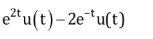
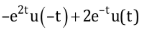
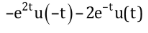
The Laplace transform of a continuous-time signal x(t) is
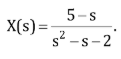
If the Fourier transform of this signal exists, then x(t) is
(GATE 2001 || EC || MCQ || 2 MARKS)

Question 6
The Laplace transform of i(t) is given by:
[Tex]I(s)=\frac{2}{s(1+s)}[/Tex]
[Tex]\text{As } t\to\infty,\ \text{the value of } i(t)\ \text{tends to}[/Tex]
(GATE 2003 || EC || MCQ || 1 MARKS)
0
1
2
∞
Question 7
Consider the function f(t) having Laplace transform [Tex]F(s)=\frac{\omega_0}{s^2+\omega_0^2}, \quad \operatorname{Re}(s)>0[/Tex]. The final value of f(t) would be:
(GATE 2006 || EC || MCQ || 2 MARKS)
0
1
[Tex]-1 \leq f(\infty) \leq 1[/Tex]
∞
Question 8
The 3-dB band width of the low-pass signal e–tu(t), where u(t) is the unit step function, is given by
(GATE 2007 || EC || MCQ || 2 MARKS)
[Tex]\frac{1}{2\pi}\ \text{Hz}[/Tex]
[Tex]\frac{1}{2\pi}\sqrt{\sqrt{2}-1}\ \text{Hz}[/Tex]
∞
1 Hz
Question 9
A linear, time-invariant, causal continuous time system has a rational transfer function with simple poles at s = –2 and s = –4, and one simple zero at s = –1. A unit step u(t) is applied at the input of the system. At steady state, the output has constant value of 1. The impulse response of this system is
(GATE 2008 || EC || MCQ || 2 MARKS)
[exp(-2t) + exp(-4t)]u(t)
[-4 exp(-2t) + 12exp(-4t) -exp(-t)]u(t)
[-4 exp(-2t) + 12exp(-4t)]u(t)
[-0.5 exp(-2t) + 1.5 exp(-4t)]u(t)
There are 9 questions to complete.
