
- Courses
- Tutorials
- Interview Prep
GATE EC||NETWORK THEORY||PYQS(2000-2025)
Question 1
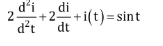
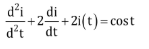
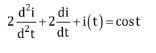
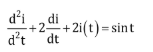
The differential equation for the current i(t) in the circuit of the figure is
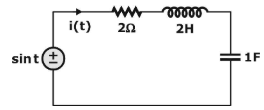
[GATE EC || PYQ || 2003 MCQ || 2 mark ]
Question 2
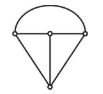
Consider the network graph shown in the figure. Which one of the following is NOT a 'tree' of this graph?
(GATE EC || PYQ || 2004 MCQ || 1 mark)


Question 3
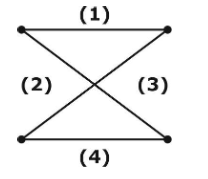
In the following graph, the number of trees (P) and the number of cut-sets (Q) are
(GATE EC|| 2008 MCQ || 1 MARK)
P = 2, Q = 2
P = 2, Q = 6
P = 4, Q = 6
P = 4, Q = 10
Question 4
The first and the last critical frequency of an RC-driving point impedance function must respectively be
(GATE EC|| 2005 MCQ || 2 MARK)
a zero and a pole
a zero and a zero
a pole and a pole
a pole and a zero
Question 5
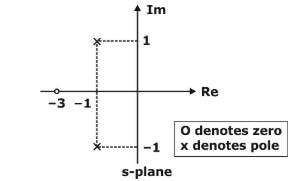
The driving-point impedance Z(s) of a network has the pole-zero locations as shown in the figure. If Z(0) = 3, then Z(s) is
(GATE EC|| 2003 MCQ || 2 MARK)
[Tex]\frac{3(s+3)}{s^2+2s+3}[/Tex]
[Tex]\frac{2(s+3)}{s^2+2s+2}[/Tex]
[Tex]\frac{3(s+3)}{s^2-2s-2}[/Tex]
[Tex]\frac{3(s-3)}{s^2-2s-3}[/Tex]
Question 6
A negative resistance Rneg is connected to a passive network N having driving point impedance as shown below. For Z2(s) to be positive real
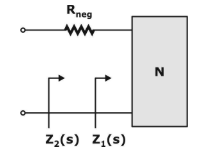
(GATE EC|| 2006 MCQ || 2 MARK)
[Tex]|R_{\mathrm{neg}}|\leq \operatorname{Re} Z_1(j\omega),\quad \forall \omega[/Tex]
[Tex]|R_{\mathrm{neg}}|\leq |Z_1(j\omega)|,\quad \forall \omega[/Tex]
[Tex]|R_{\mathrm{neg}}|\leq \operatorname{Im} Z_1(j\omega),\quad \forall \omega[/Tex]
[Tex]|R_{\mathrm{neg}}|\leq \angle Z_1(j\omega),\quad \forall \omega[/Tex]
Question 7
The first and the last critical frequencies (singularities) of a driving point impedance function of a passive network having two kinds of elements, are a pole and a zero respectively. The above property will be satisfied by
(PYQ || 2006 MCQ || 2 marks)
RL network only
RC network only
LC network only
RC as well as RL networks
Question 8
The transfer function V2(s) / V1(s) of the circuit shown below is:
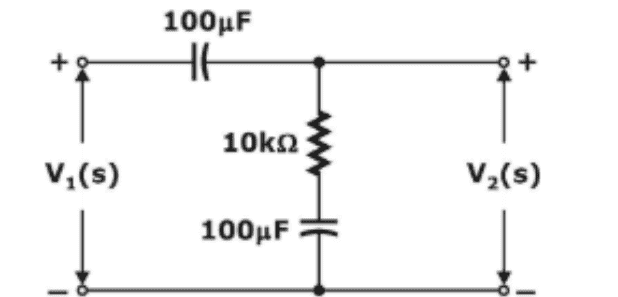
(GATE EC|| 2013 MCQ || 1 MARK)
[Tex]\frac{0.5s+1}{s+1}[/Tex]
[Tex]\frac{3s+6}{s+2}[/Tex]
[Tex]\frac{s+2}{s+1}[/Tex]
[Tex]\frac{s+1}{s+1}[/Tex]
Question 9
Consider the building block called 'Network N' shown in the figure.
Let C = 100 μF and R = 10 kΩ
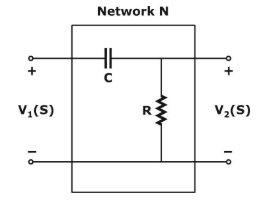
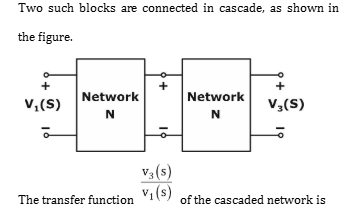
(PYQ || 2014 MCQ || 2 marks


Question 10
Consider the building block called 'Network N' shown in the figure.
Let C = 100 μF and R = 10 kΩ
(PYQ || 2014 MCQ || 2 marks)
There are 157 questions to complete.
