
- Courses
- Tutorials
- Interview Prep
Process & Threads GATE CS PYQ Quiz
Question 1
Which one of the following is FALSE?
User level threads are not scheduled by the kernel.
When a user level thread is blocked, all other threads of its process are blocked.
Context switching between user level threads is faster than context switching between kernel level threads.
Kernel level threads cannot share the code segment
Question 2
A thread is usually defined as a "light weight process" because an operating system (OS) maintains smaller data structures for a thread than for a process. In relation to this, which of the following is TRUE?
On per-thread basis, the OS maintains only CPU register state
The OS does not maintain a separate stack for each thread
On per-thread basis, the OS does not maintain virtual memory state
On per-thread basis, the OS maintains only scheduling and accounting information
Question 3
Consider the following statements about user level threads and kernel level threads. Which one of the following statement is FALSE?
Context switch time is longer for kernel level threads than for user level threads.
User level threads do not need any hardware support.
Related kernel level threads can be scheduled on different processors in a multi-processor system.
Blocking one kernel level thread blocks all related threads.
Question 4
Which of the following need not necessarily be saved on a context switch between processes?
General purpose registers
Translation look aside buffer
Program counter
All of the above
Question 5
The following two functions P1 and P2 that share a variable B with an initial value of 2 execute concurrently.
P1()
{
   C = B – 1;
   B = 2*C;
}

P2()
{
   D = 2 * B;
   B = D - 1;
}
The number of distinct values that B can possibly take after the execution is
3
2
5
4
Question 6
Consider the following statements about process state transitions for a system using preemptive scheduling.
- I. A running process can move to ready state.
- II. A ready process can move to running state.
- III. A blocked process can move to running state.
- IV. A blocked process can move to ready state.
Which of the above statements are TRUE ?
I, II, and III only
II and III only
I, II, and IV only
I, II, III and IV only
Question 7
In the following process state transition diagram for a uniprocessor system, assume that there are always some processes in the ready state: Now consider the following statements:
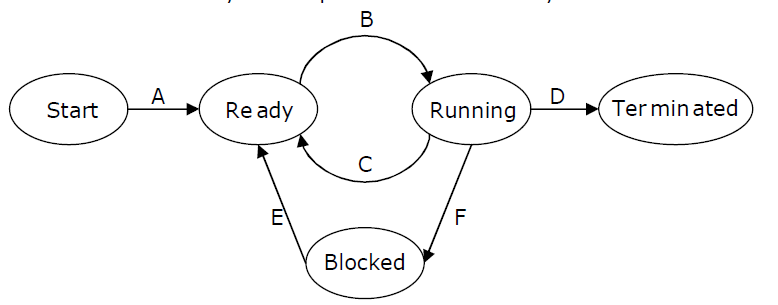
I. If a process makes a transition D, it would result in
   another process making transition A immediately.
II. A process P2 in blocked state can make transition E
    while another process P1 is in running state.
III. The OS uses preemptive scheduling.
IV. The OS uses non-preemptive scheduling.
Which of the above statements are TRUE?
I and II
I and III
II and III
II and IV
Question 8
Which combination of the following features will suffice to characterize an OS as a multi-programmed OS?
(a) More than one program may be loaded into main memory
   at the same time for execution.
(b) If a program waits for certain events such as I/O,
   another program is immediately scheduled for execution.
(c) If the execution of program terminates, another program
   is immediately scheduled for execution.
a
a and b
a and c
a, b and c
Question 9
Consider a set of n tasks with known runtimes r1, r2, .... rn to be run on a uniprocessor machine. Which of the following processor scheduling algorithms will result in the maximum throughput?
Round-Robin
Shortest-Job-First
Highest-Response-Ratio-Next
First-Come-First-Served
Question 10
Which of the following is/are shared by all the threads in a process?
I. Program Counter

II. Stack

III. Address space

IV. Registers
I and II only
III only
IV only
III and IV only
There are 19 questions to complete.
