
- Courses
- Tutorials
- Interview Prep
Queues GATE CS PYQ Quiz
Question 1
Suppose a circular queue of capacity (n – 1) elements is implemented with an array of n elements. Assume that the insertion and deletion operation are carried out using REAR and FRONT as array index variables, respectively. Initially, REAR = FRONT = 0. The conditions to detect queue full and queue empty are
Full: (REAR+1) mod n == FRONT, empty: REAR == FRONT
Full: (REAR+1) mod n == FRONT, empty: (FRONT+1) mod n == REAR
Full: REAR == FRONT, empty: (REAR+1) mod n == FRONT
Full: (FRONT+1) mod n == REAR, empty: REAR == FRONT
Question 2
An implementation of a queue Q, using two stacks S1 and S2, is given below:
void insert(Q, x) {
   push (S1, x);
}

void delete(Q){
   if(stack-empty(S2)) then
      if(stack-empty(S1)) then {
          print(“Q is empty”);
          return;
      }
      else while (!(stack-empty(S1))){
          x=pop(S1);
          push(S2,x);
      }
   x=pop(S2);
}
Let n insert and m (<=n) delete operations be performed in an arbitrary order on an empty queue Q. Let x and y be the number of push and pop operations performed respectively in the process. Which one of the following is true for all m and n?
n+m <= x < 2n and 2m <= y <= n+m
n+m <= x < 2n and 2m<= y <= 2n
2m <= x < 2n and 2m <= y <= n+m
2m <= x <2n and 2m <= y <= 2n
Question 3
A Priority-Queue is implemented as a Max-Heap. Initially, it has 5 elements. The level-order traversal of the heap is given below: 10, 8, 5, 3, 2 Two new elements ”1‘ and ”7‘ are inserted in the heap in that order. The level-order traversal of the heap after the insertion of the elements is:
10, 8, 7, 5, 3, 2, 1
10, 8, 7, 2, 3, 1, 5
10, 8, 7, 1, 2, 3, 5
10, 8, 7, 3, 2, 1, 5
Question 4
A circularly linked list is used to represent a Queue. A single variable p is used to access the Queue. To which node should p point such that both the operations enQueue and deQueue can be performed in constant time? 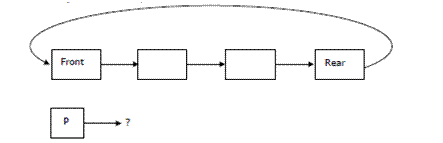
rear node
front node
not possible with a single pointer
node next to front
Question 5
A Circular queue has been implemented using singly linked list where each node consists of a value and a pointer to next node. We maintain exactly two pointers
FRONT
and
REAR
pointing to the front node and rear node of queue. Which of the following statements is/are correct for circular queue so that insertion and deletion operations can be performed in O(1) i.e. constant time.
I. Next pointer of front node points to the rear node.
II. Next pointer of rear node points to the front node.
I only
II only
Both I and II
Neither I nor II
Question 6
Consider the queues Q1 containing four elements and Q2 containing none (shown as the Initial State in the figure). The only operations allowed on these two queues are Enqueue(Q, element) and Dequeue(Q). The minimum number of Enqueue operations on Q1 required to place the elements of Q1 in Q2 in reverse order (shown as the Final State in the figure) without using any additional storage is___________.

12
9
4
0
Question 7
Let Q denote a queue containing sixteen numbers and S be an empty stack. Head(Q) returns the element at the head of the queue Q without removing it from Q. Similarly Top(S) returns the element at the top of S without removing it from S. Consider the algorithm given below.
while Q is not Empty do
  if S is Empty OR Top(S) ≤ Head (Q) then
     x:= Dequeue (Q);
     Push (S, x);
  else
     x:= Pop(S);
     Enqueue (Q, x);
  end
 end
The maximum possible number of iterations of the while loop in the algorithm is______ [This Question was originally a Fill-in-the-Blanks question]
16
32
256
64
Question 8
Let A be a priority queue for maintaining a set of elements. Suppose A is implemented using a max-heap data structure. The operation EXTRACT-MAX(A) extracts and deletes the maximum element from A. The operation INSERT(A,key) inserts a new element key in A. The properties of a max-heap are preserved at the end of each of these operations.
When A contains n elements, which one of the following statements about the worst case running time of these two operations is TRUE?
Both EXTRACT-MAX(A) and INSERT(A,key) run in O(1).
Both EXTRACT-MAX(A) and INSERT(A,key) run in O(log(n)).
EXTRACT-MAX(A) runs in O(1) whereas INSERT(A,key) runs in O(n).
EXTRACT-MAX(A) runs in O(1) whereas INSERT(A,key) runs in O(log(n)).
There are 8 questions to complete.
