
- Courses
- Tutorials
- Interview Prep
SDT(Syntax-Directed Translation) PYQ QUIZ GATE CS
Question 1
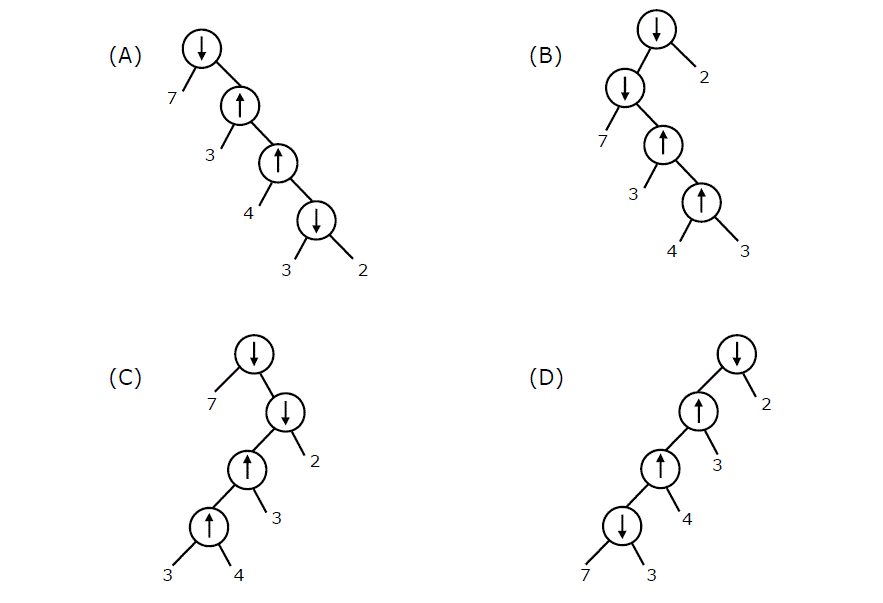
Consider two binary operators '
[Tex]\uparrow[/Tex]' and '
[Tex]\downarrow[/Tex]' with the precedence of operator
[Tex]\downarrow[/Tex]being lower than that of the
[Tex]\uparrow[/Tex]operator. Operator
[Tex]\uparrow[/Tex]is right associative while operator
[Tex]\downarrow[/Tex]is left associative. Which one of the following represents the parse tree for expression (7
[Tex]\downarrow[/Tex]3
[Tex]\uparrow[/Tex]4
[Tex]\uparrow[/Tex]3
[Tex]\downarrow[/Tex]2)?
A
B
C
D
Question 2
S -> aSa|bSb|a|b; The language generated by the above grammar over the alphabet {a,b} is the set of
All palindromes
All odd length palindromes.
Strings that begin and end with the same symbol
All even length palindromes
Question 3
Which of the following statements are TRUE?
I.  There exist parsing algorithms for some programming languages
     whose complexities are less than O(n3).
II.  A programming language which allows recursion can be implemented
    with static storage allocation.
III. No L-attributed definition can be evaluated in The framework
     of bottom-up parsing.
IV. Code improving transformations can be performed at both source
    language and intermediate code level.
I and II
I and IV
III and IV
I, III and IV
Question 4
Consider the CFG with {S,A,B) as the non-terminal alphabet, {a,b) as the terminal alphabet, S as the start symbol and the following set of production rules
S --> aB        S --> bA
B --> b         A --> a
B --> bS        A --> aS
B --> aBB       A --> bAA
Which of the following strings is generated by the grammar?
aaaabb
aabbbb
aabbab
abbbba
Question 5
A student wrote two context-free grammars G1 and G2 for generating a single C-like array declaration. The dimension of the array is at least one. For example,
int a[10][3]; The grammars use D as the start symbol, and use six terminal symbols int ; id [ ] num.
Grammar G1
D → int L;
L → id [E
E → num]
E → num] [E

Grammar G2
D → int L;
L → id E
E → E[num]
E → [num]
Which of the grammars correctly generate the declaration mentioned above?
Both G1 and G2
Only G1
Only G2
Neither G1 nor G2
Question 6
Consider the following expression grammar G.
E -> E - T | T
T -> T + F | F
F -> (E) | id
Which of the following grammars are not left recursive, but equivalent to G.
A)
E -> E - T | T
T -> T + F | F
F -> (E) | id

B)
E -> TE'
E' -> -TE' | ε
T -> T + F | F
F -> (E) | id

C)
E -> TX
X -> -TX | ε
T -> FY
Y -> +FY | ε
F -> (E) | id

D)
E -> TX | (TX)
X -> -TX | +TX | ε
T -> id
A
B
C
D
Question 7
Consider the following grammar and the semantic actions to support the inherited type declaration attributes. Let X1, X2, X3, X4, X5 and X6 be the placeholders for the non-terminals D, T, L or L1 in the following table:
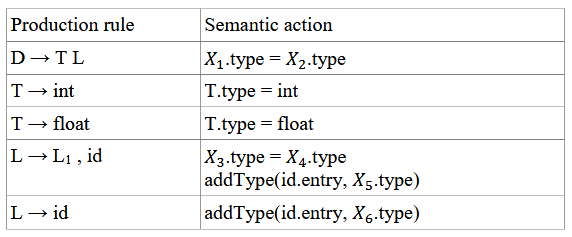
Which one of the following are the appropriate choices for X1, X2, X3 and X4?
X1 = L, X2 = T, X3 = L1, X4 = L
X1 = L, X2 = L, X3 = L1, X4 = T
X1 = T, X2 = L, X3 = L1, X4 = T
X1 = T, X2 = L, X3 = T, X4 = L1
Question 8
Consider the following grammar along with translation rules

Here # and % are operators and id is a token that represents an integer and id. val represents the corresponding integer value. The set of non-terminals is {S, T, R, P} and a subscripted non-terminal indicates an instance of the non-terminal. Using this translation scheme, the computed value of S.val for root of the parse tree for the expression 20#10%5#8%2%2 is _____________.
60
55
75
80
Question 9
Consider the translation scheme shown below
S → T R
R → + T {print ('+');} R | ε
T → num {print (num.val);}
Here num is a token that represents an integer and num.val represents the corresponding integer value. For an input string '9 + 5 + 2', this translation scheme will print
9 + 5 + 2
9 5 + 2 +
9 5 2 + +
+ + 9 5 2
Question 10
In a bottom-up evaluation of a syntax directed definition, inherited attributes can
always be evaluated
be evaluated only if the definition is L-attributed
be evaluated only if the definition has synthesized attributes
never be evaluated
There are 30 questions to complete.
