
SARIMA (Seasonal Autoregressive Integrated Moving Average) is an extension of the ARIMA model that incorporates seasonality into the model. It’s a powerful tool for modeling and forecasting time series data that exhibit both trend and seasonality.
What is SARIMA?
SARIMA is a variant of the ARIMA model that takes into account both non-seasonal and seasonal components in a time series. It is designed to capture data that shows patterns at regular intervals, such as quarterly sales or monthly weather data.
The SARIMA model is often written as:
SARIMA(p,d,q)(P,D,Q)m
where,
- p,d,q are the non-seasonal ARIMA terms.
- P,D,Q are the seasonal ARIMA terms.
- m is the number of periods in each seasonal cycle.
- p: The number of autoregressive terms.
- d: The number of differences needed to make the time series stationary.
- q: The number of moving average terms.
- P: The number of seasonal autoregressive (SAR) terms.
- D: The number of seasonal differences.
- Q: The number of seasonal moving average (SMA) terms.
- m: The length of the seasonal cycle.
Why Use SARIMA?
- Handles Seasonality: It effectively models data with seasonal patterns.
- Flexibility: The combination of seasonal and non-seasonal parameters allows it to adapt to various datasets.
- Good Forecasting Performance: SARIMA can provide accurate forecasts when the underlying data patterns are appropriately modeled.
Now we implement SARIMA in R Programming Language.
Step 1: Install and Load Required Packages
First, install and Load the necessary packages.
# Install required packages (run this once)
install.packages("forecast")
install.packages("ggplot2")
install.packages("tseries")

# Load the libraries
library(forecast)
library(ggplot2)
library(tseries)
Step 2: Create Synthetic Monthly Sales Data
Generate synthetic sales data for 36 months.
# Create synthetic monthly sales data
set.seed(123)  # For reproducibility
months <- seq(as.Date("2020-01-01"), by = "month", length.out = 36)
sales <- 200 + (1:36) * 3 + 20 * sin(2 * pi * (1:36) / 12) + rnorm(36, mean = 0, sd = 10)
data <- data.frame(Date = months, Sales = sales)
head(data)
Output:
        Date    Sales
1 2020-01-01 207.3952
2 2020-02-01 221.0187
3 2020-03-01 244.5871
4 2020-04-01 230.0256
5 2020-05-01 226.2929
6 2020-06-01 235.1506
Step 3: Convert to Time Series Format
Convert the data frame into a time series object.
# Convert to time series format
ts_data <- ts(data$Sales, start = c(2020, 1), frequency = 12)
Step 4: Visualize the Data
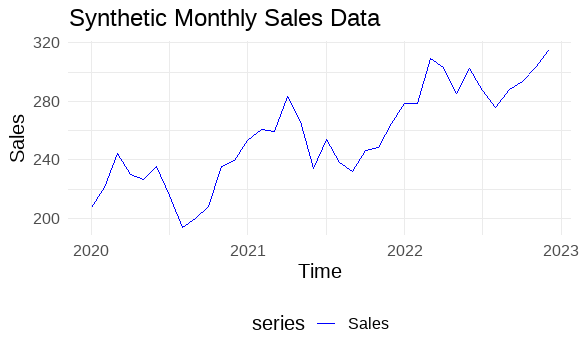
Plot the synthetic sales data to visualize trends.
# Visualize the original data with color
autoplot(ts_data, series = "Sales") +
  ggtitle("Synthetic Monthly Sales Data") +
  xlab("Time") +
  ylab("Sales") +
  scale_color_manual(values = "blue") +  # Customize line color
  theme_minimal(base_size = 15) +  # Set base font size for better visibility
  theme(legend.position = "bottom")
Output:
Step 5: Check for Stationarity
Perform the Augmented Dickey-Fuller test to check for stationarity.
# Check for stationarity
adf_test <- adf.test(ts_data)
print(adf_test)
Output:
        Augmented Dickey-Fuller Test

data:  ts_data
Dickey-Fuller = -5.3005, Lag order = 3, p-value = 0.01
alternative hypothesis: stationary
Step 6: Identify Model Parameters
Now find suitable model parameters.
# Identify model parameters with Auto ARIMA
auto_model <- auto.arima(ts_data)
summary(auto_model)
Output:
Series: ts_data
ARIMA(0,0,0)(1,1,0)[12] with drift

Coefficients:
         sar1   drift
      -0.8392  2.9958
s.e.   0.0854  0.1095

sigma^2 = 83.1:  log likelihood = -93.36
AIC=192.71   AICc=193.91   BIC=196.25

Training set error measures:
                     ME     RMSE      MAE        MPE     MAPE      MASE
Training set -0.4441953 7.126158 4.467821 -0.2139526 1.667343 0.1240441
                  ACF1
Training set 0.1815494
Step 7: Fit the SARIMA Model
Fit the SARIMA model with chosen parameters.
# Fit the SARIMA model
sarima_model <- Arima(ts_data, order=c(1,1,1), seasonal=c(1,1,1))
summary(sarima_model)
Output:
Series: ts_data
ARIMA(1,1,1)(1,1,1)[12]

Coefficients:
         ar1      ma1     sar1     sma1
      0.0267  -0.7219  -0.8417  -0.0275
s.e.  0.3068   0.2199      NaN      NaN

sigma^2 = 97.05:  log likelihood = -91.09
AIC=192.18   AICc=195.71   BIC=197.86

Training set error measures:
                    ME     RMSE      MAE        MPE     MAPE      MASE
Training set 0.3929868 7.156714 4.692756 0.07424912 1.739757 0.1302892
                    ACF1
Training set -0.02246882
Step 8: Predict the data
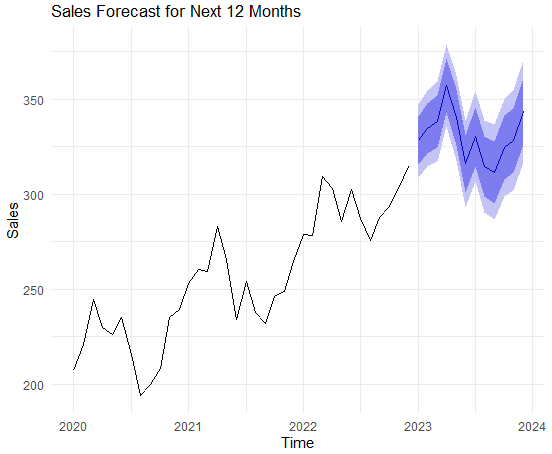
Generate forecasts for the next 12 months.
# Forecast the next 12 months
forecasted_values <- forecast(sarima_model, h=12)
Step 9: Plot the Forecasted Values
Visualize the forecasted values with confidence intervals.
# Plot the forecasted values
autoplot(forecasted_values) +
  ggtitle("Sales Forecast for Next 12 Months") +
  xlab("Time") +
  ylab("Sales") +
  theme_minimal()
Output:
Step 10: Evaluate Model Performance
Check the accuracy of the model's predictions.
# Evaluate model performance
accuracy(forecasted_values)
Output:
                    ME     RMSE      MAE        MPE     MAPE      MASE
Training set 0.3929868 7.156714 4.692756 0.07424912 1.739757 0.1302892
                    ACF1
Training set -0.02246882
Applications and Use Cases of SARIMA
- Sales Forecasting: Businesses use SARIMA to predict future sales based on historical data, helping with inventory management and production planning.
- Weather Forecasting: Meteorologists employ SARIMA to model and forecast temperature, rainfall, and other climate variables, which often exhibit seasonal trends.
- Financial Market Analysis: In finance, SARIMA can analyze and predict stock prices, interest rates, and economic indicators, aiding investment decisions.
- Energy Consumption Forecasting: Utilities use SARIMA to estimate future energy demands, allowing for better resource allocation and grid management.
- Healthcare Data Analysis: SARIMA helps analyze patient admission rates, disease outbreaks, and other healthcare-related time series, aiding in resource planning and management.
Advantages of SARIMA
- Ideal for datasets with clear seasonal patterns.
- Can be customized with different parameters to fit various types of data.
- When properly configured, SARIMA can produce accurate forecasts.
Limitations of SARIMA
- SARIMA may not perform well with datasets that have complex, nonlinear relationships.
- Requires sufficient historical data to effectively model and forecast.
- Can be influenced by outliers, which may distort the forecasts.
Conclusion
SARIMA is a powerful statistical tool for forecasting time series data that exhibit both trends and seasonality. By combining autoregressive and moving average components, along with seasonal adjustments, it offers flexibility and accuracy in modeling complex datasets. Understanding how to implement SARIMA in R enhances the ability to derive insights from time series data, making it an invaluable resource for data analysts, researchers, and business professionals.
