
Reduced Row Echelon Form of a matrix is used to find the rank of a matrix and further allows to solve a system of linear equations. A matrix is in Row Echelon form if
- All rows consisting of only zeroes are at the bottom.
- The first nonzero element of a nonzero row is always strictly to the right of the first nonzero element of the row above it.
Example :
A matrix can have several row echelon forms. A matrix is in Reduced Row Echelon Form if
- It is in row echelon form.
- The first nonzero element in each nonzero row is a 1.
- Each column containing a nonzero as 1 has zeros in all its other entries.
Example:
Where a1,a2,b1,b2,b3 are nonzero elements.
A matrix has a unique Reduced row echelon form. Matlab allows users to find Reduced Row Echelon Form using rref() method. Different syntax of rref() are:
- R = rref(A)
- [R,p] = rref(A)
Let us discuss the above syntaxes in detail:
rref(A)
It returns the Reduced Row Echelon Form of the matrix A using the Gauss-Jordan method.
% creating a matrix using magic(n)
% generates n*n matrix with values
% from 1 to n^2 where every row sum
% is equal to every column sum
A = magic(4);
disp("Matrix");
disp(A);

% Reduced Row Echelon Form of A
RA = rref(A);
disp("rref :");
disp(RA);
Output :
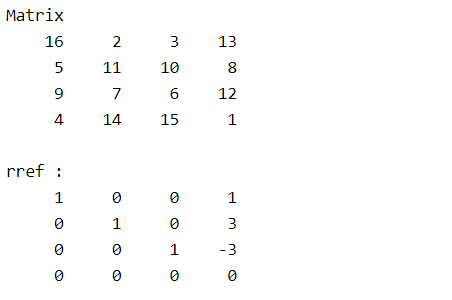
rref(A)
- It returns Reduced Row Echelon Form R and a vector of pivots p
- p is a vector of row numbers that has a nonzero element in its Reduced Row Echelon Form.
- The rank of matrix A is length(p).
- R(1:length(p),1:length(p)) (First length(p) rows and length(p) columns in R) is an identity matrix.
% creating a matrix using magic(n)
% generates n*n matrix with values
% from 1 to n^2 where every row sum
% is equal to every column sum
A = magic(5);
disp("Matrix");
disp(A);

% Reduced Row Echelon Form of A
[RA,p] = rref(A);
disp("rref :");
disp(RA);

% Displaying pivot vector p
disp("Pivot vector");
disp(p);
Output :
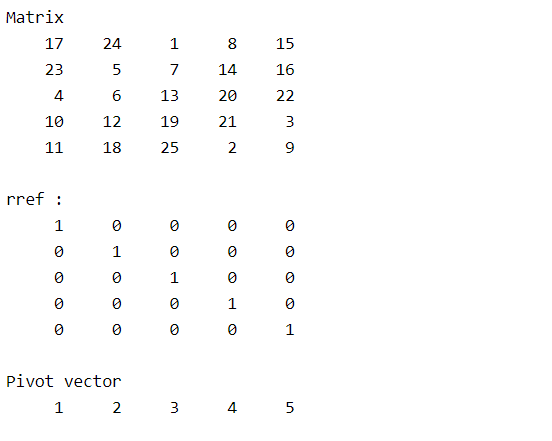
Finding solutions to a system of linear equations using Reduced Row Echelon Form:
The System of linear equations is
Coefficient matrix A is
Constant matrix B is
Then Augmented matrix [AB] is
% Coefficient matrix
A = [1  1  1;
     1  2  3;
     1  4  7];

% Constant matrix
b = [6 ;14; 30];

% Augmented matrix
M = [A b];
disp("Augmented matrix");
disp(M)

% Reduced Row echelon form of
% Augmented matrix
R = rref(M);
disp("rref");
disp(R)
Output :
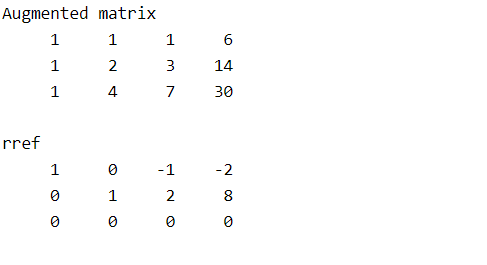
Then the reduced equations are
It has infinite solutions, one can be
