
When designing systems, two popular approaches are Data-Centric and Service-Centric Architectures. Each has its own way of organizing how data and services work together. Understanding these can help you choose the best approach for your project.
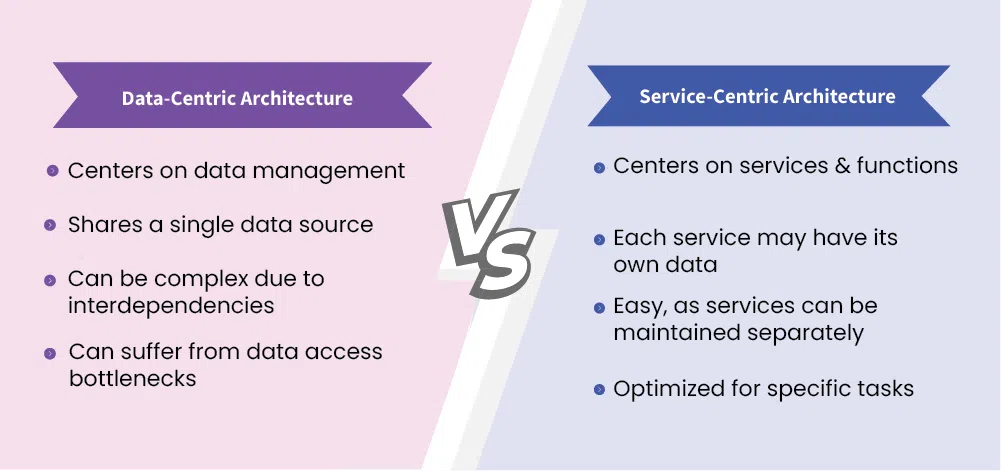
Table of Content
What is Data-Centric Architecture?
Data-Centric Architecture focuses on the data itself. In this model, the main goal is to manage and store data effectively. Applications are built around data, and many services access the same data sources.
- Advantages:
- Since everything is centered around data, it can be simpler to organize and maintain.
- Multiple applications can share the same data, leading to consistency.
- It can handle large volumes of data well.
- Disadvantages:
- It's services may become dependent on the same data, which can cause issues if changes are needed.
- Changing data structures may require updates across many services.
- It has heavy data access can slow down the system if not managed properly.
What is Service-Centric Architecture?
Service-Centric Architecture focuses on creating individual services that perform specific tasks. Each service can manage its own data and functions independently, promoting separation of concerns.
- Advantages:
- Each service can be developed, deployed, and scaled separately, making it more flexible.
- It's changes in one service don’t directly impact others, reducing risk.
- Services can be optimized for specific tasks, improving overall system efficiency.
- Disadvantages:
- Each service might need its own data storage, leading to duplicated data.
- Services need to communicate with each other, which can complicate the system.
- It is keeping data consistent across services can be more difficult
Difference between Data-Centric and Service-Centric Architecture
Below are the differences between data-centric and service-centric architecture:
Feature | Data-Centric Architecture | Service-Centric Architecture |
|---|---|---|
Focus | Centers on data management | Centers on services and functions |
Data Sharing | Shares a single data source | Each service may have its own data |
Maintenance | Can be complex due to interdependencies | Easy, as services can be maintained separately |
Performance | Can suffer from data access bottlenecks | Optimized for specific tasks |
Consistency | Generally easier to maintain consistency | More challenging to keep data consistent across services |
Development Speed | Slower due to interlinked systems | Faster, as teams can work on services independently |
Flexibility | Less flexible due to tight coupling | More flexible with independent services |
Use Cases of Data-Centric Architecture
Below are the use cases of data-centric architecture:
- Data Warehousing: Centralized storage for large volumes of historical data used for reporting and analytics.
- Big Data Analytics: Systems designed to process and analyze vast amounts of data (e.g., Hadoop, Spark).
- Business Intelligence (BI) Tools: Applications that rely heavily on data retrieval and processing to generate insights.
- Data Lakes: Storing raw data in its native format, allowing for flexible analysis and machine learning applications.
- Data Integration: Systems that aggregate data from multiple sources for a unified view (ETL processes).
Use Cases of Service-Centric Architecture
Below are the use cases of service-centric architecture:
- Microservices: Building applications as a suite of small, independent services that can be developed, deployed, and scaled independently.
- API-Driven Development: Creating services that expose APIs for other applications to consume, facilitating interoperability.
- Event-Driven Architecture: Systems that react to events in real-time, often used in IoT and real-time data processing scenarios.
- Cloud-Native Applications: Applications designed to leverage cloud resources, often utilizing containers and orchestration tools.
- Business Process Automation: Services that automate workflows across different applications and systems.
Conclusion
Data-Centric and Service-Centric Architectures have their strengths and weaknesses. Data-Centric focuses on managing data effectively, making it great for consistency. On the other hand, Service-Centric emphasizes flexibility and independent services, which can speed up development.
