
Preparing for a Google System Design interview requires a deep understanding of designing scalable, fault-tolerant, and efficient systems. This article explores key system design concepts, questions, and strategies to help you ace the interview and build scalable solutions across millions of users.

Table of Content
How to Approach Google System Design Questions?
When tackling system design questions in a Google interview, follow a structured approach to demonstrate your ability to design scalable, reliable, and efficient systems. Here’s a step-by-step guide:
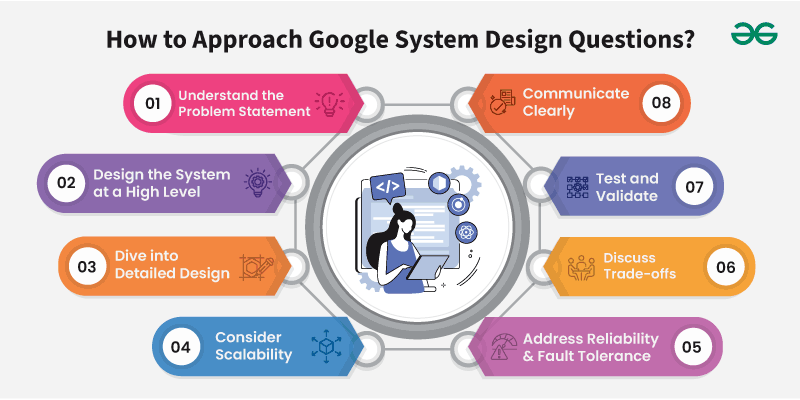
Step 1. Understand the Problem Statement
- Clarify Requirements: Start by asking questions to fully understand the problem. Determine the core requirements, constraints, and goals.
- Define Scope: Establish what features and functionalities need to be included. Clarify any ambiguities with the interviewer.
Step 2. Design the System at a High Level
- Outline Architecture: Sketch a high-level architecture diagram. Identify major components such as clients, servers, databases, and APIs.
- Choose Technologies: Select appropriate technologies and tools for each component based on scalability, reliability, and ease of maintenance.
Step 3. Dive into Detailed Design
- Component Design: Break down the system into smaller components. Define the responsibilities and interactions of each component.
- Data Modeling: Design the schema for databases, specifying how data will be stored, accessed, and managed.
- APIs and Interfaces: Specify how components will communicate with each other. Define API endpoints, data formats, and protocols.
Step 4. Consider Scalability
- Load Handling: Design how the system will handle increased load. Consider strategies such as load balancing, caching, and sharding.
- Vertical vs. Horizontal Scaling: Decide between scaling up (vertical) or scaling out (horizontal) based on the needs of the system.
Step 5. Address Reliability and Fault Tolerance
- Redundancy: Plan for redundancy to ensure system availability in case of component failures. Consider strategies like replication and failover.
- Monitoring and Alerts: Implement monitoring to detect and respond to issues. Set up alerts for critical failures or performance degradations.
Step 6. Discuss Trade-offs
- Trade-offs: Be prepared to discuss trade-offs between different design choices. For example, choosing between consistency and availability in a distributed system.
- Cost Considerations: Address potential cost implications of your design decisions, including infrastructure and maintenance costs.
Step 7. Test and Validate
- Simulate Usage: Discuss how you would test the system under different scenarios. Describe methods for load testing and stress testing.
- Validation: Ensure that the design meets all requirements and can handle real-world usage effectively.
Step 8. Communicate Clearly
- Explain Your Design: Clearly articulate your design choices and rationale. Use diagrams to illustrate your architecture.
- Seek Feedback: Engage with the interviewer, asking for feedback or clarification on any points of your design.
Important Concepts to know for Google System Design Interview Questions
Before diving into the system design interview questions listed below, it’s crucial to familiarize yourself with these key topics:
- Scalability: The ability of a system to grow and manage increased demand by adding more resources, without compromising performance.
- Load Balancing: Distributes incoming network traffic across multiple servers to ensure no single server bears too much load, enhancing availability and reliability.
- Caching: A technique used to temporarily store copies of frequently accessed data in faster storage to reduce access time and server load.
- Content Delivery Network (CDN): A network of servers distributed across various locations that deliver web content to users based on their geographic proximity, improving load times and reliability.
- Database Sharding: A method of partitioning a database into smaller, faster, more manageable pieces (shards) that are distributed across multiple servers to improve scalability and performance.
- Replication: The process of copying and maintaining database or system components across multiple servers to ensure redundancy, fault tolerance, and improved read performance.
- Consistency Models: Defines how consistent data is across distributed systems, ranging from strong consistency (immediate consistency across all nodes) to eventual consistency (eventual alignment across nodes).
- Partitioning: Dividing a system into smaller components, such as splitting a database or a data set into multiple, independent pieces to optimize performance and manageability.
- Message Queues: A communication protocol that allows asynchronous communication between services by queuing messages to be processed later, ensuring system resilience and reliability.
- Microservices Architecture: An architectural style that structures an application as a collection of loosely coupled, independently deployable services, each responsible for a specific functionality.
- API Rate Limiting: A mechanism to control the number of API requests a user or service can make within a specific time frame, ensuring fair usage and protecting system resources.
- Event-Driven Architecture: A software architecture paradigm where system components communicate and react to events (e.g., changes in state or environment) to decouple systems and improve scalability.
- Fault Tolerance: The ability of a system to continue operating properly in the event of a failure of one or more of its components, usually by having redundancy and failover strategies.
Google System Design Interview Questions
Google system design interviews feature challenges like creating scalable platforms, optimizing performance, and managing large-scale systems, testing candidates' skills in building robust and efficient architectures. Below are some main questions that have been asked in Google system design interviews.
Q1. Design Google Maps
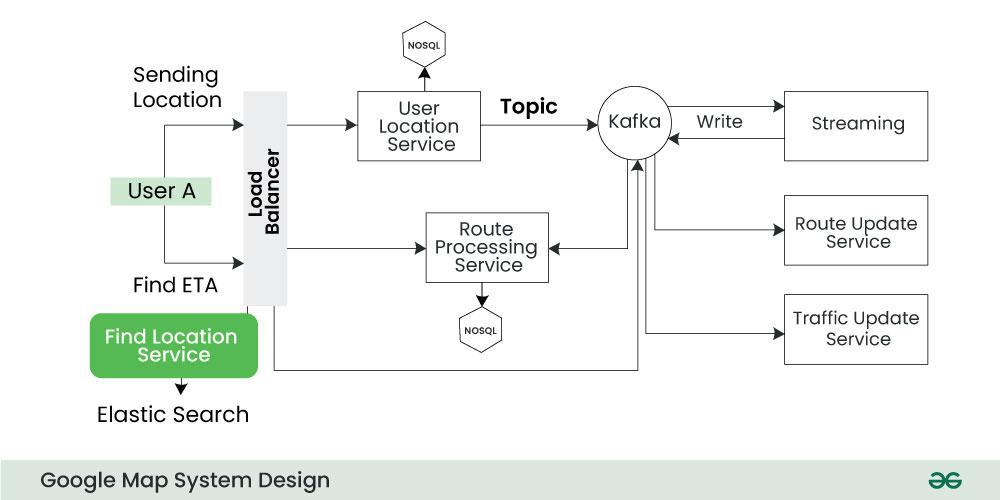
- Requirements for Designing Google Maps:
- Functional:
- Search for locations, display maps.
- Provide optimal routes with distance and travel time.
- Support real-time traffic data for route adjustments.
- Offer turn-by-turn navigation.
- Non-functional:
- High scalability to handle millions of users globally.
- Low-latency responses for route searches and updates.
- High availability, even under failure conditions (e.g., server failures).
- Functional:
- Challenges for Designing Google Maps:
- Real-time data processing: Handling dynamic data like traffic, weather, road closures, etc., in real-time while maintaining low latency.
- Scalability: Processing requests from millions of users simultaneously, often during high-traffic events like holidays.
- Fault tolerance: Ensuring uptime and accuracy during network or server failures.
- Solution for Designing Google Maps:
- Implement a distributed microservices architecture where services like geolocation, route finding, and navigation operate independently.
- Use graph databases (Neo4j or similar) for efficient storage and retrieval of location and route data.
- Caching: Cache frequent route calculations and map tiles for faster access.
- Real-time updates: Integrate with external APIs or a pub/sub system for receiving real-time traffic and weather updates.
- Key Components for Designing Google Maps:
- Geolocation Service: Tracks user location in real-time.
- Route Finder: Calculates optimal paths using algorithms like Dijkstra’s or A*.
- Map Renderer: Displays maps with real-time traffic updates.
- API Gateway: Handles user requests and distributes them to appropriate microservices.
- Load Balancer: Distributes user traffic across different servers for low-latency responses.
Further Read: Link
Q2. Design YouTube’s Video Streaming Service
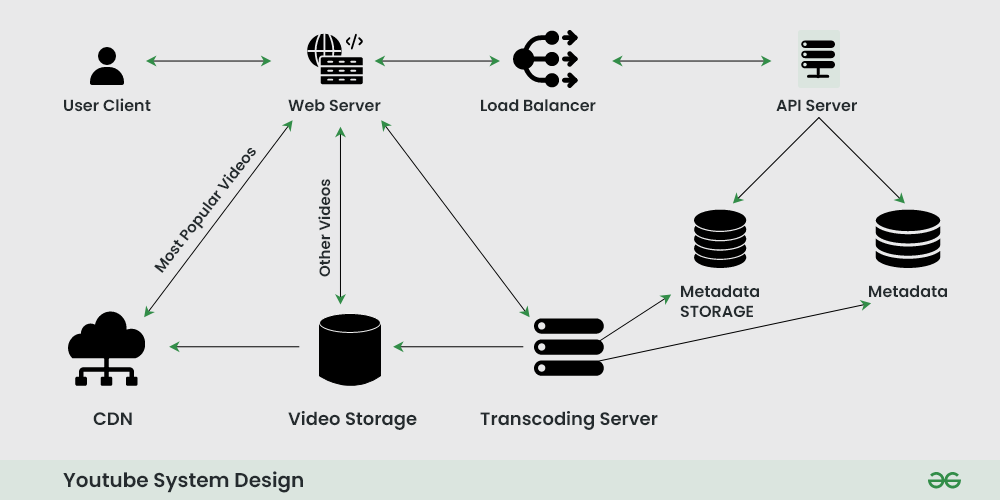
- Requirements for Designing YouTube's Video Streaming Service:
- Functional:
- Upload and stream videos in various formats and resolutions.
- Enable search functionality across a large video library.
- Stream videos with minimal buffering.
- Support for features like video recommendations and comments.
- Non-functional:
- Scalability to handle millions of concurrent users.
- Low-latency video playback and uploads.
- Fault tolerance and availability, especially during peak times.
- Functional:
- Challenges for Designing YouTube's Video Streaming Service:
- Concurrent streaming: Supporting millions of users streaming content concurrently, ensuring minimal latency and high-quality playback.
- Efficient video storage: Storing vast amounts of video content and retrieving it quickly.
- Adaptive streaming: Adjusting video quality in real-time based on network conditions.
- Solution for Designing YouTube's Video Streaming Service:
- Use a Content Delivery Network (CDN) to distribute video streams globally, reducing latency.
- Videos are transcoded into multiple formats and resolutions, and the system serves the most appropriate resolution based on the user's network conditions (using adaptive bitrate streaming).
- Implement distributed storage systems (e.g., HDFS, S3) to store large volumes of videos.
- Metadata indexing and search systems based on a distributed NoSQL database (e.g., Elasticsearch).
- Key Components for Designing YouTube's Video Streaming Service:
- CDN: Caches video data closer to users to ensure fast delivery.
- Video Encoding Service: Converts videos into multiple formats and bitrates.
- Search Service: Retrieves relevant videos based on user queries.
- Metadata Storage: Stores video details (title, description, etc.) in a NoSQL database.
- Streaming Service: Manages video streaming via adaptive bitrate protocols like HLS or MPEG-DASH.
Further Read: Link
Q3. Design a Global File Storage System (DropBox)

- Requirements for Designing Global File Storage System:
- Functional:
- Upload, download, share, and synchronize files globally.
- Access files from multiple devices with version control.
- Non-functional:
- High availability and low latency for file access globally.
- Scalability to support millions of users and petabytes of storage.
- Fault tolerance and security for data protection.
- Functional:
- Challenges for Designing Global File Storage System:
- Consistency vs. availability: Achieving a balance between strong consistency (for critical operations) and high availability.
- Data synchronization: Ensuring real-time synchronization across multiple devices.
- Fault tolerance: Handling hardware failures without data loss.
- Solution for Designing Global File Storage System:
- Data partitioning: Use sharding to split data across multiple regions, reducing access time for users.
- Replication: Implement asynchronous replication to ensure high availability without compromising performance.
- Use eventual consistency for file updates across regions and strong consistency for critical operations like file deletions.
- Key Components for Designing Global File Storage System:
- Distributed File System: Manages file storage across regions.
- Replication: Ensures copies of data are available across different servers for fault tolerance.
- Sharding: Divides large files across multiple servers.
- Synchronization Service: Handles synchronization between devices and regions.
Further Read: Link
Q4. Design a Search Autocomplete System
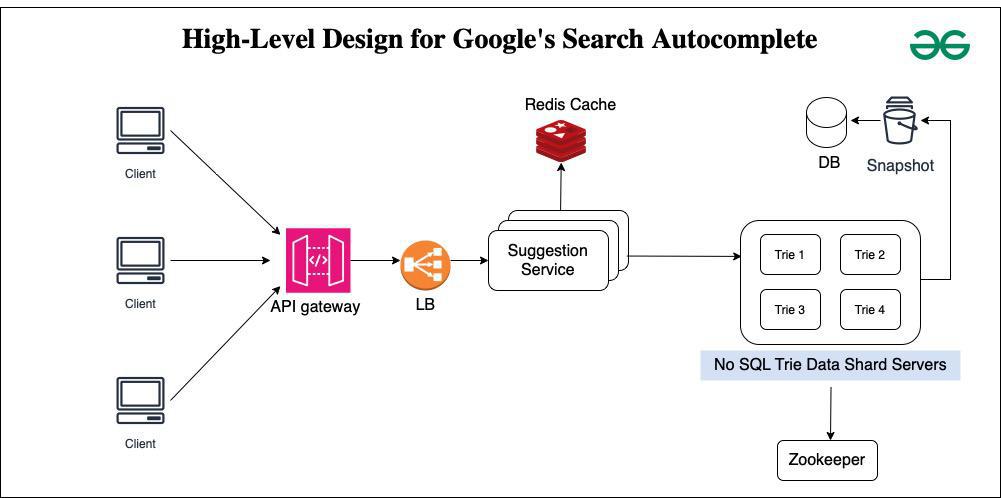
- Requirements:
- Functional:
- Provide suggestions as users type search queries.
- Adapt suggestions based on user history and trending queries.
- Non-functional:
- Low latency for instant results.
- Scalability to handle millions of users concurrently.
- Functional:
- Challenges:
- Latency: The system must generate suggestions quickly as users type.
- Handling concurrent queries: With millions of users typing simultaneously, the system must handle heavy loads.
- Solution:
- Use a Trie (prefix tree) to store and retrieve autocomplete suggestions efficiently.
- Cache popular search queries to reduce the number of lookups required.
- Use a machine learning model to rank suggestions based on user history and popularity.
- Key Components:
- NoSQL Trie Data Servers: NoSQL Trie data servers store the trie data structure used for efficient prefix matching and search.
- Redis Cache System: Caches frequent queries for faster retrieval.
- API Gateway: The API Gateway acts as an entry point for clients to access the autocomplete system.
- Suggestion Service: The suggestion service is the core component responsible for generating autocomplete suggestions based on incoming search queries.
- Load Balancer: Load balancers distribute incoming client requests across multiple instances of the suggestion service to ensure scalability, fault tolerance, and optimal resource utilization.
Further Read: Link
Q5. Design a Distributed Web Crawler

- Requirements:
- Functional:
- Crawl web pages, extract and store content for future use.
- Ensure no duplicate crawling.
- Non-functional:
- High scalability to crawl millions of websites.
- Fault tolerance in case of server failures.
- Functional:
- Challenges:
- Concurrency: Managing thousands of concurrent crawling tasks.
- Deduplication: Avoiding repeated crawling of the same URLs.
- Solution:
- Use a distributed queue system to assign URLs to different crawlers.
- Implement URL deduplication with a hash-based storage to avoid duplicate crawls.
- Store crawled data in a NoSQL database for easy retrieval and processing.
- Key Components:
- Load Balancer: The load balancer distributes incoming requests among multiple web servers to ensure load balancing and fault tolerance.
- Data Storage: Stores crawled data in a scalable NoSQL database.
- Microservices (Crawling Service): The Crawling Service is a microservice responsible for coordinating the crawling process. It consists of three components:
- Processing Service: This component processes the fetched web pages.
- Queue Service: This service manages the queue of URLs to be crawled.
- Cache Layer: This layer caches frequently accessed data to improve performance.
- Monitoring Service: This service monitors the health and performance of web servers, microservices, and databases.
- API Gateway: The API Gateway serves as a central access point for external clients to interact with the microservices.
Further Read: Link
Q6. Design a Rate Limiter for an API
- Requirements:
- Functional:
- The API should allow the definition of multiple rate-limiting rules.
- The API should provide the ability to customize the response to clients when rate limits are exceeded.
- The API should allow for the storage and retrieval of rate-limit data.
- Non-functional:
- Low latency, even under high load.
- Scalability to handle distributed requests.
- Functional:
- Challenges:
- Consistency: Ensuring rate limits are enforced across distributed servers.
- Fairness: Avoiding the overuse of resources by a single user.
- Solution:
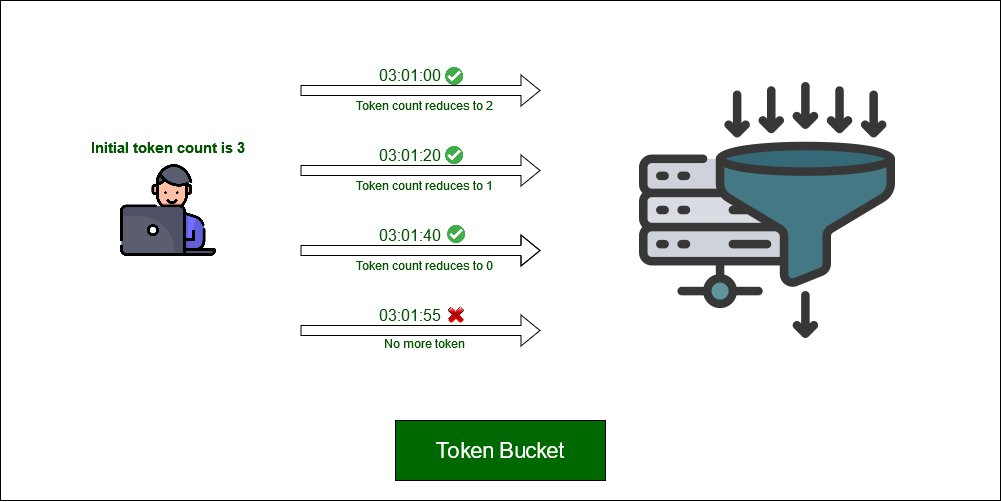
- Implement a Token Bucket algorithm for rate limiting.
- Use Redis for fast, distributed storage of request counts.
- Apply consistent hashing to distribute rate limit enforcement across multiple servers.
- Key Components:
- Token Bucket Algorithm: Limits the number of requests per user.
- Redis Cache: Stores request counts and limits.
- Rate Limiter Middleware: Enforces the rate limits by intercepting requests.
Further Read: Link
Q7. Design a Social Media Platform like Twitter
- Requirements:
- Functional:
- Should be able to post new tweets (can be text, image, video etc).
- Should be able to follow other users.
- Should have a newsfeed feature consisting of tweets from the people the user is following.
- Should be able to search tweets.
- Non-functional:
- High availability with minimal latency.
- Scalability to handle millions of concurrent users.
- Functional:
- Challenges:
- Concurrency: Handling millions of real-time posts and notifications.
- Feed generation: Creating personalized timelines for users with many followers.
- Solution:
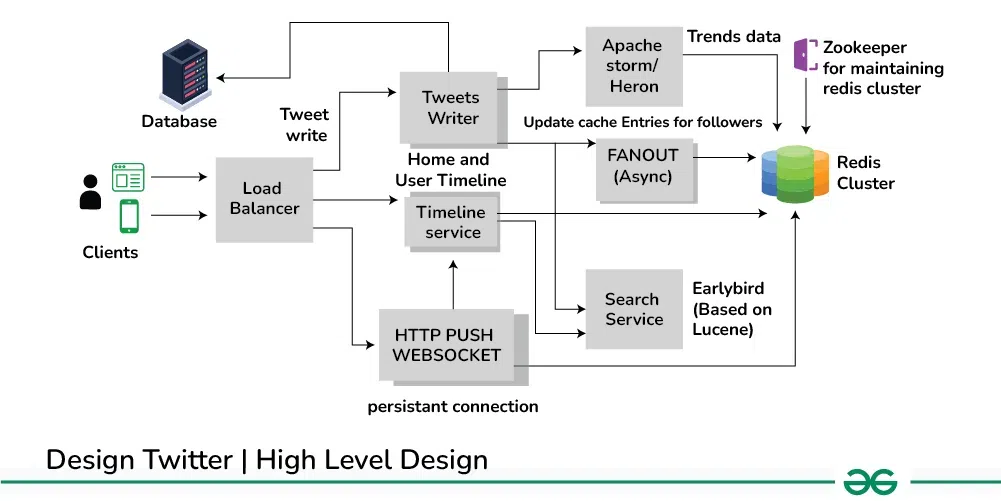
- Use a fan-out system to push posts to user timelines.
- Implement Kafka for handling real-time event-driven communication.
- Use a NoSQL database to store tweets and user interactions.
- Key Components:
- Media Service: This service will handle the media(images, videos, files etc.) uploads.
- Search Service: This service is responsible for handling search related functionality. In search service we get the Top post, latest post etc. These things we get because of ranking.
- Tweet service: The tweet service handle tweet-related use case such as posting a tweet, favorites, etc.
- Fan-out System: Pushes posts to follower timelines.
Further Read: Link
Q8. Design a Traffic Control System
- Requirements:
- Functional:
- Efficiently manage traffic signals based on real-time traffic conditions, such as vehicle flow, pedestrian movement, and congestion.
- Reduce wait times and optimize signal timings for both vehicles and pedestrians.
- Non-functional:
- Scalability to manage traffic data across large urban areas.
- Low-latency processing to make real-time adjustments in high-traffic zones.
- Functional:
- Challenges:
- Real-time data processing: Managing and processing real-time data from multiple sensors to make dynamic signal adjustments.
- Scalability: Handling traffic data across large metropolitan areas with multiple intersections and managing peak hour traffic.
- Solution:
- Implement machine learning models that predict traffic patterns and dynamically adjust signal timings. Use real-time data collected from a distributed network of sensors across intersections to ensure timely decisions.
- Integrate a message queue (e.g., Kafka) to efficiently manage communication between the sensors and the control system, ensuring traffic signals respond quickly to real-time changes.
- Key Components:
- Sensor Network: Collects real-time traffic data such as vehicle counts and pedestrian activity.
- Traffic Signal Controller: Adjusts the traffic signals based on predicted traffic patterns and real-time data.
- Machine Learning Models: Predicts future traffic patterns and adjusts the signal timings accordingly.
- Message Queue: Manages the flow of data between the sensors and the traffic control system to ensure reliable communication.
Q9. Design a Ride-Sharing System (e.g., Uber)
- Requirements:
- Functional:
- Match riders with available drivers based on proximity.
- Provide estimated time of arrival (ETA) and route navigation.
- Handle payments securely and manage surge pricing during peak demand.
- Non-functional:
- Low-latency real-time updates for both riders and drivers.
- Scalability to handle millions of users and ride requests globally.
- Functional:
- Challenges:
- Real-time matching: Efficiently matching riders and drivers in real-time based on proximity and vehicle type.
- Surge pricing: Handling demand spikes during peak hours and efficiently managing pricing adjustments.
- Solution:
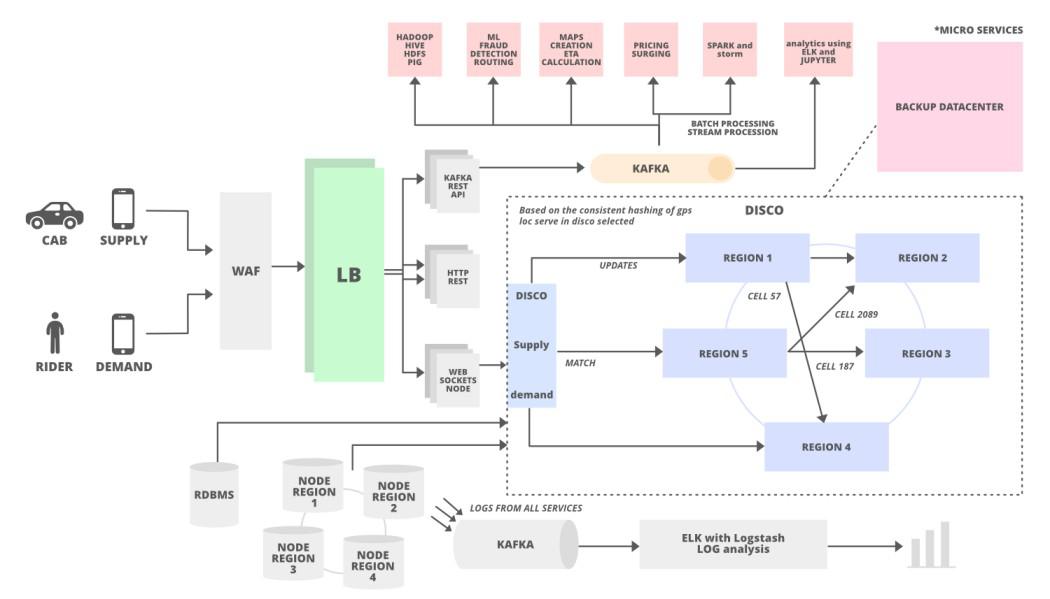
- Use geohashing to segment geographical areas and efficiently match riders with drivers based on proximity. Implement an event-driven communication system using Kafka to handle real-time updates such as ride confirmations and ETA adjustments.
- For payments, integrate secure gateways and encrypt transactions to ensure safe and reliable processing.
- Key Components:
- Geospatial Indexing: Matches riders with nearby drivers using geographic data.
- Real-time Tracking: Updates the location of both riders and drivers during the trip.
- Load Balancer: Distributes ride requests across available servers to ensure smooth operation.
- Payment Gateway: Handles secure payment processing and transactions.
- Message Queue: Manages the communication between riders, drivers, and the central system to provide real-time updates.
Further Read: Link
Tips and Tricks for Tackling Google System Design Interview
Here are some essential tips and tricks for tackling system design questions in interviews:
- Clarify Requirements: Ask questions to understand the problem's scope and requirements before diving into solutions.
- Break Down the Problem: Divide the system into smaller components, focusing on major functionalities and interactions.
- Consider Scalability: Design for scalability from the start, considering how the system will handle growth in users and data.
- Choose Appropriate Technologies: Select technologies and tools that fit the problem’s needs, such as databases, caching mechanisms, and load balancers.
- Use Design Patterns: Apply relevant design patterns to solve common problems efficiently, like using Singleton for global instances or Observer for event handling.
- Think About Data Flow: Map out how data will flow through the system, including storage, retrieval, and processing.
- Prioritize Trade-offs: Understand and discuss trade-offs between consistency, availability, and partition tolerance (CAP theorem) or other relevant concerns.
- Plan for Failures: Incorporate fault tolerance and redundancy to ensure the system remains robust under failures.
- Optimize Performance: Consider performance aspects, such as caching strategies, indexing, and load balancing, to enhance system efficiency.
- Communicate Clearly: Articulate your design decisions and reasoning clearly, and be prepared to iterate based on feedback or new requirements.
By following these tips, you can approach system design questions methodically and demonstrate your problem-solving skills effectively.
