
A serverless architecture is a cloud computing execution model that allows the cloud provider to dynamically control server provisioning and allocation. Since cloud providers handle the underlying infrastructure-including scaling, maintenance, and provisioning-developers may concentrate entirely on code with this method.
- The cloud provider automatically executes the code in stateless compute containers that are event-triggered, and fully managed by the provider.
- Developers are unaware of the complexity of operating these servers, which includes capacity planning, scaling, and server maintenance.
Serverless Computing Providers and Platforms
Serverless computing has become a key focus for cloud providers, offering platforms tailored to different development needs. Some of the leading serverless platforms and providers are.
- AWS Lambda: Without having to provision or manage servers, developers may use AWS Lambda, perhaps the most well-known serverless computing tool, to execute code in response to events from more than 200 AWS services and SaaS apps.
- Azure Functions: With Azure Functions, a serverless compute solution from Microsoft, you can execute event-triggered code without explicitly provisioning or managing infrastructure. Azure Functions easily connects with other Azure services and supports a large number of programming languages.
- Google Cloud Functions: This is the serverless execution environment used by Google to create and link cloud services. All you have to do with Google Cloud Functions is write your code; Google handles the management, scaling, and underlying infrastructure.
- Oracle Cloud Functions: Using functions that are triggered by HTTP requests or events coming from Oracle Cloud services, developers can create apps with Oracle's serverless architecture. It is intended to provide an integrated cloud experience by integrating easily with Oracle's existing cloud products.
Steps for Developing Serverless Applications
Because serverless architecture is different from typical software development, creating serverless apps requires a different methodology. The following are the primary steps and factors to take into account while building serverless applications:
Step 1: Understand the Serverless Model
Applications with unpredictable traffic and microservices architecture, which divides applications into smaller, independent components, are especially well-suited for event-driven applications, microservices, cron jobs, and lightweight APIs.
Step 2: Choose the Right Provider
Select a serverless provider that aligns with your application’s requirements and ecosystem.
- Evaluate supported languages, integrations, and provider-specific features
- Compare cost, performance, and cold start behavior across providers
- Major providers include AWS Lambda, Azure Functions, Google Cloud Functions, and others discussed previously.
Step 3: Designing Your Application
Serverless applications should be designed to maximize the benefits of the serverless execution model:
- Event-driven: Design components to respond to events (e.g., HTTP requests, file uploads, database events).
- Statelessness: Ensure that functions are stateless and independent. Use external services for maintaining state, such as databases or cloud storage.
- Microservices-oriented: Decompose application functionality into small, independent units that can be deployed, scaled, and updated independently.
Step 4: Development Environment Setup
Set up your development environment:
- Use frameworks and tools like the Serverless Framework, AWS SAM (Serverless Application Model), or Azure Functions Core Tools to simplify deploying and managing serverless applications.
- Configure local testing and simulation tools to mimic the cloud environment and reduce deployment cycles during development.
Step 5: Implementing Functions
Develop serverless functions that handle specific tasks and respond to defined events.
- Write small, single-purpose functions triggered by events
- Integrate managed services for databases, authentication, and storage to offload infrastructure responsibilities.
Step 6: Managing Dependencies
Only include necessary libraries and dependencies to keep the deployment package size small, which can improve cold start performance.
Step 7: Deployment and Continuous Integration
Automate deployment using CI/CD pipelines that integrate with your serverless platform. Tools like GitHub Actions, Jenkins, or CircleCI can be configured to deploy directly to serverless environments.
Serverless Application Design Patterns
Serverless architecture has introduced a variety of design patterns that help solve specific problems in the serverless environment efficiently. Here are some of the most common serverless application design patterns:
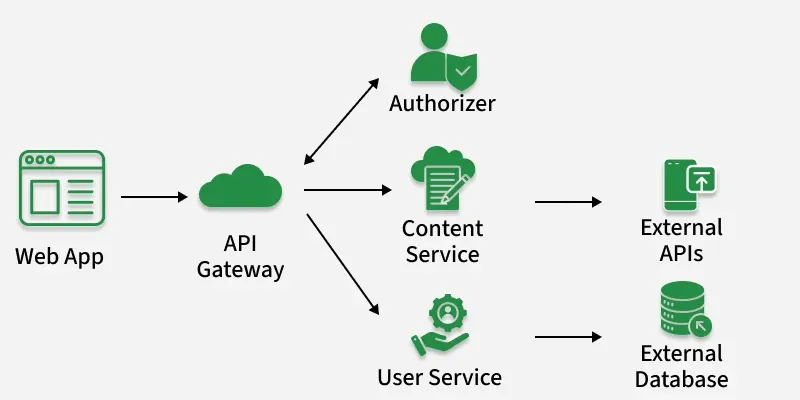
API Gateway Pattern (Serverless Integration)
A serverless function acts as a gateway to route incoming requests to backend services.
- Handles HTTP requests, performs initial processing, and forwards them to appropriate services.
- Commonly used to build lightweight API gateways.
Event Stream Processing
Responding to data streams like logs, financial transactions, or social media feeds is a good fit for serverless functions.
- In this architecture, streams of events trigger functions that process each event separately.
- This is helpful in situations like logging, real-time data analytics, and processing data from the Internet of Things.
Aggregator
A serverless function aggregates data from multiple services or functions.
- Collects and combines responses from different sources.
- Returns a unified response, often used in microservices-based systems.
Strangler Fig Pattern
This pattern helps migrate legacy systems to serverless gradually.
- New features are implemented using serverless functions.
- Legacy components are slowly replaced without a full rewrite.
Circuit Breaker
The circuit breaker pattern prevents cascading failures in a serverless system by stopping repeated failed function calls.
- Breaks the function invocation chain after a predefined failure threshold.
- Allows the system to continue operating in a degraded but stable state.
Scaling and Performance Considerations
Scaling and performance are crucial in serverless architectures, enabling applications to handle varying loads automatically without manual intervention.
1. Scaling in Serverless Computing
Scaling in serverless computing automatically adjusts resources based on incoming workload without manual intervention.
- Automatic Scaling: Serverless platforms automatically scale the execution units (functions) based on the incoming request or event rate.
- Cold Starts: A significant concern in serverless environments is the latency introduced by cold starts, when a new instance of a function is initialized. Languages like Python and Node.js typically have faster cold start times compared to JVM-based languages.
- Throttling: Cloud providers often impose limits on the rate at which functions are invoked. If the incoming requests exceed these limits, throttling can occur, leading to delayed processing unless properly managed with strategies such as retry mechanisms or increased concurrency limits.
2. Performance Optimization Strategies
Performance optimization strategies focus on reducing latency and improving execution efficiency in serverless applications.
- Optimize Function Code: Keeping the function code lean and efficient is vital. This includes minimizing dependencies and using asynchronous programming models where appropriate.
- Manage Dependencies: Reducing the size of deployment packages by trimming unnecessary libraries and files can decrease initialization times, especially important for languages with larger runtime environments.
- Persistent Connections: When integrating with databases or other services, using persistent connections (like keeping a database connection open across multiple invocations) can reduce connection overhead.
Security Best Practices for Serverless Architectures
Here are some best practices to enhance security in serverless environments:
1. Least Privilege Principle
Follow strictly to the principle of least privilege (PoLP). Only the permissions required to carry out its function should be granted to each serverless function. In the event of a security compromise, this reduces the possible harm.
2. Secure Application Secrets
Sensitive data should never be exposed directly in code or configuration.
- Avoid hard-coding API keys, tokens, or credentials.
- Use managed secret services (e.g., cloud secret managers).
3. Input Validation
Validating input helps protect serverless functions from common attacks.
- Prevents SQL injection, XSS, and command injection.
- Especially important as functions often access databases directly.
4. Secure API Gateway
Enable security features like rate limiting, authentication, and CORS policies if you're using an API gateway. Use IAM permissions, API keys, or OAuth to manage access to your API endpoints.
5. Encryption
Turn on encryption both in transit and at rest.
- Encrypt database connections, use HTTPS for serverless APIs, and make sure data storage providers are set up to encrypt data while it's in storage.
- By doing this, data exposure to unauthorized parties is less likely to occur.
Use Cases
Some of the use cases of Serverless Architecture are:
- Chatbots and Virtual Assistants: Serverless architecture, which controls user interactions through voice interfaces or messaging systems, makes it possible to swiftly construct and deploy chatbots and virtual assistants.
- Real-time Data Processing: Without requiring infrastructure management, serverless functions can analyze streaming data from several sources, providing real-time analytics, monitoring, and alerting.
- Web and Mobile Backends: Serverless backends provide a cost-effective and scalable solution for web and mobile applications, handling authentication, database interactions, and API requests.
- Scheduled Tasks and Cron Jobs: Serverless functions can be triggered on schedules, automating tasks such as data backups, report generation, and periodic maintenance.
Challenges
Challenges of Serverless Architecture are:
- Cold Start Latency: Serverless functions may experience latency when they're invoked for the first time or after being idle for a period, known as "cold starts," impacting response times for sporadically accessed functions.
- Limited Execution Environment: Serverless platforms impose constraints on available resources, such as memory, execution time, and language support, which may limit the types of applications or workloads that can be effectively run in a serverless environment.
- Debugging and Monitoring Complexity: Traditional debugging and monitoring tools may not be directly applicable to serverless architectures, requiring new approaches and tools to effectively monitor and debug functions distributed across a dynamic and event-driven environment.
- State Management: Serverless functions are typically stateless, which can complicate state management and persistence, requiring external services or workarounds for maintaining application state across invocations.
- Security and Compliance Challenges: Serverless architectures introduce new security challenges, such as securing function endpoints, managing access control, and ensuring compliance with regulatory requirements, which may require additional effort and expertise to address effectively.
