

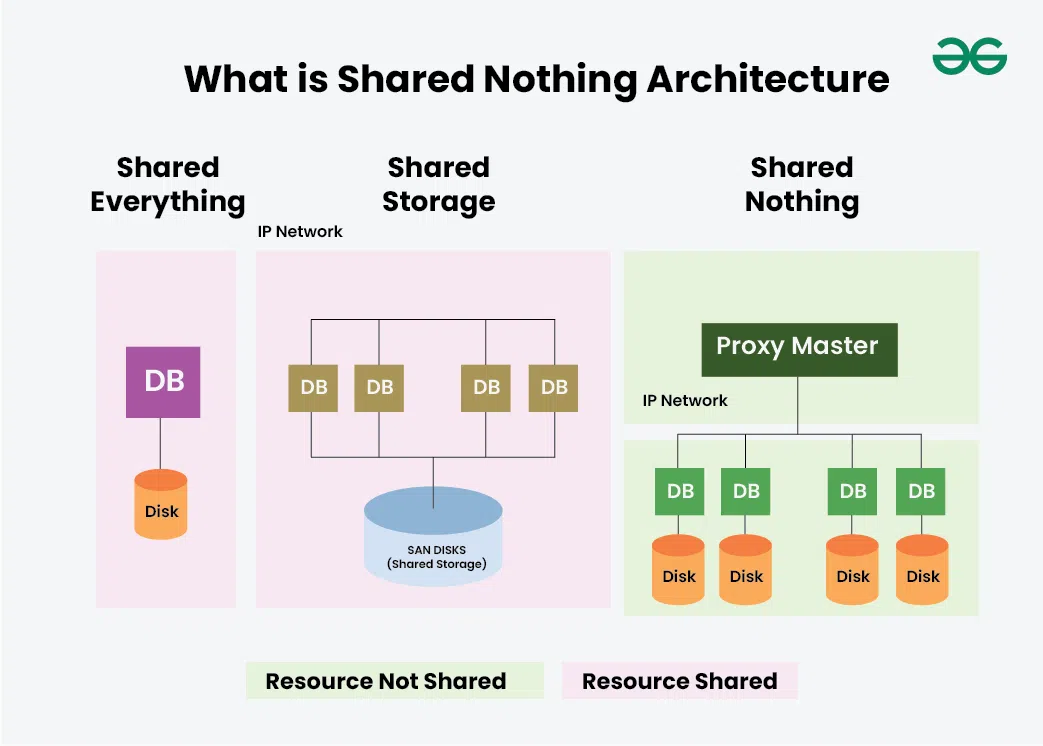
Shared Nothing Architecture (SNA) is a distributed computing architecture in which each node operates independently with its own memory and storage. Nodes communicate only through a network, eliminating shared resources and reducing system bottlenecks.
- Each node manages its own resources without sharing memory or storage with other nodes.
- New nodes can be added easily, and failures in one node do not directly affect others.
Example: A large e-commerce platform distributes customer data and transactions across multiple servers. If one server fails, the remaining servers continue operating, ensuring high availability and performance.
Characteristics
- Independence: Each node operates independently with its own memory and storage. Nodes communicate with each other only through network protocols.
- Scalability: The architecture supports horizontal scaling by adding new nodes. Each node contributes additional storage and processing power.
- Fault Isolation: Failures are isolated to individual nodes and do not directly affect other nodes. This improves system availability and resilience.
- Data Distribution: Data is distributed across multiple nodes using partitioning or sharding techniques. Each node manages a specific subset of data.
- Parallel Processing: Multiple nodes can process tasks simultaneously on different data partitions. This significantly improves performance for large-scale applications.
Importance
Shared Nothing Architecture (SNA) plays a significant role in system design, especially for distributed systems, due to its various advantages and impact on performance, scalability, and reliability.
- Scalability: Systems can be scaled easily by adding new nodes without major architectural changes. Each node adds its own storage and computing resources.
- Performance: Workloads can be distributed across multiple nodes for parallel processing. This improves performance and reduces resource contention.
- Reliability and Fault Tolerance: The failure of one node does not impact the operation of other nodes. This ensures high availability and system reliability.
- Maintenance and Manageability: Individual nodes can be upgraded, maintained, or replaced independently. This reduces downtime and simplifies system management.
- Cost-Effectiveness: Organizations can start with fewer nodes and expand as demand grows. This helps optimize infrastructure costs and resource utilization.
- Flexibility: Different system components can be developed, tested, and deployed independently. This supports faster development and easier system updates.
Components
Shared Nothing Architecture (SNA) is structured to maximize independence and parallelism among nodes in a distributed system. Here are the key components that typically make up an SNA system:
- Nodes: Each node is an independent server with its own CPU, memory, and storage. Nodes operate separately without sharing resources.
- Data Partitioning: Data is divided into smaller partitions (shards) and distributed across multiple nodes. Each node manages a specific subset of the data.
- Network Communication: Nodes communicate through network protocols such as TCP/IP. This enables coordination, data exchange, and system consistency.
- Replication and Redundancy: Data is replicated across multiple nodes to improve availability and fault tolerance. Replication can be synchronous or asynchronous based on requirements.
- Load Balancing: Load balancers distribute requests evenly across nodes. This prevents bottlenecks and ensures efficient resource utilization.
- Distributed Query Processing: Queries are divided into smaller tasks and processed by multiple nodes in parallel. The results are then combined and returned to the client.
Challenges
Although Shared Nothing Architecture (SNA) offers high scalability and reliability, it introduces challenges in data partitioning, consistency, network communication, and system management.
- Architectural Complexity: Designing an SNA system involves complex architectural decisions, such as data partitioning, network communication, and fault tolerance mechanisms.
- Implementation Overhead: Implementing these designs requires sophisticated algorithms and robust infrastructure, which can be time-consuming and resource-intensive.
- Network Partitions: Handling network partitions (situations where nodes cannot communicate with each other) and ensuring the system remains operational is a significant challenge.
- Balanced Data Distribution: Ensuring that data is evenly distributed across nodes to prevent hotspots (nodes with disproportionately high loads) requires effective sharding strategies.
- Dynamic Load Balancing: Dynamically balancing the load across nodes as workloads fluctuate can be difficult to achieve without impacting performance.
Use Cases
Shared Nothing Architecture (SNA) finds applications across various domains where scalability, reliability, and performance are crucial.
- Distributed Databases: SNA is used in distributed databases to manage large datasets across multiple nodes, enabling horizontal scalability and high availability.
- Parallel Query Processing: Multiple nodes process different parts of a query simultaneously, improving performance for large-scale data operations.
- Content Delivery Networks (CDNs): SNA helps CDNs store and deliver content from distributed edge nodes, reducing latency and improving user experience.
- Cloud Computing Platforms: Cloud providers use SNA to deliver scalable compute, storage, and database services while efficiently managing resources.
- Microservices Architecture: SNA distributes microservices across independent nodes, improving scalability, fault isolation, and system reliability.
