
Web applications handle data in two main ways: non-real-time, where updates occur only when the client requests them, and real-time, where information is delivered instantly as it changes. Choosing the right communication protocol is important for performance and user experience.
- HTTP is used for non-real-time communication where the client requests data when needed.
- WebSocket is used for real-time communication where data is delivered instantly between client and server.
HTTP
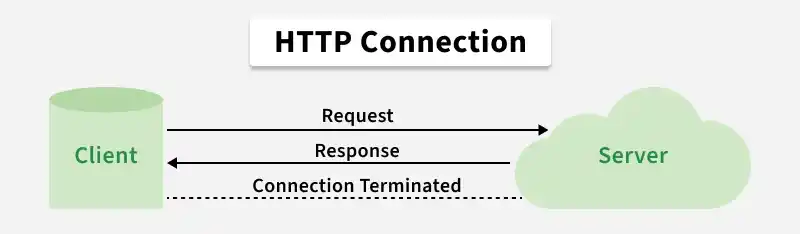
HTTP follows a request-response model where the connection closes after each request. It’s simple and reliable but not ideal for real-time updates.
- Each request carries full HTTP headers, which increases overhead especially for frequent updates.
- Suitable for traditional web applications where instant updates are not critical, as it is stateless and transactional.
Example: A news website fetching the latest headlines every 10 seconds using standard HTTP requests.
Normal HTTP Flow (When we visit a webpage)
WebSocket
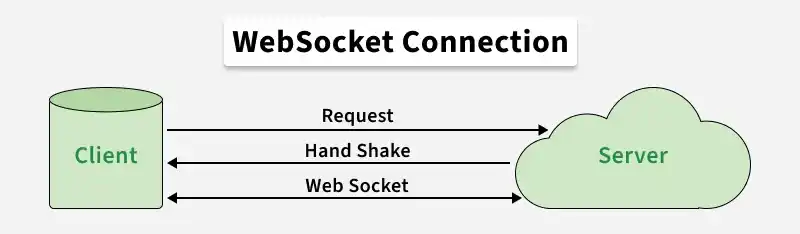
WebSocket enables persistent, full-duplex communication between client and server for real-time data exchange. Unlike polling methods, it maintains a continuous connection, making it more efficient for frequent and instant updates.
- Keeps the connection open to enable continuous two-way communication between client and server.
- Reduces overhead by exchanging only message data, making it ideal for live chat, online games, and stock tickers.
Example: A chat application where messages appear instantly on both client and server without new HTTP requests.
WebSocket Flow (When we use a web chat based application)
Woking
WebSocket enables real-time, full-duplex communication by upgrading a standard HTTP connection. Here’s the flow:
- Connection Initiation: The client sends an HTTP request with the header
Upgrade: websocketto request a protocol switch. - Handshake: The server responds with
101 Switching Protocolsto confirm the upgrade to WebSocket. - Persistent Connection: The connection switches from HTTP to WebSocket, remaining open for continuous communication.
- Full-Duplex Communication: Both client and server can send messages independently at any time without initiating new requests.
- Data Frames: Messages are transmitted as frames (text or binary), allowing efficient and structured data exchange.
- Low Overhead: Only message data is exchanged; HTTP headers are not repeated, reducing bandwidth usage.
- Keep-Alive: The connection stays active until either the client or server explicitly closes it.
- Close Handshake: One side sends a close frame, the other acknowledges, and then the TCP connection is terminated gracefully.
Applications
WebSocket is widely used in applications requiring real-time, low-latency, bidirectional communication. Common use cases include:
- Instant Messaging & Chat Apps: WhatsApp Web, Slack, Facebook Messenger – keep messages in sync between devices instantly.
- Collaborative Tools: Google Docs – real-time collaborative editing where changes appear immediately for all users.
- Video Conferencing & Live Collaboration: Zoom, Microsoft Teams – live presence indicators, chat messages, and interactive meeting controls.
- Financial & Trading Platforms: TradingView – real-time updates of stock, crypto, and forex prices.
- Live Location & Ride-Tracking Services: Uber – updates driver location and ride status in real time.
- Online Multiplayer Games: Many browser-based games use WebSockets to provide low-latency interactions between players.
Limitations
WebSocket is ideal for real-time, continuous data streams, but it is not always the best choice.
- Use WebSocket for live updates, continuous feeds, or interactive applications that require near real-time communication.
- Use HTTP for one-time requests or infrequently accessed data, such as fetching historical records or static content.
- WebSocket keeps connections open, which can increase server resource usage.
- Choosing the right protocol ensures better performance and avoids unnecessary overhead.
HTTP Vs WebSocket Connection
HTTP is a stateless protocol over TCP (connection-oriented, reliable via retransmission), while WebSocket is a stateful, full-duplex, bidirectional protocol.
| HTTP | WebSocket |
|---|---|
| Stateless; connection closes after each request | Persistent; connection stays open until closed |
| Request-response only | Full-duplex; client and server can send anytime |
| Higher overhead due to repeated headers | Low overhead; only message data is exchanged |
| Higher latency for frequent updates | Low latency; near real-time updates |
| Used for standard web pages, APIs, forms | Used for live chat, online games, stock tickers, dashboards |
Note: Depending on your project you have to choose where it will be WebSocket or HTTP Connection.
