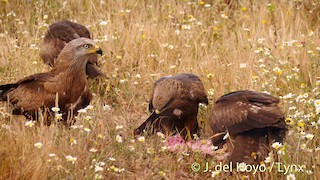

Black Kite Milvus migrans Scientific name definitions
- Names (79)
- Subspecies (7)
Revision Notes
Sign in to see your badges
Species names in eBird-supported languages
| Language | Common name |
|---|---|
| Afrikaans | Swartwou |
| Albanian | Huta e zezë bishtgërshërë |
| Arabic | حِدَأةٌ سَوْدَاء |
| Armenian | Սև ցին |
| Assamese | চিলনী |
| Asturian | Milán prietu |
| Azerbaijani | Qara çalağan |
| Bangla | ভুবন চিল |
| Bangla (Bangladesh) | ভুবন চিল |
| Bangla (India) | চিল |
| Basque | Miru beltza |
| Bulgarian | Черна каня |
| Catalan | milà negre |
| Chinese | 黑鳶 |
| Chinese (Hong Kong SAR China) | 黑鳶 |
| Chinese (SIM) | 黑鸢 |
| Croatian | crna lunja |
| Czech | luňák hnědý |
| Danish | Sort Glente |
| Dutch | Zwarte wouw |
| English | Black Kite |
| English (AVI) | Black Kite |
| English (Philippines) | Black Kite |
| English (United States) | Black Kite |
| Estonian | must-harksaba |
| Faroese | Svartgleða |
| Finnish | haarahaukka |
| French | Milan noir |
| Galician | Miñato negro |
| Georgian | ძერა |
| German | Schwarzmilan |
| Greek | Τσίφτης |
| Gujarati | સમડી |
| Hebrew | דיה שחורה |
| Hindi | चील |
| Hungarian | Barna kánya |
| Icelandic | Vatnagleða |
| Indonesian | Elang paria |
| Italian | Nibbio bruno |
| Japanese | トビ |
| Kannada | ಕಪ್ಪು ಹದ್ದು |
| Kashmiri (India) | گانٛٹھ |
| Kazakh | Қара кезқұйрық |
| Konkani | घोण |
| Korean | 솔개 |
| Kyrgyz | Айры куйрук |
| Ladakhi | ཁ་ཏ། |
| Latvian | Melnā klija |
| Lithuanian | Juodasis peslys |
| Malayalam | ചക്കിപ്പരുന്ത് |
| Manipuri | Umaibi amubi |
| Marathi | घार |
| Mongolian | Сохор элээ |
| Nepali (India) | कालो चील |
| Nepali (Nepal) | कालो चील |
| Norwegian | svartglente |
| Odia | ମାଟିଆ ଚିଲ |
| Persian | کورکور سیاه |
| Polish | kania czarna |
| Portuguese (Angola) | Milhafre-preto-comum |
| Portuguese (Brazil) | milhafre-preto |
| Portuguese (Portugal) | Milhafre-preto |
| Punjabi (India) | ਇੱਲ |
| Romanian | Gaie neagră |
| Russian | Чёрный коршун |
| Serbian | Crna lunja |
| Slovak | haja tmavá |
| Slovenian | Črni škarnik |
| Spanish | Milano Negro |
| Spanish (Spain) | Milano negro |
| Swedish | brun glada |
| Tajik | Колхоти сиёҳ |
| Tamil (India) | கரும்பருந்து |
| Telugu | నల్ల గ్రద్ద |
| Thai | เหยี่ยวดำ/เหยี่ยวหูดำ |
| Turkish | Kara Çaylak |
| Ukrainian | Шуліка чорний |
| Welsh | barcud du |
| Zulu | unhloyile |
Revision Notes
In this revision, Tim S. David revised the sections that comprise the Systematics page (Geographic Variation, Subspecies, Related Species, Nomenclature, and Fossil History).
Milvus migrans (Boddaert, 1783)
Definitions
- MILVUS
- milvus
- migrans
The Key to Scientific Names
Legend Overview
Full content is available exclusively to Birds of the World subscribers. Sign in Learn more
Introduction
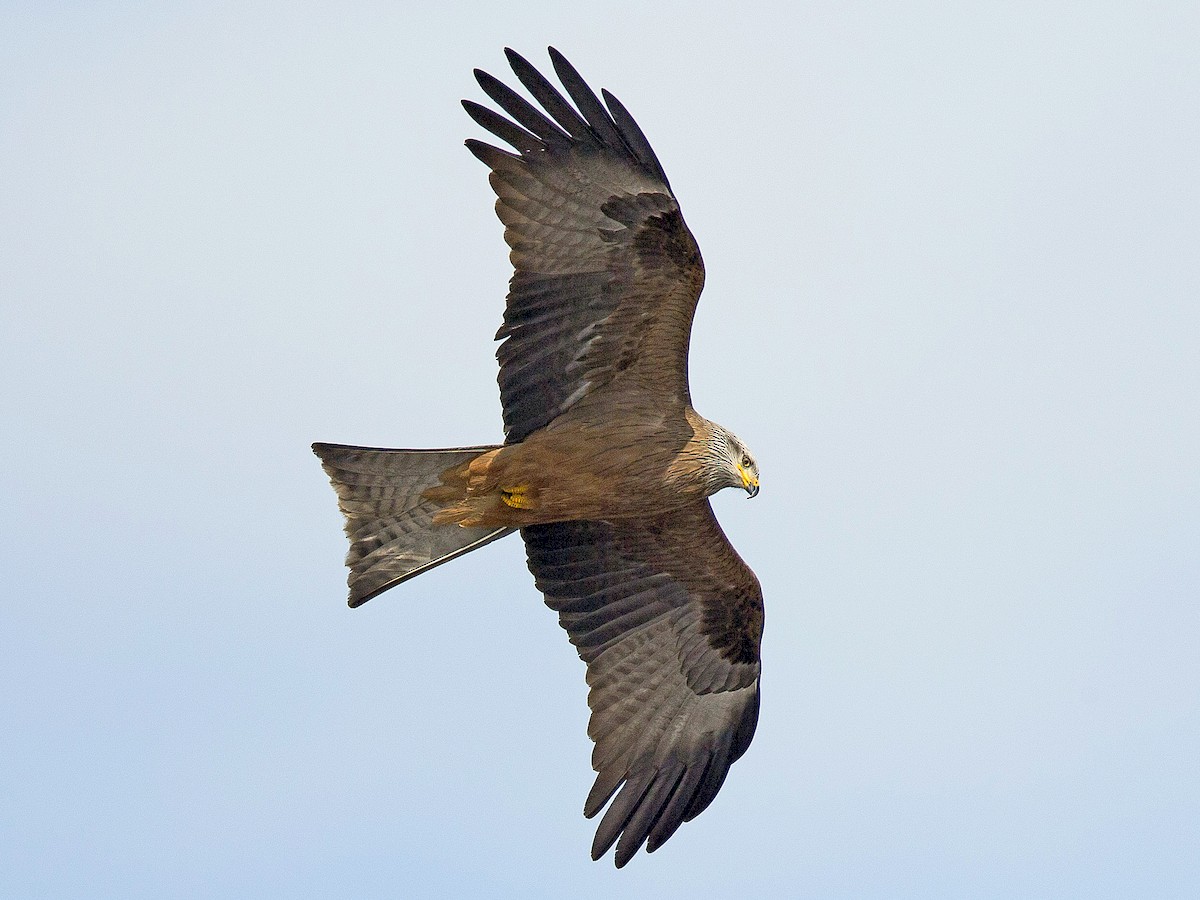
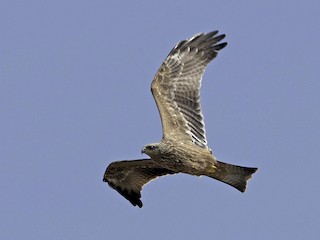
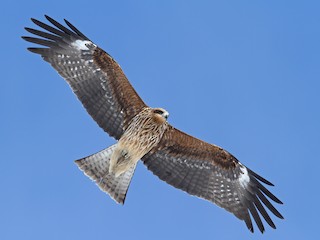
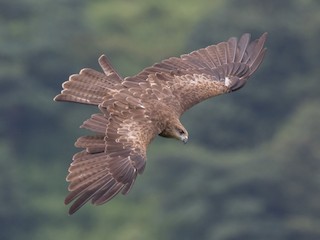
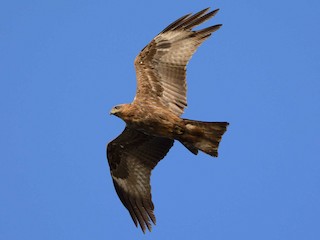
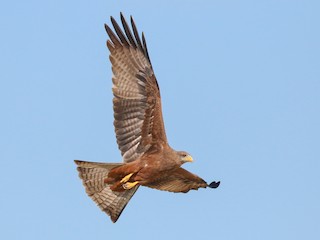
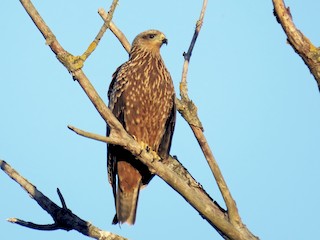
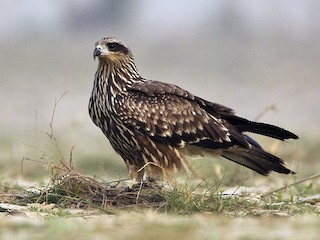
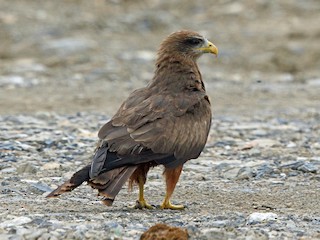
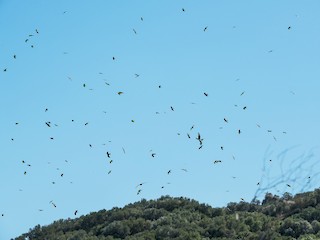
The Black Kite is widespread throughout Europe, Asia, Africa, and Australia, and is one of the most common raptors in many areas where it occurs. The species exhibits extensive geographic variation, and may actually represent multiple species, as it appears that the Red Kite (Milvus milvus) may be more closely related to some groups of Black Kite than other groups of Black Kite (1, 2). Some populations of Black Kite are highly migratory, with incredible numbers recorded migrating past Gibraltar between Europe and Africa. Black Kite feeds on a wide variety of prey items, including small mammals, birds, reptiles, amphibians, fish, and invertebrates, and is very closely associated with humans in many places, where it often feeds at garbage dumps and will also steal food from markets. Due to their extensive distribution, they have a highly variable breeding season. They often nest in trees, with females doing most of the incubation, while males bring most of the food. Because of their adaptability to human modified landscapes, they face no immediate conservation concerns, and in many places their populations have increased dramatically.
Subspecies
Black Kite (Black) Milvus migrans [migrans Group]
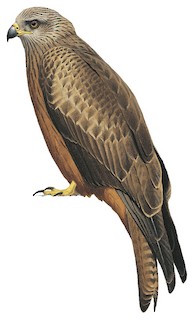
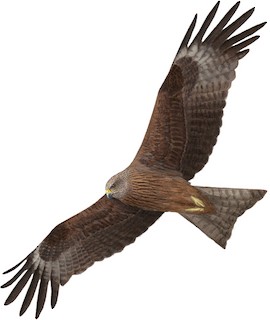
Milvus migrans migrans Scientific name definitions
Systematics History
Distribution
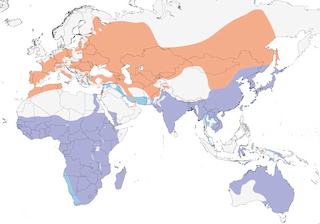
Cape Verde Islands, northwestern Africa, and southern and central Europe east to southwestern Asia (to western Pakistan); winters mainly Africa south of the Sahara.
Field Identification
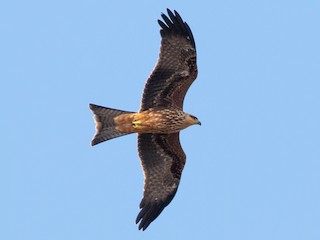
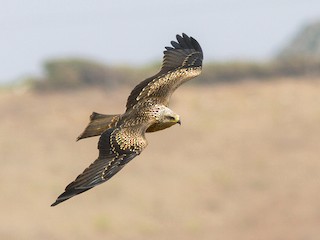
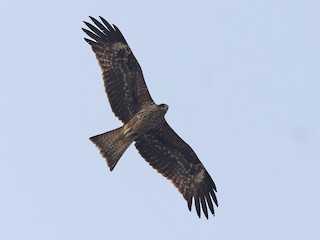
Brown overall with fine black streaks, lower body sometimes tinged rufous. Gray head with diffuse mask behind eyes. Pale diagonals on upperwing. Subtle pale gray panel on underwing. Light iris; yellow feet. Tail fork 20–35 mm (3). There is much individual variation within this subspecies, with some birds being more rufous or darker brown than most others (10).
Birds from northwestern Africa have been separated as reichenowi based on their smaller size, but this subspecies is no longer recognized. Some birds in the Middle East are very brightly colored, possibly due to environmental conditions, and thus look similar to Red Kite (4). These birds are provisionally assumed to be a local rufous morph of nominate.
Milvus migrans migrans (Boddaert, 1783)
Definitions
- MILVUS
- milvus
- migrans
The Key to Scientific Names
Legend Overview
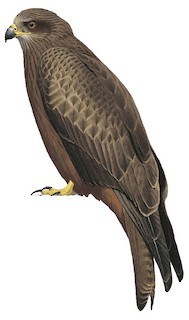
Milvus migrans govinda Scientific name definitions
Systematics History
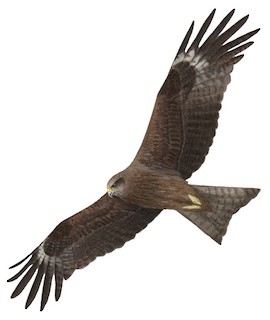
Milvus govinda Sykes, 1832 [type locality = Dukhun]. (Small) Indian Kite. Johnson et al. (2) failed to distinguish govinda from lineatus in their genetic analysis. However, Andreyenkova et al. (8) argued that all the samples were collected during the wintering period, when lineatus is also present in the same region. They concluded that these results may be due to incorrect labeling of wintering lineatus. Another study found lineatus closely related to, but distinct from govinda (5).
Distribution
Eastern Pakistan east through India and Sri Lanka to southern China (Yunnan), Indochina, and Malay Peninsula.
Field Identification
Smaller than migrans and lineatus, somewhat intermediate in plumage. There is no sexual dimorphism in size for this subspecies (10). Wings and tail shorter, with a deeper fork (3). Crown more rufous, plumage more uniformly brown. Ear coverts do not contrast as much as in lineatus. The pale gray panel on the underwing is smaller and more barred compared to lineatus (11). Bare parts are bright yellow. In juvenile plumage, the white streaks on the body are thinner than on juvenile lineatus (11). This subspecies is also less variable in plumage than migrans and lineatus (11, 10).
Milvus migrans govinda Sykes, 1832
Definitions
- MILVUS
- milvus
- migrans
- govinda
The Key to Scientific Names
Legend Overview
Milvus migrans affinis Scientific name definitions
Systematics History
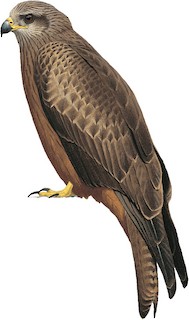
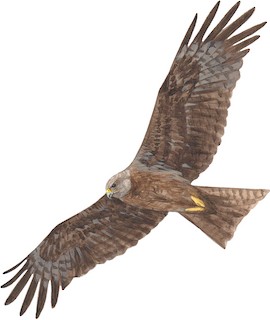
Milvus affinis Gould, 1838 [type locality = Australia]. Fork-tailed Kite. This subspecies is most similar to govinda in morphology. Preliminary analyses, including short sequences from govinda collected in summer (when lineatus has left India) found a close relationship between govinda and affinis (8). Samples from affinis formed a clade distinct from migrans and lineatus in all recent genetic analyses (2, 5).
Distribution
Sulawesi, Moluccas (Buru) and Lesser Sundas (east to Timor); eastern New Guinea; northern Australia south (in east) to Victoria.
Field Identification
Milvus migrans affinis Gould, 1838
Definitions
- MILVUS
- milvus
- migrans
- affinae / affine / affinis
The Key to Scientific Names
Legend Overview
Black Kite (Black-eared) Milvus migrans lineatus/formosanus
Milvus migrans lineatus Scientific name definitions
Systematics History
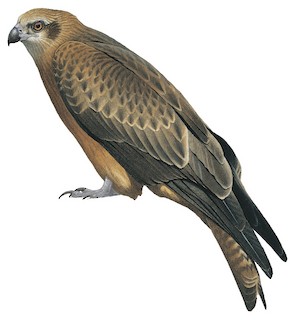
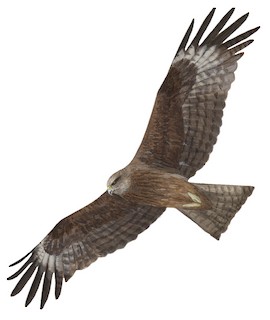
Haliaetus lineatus Gray, 1831 [type locality = China]. Black-eared Kite. Intergrades with nominate are found in a wide area extending across Eastern Europe and Western Asia (10). They show almost all intermediate phenotypes between the two subspecies. This populations is sometimes called intermedius and is said to be "huge and self-sustainable" (4).
Distribution
Ural Mountains east through Siberia to Amurland and Japan, south to northern India, northern Myanmar, northern China, and Ryukyu Islands; winters south to southern Iraq, southern India, and southeastern Asia.
Field Identification
Largest subspecies, with an almost eagle-like structure. Compared to nominate, wings are larger and show a different wing-formula. Browner crown and underbody; contrasting creamy-buff belly and undertail. Pale lores and chin give a pale-faced look while dark ear-coverts form a "mask." Black bill appears long and heavy. Large white primary patch in all plumages. Bare parts are dull bluish or greenish as opposed to the bright yellow of other subspecies. There is also much individual variation within this subspecies, with some birds being redder (although less than rufous morph migrans) and others being darker than usual (11, 10). The typical characteristics of this subspecies (black ear coverts, bluish bare parts, white wing panels) tend to be more strongly expressed in the eastern part of its range (10).
Milvus migrans lineatus (Gray, 1831)
Definitions
- MILVUS
- milvus
- migrans
- lineatum / lineatus
The Key to Scientific Names
Legend Overview
Milvus migrans formosanus Scientific name definitions
Systematics History
Milvus lineatus formosanus Kuroda, 1920 [type locality = "Gyochi, Nanto District, Central Formosa"]. Taiwan Kite. Sometimes considered to be the result of an intergrade zone between govinda and lineatus; barely distinguishable from latter (8).
Distribution
Taiwan and Hainan (southern China).
Field Identification
Similar to lineatus but smaller. The plumage is somewhat intermediate between lineatus and govinda.
Milvus migrans formosanus Kuroda, 1920
Definitions
- MILVUS
- milvus
- migrans
- formosae / formosana / formosanus
The Key to Scientific Names
Legend Overview
Black Kite (Yellow-billed) Milvus migrans aegyptius/parasitus
Milvus migrans aegyptius Scientific name definitions
Systematics History
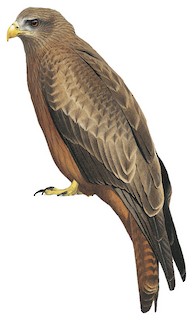
Falco aegyptius Gmelin, 1788 [type locality = Egypt]. Yellow-billed Kite. Frequently split as Milvus aegyptius (including parasitus).
Distribution
Egypt, southwestern Arabia, and coastal East Africa south to Kenya.
Field Identification
Averages smaller than migrans, except for North African population of latter (formerly separated as reichenowi). Narrower wings and more pointed wingtips (different wing-formula). Slimmer with more deeply forked tail (tail fork: 30–45 mm) (3). More uniformly brown head and neck, more rufous underbody, and distinctly barred tail. Dark iris and yellow feet. Bill usually all-yellow, but some adults with black tip (3, 4, 6). Different molt timing compared to nominate.
Birds from southern Arabia and North Somalia are still smaller, with bill varying from yellow to blackish (3). They show a brighter plumage, lighter iris, and tend to have longer fifth primaries (4). Some birds in Ethiopia also tend to be more rufous than those further south (4).
Milvus migrans aegyptius (Gmelin, 1788)
Definitions
- MILVUS
- milvus
- migrans
- aegyptius
The Key to Scientific Names
Legend Overview
Milvus migrans parasitus Scientific name definitions
Systematics History
Falco parasitus Daudin, 1800 [type locality = Africa]. Proposed subspecies tenebrosus Grant and Mackworth-Praed, 1933 (West Africa) is a synonym. This subspecies is polyphyletic according to recent molecular studies (2, 5). It includes two distinct clades which are not sisters: one in equatorial Africa and southern Arabian Peninsula (which also includes aegyptius), and the other in southern Africa and Madagascar, which is more closely related to the Red Kite (Milvus milvus). Whether morphological differences exist between them or not remains to be investigated.
Distribution
Africa south of Sahara, Comoro Islands, and Madagascar.
Field Identification
Milvus migrans parasitus (Daudin, 1800)
Definitions
- MILVUS
- milvus
- migrans
- parasitus
The Key to Scientific Names
Legend Overview
- Year-round
- Migration
- Breeding
- Non-Breeding