
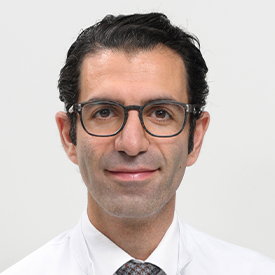
Dr. Mazda Farshad, MPH, FACS
Balgrist University Hospital
Professor Doctor of Medicine


About
Education
-
Harvard Surgical Leadership Program
2019 -
Clinical Fellowship
Spine and Scoliosis Surgery
Hospital for Special Surgery, New York, 2012 -
Board Certification for Orthopedic Surgery and Traumatology
Zurich Switzerland, 2012 -
Master of Public Health
University of Zürich, Basel,
Bern and aff.
Harvard School of Public Health, 2011 -
Medical Degree
University of Zürich, Swtizerland, 2007 -
Awards & Certifications
-
Mutliple scientific awards: (.e.g. Venel award 2014 (Swiss orthopaedics clinical research award) for ‘Abduction extension cervical nerve root stress test: anatomical basis and clinical relevance’ and 1st Marathon Award of the swissSociety of Orthopaedics:‘Does subacromial injection of a local anesthetic influence strength in healthy shoulders? – A double blinded, placebo- controlled study’)
SIWF 2023 Award for special dedication for physicians education
Links to Rankings during tenure
- World’s Best Specialized Hospitals 2020
- World’s Best Specialized Hospitals 2021
- World’s Best Specialized Hospitals 2022
- World’s Best Specialized Hospitals 2023
- World’s Best Specialized Hospitals 2024
- World’s Best Smart Hospitals 2025
- World’s Best Specialized Hospitals 2025
- World’s Best Smart Hospitals 2026
- World’s Best Specialized Hospitals 2026
Past Rankings Appearances
- World’s Best Specialized Hospitals 2020
- World’s Best Specialized Hospitals 2021
- World’s Best Specialized Hospitals 2022
- World’s Best Specialized Hospitals 2023
- World’s Best Specialized Hospitals 2024
- World’s Best Smart Hospitals 2025
- World’s Best Specialized Hospitals 2025
- World’s Best Smart Hospitals 2026
- World’s Best Specialized Hospitals 2026
Mazda Farshad is the chair of Orthopedic Surgery and spine surgery and the medical director of Balgrist University Hospital in Zurich, Switzerland.
Did you have any experiences that created an aha moment for your interest in medicine?
The moment it became crystal clear that I wanted to do medicine was when I realized, in medicine, there is so much still not answered and that there's so much potential to improve the medicine and the impact that you can have as a physician and the scientist on a patient's life. I thought that's very motivating.
What were some of the major milestones of your professional journey prior to becoming the medical director at Balgrist?
Prior to becoming the medical director of Balgrist University Hospital, I was chief of spine surgery and the founder of the unit for clinical and applied research. Before that, I was an attending surgeon in spine surgery. My stations in medicine – among others - have been educations in Zurich, New York and Geneva. I had the privilege to look at different university hospitals around the world, which obviously shaped the things that I'm doing today.
Thinking back to your earliest days as a surgeon, is there a patient story that influences the way that you act both in your capacity as a surgeon and a leader?
More than 10 years ago, there was this case of a 4-year-old child who was involved in a car accident with a dislocation fracture of the uppermost cervical spine, which in this form was not described before. I was on call as a young attending surgeon. We relocated the fracture and did a conservative treatment.
It worked well, but I thought, 'Wow, why is such a thing not described in the literature?' That was one moment when I said, 'OK, first of all, we have to publish that,' but also that's why we're doing research. That's why we publish because it has so much impact worldwide on what we do. Imagine I found the right treatment at that point; it would have relaxed the situation. That's why I've authored more than 300 scientific publications on different topics to answer unanswered questions.
What motivated you to transition into a leadership role?
I would like to have impact not only on my personal patients, but also on how the field is evolving, and with the leadership position, that's possible. This is one of the main reasons. The second reason is you cannot only shape the field directly, but also indirectly by leading people and creating platforms for talents who can evolve and who can develop and multiply the vision.
At Balgrist, your credo is 'striving for excellence.' How does this philosophy shape the culture?
Why, you might ask, should you strive for excellence at all, right? It's not easy to strive for excellence. The reason is very, very simple, because this is how you want to be treated when you are a patient yourself: in an excellent way. This is how research should be done - in an excellent way. We say that we should treat patients the same way that we want to be treated. It's not me leading, it's the credo that is actually leading.
How do you foster cohesion and culture within such a high-performing and diverse team?
You have to define the vision, and the vision must be super clear, very understandable to everybody. The vision must be noble so that it's respected by everybody, be it the cleaning force or the lead physician or surgeon.
We want to take care of the patients, and the patient could be a patient we are not related to or a patient could be our mother, daughter, father or ourselves, right? And this shouldn't make any difference. This is why we're striving for excellence, and this is how everybody is basically going in the same direction.
What are the mechanisms that you use to make that culture stick and to be the guiding force?
There are two important aspects. First of all, you have to live it yourself. If you don't live it, that's not going to work. The second aspect is you have to get the right people. And who are the right people? The right people are those who share the same credo, the same vision. And the easiest way to get the right people is to build them up yourself. This is our philosophy.
Take physicians, we start with students and then we train residents. The very best become fellows. The very best of those get promoted to attendings and so on. Most of our senior staff have been here more than 10, 15, 20 years. This is how we can make sure the culture remains stable.
Balgrist began as a clinic for children with disabilities and has grown into a leading orthopedic university hospital. Can you briefly share the story of the hospital's evolution and how its legacy influences your leadership?
More than a hundred years ago, Balgrist was created as a hospital for disabled children. Back then it was the only hospital doing that in northern Switzerland, and it was one of the only orthopedic hospitals worldwide. A couple of years later. Balgrist received a University of Zurich affiliation, and the very first chair of orthopedic surgery in Zurich was at Balgrist University Hospital. From the early days, when orthopedics was a non-surgical discipline, to now, when it's a highly specialized surgery, there have been more than a hundred years of evolution. The philosophy, however, was always the same at Balgrist.
Progress is a huge legacy. The legacy is to aim towards a top world institution in orthopedic and musculoskeletal medicine. That's why we keep our focus.
In 2018, the University Spine Center, Zurich was founded, becoming the largest spine center in Switzerland. What were the keys to building such rapid institutional success, and how do you envision its growth moving forward?
We founded the University Spine Center Zurich in 2018 with one aim. The aim was that a patient does not have to decide whether they go to a spine surgeon, neurologist, rheumatologist, chiropractor, or whoever is taking care of spinal disorders. This should not be the patient's decision.
If you're having back pain, how could you possibly know where to go first? Our center combines all disciplines, and triage is made within the center for the best of the patient. There is evidence that proves treatment can be dependent on the discipline during the first presentation of this patient.
Do you have a patient story from since you've been medical director that really moved you and reinforced the hospital's commitment to care and innovation?
There's not one patient story, but there is one disorder that we see every day in spine surgery, which is after spinal fusions, the associated complications include adjusting segment degeneration and so on.
Spinal fusion is done quite often worldwide, and it is challenging to accept that this procedure has not always a perfect outcome. This has shaped our translational research activities as we try to find alternatives to not fuse spine segments, if possible. We have multiple research groups working on that. So, it's not only one patient story, but every day we have several patient stories going into that direction.
At the end of the day, what are your core responsibilities as a leader and how do you measure success in your role?
My core responsibility as a leader is to ensure that our culture remains stable. How I measure whether I'm doing a good job or not is listening to what happens when I'm not here. If the culture is stable, even when I'm not trying to control it, then I think the job I've done previously was a sufficient one.
Can you share one hard-earned leadership lesson that you've learned along this journey and continues to influence how you lead to this day?
One hard-learned leadership lesson is basically not to ride a dead horse. It's easy said, but not so easily performed. As a university hospital, we're highly involved in translational research and innovation, and therefore we foster ideas which could go into startups and hopefully help patients in the future. And of course, as with any startup, there are risks associated, and there are financial restrictions and limitations. One of the lessons we've learned is to identify the possibility of success. If that possibility is not high, even if you have invested a lot of energy and financial resources, don't continue. Don't try the dead horse.
I've seen that happen, of course, as the director of this institution, but also as the scientific advisor of our startup incubator, where we take care of, right now, more than seven startups.
With these startups born from internal research, how do you bridge the worlds of academic research industry and clinical application to ensure real-world success?
The concept we are following is translational research. For that, you need certain characteristics of people involved, most importantly physician scientists, who speak both the language of researchers, as well as the language of clinical medicine These people can identify clinical problems, translate these problems into research questions, work together with researchers, bring up solutions, bring it back to patients, and verify whether they're valuable or not. And if you follow this philosophy, the chance of innovation is increased.
In terms of translational research, are there initiatives that you're most excited about?
Some highlights of the current translational research activities include our initiatives on how to avoid spinal fusion, which is a surgical innovation. There are also initiatives on how to integrate AI technologies into orthopedic surgery, be it navigation or data gathering during surgical procedures and support of the surgeons.
But there is also quite a large amount of effort toward biomaterials and how to modernize the way we understand implants.
You work across medicine, research industry and policy. How do you navigate these different worlds to build trust and foster collaboration?
It's not always easy to act at the intersection of medicine, research and regulatory policy. The only way these worlds can come together is through full transparency and clear structures. Otherwise, the probability that it's not going to work is very high.
To be able to act at this intersection, it's not an absolute requirement to have training for leadership. Of course, I had the typical leadership trainings, but I think it's more about acting by plausibility and integrity. Then, of course, there is learning on the way, and surgical leadership helps a lot too. You learn a lot during a surgical procedure, right? There is a start of the project. There is an end of this project. And there are challenges in between.
With the complex decisions you have to take, they are surprises and you have to deal with that. You're exposed to a lot of leadership concepts while performing a surgical procedure. I see a lot of similarities in surgery and in leadership.
How does Balgrist foster a culture of shared learning, and what do programs like the EndoSpine Academy® play in developing future leaders?
We have created platforms that allow shared learnings. Some platforms like the OR-X, which is a surgical training and research center, allow residents to come together and do surgical training and also researchers to get involved and to ask questions.
Platforms are important, and then there are structures that are important. Let's take the EndoSpine Academy®, where we've built an international platform to foster modern surgical techniques such as the ultra-minimal invasive spinal endoscopy, which is now becoming increasingly popular. We think we have taken an important role in the education of surgeons to go in that direction.
How do you balance high-stakes responsibilities with an actual personal life? Are there specific activities that help you manage stress?
Being involved in many leadership decisions and different aspects of leading a complex hospital environment and parallelly being a father with two kids, that can be challenging. The recipe to succeed in both, I think, is focus. Whatever you do at the time you're doing it, you should focus on that very strongly. So, if it's surgery, you focus on surgery. If it's playing with your daughter, you focus on your daughter. In the end, maintaining that focus—whether in surgery or with my family—is what makes both possible.
Looking ahead, what is your big vision for Balgrist University Hospital?
We will be able to really change the field of musculoskeletal medicine, continue to change the field and make disruptive, evolutionary steps. This is one very, very large aim. The second aim is to build up the next generation of leaders who are able to do that, be it in Balgrist or at other institutions.
 Visit our rankings portal
