The Jesse Cole Keynote: Law Firms Aren’t Bananas. Or Are They?
You know me and celebrity keynote speakers at legal tech conferences. Sometimes they’re good. Sometimes they’re terrible. So I approached the keynote from Jesse Cole of Bananas baseball fame at the recent 8am Kaleidoscopeconference with a healthy degree of skepticism.
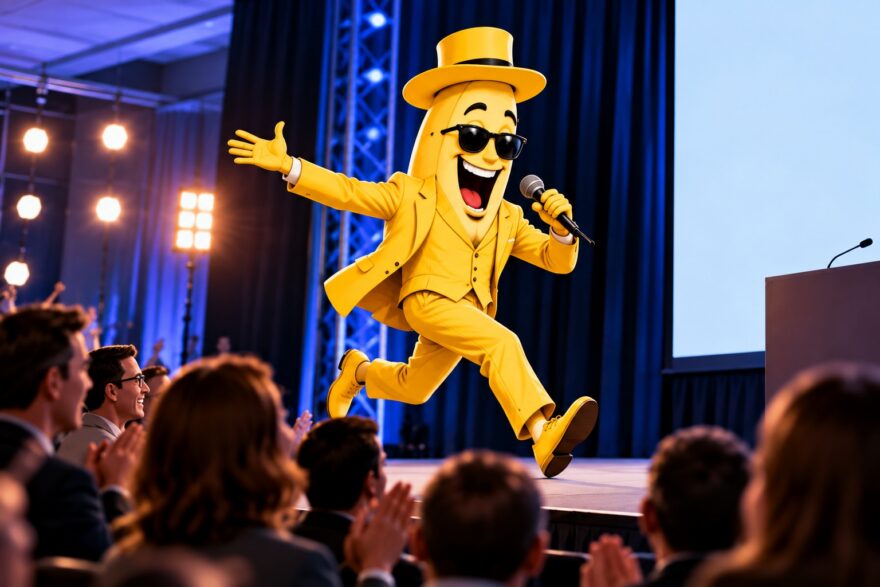
I must be one of the few people in the universe who didn’t know who Cole is. He’s the founder and owner of the Savannah Bananas, the wildly popular baseball team. Best I could tell, he’s single-handedly trying to turn America’s pastime into something resembling a cross between baseball, a rock concert, and a WWE Main Event. He’s reinventing the traditional baseball experience with his own version of the game, called Banana Ball. It’s complete with unconventional rules, choreographed dances, outrageous promotions, and nonstop fan engagement. And that’s just for starters. And the fans love it.
The Yellow Tuxedo
When I heard all this, I immediately thought what could a guy like this could possibly have relevant to say to the legal community. Then he made his entrance. He didn’t stroll onto the stage carrying a bottle of water and a PowerPoint remote. He came bolting in from the back of the room, decked out in a yellow tux, yellow hat, yellow shirt, and even yellow shoes. All to the beat of Get Ready for This playing at full tilt. I thought, Oh God. Get ready for some more bullshit from a guy who knows nothing about what we do and is there to collect a paycheck.
Well. As the subsequent 24 hours at the conference demonstrated, I do have an uncanny ability to get things completely wrong. (Which, for the sake of all of us, I won’t go into). It turns out Cole had one hell of a lot of things we need to pay attention to. And yes, he spit out a bunch of platitudes. But he backed them up with illustrative and, I daresay, memorable stories. And make no mistake, he’s a damn good storyteller.
The funny thing was, as he talked about what he had done, how he approached fans, the power of ideas, and what marketing means, I couldn’t help but reflect. Reflect on things my legal mentors and I had done over the years that were conceptually similar. And I realized that somewhere along the way, without knowing it, we’d been practicing a little Banana Ball ourselves. (Although, mercifully, we never staged a pregnant women’s dance-off to Push It).
Some Coleisms
Here’s some Coleisms:
Before you dive into any marketing and branding exercise, you need to stop and ask yourself what business you are in. For Cole, it wasn’t baseball at all. It was entertainment. That changed everything.
His underlying principle before all else: fans first.
And the target audience: the fans (aka customers. Aka clients). His underlying principle before all else: fans first. That means asking over and over what fans’ pain points are. What do they hate about the experience? From big to small.
Then: how do we ruthlessly eliminate each and every one of those pain points? Fans don’t like being nickeled and dimed with surcharges. Fine. Get rid of them and have them pay one price for their ticket. Period. Having no contact with the players? Have players sit in the stands and talk to fans like buds. Period. Players catch balls while doing somersaults. If a fan catches a ball, it’s an out. Are you kidding me?
Success requires being responsive to what your fans are saying: you have to listen carefully and respond creatively. You have to think about how to make your fans feel, says Cole. That will be what sticks. That means remembering them. Honoring them. Showing you care about them, not as a number but as a person. Each and every one.
It’s about putting every fan, from the rich to not so rich, first. The fan in the cheapest seat should feel just as important as the person paying top dollar. They all need to feel important. You have to give them all something memorable. Something remarkable. Something unique. That’s what creates fans and keeps them.
Here’s another thing, says Cole. If you truly put fans (clients) first enough times, the dollars will come on their own.
Attention beats marketing every day
But First, You Have to Get Their Attention
But to do all this, you have to get their attention. Attention, says Cole, beats marketing every day. Cole figured out when he started his business was that he was trying to do things like everyone else. That doesn’t work. You only get attention if you do things completely differently.
I won’t try to recite every attention getting example Cole gave. But here’s one he told us about after someone asked him a question about what law firms could do better. When the Bananas send a bill it’s not just a bill. They send some entertainment. It says congratulations, this is your lucky day. You get to pay the Bananas. It will change your life and on and on. Silly? Yes. Memorable? Yep. Does it put a smile on the face of the recipient? Hell yes. Mission accomplished.
Ideas and Failures
And if you’re going to go for attention grabbing, you’ve got to have ideas. Lots of ideas. Cole sits down every day and comes up with 10 new ones. Are many of them goofy? Of course. Are many of them worthless? Yep. Are most crazy? Yes. Remember the Mike Posner adage, though: not all crazy ideas are great, but all great ideas are crazy.
But it’s not just coming up with ideas. You have to try them out. And when you do, Cole says, you better be prepared to get the shit kicked out of you. A lot. Because it’s only by failing over and over that you figure out what will work. What will be the home run. You gotta go thru the mess to be great, says Cole. Over and over.
But it’s more than slogans, says Cole. Your organization has to live and breathe the philosophy behind the slogans from top to bottom. What do you talk about in your team meetings, Cole asked? About who’s doing what and how to get the work done? Or how to advance the mission? How to be fans first?
Law Firms and Bananas

So Cole built a valuable business through a bunch of gimmicks. We’re lawyers. We can’t do shit like this. Right? Wrong. As I listened to him, I began to think back on how my firm and I built a national mass tort business from little ole Louisville, Kentucky. I can tell you one thing: it wasn’t by sitting around waiting for the phone to ring.
Did Someone Say Ideas?
Instead, we went everywhere to see any client that would see us. And boy did we spew out the ideas. We created ideas about warning systems, client seminars on how to avoid exposure, and joint defense. We created storyboards for cases that hadn’t been filed. And here’s one straight from the Cole playbook: T-shirts. For each case, we created T-shirts and gave them out to the clients. We wore them to meetings.
Why? To quote Cole, one word. Attention. And you have to work pretty hard to get and keep the attention of national counsel when you are in Louisville.
I won’t embarrass myself or any of my former partners by relating all the bad ideas we came up with. But we kept trying. As one of my mentors used to tell me, “Embry, you probably have 50 ideas every week. And every now and then you have a good one.”
I also have to tell you that in my experience, coming up with those ten ideas Cole was talking about is exhausting. I know. Even now I try to now come up with five new ideas every week. It’s hard to do. But it stretches your mind.
Yes, You Gotta Crash and Burn
Cole was also right that just having ideas won’t cut it. You’ve got to try them, knowing many won’t work. That your partners will chuckle over. Our idea to create a national warning system for mass disasters? Good idea but failed miserably. Our idea to farm out all but the high-end pieces of defending a mass tort to ALSPs? Crashed and burned. My idea in the early ‘90s to handle national serial litigation involving a particular product for a flat fee? Bingo.
We drilled a lot of dry holes
Add to the ideas and the courage to fail the fact that you have to keep trying on the people end. We spent a lot of time and money going to see clients on the come. By asking for business over and over again. That meant we drilled a lot of dry holes.
Fans First for Lawyers
And like Cole, we didn’t just focus our efforts on the big players. Why? Because you never know whether a small client may someday have a big problem. Or get acquired by a big. Or make an introduction to someone who brings you a case.
So we treated smaller clients just as well as the big ones. Case in point. I met some guys with a start-up product business at a conference one time. We got to talking, which led them to hire me for a couple of small projects. I kept in touch with them over the years, although they never produced much business. Then wham. They were sued in a national class action and hired us as lead counsel. It went on for years. You never know.
And while we’re at it, let’s talk responsiveness. Not just in how quickly we answered the phone but in response to our clients’ needs. One of my partners had built a huge book of business over the years. He wasn’t the best lawyer in the house, far from it. But I asked him one time what his secret was.
It was simple. He figured out what the client really wanted to achieve. What the client’s real problem was. And then he always offered a solution. It may not have been perfect. Its chances for success may not have been the best. But the client walked away and thought, I’ll be damned. Here’s a lawyer that cares and is working with me.
We built a team of people committed to the mission of having a national mass tort practice from where we were. We didn’t just talk cases; we talked relentlessly about the little engine that could. It was who we were.
Being Memorable, Remarkable and Unique
And it was not just business. One of my mentors every year made it a point to give client representatives with whom he worked during the year a Christmas present. Not just any present. His gift was always a book. Ah, you say, that’s a nice, inexpensive idea. Yes, relatively speaking, it would seem.
But my mentor didn’t give just any book. He made sure to give a book the person he worked with would be interested in. To do that, he had to spend time listening and talking with the person not just about work but about that person as a person. Cheap gift? Maybe. Memorable? Remarkable? Unique? What do you think?
I had another partner with whom I collaborated on a big case in California. We made a bunch of trips out there with the client rep in tow. That rep not only liked to cook himself, but he loved going to one famous restaurant in Los Angeles owned by a celebrity chef. What would be a better gift for Dave than a cookbook autographed by that chef? It turned out it was not as hard to get as you’d think. Mainly because when the chef heard what we were doing and why, he immediately got it and happily signed the book.
By the way, we got a lot of business from that guy. Fans first. Customers first. Clients first.
But Steve, We’re Lawyers for God’s Sake

Right, we’re just lawyers. We can’t go bananas. All we need is to hunker down and just do good legal work. No more, no less. We don’t need some non-lawyer’s advice. I’ve seen a lot of lawyers who think like this. Most of them have little business. Their clients likely don’t remember who they are, or if they do, it’s not fondly.
I get that some just don’t want to chase business, and that’s ok. But not putting your clients first and not developing real relationships is not going to make you a very happy lawyer over the long term. And getting outside the legal echo chamber and picking up some tips is never a bad thing.
I’m not even going to begin to impart all Cole’s wisdom or his examples. And he freely admits that he’s not 100% correct about everything he did. That’s kinda the point. But based on my experience, his approach- his philosophy works. Whether you’re selling Banana Ball or legal services.
It’s fans first. Go bananas.