
AI impacts user experiences by making digital products more responsive to individual user needs. A seasoned product designer specializing in AI explains how to avoid pitfalls and maximize the potential of the latest technology.
Read MoreTRUSTED BY LEADING BRANDS


Our Services
Toptal’s AI Development Services empower businesses to harness the full potential of artificial intelligence with custom solutions tailored to their unique needs. From strategy and AI model development and deployment to optimization and scaling, we deliver responsible, high-impact AI applications that drive real business results.
Looking for guidance about the perfect AI development solution for your needs?
Get a Free Consultation NowOur AI development team with experience at leading companies will work with you to develop and deploy tailored solutions that meet your business needs and unique industry demands for sustainable results and long-term success.

 CEO, Technology Services
As Toptal’s CEO of Technology Services, Robert leads strategy and operations across our technical services portfolio, spanning AI, automation, and operations. He previously served as Deloitte’s Managing Director & Chief Commercial Officer, transforming its Cloud Operate and Engineering business into a multibillion-dollar operation. He held senior roles at IBM, Velocity, co-founded Corio, and was CIO for two Fortune 100 manufacturers.As Toptal’s CEO of Technology Services, Robert leads strategy and operations across our technical services portfolio, spanning AI, automation, and operations. He previously served as Deloitte’s Managing Director & Chief Commercial Officer, transforming its Cloud Operate and Engineering business into a multibillion-dollar operation. He held senior roles at IBM, Velocity, co-founded Corio, and was CIO for two Fortune 100 manufacturers.
Previously At











CEO, Technology Services
As Toptal’s CEO of Technology Services, Robert leads strategy and operations across our technical services portfolio, spanning AI, automation, and operations. He previously served as Deloitte’s Managing Director & Chief Commercial Officer, transforming its Cloud Operate and Engineering business into a multibillion-dollar operation. He held senior roles at IBM, Velocity, co-founded Corio, and was CIO for two Fortune 100 manufacturers.
Previously at

Technology Experience
35+ Years

Delivery Manager
Rachael serves as a Delivery Manager at Toptal with a focus on leading diverse global teams in developing innovative solutions for our clients. She works across multiple disciplines, including technology, marketing, and management consulting. Rachael specializes in managing people and client relationships, process optimization, and driving teams toward optimal business outcomes.
Previously Managed Client

Experience
9+ Years


10+ Years
of Experience
Adrian is a leading generative AI expert and two-time O'Reilly book author who currently leads Microsoft's Cloud, Data & AI Strategy for Public Sector and Healthcare. Adrian's career spans technical and business roles across diverse sectors, including telecom, fintech, consulting, and IT. Internationally, he has delivered multiple innovative initiatives across North America, LATAM, and Europe. As a key member of the Trusted AI Committee of the LF AI & Data and a Responsible AI Lead at OdiseIA, Adrian champions ethical practices in AI advancements. He is also the author of the Linux Foundation's AI Fundamentals class.
Previously at


20+ Years
of Experience
Denis is a senior full-stack AI engineer and data scientist, highly skilled in modern generative tech (GPT-4, Midjourney, and more), machine learning, ETL pipelines, data analysis, mathematical modeling, big data, and MLOps. He has a PhD in mathematics, and his data science expertise includes probabilistic risk modeling, revenue forecasting, geospatial data analysis, handwriting recognition, anomaly detection in time series, data engineering, and team leading.
Previously at


5+ Years
of Experience
Sam is a bilingual senior machine learning engineer with a background in AI and robotics and a passion for driving innovation. She dedicated the past five years to exploring the best ways to build, optimize, and automate ML pipelines, with a specialization in Google Cloud Platform and TensorFlow. During this journey, she has also had the opportunity to experience many aspects of a business outside of the technical, from line management and recruiting to marketing, thought leadership, and pre-sales.
Previously at


6+ Years
of Experience
Dragos is a passionate machine learning engineer with over three years of experience in artificial intelligence. He is well-grounded in natural language processing, Python, and SQL. Dragos has an excellent knowledge of deep learning frameworks such as TensorFlow and PyTorch.
Previously at


5+ Years
of Experience
Francesco is a data scientist with over four years of experience, a mathematician by training, and a passionate learner. He is especially interested in bringing value to a team or product, which, in his experience, has often translated to preferring simple, scalable, and understandable solutions instead of unnecessarily complex models.
Previously at


20+ Years
of Experience
Marcelo is an experienced technology leader, infrastructure solutions expert, open-source advocate, and multilinguist. With 20+ years of expertise in purpose-led high availability infrastructure solutions, he has excelled in engineering to executive leadership positions across Europe and Latin America. Marcelo focuses on building highly automated systems and has consistently delivered exceptional results. He is AWS certified and is also an open source enthusiast, Cloud Native Computing Foundation contributor, and Internet Engineering Task Force writer.
Previously at











15+ Years
of Experience
With extensive expertise in engineering and project management, particularly within Agile methodologies, Mihaela excels in driving digital projects from discovery to production. Her leadership promotes team collaboration and exceeds client expectations. Known for fostering innovation and improving processes, she thrives on challenges. Her mastery of generative AI, enriched by courses like "Prompting for AI Operations" and "ChatGPT Advanced Data Analysis," places her at the industry forefront.
Previously at


10+ Years
of Experience
Charles is an industry leader in healthcare NLP with over a decade of experience as a data-science technical manager. As a player-coach, Charles has led multimillion-dollar projects in health-tech Fortune 500s, such as UnitedHealth Group, Philips, and AstraZeneca. Charles also has a PhD in computational linguistics. With over a dozen publications and patents in his field, Charles is an authority in machine learning for named entity extraction and classification.
Previously at


15+ years
of Experience
Simone is a machine learning scientist and engineer with experience in academia and enterprises, including Microsoft and Huawei. He likes to work at the intersection of deep machine learning, NLP, and information retrieval. Simone also loves to work on exploration analysis and building theoretically sound machine learning pipelines ready for production. He especially enjoys building web products.
Previously at


14+ Years
of Experience
Joao is an AI/ML engineer with more than 14 years of experience at Fortune 100 companies like Procter & Gamble and Hearst as well as startups in the healthcare, energy, and finance industries. Joao holds a master's degree in computer engineering from the University of Porto and has multiple certifications in ML and deep learning.
Previously at


15+ Years
of Experience
Abhimanyu is a machine learning expert with 15 years of experience creating predictive solutions for business and scientific applications. He’s a cross-functional technology leader, experienced in building teams and working with C-level executives. Abhimanyu has a proven technical background in computer science and software engineering with expertise in high-performance computing, big data, algorithms, databases, and distributed systems.
Previously at


10+ Years
of Experience
Joslyn is a seasoned data practitioner with demonstrated experience across multiple industries, including technology consulting and customer service. With her academic background in applied statistics and a skillset in machine learning, data analytics, Python, and SQL, Joslyn has delivered numerous projects with positive business impacts on customers.
Previously at


18+ Years
of Experience
"Ifiok is an accomplished cloud practitioner with demonstrated success developing and executing cloud technology solutions. His knowledge of cloud and operational strategies helps promote organizational growth and cloud adoption acceleration. As an AWS 5x, Azure 2x, GCP 3x, HashiCorp, and New Relic certified professional, Ifiok is comfortable being the intermediary between business requirements and engineering value. "
Previously at


15+ Years
of Experience
Christine is a distinguished product leader specializing in AI, cloud computing, and advanced modeling. She led a major financial company's post-merger enterprisewide transformation and a $1.5 billion cloud deal. As a product director, Christine oversaw the creation of a large-scale SaaS investment management platform for high-net-worth clients. At top financial institutions such as Goldman Sachs and JP Morgan, she designs client-facing solutions focusing on data and process automation.
Previously at


10+ Years
of Experience
Filip is a machine learning engineer with several years of professional experience. He's worked on large-scale problems at Amazon Web Services as a software developer and built natural language processing models as a research associate at the University of Zagreb. Filip's main interests are machine learning and natural language processing, with an emphasis on building text classification models.
Previously at

Looking for guidance about the perfect AI development solution for your needs?
Looking for guidance about the perfect AI development solution for your needs?
UNRIVALED EXPERTISE
Having previously worked with these leading global companies, our talent brings valuable insights and expertise to deliver world-class outcomes.









Discover the cutting-edge benefits our clients enjoy from the global Toptal network.

Challenge: Bruno Scarselli, a third-generation diamond dealer, needed to create a platform that could issue cryptographic titles of authenticity, origin, and ownership for gems. He was unsure of the technical requirements, particularly around blockchain development, and faced a complex path to execution.
Solution: The team followed a rigorous project management timeline focused on rapidly delivering Scarselli’s most needed features, delivering a working MVP in just 14 weeks. The platform leverages a React/Node.js infrastructure to support an Ethereum-based blockchain protocol. The system uses a robust AWS infrastructure, including IAM, S3, CloudFront, Lambda, Aurora Serverless, KMS, SES, CloudFormation, EKS, and EC2 to ensure scalable, secure, and efficient service delivery.
Outcome: Thanks to the team’s rapid execution, Scarselli attracted his first 50 diamond-industry customers mere months after ideating on his product vision. For technology startups, this rapid speed to market is critical for both short- and long-term success.
Bruno Scarselli
Managing Partner at Scarselli Diamonds Founder



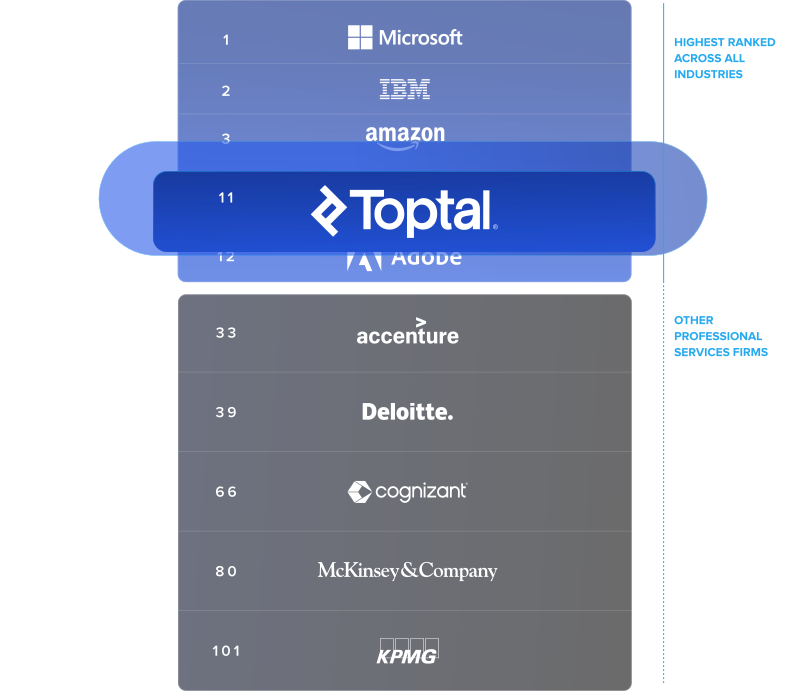
Newsweek and Statista’s rankings were based on an independent survey of more than 2,400 business decision-makers at America’s largest firms.

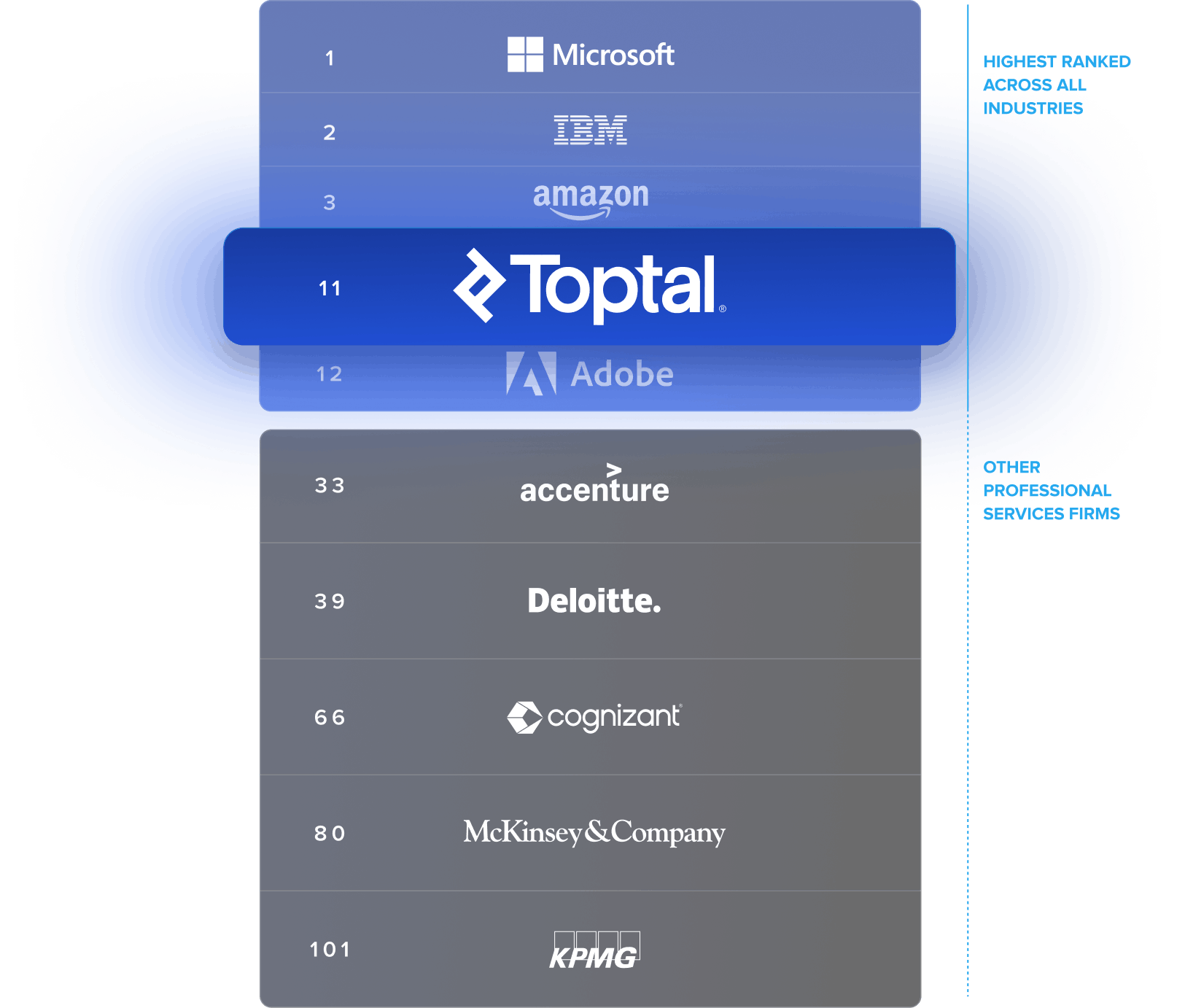
Methodology for the Rankings
How likely the respondent is to recommend the selected company to others.
Measures the convenience of interaction with the company and efficiency of processes.
Measures the company’s cost-effectiveness and quality relative to price.
Measures whether the company consistently meets or exceeds expectations in quality and timeliness of deliverables.
Measures the company’s ability to consistently fulfill commitments and maintain customer trust.
Industry Insights
Read our latest articles and resources to keep you current on emerging trends in artifical intelligence, machine learning, prompt engineering, and more.
AI impacts user experiences by making digital products more responsive to individual user needs. A seasoned product designer specializing in AI explains how to avoid pitfalls and maximize the potential of the latest technology.
Read More
Related AI Offerings
Achieve end-to-end success by completing your operational stack with services that ensure every aspect of your business is optimized.
AI is no longer just a competitive advantage—it’s a strategic imperative, and it’s value is only truly unlocked when it is deeply embedded into operations, products, and decision-making. Leveraging AI successfully depends on technical execution and finding a partner who understands the nuances of artificial intelligence and the business realities it must serve.
Building effective AI solutions requires working through complex challenges like preparing data, choosing the right models, designing infrastructure, and addressing ethical concerns. Deploying models that deliver real-world value demands careful planning and disciplined execution. The best outcomes come from service providers that treat AI as an integrated capability that evolves with your business.
In this guide, we’ll walk through the essential components of a successful AI development project, including how to choose the right partner, set expectations around cost and scalability, and ensure your AI solutions are ethical, explainable, and built to last.
Choosing the right AI consulting partner is a business-critical decision that requires a team with deep AI expertise and a clear understanding of your industry, operational challenges, and long-term goals.
A great AI development firm will guide you through the entire lifecycle from data strategy and model development to deployment and ongoing optimization. Just as importantly, they’ll act as an extension of your internal team and bring a collaborative mindset and a commitment to long-term impact.
Use these criteria to evaluate potential partners:
Investing in AI technologies means building intelligent systems that create lasting business value. Costs can vary significantly based on solution complexity, data quality, and deployment scale. A strategic approach to pricing helps ensure your project stays financially sound while maximizing long-term impact.
Keep these factors in mind when budgeting for AI services:
The best AI pricing models are rooted in value. Look for firms that align their fees with outcomes, scalability, and long-term support rather than just hours billed or models delivered.
AI development succeeds when it follows a process grounded in clarity, collaboration, and continuous learning. From early discovery to real-world deployment, a well-structured approach ensures your investment delivers measurable results and scales with your business processes across intelligent products, internal automation, and integrated systems.
Building effective AI systems requires a structured lifecycle that begins with elucidating business goals and ends with systems built for ongoing performance and governance.
The process starts with problem framing. Teams must align on specific objectives, success metrics, and whether the AI system is meant to automate tasks, augment decision-making, or support a hybrid approach. Without a clear problem definition, downstream efforts often yield technically functional but strategically misaligned models.
Next comes data preparation, which forms the backbone of any AI-powered initiative. Robust data ingestion pipelines, combined with cleaning, labeling, and governance frameworks, are essential. These foundational steps ensure that models are built on reliable, representative datasets that can stand up to real-world usage.
During model development, teams select approaches such as supervised, unsupervised, or reinforcement learning depending on the business need. This phase also includes experimentation, hyperparameter tuning, and performance benchmarking.
But model development is only half the battle. Deployment strategies must be planned early, with emphasis on monitoring, integration, and feedback loops. Human-in-the-loop systems may be necessary for tasks that require oversight or where domain expertise is critical to maintain accuracy.
Throughout the lifecycle, documentation is key. From dataset lineage to model assumptions and retraining procedures, proper documentation supports transparency, compliance, and long-term maintainability.
Transforming an AI idea into a functioning product requires both technical skill and product sensibility. The most successful AI development projects begin with user-centric framing, identifying who the product serves, what problems it solves, and how success will be measured.
Rather than rushing into development, strong AI teams focus early energy on scoping. This includes aligning on data availability, system constraints, and the minimum viable functionality needed to generate value. Prototyping plays a critical role here: lightweight proofs-of-concept validate technical feasibility and surface potential blockers early.
As products move from pilot to production, the focus shifts toward layering in necessary infrastructure, security controls, user interfaces, and scalable data operations. At this stage, it’s critical to ensure models do not operate in isolation. AI systems must be tightly integrated into existing tools, workflows, and user environments to deliver real value.
Cross-functional collaboration is non-negotiable. Product managers, engineers, data scientists, and business stakeholders must align across iterations to balance feasibility, risk, and business outcomes.
End-to-end AI product development is not just about shipping models: it’s about building usable, maintainable systems that deliver insight and business impact.
AI development projects carry a unique blend of technical uncertainty and business risk. That’s why prototypes, POCs, and MVPs are so essential: they help teams validate hypotheses before investing in full-scale systems.
The first step is validating that the necessary data exists and that it contains a usable signal. Without this, even the most advanced model will fail to generalize. Quick iterations with simplified models or small datasets can uncover these issues early.
MVPs should prioritize learning over completeness. Rather than aiming for every feature, teams should focus on delivering enough functionality to test adoption, usability, and alignment with real-world workflows.
Too often, teams jump from prototype to production without planning the handoff. Instead, successful projects define a transition path early, including retraining workflows, deployment automation, and monitoring strategies.
User feedback is the final—and ongoing—layer of validation. It helps refine features, guide prioritization, and ensure the product evolves in step with user needs and business goals.
AI systems need to scale reliably, maintain consistent quality, and integrate smoothly across platforms. Enterprise-grade AI architecture starts with modularity. Systems must support multiple models, versioning, retraining, and adaptation across different business units or teams.
Scalability also depends on data infrastructure. High-throughput applications require robust pipelines that can handle real-time ingestion, transformation, and feature generation. Model orchestration layers should coordinate training, inference, and rollback procedures to minimize risk.
These systems must also accommodate failure gracefully. AI outputs can degrade over time due to data drift, changing environments, or user behavior shifts. Architectures must be built to detect and respond to these shifts through monitoring, alerting, and automated retraining pipelines.
Integration is another critical success factor. Enterprise AI systems should not replace existing tools but enhance them, connecting with cloud services, analytics platforms, APIs, and legacy databases to create a cohesive ecosystem.
Lastly, observability and governance are essential. Especially in regulated or customer-facing environments, teams need audit trails, performance dashboards, and clear accountability for every AI-driven decision. Only with these guardrails in place can organizations deploy AI at scale without compromising trust or agility.
Effective AI solutions depend on early and informed decisions—around data quality, architecture, and governance—that ensure your system performs reliably, scales efficiently, and earns stakeholder trust.
Your AI stack shapes everything from training efficiency to long-term scalability and model governance.
Choose frameworks like TensorFlow or PyTorch based on team familiarity, community support, and extensibility. Lightweight frameworks may be better suited for edge use cases or simpler models.
Align infrastructure with compute demands. GPU- or TPU-backed cloud platforms provide elastic scaling for training and inference, while model-serving tools support version control, rollback, and performance monitoring.
For specialized use cases—like computer vision—select hardware and pipelines built for high-throughput, low-latency processing.
Across all scenarios, ensure your stack:
Just like clean code is essential for scalable software, maintainable AI models are critical for long-term reliability and trust. A robust maintenance strategy ensures that models stay accurate, compliant, and aligned with evolving data and business conditions.
Start with continuous monitoring. Use tools that detect data drift, input anomalies, or performance degradation in real time—these insights inform when and how to retrain.
Establish automated retraining pipelines triggered by business cycles, behavioral shifts, or significant product changes. In high-stakes applications, consider live-learning strategies with guardrails in place.
Version control is non-negotiable. Managing multiple model versions—with clear rollback procedures—supports auditability, safety, and uninterrupted operations.
Finally, retraining efforts should be aligned with the business context and user expectations. Minimizing downtime and unexpected model behavior maintains user trust and operational continuity.
Speed and accuracy are important aspects of AI performance, but fairness, explainability, and accuracy must also be prioritized. Addressing these factors early leads to more resilient systems and better user outcomes.
Audit models regularly across demographic groups to detect and address hidden biases. Build performance evaluations that account for both accuracy and equity.
In high-stakes applications like healthcare or finance, use tools such as SHapley Additive exPlanations (SHAP), Local Interpretable Model-agnostic Explanations (LIME), or integrated gradients to explain model outputs clearly and consistently.
To support fairness and interpretability, integrate features like:
By baking these practices into your AI development cycle, you ensure your models remain usable, compliant, and aligned with real-world needs.
AI systems must be secure, trustworthy, and built for fraud detection and compliance from day one. As models process sensitive data and power critical decisions, overlooking these concerns can lead to legal risk and user distrust.
To start, apply encryption, anonymization, and role-based access control across the full data and model lifecycle. Design with regulations in mind—whether it’s GDPR, HIPAA, or new AI-specific legislation—so compliance is baked into the system, not bolted on later.
Controlling access to model APIs and training data is especially important in shared or multi-tenant environments. Vet all third-party dependencies for security risks, and regularly audit your pipelines for exposure points.
Ultimately, compliance is an ongoing commitment. Like any high-performing system, your AI solution should be monitored, updated, and audited continuously to meet evolving standards and maintain long-term integrity.
AI enables businesses to automate decisions, surface insights, and personalize user and customer experiences at scale. When built thoughtfully, AI can unlock efficiency, innovation, and competitive advantage.
However, successful development requires navigating data quality, shifting regulations, and organizational alignment. Without clear goals and scalable infrastructure, AI efforts often stall. Understanding both the value and complexity of AI is key to making sustainable investments.
Benefits and Outcomes | Challenges |
|
|
AI plays an increasingly central role in how businesses operate, compete, and grow. Whether it’s streamlining internal processes or delivering smarter, more adaptive digital experiences, effective AI development turns data into action and strategy into impact.
AI is the future of business. As data volumes grow and customer expectations rise, companies that harness AI will gain a distinct advantage in speed, insight, and adaptability.
A custom AI solution empowers your organization to automate intelligently, personalize experiences, and make faster data-driven decisions. AI is a strategic asset that drives real business outcomes, and working with experienced AI development partners ensures your solution is designed for scalability, ethical use, and seamless integration into your operations.
From early discovery through deployment and optimization, expert AI teams help you build responsibly, reduce risk, and accelerate time to value. With the right investment today, AI can fuel long-term innovation and keep your business ahead of the curve tomorrow.
Artificial intelligence development services create intelligent systems, such as predictive models and natural language interfaces, that enhance decision-making and streamline complex processes. These capabilities strengthen internal operations by boosting team effectiveness and automating routine tasks, while also powering more personalized customer experiences and enabling faster responses to changing market conditions. When implemented effectively, AI development catalyzes long-term transformation and sustained competitive advantage.
The cost of professional AI development services depends on the complexity of the work, the level of expertise required, and the length of the engagement. Whether you’re addressing an immediate challenge or laying the groundwork for future expansion, your investment typically reflects the project scope, delivery model, and how the work aligns with broader business objectives.
Toptal’s approach differs from a conventional AI development company by offering flexible, high-caliber talent tailored to your specific needs. You can engage a single AI engineer or assemble a cross-functional team, using delivery models that integrate seamlessly into your workflows and scale with your business. With built-in project oversight and access to proven experts, Toptal provides a results-driven AI development solution that prioritizes performance and adaptability.
Toptal’s AI development solutions are designed for integration across disciplines and delivery phases—from strategy and execution to optimization and scaling. Your Toptal team can bring together specialists across engineering, design, marketing, management, and more. This interdisciplinary alignment ensures cohesive, end-to-end delivery that drives measurable business results.
Looking for guidance about the perfect AI development solution for your needs?
Get a Free Consultation Now