Between Instagram and TikTok, it seems like most young people these days really enjoy taking photos and videos of themselves. And so it's surprising that Vivo is the only brand with a phone line whose entire shtick is catering to the selfie generation. Ever since the Vivo V5 in early 2017, which was billed as the "perfect selfie phone," the Chinese company has pumped out a V phone two to three times a year, and they all usually feature sort of bland design — plastic back and muted colors — but highlighted by a selfie camera that packs more pixels than most phones' main cameras.
The new Vivo V20 series brings the same selfie-focused feature again — this time the top two variants of the phone pack a whopping 44MP front-facing camera — but for the first time in a V series, the devices look and feel good. It helps that Vivo gave them glass backs and a matte, gradient coating. The rear camera module also has one of the cleaner designs in my opinion.


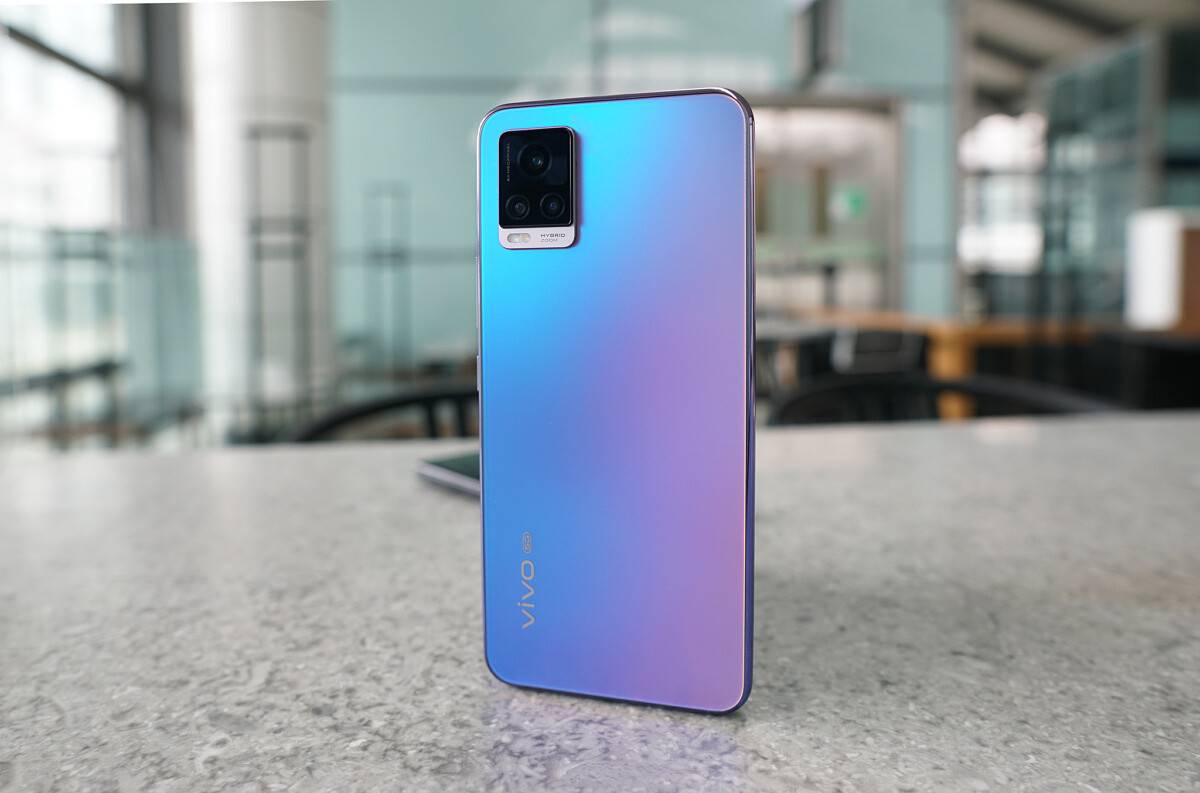

Still, the highlight of the series is that front-facing camera — well, that and the standard V20 somehow beat Google to shipping a device with Android 11 — and so for this piece I'm going to put the Vivo V20 Pro's 44MP shooter to the test against some high-profile devices such as the Samsung Galaxy Z Fold 2, Galaxy S20 FE, and iPhone 11 Pro.
But first, a rundown of the specs of all three devices:
| Specification | Vivo V20 Pro | Vivo V20 | Vivo V20 SE |
|---|---|---|---|
| System-on-chip | Qualcomm Snapdragon 765G | Qualcomm Snapdragon 720G | Qualcomm Snapdragon 665 |
| Display |
|
|
|
| Fingerprint scanner | In-display optical | In-display optical | In-display optical |
| Front camera |
|
|
|
| Rear Camera |
|
|
|
| RAM | 8GB | 8GB | 8GB |
| Storage |
|
|
|
| Battery Capacity | 4,000 mAh | 4,000 mAh | 4,100 mAh |
Vivo V20 Pro Forums ||| Vivo V20 Forums ||| Vivo V20 SE Forums
Test 1: Daytime selfie
We'll start simple with a basic selfie outside on a sunny day.


Test 2: Indoor, against harsh backlight
For this test, I purposely made it a challenging shot by shooting with harsh light coming right behind me. And the results is similar to test one, in that the iPhone 11's camera just could not find the right balance, as it blew out the lights through the window entirely. Samsung's image still gives my skin an unnatural look, and it still slightly overexposes the sky outside.


Test 3: Portrait/bokeh, with two faces
For this test, I shot a portrait/bokeh selfie with an extra person in frame to see how edge detection would work. The first thing I noticed is that the Vivo V20 Pro's shot doesn't really have any depth-of-field effect, but left both of our faces looking natural and well lit. I switched to another Samsung phone for this shot — the Galaxy S20 FE — but the usual Samsung crazy skin smoothening effect is still here, though at least there's a very creamy bokeh effect with natural edge detection.

Test 4: Low light
This is a night shot taken in a relatively dark corner of a street with a giant tree covering most of the city's ambient lights. Considering the Galaxy S20 FE's 32MP, f/2.2 front-facing camera at least gets close to the Vivo V20 Pro's 44MP, f/2.0 selfie in specs, I thought it'd be close in low light, but no — Samsung's image exhibits a lot more noise.

Test 5: Extreme low light
For this shot, I took selfies in a really dark alley. If we're just shooting a regular shot, the Pixel 4's 8MP selfie camera did an admirable job considering the hardware limitation, but it still fell short of the Vivo V20 Pro's camera. But Google has a trick up its sleeve — computational photography. With "Night Sight" on, the Pixel 4 pulls far ahead.