

Updated: 15-Jul-2019
At the Milan Air Show Fuscaldo presented a 3-cylinder barrel engine with double piston and a complicated piston interconnection mechanism through bevel gears, transmission shafts, etc.

“Fuscaldo-barrilete”
As we can see the barrilete type engine was air cooled.
-Fuscaldo had three other engines, but only photos of onbe of them have been located.
-Among the engines that Fuscaldo designed around 1928, there is a three barrel-type cylinder that appears in the text above and that has an addendum in the chapter of Isotta Fraschini who holds the license.
-It was the engine that gave 40 CV at 2,000 rpm. Another engine and whose picture appears in the text is the 7-cylinder radial.
-There was another one with 5 cylinders that gave 65 CV at 2,000 rpm.
-Fuscaldo's fourth engine was a 9-cylinder radial, air cooled as well. It delivered 120 CV at 2,000 rpm.
-This is a seven-cylinder shown in 1927.
-It had a turbocharger and variable pitch, even reversible. The engine gave 98 CV at 2,000 rpm.

“Fuscaldo 7 cylinder”
-It was a seven-cylinder radial engine with internal cylinder dimensions of 90 x 120 mm.
-The power was 90 CV at 1,800 rpm (97 CV at 2,000 rpm).
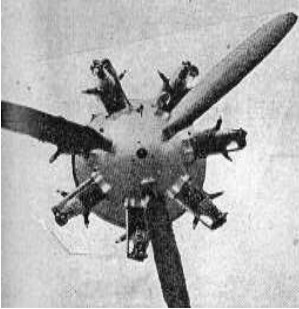
“Fuscaldo, 90/97 CV”
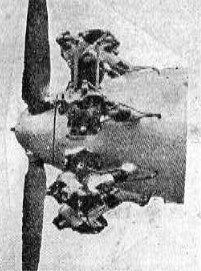
“Fuscaldo, 90/97 CV”
-The carburetor was a Memini, and the double ignition was provided by two independent batteries.
From Appendix 9: We located a photo of the revolver (or barrel) type engine that appears only in outline in the main text.
-About this engine it is clear that Isotta Fraschini acquired the rights from Fuscaldo. But the construction was entrusted to SA Motori-Marini Carraro.
-The engine was exhibited at the 1935 Milan Trade Fair. There it appeared as "Motore Carraro-Fuscaldo de la Caproni".
-The author has not found any relationship with Caproni, unless that it was installed on a Caproni plane for tests.
-This air-cooled, 2-stroke, revolver-type engine had three cylinders with double-acting pistons.
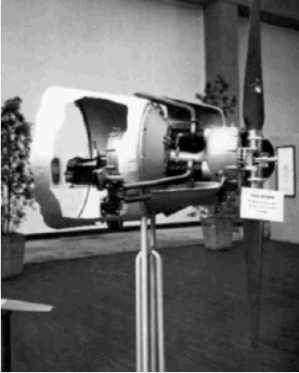
“Fuscaldo-Carraro-IF” (PiP=LBC)
From Appendix 10: We located a Fuscaldo 3-cylinder radial engine, obviated in the main text. Because it was not known. The cylinders are clearly similar to those with 7 cylinders.
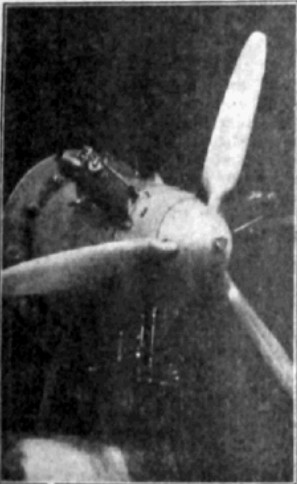
"Three-cylinder Fuscaldo radial engine"
From Appendix 12: New illustration that can help to better understand this machine.

“Fuscaldo engine, front and rear view” (PiP-Flu)
Engines of FUSCALDO
Model: 3 cyl. radial
Arquitecture: 3-cylinder Radial
Cooling:
Total Displacement:
Bore / Stroke:
Power:
Weight:
"Fuscaldo 3-cylinder radial engine"
Model: 5 cyl. radial, 75 CV
Arquitecture: 5-cylinder Radial
Cooling:
Total Displacement:
Bore / Stroke:
Power: 65 CV @ 2000 rpm
Weight:
Model: 7 cyl. radial, 40 CV
Arquitecture: 7-cylinder Radial
Cooling:
Total Displacement:
Bore / Stroke:
Power: 40 CV
Weight:
Model: 7 cyl. radial, 90/97 CV
Arquitecture: 7-cylinder Radial
Cooling:
Total Displacement: 5344 cc
Bore / Stroke: 90 x 120 mm
Power: 97 CV @ 2000 rpm
Weight:
"Fuscaldo engine, 90/97 CV"
Model: 9 cyl. radial, 120 CV
Arquitecture: 9-cylinder Radial
Cooling:
Total Displacement:
Bore / Stroke:
Power: 120 CV @ 2000 rpm
Weight:
Model: Tipo “barrilete” (Carraro-Caproni-IF)
Arquitecture: 3-cylinder Barrel
Cooling:
Total Displacement:
Bore / Stroke:
Power: 40 CV @ 2000 rpm
Weight:
"Fuscaldo-Carraro-IF" (PeT)
