ethnoscience, ethno-science
エスノサイエンス
ethnoscience, ethno-science
解説:池田光穂
エスノサイエンス[Ethnoscience]、すなわち民族科学とは、それぞれの民族の文化や社会に根拠をもつ、それぞれの民族がもつ固有の自然科学認識からうまれる概念 や実践のことである。
具体的には、生業と自然環境との関わりをもつ人びとの自然物(動植物、土壌や鉱物、生態系、物理的空間など)を、どのような語意や概念として捉 えているのかについて、分類や秩序の構成などを調べとともに、それらの利用や操作の側面との照合することが、この分野の研究手法である。また、西洋近代科 学による比較や対応関係について調べることで、他の民族集団に関するエスノサイエンスの成果との比較するという発展的な研究手法もある。
エスノサイエンスは、サイエンスにエスノという連辞符(ethno-)がついたものであるので、それぞれの社会集団(ここでは民族集団がモデル になっている)の固有の科学という意味をもつ。西洋近代科学は、さまざまな科学に分化しているため、エスノサイエンスもまたそれぞれの科学領域(例えば医 学や、その下位分野である解剖学、生理学など)に応じて、エスノ・メディシン(民族医学)、エスノ・アナトミー(民族解剖学)、エスノ・フィジオロジー (民族生理学)などと分化させることが可能である。ただし、総称であるエスノサイエンスに比べると、後者のグループはある民族のもつ独特の科学認識という 意味合いで使うことが多く、それぞれの民族の独自の科学概念を整理することが主眼におかれているわけではない。
エスノサイエンスの関心は、もともと「未開」民族が利用する有用動植物(材木、薬草、染料など)に対する資源的関心や博物学的関心から始まり、 その萌芽的な初期の研究のほとんどは、現地名称(local name)とリンネの学名との照応関係、有用部位の利用、あるいは現地人の利用形態などに関する記述と編纂に終始していた。
その後、民族誌学上の関心から、自然環境(生態系)における民族の独特の認識論として、民俗分類(folk taxonomy)について、よく訓練されたインフォーマントを使う調査へと特化していった。このころから、精緻で固有なエスノサイエンスの実態が明らか になるにつれて、「未開」民族は有用性に特化した自然認識をもつという従来の研究者の見解が修正されて、固有の民族がもつ「独自の認識」 (authentic cognition)領域への評価がなされるようになった(→野生の思考)。さらに民族認識論(ethno-epistemology)や民族意味論 (ethno-semantics)——それらはもはやエスノサイエンスとは呼ばれず独自の領域を形成している——などに展開し、言語学あるいは言語人類 学的知識をも動員されて洗練化していき、今日ではさまざまな関連領域が派生している。
エスノサイエンスに関する批判としては、(a) 研究者は生態系の自然科学に関する豊富な知識をもちながらその動植物が使われる現場において研究するに も関わらず、その民族(インフォーマント)の知識表象を利用される文脈から切り離して、固有の文脈における意味の検討をおこなわない傾向があることであ る。これは、(b) 通常の民族誌(エスノグラフィー)研究の多くが、文脈のなかにおける行為者の文化的パターンを子細に読みとろうとする方向性とは逆の傾向を もってきたことと関係しているかもしれない。
| Ethnoscience has
been defined as an attempt "to reconstitute what serves as science for
others, their practices of looking after themselves and their bodies,
their botanical knowledge, but also their forms of classification, of
making connections, etc." (Augé, 1999: 118). |
エスノサイエンス[Ethnoscience]は、「他者にとって科学として機能するもの、すなわち、彼ら自身の身体や生活をケアする実践、植物に関する知識、さらには分類や関連付けの方法などを再構成しようとする試み」と定義されている(オジェ、1999: 118)。 |
| Origins Ethnoscience has not always focused on ideas distinct from those of "cognitive anthropology", "component analysis", or "the New Ethnography"; it is a specialization of indigenous knowledge-systems, such as ethno-botany, ethno-zoology, ethno-medicine, etc. (Atran, 1991: 595). According to Scott Atran, ethnoscience looks at culture with a scientific perspective (1991: 650), although most[quantify] anthropologists abhor this definition. Ethnoscience helps to understand how people develop with different forms of knowledge and beliefs, and focuses on the ecological and historical contributions people have been given (Atran, 1991: 650)[by whom?]. Tim Ingold describes ethnoscience as a cross-discipline (2000: 160). He writes that ethnoscience is based on increased collaboration between social sciences and the humanities (e.g., anthropology, sociology, psychology, and philosophy) with natural sciences such as biology, ecology, or medicine (Ingold, 2000: 406–7). At the same time, ethnoscience is increasingly transdisciplinary in its nature (Ingold, 2000: 407). Of course, naturally over time, the ways in which data has been collected and studied has changed and the field has evolved, becoming more detailed and specific (Urry, 1972: 45).[need quotation to verify] The ideas, mechanics, and methods of ethnoscience evolved from something else - a combination of several things. This pretext amalgamation[citation needed] of theories, processes, and –isms led to the evolution of today's ethnoscience. |
起源 エスノサイエンスは、必ずしも「認知人類学」、「構成要素分析」、あるいは「ニュー・民族誌」とは異なる概念に焦点を当ててきたわけではない。それは、民 族植物学、民族動物学、民族医学などの先住民の知識体系を専門とする分野である(Atran, 1991: 595)。スコット・アトランによれば、エスノサイエンスは科学的な視点から文化を捉えるものである(1991: 650)。ただし、大多数[定量化]の人類学者はこの定義を嫌悪している。エスノサイエンスは、人々がどのようにして異なる形態の知識や信念を発展させて きたかを理解するのに役立ち、人々が与えられてきた生態学的・歴史的貢献に焦点を当てる(Atran, 1991: 650)[誰による?]。ティム・インゴールドは、エスノサイエンスを学際的な分野として定義している(2000: 160)。彼は、エスノサイエンスが社会科学や人文学(例:人類学、社会学、心理学、哲学)と、生物学、生態学、医学などの自然科学との間の協力関係の強 化に基づいていると述べている(インゴールド、2000: 406–7)。同時に、エスノサイエンスはその性質上、ますますトランスディシプリナリーなものとなっている(Ingold, 2000: 407)。 もちろん、当然ながら時間の経過とともに、データの収集や研究の方法は変化し、この分野は進化して、より詳細かつ具体的になってきた(Urry, 1972: 45)。[出典が必要] エスノサイエンスの思想、仕組み、方法は、他の何か――すなわちいくつかの要素の組み合わせ――から発展した。理論、プロセス、そして様々な「イズム」の この先駆的な融合[出典が必要]が、今日のエスノサイエンスの進化をもたらした。 |
| Early approaches Early on, Franz Boas established cultural relativism as an approach to understanding indigenous scientific practices (Uddin, 2005: 980). Cultural relativism identifies people's differences and shows how they are a result of the social, historical, and geographical conditions (Uddin, 2005: 980). Boas is known for his work in Northern Vancouver, British Columbia, Canada, working with the Kwakwaka'wakw Indians, which is where he established the importance of culture (Uddin, 2005: 980). Lévi-Strauss' structuralism was a strong contributor to the ideas of ethnoscience (Uddin, 2005: 980). It, itself, was the leading idea of providing structure to the research and a guide to organizing and relating different cultures. "Ethnoscience refers to a 'reduction of chaos' achieved by a particular culture, rather than to the 'highest possible and conscious degree' to which such chaos may be reduced"; basically, the ethnoscience of a society creates its culture (Sturtevant, 1964: 100). Much of the influence of anthropology, e.g., geographical determinism, was through the contributions of Jean Bodin (Harris, 1968: 42). In his text, he tried to explain why "northern people were faithful, loyal to the government, cruel, and sexually uninterested, compared to why southern people were malicious, craft, wise, expert in science but ill-adapted to political activity (Harris, 1968: 52)." The Greek historian, Polybius, asserted "we mortals have an irresistible tendency to yield to climatic influences; and to this cause, and no other, may be traced the great distinctions that prevail among us in character, physical formation, complexion, as well as in most of our habits..." (quoted in Harris, 1968: 41). Another aspect of anthropology prior to ethnoscience is enculturation. Newton and Newton described enculturation as a process whereby the novice, or "outsider", learns what is important to the "insider" (1998). Marvin Harris writes, "One of [enculturation's] most important technical expressions is the doctrine of 'psychic unity,' the belief that in the study of sociocultural differences, hereditary (genetic) differences cancel each other out, leaving 'experience' as the most significant variable" (Harris, 1968: 15). This is one of the many starts of people opening up to the idea that just because people are different, does not mean they are wrong in their thinking. Harris describes how religious beliefs hinder and affect the progress of anthropology and ethnography. The moral beliefs and restrictions of religion fought against anthropological ideas, possibly due to (especially at the time) to the newly hyped idea of evolutionism and Darwinism (Harris, 1968). Bronislaw Malinowski was one of many who contributed heavily to the precursor of ethnoscience. His earlier work brought attention to sociological studies; his earliest publication focused on a family in Australia, using a sociological study perspective (Harris, 1968: 547). After the First World War, anthropological work was at a standstill; nothing had evolved, if not regressed (Urry, 1972: 54). This allowed him to start from scratch, and rebuild his ideas and methods (Harris, 1968: 547). Later, however, Malinowski branched out to political evolution during World War II. The period after World War II is what led to ethnoscience; anthropologists learned their skills could be applied to problems that were affecting modern societies (Mead, 1973: 1). Malinowski said "... with his tables of kinship terms, genealogies, maps, plans and diagrams, proves an extensive and big organization, shows the contribution of the tribe, of the clan, of the family, and he gives a picture of the natives subjected to a strict code of behavior and good manners, to which in comparison the life at the Court of Versailles or Escurial was free and easy" (1922: 10). After World War II, there was an extreme amount of growth in the anthropological field, not only with research opportunities but academically, as well (Mead, 1973: 2). The anthropologist Robin Horton, who taught at several Nigerian universities, considered the traditional knowledge of indigenous peoples as incorporated within conceptual world views that bear certain similarities to, and differences from, the modern scientific worldview. Like modern science, traditional thought provides a theoretical structure that "places things in a causal order wider than that provided by common sense" (Horton, 1967, p. 53). In contrast to modern science, he saw traditional thought as having a limited awareness of theoretical alternatives and, consequently, displaying "an absolute acceptance of the established theoretical tenets" (Horton, 1967, pp. 155–6). There are dozens, if not hundreds, of related methods and processes that preceded ethnoscience. Ethnoscience is just another way to study the human culture and the way people interact in society. Taking a look at the ideas and analyses prior to ethnoscience can help understand why it was developed in the first place. Although, it is not widely used and there is criticism on both ends, ethnoscience allows for a more comprehensive way to collect data and patterns of a people. This is not to say the process is its best or that there will be nothing better. That is the best part: everything evolves, even thought. Just as the ideas did in the past, they can improve over time and regress over time but change is inevitable. |
初期のアプローチ 初期の段階において、フランツ・ボアズは先住民の科学的実践を理解するためのアプローチとして、文化相対主義を確立した(Uddin, 2005: 980)。文化相対主義は、人々の異なる点を特定し、それらが社会的、歴史的、地理的条件の結果であることを示すものである(Uddin, 2005: 980)。ボアズは、カナダのブリティッシュコロンビア州バンクーバー北部におけるクワクワカワク族インディアンとの共同研究で知られており、そこで彼は 文化の重要性を確立した(Uddin, 2005: 980)。レヴィ=ストロースの構造主義は、エスノサイエンスの思想に大きく寄与した(Uddin, 2005: 980)。それ自体が、研究に構造を与える主要な概念であり、異なる文化を整理し関連付けるための指針であった。「エスノサイエンスとは、そのような混沌 が『可能な限り最高かつ意識的なレベル』まで還元されることではなく、特定の文化によって達成される『混沌の還元』を指す」;基本的に、ある社会のエスノ サイエンスがその文化を創り出すのである(Sturtevant, 1964: 100)。地理的決定論など、人類学の影響の多くは、ジャン・ボダンの貢献によるものであった(Harris, 1968: 42)。彼はその著書の中で、「南部の人々が悪意に満ち、狡猾で、賢明であり、科学に精通しているが政治活動には不向きであるのに対し、なぜ北部の人々は 誠実で、政府に忠実であり、残酷で、性的に無関心であるのか」を説明しようとした(Harris, 1968: 52)。ギリシャの歴史家ポリュビオスは、「我々人間には、気候の影響に屈する抗いがたい傾向がある。そして、性格、体格、肌の色、そして我々の習慣の大 部分に見られる大きな違いは、この原因にのみ、他の何ものでもなく、起因するものである...」(Harris, 1968: 41より引用)と主張した。 民族科学以前の人類学のもう一つの側面は、文化化である。ニュートンとニュートンは、文化化を、初心者の、あるいは「部外者」が、「部内者」にとって何が 重要であるかを学ぶプロセスとして説明した(1998)。マーヴィン・ハリスは次のように書いている。「[文化化の]最も重要な技術的表現の一つは『精神 的統一』の教義であり、それは社会文化的差異の研究において、遺伝的(遺伝的)差異は互いに相殺され、『経験』が最も重要な変数として残るとする信念であ る」(ハリス、1968: 15)。これは、人々が異なるというものの、その考え方が間違っているわけではないという考えに人々が心を開き始めた多くの契機の一つである。ハリスは、 宗教的信念がいかに人類学や民族誌学の進展を妨げ、影響を与えたかを述べている。宗教の道徳的信念や制約は、人類学的な思想と対立した。これはおそらく (特に当時)、新たに脚光を浴びていた進化論やダーウィニズムの思想によるものだった(Harris, 1968)。 ブロニスラフ・マリノフスキーは、エスノサイエンスの先駆けに大きく貢献した数多くの研究者の一人である。彼の初期の研究は社会学的研究に注目を集めた。 彼の最初の著作は、社会学的研究の視点を用いて、オーストラリアのある家族に焦点を当てたものであった(Harris, 1968: 547)。第一次世界大戦後、人類学の研究は停滞していた。進歩どころか、むしろ後退していたさえある(Urry, 1972: 54)。この状況が、彼に白紙の状態から始め、自身の思想と手法を再構築する機会を与えた(Harris, 1968: 547)。 しかしその後、マリンノフスキーは第二次世界大戦中に政治的進化論へと研究の幅を広げた。第二次世界大戦後の時期こそがエスノサイエンスへとつながるもの であり、人類学者たちは自らの技能が現代社会に影響を及ぼしている諸問題に応用できることを学んだ(ミード、1973: 1)。マリンノフスキーは「... 親族用語表、系図、地図、図面、図解を用いて、広範かつ巨大な組織を立証し、部族、氏族、家族の貢献を示し、厳格な行動規範と礼儀作法に縛られた先住民の 姿を描き出している。それに比べれば、ヴェルサイユ宮廷やエスクリアルの生活は自由で気楽なものだった」(1922: 10)。第二次世界大戦後、人類学の分野では、研究の機会だけでなく学術的にも極めて大きな発展が見られた(ミード、1973: 2)。 ナイジェリアの複数の大学で教鞭をとった人類学者ロビン・ホートンは、先住民の伝統的知識を、現代の科学的世界観と一定の類似点および異なる点を持つ概念 的な世界観の中に組み込まれたものと捉えていた。現代科学と同様に、伝統的思考は「常識が提供する範囲よりも広い因果関係の中に物事を位置づける」理論的 構造を提供する(Horton, 1967, p. 53)。現代科学とは対照的に、彼は伝統的思考が理論的代替案に対する認識が限定的であり、その結果、「確立された理論的信条を絶対的に受容する」傾向を 示していると見なした(Horton, 1967, pp. 155–6)。 エスノサイエンスに先立つ関連手法やプロセスは、数十、あるいは数百にも及ぶ。エスノサイエンスは、人間の文化や社会における人々の相互作用を研究する、 単なる一つの方法に過ぎない。エスノサイエンス以前の思想や分析を考察することは、そもそもなぜそれが発展したのかを理解する助けとなる。広く普及してい るわけではなく、賛否両論があるとはいえ、エスノサイエンスは人々のデータやパターンを収集するための、より包括的な方法を可能にする。これは、そのプロ セスが最善であるとか、これ以上のものはないと言っているわけではない。そこが最も素晴らしい点だ。あらゆるものは進化する。思考でさえも。過去の思想が そうであったように、それらは時とともに改善することもあれば、後退することもあるが、変化は避けられない。 |
| Development Ethnoscience is a new term and study that came into anthropological theory in the 1960s. Often referred to as 'indigenous' or 'traditional' knowledge, ethnoscience introduces a perspective based on native perceptions. It is based on a complete emic perspective, which excludes all observations, interpretations and or any personal notions belonging to the ethnographer. The taxonomy and classification of indigenous systems, to name a few, used to categorize plants, animals, religion and life is adapted from a linguistic analysis. The concept of "Native Science" is also related to the understanding the role of the environment intertwined with the meaning humans place upon their lives. Understanding the language and the native people's linguistic system is one method to understand a native people's system of knowledge of organization. Not only is there categorization for things pertaining to nature and culture thought language, but more importantly and complex is the relationship between environment and culture. Ethnoscience looks at the intricacies of the connection between culture and its surrounding environment. There are also potential limitations and shortcomings in interpreting these systems of knowledge as a dictation of culture and behavior. Since an ethnographer is not able to physically enter inside an indigenous person's mind, it is essential to not only create a setting or question-answer format to understand perspective but to analyze semantics and word order of given answer to derive an emic understanding. The main focus on a particular component of the languages is placed on its lexicon. The terms "etic" and "emic" are derived from the linguistic terms of "phonetic" and "phonemic". As introduced by Gregory Cajete, some limitations the concept of indigenous knowledge, is the potential to bypass non-indigenous knowledge as pertinent and valuable. The labels of "indigenous" are overly accepted by those who seek more support by outsiders to further their cause. There might also be an unequal distribution of knowledge amongst a tribe or peoples. There is also the idea that culture is bound by environment. Some theorists conclude that indigenous people's culture is not operated by mental concentrations but solely by the earth that surrounds them. Some theorists go the extent to state that biological processes are based upon the availability, of lack thereof, environmental resources. The methods for sustainability are founded through the workings of the land. These techniques are exercised from the basis of tradition. The importance of the combination of ecological process, social structures, environmental ethics and spiritual ecology are crucial to the expression of the true connection between the natural world and "ecological consciousness". The origin of Ethnoscience began between the years 1960 to 1965; deriving from the concept of "ethno- + science". Ethno- a combining form meaning "race", "culture", "people", used in the formation of compound words: ethnography. The two concepts later emerged into "ethno-science". The origin of the word 'science' involves the empiric observation of measurable quantities and the testing of hypotheses to falsify or support them. "Ethnoscience refers to the system of knowledge and cognition typical of a given culture...to put it another way a culture itself amounts to the sum of a given society's folk classifications, all of that society's ethnoscience, its particular ways of classifying its material and social universe" (Sturtevant 1964: 99–100). The aim of ethnoscience is to gain a more complete description of cultural knowledge. Ethnoscience has been successfully used on several studies of given cultures relating to their linguistics, folk taxonomy, and how they classify their foods, animals and plants. |
発展 エスノサイエンスは、1960年代に人類学理論に登場した新しい用語であり、研究分野である。しばしば「先住民の」あるいは「伝統的な」知識と呼ばれるエ スノサイエンスは、先住民の認識に基づいた視点を提示する。これは完全なエミック(内面的)な視点に基づいており、エスノグラファーの観察、解釈、あるい は個人的な観念を一切排除するものである。植物、動物、宗教、そして生活を分類するために用いられる先住民の体系の分類法や分類体系は、言語学的分析に基 づいており、その一例に挙げられる。また、「ネイティブ・サイエンス」という概念は、人間が自らの生活に与える意味と密接に絡み合った環境の役割を理解す ることにも関連している。言語および先住民の言語体系を理解することは、先住民の組織化された知識体系を理解する一つの方法である。言語を通じて自然や文 化に関連する事象が分類されるだけでなく、より重要かつ複雑なのは、環境と文化の関係性である。エスノサイエンスは、文化とその周囲の環境とのつながりの 複雑さを考察する。また、これらの知識体系を文化や行動の規定として解釈することには、潜在的な限界や欠点も存在する。 エスノグラファーは先住民族の心の中へ物理的に入り込むことはできないため、視点を理解するための設定や質疑応答形式を設けるだけでなく、与えられた回答 の意味論や語順を分析し、エミックな理解を導き出すことが不可欠である。言語の特定の構成要素に対する主な焦点は、その語彙に置かれる。「エティック (etic)」と「エミック(emic)」という用語は、言語学用語の「フォネティック(phonetic)」と「フォネミック(phonemic)」に 由来する。 グレゴリー・カジェテが指摘するように、先住民の知識という概念には、非先住民の知識を適切かつ価値あるものとして無視してしまう可能性があるという限界 がある。「先住民」というレッテルは、自らの目的を推進するために外部からの支援をより多く求める人々によって、過度に受け入れられがちである。部族や民 族の間でも、知識の分配に不平等が生じている可能性がある。また、文化は環境に縛られているという考えもある。一部の理論家は、先住民の文化は精神的な集 中によってではなく、彼らを取り巻く大地のみによって営まれていると結論づけている。さらに一部の理論家は、生物学的プロセスは環境資源の有無に基づいて いるとまで述べている。持続可能性のための手法は、土地の働きを通じて確立されている。これらの技法は伝統に基づいて実践される。生態学的プロセス、社会 構造、環境倫理、そして精神的生態学の組み合わせの重要性は、自然界と「生態学的意識」との真のつながりを表現する上で極めて重要である。 エスノサイエンスの起源は1960年から1965年の間に始まり、「ethno-(民族の)」と「science(科学)」という概念から派生したもので ある。「ethno-」は「人種」「文化」「人々」を意味する接頭語であり、複合語の形成に用いられる(例:民族誌)。この二つの概念は後に「ethno -science」として現れた。「science」という言葉の起源には、測定可能な量の経験的観察と、仮説を検証し、それを反証または支持するための 検証が含まれる。「エスノサイエンスとは、特定の文化に特有の知識と認識の体系を指す……言い換えれば、文化そのものは、ある社会の民俗的分類、すなわち その社会のエスノサイエンスの総体、つまり物質的・社会的宇宙を分類するその社会特有の方法の総和に他ならない」(Sturtevant 1964: 99–100)。エスノサイエンスの目的は、文化的知識についてより完全な記述を得ることにある。エスノサイエンスは、言語学、民俗分類学、そして食物・ 動物・植物の分類方法など、特定の文化に関するいくつかの研究において、効果的に活用されてきた。 |
| Ethnolinguistics Ethnoscience is the examination of the perceptions, knowledge, and classifications of the world as reflected in their use of language, which can help anthropologists understand a given culture. By using an ethnographic approach to studying a culture and learning their lexicon and syntax they are able to gain more knowledge in understanding how a particular culture classifies its material and social universe. In addition, this approach "adopted provides simultaneously a point at which the discipline of linguistics, or at least some of its general attitudes, may sensibly be used in anthropology and as a means of gaining insight not only into the nature of man but also into the nature of culture" (Videbeck and Pia, 1966). Researchers can use linguistics to study what a given culture considers important in a given situation or unforeseen event, and can rank those potential situations in terms of their likelihood to recur. In addition, "understanding the contingencies is helpful in the task of comprehending folk taxonomies on the one hand, and, on the other, an understanding of the taxonomy is required for a full scale appreciation of criteria considered relevant in a given culture (Videbeck and Pia, 1966). |
民族言語学 民族科学とは、言語の使用に反映される世界に対する認識、知識、分類を考察するものであり、これは人類学者が特定の文化を理解する上で役立つ。文化を研究 し、その語彙や構文を学ぶ際に民族誌的アプローチを用いることで、特定の文化がいかに物質的・社会的な世界を分類しているかを理解する上で、より多くの知 見を得ることができる。さらに、このアプローチは「言語学という学問、あるいは少なくともその一般的な姿勢の一部を、人類学において合理的に活用できる接 点を提供すると同時に、人間の性質だけでなく文化の性質についても洞察を得る手段となる」(Videbeck and Pia, 1966)。 研究者は言語学を用いて、特定の文化が特定の状況や予期せぬ出来事において何を重要視しているかを研究し、それらの潜在的な状況が再発する可能性の度合い に基づいてランク付けすることができる。さらに、「不測の事態を理解することは、一方で民俗分類法を理解する上で役立つ。他方で、特定の文化において関連 性があるとみなされる基準を十分に評価するには、その分類法の理解が必要である」(Videbeck and Pia, 1966)。 |
| Taxonomy and classification Ethnoscience can be used to analyze the kinship terminology of a given culture, using their language and according to how they view members of their society. Taxonomies "are models of analysis whose purpose is the description of particular types of hierarchical relationships between members of a given set of elements" (Perchonock and Werner, 1969). For example, in our society we classify family groups by giving members the title of father, mother, sister, daughter, brother, son, grandfather, grandmother, etc. |
分類学と分類 エスノサイエンスは、特定の文化の言語を用い、その社会が構成員をどのように捉えているかに基づいて、その文化の親族用語を分析するために用いられる。分 類学とは、「特定の要素群の構成員間の特定の種類の階層的関係を記述することを目的とした分析モデル」である(Perchonock and Werner, 1969)。例えば、私たちの社会では、家族集団を分類する際、構成員に父、母、姉、娘、兄、息子、祖父、祖母などの称号を与える。 |
| System of classification – among cultures Ethnoscience deals with how a given culture classifies certain principles in addition to how it is express through their language. By understanding a given culture through how they view the world, anthropologists attempt to eliminate any bias through translation as well as categorized their principles in their own ways. "The new methods, which focus on the discovery and description of folk systems, have come to be known as Ethnoscience. Ethnoscience analysis has thus far concentrated on systems of classification within such cultural and linguistic domains as colors, plants, and medicines" (Perchonock and Werner, 1969). An ethnoscientific approach can be used to better understand a given culture and their knowledge of their culture. Using an ethnographic approach can help anthropologists understand how that given culture views and categorizes their own foods, animal kingdom, medicines, as well as plants. |
分類体系――文化間における エスノサイエンスは、ある文化が特定の原理をどのように分類するか、そしてそれが言語を通じてどのように表現されるかを扱う。人類学者は、その文化が世界 をどのように捉えているかを通じて文化を理解することで、翻訳による偏見を消去するとともに、その文化独自の方法で原理を分類しようとする。「民俗体系の 発見と記述に焦点を当てたこれらの新しい手法は、エスノサイエンスとして知られるようになった。エスノサイエンスの分析は、これまで色、植物、薬といった 文化的・言語的領域における分類体系に集中してきた」(Perchonock and Werner, 1969)。エスノサイエンス的アプローチを用いることで、特定の文化や、その文化に対する人々の知識をより深く理解することができる。民族誌的アプロー チを用いることは、その文化が自らの食物、動物界、薬、そして植物をどのように捉え、分類しているかを人類学者が理解する助けとなる。 |
| Contemporary research Ethnoscience can be effectively summed up as a classification system for a particular culture in the same way that a botanist would use a taxonomic system for the classification of plant species. Everything from class levels, food consumption, clothing, and material culture objects would be subjected to a taxonomic classification system. In essence, ethnoscience is a way of classifying cultural systems in a structured order to better understand the culture. The roots of ethnoscience can be traced back to influential anthropologists such as Franz Boas, Bronislaw Malinowski, and Benjamin Whorf who attempted to understand other cultures from an insider's perspective. Ward Goodenough is accredited for bringing ethnoscience to the stage when he define cultural systems of knowledge by stating: "A societies culture consists of whatever it is one has to know or believe in order to operate in a manner acceptable to its members. Culture is not a material phenomenon; it does not consist of things, behavior, or emotions. It is rather an organization of these things. It is the form of things that people have in mind, their models for perceiving, relating, and otherwise interpreting them."(Goodenough 1957:167) In order to properly put ethnoscience in context we must first understand the definition of ethnoscience. it is defined as "an attempt at cultural description from a totally emic perspective (a perspective in ethnography that uses the concepts and categories that are relevant and meaningful to the culture that is insider analysis) standpoint, this eliminating all of the ethnographer's own categories" (Morey and Luthans 27). Ethnoscience is also a way of learning and understanding how an individual or group perceive their environment and how they fit in with their environment as reflected in their own words and actions. Ethnoscience has many techniques when applied to an emic perspective. Ethnosemantics, ethnographic semantics, ethnographic ethnoscience, formal analysis, and componential analysis are the terms that apply to the practice of ethnoscience. Ethnosemantics looks at the meaning of words in order to place them in context of the culture being studied. It allows for taxonomy of a certain part of the culture being looked at so that there is a clear breakdown which in turn leads to a deeper understanding of the subject at hand. Ethnographic semantics are very similar to cognitive anthropology in that its primary focus is the intellectual and rational perspectives of the culture being studied. Ethnographic semantics specifically looks at how language is used throughout the culture. Lastly, ethnographic ethnoscience is related to ethnosemantics such that, it uses a taxonomic system to understand how cultural knowledge is accessible through language. Ethnographic ethnoscience uses similar classification systems for cultural domains like ethnobotany and ethnoanatomy. Again, ethnoscience is a way of understanding a how a culture sees itself through its own language. Understanding the cultural language allows the ethnographer to have a deeper and more intimate understanding of the culture. |
現代の研究 エスノサイエンスは、植物学者が植物種の分類に用いる分類体系と同様に、特定の文化を体系的に分類する手法として要約できる。階級、食生活、衣服、物質文 化の品々に至るまで、あらゆるものが分類体系の対象となる。本質的に、エスノサイエンスとは、文化をより深く理解するために、文化システムを構造化された 順序で分類する方法である。エスノサイエンスのルーツは、フランツ・ボアズ、ブロニスラフ・マリノフスキー、ベンジャミン・ウォーフといった、インサイ ダーの視点から他文化を理解しようとした影響力のある人類学者たちに遡ることができる。ウォード・グッドイナフは、次のように述べて文化的知識体系を定義 し、エスノサイエンスを世に広めた人物として知られている。 「ある社会の文化とは、その構成員にとって受け入れられる方法で行動するために、知っておくべきこと、あるいは信じなければならないことのすべてから成る ものである。文化は物質的な現象ではない。それは物や行動、感情から成るものではない。むしろ、それらのものの組織化である。それは人々が心に抱くものの 形であり、それらを認識し、関連づけ、あるいは解釈するためのモデルである。」(Goodenough 1957:167) エスノサイエンスを適切に文脈に位置づけるためには、まずその定義を理解しなければならない。それは「完全にエミックな視点(文化の内部から分析を行う 際、その文化にとって関連性があり意味のある概念やカテゴリーを用いる民族誌の視点)からの文化的記述の試みであり、この立場ではエスノグラファー自身の カテゴリーをすべて消去法によって排除する」と定義されている(Morey and Luthans 27)。また、エスノサイエンスとは、個人や集団が自らの言葉や行動に表れるように、どのように環境を認識し、その環境にどのように適合しているかを学 び、理解する方法でもある。 エスノサイエンスは、エミックな視点に適用される際、多くの技法を用いる。エスノセマンティクス、エスノグラフィック・セマンティクス、エスノグラフィッ ク・エスノサイエンス、形式的分析、構成要素分析といった用語が、エスノサイエンスの実践に当てはまる。エスノセマンティクスは、研究対象の文化の文脈に 言葉を位置づけるために、言葉の意味を考察する。これにより、調査対象の文化の特定の部分を分類することが可能となり、明確な構成が得られることで、結果 としてその主題に対するより深い理解につながる。民族誌的意味論は、その主たる焦点が調査対象の文化における知的かつ合理的な視点にあるという点で、認知 人類学と非常に類似している。民族誌的意味論は、特に文化全体において言語がどのように使用されているかを考察する。最後に、民族誌的民族科学は民族語義 学と関連しており、分類体系を用いて、言語を通じて文化的知識がどのようにアクセス可能かを理解する。民族誌的民族科学は、民族植物学や民族解剖学といっ た文化的領域に対して、同様の分類体系を用いる。繰り返しになるが、民族科学とは、文化が自らの言語を通じてどのように自己を捉えているかを理解する手法 である。文化的言語を理解することで、エスノグラファーはその文化についてより深く、より親密な理解を得ることができる。 |
| ethno- astronomy biology botany chemistry ecology mathematics medicine pharmacy zoology musicology 'traditional' knowledge medicine |
民族 天文学 生物学 植物学 化学 生態学 数学 医学 薬学 動物学 音楽学 「伝統的」 知識 医学 |
| References Atran, Scott (1991). "Social Science Information / Sur Les Sciences Sociales". Ethnoscience Today. 30 (4): 595–662. doi:10.1177/053901891030004001. S2CID 144923237. Augé, Marc. 1999. The war of dreams: exercises in ethno-fiction, London: Pluto Press, 1999 Cajete, Gregory. 2000. "Native Science: Natural Laws of Interdependence."Santa Fe, N.M.: Clear Light Publishers. Harris, Marvin. 1968. The Rise of Anthropological Theory: A history of Theories of Culture. New York: Thomas Y. Crowell Company. Horton, Robin (1967), "African Traditional Thought and Western Science", Africa, 37: 50–71, 155–187, doi:10.2307/1157195, JSTOR 1157195, S2CID 145507695 Ingold, Tim. 2000. The Perception of The Environment: Essays on livelihood, dwelling and skill. London, UK: Routledge. Malinowski, BC. 1922. Argonauts of the western pacific. London, UK: Routledge. Mead, Margaret (1973). "Changing Styles of Anthropological Work". Annual Review of Anthropology. 2: 1–16. doi:10.1146/annurev.an.02.100173.000245. Meehan, Peter M. 1980. Science, ethnoscience, and agricultural knowledge utilization. In: Warren DM, Brokensha D, Werner O (Eds). Indigenous knowledge systems and development. Lanham, MD, USA: University Press of America. p 383–91. Newton, DP; Newton, LD (1998). "Enculturation and understanding: Some differences between sixth formers' and graduates' conceptions of understanding in history and science". Teaching in Higher Education. 3 (3): 339–64. doi:10.1080/1356215980030305. Perchonock, Norma; Werner, Oswald (1969). "Navaho Systems of Classifications: Some Implications for Ethnoscience". Ethnology. 8 (3): 229–242. doi:10.2307/3772753. JSTOR 3772753. Sturtevant, William C (1964). "Studies in Ethnoscience". American Anthropologist. 66 (3): 99–131. doi:10.1525/aa.1964.66.3.02a00850. Urry, James (1972). "Notes and Queries on Anthropology". Royal Anthropological Institute of Great Britain and Ireland. 1972: 45–57. doi:10.2307/3031732. JSTOR 3031732. Videbeck, R. and J. Pia. 1966. Plans for Coping: An Approach to Ethnoscience. Syracuse University. Anthropological Linguistics, Vol. 8, No. 8. Ethnoscience: A Symposium Presented at the 1966 Meeting of the Central States Anthropological Society (Nov., 1966), pp. 71–77. Werner, Oswald (1972). "Ethnoscience 1972". Annual Review of Anthropology. 1: 271–308. doi:10.1146/annurev.an.01.100172.001415. |
参考文献 アトラン、スコット(1991)。「Social Science Information / Sur Les Sciences Sociales」。『Ethnoscience Today』30巻4号:595–662頁。doi:10.1177/053901891030004001。S2CID 144923237。 オーギュ、マルク。1999年。『夢の戦争:エスノフィクションの演習』、ロンドン:Pluto Press、1999年 カジェテ、グレゴリー。2000年。「ネイティブ・サイエンス:相互依存の自然法則」。ニューメキシコ州サンタフェ:Clear Light Publishers。 ハリス、マーヴィン。1968年。『人類学理論の台頭:文化理論の歴史』。ニューヨーク:トーマス・Y・クロウェル社。 ホートン、ロビン(1967年)、「アフリカの伝統的思考と西洋科学」、『アフリカ』、37号:50–71、155–187、 doi:10.2307/1157195, JSTOR 1157195, S2CID 145507695 インゴールド、ティム。2000年。『環境の知覚:生業、住居、技能に関するエッセイ』。英国ロンドン:ラウトリッジ。 マリノフスキー、B.C.。1922年。『西太平洋のアルゴナウタイ』. 英国ロンドン:Routledge. ミード、マーガレット (1973). 「人類学研究の様式の変化」. 『Annual Review of Anthropology』. 2: 1–16. doi:10.1146/annurev.an.02.100173.000245. ミーハン、ピーター・M. 1980. 『科学、エスノサイエンス、および農業知識の活用』. In: ウォーレン・D・M、ブロークンシャ・D、ワーナー・O (編). 『先住民の知識体系と開発』. ランハム、メリーランド州、米国:ユニバーシティ・プレス・オブ・アメリカ. p 383–91. ニュートン, DP; ニュートン, LD (1998). 「文化化と理解:歴史および科学における理解に関する高校3年生と卒業生の概念の異なる点」. 『Teaching in Higher Education』. 3 (3): 339–64. doi:10.1080/1356215980030305. パーチョノック, ノーマ; ワーナー, オズワルド (1969). 「ナバホ族の分類体系:民族科学への示唆」. 『Ethnology』. 8 (3): 229–242. doi:10.2307/3772753. JSTOR 3772753. スターテヴァント、ウィリアム・C(1964)。「民族科学の研究」。『アメリカン・アンソロポロジスト』。66 (3): 99–131. doi:10.1525/aa.1964.66.3.02a00850. アーリー、ジェームズ(1972)。「人類学に関する注記と質問」。『英国・アイルランド王立人類学協会誌』。1972: 45–57. doi:10.2307/3031732. JSTOR 3031732. ヴィデベック, R. および J. ピア. 1966. 『対処のための計画:エスノサイエンスへのアプローチ』. シラキュース大学. 『Anthropological Linguistics』, 第8巻, 第8号. 『Ethnoscience: A Symposium Presented at the 1966 Meeting of the Central States Anthropological Society (Nov., 1966)』, pp. 71–77. ヴェルナー、オズワルド (1972). 「エスノサイエンス1972」. 『Annual Review of Anthropology』. 1: 271–308. doi:10.1146/annurev.an.01.100172.001415. |
| https://en.wikipedia.org/wiki/Ethnoscience |
|
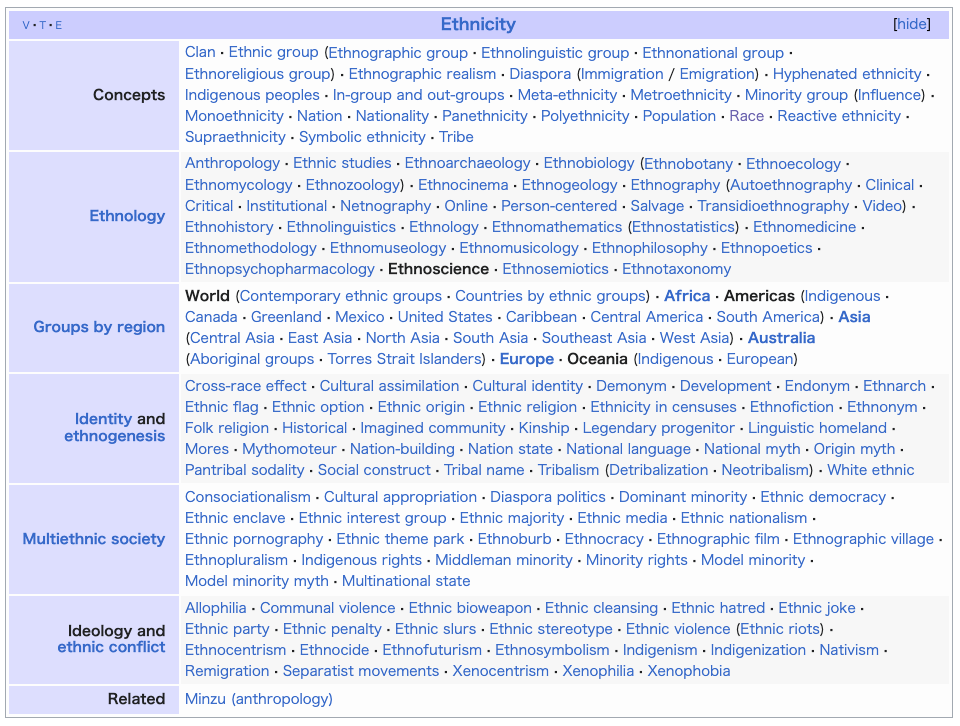
☆エスニシティ(民族性)に関するウィキペディアのエントリー
リンク
文献
その他の情報

++
Copyleft,
CC, Mitzub'ixi Quq Chi'j, 1996-2099
