アグノトロジー
Agnotology, 無知学
☆ 知識社会学において、アグノトロジー(以前はアグナトロジー; agnotology) とは、意図的な、文化的に誘導された無知や疑いを研究する学問である。典型的には、不正確な、あるいは誤解を招くような科学的データの公表(ディスイン フォメーション)を通じて、製品を販売したり、世論に影響を与えたり、好意を得たりすることを目的としている。より一般的に言えば、この用語は、ある主題 についてより多くの知識がより大きな不確実性を生み出す状況を含む。 スタンフォード大学のロバート・N・プロクター教授は、たばこ産業がたばこ使用の健康への悪影響について疑いを生じさせるための広報キャンペーンを展開し たことを、その典型的な例として挙げている。[7][8] コーネル大学のデビッド・ダニングは、強力な権力がインターネットを利用して「無知を広める」ことを警告している。[6] 文化的に誘導された無知の要因には、メディア、企業、政府機関などが含まれ、機密保持や情報の隠蔽、文書の破棄、選択的記憶などを通じて無知が蔓延する。 受動的な要因には、人種や階級の違いを反映する構造的な情報バブルなど、情報へのアクセスに基づくものがある。 アグノトロジーはまた、多様な知識が「存在するようになる」ことがない理由、あるいは無視されたり遅延したりする理由にも焦点を当てている。例えば、プ レートテクトニクスに関する知識は、一部の証拠が海底戦争に関連する機密軍事情報として分類されていたため、少なくとも10年間は検閲され遅延した。 大量の知識が利用可能になることで、人々は自分の信念を補強する情報(事実かどうかは問わない)を恣意的に選択するようになり[10]、反復的または事実 無根の娯楽を消費することで都合の悪い知識を無視するようになる可能性がある。テレビが視聴者に与える影響については、相反する証拠がある。[11]
| Within the sociology
of knowledge, agnotology (formerly agnatology) is the study of
deliberate, culturally induced ignorance or doubt, typically to sell a
product, influence opinion, or win favour, particularly through the
publication of inaccurate or misleading scientific data
(disinformation).[5][6] More generally, the term includes the condition
where more knowledge of a subject creates greater uncertainty. Stanford University professor Robert N. Proctor cites the tobacco industry's public relations campaign to manufacture doubt about the adverse health effects of tobacco use as a prime example.[7][8] David Dunning of Cornell University warns that powerful interests exploit the internet to "propagate ignorance".[6] Agents of culturally induced ignorance include the media, corporations, and government agencies, through secrecy and suppression of information, document destruction, and selective memory.[9] Passive causes include structural information bubbles, including those that reflect racial and class differences, based on access to information. Agnotology also focuses on how and why diverse knowledge does not "come to be", or is ignored or delayed. For example, knowledge about plate tectonics was censored and delayed for at least a decade because some evidence remained classified military information related to undersea warfare.[7] The availability of large amounts of knowledge may allow people to cherry-pick information (whether or not factual) that reinforces their beliefs[10] and ignore inconvenient knowledge by consuming repetitive or fact-free entertainment. Evidence conflicts on how television affects viewers.[11] |
知識社会学において、アグノトロジー(以前はアグナトロジー)とは、意
図的な、文化的に誘導された無知や疑いを研究する学問である。典型的には、不正確な、あるいは誤解を招くような科学的データの公表(ディスインフォメー
ション)を通じて、製品を販売したり、世論に影響を与えたり、好意を得たりすることを目的としている。より一般的に言えば、この用語は、ある主題について
より多くの知識がより大きな不確実性を生み出す状況を含む。 スタンフォード大学のロバート・N・プロクター教授は、たばこ産業がたばこ使用の健康への悪影響について疑いを生じさせるための広報キャンペーンを展開し たことを、その典型的な例として挙げている。[7][8] コーネル大学のデビッド・ダニングは、強力な権力がインターネットを利用して「無知を広める」ことを警告している。[6] 文化的に誘導された無知の要因には、メディア、企業、政府機関などが含まれ、機密保持や情報の隠蔽、文書の破棄、選択的記憶などを通じて無知が蔓延する。 受動的な要因には、人種や階級の違いを反映する構造的な情報バブルなど、情報へのアクセスに基づくものがある。 アグノトロジーはまた、多様な知識が「存在するようになる」ことがない理由、あるいは無視されたり遅延したりする理由にも焦点を当てている。例えば、プ レートテクトニクスに関する知識は、一部の証拠が海底戦争に関連する機密軍事情報として分類されていたため、少なくとも10年間は検閲され遅延した。 大量の知識が利用可能になることで、人々は自分の信念を補強する情報(事実かどうかは問わない)を恣意的に選択するようになり[10]、反復的または事実 無根の娯楽を消費することで都合の悪い知識を無視するようになる可能性がある。テレビが視聴者に与える影響については、相反する証拠がある。[11] |
| Origins There is a cult of ignorance in the United States, and there has always been. The strain of anti-intellectualism has been a constant thread winding its way through our political and cultural life, nurtured by the false notion that democracy means that "my ignorance is just as good as your knowledge".---- Isaac Asimov, 1980[12] The term was coined in 1992 by linguist and social historian Iain Boal[13][5][14][15] at the request of Stanford University professor Robert N. Proctor.[16] The word is based on the Neoclassical Greek word agnōsis (ἄγνωσις, 'not knowing'; cf. Attic Greek ἄγνωτος, 'unknown' and -logia (-λογία).[7] The term "agnotology" first appeared in print in a footnote in Stanford University professor Proctor's 1995 book, The Cancer Wars: How Politics Shapes What We Know and Don't Know About Cancer: Historians and philosophers of science have tended to treat ignorance as an ever-expanding vacuum into which knowledge is sucked – or even, as Johannes Kepler once put it, as the mother who must die for science to be born. Ignorance, though, is more complex than this. It has a distinct and changing political geography that is often an excellent indicator of the politics of knowledge. We need a political agnotology to complement our political epistemologies.[17] In a 2001 interview about his lapidary work with agate, Proctor used the term to describe his research "only half jokingly" as "agnotology". He connected the topics by noting the lack of geologic knowledge and study of agate since its first known description by Theophrastus in 300 BC, relative to the extensive research on other rocks and minerals such as diamonds, asbestos, granite, and coal. He said agate was a "victim of scientific disinterest," the same "structured apathy" he called "the social construction of ignorance".[18] He was later quoted as calling it "agnotology, the study of ignorance," in a 2003 The New York Times story on medical historians who testify as expert witnesses.[19] In 2004, Londa Schiebinger[20] claimed that agnotology questions why humans do not know important information and that it could be an "outcome of cultural and political struggle".[21] In 2004, Schiebinger offered a more precise definition in a paper on 18th-century voyages of scientific discovery and gender relations,[20] and contrasted it with epistemology, the theory of knowledge, saying that the latter questions how humans know while the former questions why humans do not know: "Ignorance is often not merely the absence of knowledge but an outcome of cultural and political struggle."[21] Proctor co-organized events with Schiebinger, his wife and fellow professor of science history.[22][9] In 2008, they published an anthology entitled Agnotology: The Making and Unmaking of Ignorance, which "provides a new theoretical perspective to broaden traditional questions about 'how we know' to ask: Why don't we know what we don't know?" They locate agnotology within the field of epistemology.[23] |
起源 米国には無知のカルトが存在し、それは常に存在してきた。反知性の風潮は、政治や文化の生活に絶えず入り込み、民主主義とは私の無知はあなたの知識と同じくらい価値がある」という誤った考えによって育まれてきた。——アイザック・アシモフ、1980年[12] この用語は、スタンフォード大学のロバート・N・プロクター教授の依頼により、言語学者で社会史家のイアン・ボールが1992年に造語したものである。 [13][5][14][15] この言葉は、 新古典ギリシャ語のagnōsis(ἄγνωσις、「知らない」;アッティカ・ギリシャ語ἄγνωτος、「未知」および-logia(-λογία) を参照。[7] 「アグノロジー」という用語は、スタンフォード大学のプロクター教授が1995年に出版した著書『The Cancer Wars: How Politics Shapes What We Know and Don't Know About Cancer』の脚注で初めて印刷物として登場した。 科学史家や科学哲学者たちは、無知を知識が吸い込まれる、拡大し続ける真空地帯として扱う傾向がある。あるいは、ヨハネス・ケプラーがかつて述べたよう に、科学が誕生するには死ななければならない母のようなものとして扱う傾向もある。しかし、無知はそれよりも複雑である。無知には、知識の政治を明確に示 し、変化する独特の政治地理がある。私たちは、政治的認識論を補完する政治的アグノトロジーを必要としている。 2001年のインタビューで、瑪瑙(めのう)の宝石細工に関する研究について、プロクターは「半分冗談で」自身の研究を「アグノロジー」と表現した。彼 は、紀元前300年にテオフラストスが瑪瑙について初めて記述して以来、瑪瑙に関する地質学的知識や研究がほとんど進んでいないことを指摘し、ダイヤモン ド、アスベスト、花崗岩、石炭など、他の鉱物や岩石に関する広範な研究と比較した。彼は、アゲートは「科学的な無関心の犠牲者」であり、それは彼が「無知 の社会的構築」と呼ぶのと同じ「構造化された無関心」であると述べた。[18] 彼は後に、2003年のニューヨーク・タイムズ紙の記事で、専門家証人として証言する医学史家たちについて、「アグノロジー(agnotology)、無知の研究」と呼んだと引用されている。[19] 2004年には、ロンド・シービンガー(Londa Schiebinger)[20]が、アグノトロジーは人間が重要な情報を知らない理由を問うものであり、それは「文化や政治闘争の結果」である可能性があると主張した。[21] 2004年、Schiebingerは18世紀の科学的発見の航海とジェンダー関係に関する論文で、より正確な定義を提示し[20]、認識論(知識の理 論)と対比させ、後者は人間がどのように知るかを問うのに対し、前者は人間がなぜ知らないかを問うと述べた。「無知とは、しばしば単に知識の欠如ではな く、文化的・政治的闘争の結果である。」[21] プロクターは、妻であり科学史の同僚教授であるシビリンガーと共同でイベントを企画した。[22][9] 2008年には、彼らは『アグノロジー: 「無知の生成と消滅」という題名で、「「我々が何を知っているか」という従来の問いを広げる新しい理論的視点を提供する。「我々が知らないことをなぜ知ら ないのか?」」 彼らはアグノロジーを認識論の分野に位置づけている。[23] |
| Examples Some other examples offered by Proctor include Nakba education in the United States [24] and Penn State as an official United States Marine Corps university.[24] The fossil fuel industry used the technique in its campaign against the scientific consensus on climate change. It became the focus of the 2010 book Merchants of Doubt by Naomi Oreskes and Erik M. Conway.[25] Oil companies paid teams of scientists to downplay its effects.[26] Michael Betancourt used agnotology in a critical assessment of political economy in a 2010 article and book.[27][28] His analysis focused on the housing bubble as well as the 1980 to 2008 period. Betancourt argued that this political economy should be termed "agnotologic capitalism", claiming that the systematic production and maintenance of ignorance enabled a "bubble economy" that allowed the economy to function.[20] In his view, the role of affective labor is to create/maintain agnotologic views that enable the maintenance of the capitalist status quo. This is done by proffering counters to every fact, creating contention and confusion that is difficult to resolve. This confusion reduces dissent by deenergizing its motivating alienation and thus its potential to address weaknesses that may trigger collapse.[27] |
例 プロクターが挙げたその他の例としては、米国におけるナクバ教育[24]や、米国海兵隊の公式大学としてのペンシルベニア州立大学[24]などがある。 化石燃料業界は、気候変動に関する科学的コンセンサスに対するキャンペーンでこのテクニックを使用した。このテクニックは、2010年の書籍 『Merchants of Doubt』(疑いの商人)の中心テーマとなった。この書籍は、ナオミ・オレスケスとエリック・M・コンウェイによる共著である。[25] 石油会社は、その影響を過小評価する科学者チームに報酬を支払った。[26] マイケル・ベタンクールは、2010年の論文および著書において、政治経済の批判的評価にアグノロジーを用いた。[27][28] 彼の分析は、住宅バブルと1980年から2008年の期間に焦点を当てた。ベタンクールは、この政治経済を「アグノロジック資本主義」と呼ぶべきだと主張 し、無知の体系的な生産と維持が「バブル経済」を可能にし、経済が機能することを可能にしていると主張した。[20] 彼の考えでは、感情労働の役割は、資本主義の現状を維持することを可能にするアグノロジックな見解を創出・維持することである。これは、あらゆる事実に対 して反論を提示し、解決が困難な論争や混乱を生み出すことによって行われる。この混乱は、動機となる疎外感を弱め、崩壊の引き金となる可能性のある弱点に 対処する潜在的な力を奪うことによって、反対意見を減らす。[27] |
| Related concepts Agnoiology Main article: Agnoiology From the same Greek roots, agnoiology refers either to "the science or study of ignorance, which determines its quality and conditions"[29] or "the doctrine concerning those things of which we are necessarily ignorant,"[30] describing a branch of philosophy studied by James Frederick Ferrier in the 19th century.[31] Ainigmology Anthropologist Glenn Stone points out that some examples of agnotology (such as work promoting tobacco use) do not actually create a lack of knowledge so much as they create confusion. As a more accurate term Stone suggested "ainigmology", from the Greek root ainigma (as in 'enigma'), referring to riddles or to language that obscures the true meaning of a story.[32] Cognitronics An emerging scientific discipline that connects to agnotology is cognitronics,[33][34] which aims to explain distortions in perception caused by the information society and globalization and cope with these distortions.[34] Unknowledge Irvin C. Schick distinguishes unknowledge from ignorance, using the example of "terra incognita" in early maps in which mapmakers marked unexplored territories with that or similar labels, which provided "potential objects of Western political and economic attention."[35] |
関連概念 アグノロジー 詳細は「アグノロジー」を参照 同じギリシャ語の語源から、アグノロジーは「無知の質と条件を決定する科学または研究」[29]、あるいは「我々が必然的に無知であるものに関する教義」[30]を指し、19世紀にジェームズ・フレデリック・フェリエが研究した哲学の一分野を指す。 アインギノロジー 人類学者グレン・ストーンは、アグノロジーの例(例えば、たばこの使用を促進するような活動)の中には、実際には知識の欠如を生み出すというよりも、むし ろ混乱を生み出すものもあると指摘している。より正確な用語として、ストーンはギリシャ語の「アインギマ(エニグマと同様)」を語源とする「アインギノロ ジー」を提案している。これは、謎や、物語の真の意味を不明瞭にするような言語を指すものである。 コグニトロニクス アグノトロジーと関連する新興の科学分野にコグニトロニクスがある。これは、情報社会やグローバル化によって引き起こされる知覚の歪みを説明し、それに対処することを目的としている。 アンノレッジ アーヴィン・C・シックは、「アンノレッジ」と「無知」を区別し、初期の地図における「terra incognita(未知の地)」の例を挙げている。地図製作者たちは、そのラベルや類似のラベルで未開拓の地域をマークし、それによって「西洋の政治 的・経済的関心の対象となり得るもの」が示された[35]。 |
| See also Antiscience – Attitudes that reject science and the scientific method Anti-intellectualism – Hostility to and mistrust of education, philosophy, art, literature, and science Cancer Wars – 1998 documentary, a six-part documentary that aired on PBS in 1997, based on Robert N. Proctor's 1995 book, Cancer Wars: How Politics Shapes What we Know and Don't Know About Cancer Cognitive dissonance – Stress from contradiction between beliefs and actions, a social psychology theory that may explain the ease of maintaining ignorance (because people are driven to ignore conflicting evidence) and which also provides clues to how to bring about knowledge (perhaps by forcing the learner to reconcile reality with long-held, though inaccurate beliefs; see Socratic method) Cognitive inertia – Lack of motivation to mentally tackle a problem or issue Confirmation bias – Bias confirming existing attitudes Conspiracy of silence (expression) – CULTURE OF SILENCE Creationism – Belief that nature originated through supernatural acts, systematic denial of scientific biological realities by misrepresenting them in terms of various dogmatic tenets Denialism – Person's choice to deny psychologically uncomfortable truth Doubt Is Their Product – 2008 book by David Michaels The Dunning–Kruger effect, a cognitive bias whereby people with low ability at a task overestimate their skill level, and people with high ability at a task underestimate their skill level. Fear, uncertainty and doubt (FUD) – Tactic used to influence opinion, a disinformation technique using the appeal to fear Intelligent design – Pseudoscientific argument for the existence of God, a class of creationism that attempts to support assorted topics in biological denialism by misrepresenting them and related junk science as scientific research Japanese commercial whaling – Commercial hunting of whales by the Japanese fishing industry, an attempt at obfuscation of the culpability of commercial whaling by misrepresenting its junk-scientific rationale as scientific research. Junk science – Scientific data considered to be spurious or fraudulent Merchants of Doubt – 2010 book by Naomi Oreskes and Erik M. Conway Misinformation Historical negationism – Illegitimate distortion of the historical record Neo-Luddism – Philosophy opposing modern technology Obscurantism – Practice of obscuring information Sociology of scientific ignorance – Study of ignorance in science, or Ignorance Studies, the study of ignorance as something relevant. Subvertising – Parody advertising The Republican War on Science – 2005 book by Chris Mooney Thought suppression – Conscious effort to discontinue a thought Vaccine controversies – Reluctance or refusal to be vaccinated or have one's children vaccinated, based on assorted junk-scientific strategies to misrepresent life- and health-saving technologies as harmful rather than beneficial. |
関連項目 反科学 – 科学や科学的手法を拒絶する態度 反知性主義 – 教育、哲学、芸術、文学、科学に対する敵意や不信 Cancer Wars – 1998年のドキュメンタリー、1997年にPBSで放映された6部構成のドキュメンタリー、ロバート・N・プロクターの1995年の著書『Cancer Wars: How Politics Shapes What we Know and Don't Know About Cancer』に基づく 認知的不協和 - 信念と行動の間の矛盾から生じるストレス。無知を維持しやすい理由を説明する社会心理学理論(人々は相反する証拠を無視するよう駆り立てられるため)。ま た、知識を得る方法の手がかりも提供する(おそらく、長年抱いてきた不正確な信念と現実を学習者に和解させることで、ソクラテス式教授法を参照)。 認知の惰性 - 問題や課題に精神的に取り組む意欲の欠如 確証バイアス(Confirmation bias) – 既存の態度を裏付けるバイアス 沈黙の共謀(Conspiracy of silence) – 沈黙の文化 創造説(Creationism) – 自然は超自然的行為によって生じたという信念。科学的生物学的現実を、さまざまな独断的教義の観点から誤って表現することによって体系的に否定する 否定論(Denialism) – 心理的に不快な真実を否定するという個人の選択 疑いが彼らの商品(Doubt Is Their Product) – 2008年のデビッド・マイケルズ著の書籍 ダンニング=クルーガー効果:ある課題に対して能力が低い人が自分のスキルレベルを過大評価し、高い人がスキルレベルを過小評価する認知バイアス。 恐怖、不安、疑念(FUD):意見に影響を与えるための戦術、恐怖を煽る偽情報テクニック インテリジェント・デザイン – 神の存在を主張する疑似科学的な議論であり、生物学的否定論のさまざまなトピックを、それらと関連するジャンクサイエンスを科学的研究であるかのように偽って表現することで支持しようとする創造論の一種 日本の商業捕鯨 – 日本の漁業業界による商業捕鯨、ジャンクサイエンス的な根拠を科学的研究であるかのように偽って表現することで、商業捕鯨の罪の意識を曖昧にしようとする試み ジャンクサイエンス(がらくた科学) – 偽りの、または不正な科学的データ 疑いの商人(Merchants of Doubt) – 2010年にナオミ・オレスケスとエリック・M・コンウェイが発表した書籍 誤報 歴史否定論(Historical negationism) – 歴史記録の不正な歪曲 新ラッダイト主義(Neo-Luddism) – 近代技術に反対する哲学 オブラクティズム(Obscurantism) – 情報を隠蔽する行為 科学的無知の社会学 - 科学における無知の研究、または無知研究、無知を関連するものとして研究する学問。 サボタイジング - パロディ広告 共和党の科学戦争 - 2005年のクリス・ムーニー著 思考抑制 - 思考を停止させる意識的努力 ワクチン論争 – ワクチン接種や子供のワクチン接種を拒否すること。それは、救命・健康維持技術を有害であると誤って表現する、さまざまなジャンクサイエンス戦略に基づいている。 |
| https://en.wikipedia.org/wiki/Agnotology |
|
| Cognitive bias |
認知バイアス[cognitive bias] |
| A cognitive bias
is a systematic pattern of deviation from norm or rationality in
judgment.[1][2] Individuals create their own "subjective reality" from
their perception of the input. An individual's construction of reality,
not the objective input, may dictate their behavior in the world. Thus,
cognitive biases may sometimes lead to perceptual distortion,
inaccurate judgment, illogical interpretation, and
irrationality.[3][4][5] While cognitive biases may initially appear to be negative, some are adaptive. They may lead to more effective actions in a given context.[6] Furthermore, allowing cognitive biases enables faster decisions which can be desirable when timeliness is more valuable than accuracy, as illustrated in heuristics.[7] Other cognitive biases are a "by-product" of human processing limitations,[1] resulting from a lack of appropriate mental mechanisms (bounded rationality), the impact of an individual's constitution and biological state (see embodied cognition), or simply from a limited capacity for information processing.[8][9] Cognitive biases can make individuals more inclined to endorsing pseudoscientific beliefs by requiring less evidence for claims that confirm their preconceptions. This can potentially distort their perceptions and lead to inaccurate judgments.[10] A continually evolving list of cognitive biases has been identified over the last six decades of research on human judgment and decision-making in cognitive science, social psychology, and behavioral economics. The study of cognitive biases has practical implications for areas including clinical judgment, entrepreneurship, finance, and management.[11][12] |
認知バイアス[cognitive bias]
とは、判断において規範や合理性から逸脱する体系的なパターンを指す。[1][2]
個人は、受け取った情報に対する自身の認識から、独自の「主観的現実」を構築する。客観的な情報そのものではなく、個人が構築した現実像が、その人の行動
を左右することがある。したがって、認知バイアスは、知覚の歪み、不正確な判断、非論理的な解釈、そして非合理性につながる場合がある。[3][4]
[5] 認知バイアスは一見すると否定的に見えるかもしれないが、中には適応的なものもある。特定の状況下では、より効果的な行動につながる場合がある。[6] さらに、認知バイアスを許容することで意思決定が迅速化され、ヒューリスティクスで示されるように、正確さよりも迅速さが重視される場合には望ましい結果 をもたらすことがある。[7] その他の認知バイアスは、人間の処理能力の限界による「副産物」であり[1]、適切な精神的メカニズムの欠如(限定合理性)、個人の体質や生物学的状態の 影響(身体化された認知を参照)、あるいは単に情報処理能力の限界に起因するものである。[8][9] 認知バイアスは、既成概念を裏付ける主張に対して必要な証拠の量を減らすことで、個人が疑似科学的な信念を支持する傾向を強める可能性がある。これによ り、個人の認識が歪められ、不正確な判断につながる可能性がある。[10] 認知科学、社会心理学、行動経済学における人間の判断と意思決定に関する過去60年間の研究を通じて、絶えず進化し続ける認知バイアスのリストが特定されてきた。認知バイアスの研究は、臨床判断、起業、金融、経営などの分野において実用的な意義を持つ。[11][12] |
| Overview When making judgments under uncertainty, people rely on mental shortcuts or heuristics, which provide swift estimates about the possibility of uncertain occurrences. For example, the representativeness heuristic is defined as the tendency to judge the frequency or likelihood of an occurrence by the extent of which the event resembles the typical case.[13] Similarly the availability heuristic is that individuals estimate the likelihood of events by how easy they are to recall, and the anchoring heuristic prefers the initial reference points that are recalled.[14] While these heuristics are efficient and simple for the brain to compute, they sometimes introduce predictable and systematic cognitive errors, or biases.[7] The "Linda Problem" illustrates the representativeness heuristic and corresponding bias. Participants were given a description of "Linda" that suggests Linda might well be a feminist (e.g., she is said to be concerned about discrimination and social justice issues). They were then asked whether they thought Linda was more likely to be (a) a "bank teller" or (b) a "bank teller and active in the feminist movement." A majority chose answer (b). Independent of the information given about Linda, though, the more restrictive answer (b) is under any circumstance statistically less likely than answer (a). This is an example of the conjunction fallacy: respondents chose (b) because it seemed more "representative" or typical of persons who might fit the description of Linda.[15] The representativeness heuristic may lead to errors such as activating stereotypes and inaccurate judgments of others.[16] Gerd Gigerenzer argues that heuristics should not lead us to conceive of human thinking as riddled with irrational cognitive biases. They should rather conceive rationality as an adaptive tool, not identical to the rules of formal logic or the probability calculus.[17] Gigerenzer believes that cognitive biases are not biases, but rules of thumb, or as he would put it "gut feelings" that can actually help us make accurate decisions in our lives. There is not clear evidence that these behaviors are genuinely, severely biased once the actual problems people face are understood. Advances in economics and cognitive neuroscience now suggest that many behaviors previously labeled as biases might instead represent optimal decision-making strategies.[18] |
概要 不確実な状況下で判断を下す際、人は「メンタルショートカット」や「ヒューリスティック」に依存し、それによって不確実な事象の発生可能性について迅速な 推定を行います。例えば、「代表性ヒューリスティック」とは、ある事象が典型的な事例にどの程度似ているかによって、その発生頻度や可能性を判断する傾向 を指します。[13] 同様に、利用可能性ヒューリスティックとは、個人が事象を思い出しやすいかどうかに基づいてその発生確率を推定するものであり、アンカリング・ヒューリス ティックは、最初に思い浮かんだ基準点を優先する傾向を指す。[14] これらのヒューリスティックは、脳にとって効率的で計算が容易であるが、時に予測可能かつ体系的な認知的誤り、すなわちバイアスを引き起こすことがある。 [7] 「リンダ問題」は、代表性ヒューリスティックとそれに対応するバイアスを例示している。被験者には、リンダがフェミニストである可能性が高いことを示唆す る説明(例:彼女は差別や社会正義の問題に関心を持っていると言われている)が与えられた。その後、リンダが(a)「銀行の窓口係」である可能性と、 (b)「銀行の窓口係であり、フェミニスト運動にも積極的に参加している」可能性のどちらが高いと思うか尋ねられた。大多数が(b)を選んだ。しかし、リ ンダに関する与えられた情報とは無関係に、より限定的な回答(b)は、いかなる状況においても統計的には回答(a)よりも確率が低い。これは結合の誤謬の 一例である。回答者が(b)を選んだのは、それがリンダの描写に当てはまる人物にとってより「代表的」あるいは典型的であるように見えたからである。 [15] 代表性ヒューリスティックは、ステレオタイプを活性化させたり、他者に対する不正確な判断を下したりといった誤りを招く可能性がある。[16] ゲルト・ギゲレンツァーは、ヒューリスティックによって人間の思考が非合理的な認知バイアスに満ちていると捉えるべきではないと主張している。むしろ、 ヒューリスティックは、形式論理や確率計算の規則と同一ではない、適応的なツールとして合理性を捉えるべきである。[17] ギゲレンツァーは、認知バイアスはバイアスではなく、経験則、あるいは彼が言うところの「直感」であり、実際には私たちが人生において正確な決定を下すの に役立つものであると考えている。人々が直面する実際の問題を理解すれば、こうした行動が真に、かつ深刻なバイアスであるという明確な証拠はない。経済学 や認知神経科学の進歩により、以前はバイアスとラベル付けされていた多くの行動は、むしろ最適な意思決定戦略を表している可能性があることが示唆されてい る。[18] |
| "bias ... that occurs when humans are processing and interpreting information" |
「人間が情報を処理し、解釈する際に生じるバイアス」——SO/IEC TR 24027:2021(en), 3.2.4,[19] ISO/IEC TR 24368:2022(en), 3.8[20] |
| "...we can define cognitive
biases as systematic errors in cognition that occur when, having an
epistemic goal, we non-consciously deviate from it by relying on
irrelevant or partially relevant information and ignoring that which is
relevant." |
「……認知バイアスとは、認識上の目標を持ちながらも、無意識のうち
に、関連性のない情報や部分的にしか関連性のない情報に依存し、関連性のある情報を無視することで、その目標から逸脱してしまう際に生じる、認知における
体系的な誤りであると定義できる。」——Nadurak V. (2025). Heuristics and cognitive biases:
A conceptual analysis. Memory & cognition,
10.3758/s13421-025-01814-w. Advance online publication.
https://doi.org/10.3758/s13421-025-01814-w[21] |
| List of biases Main article: List of cognitive biases The following is a list of the more commonly studied cognitive biases: |
バイアスの一覧 主な記事:認知バイアスの一覧[List of cognitive biases] 以下は、よく研究されている認知バイアスの一覧です: |
認知バイアス一覧表(1/2) |
認知バイアス一覧表(2/2)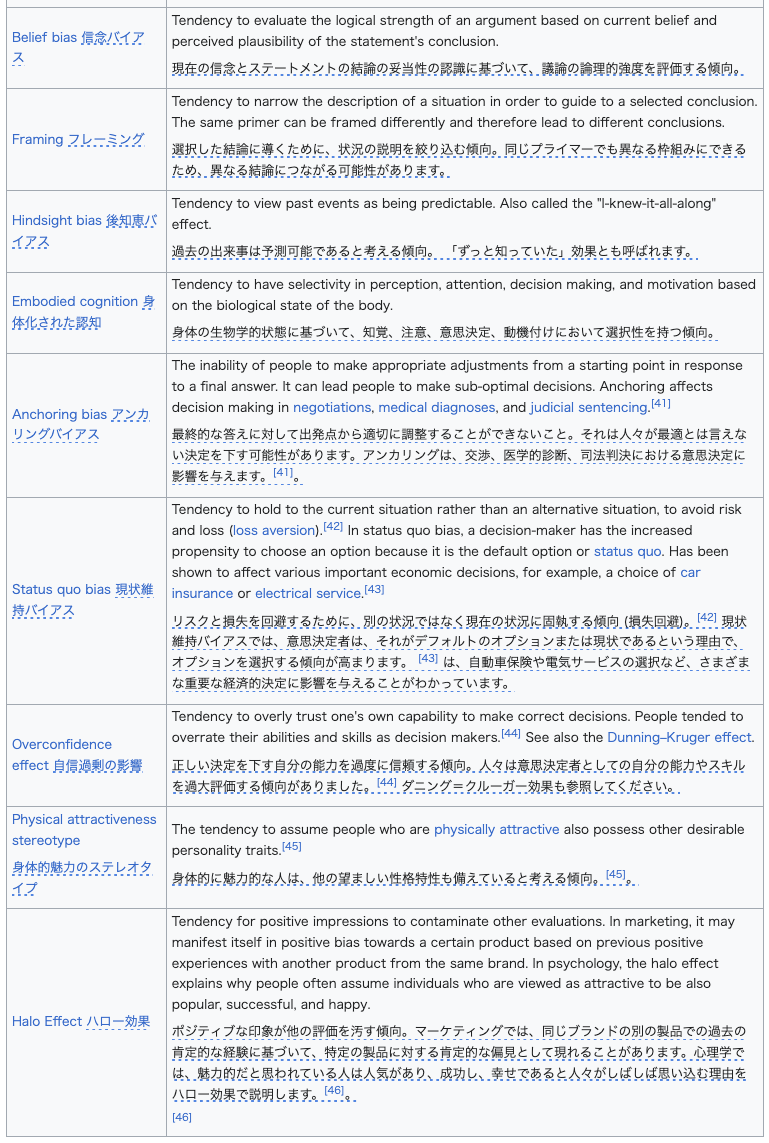 |
The relation between cognitive bias, habit and social convention is still an important issue. |
認知バイアス、習慣、そして社会的慣習の関係は、依然として重要な課題である。 |
| https://en.wikipedia.org/wiki/Cognitive_bias |

Having called conclusions about human-caused climate change "alarmist"[1] contrary to the scientific consensus on climate change, Republican Senator Jim Inhofe displayed a snowball—in winter—as evidence the globe was not warming[2]—in a year that was found to be Earth's warmest to date.[3] The director of NASA's Goddard Institute for Space Studies distinguished local weather in a single location in a single week from global climate change.[4]
人
間による気候変動に関する結論を「誇張的」と表現した共和党の上院議員ジム・インホフ氏は科学的見地からの気候変動に関するコンセンサスに反するものとし
て[1]、地球温暖化が進んでいない証拠として冬に雪玉を披露した[2]
。これは、地球がこれまでに最も温暖化した年であることが判明した年での出来事である。[3]
NASAのゴダード宇宙研究所の所長は、1週間の1つの場所における局地的な気象を、地球規模の気候変動と区別した。[4]
☆認知バイアス一覧表(1/2)
★認知バイアス一覧表(2/2)
リ ンク
文 献
そ の他の情報
Copyleft, CC, Mitzub'ixi Quq Chi'j, 1996-2099

☆
 ☆
☆
