
人新世
Anthropocene
人新世[じんしんせい;ひとしんせい;どちらも問題なし:アントロポセーン][Anthropocene]とは「人為的な気候変動に限らず、地球の地質 や生態系に人類が大き な影響を及ぼし始めた時期から始まる地質学的なエポックの提案である。2022年2月現在、国際層序委員会(ICS)も国際地質科学連合(IUGS)も、 この用語を地質学的時間の区分として公式に承認しているわけではない。しかしながら、この地質時代区分は、第二次世界大戦後に社会経済や地球システムのト レンドが飛躍的に増加した「大加速」の 開始時期や「原子時代(the Atomic Age)」と重なる。人新世の開始時期については、12,000~15,000年前の農業革命の始まりから1960年代まで、様々なものが提唱されてい る。しかし、1950年代の原爆実験による放射性核種の降下量のピークを、人新世の始まりとする説が有力で、1945年の最初の原爆の爆発、あるいは 1963年の部分的核実験禁止条約が制定された頃とされている」出典)。
もし、人新世(Plantationocene.html)という概念が、グローバル・スタ ディーズに影響をうけつつ登場したとすれば、「プ ランテーション新世(Plantationocene)」は、それに似ていながら、その概念の政治的中立性というカモフラージュを払拭し、地球全体の人類 の苦境を表現する対抗的な概念で あることがわかるだろう。
プランテーション新世(Plantationocene)は、「人新世」に代わる用語として 「人新世の起源 を近世のアメリカ大陸 における植民地主義の始まりとし、プランテーションの歴史に注目することで、その背後にある暴力的な歴史を浮き彫りにした」かたちで提示された。プラン テーション新世(Plantationocene)とは「スペインとポルトガルの植 民者が、1,500年代までに、大西洋諸島で100年前に開発したプランテーションのモデルをアメリカ大陸に輸入し始めたことからはじまる(→「生態学的 帝国主義」)。これらのプランテーションのモ デ ルは、移住による強制労働(奴隷制)、集約的な土地利用、グローバル化した商業、絶え間ない人種的暴力に基づくもので、これらすべてが世界中の人間および 人類以外の生物の生活を一変させた。現在および過去のプランテーションは、植民地主義、資本主義、人種差別の歴史と、気温上昇、海水面の上昇、有害物質、 土地の処 分などに対して他の人間よりもリスクが大きい環境問題を切り離すことができないという」点で重要なのである(出典)。
| Anthropocene is a
term that has been used to refer to the period of time during which
humanity has become a planetary force of change. It appears in
scientific and social discourse, especially with respect to
accelerating geophysical and biochemical changes that characterize the
20th and 21st centuries on Earth. Originally a proposal for a new
geological epoch following the Holocene, it was rejected as such in
2024 by the International Commission on Stratigraphy (ICS) and the
International Union of Geological Sciences (IUGS).[1][2][3] The term has been used in research relating to Earth's water, geology, geomorphology, landscape, limnology, hydrology, ecosystems and climate.[4][5] The effects of human activities on Earth can be seen for example in biodiversity loss and climate change. Various start dates for the Anthropocene have been proposed, ranging from the beginning of the Neolithic Revolution (12,000–15,000 years ago), to as recently as the 1960s. The biologist Eugene F. Stoermer is credited with first coining and using the term anthropocene informally in the 1980s; Paul J. Crutzen re-invented and popularized the term.[6] The Anthropocene Working Group (AWG) of the Subcommission on Quaternary Stratigraphy (SQS) of the ICS voted in April 2016 to proceed towards a formal golden spike (GSSP) proposal to define an Anthropocene epoch in the geologic time scale. The group presented the proposal to the International Geological Congress in August 2016.[7] In May 2019, the AWG voted in favour of submitting a formal proposal to the ICS by 2021.[8] The proposal located potential stratigraphic markers to the mid-20th century.[9][8][10] This time period coincides with the start of the Great Acceleration, a post-World War II time period during which global population growth, pollution and exploitation of natural resources have all increased at a dramatic rate.[11] The Atomic Age also started around the mid-20th century, when the risks of nuclear wars, nuclear terrorism and nuclear accidents increased. Twelve candidate sites were selected for the GSSP; the sediments of Crawford Lake, Canada were finally proposed, in July 2023, to mark the lower boundary of the Anthropocene, starting with the Crawfordian stage/age in 1950.[12][13] In March 2024, after 15 years of deliberation, the Anthropocene Epoch proposal of the AWG was voted down by a wide margin by the SQS, owing largely to its shallow sedimentary record and extremely recent proposed start date.[14][15] The ICS and the IUGS later formally confirmed, by a near unanimous vote, the rejection of the AWG's Anthropocene Epoch proposal for inclusion in the Geologic Time Scale.[1][2][3] The IUGS statement on the rejection concluded: "Despite its rejection as a formal unit of the Geologic Time Scale, Anthropocene will nevertheless continue to be used not only by Earth and environmental scientists, but also by social scientists, politicians and economists, as well as by the public at large. It will remain an invaluable descriptor of human impact on the Earth system."[3] |
アントロポセン(人新世)[Anthropocene]とは、人類が惑星を変化させる力となった期間
を指す言葉である。科学的・社会的な言説の中で、特に20世紀と21世紀の地球を特徴づける加速度的な地球物理学的・生化学的変化に関して登場する。もと
もとは完新世に続く新しい地質学的エポックの提案であったが、2024年に国際層序委員会(ICS)と国際地質科学連合(IUGS)によって却下された
[1][2][3]。 この用語は、地球の水、地質学、地形学、景観、湖沼学、水文学、生態系、気候に関連する研究で使用されている[4][5]。地球に対する人間活動の影響 は、例えば生物多様性の損失や気候変動に見られる。人新世の始まりは、新石器革命の始まり(12,000~15,000年前)から1960年代まで、様々 な年代が提唱されている。生物学者のユージン・F・ストーマーは、1980年代にアントロポセンという用語を最初に作り、非公式に使用したとされている。 ICSの第四紀層序小委員会(SQS)の人新世ワーキンググループ(AWG)は、2016年4月に地質学的時間スケールにおける人新世エポックを定義する ための正式なゴールデンスパイク(GSSP)提案に向けて進むことを決議した。同グループは2016年8月の国際地質学会議にこの提案を提出した[7]。 2019年5月、AWGは、2021年までにICSに正式な提案を提出することに賛成票を投じた[8]。 提案は、20世紀半ばに潜在的な層序学的マーカーを位置づけた[9][8][10]。 この時期は、世界的な人口増加、汚染、天然資源の搾取のすべてが劇的な速度で増加した第二次世界大戦後の時期である「大加速」の始まりと一致する [11]。 核戦争、核テロ、原発事故のリスクが高まった20世紀半ば頃には、原子時代も始まった[12]。 GSSPには12の候補地が選ばれたが、最終的にカナダのクロフォード湖の堆積物が2023年7月に提案され、1950年のクロフォード紀から始まる人新 世の下位境界を示すことになった[12][13]。 2024年3月、15年にわたる審議の後、AWGの人新世エポックの提案は、その浅い堆積記録と、提案された開始時期が極めて新しいことが主な原因となっ て、SQSによって大差で否決された[14][15]。 その後、ICSとIUGSは、ほぼ全会一致の投票によって、AWGの人新世エポックの提案を地質学的時間スケールに含めるための否決を正式に確認した [1][2][3]。否決に関するIUGSの声明は、次のように結んでいる: 「地質学的時間スケールの正式な単位としては却下されたものの、人新世は地球科学者や環境科学者だけでなく、社会科学者、政治家、経済学者、そして一般の 人々にも使われ続けるだろう。人類新世は、人類が地球システムに与える影響を表す貴重な言葉であり続けるだろう」[3]。 |
Development of the concept The Anthropocene is characterized by human impacts on their environment, with ramifications for variables such as climate change, biodiversity loss, and global food insecurity.[16] An early concept for the Anthropocene was the Noosphere by Vladimir Vernadsky, who in 1938 wrote of "scientific thought as a geological force".[17] Scientists in the Soviet Union appear to have used the term Anthropocene as early as the 1960s to refer to the Quaternary, the most recent geological period.[18] Ecologist Eugene F. Stoermer subsequently used Anthropocene with a different sense in the 1980s[19][20] and the term was widely popularised in 2000 by atmospheric chemist Paul J. Crutzen,[6][21] who regards the influence of human behavior on Earth's atmosphere in recent centuries as so significant as to constitute a new geological epoch.[22]: 21 [23] The pressures we exert on the planet have become so great that scientists are considering whether the Earth has entered an entirely new geological epoch: the Anthropocene, or the age of humans. It means that we are the first people to live in an age defined by human choice, in which the dominant risk to our survival is ourselves. —Achim Steiner, UNDP Administrator[24] The term Anthropocene is informally used in scientific contexts.[25] The Geological Society of America entitled its 2011 annual meeting: Archean to Anthropocene: The past is the key to the future.[26] The new epoch has no agreed start-date, but one proposal, based on atmospheric evidence, is to fix the start with the Industrial Revolution c.1780, with the invention of the steam engine.[27][28] Other scientists link the new term to earlier events, such as the rise of agriculture and the Neolithic Revolution (around 12,000 years BP). Evidence of relative human impact – such as the growing human influence on land use, ecosystems, biodiversity, and species extinction – is substantial; scientists think that human impact has significantly changed (or halted) the growth of biodiversity.[29][30][31][32] Those arguing for earlier dates posit that the proposed Anthropocene may have begun as early as 14,000–15,000 years BP, based on geologic evidence; this has led other scientists to suggest that "the onset of the Anthropocene should be extended back many thousand years";[33]: 1 this would make the Anthropocene essentially synonymous with the current term, Holocene. |
概念の発展 人新世は、気候変動、生物多様性の喪失、世界的な食糧不安などの変数に影響を及ぼす、人間が環境に与える影響によって特徴付けられる[16]。 人新世の初期の概念は、1938年に「地質学的な力としての科学的思考」と書いたウラジーミル・ヴェルナドスキーによるヌースフィアであった[17]。ソ ビエト連邦の科学者たちは、地質学的に最も新しい時代である第四紀を指すために、1960年代には早くも人新世という用語を使っていたようである [18]。ストーマーはその後、1980年代に異なる意味で人新世を使用し[19][20]、この用語は2000年に大気化学者のポール・J・クルッツェ ンによって広く一般化された[6][21]。彼は、ここ数世紀における地球の大気に対する人間の行動の影響を、新たな地質学的エポックを構成するほど重大 であるとみなしている[22]: 21 [23]。 私たちが地球に及ぼしている圧力は非常に大きくなっており、科学者たちは、地球がまったく新しい地質学的エポック「人新世」(人類の時代)に突入したかど うかを検討している。つまり、私たちは、人間の選択によって定義された時代に生きる最初の人間であり、その中で私たちの生存に対する支配的なリスクは、私 たち自身なのである。 -アキム・シュタイナー、国連開発計画(UNDP)長官[24]。 人新世という用語は、科学的な文脈で非公式に使用されている[25]: アルケアンから人新世へ: この新しいエポックには合意された開始日がないが、大気圏の証拠に基づく一つの提案は、蒸気機関の発明による1780年頃の産業革命を開始日とするもので ある[27][28]。他の科学者は、この新しい用語を、農業の勃興や新石器革命(約12,000年BP)など、それ以前の出来事に結びつけている。 土地利用、生態系、生物多様性、種の絶滅に対する人間の影響の増大など、相対的な人間の影響の証拠は相当なものであり、科学者たちは、人間の影響が生物多 様性の成長を著しく変化させた(あるいは止めた)と考えている[29][30][31]。 [29][30][31][32]より早い年代を主張する人々は、地質学的証拠に基づいて、提案されている人新世は14,000-15,000年BPにも 始まった可能性があると仮定している。このため、他の科学者は「人新世の始まりは何千年も遡るべきである」と提案している[33]: 1これは、人新世を 現在の用語である完新世と本質的に同義にすることになる。 |
| Anthropocene Working Group In 2008, the Stratigraphy Commission of the Geological Society of London considered a proposal to make the Anthropocene a formal unit of geological epoch divisions.[5][27] A majority of the commission decided the proposal had merit and should be examined further. Independent working groups of scientists from various geological societies began to determine whether the Anthropocene will be formally accepted into the Geological Time Scale.[34]  The Trinity test in July 1945 has been proposed as the start of the Anthropocene. In January 2015, 26 of the 38 members of the International Anthropocene Working Group published a paper suggesting the Trinity test on 16 July 1945 as the starting point of the proposed new epoch.[35] However, a significant minority supported one of several alternative dates.[35] A March 2015 report suggested either 1610 or 1964 as the beginning of the Anthropocene.[36] Other scholars pointed to the diachronous character of the physical strata of the Anthropocene, arguing that onset and impact are spread out over time, not reducible to a single instant or date of start.[37] A January 2016 report on the climatic, biological, and geochemical signatures of human activity in sediments and ice cores suggested the era since the mid-20th century should be recognised as a geological epoch distinct from the Holocene.[38] The Anthropocene Working Group met in April 2016 to consolidate evidence supporting the argument for the Anthropocene as a true geologic epoch.[39] Evidence was evaluated and the group voted to recommend Anthropocene as the new geological epoch in August 2016.[7] In April 2019, the Anthropocene Working Group (AWG) announced that they would vote on a formal proposal to the International Commission on Stratigraphy, to continue the process started at the 2016 meeting.[10] In May 2019, 29 members of the 34 person AWG panel voted in favour of an official proposal to be made by 2021. The AWG also voted with 29 votes in favour of a starting date in the mid 20th century. Ten candidate sites for a Global boundary Stratotype Section and Point have been identified, one of which will be chosen to be included in the final proposal.[8][9] Possible markers include microplastics, heavy metals, or radioactive nuclei left by tests from thermonuclear weapons.[40] In November 2021, an alternative proposal that the Anthropocene is a geological event, not an epoch, was published[41][42] and later expanded in 2022.[43] This challenged the assumption underlying the case for the Anthropocene epoch – the idea that it is possible to accurately assign a precise date of start to highly diachronous processes of human-influenced Earth system change. The argument indicated that finding a single GSSP would be impractical, given human-induced changes in the Earth system occurred at different periods, in different places, and spread under different rates. Under this model, the Anthropocene would have many events marking human-induced impacts on the planet, including the mass extinction of large vertebrates, the development of early farming, land clearance in the Americas, global-scale industrial transformation during the Industrial Revolution, and the start of the Atomic Age. The authors are members of the AWG who had voted against the official proposal of a starting date in the mid-20th century, and sought to reconcile some of the previous models (including Ruddiman and Maslin proposals). They cited Crutzen's original concept,[44] arguing that the Anthropocene is much better and more usefully conceived of as an unfolding geological event, like other major transformations in Earth's history such as the Great Oxidation Event. In July 2023, the AWG chose Crawford Lake in Ontario, Canada as a site representing the beginning of the proposed new epoch. The sediment in that lake shows a spike in levels of plutonium from hydrogen bomb tests, a key marker the group chose to place the start of the Anthropocene in the 1950s, along with other elevated markers including carbon particles and nitrates from the burning of fossil fuels and widespread application of chemical fertilizers respectively. Had it been approved, the official declaration of the new Anthropocene epoch would have taken place in August 2024,[45] and its first age may have been named Crawfordian after the lake.[46] Rejection in 2024 vote by IUGS In March 2024, an internal vote was held by the IUGS: After nearly 15 years of debate, the proposal to ratify the Anthropocene had been defeated by a 12-to-4 margin, with 2 abstentions.[15] These results were not out of a dismissal of human impact on the planet, but rather an inability to constrain the Anthropocene in a geological context. This is because the widely-adopted 1950 start date was found to be prone to recency bias. It also overshadowed earlier examples of human impacts, many of which happened in different parts of the world at different times. Although the proposal could be raised again, this would require the entire process of debate to start from the beginning.[14] The results of the vote were officially confirmed by the IUGS and upheld as definitive later that month.[15] |
人新世ワーキンググループ 2008年、ロンドン地質学会の層序委員会は、人新世を地質年代区分の正式な単位とする提案を検討した[5][27]。様々な地質学会の科学者からなる独 立したワーキンググループは、人新世が地質学的時間スケールに正式に受け入れられるかどうかを決定し始めた[34]。 1945年7月のトリニティ実験は、人新世の始まりとして提案されている。 2015年1月、国際人新世ワーキンググループの38人のメンバーのうち26人は、提案された新しいエポックの開始点として1945年7月16日のトリニ ティ・テストを提案する論文を発表した[35]。しかし、かなりの少数派はいくつかの代替日のいずれかを支持した。 [35]2015年3月の報告書は、人新世の始まりとして1610年か1964年のいずれかを提案していた[36]。他の学者たちは、人新世の物理的な地 層の通時的な特徴を指摘し、発生と影響は時間的に広がっており、単一の瞬間や開始日に還元することはできないと主張していた[37]。 堆積物や氷床コアにおける人間活動の気候的、生物学的、地球化学的シグネチャーに関する2016年1月の報告書は、20世紀半ば以降の時代は完新世とは異 なる地質学的エポックとして認識されるべきであると示唆した[38]。 人新世作業部会は2016年4月に会合を開き、人新世を真の地質学的エポックとする議論を支持する証拠を集約した[39]。 証拠が評価され、2016年8月に人新世を新たな地質学的エポックとして推奨することに投票した[7]。 2019年4月、人新世ワーキンググループ(AWG)は、2016年の会議で開始されたプロセスを継続するために、国際層序委員会への正式な提案について 投票すると発表した[10]。 2019年5月、34人格のAWGパネルの29人のメンバーは、2021年までに行われる正式な提案に賛成票を投じた。AWGはまた、20世紀半ばを開始 日とすることに29票の賛成票を投じた。地球境界成層圏の区間と地点の候補地10か所が特定され、そのうちの1か所が最終提案に含まれるよう選ばれる [8][9]。考えられるマーカーとしては、マイクロプラスチック、重金属、熱核兵器の実験によって残された放射性核種などがある[40]。 2021年11月、人新世はエポックではなく地質学的事象であるという代替案が発表され[41][42]、その後2022年に拡大された[43]。これ は、人新世エポックのケースの根底にある仮定、つまり、人類が影響した地球システムの変化の非常に通時的なプロセスに正確な開始日を割り当てることが可能 であるという考えに異議を唱えた。この議論では、人類が引き起こした地球システムの変化が、異なる時期に、異なる場所で、異なる速度で起こったことを考え ると、単一のGSSPを見つけることは非現実的であると指摘した。このモデルの下では、人新世は、大型脊椎動物の大量絶滅、初期の農業の発展、アメリカ大 陸の開墾、産業革命期の地球規模の産業転換、原子時代の開始など、人類が地球に与えた影響を示す多くの出来事を持つことになる。著者らはAWGのメンバー であり、20世紀半ばを開始日とする公式提案に反対票を投じ、以前のモデル(RuddimanとMaslinの提案を含む)のいくつかを調和させようとし た。彼らはクルッツェンのオリジナルの概念を引用し、人新世は、大酸化現象などの地球の歴史における他の大きな変容のように、展開する地質学的な出来事と して概念化する方がはるかに優れており、より有益であると主張した[44]。 2023年7月、AWGはカナダのオンタリオ州にあるクロフォード湖を、新しいエポックの始まりの場所として選んだ。その湖の堆積物には、水爆実験による プルトニウムの濃度が急上昇している。これは、グループが人新世の始まりを1950年代とした重要なマーカーであり、その他にも化石燃料の燃焼や化学肥料 の広範囲な散布による炭素粒子や硝酸塩などのマーカーがそれぞれ上昇している。もしそれが承認されていれば、新しい人新世の公式宣言は2024年8月に行 われ[45]、その最初の時代は湖にちなんでクロフォード紀と名付けられたかもしれない[46]。 IUGSによる2024年の投票での却下 2024年3月、IUGSによる内部投票が行われた: この結果は、地球に対する人類の影響を否定したのではなく、むしろ地質学的な文脈で人新世を制約することができなかったためである。というのも、広く採用 されている1950年という開始時期は、過去にさかのぼるバイアスがかかりやすいことが判明したからである。また、1950年という日付は、それ以前に起 こった人類による影響の例を覆い隠してしまった。この提案は再度提起される可能性もあるが、そのためには議論のプロセス全体を最初からやり直す必要があ る。投票結果はIUGSによって公式に確認され、同月末に確定的なものとして支持された[15]。 |
| Proposed starting point Industrial Revolution Main article: Industrial Revolution Crutzen proposed the Industrial Revolution as the start of Anthropocene.[47] Lovelock proposes that the Anthropocene began with the first application of the Newcomen steam engine in 1712.[48] The Intergovernmental Panel on Climate Change takes the pre-industrial era (chosen as the year 1750) as the baseline related to changes in long-lived, well mixed greenhouse gases.[49] Although it is apparent that the Industrial Revolution ushered in an unprecedented global human impact on the planet,[50] much of Earth's landscape already had been profoundly modified by human activities.[51] The human impact on Earth has grown progressively, with few substantial slowdowns. A 2024 scientific perspective paper authored by a group of scientists led by William J. Ripple proposed the start of the Anthropocene around 1850, stating it is a "compelling choice ... from a population, fossil fuel, greenhouse gasses, temperature, and land use perspective."[52] Mid 20th century (Great Acceleration) Main article: Great Acceleration In May 2019 the twenty-nine members of the Anthropocene Working Group (AWG) proposed a start date for the Epoch in the mid-20th century, as that period saw "a rapidly rising human population accelerated the pace of industrial production, the use of agricultural chemicals and other human activities. At the same time, the first atomic-bomb blasts littered the globe with radioactive debris that became embedded in sediments and glacial ice, becoming part of the geologic record." The official start-dates, according to the panel, would coincide with either the radionuclides released into the atmosphere from bomb detonations in 1945, or with the Limited Nuclear Test Ban Treaty of 1963.[8] First atomic bomb (1945) The peak in radionuclides fallout consequential to atomic bomb testing during the 1950s is another possible date for the beginning of the Anthropocene (the detonation of the first atomic bomb in 1945 or the Partial Nuclear Test Ban Treaty in 1963).[8] |
出発点の提案 産業革命 主な記事 産業革命 クラッツェンは産業革命を人新世の始まりと提唱した。 ラブロックは、人新世は1712年にニューコメン蒸気機関が初めて実用化されたことから始まったと提唱している[48]。気候変動に関する政府間パネル は、長寿命でよく混合された温室効果ガスの変化に関する基準として産業革命前(1750年として選ばれた)を採用している。 [49]産業革命が地球に対する前例のない世界的な人間の影響をもたらしたことは明らかであるが[50]、地球の景観の多くはすでに人間の活動によって大 きく変化していた[51]。 地球に対する人間の影響は、実質的な減速はほとんどなく、徐々に拡大してきた。ウィリアム・J・リップル率いる科学者グループによって執筆された2024 年の科学的展望論文は、1850年頃に人新世が始まると提案し、それが「人口、化石燃料、温室効果ガス、気温、土地利用の観点から...説得力のある選択 である」と述べている[52]。 20世紀半ば(大加速) 主な記事 大加速 2019年5月、人新世作業部会(AWG)の29人のメンバーは、エポックの開始時期を20世紀半ばとすることを提案した。この時期は、「人類の人口が急 速に増加し、工業生産や農薬の使用、その他の人間活動のペースが加速した。同時に、最初の原爆投下によって放射性物質が地球上に散らばり、それが堆積物や 氷河の氷に埋もれて地質学的記録の一部となった。委員会によれば、正式な開始日は、1945年の原爆爆発によって大気中に放出された放射性核種か、 1963年の限定的核実験禁止条約[8]のいずれかと一致する。 最初の原子爆弾(1945年) 1950年代の原爆実験に起因する放射性核種降下量のピークは、人新世の始まり(1945年の最初の原爆の爆発、または1963年の部分的核実験禁止条 約)のもう一つの可能な日付である[8]。 |
| Etymology The name Anthropocene is a combination of anthropo- from the Ancient Greek ἄνθρωπος (ánthropos) meaning 'human' and -cene from καινός (kainós) meaning 'new' or 'recent'.[53][54] As early as 1873, the Italian geologist Antonio Stoppani acknowledged the increasing power and effect of humanity on the Earth's systems and referred to an 'anthropozoic era'.[47] |
語源 アントロポセンという名称は、「人間」を意味する古代ギリシャ語ἄνθρωπος (ánthropos)に由来するanthropo-と、「新しい」や「最近の」を意味するκαινός (kainós)に由来する-ceneを組み合わせたものである[53][54]。 1873年の時点で、イタリアの地質学者アントニオ・ストッパーニは、地球のシステムに対する人類の力と影響の増大を認めており、「人類時代」と呼んでい た[47]。 |
| Nature of human effects Main article: Human impact on the environment Biodiversity loss Main articles: Holocene extinction and Biodiversity loss The human impact on biodiversity forms one of the primary attributes of the Anthropocene.[55] Humankind has entered what is sometimes called the Earth's sixth major extinction.[56][57][58][59][60] Most experts agree that human activities have accelerated the rate of species extinction.[31][61] The exact rate remains controversial – perhaps 100 to 1000 times the normal background rate of extinction.[62][63] Anthropogenic extinctions started as humans migrated out of Africa over 60,000 years ago.[64] Increases in global rates of extinction have been elevated above background rates since at least 1500, and appear to have accelerated in the 19th century and further since.[4] Rapid economic growth is considered a primary driver of the contemporary displacement and eradication of other species.[65] According to the 2021 Economics of Biodiversity review, written by Partha Dasgupta and published by the UK government, "biodiversity is declining faster than at any time in human history."[66][67] A 2022 scientific review published in Biological Reviews confirms that an anthropogenic sixth mass extinction event is currently underway.[68][69] A 2022 study published in Frontiers in Ecology and the Environment, which surveyed more than 3,000 experts, states that the extinction crisis could be worse than previously thought, and estimates that roughly 30% of species "have been globally threatened or driven extinct since the year 1500."[70][71] According to a 2023 study published in Biological Reviews some 48% of 70,000 monitored species are experiencing population declines from human activity, whereas only 3% have increasing populations.[72][73][74] This section is an excerpt from Biodiversity loss.[edit]  Summary of major environmental-change categories that cause biodiversity loss. The data is expressed as a percentage of human-driven change (in red) relative to baseline (blue), as of 2021. Red indicates the percentage of the category that is damaged, lost, or otherwise affected, whereas blue indicates the percentage that is intact, remaining, or otherwise unaffected.[75] Biodiversity loss happens when plant or animal species disappear completely from Earth (extinction) or when there is a decrease or disappearance of species in a specific area. Biodiversity loss means that there is a reduction in biological diversity in a given area. The decrease can be temporary or permanent. It is temporary if the damage that led to the loss is reversible in time, for example through ecological restoration. If this is not possible, then the decrease is permanent. The cause of most of the biodiversity loss is, generally speaking, human activities that push the planetary boundaries too far.[75][76][77] These activities include habitat destruction[78] (for example deforestation) and land use intensification (for example monoculture farming).[79][80] Further problem areas are air and water pollution (including nutrient pollution), over-exploitation, invasive species[81] and climate change.[78] Many scientists, along with the Global Assessment Report on Biodiversity and Ecosystem Services, say that the main reason for biodiversity loss is a growing human population because this leads to human overpopulation and excessive consumption.[82][83][84][85][86] Others disagree, saying that loss of habitat is caused mainly by "the growth of commodities for export" and that population has very little to do with overall consumption. More important are wealth disparities between and within countries.[87] Climate change is another threat to global biodiversity.[88][89] For example, coral reefs—which are biodiversity hotspots—will be lost by the year 2100 if global warming continues at the current rate.[90][91] Still, it is the general habitat destruction (often for expansion of agriculture), not climate change, that is currently the bigger driver of biodiversity loss.[92][93] Invasive species and other disturbances have become more common in forests in the last several decades. These tend to be directly or indirectly connected to climate change and can cause a deterioration of forest ecosystems.[94][95] |
人的影響の本質 主な記事 人間が環境に与える影響 生物多様性の損失 主な記事 完新世の絶滅と生物多様性の損失 生物多様性に対する人間の影響は、人新世の主要な特質の一つを形成している[55]。人類は、地球で6番目の大絶滅と呼ばれることもある時期に突入してい る[56][57][58][59][60]。ほとんどの専門家は、人間の活動が種の絶滅の速度を加速させていることに同意している[31][61]。正 確な速度については依然として議論の余地があり、おそらく通常のバックグラウンドの絶滅速度の100倍から1000倍である[62][63]。 人為的な絶滅は、6万年以上前に人類がアフリカから移住してきたときに始まった[64]。世界的な絶滅率の増加は、少なくとも1500年以降、バックグラ ウンド率を上回っており、19世紀以降さらに加速しているようである[4]。急速な経済成長は、現代における他の種の移動と根絶の主な原動力であると考え られている[65]。 パルタ・ダスグプタによって執筆され、英国政府によって発表された2021年の生物多様性の経済学レビューによると、「生物多様性は人類史上いつにも増し て急速に減少している」[66][67]。 Biological Reviewsに発表された2022年の科学レビューは、人為的な第6の大量絶滅現象が現在進行中であることを確認している。 [68][69] 3,000人以上の専門家を調査した『Frontiers in Ecology and the Environment』誌に掲載された2022年の研究では、絶滅危機は以前考えられていたよりも悪化している可能性があると述べており、およそ30% の種が「1500年以降、世界的に絶滅の危機に瀕しているか、絶滅に追い込まれている」と推定している[70][71] 。『Biological Reviews』誌に掲載された2023年の研究によると、モニターされている70,000種のうち約48%が人間活動による個体数の減少を経験している のに対し、個体数が増加しているのはわずか3%である[72][73][74]。 このセクションは生物多様性の損失からの抜粋である[編集]。 生物多様性の損失を引き起こす主な環境変化カテゴリーの概要。データは2021年時点の、ベースライン(青)に対する人為的変化(赤)の割合で示されてい る。赤は、損傷、損失、その他の影響を受けたカテゴリの割合を示し、青は、無傷、残存、その他の影響を受けていない割合を示す[75]。 生物多様性の損失は、動植物の種が地球上から完全に消滅する(絶滅)か、特定の地域で種の減少や消滅が起こる場合に起こる。生物多様性の損失とは、特定の 地域における生物多様性の減少を意味する。減少には一時的なものと永続的なものがある。損失につながった損害が、例えば生態系の回復などを通じて、時間の 経過とともに回復可能な場合は一時的なものである。それが不可能な場合は、永続的な減少となる。生物多様性喪失の原因のほとんどは、一般的に言って、惑星 の境界を過度に押し広げる人間の活動である[75][76][77]。これらの活動には、生息地の破壊[78](森林伐採など)や土地利用の集約化(単一 栽培農業など)が含まれる[79][80]。さらに問題となる領域は、大気汚染や水質汚染(栄養塩汚染を含む)、乱獲、移入種[81]、気候変動である [78]。 多くの科学者は、生物多様性と生態系サービスに関する世界アセスメント報告書とともに、生物多様性損失の主な原因は人間の人口増加であり、これは人間の過 剰人口と過剰消費につながるためであると述べている[82][83][84][85][86]。また、生息地の損失は主に「輸出用商品の増加」によって引 き起こされ、人口は消費全体とはほとんど関係がないとする反対意見もある。より重要なのは、国家間および国家内の貧富の格差である[87]。 気候変動も世界の生物多様性に対する脅威である[88][89]。 例えば、生物多様性のホットスポットであるサンゴ礁は、現在のペースで地球温暖化が続けば、2100年までに失われると言われている[90][91]。そ れでも、現在のところ生物多様性損失の大きな原動力となっているのは、気候変動ではなく、一般的な生息地の破壊(多くの場合、農業拡大のため)である [92][93]。 外来種やその他の攪乱は、ここ数十年で森林でより一般的になっている。これらは気候変動と直接的または間接的に関連する傾向があり、森林生態系の悪化を引 き起こす可能性がある[94][95]。 |
| Biogeography and nocturnality Main article: Biogeography Studies of urban evolution give an indication of how species may respond to stressors such as temperature change and toxicity. Species display varying abilities to respond to altered environments through both phenotypic plasticity and genetic evolution.[96][97][98] Researchers have documented the movement of many species into regions formerly too cold for them, often at rates faster than initially expected.[99] Permanent changes in the distribution of organisms from human influence will become identifiable in the geologic record. This has occurred in part as a result of changing climate, but also in response to farming and fishing, and to the accidental introduction of non-native species to new areas through global travel.[4] The ecosystem of the entire Black Sea may have changed during the last 2000 years as a result of nutrient and silica input from eroding deforested lands along the Danube River.[100][101] Researchers have found that the growth of the human population and expansion of human activity has resulted in many species of animals that are normally active during the day, such as elephants, tigers and boars, becoming nocturnal to avoid contact with humans, who are largely diurnal.[102][101] |
生物地理学と夜行性 主な記事 生物地理学 都市の進化に関する研究は、気温の変化や毒性などのストレス要因に種がどのように対応するかを示している。生物種は、表現型の可塑性と遺伝的進化の両方を 通じて、変化した環境に対応する様々な能力を示している[96][97][98]。研究者たちは、多くの種が以前は寒すぎて生息できなかった地域に移動 し、しばしば当初の予想よりも速い速度で移動したことを記録している[99]。 人間の影響による生物の分布の永続的な変化は、地質学的記録で確認できるようになる。これは、気候の変化の結果もあるが、農業や漁業への対応や、世界的な 旅行を通じて新しい地域に外来種が偶発的に持ち込まれることによっても起こっている[4]。黒海全体の生態系は、ドナウ川沿いの森林伐採地の浸食による栄 養塩とシリカの投入の結果、過去2000年の間に変化した可能性がある[100][101]。 研究者たちは、人間の人口の増加と人間活動の拡大によって、ゾウ、トラ、イノシシなど、通常は日中に活動する動物の多くの種が、主に昼行性である人間との接触を避けるために夜行性になっていることを発見した[102][101]。 |
| Climate change Main articles: Climate change, Effects of climate change, and Carbon dioxide in Earth's atmosphere One geological symptom resulting from human activity is increasing atmospheric carbon dioxide (CO2) content. This signal in the Earth's climate system is especially significant because it is occurring much faster,[103] and to a greater extent, than previously. Most of this increase is due to the combustion of fossil fuels such as coal, oil, and gas. This section is an excerpt from Carbon dioxide in Earth's atmosphere.[edit]  Atmospheric CO2 concentration measured at Mauna Loa Observatory in Hawaii from 1958 to 2023 (also called the Keeling Curve). The rise in CO2 over that time period is clearly visible. The concentration is expressed as μmole per mole, or ppm. In Earth's atmosphere, carbon dioxide is a trace gas that plays an integral part in the greenhouse effect, carbon cycle, photosynthesis and oceanic carbon cycle. It is one of three main greenhouse gases in the atmosphere of Earth. The concentration of carbon dioxide (CO2) in the atmosphere reached 427 ppm (0.0427%) on a molar basis in 2024, representing 3341 gigatonnes of CO2.[104] This is an increase of 50% since the start of the Industrial Revolution, up from 280 ppm during the 10,000 years prior to the mid-18th century.[105][106][107] The increase is due to human activity.[108] This section is an excerpt from Effects of climate change.[edit] Effects of climate change are well documented and growing for Earth's natural environment and human societies. Changes to the climate system include an overall warming trend, changes to precipitation patterns, and more extreme weather. As the climate changes it impacts the natural environment with effects such as more intense forest fires, thawing permafrost, and desertification. These changes impact ecosystems and societies, and can become irreversible once tipping points are crossed. Climate activists are engaged in a range of activities around the world that seek to ameliorate these issues or prevent them from happening.[109] The effects of climate change vary in timing and location. Up until now the Arctic has warmed faster than most other regions due to climate change feedbacks.[110] Surface air temperatures over land have also increased at about twice the rate they do over the ocean, causing intense heat waves. These temperatures would stabilize if greenhouse gas emissions were brought under control. Ice sheets and oceans absorb the vast majority of excess heat in the atmosphere, delaying effects there but causing them to accelerate and then continue after surface temperatures stabilize. Sea level rise is a particular long term concern as a result. The effects of ocean warming also include marine heatwaves, ocean stratification, deoxygenation, and changes to ocean currents.[111]: 10 The ocean is also acidifying as it absorbs carbon dioxide from the atmosphere.[112] |
気候変動 主な記事 気候変動、気候変動の影響、地球大気中の二酸化炭素 人間活動に起因する地質学的徴候の一つは、大気中の二酸化炭素(CO2)含有量の増加である。地球の気候システムにおけるこのシグナルは、以前よりもはる かに速く、より広範囲に発生しているため、特に重要である[103]。この増加のほとんどは、石炭、石油、ガスなどの化石燃料の燃焼によるものである。 このセクションは、地球の大気中の二酸化炭素[編集]からの抜粋である。 ハワイのマウナロア天文台で1958年から2023年まで測定された大気中の二酸化炭素濃度(キーリング曲線とも呼ばれる)。この期間におけるCO2の上昇がはっきりとわかる。濃度は1モルあたりμモル、ppmで表される。 地球の大気中では、二酸化炭素は温室効果、炭素循環、光合成、海洋炭素循環に不可欠な役割を果たす微量ガスである。地球大気中の3大温室効果ガスのひとつ である。大気中の二酸化炭素(CO2)濃度は、2024年にはモルベースで427ppm(0.0427%)に達し、CO2の3341ギガトンに相当する [104]。これは産業革命の開始以来50%の増加であり、18世紀半ば以前の1万年間では280ppmであった[105][106][107]。この増 加は人間活動によるものである[108]。 この節は、気候変動の影響[編集]からの抜粋である。 気候変動の影響は十分に文書化されており、地球の自然環境と人間社会への影響は増大している。気候システムの変化には、全体的な温暖化傾向、降水パターン の変化、異常気象の増加などがある。気候が変化すると、森林火災の増加、永久凍土の融解、砂漠化など、自然環境に影響を及ぼす。こうした変化は生態系や社 会に影響を与え、転換点を超えると不可逆的になる可能性がある。気候活動家たちは、こうした問題を改善したり、未然に防いだりしようと、世界中でさまざま な活動を行っている[109]。 気候変動の影響は、時期や場所によって異なる。これまで北極圏は、気候変動のフィードバックにより、他のほとんどの地域よりも早く温暖化してきた [110]。陸地の地表気温も、海洋の気温の約2倍の速度で上昇しており、強烈な熱波を引き起こしている。温室効果ガスの排出が抑制されれば、これらの気 温は安定するだろう。氷床と海洋は、大気中の過剰な熱の大部分を吸収するため、大気への影響は遅らせることができるが、表面温度が安定した後も、その影響 は加速し、継続する。その結果、海面上昇が特に長期的な懸念事項となっている。海洋温暖化の影響には、海洋熱波、海洋成層化、脱酸素化、海流の変化も含ま れる[111]: 10 大気から二酸化炭素を吸収するため、海洋も酸性化している[112]。 |
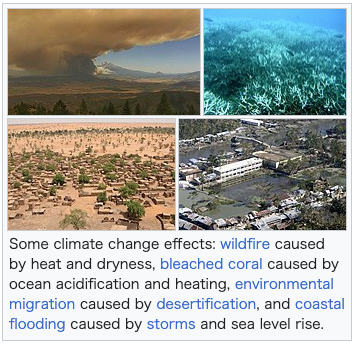 Thick orange-brown smoke blocks half a blue sky, with conifers in the foreground A few grey fish swim over grey coral with white spikes Desert sand half covers a village of small flat-roofed houses with scattered green trees large areas of still water behind riverside buildings Some climate change effects: wildfire caused by heat and dryness, bleached coral caused by ocean acidification and heating, environmental migration caused by desertification, and coastal flooding caused by storms and sea level rise. Geomorphology Changes in drainage patterns traceable to human activity will persist over geologic time in large parts of the continents where the geologic regime is erosional. This involves, for example, the paths of roads and highways defined by their grading and drainage control. Direct changes to the form of the Earth's surface by human activities (quarrying and landscaping, for example) also record human impacts. It has been suggested[by whom?] that the deposition of calthemite formations exemplify a natural process which has not previously occurred prior to the human modification of the Earth's surface, and which therefore represents a unique process of the Anthropocene.[113] Calthemite is a secondary deposit, derived from concrete, lime, mortar or other calcareous material outside the cave environment.[114] Calthemites grow on or under man-made structures (including mines and tunnels) and mimic the shapes and forms of cave speleothems, such as stalactites, stalagmites, flowstone etc. |
オレンジ褐色の濃い煙が青空の半分を遮り、手前には針葉樹が生い茂る。 数匹の灰色の魚が、白いトゲのある灰色のサンゴの上を泳いでいる。 砂漠の砂が、緑の木々が散在する小さな平屋建ての村を半分覆っている。 川沿いの建物の背後には静水域が広がっている。 気候変動の影響:暑さと乾燥による山火事、海の酸性化と加熱によるサンゴの白化、砂漠化による環境移動、暴風雨と海面上昇による沿岸の洪水。 地形学 地質学的レジームが侵食的である大陸の大部分では、人間活動に起因する排水パターンの変化が地質学的な時間にわたって持続する。これは、例えば、道路や高 速道路が、その勾配や排水制御によって規定される経路に関係する。人間の活動(例えば採石や造園)による地表の形への直接的な変化も、人間の影響を記録し ている。 カルトテマイト地層の堆積は、人間が地球表面を改変する以前に起こったことのない自然プロセスを例証するものであり、したがって人新世の特異なプロセスを 示すものであると示唆されている。 [カルツェマイトは、コンクリート、石灰、モルタル、または洞窟環境外の他の石灰質物質に由来する二次堆積物である[114]。カルツェマイトは、人工構 造物(鉱山やトンネルを含む)の上や下に生育し、鍾乳石、石筍、流紋岩など、洞窟の岩石類の形状や形態を模倣する。 |
| Stratigraphy Sedimentological record Human activities, including deforestation and road construction, are believed to have elevated average total sediment fluxes across the Earth's surface.[4] However, construction of dams on many rivers around the world means the rates of sediment deposition in any given place do not always appear to increase in the Anthropocene. For instance, many river deltas around the world are actually currently starved of sediment by such dams, and are subsiding and failing to keep up with sea level rise, rather than growing.[4][115] Fossil record Increases in erosion due to farming and other operations will be reflected by changes in sediment composition and increases in deposition rates elsewhere. In land areas with a depositional regime, engineered structures will tend to be buried and preserved, along with litter and debris. Litter and debris thrown from boats or carried by rivers and creeks will accumulate in the marine environment, particularly in coastal areas, but also in mid-ocean garbage patches. Such human-created artifacts preserved in stratigraphy are known as "technofossils".[4][116] 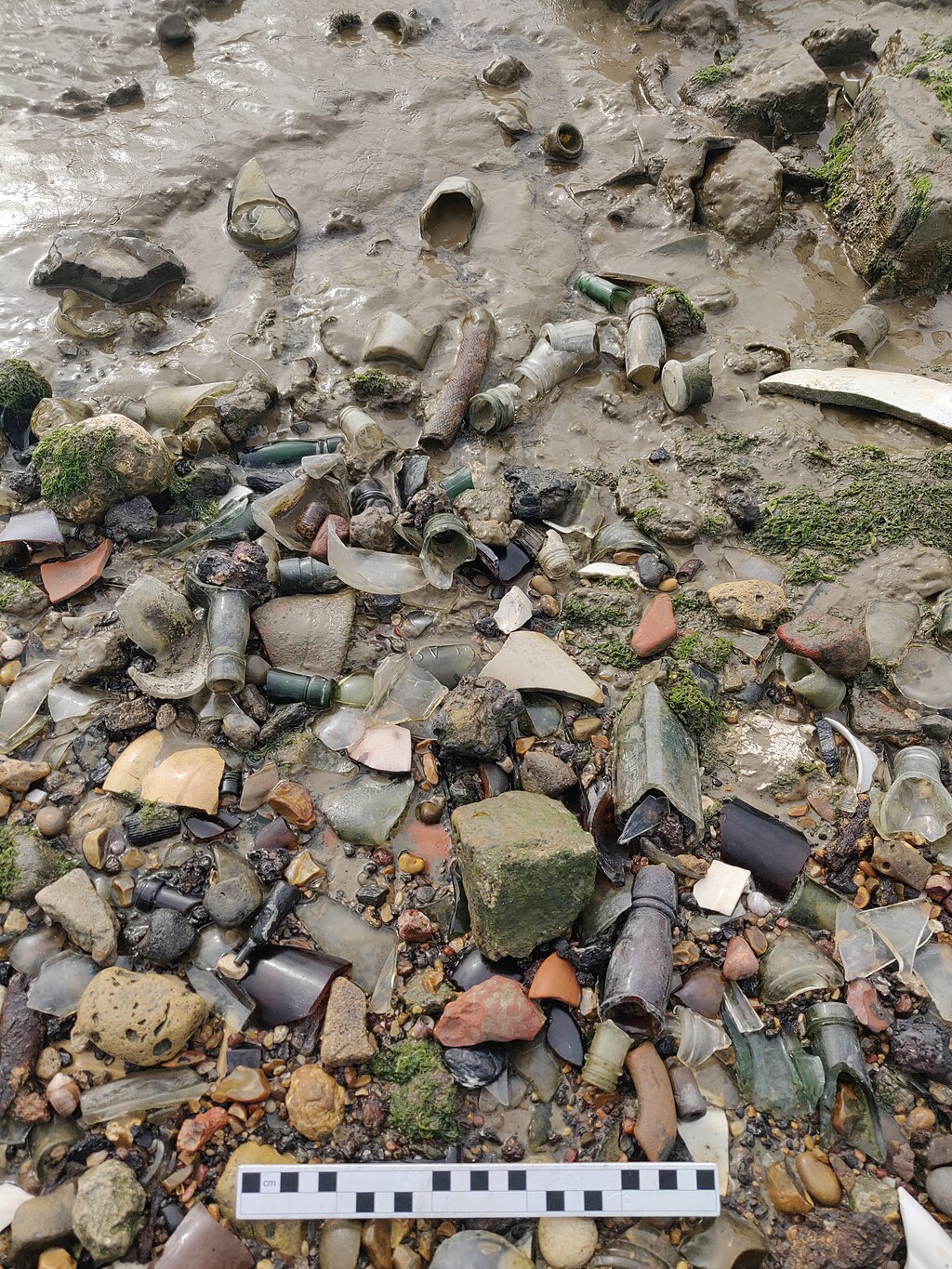 Twentieth-century technofossils in inundated landfill deposits at East Tilbury on the River Thames estuary Changes in biodiversity will also be reflected in the fossil record, as will species introductions. An example cited is the domestic chicken, originally the red junglefowl Gallus gallus, native to south-east Asia but has since become the world's most common bird through human breeding and consumption, with over 60 billion consumed annually and whose bones would become fossilised in landfill sites.[117] Hence, landfills are important resources to find "technofossils".[118] |
層序学 堆積学的記録 森林伐採や道路建設などの人間活動は、地球表面の平均的な土砂総フラックスを増加させたと考えられている[4]。しかし、世界中の多くの河川にダムが建設 されたため、人新世において、任意の場所における土砂堆積の割合が必ずしも増加したようには見えない。例えば、世界中の多くの河川デルタは、実際にそのよ うなダムによって土砂に飢えており、成長するどころか、沈降して海面上昇に追いつけなくなっている[4][115]。 化石記録 耕作やその他の作業による侵食の増加は、土砂組成の変化や他の場所での堆積速度の増加によって反映される。堆積レジームがある陸地では、人工構造物は、ゴ ミや残骸とともに埋もれ、保存される傾向がある。船から投げ込まれたり、河川やクリークによって運ばれたりしたゴミや残骸は、海洋環境、特に沿岸域に蓄積 されるが、中海のゴミパッチにも蓄積される。地層中に保存されているこのような人間が作り出した人工物は、「テクノフォッシル」として知られている[4] [116]。 テムズ川河口のイースト・ティルベリーにある、浸水した埋立堆積物中の20世紀のテクノフォッシル 生物多様性の変化も、種の導入と同様に化石記録に反映される。例として挙げられているのは家禽のニワトリで、もともとは東南アジア原産の赤いジャングルの 鳥Gallus gallusだったが、人間の繁殖と消費によって世界で最も一般的な鳥となり、年間600億羽以上が消費され、その骨は埋立地で化石化するようになった [117]。 |
| Trace elements In terms of trace elements, there are distinct signatures left by modern societies. For example, in the Upper Fremont Glacier in Wyoming, there is a layer of chlorine present in ice cores from 1960's atomic weapon testing programs, as well as a layer of mercury associated with coal plants in the 1980s.[119][120][121] From the late 1940s, nuclear tests have led to local nuclear fallout and severe contamination of test sites both on land and in the surrounding marine environment. Some of the radionuclides that were released during the tests are 137Cs, 90Sr, 239Pu, 240Pu, 241Am, and 131I. These have been found to have had significant impact on the environment and on human beings. In particular, 137Cs and 90Sr have been found to have been released into the marine environment and led to bioaccumulation over a period through food chain cycles. The carbon isotope 14C, commonly released during nuclear tests, has also been found to be integrated into the atmospheric CO2, and infiltrating the biosphere, through ocean-atmosphere gas exchange. Increase in thyroid cancer rates around the world is also surmised to be correlated with increasing proportions of the 131I radionuclide.[122] The highest global concentration of radionuclides was estimated to have been in 1965, one of the dates which has been proposed as a possible benchmark for the start of the formally defined Anthropocene.[123] Human burning of fossil fuels has also left distinctly elevated concentrations of black carbon, inorganic ash, and spherical carbonaceous particles in recent sediments across the world. Concentrations of these components increases markedly and almost simultaneously around the world beginning around 1950.[4] |
微量元素 微量元素に関しては、現代社会が残した明確な痕跡がある。例えば、ワイオミング州のアッパー・フリーモント氷河では、1960年代の原子兵器実験計画に由 来する塩素の層が氷床コアに存在し、1980年代の石炭発電所に関連した水銀の層も存在する[119][120][121]。 1940年代後半から、核実験は局所的な放射性降下物や、陸上と周辺の海洋環境の両方における実験場の深刻な汚染をもたらした。核実験中に放出された放射 性核種には、137Cs、90Sr、239Pu、240Pu、241Am、131Iがある。これらは環境や人間に重大な影響を与えたことが判明している。 個別主義では、137Csと90Srが海洋環境に放出され、食物連鎖のサイクルを経て生物濃縮に至ったことが判明している。また、核実験中によく放出され る炭素同位体14Cは、海洋と大気のガス交換を通じて、大気中の二酸化炭素に溶け込み、生物圏に浸透していることが分かっている。世界中の甲状腺がん発生 率の増加も、131I放射性核種の割合の増加と相関していると推測されている[122]。 放射性核種の世界的な最高濃度は1965年であったと推定されており、これは正式に定義された人新世の開始の可能な基準として提案されている日付の一つである[123]。 化石燃料の人為的燃焼はまた、世界中の最近の堆積物中に、ブラックカーボン、無機灰分、球状の炭素質粒子の明確な高濃度を残している。これらの成分の濃度は、1950年頃から世界中で顕著に、ほぼ同時に増加している[4]。 |
| Anthropocene markers A marker that accounts for a substantial global impact of humans on the total environment, comparable in scale to those associated with significant perturbations of the geological past, is needed in place of minor changes in atmosphere composition.[124][125] A useful candidate for holding markers in the geologic time record is the pedosphere. Soils retain information about their climatic and geochemical history with features lasting for centuries or millennia.[126] Human activity is now firmly established as the sixth factor of soil formation.[127] Humanity affects pedogenesis directly by, for example, land levelling, trenching and embankment building, landscape-scale control of fire by early humans, organic matter enrichment from additions of manure or other waste, organic matter impoverishment due to continued cultivation and compaction from overgrazing. Human activity also affects pedogenesis indirectly by drift of eroded materials or pollutants. Anthropogenic soils are those markedly affected by human activities, such as repeated ploughing, the addition of fertilisers, contamination, sealing, or enrichment with artefacts (in the World Reference Base for Soil Resources they are classified as Anthrosols and Technosols). An example from archaeology would be dark earth phenomena when long-term human habitation enriches[128] the soil with black carbon. Anthropogenic soils are recalcitrant repositories of artefacts and properties that testify to the dominance of the human impact, and hence appear to be reliable markers for the Anthropocene. Some anthropogenic soils may be viewed as the 'golden spikes' of geologists (Global Boundary Stratotype Section and Point), which are locations where there are strata successions with clear evidences of a worldwide event, including the appearance of distinctive fossils.[129] Drilling for fossil fuels has also created holes and tubes which are expected to be detectable for millions of years.[130] The astrobiologist David Grinspoon has proposed that the site of the Apollo 11 Lunar landing, with the disturbances and artifacts that are so uniquely characteristic of our species' technological activity and which will survive over geological time spans could be considered as the 'golden spike' of the Anthropocene.[131] An October 2020 study coordinated by University of Colorado at Boulder found that distinct physical, chemical and biological changes to Earth's rock layers began around the year 1950. The research revealed that since about 1950, humans have doubled the amount of fixed nitrogen on the planet through industrial production for agriculture, created a hole in the ozone layer through the industrial scale release of chlorofluorocarbons (CFCs), released enough greenhouse gasses from fossil fuels to cause planetary level climate change, created tens of thousands of synthetic mineral-like compounds that do not naturally occur on Earth, and caused almost one-fifth of river sediment worldwide to no longer reach the ocean due to dams, reservoirs and diversions. Humans have produced so many millions of tons of plastic each year since the early 1950s that microplastics are "forming a near-ubiquitous and unambiguous marker of Anthropocene".[132][133] The study highlights a strong correlation between global human population size and growth, global productivity and global energy use and that the "extraordinary outburst of consumption and productivity demonstrates how the Earth System has departed from its Holocene state since c. 1950 CE, forcing abrupt physical, chemical and biological changes to the Earth's stratigraphic record that can be used to justify the proposal for naming a new epoch—the Anthropocene."[133] A December 2020 study published in Nature found that the total anthropogenic mass, or human-made materials, outweighs all the biomass on earth, and highlighted that "this quantification of the human enterprise gives a mass-based quantitative and symbolic characterization of the human-induced epoch of the Anthropocene."[134][135] |
人新世マーカー 大気の組成のわずかな変化の代わりに、地質学的過去の重大な摂動に関連するものに匹敵する規模の、地球環境全体に対する人類の実質的な影響を説明するマーカーが必要である[124][125]。 地質学的時間記録のマーカーとして有用な候補は、土壌圏である。土壌は、何世紀あるいは何千年も続く特徴によって、気候や地球化学的な歴史に関する情報を 保持している[126]。人間の活動は、土壌形成の第6の要因として、現在では確固たる地位を築いている[127]。人間の活動も、侵食された物質や汚染 物質の漂着によって、間接的に土壌形成に影響を与える。人為起源の土壌とは、繰り返しの耕作、肥料の添加、汚染、封鎖、人工物による濃縮など、人間の活動 によって著しい影響を受けた土壌である(土壌資源の世界基準ベースでは、これらはアントロゾルとテクノゾルに分類されている)。考古学の例としては、人間 が長期にわたって居住することで、土壌が黒色炭素で濃縮[128]された場合のダークアース現象がある。 人為起源の土壌は、人為的な影響の優位性を証明する遺物や特性の不屈の保管場所であり、それゆえ人新世の信頼できるマーカーとなるようである。人為起源の 土壌の一部は、地質学者の「黄金のスパイク」(Global Boundary Stratotype Section and Point)と見なすことができる。これは、特徴的な化石の出現を含む、世界的な出来事の明確な証拠を伴う地層の連続が存在する場所である[129]。化 石燃料の掘削はまた、数百万年にわたって検出可能であると予想される穴や管を作り出している。 [130] 宇宙生物学者のデイヴィッド・グリンスプーンは、アポロ11号の月面着陸地点は、我々の種の技術活動に特有であり、地質学的な時間的スパンで生き残る撹乱 や人工物とともに、人新世の「黄金のスパイク」とみなすことができると提唱している[131]。 コロラド大学ボルダー校がコーディネートした2020年10月の研究は、地球の岩石層に対する明確な物理的、化学的、生物学的変化が1950年頃から始 まっていることを発見した。1950年ごろから、人類は農業のための工業生産によって地球上の固定窒素の量を2倍に増やし、フロン(CFCs)を工業規模 で放出することによってオゾン層に穴を開け、惑星レベルの気候変動を引き起こすのに十分な量の温室効果ガスを化石燃料から放出し、地球上に自然には存在し ない何万種類もの合成鉱物のような化合物を作り出し、ダムや貯水池、分水によって世界中の河川の堆積物のほぼ5分の1が海に到達しなくなったことを明らか にした。人類は1950年代初頭から毎年何百万トンものプラスチックを生産してきたため、マイクロプラスチックは「人新世のほぼ普遍的で明白な目印を形成 している」[132][133]。この研究は、世界的な人類の人口規模と成長、世界的な生産性、世界的なエネルギー使用の間に強い相関関係があることを強 調し、「消費と生産性の異常な爆発は、地球システムが1950年頃からいかに完新世の状態から逸脱してきたかを示している。1950年以降、地球システム がいかに完新世の状態から逸脱し、地球の層序学的記録に物理的、化学的、生物学的な急激な変化を余儀なくされたかを示している。 2020年12月にNature誌に掲載された研究は、人為的質量、つまり人間が作り出した物質の総量が、地球上の全てのバイオマスを上回っていることを 発見し、「人間による事業のこの定量化は、人新世という人間が引き起こしたエポックの、質量をベースとした定量的かつ象徴的な特徴を与える」と強調した [134][135]。 |
| Debates "While we often think of ecological damage as a modern problem our impacts date back millennia to the times in which humans lived as hunter-gatherers. Our history with wild animals has been a zero-sum game: either we hunted them to extinction, or we destroyed their habitats with agricultural land." – Hannah Ritchie for Our World in Data.[136] Although the validity of Anthropocene as a scientific term remains disputed, its underlying premise, i.e., that humans have become a geological force, or rather, the dominant force shaping the Earth's climate, has found traction among academics and the public. In an opinion piece for Philosophical Transactions of the Royal Society B, Rodolfo Dirzo, Gerardo Ceballos, and Paul R. Ehrlich write that the term is "increasingly penetrating the lexicon of not only the academic socio-sphere, but also society more generally", and is now included as an entry in the Oxford English Dictionary.[137] The University of Cambridge, as another example, offers a degree in Anthropocene Studies.[138] In the public sphere, the term Anthropocene has become increasingly ubiquitous in activist, pundit, and political discourses. Some who are critical of the term Anthropocene nevertheless concede that "For all its problems, [it] carries power."[139] The popularity and currency of the word has led scholars to label the term a "charismatic meta-category"[140] or "charismatic mega-concept."[141] The term, regardless, has been subject to a variety of criticisms from social scientists, philosophers, Indigenous scholars, and others. The anthropologist John Hartigan has argued that due to its status as a charismatic meta-category, the term Anthropocene marginalizes competing, but less visible, concepts such as that of "multispecies."[142] The more salient charge is that the ready acceptance of Anthropocene is due to its conceptual proximity to the status quo – that is, to notions of human individuality and centrality. Other scholars appreciate the way in which the term Anthropocene recognizes humanity as a geological force, but take issue with the indiscriminate way in which it does. Not all humans are equally responsible for the climate crisis. To that end, scholars such as the feminist theorist Donna Haraway and sociologist Jason Moore, have suggested naming the Epoch instead as the Capitalocene.[143][144][145] Such implies capitalism as the fundamental reason for the ecological crisis, rather than just humans in general.[146][147][148] However, according to philosopher Steven Best, humans have created "hierarchical and growth-addicted societies" and have demonstrated "ecocidal proclivities" long before the emergence of capitalism.[149] Hartigan, Bould, and Haraway all critique what Anthropocene does as a term; however, Hartigan and Bould differ from Haraway in that they criticize the utility or validity of a geological framing of the climate crisis, whereas Haraway embraces it. In addition to "Capitalocene," other terms have also been proposed by scholars to trace the roots of the Epoch to causes other than the human species broadly. Janae Davis, for example, has suggested the "Plantationocene" as a more appropriate term to call attention to the role that plantation agriculture has played in the formation of the Epoch, alongside Kathryn Yusoff's argument that racism as a whole is foundational to the Epoch. The Plantationocene concept traces "the ways that plantation logics organize modern economies, environments, bodies, and social relations."[150][151][152][153] In a similar vein, Indigenous studies scholars such as Métis geographer Zoe Todd have argued that the Epoch must be dated back to the colonization of the Americas, as this "names the problem of colonialism as responsible for contemporary environmental crisis."[154] Potawatomi philosopher Kyle Powys Whyte has further argued that the Anthropocene has been apparent to Indigenous peoples in the Americas since the inception of colonialism because of "colonialism's role in environmental change."[155][156][157] Other critiques of Anthropocene have focused on the genealogy of the concept. Todd also provides a phenomenological account, which draws on the work of the philosopher Sara Ahmed, writing: "When discourses and responses to the Anthropocene are being generated within institutions and disciplines which are embedded in broader systems that act as de facto 'white public space,' the academy and its power dynamics must be challenged."[158] Other aspects which constitute current understandings of the concept of the Anthropocene such as the ontological split between nature and society, the assumption of the centrality and individuality of the human, and the framing of environmental discourse in largely scientific terms have been criticized by scholars as concepts rooted in colonialism and which reinforce systems of postcolonial domination.[159] To that end, Todd makes the case that the concept of Anthropocene must be indigenized and decolonized if it is to become a vehicle of justice as opposed to white thought and domination. Eco-philosopher David Abram, in a book chapter titled 'Interbreathing in the Humilocene', has proposed adoption of the term ‘Humilocene’ (the Epoch of Humility), which emphasizes an ethical imperative and ecocultural direction that human societies should take. The term plays with the etymological roots of the term ‘human’, thus connecting it back with terms such as humility, humus (the soil), and even a corrective sense of humiliation that some human societies should feel given their collective destructive impact on the earth.[160] |
討論 「私たちはしばしば生態系へのダメージを現代の問題として考えるが、その影響は人類が狩猟採集生活をしていた数千年前までさかのぼる。野生動物との歴史は ゼロサムゲームであった。狩猟で絶滅させるか、農地で生息地を破壊するかのどちらかであった。- ハンナ・リッチー『Our World in Data』誌[136]。 科学用語としてのアントロポセン(人新世)の妥当性については依然として論争が続いているが、その根底にある前提、すなわち、人類が地質学的な力、いや、 地球の気候を形成する支配的な力になっているということは、学者や一般市民の間で支持を得ている。ロドルフォ・ディルゾ、ジェラルド・セバロス、ポール・ R・エーリッヒは、『Philosophical Transactions of the Royal Society B』誌のオピニオン・ピースで、この用語は「学術的な社会圏だけでなく、より一般的な社会の辞書に浸透しつつある」と書いており、現在ではオックスフォー ド英語辞典の項目にも含まれている。 [138]公的な場では、アントロポセンという用語は活動家、評論家、政治家の言説の中でますます偏在するようになっている。アントロポセンという用語に 批判的な者の中には、それでも「そのすべての問題に対して、(それは)力を持つ」と認めている者もいる[139]。この言葉の人気と通用性から、学者たち はこの用語を「カリスマ的なメタカテゴリー」[140]、あるいは「カリスマ的なメガコンセプト」[141]と呼んでいる。 人類学者のジョン・ハーティガンは、カリスマ的なメタカテゴリーとしての地位のために、アントロポセンという用語が「多種多様性」のような、競合するがあ まり目立たない概念を疎外すると主張している[142]。より顕著な告発は、アントロポセンがすぐに受け入れられるのは、その概念的な現状への近さ、つま り人間の個性や中心性の概念によるものだというものである。 他の学者たちは、アントロポセンという用語が人類を地質学的な力として認識している点については評価しているが、その無差別な方法については問題視してい る。すべての人類が気候危機に等しく責任を負っているわけではない。そのため、フェミニスト理論家のドナ・ハラウェイや社会学者のジェイソン・ムーアのよ うな学者は、このエポックを「キャピタロセン」と命名することを提案している[143][144][145]。 [146][147][148]しかし、哲学者のスティーヴン・ベストによれば、人類は資本主義が出現するずっと以前から「階層的で成長中毒の社会」を作 り上げ、「生態系を破壊する性癖」を示してきた[149]。 キャピタロセン」以外にも、エポックの根源を広く人類以外の原因に求める学者によって、他の用語も提案されている。例えば、ジャナイ・デイヴィスは、人種 主義全体がエポックの基礎であるというキャサリン・ユーソフの主張と並んで、プランテーション農業がエポックの形成に果たした役割に注意を喚起するための より適切な用語として「プランテーション新世」を提案している。プランテーション新世の概念は、「プランテーションの論理が現代の経済、環境、身体、社会 関係を組織化する方法」を追跡するものである[150][151][152][153]。同様の流れで、メティスの地理学者であるゾーイ・トッドのような 先住民研究者は、エポックをアメリカ大陸の植民地化まで遡らなければならないと主張している。 「ポタワトミの哲学者であるカイル・パウィス・ホワイテはさらに、「植民地主義が環境変化において果たした役割」[155][156][157]のため に、人新世は植民地主義の始まりからアメリカ大陸の先住民にとって明白であったと主張している。 アントロポセンに対する他の批評は、その概念の系譜に焦点を当てている。トッドはまた、哲学者サラ・アーメッドの仕事を利用した現象学的な説明も提供して おり、次のように書いている: 人新世に対する言説や反応が、事実上の「白い公共空間」として機能する、より広範なシステムに組み込まれた制度や学問分野の中で生み出されるとき、アカデ ミズムとその権力力学は異議を唱えられなければならない。 「アントロポセンという概念の現在の理解を構成する他の側面、例えば、自然と社会との間の存在論的分裂、人間の中心性と個別性の仮定、主に科学的用語で環 境言説の枠組みを構成することなどは、植民地主義に根ざした概念であり、ポストコロニアル支配のシステムを強化するものであるとして、学者たちによって批 判されてきた。 [そのためトッドは、アントロポセンという概念が白人の思想や支配に対抗する正義の手段となるためには、土着化・脱植民地化されなければならないと主張し ている。 環境哲学者のデイヴィッド・エイブラムは、「Humiloceneにおける相互呼吸」と題した本の章の中で、「Humilocene」(謙虚の時代)とい う用語の採用を提案している。この用語は、「人間」という用語の語源と戯れ、謙虚さ、腐植(土壌)、さらには人類社会が地球に与えた集団的な破壊的影響か ら感じるべき屈辱感の是正といった用語と結びつけている[160]。 |
| "Early anthropocene" model Main article: Early anthropocene William Ruddiman has argued that the Anthropocene began approximately 8,000 years ago with the development of farming and sedentary cultures.[161] At that point, humans were dispersed across all continents except Antarctica, and the Neolithic Revolution was ongoing. During this period, humans developed agriculture and animal husbandry to supplement or replace hunter-gatherer subsistence.[162] Such innovations were followed by a wave of extinctions, beginning with large mammals and terrestrial birds. This wave was driven by both the direct activity of humans (e.g. hunting) and the indirect consequences of land-use change for agriculture. Landscape-scale burning by prehistoric hunter-gathers may have been an additional early source of anthropogenic atmospheric carbon.[163] Ruddiman also claims that the greenhouse gas emissions in-part responsible for the Anthropocene began 8,000 years ago when ancient farmers cleared forests to grow crops.[164][165][166] Ruddiman's work has been challenged with data from an earlier interglaciation ("Stage 11", approximately 400,000 years ago) which suggests that 16,000 more years must elapse before the current Holocene interglaciation comes to an end, and thus the early anthropogenic hypothesis is invalid.[167] Also, the argument that "something" is needed to explain the differences in the Holocene is challenged by more recent research showing that all interglacials are different.[168] |
「前期人新世」モデル 主な記事 初期人新世 ウィリアム・ラディマンは、人新世はおよそ8,000年前に農耕と定住文化の発展とともに始まったと主張している[161]。その時点で、人類は南極大陸 を除く全ての大陸に分散し、新石器革命が進行していた。この時期、人類は狩猟採集生活を補うため、あるいは狩猟採集生活に取って代わるために、農業と畜産 業を発展させた[162]。このような技術革新の後、大型哺乳類と陸生鳥類を皮切りに、絶滅の波が押し寄せた。この波は、人間の直接的な活動(狩猟など) と、農業のための土地利用の変化がもたらした間接的な結果の両方によって引き起こされた。先史時代の狩猟採集民による景観規模の焼畑は、人為起源の大気中 炭素のさらなる初期発生源であった可能性がある[163]。ラディマンはまた、人新世の原因の一部である温室効果ガスの排出は、8,000年前に古代の農 民が作物を栽培するために森林を伐採したときに始まったと主張している[164][165][166]。 ラディマンの研究は、現在の完新世の間氷期が終わるまでにさらに16,000年経過しなければならず、したがって初期の人為起源仮説は無効であることを示 唆する初期の間氷期(「ステージ11」、約40万年前)のデータによって異議を唱えられた[167]。また、完新世の違いを説明するために「何か」が必要 であるという主張は、すべての間氷期が異なることを示すより最近の研究によって異議を唱えられた[168]。 |
| Homogenocene Homogenocene (from old Greek: homo-, same; geno-, kind; kainos-, new;) is a more specific term used to define our current epoch, in which biodiversity is diminishing and biogeography and ecosystems around the globe seem more and more similar to one another mainly due to invasive species that have been introduced around the globe either on purpose (crops, livestock) or inadvertently. This is due to the newfound globalism that humans participate in, as species traveling across the world to another region was not as easily possible in any point of time in history as it is today.[169] The term Homogenocene was first used by Michael Samways in his editorial article in the Journal of Insect Conservation from 1999 titled "Translocating fauna to foreign lands: Here comes the Homogenocene."[170] The term was used again by John L. Curnutt in the year 2000 in Ecology, in a short list titled "A Guide to the Homogenocene",[171] which reviewed Alien species in North America and Hawaii: impacts on natural ecosystems by George Cox. Charles C. Mann, in his acclaimed book 1493: Uncovering the New World Columbus Created, gives a bird's-eye view of the mechanisms and ongoing implications of the homogenocene.[172] |
ホモジェノセン ホモジェノセン(古ギリシャ語:homo-「同じ」、geno-「種類」、kainos-「新しい」)とは、生物多様性が減少し、生物地理学や世界中の生 態系が、意図的(農作物や家畜)に、あるいは不注意に世界中に持ち込まれた移入種のために、互いにますます類似しているように見える現在の時代を定義する ために使われる、より具体的な用語である。これは、人類が新たに見出したグローバリズムによるものであり、種が世界を横断して別の地域に移動することは、 歴史のどの時点においても、今日ほど容易ではなかったからである[169]。 ホモゲノセンという言葉は、1999年にマイケル・サムウェイズがJournal of Insect Conservationに寄稿した「Translocating fauna to foreign lands: ホモゲノセンがやってくる」[170]。 この用語は、2000年にジョン・L・カーナットが『Ecology』誌の「A Guide to the Homogenocene」と題された短いリストの中で再び使用した[171]。このリストでは、ジョージ・コックスによる「Alien species in North America and Hawaii: impacts on natural ecosystems(北米とハワイの外来種:自然生態系への影響)」をレビューしている。チャールズ・C・マンは絶賛された著書『1493: Uncovering the New World Columbus Created(コロンブスが創造した新世界を暴く)』では、ホモジェノセンのメカニズムと現在進行中の意味合いを俯瞰している[172]。 |
| Society and culture Humanities The concept of the Anthropocene has also been approached via humanities such as philosophy, literature and art. In the scholarly world, it has been the subject of increasing attention through special journals,[173] conferences,[174][175] and disciplinary reports.[176] The Anthropocene, its attendant timescale, and ecological implications prompt questions about death and the end of civilisation,[177] memory and archives,[178] the scope and methods of humanistic inquiry,[179] and emotional responses to the "end of nature".[180] Some scholars have posited that the realities of the Anthropocene, including "human-induced biodiversity loss, exponential increases in per-capita resource consumption, and global climate change," have made the goal of environmental sustainability largely unattainable and obsolete.[181] Historians have actively engaged the Anthropocene. In 2000, the same year that Paul Crutzen coined the term, world historian John McNeill published Something New Under the Sun,[182] tracing the rise of human societies' unprecedented impact on the planet in the twentieth century.[182] In 2001, historian of science Naomi Oreskes revealed the systematic efforts to undermine trust in climate change science and went on to detail the corporate interests delaying action on the environmental challenge.[183][184] Both McNeill and Oreskes became members of the Anthropocene Working Group because of their work correlating human activities and planetary transformation. |
社会と文化 人文科学 人新世の概念は、哲学、文学、芸術などの人文科学を通じてもアプローチされてきた。人新世、それに付随するタイムスケール、生態学的な意味合いは、死と文 明の終焉、[177]記憶とアーカイブ、[178]人文学的探求の範囲と方法、[179]そして「自然の終焉」に対する感情的な反応についての疑問を促し ている。 [180]「人為的な生物多様性の喪失、一人当たりの資源消費量の指数関数的な増加、地球規模の気候変動」を含む人新世の現実は、環境の持続可能性という 目標をほとんど達成不可能で陳腐なものにしているとする学者もいる[181]。 歴史家は人新世に積極的に関与してきた。2000年、ポール・クルッツェンがこの言葉を作ったのと同じ年に、世界史家のジョン・マクニールは 『Something New Under the Sun』を出版した。 [2001年、科学史家のナオミ・オレスケスは、気候変動科学に対する信頼を損なわせようとする組織的な取り組みを明らかにし、環境問題への取り組みを遅 らせている企業の利益について詳述した[183][184]。マクニールとオレスケスは共に、人間の活動と惑星の変容を関連付ける仕事をしたことから、人 新世作業部会のメンバーとなった。 |
| Popular culture In 2019, the English musician Nick Mulvey released a music video on YouTube named "In the Anthropocene".[185] In cooperation with Sharp's Brewery, the song was recorded on 105 vinyl records made of washed-up plastic from the Cornish coast.[186] The Anthropocene Reviewed is a podcast and book by author John Green, where he "reviews different facets of the human-centered planet on a five-star scale".[187] Photographer Edward Burtynsky created "The Anthropocene Project" with Jennifer Baichwal and Nicholas de Pencier, which is a collection of photographs, exhibitions, a film, and a book. His photographs focus on landscape photography that captures the effects human beings have had on the earth.[188][189] In 2015, the American death metal band Cattle Decapitation released its seventh studio album titled The Anthropocene Extinction.[190] In 2020, Canadian musician Grimes released her fifth studio album titled Miss Anthropocene. The name is also a pun on the feminine title "Miss" and the words "misanthrope" and "Anthropocene."[191] |
大衆文化 2019年、イギリスのミュージシャンであるニック・マルヴェイは、YouTubeで「In the Anthropocene」と名付けられたミュージックビデオを公開した[185]。 シャープス・ブルワリーの協力のもと、この曲はコーンウォール海岸で洗われたプラスチックで作られた105枚のレコードで録音された[186]。 The Anthropocene Reviewed』は、作家のジョン・グリーンによるポッドキャストと本で、「人間を中心とした地球の異なる側面を5つ星でレビュー」している[187]。 写真家のエドワード・バーティンスキーは、ジェニファー・バイチュワル、ニコラス・ド・ペンシエとともに「人新世プロジェクト」を立ち上げ、写真集、展覧 会、映画、本を出版した。彼の写真は、人類が地球に与えた影響を捉えた風景写真に焦点を当てている[188][189]。 2015年、アメリカのデスメタル・バンド、キャトル・デカピテーションが『The Anthropocene Extinction』というタイトルの7枚目のスタジオ・アルバムをリリースした[190]。 2020年、カナダのミュージシャン、グライムスは『ミス・アントロポセン』というタイトルの5枚目のスタジオ・アルバムをリリースした。この名前は、女性的なタイトルである「ミヘ」と「人間嫌い」と「アントロポセン」をかけたダジャレでもある[191]。 |
| Earth Overshoot Day – Calculated calendar date when humanity's yearly consumption exceeds Earth's replenishment Ecological footprint – Individual's or a group's human demand on nature Ecological overshoot – Demands on ecosystem exceeding regeneration Holocene extinction – Ongoing extinction event caused by human activity Novel ecosystem – Human-created ecological niche Overconsumption (economics) – Resource use exceeding carrying capacity Planetary boundaries – Limits not to be exceeded if humanity wants to survive in a safe ecosystem |
アース・オーバーシュート・デー - 人類の年間消費量が地球への補給量を上回る暦日を算出する。 エコロジカル・フットプリント - 個人または集団の自然に対する人間の需要 エコロジカル・オーバーシュート - 生態系への要求が再生を上回ること 完新世の絶滅 - 人間の活動によって引き起こされた継続的な絶滅現象 新しい生態系 - 人間が作り出した生態学的ニッチ 過剰消費(経済学) - 容量を超える資源利用 惑星の境界 - 人類が安全な生態系で生き延びたいのであれば、超えてはならない限界値 |
| References "International Chronostratigraphic Chart". International Commission on Stratigraphy. Retrieved 7 April 2024. "What is the Anthropocene? – current definition and status". quaternary.stratigraphy.org. Subcommission on Quaternary Stratigraphy, Working Group on the 'Anthropocene'. Retrieved 7 April 2024. The Anthropocene: IUGS-ICS Statement. March 20, 2024. https://www.iugs.org/_files/ugd/f1fc07_ebe2e2b94c35491c8efe570cd2c5a1bf.pdf Waters, C.N.; et al. (8 January 2016). "The Anthropocene is functionally and stratigraphically distinct from the Holocene". Science. 351 (6269): aad2622. doi:10.1126/science.aad2622. PMID 26744408. S2CID 206642594. Edwards, Lucy E. (30 November 2015). "What is the Anthropocene?". Eos. Vol. 96. doi:10.1029/2015EO040297. Dawson, Ashley (2016). Extinction: A radical history. OR Books. p. 19. ISBN 978-1944869014. Carrington, Damian (29 August 2016). "The Anthropocene epoch: Scientists declare dawn of human-influenced age". The Guardian. Retrieved 29 August 2016. Subramanian, Meera (21 May 2019). "Anthropocene now: Influential panel votes to recognize Earth's new epoch". Nature. doi:10.1038/d41586-019-01641-5. PMID 32433629. S2CID 182238145. Retrieved 5 June 2019. "Results of binding vote by AWG". Anthropocene Working Group. International Commission on Stratigraphy. 21 May 2019. Archived from the original on 5 June 2019. Meyer, Robinson (16 April 2019). "The cataclysmic break that (maybe) occurred in 1950". The Atlantic. Retrieved 5 June 2019. "The Anthropocene". The Geological Society. Waters, Colin N; Turner, Simon D; Zalasiewicz, Jan; Head, Martin J (April 2023). "Candidate sites and other reference sections for the Global boundary Stratotype Section and Point of the Anthropocene series". The Anthropocene Review. 10 (1): 3–24. Bibcode:2023AntRv..10....3W. doi:10.1177/20530196221136422. Voosen, Paul (11 July 2023). "Pond mud proposed as Anthropocene's 'golden spike,' defining human-altered geological age". Science. 381 (6654): 114–115. doi:10.1126/science.adj6978. Retrieved 23 April 2024. Zhong, Raymond (5 March 2024). "Are We in the 'Anthropocene,' the Human Age? Nope, Scientists Say". The New York Times. ISSN 0362-4331. Retrieved 5 March 2024. Zhong, Raymond (20 March 2024). "Geologists Make It Official: We're Not in an 'Anthropocene' Epoch". The New York Times. ISSN 0362-4331. Retrieved 19 April 2024. Petersen-Rockney, Margiana; Baur, Patrick; Guzman, Aidee; Bender, S. Franz; Calo, Adam; Castillo, Federico; De Master, Kathryn; Dumont, Antoinette; Esquivel, Kenzo; Kremen, Claire; LaChance, James; Mooshammer, Maria; Ory, Joanna; Price, Mindy J.; Socolar, Yvonne (15 March 2021). "Narrow and Brittle or Broad and Nimble? Comparing Adaptive Capacity in Simplifying and Diversifying Farming Systems". Frontiers in Sustainable Food Systems. 5. doi:10.3389/fsufs.2021.564900. ISSN 2571-581X. Ogden, M. (29 February 2016). "'The Anthropocene' viewed from Vernadsky's Noosphere". Promethean Pac. LaRouche PAC. Doklady: Biological sciences sections, Volumes 132–135. Akademii͡a nauk SSSR.[full citation needed] Revkin, Andrew C. (11 May 2011). "Confronting the 'Anthropocene'". The New York Times. Retrieved 25 March 2014. Badri, Adarsh (5 February 2024). "Feeling for the Anthropocene: affective relations and ecological activism in the global South". International Affairs. 100 (2): 731–749. doi:10.1093/ia/iiae010. ISSN 0020-5850. Crutzen, Paul J.; Stoermer, Eugene F. "The "Anthropocene"". IGBP Newsletter. pp. 17–18. Pearce, Fred (2007). With Speed and Violence: Why Scientists fear tipping points in Climate Change. Boston, Massachusetts: Beacon Press. ISBN 978-0-8070-8576-9. Retrieved 5 September 2016. "Paul Crutzen died on January 28th". The Economist. 13 February 2021. ISSN 0013-0613. Retrieved 21 February 2021. Steiner, Achim (15 December 2020). "The Next Frontier: Human Development and the Anthropocene (Foreword)" (PDF). UNDP. Retrieved 16 December 2020. Ehlers, Eckart; Moss, C.; Krafft, Thomas (2006). Earth System Science in the Anthropocene: Emerging issues and problems. Springer Science+Business Media. ISBN 9783540265900. "2011 GSA Annual Meeting". Geological Society of America. Archived from the original on 29 September 2019. Retrieved 28 November 2015. Zalasiewicz, Jan; et al. (2008). "Are we now living in the Anthropocene?". GSA Today. 18 (2): 4–8. Bibcode:2008GSAT...18b...4Z. doi:10.1130/GSAT01802A.1. Crutzen, P.J. & Stoermer, E.F. (2000). "The 'Anthropocene'". Global Change Newsletter. 41: 17–18. Sahney, S.; Benton, M. J. & Ferry, P. A. (2010). "Links between global taxonomic diversity, ecological diversity and the expansion of vertebrates on land". Biology Letters. 6 (4): 544–547. doi:10.1098/rsbl.2009.1024. PMC 2936204. PMID 20106856. ... it could be that without human influence the ecological and taxonomic diversity of tetrapods would continue to increase in an exponential fashion until most or all of the available ecospace is filled. Pimm, S.L.; Jenkins, C.N.; Abell, R.; Brooks, T.M.; Gittleman, J.L.; Joppa, L.N.; Raven, P. H.; Roberts, C.M.; Sexton, J.O. (2014). "The biodiversity of species and their rates of extinction, distribution, and protection" (PDF). Science. 344 (6187): 1246752. doi:10.1126/science.1246752. PMID 24876501. S2CID 206552746. Retrieved 15 December 2016. The overarching driver of species extinction is human population growth and increasing per capita consumption. Vignieri, Sacha (2014). "Vanishing fauna". Science. 345 (6195): 392–395. Bibcode:2014Sci...345..392V. doi:10.1126/science.345.6195.392. PMID 25061199. Ceballos, Gerardo; Ehrlich, Paul R.; Barnosky, Anthony D.; García, Andrés; Pringle, Robert M.; Palmer, Todd M. (2015). "Accelerated modern human–induced species losses: Entering the sixth mass extinction". Science Advances. 1 (5): e1400253. Bibcode:2015SciA....1E0253C. doi:10.1126/sciadv.1400253. PMC 4640606. PMID 26601195. Doughty, C.E.; Wolf, A.; Field, C.B. (2010). "Biophysical feedbacks between the Pleistocene megafauna extinction and climate: The first human-induced global warming?". Geophysical Research Letters. 37 (L15703): L15703. Bibcode:2010GeoRL..3715703D. doi:10.1029/2010GL043985. Zalasiewicz, J.; et al. (2010). "The new world of the Anthropocene". Environmental Science & Technology. 44 (7): 2228–2231. Bibcode:2010EnST...44.2228Z. doi:10.1021/es903118j. hdl:1885/36498. PMID 20184359. "Was first nuclear test the start of new human-dominated epoch, the Anthropocene?". News Center. University of California, Berkeley. 16 January 2015. Lewis, Simon L.; Maslin, Mark A. (March 2015). "Defining the Anthropocene" (PDF). Nature. 519 (7542): 171–180. Bibcode:2015Natur.519..171L. doi:10.1038/nature14258. PMID 25762280. S2CID 205242896. Archived from the original (PDF) on 24 December 2015. Edgeworth, Matt; Richter, Dan de B.; Waters, Colin; Haff, Peter; Neal, Cath; Price, Simon James (1 April 2015). "Diachronous beginnings of the Anthropocene: The lower bounding surface of anthropogenic deposits" (PDF). The Anthropocene Review. 2 (1): 33–58. Bibcode:2015AntRv...2...33E. doi:10.1177/2053019614565394. ISSN 2053-0196. S2CID 131236197. Waters, Colin N.; Zalasiewicz, Jan; Summerhayes, Colin; Barnosky, Anthony D.; Poirier, Clément; Gałuszka, Agnieszka; Cearreta, Alejandro; Edgeworth, Matt; Ellis, Erle C. (8 January 2016). "The Anthropocene is functionally and stratigraphically distinct from the Holocene". Science. 351 (6269): aad2622. doi:10.1126/science.aad2622. ISSN 0036-8075. PMID 26744408. S2CID 206642594. "Subcommission on Quaternary Stratigraphy – Working Group on the 'Anthropocene'". International Commission on Stratigraphy. Retrieved 28 November 2015. Davison, Nicola (30 May 2019). "The Anthropocene epoch: Have we entered a new phase of planetary history?". The Guardian. Retrieved 5 June 2019. Gibbard, by Philip L.; Bauer, Andrew M.; Edgeworth, Matthew; Ruddiman, William F.; Gill, Jacquelyn L.; Merritts, Dorothy J.; Finney, Stanley C.; Edwards, Lucy E.; Walker, Michael J. C.; Maslin, Mark; Ellis, and Erle C. (2021). "A practical solution: the Anthropocene is a geological event, not a formal epoch". Episodes Journal of International Geoscience. 45 (4): 349–357. doi:10.18814/epiiugs/2021/021029. S2CID 244165877. Bauer, Andrew M.; Edgeworth, Matthew; Edwards, Lucy E.; Ellis, Erle C.; Gibbard, Philip; Merritts, Dorothy J. (16 September 2021). "Anthropocene: event or epoch?". Nature. 597 (7876): 332. Bibcode:2021Natur.597..332B. doi:10.1038/d41586-021-02448-z. ISSN 0028-0836. PMID 34522014. S2CID 237515330. Gibbard, Philip; Walker, Michael; Bauer, Andrew; Edgeworth, Matthew; Edwards, Lucy; Ellis, Erle; Finney, Stanley; Gill, Jacquelyn L.; Maslin, Mark; Merritts, Dorothy; Ruddiman, William (2022). "The Anthropocene as an Event, not an Epoch". Journal of Quaternary Science. 37 (3): 395–399. Bibcode:2022JQS....37..395G. doi:10.1002/jqs.3416. ISSN 0267-8179. S2CID 247378724. Crutzen, Paul J. (2002). "Geology of mankind". Nature. 415 (6867): 23. Bibcode:2002Natur.415...23C. doi:10.1038/415023a. ISSN 1476-4687. PMID 11780095. S2CID 9743349. Carrington, Damian (11 July 2023). "Canadian lake chosen to represent start of Anthropocene". The Guardian. Retrieved 11 July 2023. "The Anthropocene: Canadian lake mud 'symbolic of human changes to Earth'". BBC News. 11 July 2023. Retrieved 16 July 2023. Crutzen, P. J. (2002). "Geology of mankind". Nature. 415 (6867): 23. Bibcode:2002Natur.415...23C. doi:10.1038/415023a. PMID 11780095. S2CID 9743349. Lovelock, James; Appleyard, Bryan (4 July 2019). Novacene : the coming age of hyperintelligence. London: Allen Lane. ISBN 9780241399361. OCLC 1104037419. US Department of Commerce; NOAA; Earth System Research Laboratory. "NOAA/ESRL Global Monitoring Division – The NOAA annual greenhouse gas index (AGGI)". esrl.noaa.gov. Retrieved 17 May 2017. Douglas, I.; Hodgson, R. & Lawson, N. (2002). "Industry, environment and health through 200 years in Manchester". Ecological Economics. 41 (2): 235–255. Bibcode:2002EcoEc..41..235D. doi:10.1016/S0921-8009(02)00029-0. Kirch, P.V. (2005). "The Holocene record". Annual Review of Environment and Resources. 30 (1): 409–440. doi:10.1146/annurev.energy.29.102403.140700. Ripple, William J.; Wolf, Christopher; van Vuuren, Detlef P.; Gregg, Jillian W.; Lenzen, Manfred (9 January 2024). "An environmental and socially just climate mitigation pathway for a planet in peril". Environmental Research Letters. 19 (2): 021001. Bibcode:2024ERL....19b1001R. doi:10.1088/1748-9326/ad059e. Specifically, our results show a great escalation beginning around 1850 for most variables. If combined with information on carrying capacity or planetary boundaries, these data could be used to explore the possibility that human demands on multiple fronts have greatly accelerated and may have approached or exceeded the biosphere's regenerative capacity. From a population, fossil fuel, greenhouse gasses, temperature, and land use perspective, the mid 19th century (∼1850) stands out as a compelling choice among the potential starting points for the Anthropocene. ἄνθρωπος, καινός. Liddell, Henry George; Scott, Robert; A Greek–English Lexicon at the Perseus Project. Harper, Douglas. "-cene". Online Etymology Dictionary. McNeill, J.R. (2012). "Global Environmental History: The first 150,000 years". In McNeill, J. R.; Mauldin, E.S. (eds.). A Companion to Global Environmental History. Wiley-Blackwell. pp. 3–17. ISBN 978-1-444-33534-7. Leakey, Richard; Lewin, Roger (1995). The Sixth Extinction: Patterns of life and the future of humankind. London: Doubleday. ISBN 9780385424974. Dirzo, Rodolfo; Hillary S. Young; Mauro Galetti; Gerardo Ceballos; Nick J. B. Isaac; Ben Collen (2014). "Defaunation in the Anthropocene" (PDF). Science. 345 (6195): 401–406. Bibcode:2014Sci...345..401D. doi:10.1126/science.1251817. PMID 25061202. S2CID 206555761. Kolbert, Elizabeth (2014). The Sixth Extinction: An Unnatural History. New York City: Henry Holt and Company. ISBN 978-0805092998. Ripple WJ, Wolf C, Newsome TM, Galetti M, Alamgir M, Crist E, Mahmoud MI, Laurance WF (13 November 2017). "World Scientists' Warning to Humanity: A Second Notice". BioScience. 67 (12): 1026–1028. doi:10.1093/biosci/bix125. hdl:1808/25687. Moreover, we have unleashed a mass extinction event, the sixth in roughly 540 million years, wherein many current life forms could be annihilated or at least committed to extinction by the end of this century. Ceballos, Gerardo; Ehrlich, Paul R.; Raven, Peter H. (1 June 2020). "Vertebrates on the brink as indicators of biological annihilation and the sixth mass extinction". PNAS. 117 (24): 13596–13602. Bibcode:2020PNAS..11713596C. doi:10.1073/pnas.1922686117. PMC 7306750. PMID 32482862. Andermann, Tobias; Faurby, Søren; Turvey, Samuel T.; Antonelli, Alexandre; Silvestro, Daniele (1 September 2020). "The past and future human impact on mammalian diversity". Science Advances. 6 (36): eabb2313. Bibcode:2020SciA....6.2313A. doi:10.1126/sciadv.abb2313. ISSN 2375-2548. PMC 7473673. PMID 32917612. S2CID 221498762. Text and images are available under a Creative Commons Attribution 4.0 International License. "Anthropocene: Have humans created a new geological age?". BBC News. 10 May 2011. Pimm, S. L.; Jenkins, C. N.; Abell, R.; Brooks, T. M.; Gittleman, J. L.; Joppa, L. N.; Raven, P. H.; Roberts, C. M.; Sexton, J. O. (30 May 2014). "The biodiversity of species and their rates of extinction, distribution, and protection" (PDF). Science. 344 (6187): 1246752. doi:10.1126/science.1246752. PMID 24876501. S2CID 206552746. Johns, David; Crist, Eileen; Sahgal, Bittu, eds. (2022). "Ending the Colonization of the Non-Human World". Biological Conservation. Cafaro, Philip (2022). "Reducing Human Numbers and the Size of our Economies is Necessary to Avoid a Mass Extinction and Share Earth Justly with Other Species". Philosophia. 50 (5): 2263–2282. doi:10.1007/s11406-022-00497-w. S2CID 247433264. Dasgupta, Partha (2021). "The Economics of Biodiversity: The Dasgupta Review Headline Messages" (PDF). UK government. p. 1. Retrieved 15 December 2021. Biodiversity is declining faster than at any time in human history. Current extinction rates, for example, are around 100 to 1,000 times higher than the baseline rate, and they are increasing. Carrington, Damian (2 February 2021). "Economics of biodiversity review: what are the recommendations?". The Guardian. Retrieved 16 December 2021. Cowie, Robert H.; Bouchet, Philippe; Fontaine, Benoît (2022). "The Sixth Mass Extinction: fact, fiction or speculation?". Biological Reviews. 97 (2): 640–663. doi:10.1111/brv.12816. PMC 9786292. PMID 35014169. S2CID 245889833. Sankaran, Vishwam (17 January 2022). "Study confirms sixth mass extinction is currently underway, caused by humans". The Independent. Archived from the original on 7 May 2022. Retrieved 18 January 2022. Melillo, Gianna (19 July 2022). "Threat of global extinction may be greater than previously thought, study finds". The Hill. Retrieved 20 July 2022. Isbell, Forest; Balvanera, Patricia; et al. (2022). "Expert perspectives on global biodiversity loss and its drivers and impacts on people". Frontiers in Ecology and the Environment. 21 (2): 94–103. doi:10.1002/fee.2536. hdl:10852/101242. S2CID 250659953. "Biodiversity: Almost half of animals in decline, research shows". BBC. 23 May 2023. Retrieved 23 May 2023. Finn, Catherine; Grattarola, Florencia; Pincheira-Donoso, Daniel (2023). "More losers than winners: investigating Anthropocene defaunation through the diversity of population trends". Biological Reviews. 98 (5): 1732–1748. doi:10.1111/brv.12974. PMID 37189305. S2CID 258717720. Paddison, Laura (22 May 2023). "Global loss of wildlife is 'significantly more alarming' than previously thought, according to a new study". CNN. Retrieved 23 May 2023. Bradshaw, Corey J. A.; Ehrlich, Paul R.; Beattie, Andrew; Ceballos, Gerardo; Crist, Eileen; Diamond, Joan; Dirzo, Rodolfo; Ehrlich, Anne H.; Harte, John; Harte, Mary Ellen; Pyke, Graham; Raven, Peter H.; Ripple, William J.; Saltré, Frédérik; Turnbull, Christine; Wackernagel, Mathis; Blumstein, Daniel T. (2021). "Underestimating the Challenges of Avoiding a Ghastly Future". Frontiers in Conservation Science. 1. doi:10.3389/fcosc.2020.615419. Ripple WJ, Wolf C, Newsome TM, Galetti M, Alamgir M, Crist E, Mahmoud MI, Laurance WF (13 November 2017). "World Scientists' Warning to Humanity: A Second Notice". BioScience. 67 (12): 1026–1028. doi:10.1093/biosci/bix125. hdl:11336/71342. Moreover, we have unleashed a mass extinction event, the sixth in roughly 540 million years, wherein many current life forms could be annihilated or at least committed to extinction by the end of this century. Cowie RH, Bouchet P, Fontaine B (April 2022). "The Sixth Mass Extinction: fact, fiction or speculation?". Biological Reviews of the Cambridge Philosophical Society. 97 (2): 640–663. doi:10.1111/brv.12816. PMC 9786292. PMID 35014169. S2CID 245889833. "Global Biodiversity Outlook 3". Convention on Biological Diversity. 2010. Archived from the original on 19 May 2022. Retrieved 24 January 2017. Kehoe L, Romero-Muñoz A, Polaina E, Estes L, Kreft H, Kuemmerle T (August 2017). "Biodiversity at risk under future cropland expansion and intensification". Nature Ecology & Evolution. 1 (8): 1129–1135. Bibcode:2017NatEE...1.1129K. doi:10.1038/s41559-017-0234-3. ISSN 2397-334X. PMID 29046577. S2CID 3642597. Archived from the original on 23 April 2022. Retrieved 28 March 2022. Allan E, Manning P, Alt F, Binkenstein J, Blaser S, Blüthgen N, Böhm S, Grassein F, Hölzel N, Klaus VH, Kleinebecker T, Morris EK, Oelmann Y, Prati D, Renner SC, Rillig MC, Schaefer M, Schloter M, Schmitt B, Schöning I, Schrumpf M, Solly E, Sorkau E, Steckel J, Steffen-Dewenter I, Stempfhuber B, Tschapka M, Weiner CN, Weisser WW, Werner M, Westphal C, Wilcke W, Fischer M (August 2015). "Land use intensification alters ecosystem multifunctionality via loss of biodiversity and changes to functional composition". Ecology Letters. 18 (8): 834–843. Bibcode:2015EcolL..18..834A. doi:10.1111/ele.12469. PMC 4744976. PMID 26096863. Walsh JR, Carpenter SR, Vander Zanden MJ (April 2016). "Invasive species triggers a massive loss of ecosystem services through a trophic cascade". Proceedings of the National Academy of Sciences of the United States of America. 113 (15): 4081–5. Bibcode:2016PNAS..113.4081W. doi:10.1073/pnas.1600366113. PMC 4839401. PMID 27001838. Stokstad, Erik (6 May 2019). "Landmark analysis documents the alarming global decline of nature". Science. doi:10.1126/science.aax9287. For the first time at a global scale, the report has ranked the causes of damage. Topping the list, changes in land use—principally agriculture—that have destroyed habitat. Second, hunting and other kinds of exploitation. These are followed by climate change, pollution, and invasive species, which are being spread by trade and other activities. Climate change will likely overtake the other threats in the next decades, the authors note. Driving these threats are the growing human population, which has doubled since 1970 to 7.6 billion, and consumption. (Per capita of use of materials is up 15% over the past 5 decades.) Pimm SL, Jenkins CN, Abell R, Brooks TM, Gittleman JL, Joppa LN, Raven PH, Roberts CM, Sexton JO (May 2014). "The biodiversity of species and their rates of extinction, distribution, and protection". Science. 344 (6187): 1246752. doi:10.1126/science.1246752. PMID 24876501. S2CID 206552746. The overarching driver of species extinction is human population growth and increasing per capita consumption. Cafaro, Philip; Hansson, Pernilla; Götmark, Frank (August 2022). "Overpopulation is a major cause of biodiversity loss and smaller human populations are necessary to preserve what is left" (PDF). Biological Conservation. 272. 109646. Bibcode:2022BCons.27209646C. doi:10.1016/j.biocon.2022.109646. ISSN 0006-3207. S2CID 250185617. Archived (PDF) from the original on 8 December 2023. Retrieved 25 December 2022. Conservation biologists standardly list five main direct drivers of biodiversity loss: habitat loss, overexploitation of species, pollution, invasive species, and climate change. The Global Assessment Report on Biodiversity and Ecosystem Services found that in recent decades habitat loss was the leading cause of terrestrial biodiversity loss, while overexploitation (overfishing) was the most important cause of marine losses (IPBES, 2019). All five direct drivers are important, on land and at sea, and all are made worse by larger and denser human populations. Crist, Eileen; Mora, Camilo; Engelman, Robert (21 April 2017). "The interaction of human population, food production, and biodiversity protection". Science. 356 (6335): 260–264. Bibcode:2017Sci...356..260C. doi:10.1126/science.aal2011. PMID 28428391. S2CID 12770178. Retrieved 2 January 2023. Research suggests that the scale of human population and the current pace of its growth contribute substantially to the loss of biological diversity. Although technological change and unequal consumption inextricably mingle with demographic impacts on the environment, the needs of all human beings—especially for food—imply that projected population growth will undermine protection of the natural world. Ceballos, Gerardo; Ehrlich, Paul R. (2023). "Mutilation of the tree of life via mass extinction of animal genera". Proceedings of the National Academy of Sciences of the United States of America. 120 (39): e2306987120. Bibcode:2023PNAS..12006987C. doi:10.1073/pnas.2306987120. PMC 10523489. PMID 37722053. Current generic extinction rates will likely greatly accelerate in the next few decades due to drivers accompanying the growth and consumption of the human enterprise such as habitat destruction, illegal trade, and climate disruption. Hughes, Alice C.; Tougeron, Kévin; Martin, Dominic A.; Menga, Filippo; Rosado, Bruno H. P.; Villasante, Sebastian; Madgulkar, Shweta; Gonçalves, Fernando; Geneletti, Davide; Diele-Viegas, Luisa Maria; Berger, Sebastian; Colla, Sheila R.; de Andrade Kamimura, Vitor; Caggiano, Holly; Melo, Felipe (1 January 2023). "Smaller human populations are neither a necessary nor sufficient condition for biodiversity conservation". Biological Conservation. 277: 109841. Bibcode:2023BCons.27709841H. doi:10.1016/j.biocon.2022.109841. ISSN 0006-3207. Through examining the drivers of biodiversity loss in highly biodiverse countries, we show that it is not population driving the loss of habitats, but rather the growth of commodities for export, particularly soybean and oil-palm, primarily for livestock feed or biofuel consumption in higher income economies. "Climate change and biodiversity" (PDF). Intergovernmental Panel on Climate Change. 2005. Archived from the original (PDF) on 5 February 2018. Retrieved 12 June 2012. Kannan, R.; James, D. A. (2009). "Effects of climate change on global biodiversity: a review of key literature" (PDF). Tropical Ecology. 50 (1): 31–39. Archived from the original on 15 April 2021. Retrieved 21 May 2014. "Climate change, reefs and the Coral Triangle". wwf.panda.org. Archived from the original on 2 May 2018. Retrieved 9 November 2015. Aldred, Jessica (2 July 2014). "Caribbean coral reefs 'will be lost within 20 years' without protection". The Guardian. Archived from the original on 20 October 2022. Retrieved 9 November 2015. Ketcham, Christopher (3 December 2022). "Addressing Climate Change Will Not "Save the Planet"". The Intercept. Archived from the original on 18 February 2024. Retrieved 8 December 2022. Caro, Tim; Rowe, Zeke (2022). "An inconvenient misconception: Climate change is not the principal driver of biodiversity loss". Conservation Letters. 15 (3): e12868. Bibcode:2022ConL...15E2868C. doi:10.1111/conl.12868. S2CID 246172852. Bank, European Investment (8 December 2022). Forests at the heart of sustainable development: Investing in forests to meet biodiversity and climate goals. European Investment Bank. ISBN 978-92-861-5403-4. Archived from the original on 21 March 2023. Retrieved 9 March 2023. Finch, Deborah M.; Butler, Jack L.; Runyon, Justin B.; Fettig, Christopher J.; Kilkenny, Francis F.; Jose, Shibu; Frankel, Susan J.; Cushman, Samuel A.; Cobb, Richard C. (2021). "Effects of Climate Change on Invasive Species". In Poland, Therese M.; Patel-Weynand, Toral; Finch, Deborah M.; Miniat, Chelcy Ford (eds.). Invasive Species in Forests and Rangelands of the United States: A Comprehensive Science Synthesis for the United States Forest Sector. Cham: Springer International Publishing. pp. 57–83. doi:10.1007/978-3-030-45367-1_4. ISBN 978-3-030-45367-1. S2CID 234260720. Bender, Eric (21 March 2022). "Urban evolution: How species adapt to survive in cities". Knowable Magazine. Annual Reviews. doi:10.1146/knowable-031822-1. Retrieved 31 March 2022. Diamond, Sarah E.; Martin, Ryan A. (2 November 2021). "Evolution in Cities". Annual Review of Ecology, Evolution, and Systematics. 52 (1): 519–540. doi:10.1146/annurev-ecolsys-012021-021402. ISSN 1543-592X. S2CID 239646134. Archived from the original on 31 March 2022. Retrieved 1 April 2022. Diamond, Sarah E; Chick, Lacy D; Perez, Abe; Strickler, Stephanie A; Zhao, Crystal (14 June 2018). "Evolution of plasticity in the city: urban acorn ants can better tolerate more rapid increases in environmental temperature". Conservation Physiology. 6 (1): coy030. doi:10.1093/conphys/coy030. ISSN 2051-1434. PMC 6007456. PMID 29977563. Harvey, Fiona (18 August 2011). "Climate change driving species out of habitats much faster than expected". The Guardian. Retrieved 8 November 2015. Nuwer, Rachel (14 September 2012). "From Ancient Deforestation, a Delta Is Born". The New York Times. Retrieved 14 June 2018. Gaynor, Kaitlyn M.; et al. (2018). "The influence of human disturbance on wildlife nocturnality". Science. 360 (6394): 1232–1235. Bibcode:2018Sci...360.1232G. doi:10.1126/science.aar7121. PMID 29903973. Brennan, William (1 October 2018). "When Animals Take the Night Shift". The Atlantic. Retrieved 16 February 2019. "Deep ice tells long climate story". BBC News. 4 September 2006. Retrieved 28 November 2015. The 'scary thing', [Dr. Wolff] added, was the rate of change now occurring in CO2 concentrations. In the core, the fastest increase seen was of the order of 30 parts per million (ppm) by volume over a period of roughly 1,000 years. The last 30 ppm of increase has occurred in just 17 years. We really are in the situation where we don't have an analogue in our records. Change, NASA Global Climate. "Carbon Dioxide Concentration | NASA Global Climate Change". Climate Change: Vital Signs of the Planet. Retrieved 3 November 2024. Eggleton, Tony (2013). A Short Introduction to Climate Change. Cambridge University Press. p. 52. ISBN 9781107618763. Archived from the original on 14 March 2023. Retrieved 14 March 2023. "Carbon dioxide now more than 50% higher than pre-industrial levels". National Oceanic and Atmospheric Administration. 3 June 2022. Archived from the original on 5 June 2022. Retrieved 14 June 2022. "The NOAA Annual Greenhouse Gas Index (AGGI) – An Introduction". NOAA Global Monitoring Laboratory/Earth System Research Laboratories. Archived from the original on 27 November 2020. Retrieved 18 December 2020. Etheridge, D.M.; L.P. Steele; R.L. Langenfelds; R.J. Francey; J.-M. Barnola; V.I. Morgan (1996). "Natural and anthropogenic changes in atmospheric CO2 over the last 1000 years from air in Antarctic ice and firn". Journal of Geophysical Research. 101 (D2): 4115–28. Bibcode:1996JGR...101.4115E. doi:10.1029/95JD03410. ISSN 0148-0227. S2CID 19674607. CounterAct; Women's Climate Justice Collective (4 May 2020). "Climate Justice and Feminism Resource Collection". The Commons Social Change Library. Retrieved 8 July 2024. Lindsey, Rebecca; Dahlman, Luann (28 June 2022). "Climate Change: Global Temperature". climate.gov. National Oceanic and Atmospheric Administration. Archived from the original on 17 September 2022. Intergovernmental Panel on Climate Change (IPCC), ed. (2022), "Summary for Policymakers", The Ocean and Cryosphere in a Changing Climate: Special Report of the Intergovernmental Panel on Climate Change, Cambridge: Cambridge University Press, pp. 3–36, doi:10.1017/9781009157964.001, ISBN 978-1-009-15796-4, retrieved 24 April 2023 Doney, Scott C.; Busch, D. Shallin; Cooley, Sarah R.; Kroeker, Kristy J. (17 October 2020). "The Impacts of Ocean Acidification on Marine Ecosystems and Reliant Human Communities". Annual Review of Environment and Resources. 45 (1): 83–112. doi:10.1146/annurev-environ-012320-083019. ISSN 1543-5938. S2CID 225741986. Dixon, Simon J.; Viles, Heather A.; Garrett, Bradley L. (2018). "Ozymandias in the Anthropocene: The city as an emerging landform". Area. 50 (1): 117–125. Bibcode:2018Area...50..117D. doi:10.1111/area.12358. ISSN 1475-4762. Smith, G.K. (April 2016). "Calcite straw stalactites growing from concrete structures". Cave and Karst Science. 43 (1): 4–10. Retrieved 14 June 2018. Giosan, L.; Syvitski, J.P.M.; Constantinescu, S.; Day, J. (3 December 2014). "Climate change: Protect the world's deltas". Nature. 516 (7529): 31–33. Bibcode:2014Natur.516...31G. doi:10.1038/516031a. PMID 25471866. S2CID 1970583. Cabadas-Báez, H.V.; Sedov, S.; Jiménez-Álvarez, S; Leonard, D.; Lailson-Tinoco, B.; García-Moll, R.; Ancona-Aragón, I.; Hernández, L. (2017). "Soils as a source of raw materials for ancient ceramic production in the Maya region of Mexico: Micromorphological insight". Boletín de la Sociedad Geológica Mexicana. 70 (1): 21–48. doi:10.18268/BSGM2018v70n1a2. Carrington, Damian (31 August 2016). "How the domestic chicken rose to define the Anthropocene". The Guardian. Achmon, Yigal; Achmon, Moshe; Dowdy, F. Ryan; Spiegel, Orr; Claypool, Joshua T.; Toniato, Juliano; Simmons, Christopher W. (2018). "Understanding the Anthropocene through the lens of landfill microbiomes". Frontiers in Ecology and the Environment. 16 (6): 354–360. Bibcode:2018FrEE...16..354A. doi:10.1002/fee.1819. ISSN 1540-9309. S2CID 89937817. Sousa, Matthew; Benson, Bryce; Welty, Connor; Price, Dylan; Thirkill, Ruth; Erickson, William; et al. (February 2020). "Atmospheric Deposition of Coal-Related Pollutants in the Pacific Northwest of the United States from 1950 to 2016". Environmental Toxicology and Chemistry. 39 (2): 335–342. doi:10.1002/etc.4635. PMID 31743941. S2CID 208186469. Cecil, L. DeWayne; David L. Naftz; Paul F. Schuster; David D. Susong; Jaromy R. Green (2010). The Paleoenvironmental Record Preserved in Middle Latitude, High-Mountain Glaciers – An Overview of U.S. Geological Survey Experience in Central Asia and the United States (PDF) (Report). United States Geological Survey. Retrieved 14 May 2022. Krabbenhoft, David; Paul Schuster. Glacial Ice Cores Reveal a Record of Natural and Anthropogenic Atmospheric Mercury Deposition for the Last 270 Years (PDF) (Report). USGS Fact Sheet. Vol. FS-051-02. U.S. Geological Survey. Archived from the original (PDF) on 8 March 2022. Retrieved 14 May 2022. Prăvălie, Remus (October 2014). "Nuclear weapons tests and environmental consequences: A global perspective". Ambio. 43 (6): 729–744. Bibcode:2014Ambio..43..729P. doi:10.1007/s13280-014-0491-1. PMC 4165831. PMID 24563393. Turney, Chris S.M.; Palmer, Jonathan; Maslin, Mark A.; Hogg, Alan; Fogwill, Christopher J.; Southon, John; et al. (2018). "Global peak in atmospheric radiocarbon provides a potential definition for the onset of the Anthropocene Epoch in 1965". Scientific Reports. 8 (1): 3293. Bibcode:2018NatSR...8.3293T. doi:10.1038/s41598-018-20970-5. PMC 5818508. PMID 29459648. Zalasiewicz, J.; Williams, M.; Steffen, W. & Crutzen, P.J. (2010). "Response to 'The Anthropocene forces us to reconsider adaptationist models of human-environment interactions'". Environmental Science & Technology. 44 (16): 6008. Bibcode:2010EnST...44.6008Z. doi:10.1021/es102062w. Zalasiewicz, J.; et al. (2011). "Stratigraphy of the Anthropocene". Philosophical Transactions of the Royal Society A. 369 (1938): 1036–1055. Bibcode:2011RSPTA.369.1036Z. doi:10.1098/rsta.2010.0315. PMID 21282159. Richter, D. deB. (2007). "Humanity's transformation of Earth's soil: Pedology's new frontier". Soil Science. 172 (12): 957–967. Bibcode:2007SoilS.172..957R. doi:10.1097/ss.0b013e3181586bb7. S2CID 15921701. Amundson, R. & Jenny, H. (1991). "The place of humans in the state factor theory of ecosystems and their soils". Soil Science. 151 (1): 99–109. Bibcode:1991SoilS.151...99A. doi:10.1097/00010694-199101000-00012. S2CID 95061311. Janovský, Martin (2024). "Stable isotope analysis in soil prospection reveals the type of historic land ‑ use under contemporary temperate forests in Europe". Scientific Reports. 14 (1): 14746. doi:10.1038/s41598-024-63563-1. PMC 11208554. PMID 38926400. Certini, G. & Scalenghe, R. (2011). "Anthropogenic soils are the golden spikes for the Anthropocene". The Holocene. 21 (8): 1269–1274. Bibcode:2011Holoc..21.1269C. doi:10.1177/0959683611408454. S2CID 128818837. "The Advent of the Anthropocene: Was that the big story of the 20th century?". World of Ideas, Boston U. Radio. Archived from the original on 4 March 2016. Retrieved 28 November 2015. Grinspoon, D. (28 June 2016). "The golden spike of Tranquility Base". Sky & Telescope. Simpkins, Kelsey (16 October 2020). "Unprecedented energy use since 1950 has transformed humanity's geologic footprint". phys.org. University of Colorado at Boulder. Retrieved 17 October 2020. Syvitski, Jaia; Waters, Colin N.; Day, John; et al. (2020). "Extraordinary human energy consumption and resultant geological impacts beginning around 1950 CE initiated the proposed Anthropocene Epoch". Communications Earth & Environment. 1 (32): 32. Bibcode:2020ComEE...1...32S. doi:10.1038/s43247-020-00029-y. hdl:10810/51932. S2CID 222415797. Laville, Sandra (9 December 2020). "Human-made materials now outweigh Earth's entire biomass – study". The Guardian. Retrieved 10 December 2020. Elhacham, Emily; Ben-Uri, Liad; et al. (2020). "Global human-made mass exceeds all living biomass". Nature. 588 (7838): 442–444. Bibcode:2020Natur.588..442E. doi:10.1038/s41586-020-3010-5. PMID 33299177. S2CID 228077506. Ritchie, Hannah (20 April 2021). "Wild mammals have declined by 85% since the rise of humans, but there is a possible future where they flourish". Our World in Data. Retrieved 18 April 2023. Dirzo, Rodolfo; Ceballos, Gerardo; Ehrlich, Paul R. (2022). "Circling the drain: the extinction crisis and the future of humanity". Philosophical Transactions of the Royal Society B. 377 (1857). doi:10.1098/rstb.2021.0378. PMC 9237743. PMID 35757873. "MPhil in Anthropocene Studies". Sutoris, Peter (20 October 2021). "The term 'Anthropocene' isn't perfect – but it shows us the scale of the environmental crisis we've caused". The Conversation. Archived from the original on 20 October 2021. Reddy, Elizabeth (8 April 2014). "What Does it Mean to do Anthropology in the Anthropocene?". Platypus. Archived from the original on 31 May 2014. Davis, Heather; Turpin, Etienne (2014). Art in the Anthropocene: Encounters Among Aesthetics, Politics, Environments and Epistemologies. Open Humanities Press. pp. 3–30. ISBN 978-1-78542-008-5. Hartigan, John (12 December 2014). "Multispecies vs Anthropocene". Somatosphere. Archived from the original on 21 September 2020. Haraway, Donna (2014). Davis, Heather; Turpin, Etienne (eds.). Art in the Anthropocene: Encounters Among Aesthetics, Politics, Environments and Epistemologies. Open Humanities Press. pp. 255–270. ISBN 978-1-78542-008-5. Moore, Jason W., ed. (2016). Anthropocene or Capitalocene? Nature, history, and the crisis of capitalism. Oakland, CA: PM Press. ISBN 978-1629631486. Davies, Jeremy (24 May 2016). The Birth of the Anthropocene (1st, hardcover ed.). Oakland: University of California Press. pp. 94–95. ISBN 978-0-520-28997-0. LCCN 2015043076. OCLC 926061257. OL 27210120M. Wikidata Q114630752. Hickel, Jason (2021). Less is More: How Degrowth Will Save the World. Windmill Books. pp. 39–40. ISBN 978-1786091215. It was only with the rise of capitalism over the past few hundred years, and the breathtaking acceleration of industrialization from the 1950s, that on a planetary scale things began to tip out of balance. Foster, John Bellamy (2022). Capitalism in the Anthropocene: Ecological Ruin or Ecological Revolution. Monthly Review Press. p. 1. ISBN 978-1583679746. The advent of the Anthropocene coincided with a planetary rift, as the human economy under capitalism heedlessly crossed, or began to cross, Earth System boundaries, fouling its own nest and threatening the destruction of the planet as a safe home for humanity. Derber, Charles; Moodliar, Suren (2023). Dying for Capitalism: How Big Money Fuels Extinction and What We Can Do About It. Routledge. ISBN 978-1032512587. Best, Steven (2021). "Failed Species: The Rise and Fall of the Human Empire". Romanian Journal of Artistic Creativity. 9 (2). Today we call this planetary monolith "global capitalism," but humans became global animals tens of thousands of years before the onset of capitalism. Humans created hierarchical and growth-addicted societies some ten thousand years ago and their ecocidal proclivities stretch back millennia more into prehistory. And just like every political empire of the past, the human empire has possibly reached its zenith and begun its downward spiral toward collapse. This empire's peak and slide into catastrophe marks a new epoch not only in human history, but also the history of the earth. Debates over whether advanced societies have entered into a new "postmodernity" pale in significance to the scientifically-based proposition that human activity has created a new epoch in geological history—the age of the Anthropocene. This epoch characterized by the dominance of human influence over earth's systems and has led to, among other colossal events, a sixth mass extinction crisis and runaway climate change. "What is the Plantationocene?". Edge Effects Magazine. c. 2020. Haraway, Donna (2015). "Anthropocene, Capitalocene, Plantationocene, Chthulucene: Making kin" (PDF). Environmental Humanities. 6: 159–165. doi:10.1215/22011919-3615934. Archived from the original (PDF) on 14 July 2015. Yusoff, Kathryn. A Billion Black Anthropocenes or None. University of Minnesota Press. Davis, Janae; Moulton, Alex A.; Sant, Levi Van; Williams, Brian (2019). "Anthropocene, Capitalocene, ... Plantationocene?: A Manifesto for Ecological Justice in an Age of Global Crises". Geography Compass. 13 (5): e12438. Bibcode:2019GComp..13E2438D. doi:10.1111/gec3.12438. ISSN 1749-8198. S2CID 155374232. Davis, Heather; Todd, Zoe (20 December 2017). "On the Importance of a Date, or, Decolonizing the Anthropocene". ACME: An International Journal for Critical Geographies. 16 (4): 761–780. ISSN 1492-9732. Whyte, Kyle (2017). "Indigenous Climate Change Studies : Indigenizing Futures, Decolonizing the Anthropocene". English Language Notes. 55 (1): 153–162. doi:10.1215/00138282-55.1-2.153. ISSN 2573-3575. S2CID 132153346. Whyte, Kyle (2016). "Is it Colonial DéJà Vu? Indigenous Peoples and Climate Injustice". In Adamson, Joni (ed.). Humanities for the Environment: Integrating Knowledges, Forging New Constellations of Practice. Routledge. pp. 88–104. doi:10.2139/ssrn.2925277. SSRN 2925277. Whyte, Kyle P. (1 March 2018). "Indigenous science (fiction) for the Anthropocene: Ancestral dystopias and fantasies of climate change crises". Environment and Planning E: Nature and Space. 1 (1–2): 224–242. Bibcode:2018EnPlE...1..224W. doi:10.1177/2514848618777621. ISSN 2514-8486. S2CID 158298529. Todd, Zoe (2014). Davis, Heather; Turpin, Etienne (eds.). Art in the Anthropocene: Encounters Among Aesthetics, Politics, Environments and Epistemologies. Open Humanities Press. pp. 241–254. ISBN 978-1-78542-008-5. Hacıgüzeller, Piraye (December 2021). "On critical hope and the anthropos of non-anthropocentric discourses. Some thoughts on archaeology in the Anthropocene". Archaeological Dialogues. 28 (2): 163–170. doi:10.1017/S1380203821000192. hdl:10067/1836770151162165141. S2CID 244775395. Milstein, Tema; Castro-Sotomayor, José, eds. (1 May 2020). Routledge Handbook of Ecocultural Identity (1 ed.). Abingdon, Oxon ; New York, NY : Routledge, 2020. |: Routledge. doi:10.4324/9781351068840. ISBN 978-1-351-06884-0. Certini, Giacomo; Scalenghe, Riccardo (April 2015). "Is the Anthropocene really worthy of a formal geologic definition?". The Anthropocene Review. 2 (1): 77–80. Bibcode:2015AntRv...2...77C. doi:10.1177/2053019614563840. ISSN 2053-0196. S2CID 130059700. Ellis, Erle; Goldewijk, Kees Klein; Gaillard, Marie-José; Kaplan, Jed O.; Thornton, Alexa; Powell, Jeremy; et al. (30 August 2019). "Archaeological assessment reveals Earth's early transformation through land use". Science. 365 (6456): 897–902. Bibcode:2019Sci...365..897S. doi:10.1126/science.aax1192. hdl:10150/634688. ISSN 0036-8075. PMID 31467217. S2CID 201674203. Lightfoot, Kent G.; Cuthrell, Rob Q. (29 May 2015). "Anthropogenic burning and the Anthropocene in late-Holocene California". The Holocene. 25 (10): 1581–1587. Bibcode:2015Holoc..25.1581L. doi:10.1177/0959683615588376. ISSN 0959-6836. S2CID 130614921. Mason, Betsy (2003). "Man has been changing climate for 8,000 years". Nature. doi:10.1038/news031208-7. Robert, Adler (11 December 2003). "Early farmers warmed Earth's climate". New Scientist. Retrieved 4 February 2008. Ruddiman, William F. (2003). "The anthropogenic greenhouse era began thousands of years ago" (PDF). Climatic Change. 61 (3): 261–293. CiteSeerX 10.1.1.651.2119. doi:10.1023/B:CLIM.0000004577.17928.fa. S2CID 2501894. Archived from the original (PDF) on 16 April 2014. Broecker, Wallace S.; Stocker, Thomas F. (2006). "The Holocene CO2 rise: Anthropogenic or natural?". Eos, Transactions American Geophysical Union. 87 (3): 27. Bibcode:2006EOSTr..87...27B. doi:10.1029/2006EO030002. ISSN 2324-9250. Tzedakis, P.C.; Raynaud, D.; McManus, J.F.; Berger, A.; Brovkin, V.; Kiefer, T. (2009). "Interglacial diversity". Nature Geoscience. 2 (11): 751–755. Bibcode:2009NatGe...2..751T. doi:10.1038/ngeo660. Crawley MJ. 1989. Chance and timing in biological invasions. In: Drake JA, Mooney HJ, DiCastri F, et al. (Eds). Biological invasions: a global perspective. Chichester, UK: John Wiley. Michael, Samways (1999). "Translocating fauna to foreign lands: Here comes the Homogenocene". Journal of Insect Conservation. 3 (2): 65–66. doi:10.1023/A:1017267807870. S2CID 263987331. Curnutt, John L. (2000). "AA Guide to the Homogenocene". Ecology. 81 (6): 1756–1757. doi:10.1890/0012-9658(2000)081[1756:AGTTH]2.0.CO;2. Mann, Charles C. (2011). 1493: Uncovering the New World Columbus Created. New York: Knopf. ISBN 978-0-307-26572-2. Clark, Timothy (1 December 2012). Clark, Timothy (ed.). "Special Issue: Deconstruction in the Anthropocene". Oxford Literary Review. 34 (2): v–vi. doi:10.3366/olr.2012.0039. Humanities Research Centre, Australian National University (13 June 2012). Anthropocene Humanities: The 2012 Annual Meeting of the Consortium of Humanities Centers and Institutes. Canberra, Australia. Archived from the original on 31 August 2014. Retrieved 21 July 2014. Rachel Carson; Alexander von Humboldt (14 June 2013). Culture and the Anthropocene. Munich, Germany. Retrieved 21 July 2014. Wenzel, Jennifer (13 March 2014). "Climate Change". State of the Discipline Report: Ideas of the Decade. American Comparative Literature Association. Scranton, Roy (10 November 2013). "Learning how to die in the Anthropocene". Opinionator. The New York Times. Retrieved 17 July 2014. Colebrook, Claire (27 January 2014). "The Anthropocene and the Archive". The Memory Network: Exchanges. Archived from the original on 3 March 2016. Retrieved 21 July 2014. Nowviskie, Bethany (10 July 2014). "Digital humanities in the anthropocene". nowviskie.org. Retrieved 10 July 2014. Ronda, Margaret (10 June 2013). "Mourning and Melancholia in the Anthropocene". Post45. Retrieved 21 July 2014. Benson, Melinda Harm; Craig, Robin Kundis (2014). "The End of Sustainability". Society & Natural Resources. 27 (7): 777–782. Bibcode:2014SNatR..27..777B. doi:10.1080/08941920.2014.901467. ISSN 0894-1920. S2CID 67783261. McNeill, John (2000). Something New Under the Sun: An Environmental History of the Twentieth-Century World. New York: W. W. Norton & Company. Oreskes, Naomi; Eric, Conway (2010). Merchants of Doubt: How a handful of scientists obscured the truth on issues from tobacco smoke to climate change. Oreskes, Naomi (3 December 2004). "The Scientific Consensus on Climate Change". Science. 306 (5702): 1686. doi:10.1126/science.1103618. PMID 15576594. S2CID 153792099. Mulvey, Nick (1 October 2019). Nick Mulvey – In the Anthropocene. Retrieved 27 June 2024 – via YouTube. CMU: Nick Mulvey releases vinyl made from recycled plastic washed up on Cornish beaches "The Anthropocene Reviewed – WNYC Studios and Complexly". Spotify. Retrieved 13 May 2020. Kenigsberg, Ben (24 September 2019). "'Anthropocene: The Human Epoch' Review: Global Warnings". The New York Times. Davison, Nicola. "The devastating environmental impact of human progress like you've never seen it before". Wired. ISSN 1059-1028. Retrieved 5 April 2024. "Cattle Decapitation – To Release 'The Anthropocene Extinction' This August Via Metal Blade Records" (Press release). Metal Blade Records. 20 May 2015. Retrieved 20 October 2020. "The 25 Best Pop Albums of 2020: Staff Picks". Billboard. 15 November 2019. Retrieved 5 May 2024. |
参考文献 「国際年代層序図」. 国際層序委員会. 2024 年 4 月 7 日を参照。 「人新世とは何か?- 現在の定義と現状」. quaternary.stratigraphy.org. 第四紀層序小委員会「人新世」作業部会. 2024 年 4 月 7 日を参照。 人新世: IUGS-ICS 声明。March 20, 2024. https://www.iugs.org/_files/ugd/f1fc07_ebe2e2b94c35491c8efe570cd2c5a1bf.pdf Waters, C.N.; et al. 「人新世は完新世とは機能的にも層序的にも異なる」. Science. 351 (6269): aad2622. doi:10.1126/science.aad2622. PMID 26744408. S2CID 206642594. Edwards, Lucy E. (30 November 2015). 「人新世とは何か?」. Eos. Vol. 96. doi:10.1029/2015EO040297. Dawson, Ashley (2016). 絶滅: A radical history. OR Books. p. 19. ISBN 978-1944869014. Carrington, Damian (29 August 2016). 「人新世エポック: 科学者たちは人類が影響する時代の幕開けを宣言する」. The Guardian. Retrieved 29 August 2016. Subramanian, Meera (21 May 2019). 「人新世の今: 影響力のあるパネルが地球の新たなエポックを認めることに投票した」. Nature. doi:10.1038/d41586-019-01641-5. PMID 32433629. S2CID 182238145. 2019年6月5日取得。 「AWGによる拘束投票結果」. 人新世作業部会。国際層序委員会. 21 May 2019. 2019年6月5日に原文からアーカイブされた。 Meyer, Robinson (16 April 2019). 「The cataclysmic break that (maybe) occurred in 1950」. The Atlantic. 2019年6月5日取得。 「人新世」. 地質学会。 Waters, Colin N; Turner, Simon D; Zalasiewicz, Jan; Head, Martin J (April 2023). 「地球境界層序区間と人新世の地点シリーズの候補地とその他の参照区間」. The Anthropocene Review. 10 (1): 3-24. Bibcode:2023AntRv..10....3W. doi:10.1177/20530196221136422. Voosen, Paul (11 July 2023). 「池の泥は人新世の「黄金のスパイク」として提案され、人為的に変化した地質年代を定義している」. Science. 381 (6654): 114–115. doi:10.1126/science.adj6978. 2024年4月23日取得。 Zhong, Raymond (5 March 2024). 我々は「人新世」、人類の時代にいるのか?Nope, Scientists Say」. The New York Times. issn 0362-4331. Retrieved 5 March 2024. Zhong, Raymond (2024 年 3 月 20 日). 「地質学者が公式に発表した: We're Not in an 'Anthropocene' Epoch」. The New York Times. issn 0362-4331. 2024年4月19日取得。 Petersen-Rockney, Margiana; Baur, Patrick; Guzman, Aidee; Bender, S. Franz; Calo, Adam; Castillo, Federico; De Master, Kathryn; Dumont, Antoinette; Esquivel, Kenzo; Kremen, Claire; LaChance, James; Mooshammer, Maria; Ory, Joanna; Price, Mindy J.; Socolar, Yvonne (15 March 2021). 「狭くて脆いか、広くて機敏か?単純化した農業システムと多様化した農業システムにおける適応能力の比較」. 持続可能な食料システムの最前線」. 5. doi:10.3389/fsufs.2021.564900. ISSN 2571-581X. Ogden, M. (29 February 2016). 「'The Anthropocene' viewed from Vernadsky's Noosphere」. Promethean Pac. LaRouche PAC. Doklady: Biological sciences sections, Volumes 132-135. Akademii͡a nauk SSSR.[full citation needed]. Revkin, Andrew C. (11 May 2011). 「Confronting the Anthropocene」. The New York Times. 2014年3月25日取得。 Badri, Adarsh (5 February 2024). 「Feeling for the Anthropocene: affective relations and ecological activism in the global South」. International Affairs. 100 (2): 731–749. doi:10.1093/ia/iiae010. ISSN 0020-5850. The 「Anthropocene」. IGBP Newsletter. IGBP ニュースレター. Pearce, Fred (2007). スピードと暴力で: Why Scientists fear tipping points in Climate Change. マサチューセッツ州ボストン: Beacon Press. ISBN 978-0-8070-8576-9. 2016年9月5日取得。 「ポール・クルッツェンが1月28日に死去した。The Economist. 13 February 2021. issn 0013-0613. Retrieved 21 February 2021. Steiner, Achim (15 December 2020). 「The Next Frontier: Human Development and the Anthropocene (Foreword)" (PDF). UNDP。2020年12月16日取得。 Ehlers, Eckart; Moss, C.; Krafft, Thomas (2006). 人新世における地球システム科学: Emerging issues and problems. Springer Science+Business Media. ISBN 9783540265900. 「2011 GSA Annual Meeting」. Geological Society of America. 2019年9月29日に原文からアーカイブされた。2015年11月28日を取得した。 Zalasiewicz, Jan; et al. (2008). 「Are we now living in the Anthropocene?」. GSA Today. 18 (2): 4-8. Bibcode:2008GSAT...18b...4Z. doi:10.1130/GSAT01802A.1. Crutzen, P.J. & Stoermer, E.F. (2000). 「人新世"。Global Change Newsletter. 41: 17-18. Sahney, S.; Benton, M. J. & Ferry, P. A. (2010). 「世界的な分類学的多様性、生態学的多様性と陸上脊椎動物の拡大との関連性」。Biology Letters. 6 (4): 544–547. doi:10.1098/rsbl.2009.1024. PMC 2936204. PMID 20106856. ... 人間の影響がなければ、四肢動物の生態学的・分類学的多様性は、利用可能な生態空間がほとんどあるいはすべて埋まるまで、指数関数的に増加し続けるだろ う。 Pimm, S.L.; Jenkins, C.N.; Abell, R.; Brooks, T.M.; Gittleman, J.L.; Joppa, L.N.; Raven, P. H.; Roberts, C.M.; Sexton, J.O. (2014). 「The biodiversity of species and their rates of extinction, distribution, and protection" (PDF). Science. 344 (6187): 1246752. doi:10.1126/science.1246752. PMID 24876501. S2CID 206552746. 2016年12月15日取得。種の絶滅の包括的な要因は、人間の人口増加と一人当たりの消費量の増加である。 Vignieri, Sacha (2014). 「Vanishing fauna」. Science. 345 (6195): 392-395. Bibcode:2014Sci...345..392V. doi:10.1126/science.345.6195.392. PMID 25061199. Ceballos, Gerardo; Ehrlich, Paul R.; Barnosky, Anthony D.; García, Andrés; Pringle, Robert M.; Palmer, Todd M. (2015). 「Accelerated modern human-induced species losses: 第6次大量絶滅に突入」. Science Advances. 1 (5): e1400253. Bibcode:2015SciA....1E0253C. doi:10.1126/sciadv.1400253. PMC 4640606. PMID 26601195. Doughty, C.E.; Wolf, A.; Field, C.B. (2010). 「更新世の巨大動物絶滅と気候の間の生物物理学的フィードバック: 人類が引き起こした最初の温暖化?」. Geophysical Research Letters. 37 (L15703): L15703. Bibcode:2010GeoRL..3715703D. doi:10.1029/2010GL043985. Zalasiewicz, J.; et al. 「The new world of the Anthropocene」. Environmental Science & Technology. 44 (7): 2228-2231. Bibcode:2010EnST...44.2228Z. doi:10.1021/es903118j. hdl:1885/36498. PMID 20184359. 「Is first nuclear test the start of new human-dominated epoch, the Anthropocene?」. News Center. カリフォルニア大学バークレー校。16 January 2015. Lewis, Simon L.; Maslin, Mark A. (March 2015). 「Defining the Anthropocene" (PDF). Nature. 519 (7542): 171-180. Bibcode:2015Natur.519..171L. doi:10.1038/nature14258. PMID 25762280. S2CID 205242896. 2015年12月24日に原文(PDF)からアーカイブされた。 Edgeworth, Matt; Richter, Dan de B.; Waters, Colin; Haff, Peter; Neal, Cath; Price, Simon James (1 April 2015). 「人新世の通時的な始まり: The lower bounding surface of anthropogenic deposits" (PDF). The Anthropocene Review. 2 (1): 33-58. Bibcode:2015AntRv...2...33E. doi:10.1177/2053019614565394. issn 2053-0196. s2cid 131236197. Waters, Colin N.; Zalasiewicz, Jan; Summerhayes, Colin; Barnosky, Anthony D.; Poirier, Clément; Gałuszka, Agnieszka; Cearreta, Alejandro; Edgeworth, Matt; Ellis, Erle C. (8 January 2016). 「人新世は完新世とは機能的にも層序的にも異なる」. Science. 351 (6269): aad2622. doi:10.1126/science.aad2622. issn 0036-8075. PMID 26744408. S2CID 206642594. 第四紀層序小委員会-「人新世」作業部会」. 国際層序委員会. 2015年11月28日取得。 Davison, Nicola (30 May 2019). 「The Anthropocene epoch: Have we entered a new phase of planetary history?」. ガーディアン紙。2019年6月5日取得。 Gibbard, by Philip L.; Bauer, Andrew M.; Edgeworth, Matthew; Ruddiman, William F.; Gill, Jacquelyn L.; Merritts, Dorothy J.; Finney, Stanley C.; Edwards, Lucy E.; Walker, Michael J. C.; Maslin, Mark; Ellis, and Erle C. (2021). 「現実的な解決策:人新世は地質学的事象であり、正式なエポックではない」. エピソード国際地球科学ジャーナル。45 (4): 349–357. doi:10.18814/epiiugs/2021/021029. s2cid 244165877. Bauer, Andrew M.; Edgeworth, Matthew; Edwards, Lucy E.; Ellis, Erle C.; Gibbard, Philip; Merritts, Dorothy J. (16 September 2021). 「人新世:イベントまたはエポック?」. Nature. 597 (7876): 332. Bibcode:2021Natur.597..332B. doi:10.1038/d41586-021-02448-z. issn 0028-0836. PMID 34522014. S2CID 237515330. Gibbard, Philip; Walker, Michael; Bauer, Andrew; Edgeworth, Matthew; Edwards, Lucy; Ellis, Erle; Finney, Stanley; Gill, Jacquelyn L.; Maslin, Mark; Merritts, Dorothy; Ruddiman, William (2022). 「The Anthropocene as an Event, not an Epoch」. Journal of Quaternary Science. 37 (3): 395-399. Bibcode:2022JQS....37..395G. doi:10.1002/jqs.3416. issn 0267-8179. s2cid 247378724. Crutzen, Paul J. (2002). 「人類の地質学」. Nature. 415 (6867): 23. Bibcode:2002Natur.415...23C. doi:10.1038/415023a. issn 1476-4687. PMID 11780095. S2CID 9743349. Carrington, Damian (11 July 2023). 「カナダの湖が人新世の始まりに選ばれる」. The Guardian. 2023年7月11日取得。 「人新世: カナダの湖の泥は「地球に対する人間の変化の象徴」」. BBC ニュース. 11 July 2023. 2023年7月16日取得。 Crutzen, P. J. (2002). 「人類の地質学」. Nature. 415 (6867): 23. Bibcode:2002Natur.415...23C. doi:10.1038/415023a. PMID 11780095. S2CID 9743349. Lovelock, James; Appleyard, Bryan (4 July 2019). Novacene : The coming age of hyperintelligence. London: Allen Lane. ISBN 9780241399361. OCLC 1104037419. 米国商務省; NOAA; 地球システム研究所. 「NOAA/ESRL Global Monitoring Division - The NOAA annual greenhouse gas index (AGGI)」. esrl.noaa.gov. 2017年5月17日取得。 Douglas, I.; Hodgson, R. & Lawson, N. (2002). 「マンチェスター200年の産業、環境、保健」. Ecological Economics. 41 (2): 235-255. Bibcode:2002EcoEc..41..235D. doi:10.1016/S0921-8009(02)00029-0. Kirch, P.V. (2005). 「完新世の記録」. 環境と資源の年次レビュー。30 (1): 409–440. doi:10.1146/annurev.energy.29.102403.140700. Ripple, William J.; Wolf, Christopher; van Vuuren, Detlef P.; Gregg, Jillian W.; Lenzen, Manfred (9 January 2024). 「危機に瀕した地球のための、環境的かつ社会的に公正な気候緩和の道筋」. Environmental Research Letters. 19 (2): 021001. Bibcode:2024ERL....19b1001R. doi:10.1088/1748-9326/ad059e. 具体的には、我々の結果は、ほとんどの変数について1850年頃から大きくエスカレートしていることを示している。環境収容力や惑星境界に関する情報と組 み合わせれば、これらのデータを用いて、人類の多方面にわたる需要が大幅に加速し、生物圏の再生能力に近づいた、あるいはそれを超えた可能性を探ることが できる。人口、化石燃料、温室効果ガス、気温、土地利用の観点から、19世紀半ば(約1850年)は、人新世の出発点として有力な選択肢である。 ἄνθρωπος, καινός. Liddell, Henry George; Scott, Robert; A Greek-English Lexicon at the Perseus Project. Harper, Douglas. 「-cene」. オンライン語源辞典. McNeill, J.R. (2012). 「地球環境史: 最初の15万年」. McNeill, J. R.; Mauldin, E.S. (eds.). A Companion to Global Environmental History. Wiley-Blackwell. 3-17. ISBN 978-1-444-33534-7. Leakey, Richard; Lewin, Roger (1995). 第6の絶滅: 生命のパターンと人類の未来. ロンドン: Doubleday. ISBN 9780385424974。 Dirzo, Rodolfo; Hillary S. Young; Mauro Galetti; Gerardo Ceballos; Nick J. B. Isaac; Ben Collen (2014). 「Defaunation in the Anthropocene" (PDF). Science. 345 (6195): 401-406. Bibcode:2014Sci...345..401D. doi:10.1126/science.1251817. PMID 25061202. S2CID 206555761. Kolbert, Elizabeth (2014). 第6の絶滅: An Unnatural History. New York City: Henry Holt and Company. ISBN 978-0805092998. Ripple WJ, Wolf C, Newsome TM, Galetti M, Alamgir M, Crist E, Mahmoud MI, Laurance WF (13 November 2017). 「World Scientists' Warning to Humanity: 第二の通知」. BioScience. 67 (12): 1026-1028. doi:10.1093/biosci/bix125. hdl:1808/25687. さらに、私たちは、およそ5億4,000万年ぶり6回目となる大量絶滅現象を引き起こしており、今世紀末までに、現在の生命体の多くが絶滅するか、少なく とも絶滅に追い込まれる可能性がある。 Ceballos, Gerardo; Ehrlich, Paul R.; Raven, Peter H. (1 June 2020). 「生物学的絶滅と第6次大量絶滅の指標としての瀬戸際の脊椎動物」. PNAS. 117 (24): 13596-13602. Bibcode:2020PNAS..11713596C. doi:10.1073/pnas.1922686117. PMC 7306750. PMID 32482862. Andermann, Tobias; Faurby, Søren; Turvey, Samuel T.; Antonelli, Alexandre; Silvestro, Daniele (1 September 2020). 「哺乳類の多様性に対する過去と未来の人類の影響」. Science Advances. 6 (36): eabb2313. Bibcode:2020SciA....6.2313A. doi:10.1126/sciadv.abb2313. issn 2375-2548. PMC 7473673. PMID 32917612. S2CID 221498762. テキストと画像はクリエイティブ・コモンズ 表示 4.0 国際 ライセンスの下で利用できる。 「人新世": 人類は新たな地質時代を作り出したのか?」. BBC News. 10 May 2011. Pimm, S. L.; Jenkins, C. N.; Abell, R.; Brooks, T. M.; Gittleman, J. L.; Joppa, L. N.; Raven, P. H.; Roberts, C. M.; Sexton, J. O. (30 May 2014). 「The biodiversity of species and their rates of extinction, distribution, and protection" (PDF). Science. 344 (6187): 1246752. doi:10.1126/science.1246752. PMID 24876501. S2CID 206552746. Johns, David; Crist, Eileen; Sahgal, Bittu, eds. (2022). 「Ending the Colonization of the Non-Human World」. Biological Conservation. Cafaro, Philip (2022). 「大量絶滅を回避し、他の種と地球を公平に共有するためには、人間の数と経済の規模を縮小することが必要である」. Philosophia. 50 (5): 2263–2282. doi:10.1007/s11406-022-00497-w. s2cid 247433264. Dasgupta, Partha (2021). 「生物多様性の経済学: The Dasgupta Review Headline Messages" (PDF). 英国政府。2021年12月15日取得。生物多様性は、人類史上かつてない速さで減少している。例えば、現在の絶滅率はベースラインの約100倍から 1,000倍であり、しかも増加している。 Carrington, Damian (2 February 2021). 「生物多様性の経済学レビュー:提言は何か?」. The Guardian. 2021年12月16日取得。 Cowie, Robert H.; Bouchet, Philippe; Fontaine, Benoît (2022). 「第6回大量絶滅:事実か、虚構か、推測か?」. Biological Reviews. 97 (2): 640–663. doi:10.1111/brv.12816. PMC 9786292. PMID 35014169. S2CID 245889833. Sankaran, Vishwam (17 January 2022). 「6番目の大量絶滅が人類によって引き起こされ、現在進行中であることを確認する研究」. The Independent. Archived from the original on 7 May 2022. 18 January 2022. Melillo, Gianna (19 July 2022). 「世界絶滅の脅威は以前考えられていたよりも大きいかもしれない、研究が発見した」. The Hill. 2022年7月20日取得。 Isbell, Forest; Balvanera, Patricia; et al. 「世界的な生物多様性の損失とその推進要因、そして人々への影響に関する専門家の視点」. Frontiers in Ecology and the Environment. 21 (2): 生物多様性の損失とその要因が人々に及ぼす影響」. s2cid 250659953. 「生物多様性: ほぼ半数の動物が減少していることが調査で明らかになった」. BBC. 23 May 2023. 2023年5月23日取得. Finn, Catherine; Grattarola, Florencia; Pincheira-Donoso, Daniel (2023). 「More losers than winners: investigating Anthropocene defaunation through the diversity of population trends」. Biological Reviews. 98 (5): 1732–1748. doi:10.1111/brv.12974. PMID 37189305. S2CID 258717720. Paddison, Laura (22 May 2023). 「野生生物の世界的な損失は、以前考えられていたよりも「著しく憂慮すべきもの」である、新しい研究によると」. CNN. 2023年5月23日取得。 Bradshaw, Corey J. A.; Ehrlich, Paul R.; Beattie, Andrew; Ceballos, Gerardo; Crist, Eileen; Diamond, Joan; Dirzo, Rodolfo; Ehrlich, Anne H.; Harte, John; Harte, Mary Ellen; Pyke, Graham; Raven, Peter H.; Ripple, William J.; Saltré, Frédérik; Turnbull, Christine; Wackernagel, Mathis; Blumstein, Daniel T. (2021). 「Underestimating the Challenges of Avoiding a Ghastly Future」. Frontiers in Conservation Science. 1. doi:10.3389/fcosc.2020.615419. Ripple WJ, Wolf C, Newsome TM, Galetti M, Alamgir M, Crist E, Mahmoud MI, Laurance WF (13 November 2017). 「World Scientists' Warning to Humanity: 第二の通知」. BioScience. 67 (12): 1026-1028. doi:10.1093/biosci/bix125. hdl:11336/71342. さらに、私たちは、およそ5億4,000万年ぶり6回目となる大量絶滅現象を引き起こしており、今世紀末までに、現在の生命体の多くが絶滅するか、少なく とも絶滅に追い込まれる可能性がある。 Cowie RH, Bouchet P, Fontaine B (April 2022). 「第6回大量絶滅:事実か、フィクションか、それとも推測か?」. ケンブリッジ哲学協会の生物学的レビュー。97 (2): 640–663. doi:10.1111/brv.12816. PMC 9786292. PMID 35014169. S2CID 245889833. 「Global Biodiversity Outlook 3」. 生物多様性条約. 2010. Archived from the original on 19 May 2022. 2017年1月24日取得。 Kehoe L, Romero-Muñoz A, Polaina E, Estes L, Kreft H, Kuemmerle T (August 2017). 「Biodiversity at risk under future cropland expansion and intensification」. Nature Ecology & Evolution. 1 (8): 1129-1135. Bibcode:2017NatEE...1.1129K. doi:10.1038/s41559-017-0234-3. ISSN 2397-334X. PMID 29046577. S2CID 3642597. 2022年4月23日に原文からアーカイブされた。28月2022を取得した。 Allan E, Manning P, Alt F, Binkenstein J, Blaser S, Blüthgen N, Böhm S, Grassein F, Hölzel N, Klaus VH, Kleinebecker T, Morris EK, Oelmann Y, Prati D, Renner SC, Rillig MC, Schaefer M, Schloter M、 Schmitt B, Schöning I, Schrumpf M, Solly E, Sorkau E, Steckel J, Steffen-Dewenter I, Stempfhuber B, Tschapka M, Weiner CN, Weisser WW, Werner M, Westphal C, Wilcke W, Fischer M (August 2015). 「Land use intensification alters ecosystem multifunctionality via loss of biodiversity and changes to functional composition」. Ecology Letters. 18 (8): 834-843. Bibcode:2015EcolL..18..834A. doi:10.1111/ele.12469. PMC 4744976. PMID 26096863. Walsh JR, Carpenter SR, Vander Zanden MJ (April 2016). 「Invasive species triggers a massive loss of ecosystem services through a trophic cascade」. Proceedings of the National Academy of Sciences of the United States of America. 113 (15): 4081-5. Bibcode:2016PNAS..113.4081W. doi:10.1073/pnas.1600366113. PMC 4839401. PMID 27001838. Stokstad, Erik (6 May 2019). 「Landmark analysis documents the alarming global decline of nature」. Science. doi:10.1126/science.aax9287. 世界規模で初めて、報告書は被害の原因をランク付けした。第1位は、生息地を破壊した土地利用の変化(主に農業)である。第2位は狩猟やその他の搾取であ る。次いで、気候変動、汚染、貿易やその他の活動によって広がっている外来種となっている。気候変動は今後数十年のうちに、他の脅威を追い越す可能性が高 いと著者は指摘する。これらの脅威の原動力となっているのは、1970年以来2倍の76億人に増加した人類の人口と消費である。(一人当たりの物質使用量 は過去50年間で15%増加している)。 Pimm SL, Jenkins CN, Abell R, Brooks TM, Gittleman JL, Joppa LN, Raven PH, Roberts CM, Sexton JO (May 2014). 「種の生物多様性と絶滅率、分布、保護」. Science. 344 (6187): 1246752. doi:10.1126/science.1246752. PMID 24876501. S2CID 206552746. 種の絶滅の包括的な要因は、人間の人口増加と一人当たりの消費量の増加である。 Cafaro, Philip; Hansson, Pernilla; Götmark, Frank (August 2022). 「過剰人口は生物多様性損失の主な原因であり、残されたものを保全するためにはより少ない人間集団が必要である」(PDF)。生物保全。272. 109646. Bibcode:2022BCons.27209646C. doi:10.1016/j.biocon.2022.109646. issn 0006-3207. s2cid 250185617. Archived (PDF) from the original on 8 December 2023. 2022年12月25日取得。保全生物学者は、生物多様性損失の直接的な要因として、生息地の損失、種の乱獲、汚染、外来種、気候変動の5つを挙げてい る。生物多様性と生態系サービスに関する世界評価報告書(Global Assessment Report on Biodiversity and Ecosystem Services)は、ここ数十年、生息地の損失が陸上の生物多様性損失の主な原因であり、乱獲(乱獲)が海洋の損失の最も重要な原因であることを明らか にした(IPBES, 2019)。この5つの直接的な要因のすべてが、陸上でも海上でも重要であり、人間集団の増大と密集によって悪化している。 Crist, Eileen; Mora, Camilo; Engelman, Robert (21 April 2017). 「The interaction of human population, food production, and biodiversity protection」. Science. 356 (6335): 260-264. Bibcode:2017Sci...356..260C. doi:10.1126/science.aal2011. PMID 28428391. S2CID 12770178. 2023年1月2日取得。人類の人口規模やその増加ペースが、生物多様性の喪失に大きく寄与していることが、研究によって示唆されている。技術革新と不平 等な消費は、人口動態が環境に与える影響と表裏一体であるが、全人類のニーズ、特に食料に対するニーズは、予測される人口増加が自然界の保護を損なうこと を意味している。 Ceballos, Gerardo; Ehrlich, Paul R. (2023). 「動物属の大量絶滅による生命の樹の切断」. Proceedings of the National Academy of Sciences of the United States of America. 120 (39): e2306987120. Bibcode:2023PNAS..12006987C. doi:10.1073/pnas.2306987120. PMC 10523489. PMID 37722053. 現在の一般的な絶滅率は、生息地の破壊、違法取引、気候の混乱など、人間事業の成長と消費に伴う要因によって、今後数十年で大幅に加速すると考えられる。 Hughes, Alice C.; Tougeron, Kévin; Martin, Dominic A.; Menga, Filippo; Rosado, Bruno H. P.; Villasante, Sebastian; Madgulkar, Shweta; Gonçalves, Fernando; Geneletti, Davide; Diele-Viegas, Luisa Maria; Berger, Sebastian; Colla, Sheila R.; de Andrade Kamimura, Vitor; Caggiano, Holly; Melo, Felipe (1 January 2023). 「人間の個体数が少ないことは、生物多様性保全の必要条件でも十分条件でもない」. 生物保全。277: 109841. Bibcode:2023BCons.27709841H. doi:10.1016/j.biocon.2022.109841. issn 0006-3207. 生物多様性の高い国々における生物多様性損失の要因を検証することで、生息地の損失をもたらしているのは人口ではなく、高所得経済圏における主に家畜飼料 やバイオ燃料消費用の輸出用商品、特に大豆やオイルパームの増加であることを示した。 「気候変動と生物多様性"(PDF). 気候変動に関する政府間パネル. 2005. 2018年2月5日に原文(PDF)からアーカイブされた。2012年6月12日取得。 Kannan, R.; James, D. A. (2009). 「Effects of climate change on global biodiversity: a review of key literature" (PDF). Tropical Ecology. 50 (1): 31-39. 2021年4月15日に原文からアーカイブされた。2014年5月21日取得。 「Climate change, reefs and the Coral Triangle」. wwf.panda.org. 2018年5月2日に原文からアーカイブされた。2015年11月9日を取得した。 Aldred, Jessica (2 July 2014). 「Caribbean coral reefs 'will be lost within 20 years' without protection」. ガーディアン紙。2022年10月20日に原文からアーカイブされた。2015年11月9日取得。 Ketcham, Christopher (3 December 2022). 「Addressing Climate Change Will Not 「Save the Planet」」. The Intercept. 2024年2月18日に原文からアーカイブされた。2022年12月8日取得。 Caro, Tim; Rowe, Zeke (2022). 「不都合な誤解: 気候変動は生物多様性損失の主な要因ではない」. Conservation Letters. 15 (3): e12868. Bibcode:2022ConL...15E2868C. doi:10.1111/conl.12868. s2cid 246172852. 欧州投資銀行(2022年12月8日). 持続可能な開発の中心にある森林: 生物多様性と気候の目標を達成するための森林への投資。European Investment Bank. ISBN 978-92-861-5403-4. 2023年3月21日、原文よりアーカイブ。2023年3月9日取得。 Finch, Deborah M.; Butler, Jack L.; Runyon, Justin B.; Fettig, Christopher J.; Kilkenny, Francis F.; Jose, Shibu; Frankel, Susan J.; Cushman, Samuel A.; Cobb, Richard C. (2021). 「気候変動が外来種に及ぼす影響」. In Poland, Therese M.; Patel-Weynand, Toral; Finch, Deborah M.; Miniat, Chelcy Ford (eds.). In Poland, Therese M; Patel-Weynand Toral; Finch, Deborah M; Miniat, Chelcy Ford (ed.): A Comprehensive Science Synthesis for the United States Forest Sector. Cham: pp.57-83. doi:10.1007/978-3-030-45367-1_4. ISBN 978-3-030-45367-1. s2cid 234260720. Bender, Eric (21 March 2022). 「都市の進化: どのように種は都市で生き残るために適応するか」. Knowable Magazine. doi:10.1146/knowable-031822-1. 2022年3月31日取得。 Diamond, Sarah E.; Martin, Ryan A. (2 November 2021). 「都市における進化」. Annual Review of Ecology, Evolution, and Systematics. 52 (1): 519–540. doi:10.1146/annurev-ecolsys-012021-021402. issn 1543-592x. s2cid 239646134. 2022年3月31日に原文からアーカイブされた。2022年4月1日取得。 Diamond, Sarah E; Chick, Lacy D; Perez, Abe; Strickler, Stephanie A; Zhao, Crystal (14 June 2018). 「Evolution of plasticity in the city: urban acorn ants can better tolerate more rapid increase in environmental temperature」. Conservation Physiology. 6 (1): coy030. doi:10.1093/conphys/coy030. ISSN 2051-1434. PMC 6007456. PMID 29977563. Harvey, Fiona (18 August 2011). 「気候変動は予想よりもはるかに速く種を生息地から追い出す」. The Guardian. 2015年11月8日取得。 Nuwer, Rachel (14 September 2012). 「From Ancient Deforestation, a Delta Is Born」. The New York Times. 2018年6月14日取得。 Gaynor, Kaitlyn M.; et al. 「The influence of human disturbance on wildlife nocturnality」. Science. 360 (6394): 1232-1235. Bibcode:2018Sci...360.1232G. doi:10.1126/science.aar7121. PMID 29903973. Brennan, William (1 October 2018). 「When Animals Take the Night Shift」. The Atlantic. Retrieved 16 February 2019. 「Deep ice tells long climate story」. BBC News. 4 September 2006. 2015年11月28日取得。恐ろしいこと」は、CO2濃度で現在起きている変化の速度である、と[ウォルフ博士は]付け加えた。コアでは、およそ 1,000年の間に体積にして30ppmのオーダーで最も速い増加が見られた。この30ppmの増加は、わずか17年の間に起こっている。私たちの記録に は類似例がないのだ。 NASAグローバル・クライメート 「二酸化炭素濃度|NASA Global Climate Change」. 気候変動: 地球のバイタルサイン。2024年11月3日取得。 Eggleton, Tony (2013). A Short Introduction to Climate Change. ケンブリッジ大学出版局。ISBN 9781107618763. Archived from the original on 14 March 2023. 2023年3月14日取得。 「二酸化炭素は現在、産業革命前のレベルより50%以上高い」. 国民海洋大気庁。3 June 2022. 2022年6月5日に原文からアーカイブされた。2022年6月14日取得。 「NOAA Annual Greenhouse Gas Index (AGGI) - An Introduction」. NOAA Global Monitoring Laboratory/Earth System Research Laboratories. Archived from the original on 27 November 2020. 2020年12月18日取得。 Etheridge, D.M.; L.P. Steele; R.L. Langenfelds; R.J. Francey; J.-M. Barnola; V.I. Morgan (1996). 「南極の氷とモミの中の空気から過去1000年間の大気中のCO2の自然および人為的変化」. Journal of Geophysical Research. 101 (D2): 4115-28. Bibcode:1996JGR...101.4115E. doi:10.1029/95JD03410. issn 0148-0227. s2cid 19674607. CounterAct; Women's Climate Justice Collective (4 May 2020). 「Climate Justice and Feminism Resource Collection」. コモンズ社会変革ライブラリー. 2024年7月8日取得。 Lindsey, Rebecca; Dahlman, Luann (28 June 2022). 「気候変動: Global Temperature」. climate.gov. National Oceanic and Atmospheric Administration. 2022年9月17日にオリジナルからアーカイブされた。 気候変動に関する政府間パネル(IPCC)編(2022年)、「政策決定者のための要約」、The Ocean and Cryosphere in a Changing Climate: 気候変動に関する政府間パネル特別報告書、ケンブリッジ: Cambridge University Press, pp.3-36, doi:10.1017/9781009157964.001, ISBN 978-1-009-15796-4, 2023年4月24日検索。 Doney, Scott C.; Busch, D. Shallin; Cooley, Sarah R.; Kroeker, Kristy J. (17 October 2020). 「海洋酸性化が海洋生態系とそれに関連する人間社会に与える影響」. Annual Review of Environment and Resources. 45 (1): 83–112. doi:10.1146/annurev-environ-012320-083019. issn 1543-5938. s2cid 225741986. Dixon, Simon J.; Viles, Heather A.; Garrett, Bradley L. (2018). 「人新世におけるオジマンディアス: The city as an emerging landform」. Area. 50 (1): 117-125. Bibcode:2018Area...50..117D. doi:10.1111/area.12358. issn 1475-4762. Smith, G.K. (April 2016). 「Calcite straw stalactites growing from concrete structures」. Cave and Karst Science. 43 (1): 4-10. 2018年6月14日取得。 Giosan, L.; Syvitski, J.P.M.; Constantinescu, S.; Day, J. (3 December 2014). 「気候変動: 世界の三角州を守れ」. Nature. 516 (7529): 31-33. Bibcode:2014Natur.516...31G. doi:10.1038/516031a. PMID 25471866. S2CID 1970583. Cabadas-Báez, H.V.; Sedov, S.; Jiménez-Álvarez, S; Leonard, D.; Lailson-Tinoco, B.; García-Moll, R.; Ancona-Aragón, I.; Hernández, L. (2017). 「Soils as a raw material for ancient ceramic production in the Maya region of Mexico: 微形態学的洞察」. Boletín de la Sociedad Geológica Mexicana. 70 (1): 21–48. doi:10.18268/BSGM2018v70n1a2. Carrington, Damian (31 August 2016). 「How the domestic chicken rose to define the Anthropocene」. The Guardian. Achmon, Yigal; Achmon, Moshe; Dowdy, F. Ryan; Spiegel, Orr; Claypool, Joshua T.; Toniato, Juliano; Simmons, Christopher W. (2018). 「Understanding the Anthropocene through the lens of landfill microbiomes」. Frontiers in Ecology and the Environment. 16 (6): 354-360. Bibcode:2018FrEE...16..354A. doi:10.1002/fee.1819. issn 1540-9309. s2cid 89937817. Sousa, Matthew; Benson, Bryce; Welty, Connor; Price, Dylan; Thirkill, Ruth; Erickson, William; et al. 「1950年から2016年までの米国太平洋岸北西部における石炭関連汚染物質の大気沈着」. Environmental Toxicology and Chemistry. 39 (2): 335-342. doi:10.1002/etc.4635. PMID 31743941. S2CID 208186469. Cecil, L. DeWayne; David L. Naftz; Paul F. Schuster; David D. Susong; Jaromy R. Green (2010). The Paleoenvironmental Record Preserved in Middle Latitude, High-Mountain Glaciers - An Overview of U.S. Geological Survey Experience in Central Asia and the United States (PDF) (Report). 米国地質調査所。2022年5月14日取得。 Krabbenhoft, David; Paul Schuster. Glacial Ice Cores Reveal a Record of Natural and Anthropogenic Atmospheric Mercury Deposition for the Last 270 Years (PDF) (Report). USGSファクトシート。FS-051-02巻。米国地質調査所。2022年3月8日に原文(PDF)からアーカイブされた。2022年5月14日取得。 Prăvălie, Remus (October 2014). 「核実験と環境影響: グローバルな視点」. Ambio. 43 (6): 729-744. Bibcode:2014Ambio..43..729P. doi:10.1007/s13280-014-0491-1. PMC 4165831. PMID 24563393. Turney, Chris S.M.; Palmer, Jonathan; Maslin, Mark A.; Hogg, Alan; Fogwill, Christopher J.; Southon, John; et al. (2018). 「Global peak in atmospheric radiocarbon provides a potential definition for the onset of the Anthropocene Epoch in 1965」. Scientific Reports. 8 (1): 3293. Bibcode:2018NatSR...8.3293T. doi:10.1038/s41598-018-20970-5. PMC 5818508. PMID 29459648. Zalasiewicz, J.; Williams, M.; Steffen, W. & Crutzen, P.J. (2010). 「The Anthropocene forces us to reconsider adaptationist models of human-environment interactions」. Environmental Science & Technology. 44 (16): 6008. Bibcode:2010EnST...44.6008Z. doi:10.1021/es102062w. Zalasiewicz, J.; et al. 「人新世の層序学」. Philosophical Transactions of the Royal Society A. 369 (1938): 1036-1055. Bibcode:2011RSPTA.369.1036Z. doi:10.1098/rsta.2010.0315. PMID 21282159. Richter, D. deB. (2007). 「人類による地球の土壌の変容: Pedology's new frontier」. 土壌科学。172 (12): 957-967. Bibcode:2007SoilS.172..957R. doi:10.1097/ss.0b013e3181586bb7. s2cid 15921701. Amundson, R. & Jenny, H. (1991). 「生態系とその土壌の状態要因理論における人間の位置」. 土壌科学。151 (1): 99-109. Bibcode:1991SoilS.151...99A. doi:10.1097/00010694-199101000-00012. s2cid 95061311. Janovský, Martin (2024). 「Stable isotope analysis in soil prospection reveals the type of historic land - use under contemporary temperate forests in Europe」. Scientific Reports. 14 (1): 14746. doi:10.1038/s41598-024-63563-1. PMC 11208554. PMID 38926400. Certini, G. & Scalenghe, R. (2011). 「人為起源の土壌は人新世の黄金のスパイクである」. The Holocene. 21 (8): 1269-1274. Bibcode:2011Holoc..21.1269C. doi:10.1177/0959683611408454. s2cid 128818837. 「人新世の到来: それは20世紀の大きな物語だったのか?」. World of Ideas, Boston U. Radio. Archived from the original on 4 March 2016. 2015年11月28日取得。 Grinspoon, D. (28 June 2016). 「The golden spike of Tranquility Base」. Sky & Telescope. Simpkins, Kelsey (16 October 2020). 「Unprecedented energy use since 1950 has transformed humanity's geologic footprint」. phys.org. University of Colorado at Boulder. Retrieved 17 October 2020. Syvitski, Jaia; Waters, Colin N.; Day, John; et al. 「1950年頃から始まった人類のエネルギー消費とその結果生じた地質学的影響は、人新世エポックをもたらした」. 通信 地球と環境. 1 (32): 32. Bibcode:2020ComEE...1...32S. doi:10.1038/s43247-020-00029-y. hdl:10810/51932. s2cid 222415797. Laville, Sandra (9 December 2020). 「人間が作り出した物質が地球のバイオマス全体を上回る - 研究」. The Guardian. Retrieved 10 December 2020. Elhacham, Emily; Ben-Uri, Liad; et al. 「地球上の人為的質量が全生物バイオマスを上回る」. Nature. 588 (7838): 442-444. Bibcode:2020Natur.588..442E. doi:10.1038/s41586-020-3010-5. PMID 33299177. S2CID 228077506. Ritchie, Hannah (20 April 2021). 「野生の哺乳類は人類の増加以来85%減少しているが、彼らが繁栄する可能性のある未来がある」. データで見る私たちの世界. 2023年4月18日取得。 Dirzo, Rodolfo; Ceballos, Gerardo; Ehrlich, Paul R. (2022). 「Circling the drain: the extinction crisis and the future of humanity」. 英国王立協会紀要 B. 377 (1857). doi:10.1098/rstb.2021.0378. PMC 9237743. PMID 35757873. 「人新世研究のMPhil」. Sutoris, Peter (2021/10/20). 「「人新世」という言葉は完璧ではないが、我々が引き起こした環境危機の規模を示している」. The Conversation. Archived from the original on 20 October 2021. Reddy, Elizabeth (8 April 2014). 「What Does it Mean to do Anthropology in the Anthropocene?」. Platypus. Archived from the original on 31 May 2014. Davis, Heather; Turpin, Etienne (2014). Art in the Anthropocene: Art in Anthropocene: Encounters Among Aesthetics, Politics, Environments and Epistemologies. Open Humanities Press. 3-30. ISBN 978-1-78542-008-5. Hartigan, John (12 December 2014). 「Multispecies vs Anthropocene」. Somatosphere. Archived from the original on 21 September 2020. Haraway, Donna (2014). Davis, Heather; Turpin, Etienne (eds.). Art in the Anthropocene: Art in Anthropocene: Encounters Among Aesthetics, Politics, Environments and Epistemologies. Open Humanities Press. ISBN 978-1-78542-008-5. Moore, Jason W., ed. (2016). 人新世か資本新世か?自然、歴史、資本主義の危機. カリフォルニア州オークランド: PM Press. ISBN 978-1629631486. Davies, Jeremy (24 May 2016). 人新世の誕生(第1版、ハードカバー). オークランド: カリフォルニア大学出版局. ISBN 978-0-520-28997-0. LCCN 2015043076. OCLC 926061257. OL 27210120M. ウィキデータ Q114630752. Hickel, Jason (2021). Less is More: How Degrowth Will Save the World. Windmill Books. 39-40. ISBN 978-1786091215. 過去数百年の間に資本主義が台頭し、1950年代から工業化が息をのむほど加速したことで、地球規模で物事のバランスが崩れ始めた。 フォスター、ジョン・ベラミー(2022)。人新世における資本主義: Ecological Ruin or Ecological Revolution. Monthly Review Press. ISBN 978-1583679746. 人新世の到来は、資本主義の下での人類経済が地球システムの境界を軽率に越え、あるいは越え始めたことで、自らの巣を汚し、人類の安全な住処としての地球 の破壊を脅かすという、惑星の裂け目と重なった。 Derber, Charles; Moodliar, Suren (2023). Dying for Capitalism: How Big Money Fuels Extinction and What We Can Do About It. Routledge. ISBN 978-1032512587. Best, Steven (2021). 「Failed Species: Failed Species: The Rise and Fall of the Human Empire」. Romanian Journal of Artistic Creativity. 9 (2). 今日、私たちはこの惑星規模のモノリスを「グローバル資本主義」と呼んでいるが、人類がグローバルな動物になったのは、資本主義が始まる何万年も前のこと だ。人類は約1万年前に階層社会と成長中毒社会を作り上げ、生態系を破壊する性癖は数千年前の先史時代にまで遡る。そして、過去のあらゆる政治帝国がそう であったように、人類帝国もその頂点に達し、崩壊に向かって下降線をたどり始めた。この帝国の頂点と破局への転落は、人類の歴史だけでなく、地球の歴史に おいても新たなエポックを示している。先進社会が新たな「ポストモダン」を迎えたかどうかをめぐる議論は、人間の活動が地質学的歴史に新たなエポック-人 新世の時代-を生み出したという科学的根拠に基づく命題に比べれば、その重要性は薄い。このエポックは、地球のシステムに対する人間の影響力の支配を特徴 とし、とりわけ第6の大量絶滅危機と気候変動の暴走という巨大な出来事をもたらした。 「プランテーション新世とは何か?Edge Effects Magazine. Haraway, Donna (2015). 「人新世、資本新世、プランテーション新世、チュールセン: キンを作る" (PDF). Environmental Humanities. 6: 159-165. doi:10.1215/220119-3615934. 2015年7月14日に原文(PDF)からアーカイブされた。 Yusoff, Kathryn. A Billion Black Anthropocenes or None. University of Minnesota Press. Davis, Janae; Moulton, Alex A.; Sant, Levi Van; Williams, Brian (2019). 「人新世、資本新世、...?Plantationocene? A Manifesto for Ecological Justice in an Age of Global Crises」. Geography Compass. 13 (5): e12438. Bibcode:2019GComp..13E2438D. doi:10.1111/gec3.12438. issn 1749-8198. s2cid 155374232. Davis, Heather; Todd, Zoe (20 December 2017). 「On the Importance of a Date, or, Decolonizing the Anthropocene」. ACME: An International Journal for Critical Geographies. 16 (4): 761-780. issn 1492-9732. Whyte, Kyle (2017). 「Indigenous Climate Change Studies : Indigenizing Futures, Decolonizing the Anthropocene」. English Language Notes. 55 (1): 153–162. doi:10.1215/00138282-55.1-2.153. issn 2573-3575. s2cid 132153346. Whyte, Kyle (2016). 「Is it Colonial DéJà Vu? Indigenous Peoples and Climate Injustice」. In Adamson, Joni (ed.). Humanities for the Environment: Integrating Knowledges, Forging New Constellations of Practice. Doi:10.2139/ssrn.2925277. SSRN 2925277. Whyte, Kyle P. (1 March 2018). 「Indigenous science (fiction) for the Anthropocene: Ancestral dystopias and fantasies of climate change crisis」. Environment and Planning E: Nature and Space. 1 (1-2): 224-242. Bibcode:2018EnPlE...1..224W. doi:10.1177/2514848618777621. issn 2514-8486. s2cid 158298529. Todd, Zoe (2014). Davis, Heather; Turpin, Etienne (eds.). Art in the Anthropocene: Art in Anthropocene: Encounters Among Aesthetics, Politics, Environments and Epistemologies. Open Humanities Press. ISBN 978-1-78542-008-5. Hacıgüzeller, Piraye (December 2021). 「批評的希望と非人間中心主義的言説の人間性について。人新世における考古学に関するいくつかの考察」. Archaeological Dialogues. 28 (2): 163–170. doi:10.1017/S1380203821000192. hdl:10067/1836770151162165141. S2CID 244775395. Milstein, Tema; Castro-Sotomayor, José, eds. (1 May 2020). Routledge Handbook of Ecocultural Identity (1 ed.). Abingdon, Oxon ; New York, NY : Routledge, 2020. |: Routledge. doi:10.4324/9781351068840. ISBN 978-1-351-06884-0. Certini, Giacomo; Scalenghe, Riccardo (April 2015). 「人新世は本当に正式な地質学的定義に値するのか?」. The Anthropocene Review. 2 (1): 77-80. Bibcode:2015AntRv...2...77C. doi:10.1177/2053019614563840. issn 2053-0196. s2cid 130059700. Ellis, Erle; Goldewijk, Kees Klein; Gaillard, Marie-José; Kaplan, Jed O.; Thornton, Alexa; Powell, Jeremy; et al. (30 August 2019). 「考古学的評価により、土地利用による地球の初期の変容が明らかになった」. Science. 365 (6456): 897-902. Bibcode:2019Sci...365..897S. doi:10.1126/science.aax1192. hdl:10150/634688. issn 0036-8075. PMID 31467217. S2CID 201674203. Lightfoot, Kent G.; Cuthrell, Rob Q. (29 May 2015). 「Anthropogenic burning and the Anthropocene in late-Holocene California」. The Holocene. 25 (10): 1581-1587. Bibcode:2015Holoc..25.1581L. doi:10.1177/0959683615588376. issn 0959-6836. s2cid 130614921. Mason, Betsy (2003). 「人間は8,000年間気候を変化させてきた」. Nature. doi:10.1038/news031208-7. Robert, Adler (11 December 2003). 「Early farmers warmed Earth's climate」. New Scientist. 2008年2月4日取得。 Ruddiman, William F. (2003). 「The anthropogenic greenhouse era began thousands of years ago" (PDF). Climatic Change. 61 (3): 261-293. CiteSeerX 10.1.1.651.2119. doi:10.1023/B:CLIM.0000004577.17928.fa. S2CID 2501894. 2014年4月16日に原文(PDF)からアーカイブされた。 Broecker, Wallace S.; Stocker, Thomas F. (2006). 「完新世のCO2上昇: 人為的か自然か?」. Eos, Transactions American Geophysical Union. 87 (3): 27. Bibcode:2006EOSTr..87...27B. doi:10.1029/2006EO030002. issn 2324-9250. Tzedakis, P.C.; Raynaud, D.; McManus, J.F.; Berger, A.; Brovkin, V.; Kiefer, T. (2009). 「間氷期の多様性」. Nature Geoscience. 2 (11): 751-755. Bibcode:2009NatGe...2..751T. doi:10.1038/ngeo660. Crawley MJ. 1989. 生物学的侵略におけるチャンスとタイミング。In: ドレイクJA、ムーニーHJ、ディカストリF、他(編)。Biological invasions: a global perspective. 英国チチェスター:ジョン・ワイリー。 Michael, Samways (1999). 「動物相を外国に移住させる: Here comes the Homogenocene」. Journal of Insect Conservation. 3 (2): 65–66. doi:10.1023/A:1017267807870. s2cid 263987331. Curnutt, John L. (2000). 「AA Guide to the Homogenocene」. Ecology. 81 (6): 1756–1757. doi:10.1890/0012-9658(2000)081[1756:AGTTH]2.0.CO;2. Mann, Charles C. (2011). 1493: Uncovering the New World Columbus Created. New York: Knopf. ISBN 978-0-307-26572-2. Clark, Timothy (1 December 2012). Clark, Timothy (ed.). 特集 人新世における脱構築」. Oxford Literary Review. 34 (2): v-vi. doi:10.3366/olr.2012.0039. オーストラリア国民大学人文科学研究センター (13 June 2012). Anthropocene Humanities: 人文科学センター・研究所コンソーシアム2012年度年次総会。オーストラリア、キャンベラ。Archived from the original on 31 August 2014. Retrieved 21 July 2014. Rachel Carson; Alexander von Humboldt (14 June 2013). Culture and the Anthropocene. ドイツ、ミュンヘン。2014年7月21日取得。 Wenzel, Jennifer (13 March 2014). 「気候変動」. State of the Discipline Report: Ideas of the Decade. アメリカ比較文学協会。 Scranton, Roy (10 November 2013). 「Learning how to die in the Anthropocene」. Opinionator. The New York Times. 2014年7月17日取得。 Colebrook, Claire (27 January 2014). 「人新世とアーカイブ」. The Memory Network: Exchanges. Archived from the original on 3 March 2016. 2014年7月21日取得。 Nowviskie, Bethany (10 July 2014). 「Digital humanities in the anthropocene」. nowviskie.org. 2014年7月10日取得。 Ronda, Margaret (10 June 2013). 「Mourning and Melancholia in the Anthropocene」. Post45. 2014年7月21日取得。 Benson, Melinda Harm; Craig, Robin Kundis (2014). 「The End of Sustainability」. Society & Natural Resources. 27 (7): 777-782. Bibcode:2014SNatR..27..777B. doi:10.1080/08941920.2014.901467. ISSN 0894-1920. s2cid 67783261. McNeill, John (2000). Something New Under the Sun: An Environmental History of the Twentieth-Century World. New York: W. W. Norton & Company. Oreskes, Naomi; Eric, Conway (2010). タバコの煙から気候変動まで、一握りの科学者がいかに真実を隠蔽したか。 Oreskes, Naomi (3 December 2004). 「The Scientific Consensus on Climate Change」. Science. 306 (5702): 1686. doi:10.1126/science.1103618. PMID 15576594. S2CID 153792099. Mulvey, Nick (2019/10/1). Nick Mulvey - In the Anthropocene. Retrieved 27 June 2024 - via YouTube. CMU:ニック・マルヴェイ、コーニッシュ・ビーチに打ち上げられたプラスチックをリサイクルしたヴァイナルをリリース 「The Anthropocene Reviewed - WNYC Studios and Complexly」. Spotify. Retrieved 13 May 2020. Kenigsberg, Ben (24 September 2019). 「『人新世』: The Human Epoch』レビュー: グローバルな警告」. The New York Times. Davison, Nicola. 「The devastating environmental impact of human progress like you've never seen it before」. Wired. issn 1059-1028. 2024年4月5日取得。 「キャトル・デカピテーション - 今年8月にメタル・ブレイド・レコーズから「人類新世絶滅」をリリース" (プレスリリース). メタル・ブレイド・レコーズ. 20 May 2015. 2020年10月20日取得。 「The 25 Best Pop Albums of 2020: スタッフ・ピック」. Billboard. 15 November 2019. Retrieved 5 May 2024. |
| https://en.wikipedia.org/wiki/Anthropocene |
★人新世(日本語ウィキペディア)

| 人新世(じ
んしんせい[1]、ひとしんせい[1]、英:
Anthropocene[1])とは、人類が地球の地質や生態系に与えた影響に注目して提案されている地質時代における現代を含む区分である[2]。人
新世の特徴は、地球温暖化などの気候変動(気候危機)、大量絶滅による生物多様性の喪失、人工物質の増大[3]、化石燃料の燃焼や核実験による堆積物の変
化などがあり、人類の活動が原因とされる[4]。 オゾンホールの研究でノーベル化学賞を受賞したパウル・クルッツェンらが2000年に提唱し、2009年に国際地質科学連合で人新世作業部会が設置された [2](語源・語義は後述)。日本語での名称は人新世のほかに新人世(しんじんせい)[注釈 1]や人類新世[7]、人類世[8]がある。人新世という用語は、科学的な文脈で非公式に使用されており、正式な地質年代とするかについて議論が続いてい る[9]。人新世の開始年代について様々な提案があり、12,000年前の農耕革命を始まりとするものから、産業革命、1900年頃、1960年代以降と いう遅い時期を始まりとする意見まで幅がある[10][11]。人新世の最も若い年代、特に第二次世界大戦後は社会経済や地球環境の変動が劇的に増加して おり、この時期はグレート・アクセラレーション(大加速)と呼ばれる[注釈 2][13]。2024年3月、国際地質科学連合においてこの問題を検討していた国際層序委員会の第四紀層序小委員会は、提案から15年の検討を経て人新 世を地質学的な年代とするという提案を反対多数で否決した[14]。 |
|
| 英語 Anthropocene は、「人」を意味する
anthropo- と、新生代における「世」に用いられる接尾辞 -cene とをあわせたもの。後者は「新しい」を意味する古典ギリシア語
καινός(kainos)から取られたもので、日本語では暁新世から完新世まで「新世」の用字があてられている。 日本語に訳さない場合、自然史分野では通常「アントロポシーン」を用いる[15][16]が、フランス語風の「アントロポセン」も使われている。なお、 JISの基本方針に従い「一般的な英語読みをそのまま片仮名にした」場合は「アンスロポシーン」となると思われる[17][注釈 3]。 |
|
| 用語の誕生 アメリカ合衆国の生態学者ユージン・F・ストーマー(英語版)が1980年代に "Anthropocene" という用語を造ったと記述されていることが多く、オランダの大気化学者パウル・クルッツェンがそれを独自に再発見して普及したとされている[注釈 4][19]。 人新世が普及するきっかけは、科学者の会議だった。2000年2月23日にクエルナバカで開催された地球圏・生物圏国際協同研究計画(IGBP)の第15 回科学委員会会議で、クルッツェンはプレゼンテーションを聞いていた。完新世に関する発言を聞いたクルッツェンは、完新世という語が現在を表現するには不 適切ではないかと考えた。完新世は約1万1700年間にわたるが、石器時代と人類の影響が地球規模に及んだ現在では大きく違う。そこで、「完新世という言 葉が用いられているが、われわれはもう人新世に入っているのではないか」という趣旨の発言をしたところ、会議は一瞬静まった後に熱心な議論が始まった。ク ルッツェンに対して、人新世という語の特許を取っているかとたずねる者もいた[注釈 5]。反響の大きさに驚いたクルッツェンは、人新世という語を先に使っていたストーマーがいることを知る。クルッツェンはストーマーに連絡し、2000年 5月にIGBPのニュースレターに共著論文を発表した。最初の論文は1ページだったが、2002年にクルッツェンは「人類の地質学」という論文を雑誌『ネ イチャー』に発表し、アカデミックな場で次第に広まっていった。クルッツェン自身は人新世を隠喩として解釈している[21]。 |
|
| 根拠となる仮説 人新世の概念が根拠とする主な仮説は2つあり、グレート・アクセラレーション(大加速[注釈 6])と、プラネタリー・バウンダリー(地球の限界[注釈 7])である[27]。人類活動が全地球的な環境に与える影響についての仮説は2010年代以降に増え、他に第6の大量絶滅仮説(後述)や、フィードバッ ク効果に関するリスク仮説などがある[28]。 グレート・アクセラレーション 社会経済システムと地球システムの12の指標が、20世紀後半から急速に上昇傾向にあるという仮説を指す[13]。開始時期については1945年、1950年代など諸説がある[24]。この仮説は2004年から使われている[注釈 8][29]。 社会経済システムの指標:人口、国内総生産(実質GDP)、対外直接投資(FDI)、都市人口、一次エネルギーの使用、化学肥料の使用、巨大ダム、水利用、製紙、交通、遠隔通信、海外旅行となる[13]。 地球システムの指標:二酸化炭素、亜酸化窒素、メタン、成層圏オゾン、地球の表面温度、海洋酸性化、海洋における漁獲量、エビ養殖、海洋の富栄養化や無酸 素化につながる沿岸窒素の増加、熱帯雨林と森林地域の喪失、土地利用の増大、陸上の生物種の推定絶滅率となる[30][13]。 これらの指標は20世紀後半から急速に上昇傾向にあり、地球環境の負の方向への変化を示している。グレート・アクセラレーションの考え方が普及するまでは、地球環境問題は温暖化などの個別の指標の分析にとどまっていた[13]。 グレート・アクセラレーションは、6500万年前の巨大隕石の落下など過去の災害との類似点も比較されている。隕石の落下そのものは地質学的なスケールで は瞬時だが、その影響は長期間におよび大量絶滅も起こした。グレート・アクセラレーションも地質学的スケールでは瞬時に終わるかもしれないが、その影響は 長期間にわたって継続する[31]。 |
|
| プラネタリー・バウンダリー 人類がもたらした変化が、地球の限界を超えつつあるという警告を含む仮説を指す。地球をシステムとして考えると、恒常性を維持するフィードバックが働いて いる。しかし、引き返し不能点(ティッピング・ポイント)を超えると、システムは予想がつかない振る舞いをする[32]。この仮説は2009年に発表され た[注釈 9]。当初の提唱者は、地球システムを研究するスウェーデンの環境学者ヨハン・ロックストロームと化学者のウィル・ステフェン(英語版)をはじめとする約 20名の研究者だった[注釈 10][34]。 仮説では9つの限界点を指標にしており、機能によって3種類に分けられる[35]。 地球的な閾値が明確に定義されたもの:気候変動、成層圏オゾン層の破壊、海洋酸性化[36]。 緩やかに変化する地球環境にかかる変数にもとづくもの:土地利用の変化、淡水利用、生物多様性の喪失、窒素とリンの循環。これらは緩やかな限界値とも呼ばれる[36]。 人類が作り出した脅威:大気エアロゾルの環境に負荷を与える化学物質、重金属や有機化学物質による生物圏の汚染[36]。 この中で、気候変動、生物多様性の損失、生物地球化学的循環は2009年時点で限界を超えたともいわれている[37]。 |
|
| 類の影響 →詳細は「環境に及ぼす人類の影響」を参照 気候 様々な手法で得られた過去2000年間の気温の復元 →詳細は「地球温暖化」を参照 人類の活動から生じる地質学的兆候の1つは、大気中の二酸化炭素(CO2)含有量の増加である。産業革命前の280ppmから2014年の400ppmに 上昇し、過去80万年の中で最多となった[注釈 11][39]。2021年6月時点では417ppmとなっている[40]。この数値は、以前の同様の変化よりもはるかに速く、規模もより大きい [41]。 この増加の大部分は、石炭、石油、天然ガスといった化石燃料の燃焼による。人類による二酸化炭素の排出は、温暖化に影響を与えている。また、二酸化炭素を 吸収する森林の伐採も影響しているとされる[注釈 12][42]。排出された二酸化炭素の1/3は海洋に吸収され、海洋酸性化を起こしている[43]。特に北極圏では2倍以上のペースで温暖化が進んでお り、科学者は北極圏が今後さらに加速的に暑くなると指摘した[44]。 二酸化炭素と同じく温室効果ガスであるメタンは2015年時点の排出量の16%を占める[45]。メタンの温室効果は二酸化炭素の25倍あり、温暖化で海 底や永久凍土の中にあるメタンが大気中に排出されると温暖化がさらに進む悪循環となる[46]。メタンは15億頭にのぼる家畜のウシからも大量に排出され ている[45]。 完新世と人新世を区別する根拠の一つに、気候変動の周期がある。氷期から間氷期のサイクルは10万年、4万年、2万年の周期がある[注釈 13]。氷期から間氷期サイクルの中では急激な気候変動も繰り返されており、「暴れる気候」とも呼ばれる[注釈 14]。完新世は「暴れる気候」がない安定した気候であり、完新世では来年が今年と似ていることを前提とした生活が可能となり、人類が農耕による安定した 食糧生産を行う基盤となった[48]。地球表面の30%が氷に覆われた最終氷期の終焉は、暖かな世界へとつながった。人類は更新世にも存在していたが、繁 栄したのは完新世からであり、21世紀は地球の歴史上どの時点よりも多くの人類が生息している[49]。しかし、人新世の気候変動によって農耕による安定 した食糧生産が失われる可能性がある[48]。 |
|
| 生物多様性 主な生物多様性に関する環境変化の分野をまとめたもの、人が引き起した変化の割合が赤色で表示されている。 →詳細は「大量絶滅 § 完新世」、および「生物多様性 § 生物多様性への脅威」を参照 生物多様性における人類の影響は、人新世の主な属性の1つである[50]。人類の出現による生物の大量絶滅は、第四紀の大量絶滅や完新世の大量絶滅と呼ば れ、地球に5度起きたという大量絶滅の次にあたる「第6の大量絶滅期」とも呼ばれる[注釈 15][52][53]。人類の活動が生物種の絶滅速度を加速させていることに大半の専門家が同意している。2019年時点の報告では、約100万種の動 植物が絶滅の危機に瀕しており、生物種絶滅のペースは過去1,000万年の平均と比べて少なくとも数十倍から数百倍とされる[注釈 16][55]。人類の影響がなければ、生物多様性は指数関数的に成長し続けたであろう、と一部の学識者は仮定している[56]。 2010年の調査では、地球の全光合成生物資源の約半分を占める海洋の植物プランクトンは、過去1世紀間に大幅に減少した。1950年からでも、藻類の生 物量は恐らく海洋温暖化によって約40%減少したと判明した[57]。海洋酸性化は炭酸カルシウムの形成を妨げるため、貝類やプランクトンの殻、クジラの 耳骨などの変形も起こし、サンゴ礁の減少による生物多様性の低下の一因となっている[注釈 17][60][61]。2015年に公開された研究では、シイノミマイマイ科のハワイマイマイ絶滅[62]を通して、生物多様性の危機は現実であり、 1980年時点で存在していた全生物種のうち7%が既に消滅している可能性があるとの結論を導き出した[63][64]。人類による捕食は、他の頂点捕食 者を捕まえて食べるなど世界規模の食物網に広範な影響を及ぼし、全世界に分布する歴史上で唯一の「スーパー捕食者」であると指摘された[65]。 2018年時点の全哺乳類の生物量[66][67] 家畜(大半がブタとウシ) (60%) 人間 (36%) 野生 (4%) 2017年5月に『米国科学アカデミー紀要』で発表された研究は、人類によって大量絶滅に類似の生物学的全滅(biological annihilation)が進行中であると発表した。その要因として人口増加と、特に富裕層の過剰消費があると指摘した[68][69]。同アカデミー 紀要で2018年5月に発表された別の研究によると、文明の夜明け以来、野生哺乳類の83%が消滅している。現在では地球にいる全哺乳類の生物量の60% を家畜が占めており、人間(36%)と野生哺乳類(4%)がこれに続く[66][70]。生物多様性及び生態系サービスに関する政府間科学政策プラット フォーム(英語版)(IPBES)がまとめた2019年の生物多様性と生態系サービスに関するグローバル評価報告書(英語版)によると、動植物種の25% が絶滅の危機に瀕している[71]。 2019年の研究によれば、全ての昆虫種のうち40%が減少しており、数十年で絶滅する可能性がある。特に花粉を媒介するハチやチョウなどの虫や動物の排 泄物や死骸を分解する虫、水中に産卵する虫の状況が悪化している[注釈 18]。原因は森林伐採、農地開発、農薬や殺虫剤などの化学物質とされる。昆虫の減少は、それをエサとする全動物の減少、受粉を昆虫に依存する植物の減 少、栄養分のリサイクルの減少につながる。顕花植物の75%と、食料供給の1/3にあたる作物の受粉は昆虫に依存している[72]。 |
|
| 生物の分布 →詳細は「生物地理学」を参照 人類の影響による生物分布の永続的な変化は、地質記録で特定可能になるとされている。しばしば当初の予想よりも速い速度で、多くの生物種がかつては寒すぎ る地域へと移動するのを研究者達は確認している[73]。気候変化によって発生したものの他に、農業や漁業による影響や、貿易や旅行を通じて外来種が新た な地域に入った影響によっても移動が起きている[注釈 19] [54]。 温暖化で生息環境の気温が上昇するため、山岳の動物は同じ気温を求めて10年間あたり12メートルのペースで標高の高い場所に移動している。山岳の周囲が人類によって開発されている場合、生物種が孤立して絶滅する可能性がある[76]。 複数の研究者が、人口増加と人類活動の拡大により、ゾウ、トラ、イノシシなど通常は日中に活動する動物種の多くが夜行性になり、人類との接触を避けている ことを発見している[77][75]。人類が存在する地域では、生物種、大陸、環境に関係なく83%の生物が夜行性に移った。人口密度が少ない山岳部で も、林道などがある地域では夜行性となる。こうした変化は食物連鎖への影響が懸念されている[78]。 |
|
| 地形 アラル海が縮小する様子。ソビエト連邦の自然改造計画による農業政策で湖水は減少したが、近年は水位が戻りつつある[79]。 人類の活動に起因する排水パターンの変化は、地質構造が侵食されている大陸の大部分で地質学的時間にわたって持続すると想定されている。これにはグレー ディングと排水制御により定義される道路や高速道路の経路が含まれる。たとえば、採石や造園による地球表面の形状への直接的な変化も人類の影響を記録する ものである。鉱業によって変形した地形は宇宙からも確認できる[80]。 気候変動による極地の氷の融解も人工衛星から確認できる規模となっている[81]。温暖化による海面上昇も地形の変形をもたらす。平均気温上昇が、パリ協 定の目標とする産業革命以降の2度を超えれば、南極では氷の融解が加速化して海面上昇が2倍になる可能性がある[82]。北極圏では永久凍土の融解で地盤 が変化してインフラストラクチャーに被害が出ており、建築物の沈下によるノリリスク油流出事故も起きた[83]。温暖化のペースが続いた場合、山間部の氷 河は21世紀中盤で消滅するという研究結果も出た[84]。 海面上昇は、特に島嶼部の地域にとって危機となる。モルディブやキリバスをはじめとして国土の喪失が続いており、移住計画も進められている[85]、小島 嶼国は、気候変動に対応するために小島嶼国連合(AOSIS)を設立した[86]。日本では1メートルの海面上昇で砂浜の90%が消滅し、大阪府堺市、東 京都江東区・墨田区・江戸川区・葛飾区などが影響を受けると予想されている[87]。 |
|
| 地質 時期区分 地質学の時期区分には「累代」「代」「紀」「世」「期」の階層があり、累代が最大で、期が最小の区分となる[88]。最も新しい「代」にあたる新生代には 7つの「世」があり、暁新世、始新世、漸新世、中新世、鮮新世、更新世、完新世となる。人新世は、完新世のどこかの時点より後を分割して[注釈 20]新しい区分にすることになる。地質学的な時期は巨視的時間スケールにあたるが、人類の活動の影響が地質学的に見ても無視できない規模に達しているこ とを示している[注釈 21][90]。堆積物や氷床コアにおける人類活動の気候的、生物学的、地球化学的特徴に関するレポートには、20世紀半ば以降の時代が完新世とは異なる 地質時代として認識されるべきだという示唆がある[91]。 堆積学的記録 森林伐採や道路造成などの活動が、地球表面の至る所で堆積物の流量を高めていると考えられている[54]。人類が動かす堆積物や岩石は、河川・氷河・風雨 が動かす量の3倍以上となっている[92]。しかし、河川におけるダム建設では、土砂堆積速度がどの場所でも必ずしも増加するとは限らない。 たとえば、世界中にある三角州の多くはダムによって土砂堆積物が不足しており、成長するどころか海面上昇に追いつかずに沈下しつつある[54][93]。 人類以前に発生したことのない自然プロセスの一例として、カルテマイト(英語版)層の堆積がある[94]。カルテマイトとは、コンクリート、石灰、モルタ ル、または洞窟環境外にあるその他の石灰質素材から派生した二次堆積物である[95]。カルテマイトは人工構造物(鉱山やトンネルを含む)の上または下で 成長し、鍾乳石、石筍、流華石といった洞窟生成物に似た形状になる[96]。 プラスティックの生産が始まって以来、その破片であるマイクロプラスチックが堆積するようになった。マイクロプラスチックは海底から高山まで拡散してお り、数百年間にわたって残ると推定される[注釈 22][97]。堆積速度は1940年代から15年ごとに倍増しており、海底で堆積したマイクロプラスチックの2/3は洗濯などで合成繊維の衣服から抜け た繊維だった。マイクロファイバーはプランクトンの活動の妨げになるほか、誤って食べる原因にもなる[98]。 化石記録 technofossilの一例 農業やその他作業による侵食の増加は、堆積物の組成変化および他の場所での堆積速度の増加に反映されるであろう。埋め立て政策のある土地区画では、工学的 構造物がゴミや瓦礫とともに埋められて保存される傾向がある。 投棄されたり河川や小川によって運ばれたりしたゴミや瓦礫は、海洋環境の特に沿岸地域に蓄積することになる。 層序に保存されたこうした人工物は「テクノフォッシル(technofossil)」[注釈 23]として知られる[54][99]。 生物多様性の変化もまた種の導入と同じく化石記録に反映されることになる。 たとえば家禽のニワトリは、元々は東南アジアの赤色野鶏だが、人類の繁殖と消費を通じて世界で最も一般的な鳥になり、年間600億羽以上が消費されて、そ の骨は埋立地で化石化していくことになる[100]。したがって、埋立地はテクノフォッシルを発見するための重要な資源である[101]。 微量元素 微量元素に関しては、多くの特徴が残されている。1945年から1951年にかけて、放射性降下物は原子爆弾の核実験場周辺で局所的に見られたが、 1952年から1980年にかけての水素爆弾実験では炭素14(14C)やプルトニウム239、その他の人工的な放射性核種の数値が世界各地で明確に残 り、炭素14は1964年に2倍となった。世界的な放射性核種の最高濃度は1965年で、人新世の始まりとして提案された年代の1つである[102]。地 上核実験の減少については「部分的核実験禁止条約」参照。 人類による化石燃料の燃焼により、世界中の最近の堆積物で黒色炭素、無機灰、球状炭素質粒子の濃度が上昇している。 これらの濃度は1950年頃から世界中でほぼ同時に著しく増加している[54]。2019年9月17日には、黒色炭素(ブラックカーボン)の粒子が胎盤の 胎児に面している側である「胎児面」から検出されたとの研究論文が科学誌『ネイチャー コミュニケーションズ』で発表された[103]。 人新世を地質時代として認定するかどうかのプロセスは、模式地探しとともに進められた。国際地質科学連合の地質学者らは、2009年よりこの問題に取組 み、この区分のために全世界の地質に共通する人間由来の堆積物質を見つけるため、2020年に水底の年縞等を調査する候補地を絞り込む作業が始まった[注 釈 24][2][104]。合衆国西岸、カナダの湖、メキシコ湾、イタリアの鍾乳洞、バルト海、ポーランドの泥炭地、中国の湖、オーストラリア沖のグレート バリアリーフ、南極氷床とともに、日本の別府湾(大分県)等世界12か所の堆積物調査が行われた[105]。 その結果、1950年代以降、合衆国西岸では農産物増産のための化学肥料により大量の窒素・リン等の栄養塩が海や湖に流れ込み、藻類・植物プランクトンの 大量発生の影響がみられた[106]。カナダ・中国の湖や海底生物が少ないため土砂がかき乱されず堆積する別府湾では1950年頃から、世界的な戦後復興 や大量消費社会の始まりに伴う石炭・石油の大量消費による球状炭化粒子の急増が見られた[106]。鉛などの重金属やマイクロプラスチックも1950年あ たりから急増していた[106]。核実験の影響とみられるプルトニウム濃度の急増が南極を含む全ての箇所で確認された。このことから、プルトニウムが長い 半減期もあって明確な指標として適するとプルトニウムを主要指標に1952年を人新世とすることが2024年末に提案されたが、その後否決されている [107][106]。人が地球環境に圧倒的な影響を与え始めたのは、1万年以上前の農耕の始まりや産業革命等、他に適当な時代があるのではないかという 異論も強い[107][106]。なお、二酸化濃度の急増も1952年直前の時期から急増している[106]。 |
|
| 期間の定義 人新世の開始時期について議論が続いており、広島市と長崎市に原子爆弾が投下された1945年の説が有力となっている[108]。他の学者達は人新世の物 理層にあるダイアクロナス(英語版)[注釈 25]な特徴を指摘している。開始と影響は時間経過と共に広がっていくため、単一の瞬間または開始日は特定できないという反論もある[109]。 先史時代 →「初期人新世(英語版)」も参照 地球で起きている環境変化の大半が産業革命の直接的な結果と考えられる一方、人新世が約8,000年前の農耕や定住性文化の発展と共に始まったという説が ある[注釈 26] [111]。温室効果ガスの排出の影響は産業時代が始まりではなく、古代の農民が穀物を育てるために森林を伐採した時期の8,000年前からだという[注 釈 27] [114]。 人新世の開始を農耕の端緒や新石器革命(約12,000年前)と結び付ける説もある。この時代に人類は南極大陸を除く全大陸に散在しており、狩猟採集社会 での自給自足を補填するまたは置き換える目的で農業や畜産を発展させた[10]。土地利用、生態系、生物多様性、種の絶滅における人口爆発の影響など、人 類に関連した証拠は数多い。人類の影響が生物多様性を大きく変えたか停止させたと複数の科学者が考えている[4]。昔の年代を主張する者達は、地質学的証 拠にもとづいて、提案された人新世が現在の14,000-15,000年前に始まった可能性があるとしている。これが「人新世の始まりは何千年も前にさか のぼるべきだ」という他の科学者達の示唆につながっている[115]。 古代 人新世の出発点として、完新世の最終フェーズであるサブアトランティック期(英語版)[注釈 28]の開始をあげる説がある[116]。古代の文明においては、数に対する抽象概念、余剰知識の活用による科学(実践的な知識をシステマティックに省察 することで生み出される)などの共通点もみられる[117]。 人類の活動による環境の変化は古代から記録されており、建築や造船のための森林伐採は土地の荒廃を招いた。最古の叙事詩ともいわれる『ギルガメシュ叙事 詩』におけるレバノンスギの伐採や[注釈 29][119]、古代ギリシアの哲学者プラトンが『クリティアス』に書いた森林伐採による土壌の流失などがある[注釈 30][121]。加えて、採掘などの活動はより広範囲な自然条件の変化を伴った[122]。 ヨーロッパ諸国によるアメリカ大陸の植民地化 →「ヨーロッパ諸国によるアメリカ大陸の植民地化」および「コロンブス交換」も参照 マーク・マスリンとサイモン・ルイスが2015年に『ネイチャー』に発表した論文によれば、ヨーロッパ諸国によるアメリカ大陸の植民地化が進められた時代 に地球規模で二酸化炭素濃度の低下が観測されている。原因は、ヨーロッパ人が持ち込んだ病気で先住民の人口が急激に減少して農地を放棄したことにある可能 性が高い[123]。1492年から1610年にかけて5000万人の先住民が死亡したとされ、農地が森林に変わって二酸化炭素濃度を低下させた。マスリ ンとルイスは、この劇的な変化の時期を「Orbis spike」(ラテン語で「世界のスパイク」を意味する)と呼び、人新世の開始となる国際標準模式層断面及び地点(GSSP)と見なすべきであると提案し ている[124]。マスリンとルイスはまた、ヨーロッパ諸国によるアメリカ大陸の植民地化が世界的な貿易ネットワークと資本主義経済の発展に貢献し、産業 革命とグレート・アクセラレーションの始まりに重要な役割を果たした点から、同大陸の植民地化に人新世を関連付けることは理にかなうと主張している[注釈 31][126]。ヨーロッパとアメリカの病気、奴隷貿易、作物の伝播などをめぐる関係は、コロンブス交換とも呼ばれ、「コロンブスの最初の航海を口火と して始まった大規模な探検と収奪にともなう、動植物や病原体の大移動」を指す[注釈 32][128][129]。 ヨーロッパ人による植民地化でアメリカ大陸の環境は変化した。北米大陸では1685年には森林破壊の影響による洪水が始まり、18世紀には土壌流失が始 まっていた。奴隷の労働力に依存した綿花とタバコの栽培は土壌への負担も大きく、2年から3年で収穫が減ったために農地が移っていき、産業革命以降の表土 喪失やダストボウルへとつながってゆく[130]。 産業革命 地球の大気の証拠に基づく提案として、蒸気機関が普及した産業革命の開始時期である18世紀に設定しようとする案がある[注釈 33][133][134]。気候変動に関する政府間パネル(IPCC)は、長期間における温室効果ガスの変化に関連するベースラインとして1750年を 採用している[135]。産業革命が世界的な人類の影響の先駆けとなったのは明白であるが[136]、地球の景観の大部分は既に人類の活動によってだいぶ 変えられていた[137]。 「黒いブリザード」と呼ばれた1934年のサウスダコタのダストボウル(砂嵐)。大規模なものは高さ数百メートルに達した[138]。 大気汚染は、産業革命が最も早く進んだイギリスにおいて問題となった。大規模な石炭利用が始まった17世紀には、煤煙による建築物の腐食、肺結核や風邪の 増加が記録された。18世紀には炭酸ナトリウムを使うソーダ工業によって酸性雨が降り、工場周辺では農地や森林が枯れた。イギリスでは規制のためにアルカ リ法(英語版)(1863年)が制定され、大気中の二酸化炭素、塩素、硫黄、アンモニアなどを測定する公害観測が始まった[注釈 34][140]。19世紀にはイギリスから排出されたガスが他の地域で酸性雨を降らし、生物に悪影響を及ぼすようになった[注釈 35]。アメリカでは過剰な農地化によって1930年代にダストボウルと呼ばれる砂嵐が起き、8億5000万トンの表土が失われて350万人の農民が農地 を放棄した[注釈 36][142]。同様の土壌の荒廃はソビエト連邦時代のウクライナなど世界各地で起きた[143]。 産業革命は、気候変動に影響を与える人類の活動が、不平等のもとで進められた点も明らかにしている。1850年以降の二酸化炭素排出量は、全人口の 18.8%にあたる2008年時点の先進国が72.6%を占めている。21世紀初頭の全人口のうち45%にあたる貧困層の人々の排出量は7%であり、最富 裕層にあたる7%の人々の排出量は50%となっている[注釈 37][146]。 1940年代以降 最初の核実験である1945年のトリニティ実験は、人新世の始まりとして提案されている一つである。 2016年の国際シンポジウム[147]では、グレート・アクセラレーションの開始時期にあたる1950年代を区切りとする意見も示された。この年代は、 大気中核実験や安価な原油を利用した工業化による大量生産・大量消費、地球規模の大衆化による人工物質の増大、化学肥料・農薬・品種改良による食糧生産の 増大や抗生物質による感染症の予防によって平均余命や人口過多が顕著となった時代にあたる[注釈 38][149]。これらの変化は地理的、社会的に不平等でもあった[148]。国を超えた広域汚染として最初に問題とされたのは、酸性雨だった。 1972年から初の環境問題の国際会議として国際連合人間環境会議が始まり、ヨーロッパと北米で対策が進んだ[注釈 39][150]。 2015年1月、層序学の観点から人新世を検討する人新世ワーキング・グループ(英語版)(AWG)のメンバー38人中26人が、提案された新時代の出発 点として1945年7月16日に行われた最初の核実験であるトリニティ実験を示唆する論文を発表した[108]。しかし、人類が土壌の改変を始めた時期な どを支持する少数派もいる[108]。2019年6月時点で批准プロセスは継続中であり、1945年のトリニティ実験が他の案よりも有力である。2019 年5月、AWGは20世紀半ばを開始年代とする票決を行ったが、2021年まで最終決定は行われない模様である[149][151]。トリニティ実験以降 の核実験や原子力発電所の事故、産業による化学物質は人類の身体に影響を及ぼし、放射線障害や公害病を引き起こした[注釈 40][152]。 人新世のマーカー AWGの報告書『地質年代区分としての人新世 - 科学的エビデンスと最新議論ガイド』(2019年)には、人新世の地層を確認するエビデンスとして、プラスティック、化学物質、放射性物質、絶滅の痕跡、人類活動に起因する地形の変形などがリストにされている[153]。 大気組成のわずかな変化によるマーカーの代替となる[154][155]、マーカーの有用な候補が土壌圏である。土壌圏は、何世紀または何千年も続く特徴 を備えた気候と地球化学の歴史情報を保持している[156]ため、人類が地質時代の大きな摂動と同等の影響を地球規模に及ぼしたことの証となる。人類の活 動は現在、土壌生成の6番目の因子として確立している[注釈 41][157]。人類の整地・掘削・堤防建設による地形変化、肥料やその他廃棄物による有機物の濃縮、継続的な栽培や過放牧による有機物の枯渇なども起 こる。また侵食された素材や汚染物質による間接的な影響もある。人為的土壌とは、繰り返される耕作、肥料の添加、汚染、密閉、または人工物の濃縮など、人 類活動の影響を受ける土壌のことである。世界土壌資源照合基準においては、アンスロソル(英語版)およびテクノソル(英語版)として分類される。それらは 人為的影響の証明であり、人新世の信頼できるマーカーとされる。一部の人為起源の土壌は地質学上のゴールデンスパイクと見なされるかもしれず、化石の出土 を含む明確な証拠をともなう地層がある[116]。化石燃料のための掘削は、数百万年間は検出可能と思われる穴や空洞も作った[158]。宇宙生物学者の デヴィッド・グリンスプーン(英語版)は、1969年7月20日のアポロ11号の月面着陸地点を、唯一無二の出来事および人工物であり地質時間スケールを 超えて存続するだろうから、人新世のゴールデンスパイクになると提案している[159]。 |
|
| 文化 人新世という言葉は、人類の活動が地球規模で環境を激変させ、長期的な痕跡を残すという考えを広めることに貢献した[注釈 42]。自然科学から文化への一方向な影響ではなく、相互に影響を与え合う関係にある[161]。気候変動への対策では、自然科学の観点だけで温室効果ガ スの削減を訴えても解決せず、政治的・社会的・文化的・情動的な面も考える必要がある。文化や価値の変容をどのように解決するかについては技術的な解決と 異なる困難があり、社会科学や人文科学の知見が必要となる[注釈 43][162]。 人新世は、自然科学以外の分野でも普及が進んだ。2016年1月に、日本の国立科学博物館で行われた国際シンポジウムでは、自然史と人類の活動の歴史(特 に産業史、技術史、科学史、哲学史、宗教等)の知見で人新世を総体的にとらえることが試みられた[注釈 45]。このシンポジウムでは、人新世は層序学の学術用語としては検討中だが、一般用語として「ルネサンス」などと同じように使われることは妨げられない ことが確認された[注釈 46][163]。同年10月にはスコットランドのストラスクライド大学で人新世における法と人権をテーマとしたシンポジウムが開催された[164]。 2019年5月にはスウェーデン王立工科大学でポストヒューマニティーズ・ハブ(The Posthumanities Hub)の主宰によるシンポジウムが開催され、芸術家、学者、教育者、市民、活動家、ジャーナリストらが参加し、人新世における思考と行動について対話が 行われた。イベントの模様は動画配信された[165]。国際地質科学連合執行理事である北里洋(早稲田大学招聘研究員)は、人新世について「環境破壊への 警鐘になるが、(地質時代として)科学的に認められるかは全く別」と指摘している[104]。 学術分野 人文学界では、学術誌の特集課題[166]、会議[167][168]、専門分野のレポート[169]を通して注目を集めている。2013年には、ベルリ ンの世界文化会館(英語版)とマックス・プランク科学史研究所によって人新世カリキュラムが開始された。これは人新世に関する研究・教育・学習のための方 法の樹立を目的としており、学際的な共学習(英語版)・共創(英語版)の活動を進めている[170]。 人新世の概念が広まることで、既存の学術分野に変化をもたらした。自然科学においては地球システム科学が生まれ、社会科学や人文科学においては環境人文学が生まれた[171]。 地球システム科学 地球システム科学(英語版)は、地球を単一のシステムとしてとらえ、全地球的な環境を研究する。地球システム科学が扱うデータは、現在の地球環境の状況に 加えて、長期の過去も含まれる。これにより、人類活動が地球に与える影響を明らかにすることを目的としている[172]。地球システム科学が可能となった のは、地球圏・生物圏国際協同研究計画(IGBP)が1983年に設立され、地球環境の物理的・科学的・生物的要素の分析を続けてきたデータの蓄積の成果 がある[注釈 47][173]。 環境人文学 環境人文学は、変化する環境と人類の関係を理解し、危機に対応するための学際的な学問である。自然観や環境に対する価値観・倫理観を形成する文化的・哲学 的な枠組みを研究し、政策立案や価値観の創造に関わる活動も含まれる[174]。環境人文学の成立にあたっては、1970年代の環境哲学、1980年代の 環境史(英語版)、1990年代のエコクリティシズム、そして人新世の普及による人間観の変化がもとになっている[175][176]。 ポップカルチャー・芸術 人新世の概念はポップカルチャーや芸術にも影響を与え、環境アートをはじめ人新世に関連のあるアート作品も制作されるようになった[177]。たとえば Kelly Jazvacら3名の共同による『プラスティグロメレート(英語版)』(2013年)という作品のタイトルの意味は、「人が撒き散らかしたゴミ、または石 油製品などが海中等の様々な物質とともに熱せられるなどして石のような塊になった物質」を指す[注釈 48] [178]。人新世をテーマとする展覧会として、ニコラ・ブリオーによる台北ビエンナーレの『グレート・アクセラレーション』(2014)、長谷川祐子に よるモスクワ国際現代美術ビエンナーレ(英語版)の『雲 ⇆ 森』(2017)なども開催された[179]。音楽ではニック・マルヴェイ(英語版)がコーンウォールの海岸に漂着したプラスチックを素材にして、アナロ グレコード作品『In The Anthropocene』を制作した。その他にも人新世をタイトルやテーマに冠した作品を発表するミュージシャンがいる[注釈 49][183]。 人新世の概念の普及には映像作品も影響を与えており、『Anthropocene』(2015年)、『Anthropocene: The Human Epoch』(2018年)、『L'homme a mangé la terre』(2019年)などのドキュメンタリーは注目を集めた[184][185][186] 。クリス・ジョーダン(英語版)はミッドウェイ諸島のアホウドリを撮影し、親鳥からプラスティックを与えられて消化できずに死亡した雛の姿を発表した [187]。ジョーダンはのちにこれを『アホウドリ』(2017年)として映画化した[188]。プラネタリー・バウンダリーの提唱者でもあるヨハン・ ロックストロームは、Netflixのドキュメンタリー『地球の限界: 私たちの地球の科学』(2021年)に出演して問題の解決を訴えた[189]。 ドキュメンタリー以外の作品としては、アニメ映画『天気の子』(2019年)がある。この作品は気候変動に見舞われ東京の多くが海没している近未来の世界 が舞台となり、登場人物が読む雑誌の誌面に「アントロポセン」と書かれているシーンがある[104][190]。漫画では、産業社会が崩壊し特異な生態系 に覆われた地球を舞台にした『風の谷のナウシカ』を人新世に関連づける言及もなされている[191][192]。 |
|
| 研究史 前史 博物学者のビュフォンは著書『一般と個別の博物誌』シリーズの『自然の諸時期』(1778年)において、「地球のすべての表面は人間の力の痕跡をとどめて いる」と書き、人間が気候帯の諸条件を自らに適したものに固定していると指摘した。同時に、短期的な視点による行動は破壊的な結末になり得ると警告した [193]。19世紀初頭には気候が世界規模で連結しているという学説が現れ、フランスの工学者ローシュ・ド・ラ・ベルジュリーやイギリスの植物学者ジョ ゼフ・バンクスらは森林伐採が悪天候につながると論じた[194]。アメリカの地理学者ジョージ・P・マーシュ(英語版)は『人間と自然 - 人間行為によって改変されたものとしての自然地理学』(1864年)で産業が地形や地質に与える影響を指摘した。1873年には、イタリアの地質学者アン トニオ・ストッパーニ(英語版)が地球における人類の力および影響の増大を認めて「人類代(anthropozoic era)」に言及した[195]。 人新世の初期概念は、1938年にソビエト連邦の鉱物学者ウラジーミル・ヴェルナツキーによるノウアスフィアで提案された[注釈 50][196]。ソビエト連邦の科学者は、1960年代には「人新世」という用語を使用して最新の地質時代である第四紀に言及していたようである [197]。 地球を一つのシステムとして考えることは、ヴェルナツキーの他に1950年代の生物学者ユージン・オダム(英語版)のエコシステム、1980年代のジェー ムズ・ラヴロックのガイア仮説などもある[198]。人類の製造した化学物質が生態系に与える悪影響は生物学者レイチェル・カーソン『沈黙の春』 (1962年)で指摘され、資源の制約と経済活動の関係についてはローマクラブの報告書『成長の限界』(1972年)がある[199]。しかし、1980 年代以前の研究は個別研究であり、全地球的なデータには基づいていなかった[198]。 1980年代以降に地球規模で環境問題を研究するプロジェクトが開始された。1980年の世界気候研究計画(WCRP)、1987年のIGBP、1990 年の地球環境変化の人間・社会的側面に関する国際研究計画(英語版)(IHDP)、1991年の生物多様性国際研究プログラム(英語版) (DIVERSITAS)の4つが主なプロジェクトとなった。これら4つはGECプログラムズ(英語版)と総称され、研究結果が共有された。これによりイ ンフラストラクチャーが整備され、環境の研究が進んだ[注釈 51][200]。 |
|
| 用語の普及 人新世という用語が広まるにつれて、正式な地質年代として登録する活動も始まった。2008年、ロンドン地質学会の層序学委員会は人新世を地質時代区分の 正式な単位にすることを検討し、国際層序委員会(ICS)では第四紀層序学小委員会の人新世ワーキング・グループ(AWG)も設立された[201] [133]。委員会の過半数が、この提案にはメリットがあり、さらに検証する必要があると判断した。地質学会から独立したさまざまな科学者のワーキンググ ループが、地質時間スケールに人新世が正式に受け入れられるか否かを判断するようになった[注釈 52][204]。 2012年にリオデジャネイロで開催された国連持続可能な開発会議(英語版)では、動画作品『ようこそ、人新世へ』がオープニング上映され、国際社会に知 られるようになった。2014年には学術誌『人新世レヴュー(The Anthropocene Review)』が創刊され、2015年には国際学術連合会議の国際プロジェクト「フューチャー・アース」プロジェクトが開始されて『人新世マガジン (Anthropocene Magazine)』が定期刊行された[205]。 AWGは2016年4月にオスロで会合を開き、人新世を真の地質時代とする議論を支持する証拠をまとめた[206]。証拠が評価されると、AWGは 2016年8月に新しい地質時代として人新世を勧告することを票決した[207]。ICSがこの勧告を承認した場合、この用語を採用する提案は、地質時間 スケールの一部として正式採用される前に国際地質科学連合(IUGS)によって批准される必要がある[208]。 2019年6月時点で、ICSとIUGSは人新世を地質時代の公認下位区分としては正式に承認していない[201][209][208]。AWGは、地質 時間スケールで人新世を定義するための公式なゴールデンスパイク(GSSP)の提案に向けて2016年4月に票決を行い、その勧告を2016年8月の万国 地質学会議に提示した[207]。2019年5月、AWGの会員34人がICSに対して公式提案を行うことに賛成票を投じた[149][210]。 2019年4月、AWGは2016年会合で開始されたプロセスを継続するために、ICSへの正式な提案を票決すると発表した[210]。2019年5月 21日、AWGの識者34人のうち29人の会員が2021年までに公式提案がなされることに賛成票を投じた。またAWGは20世紀半ばを開始日とする支持 にも29票を投じた。国際標準模式層断面及び地点(GSSP)の候補地が10ヵ所認定されており、うち1ヵ所が最終提案に含まれるよう選択される予定であ る[149][151]。可能性があるマーカーには、マイクロプラスチック、重金属、熱核兵器の試験によって残った放射性原子核などがある[211]。 |
|
| 議論 人新世とそれに付随する時間尺度や生態学上の含意は、死と文明の終焉[212]、記憶と保管記録[213]、人文主義的調査の範囲と方法[214]、およ び「自然の終焉」への感情的反応[215] についての議論を呼んでいる。人新世がもたらすイデオロギーの側面も批判されている[216]。 「人」の定義 人新世における「人」とは何を指すかという議論がある。人新世では人類の影響が自明とされるが、これが人類による環境操作を正当化する人間中心主義につな がることが問題とされる[注釈 53][218]。人新世は、これまで社会科学や人文科学で研究されてきたジェンダー、セクシュアリティ、人種、階級、宗教などを全人類のリスクの観点か ら見直す機会としても論じられている[219]。 人新世における人間中心主義や価値の一元化に対して、様々な分野から検討がされている。人類学の観点からは、「人」の範囲を拡張するマルチスピーシーズ民 族誌がある。これは、人間社会を体内の微生物・ウイルス、食用の生物、ペットを含む複数の生物種のコミュニティとみなすアプローチである[220]。フェ ミニズムやクィア理論では、人間の身体や異性愛を自明とする観点が批判的に検討されている[注釈 54]。人新世において自然や生物種の存続が重要とされる場合、「未来の世代のために環境を守る」という価値観や、異性愛中心主義が求められる可能性があ る。これに対して、人新世を根拠に価値観の一元化をするのではなく、複数の価値観を担保することが重要だと論じている[注釈 55][223]。20世紀末から始まったポスト・ヒューマニズムの学派の中には、人間の完全性や中心性には懐疑的であるため人新世の人間中心主義を批判 する論者がいる[注釈 56][225]。社会経済的な観点からは、「人」という括りで全人類に同じ責任を課すことに対する批判もある(後述)。 科学者コミュニティと社会の関係 人新世の概念は、学術的な議論の積み重ねによって民主的に定まっていったボトムアップ型の経緯を持つ。この点で、国際政治においてトップダウン型に普及し たミレニアム開発目標(MDGs)や持続可能な開発目標(SDGs)などの語とは異なる[注釈 57][227]。他方で、科学の方向性が大企業やその影響を受けた政府に左右されると、民主的かつボトムアップ型の性質が影響を受ける可能性がある [228]。 人新世概念の普及に貢献したクルッツェンは、オゾンホールの研究でノーベル化学賞を受賞しており、隠喩の力を熟知していた。たとえば「大気中のオゾン濃度 の減少」ではなく「オゾンホール」と呼んだほうが、人々の想像を喚起して環境問題を考えさせる影響は大きい。人新世についても、クルッツェンは人類と自然 の関係の隠喩だと語っている[229]。 科学者の研究と、社会に及ぼす影響のギャップが問題とされている。国連の気候変動に関する政府間パネル(IPCC)と、生物多様性及び生態系サービスに関 する政府間科学政策プラットフォーム(英語版)(IPBES)では地球のエコシステムに関する知見を報告書にまとめたが、一般社会やメディアでは注目を集 めず、経済政策に反映されていない。気温上昇を産業革命以降からの1.5度から2度以下に抑えるための二酸化炭素の排出可能量は600から800ギガトン とされ、2016年に排出減少を始めれば25年の猶予があったが、2025年に排出減少を始めた場合は10年の猶予となり遅すぎるという警告も出された [230]。パリ協定では21世紀中に気温上昇を2度未満に抑えることが目標とされているが、パリ協定以降に各国が出した削減目標では、21世紀中に3度 上昇すると予想されている[注釈 58][82]。 人新世の社会的起源、不平等 人新世が人類の活動を原因(人為起源)とするならば、それは社会活動の帰結でもあり、社会起源ともいえる。自然科学に重点を置いた人新世の議論は、この世 界を形作った資本主義、帝国主義、人種主義などの不平等が考慮されていないという指摘がある。この観点からは人新世は政治・経済的な起源も重要とされる [232]。 地域や生活によってエネルギー消費の不平等が存在し、全ての人間が同じように環境に影響を与えているわけではない。たとえば牧畜生活と都市生活ではエネル ギー消費の差が1000倍ともいわれる[233]。2016年時点で世界人口の13%にあたる9億4000万人が電気を利用できない状態にある [234]。1850年から2010年までに排出された二酸化炭素とメタンの総量の63%は、90の私企業から排出された[235]。環境への負荷につい てはエコロジカル・フットプリントとバイオキャパシティ(英語版)(環境収容力)という指標があり、国際的な不平等が明らかとなっている。1973年時点 のバイオキャパシティに対するエコロジカル・フットプリントの割合は、アメリカ176%、イギリス377%、フランス141%、西ドイツ292%、日本 576%だったのに対して、その他のアフリカ、アジア、ラテンアメリカ諸国の多くは50%以下だった。工業国は他の地域から資源を集めて富を生み出し、他 方で汚染物質と温室効果ガスを排出し、他の地域の生態系の修復作用を低下させている[注釈 59][237]。2019年時点で最も温室効果ガスの排出が多い上位10%の所得層は排出量の50%を占めており、最も温室効果ガスの排出が少ない 50%の所得層は排出量の10%にとどまっている。このため富裕国と富裕層により大きな責任があるという指摘がある[238]。 人新世によって全人類が被害をこうむるという表現がなされることがあるが、そうした表現が災害における不平等を隠すという批判がある。2005年のハリ ケーン・カトリーナにおけるニューオーリンズの黒人社会と白人社会の違い[233]、2011年のタイの洪水における地方政府と中央政府の対立[注釈 60][240]、海面上昇におけるキリバスやバングラデシュとオランダの違いなどが一例である。地域や所得によって気候変動への対策に投入できる費用が 異なり、不平等が生じる。こうした状況は「富裕者と特権階級の救命ボート」とも表現される[241]。 技術的な解決策 人新世の将来に対するアプローチとして、ジオエンジニアリングなどの技術による環境問題の解決という案がある。大きく分けて、太陽光を反射して気候を冷却 する太陽放射管理(英語版)(SRM)と、二酸化炭素の吸収などによる二酸化炭素除去(CDR)の2つの方法がある[注釈 61]。ジオエンジニアリングは、急激な気候変動を起こす危険性や軍事利用の懸念からタブー視されていた。その流れを変えたのは、クルッツェンが2006 年に発表した論文だった。クルッツェンは冷却効果をもつ硫酸エアロゾルを成層圏に散布する方法を発表し、ジオエンジニアリングの必要性を論じた[注釈 62][246][247]。パリ協定の枠組みでは21世紀中の気温上昇を2度未満に抑える目標には到達しないことが判明しているため、ジオエンジニアリ ングによる解決が注目されている[注釈 63][244]。 ジオエンジニアリングはいくつかの問題点も指摘されている。(1) 太陽放射管理を止めた場合、温室効果が急激に進む。(2) 太陽放射管理は二酸化炭素濃度を減らさないため海洋酸性化は止まらない。(3) 太陽放射管理によって全球で水循環が減る可能性がある[注釈 64]。(4) 生態系を利用するCO2除去は生態系への悪影響の可能性がある[250]。(5) 素朴な人間中心主義や技術楽観主義である[218]。(6) 人新世の社会的起源に対する視点がなく、産業革命以降の構造的な格差を温存する可能性がある[251]。(7) 地域紛争をまねく可能性がある。たとえば人工降雨を一方的に導入すると、大気中の水分をめぐって「雨を盗んだ」などの非難が起こりうる[252]。 環境保護活動を表面的に告知するが実質は貢献していないものはグリーンウォッシングとも呼ばれており、企業活動に多い。2010年の調査では、グリーンウォッシングが環境改善の最大の阻害要因となっているという結果もある[注釈 65][254]。 時間尺度 人新世の期間についての議論として、将来に及ぼす影響がある。仮に二酸化炭素の排出ゼロをただちに実現したとしても、それまでの完新世と同じ安定した気候 を取り戻すには、数世紀から数十世紀が必要とされる[注釈 66][255]。温度の低下は二酸化炭素濃度よりもペースが遅く、スーザン・ソロモンらの論文によれば、排出をゼロにしても温度低下は1000年で約 0.5度のペースとなる[256]。 他方で、時間尺度の観点から人新世を批判する意見もある。地質学的な出来事としては短期間なので、遠い未来の地質学者は数千年という人類文明の存在には気付かないだろうという指摘がある[注釈 67][257]。 類似語 宇宙生物学者のデヴィッド・グリンスプーンは、人新世をさらに2つの「プロト人新世」(proto-Anthropocene)と「成熟人新世」 (mature Anthropocene)に分けている。プロト人新世とは、人類が無自覚なうちに地球を作り変えた時代を指す。成熟人新世とは、人類が持続可能な生活を 可能として熟慮しながら地球をコントロールする時代を指すが、まだ始まっていない。グリンスプーンは「テラサピエンス」(Terra Sapiens)や「賢い地球」(Wise Earth)という言葉を使い、技術による地球の管理と人類の管理を提案した[258]。 均質新世(Homogenocene)は、さらに特有の用語であり、生物多様性が減少し、侵入種(作物、家畜)が原因で世界中の生態系が互いに似通ってく る時代を指す。均質新世という用語は、1999年の学術誌『Journal of Insect Conservation』の編集記事「諸外国への動物相の移転:ここが均質新世の出現」で昆虫学者のマイケル・サムウェイズが最初に使用した[注釈 68][261]。 政治経済的な観点からは、人類が選択した資本主義がこの状況を作ったという主張にもとづく資本新世(Capitalocene、キャピタロシーン)という 語もある[262][263][264]。資本新世は2009年以降に数人の論者によって独立して使われ始めた[注釈 69]。資本主義的生産様式による不平等を重視しており、資本新世を提案する論者の中には、人新世という語は人間の不平等をカモフラージュしていると批判 する者もいる[注釈 70][266]。 また、生物の輸送や殺戮によるモノカルチャー、奴隷や強制労働などを象徴するために植民新世(Plantationocene)という語もある[262]。 |
|
| 出典・脚注 [脚注の使い方] 注釈 第2ドイツテレビ (ZDF) の番組 "ANTHROPOCENE - The Rise of Humans"(制作:ZDF Enterprises〈en〉)[5]のNHKによる和訳タイトルは『新人世 人類の時代に未来を見つめて』[6]。 たとえば、ロンドン地質学会は1945年をグレート・アクセラレーションとして言及している[12]。 英語発音[ˈænθɹəpəˌsiːn, ˌænˈθɹʌpəˌsiːn]。地質年代の片仮名表記は、International Chronostratigraphic Chart にある単元名の「一般的な英語読みをそのまま片仮名にしたもの」がJISの基本方針である[18]。 ストーマーは「私が1980年代に "Anthropocene" という語を使い始めたが、パウルが私に連絡するまで全く世に出なかった」と書いている[19]。 クルッツェンは「誰かが完新世に関して何事かを述べている会議に自分は出席していた。突然これは間違いだと自分は思った。この世界はあまりに も変わってしまっている。そこで私は言ったんだ「違うよ、我々は人新世にいる」とね。私は咄嗟の思い付きでその言葉を作り上げました。誰もがショックを受 けていてました。全員が固まってしまったようだった」と述べている[20]。 「大加速」[22] や「大加速化」[23]、「人類活動の巨大な加速化」[24]などの日本語訳がある。 「地球の限界」[25]や「惑星限界」[26]などの日本語訳がある。 IGBPが刊行した『グローバル変動と地球システム - 逼迫する地球環境』という書籍から出た仮説となる[29]。 『ネイチャー』や『サイエンス』など複数の科学誌に掲載された[33]。 ロックストロームは水資源のレジリエンスが専門、ステフェンは気候科学や地球科学を専門とする[33]。 二酸化炭素濃度は1809年に完新世の最大値284ppmに達した[38]。 森林によって88億トンの二酸化炭素が吸収されており、人類が排出する温室効果ガスの1/3にあたる[42]。 琵琶湖の湖底のスギ花粉の分析では2万年周期の変動が判明した[47]。 最終氷期の急激な温暖化と寒冷化はダンスガード・オシュガーサイクルと呼ばれ、グリーンランド周辺では数十年間に16度の温暖化も起きた[48]。 5度の大量絶滅とはオルドビス紀、デボン紀、ペルム紀、三畳紀、白亜紀を指し、ビッグファイブとも呼ぶ[51]。 絶滅速度の増加は、少なくとも1500年以降は通常ペースを上回っており、19世紀およびそれ以降に加速していると推測される[54]。 2012年7月13日、ニューヨーク・タイムズ紙のオプエド記事で、生態学者ロジャー・ブラッドベリーは海洋の生物多様性の終わりを予測して 「サンゴ礁は人新世に死んでしまう最初の、ただし確実に最後ではない、主要な生態系になるだろう」と断定した[58]。この寄稿記事は自然保護活動家の間 で多くの議論を生んだ。ザ・ネイチャー・コンサーバンシー(英語版)(TNC)はウェブサイト上で反論し、サンゴ礁を減少させる人類の影響が続いていると はいえサンゴ礁を保護する立場を擁護した[59]。 2017年までの27年間にドイツの昆虫の生物量は75以上減少し、プエルトリコの熱帯雨林では節足動物全体の生物量が1/10から1/60にまで減っている[72]。 黒海全体の生態系は、ドナウ川沿いの森林破壊された土地の侵食による栄養素およびシリカ流入の結果として、過去2000年の間に変化した可能性がある[74][75]。 後述するような、人新世が1万2000年以上前に始まったという説をとる場合を除く[要出典]。 近年になって新しく認められた区分としては、2020年に決定したチバニアン期がある[89]。 海底には、海流によってマイクロプラスチックの集まるホットスポットができる。地中海海底では、1平方メートルあたり最大190万個が層をなす場所もあった[97]。 まだ定訳は存在しない。直訳するなら「科学技術化石」「テクノ化石」で、科学文明から出たごみ(主に不燃構造物)が地中廃棄されて、地層内で化石同様に形を留めることを言う。 別府湾には酸素が少ないため海底の堆積物が生物の影響を受けにくくい海域があり、愛媛大学や東京大学が水深70メートルの海底から放射性降下物、プラスチック、石炭燃焼灰など9種類のデータを収集・分析した[2][104]。 堆積岩形成物中における素材が似たような性質ながら、堆積場所によって「その年代が異なる」こと。 古気候学者のウィリアム・ラディマン(英語版)による。のちにラディマンの研究には、約40万年前の間氷期からのデータによって異論が唱えら れた。現在の完新世間氷期が終了するには、さらに16,000年が経過しなければならないことを示唆するもので、そのため初期の人新世仮説は無効とされて いる[110]。 8,000年前、地球には数百万人が存在していたが、それでも基本的には原始的であった[112]。この主張は、人新世の初期年代が人類の本質的な足跡を説明するという主張の根拠となっている[113]。 国際層序委員会の公式分類とは別に、完新世を5つに区分けしたAxel BlyttとRutger Sernanderによる研究分類における、最も新しい「2600年前-現在まで」を指す期間。詳細は英語版en:Blytt-Sernander systemとen:Subatlanticを参照。 ギルガメシュ叙事詩では、英雄ギルガメシュが森の神フンババを殺したために主神エンリルの罰を受ける物語がある。ギルガメシュの目的はレバノ ンスギだったが、紀元前3000年当時すでに乱伐によって減少しており、ギルガメシュが罰を受けたのは森林を保護する観点によるという解釈もある [118]。 プラトンは人類が自然の秩序を保持することを肯定し、『国家』や『法律』で植樹や治水の重要性を書いている[120]。 ヨーロッパはアメリカ大陸とアフリカ大陸への進出によって、鉱物資源や製品の輸出先などの問題を解決した。これによって人口増加と手工業の拡大を続けて、他の地域よりも産業革命がいち早く進行した[125]。 コロンブス交換という表現は、歴史学者アルフレッド・クロスビーが1972年に最初に使った[127]。 クルッツェンは人新世の始まりとして産業革命を提案した[131]。ラヴロックは、人新世が1712年のニューコメン蒸気機関の実用化から始まったと提案している[132]。 初代アルカリ監視官のロバート・アンガス・スミス(英語版)は『大気と雨』(1872年)で世界初の「酸性雨」という表現を使った[139]。 産業がもたらす環境への悪影響を問題提起した作品として、古くはヘンリック・イプセンの戯曲『民衆の敵』(1882年)がある。ジャーナリズムによる扇動、経済開発に反対する少数派への攻撃など21世紀にも通じる問題が描かれている[141]。 アメリカ作家ジョン・スタインベックはこの時代に苦難の生活をした農民を中心とした小説『怒りの葡萄』(1939年)を書いた[142]。 石炭の利用によって、化石燃料の枯渇に関する研究も始まった。経済学者ウィリアム・ジェボンズは著書『石炭問題(英語版)』で、石炭の減少に よる経済の衰退や、ジェボンズのパラドックスと呼ばれる資源利用の増加を論じた。ジェボンズのパラドックスは、現在は資源のリバウンド効果(英語版)とも 呼ばれる[144][145]。 20世紀前半までの化石エネルギーの消費は年間1.7%の増加だったが、1945年から1973年の間に年間4.48%の増加となった。 1950年から1970年にかけて世界人口は1.46倍、GDPは2.6倍、鉱石と鉱山生産物の消費は3.08倍、建設用物資の消費は2.94倍となった [148]。 スウェーデンの土壌学者スヴァンテ・オーデン(英語版)は、北欧の酸性雨の主な原因はイギリスやドイツからの硫黄酸化物であるという研究を 1968年に発表した。カナダとアメリカ北東部の酸性化も著しく、両国は越境大気汚染に関する合意覚書を交換した。1987年には「30%クラブ」と呼ば れる二酸化硫黄の削減協約、1991年には窒素酸化物の削減協約が続いた[150]。 これらは作品のテーマにもなった。ネバダやユタを舞台に自然・女性・核技術のつながりについて書くテリー・テンペスト・ウィリアムズ、水俣病について書いた石牟礼道子らがいる[152]。 他の5つの因子は母材、気候、生物、地形、時間となる[157]。 英語圏では、人新世をタイトルに含む書籍の出版点数が2016年から2017年に急増し、2019年に70点、2020年に79点となった。 内容の多くが社会科学や人文科学となっている。日本で人新世をタイトルに含めた最初の出版物は、2016年発行の雑誌『5 Designing Media Ecology』6号の特集「アンソロポセンの光と影 - 人間と自然の未来」とされる[160]。斎藤幸平『人新世の「資本論」』(2020年)は30万部以上出版され、警世論や文明論の一環として使われた [104] たとえば移住や動植物の保護区によって、コミュニティの伝統的な自然利用を変えなければいけない場合がある[162]。 「アントロポシーン」は英語での発音からで、地質年代を表す層序の学術用語ならば語尾の発音は通常「~シーン」となる[163]。 シンポジウム名は「アントロポシーン(人の時代)における博物館 生物圏(バイオスフィア)と技術圏(テクノスフィア)の中の人間史をめざして」だった[注釈 44][16]。 たとえば「ルネサンス」や「新石器時代」などは文化的な用語であり、開始場所は地域によって異なる。人新世が人類の活動を基準とするならば、 地域によって開始時期が異なるという解釈も可能であり、時間的な基準としてよりも文化的に使う方が有用性があるという指摘がある[163]。 IGBPには中核となる8つのプロジェクトがあり、地球大気化学研究(IGAC)、全地球海流研究(JGOFS)、地球変化と陸域生態系研究 (GCTE)、水循環の生物的側面研究(BAHC)、古環境の変遷研究(PAGES)、沿岸域における陸地 - 海洋相互作用研究(LOICZ)、土地利用・被覆変化研究(LUCC)、全地球海洋生態系動態研究(GLOBEC)となる。この他に大規模な国際研究プロ ジェクトもある[173]。 作者はKelly Jazvac, Patricia Cororan, チャールズ・ムーア(Charles Moore)[178]。 キャトル・デカピテイションの『The Anthropocene Extinction』(2015年)[180]、蓮沼執太フィルの『ANTHROPOCENE』(2018年)[181]、グライムスの『Miss Anthropocene』(2020年)[182]などがある。 ヴェルナツキーは1938年に『scientific thought as a geological force(地質学的な力としての科学的思考)』を書いた[196]。 研究インフラの内容として、(1) 技術の進展による研究分野の拡大、(2) 人工衛星によるリモートセンシングのデータの大量蓄積、(3) 自然科学と社会科学を架橋した生態系と社会の相関関係についての理論の進展がある[198]。 2008年に地質学者のヤン・ザラシーヴィッチ(ポーランド語版)は学術誌『GSA Today』で、人新世という時代が今や適切であることを示唆した。ザラシーヴィッチはのちに人新世ワーキング・グループ(AWG)の委員長も務めた [133][202]。米国地質学会は2011年の年次会合のタイトルを「太古代から人新世へ:過去は未来への鍵」と称した[203]。 古代ギリシアの哲学者アリストテレスは著作『政治学』で、アンソローポスを「ゾーン・ポリティコン(政治的生物)」と定義した。古代ギリシアで政治に参加できるのは成人男性の市民であり、女性や奴隷は排除されていた[217]。 哲学とフェミニズムをテーマとする学術誌『philoSOPHIA』とゲイ・レズビアン・スタディーズやクィア理論をテーマとする学術誌『CLQ』は、ともに2015年に人新世特集を組んだ[221]。 このために親子関係に限らない類縁関係の普及を提案する論者もいる。性・生殖・再生産の結びつきを自明とする価値観に対する批判でもある[222]。 特にアクターネットワーク理論やニュー・マテリアリズムの観点からは人間中心主義への懐疑がある[224]。 ただし、プラネタリー・バウンダリーなどの仮説は、SDGsの策定に影響を与えたとされる[226]。 アメリカでは、ドナルド・トランプ政権が科学政策や環境規制の弱体化を行い、パリ協定からの離脱を決定するという出来事も起きた。のちのジョー・バイデン政権は2021年にパリ協定に復帰した[231]。 アメリカや西欧では森林が回復しつつあるが、貧窮する国家では森林が減少を続けている[236]。 バンコクの中心部は洪水の被害が少なかったが、他方で中央政府が地方政府の対応に干渉した地域では洪水の被害が悪化したという研究がある[239]。 宮沢賢治の童話『グスコーブドリの伝記』(1932年)は、科学者が人工降雨や火山の噴火などを起こして農民を助ける物語で、気候工学の先駆的な内容となっている[242][243]。 この方法は成層圏エアロゾル注入(英語版)(SAI)と呼ばれる[244]。上空圏へのエアロゾル噴射技術は、1961年のソ連のミハイル・ブディコの提案を発端とする[245]。 クルッツェンは、ステフェンや歴史学者ジョン・マクニール(英語版)らと共同執筆した論考で、人新世を3つのステージ(1800年から 1945年、1945年から2005年、2015年以降)に分け、ステージ3では人類が地球システムを管理することを求めた[248]。 成層圏エアロゾル注入によって温暖化を相殺化すると、地表面の正味放射が減少し、水循環を弱める方向に働く[249]。 グリーンウォッシングの一例として、世界自然保護基金(WWF)による報告がある[253]。 大気中の二酸化炭素分子の残留期間は、その多くが数百年にわたり、10%から15%は1万年、7%は10万年にわたると推測されている[255]。 ピーター・ブランネンの指摘による[257]。 この用語は2000年に生態学者ジョン・L・カーナットの「均質新世の手引き」と題されたリストで再び使用されており[259]、それはイギ リスの歴史学者ジョージ・ウィリアム・コックス(英語版)による『Alien species in North America and Hawaii: impacts on natural ecosystems』[260]の批評総括であった。ジャーナリストのチャールズ・C・マン(英語版)は著書『1493 : 世界を変えた大陸間の「交換」』で、同質新世のメカニズムおよび進行中の結末に関する見通しを述べた[259][259]。 アルフ・ホーンボルは2009年のスウェーデンのセミナー、ダナ・ハラウェイは2012年の講演、ジェイソン・ムーアは2016年に資本新世を使い始めた[265]。 70. 社会学者ジェイソン・ムーアや哲学者スラヴォイ・ジジェクらの批判がこれに含まれる[224]。 |
|
| 出典 01. 寺田, ナイルズ 2021, pp. 66–67. 「人新世」地質時代に加わるか 別府温泉前の海底に痕跡 朝日新聞デジタル(2021年5月31日)2021年8月16日閲覧 イスラエルのワイツマン科学研究所は2020年、コンクリートやプラスチックといった人工物質の総量が1兆トンを超えていて植物など自然由来 の物質を上回っているという推計と、2040年には3兆トンへと増えるとする予測を発表している。「地球の人工物1兆トン超、自然由来を上回る コンクリート、プラ…100年で急増」毎日新聞(2021年1月14日配信)2021年8月16日閲覧 寺田, ナイルズ 2021, pp. 13–18. “Anthropocene - The Rise of Humans” (英語). ZDF Enterprises. 2020年1月4日閲覧。 Eテレ『サイエンスZERO』「世界の科学番組制作の最前線! 注目作品一挙紹介SP」(2019年12月29日放送回)の中で番組を紹介[要出典]。 ハイザ 2017, p. 254. “人類世(人新世)をめぐって”. 安成通信 (2017年3月31日). Template:Cite webの呼び出しエラー:引数 accessdate は必須です。 Ehlers, Eckart; Moss, C.; Krafft, Thomas (2006). Earth System Science in the Anthropocene: Emerging issues and problems. Springer Science+Business Media. ISBN 9783540265900 Ellis, Erle; Goldewijk, Kees Klein; Gaillard, Marie-José; Kaplan, Jed O.; Thornton, Alexa; Powell, Jeremy; Garcia, Santiago Munevar; Beaudoin, Ella et al. (2019-08-30). “Archaeological assessment reveals Earth's early transformation through land use” (英語). Science 365 (6456): 897-902. doi:10.1126/science.aax1192. ISSN 0036-8075. PMID 31467217. 「Cover Story:人類の時代:人新世(Anthropocene)を定義する」『Nature』519,7542、2015年3月12日。 “The Anthropocene”. The Geological Society. 2019年10月5日閲覧。 寺田, ナイルズ 2021, pp. 12–13. Alexandra Witze. Nature 627 (8003): 249-250. doi:10.1038/d41586-024-00675-8. “Kamei,O., et al., "Museums in the Anthropocene: Toward the History of Humankind within Biosphere & Technosphere", 2016”. National Museum of Nature and Science. 2020年11月11日閲覧。 有賀 2017, p. 6522/7181. 寺田, ナイルズ 2021, pp. 65–66. 「JISに定められた地質年代の日本語表記」日本地質学会(2018年1月25日) Steffen, Will; Grinevald, Jacques; Crutzen, Paul; McNeill, John (2011). “The Anthropocene: conceptual and historical perspectives”. Phil. Trans. R. Soc. A 369 (1938): 843. Bibcode:2011RSPTA.369..842S. doi:10.1098/rsta.2010.0327 2014年12月31日閲覧。. Pearce, Fred (2007-03-07). With Speed and Violence: Why Scientists fear tipping points in Climate Change. Boston, Massachusetts: Beacon Press. ISBN 978-0-8070-8576-9 2016年9月5日閲覧。 寺田, ナイルズ 2021, pp. 19–23. 立川雅司 (2019). 分野別研究動向(人新世) ――人新世概念が社会学にもたらすもの――. 70. 日本社会学会. 146-160 2020年8月3日閲覧。 河原林孝由基 (jan 2020). 2020年を迎えるにあたり2015年を振り返る─ SDGs時代にパリ協定がいよいよ本格スタート ─. 農林中金総合研究所. 22-23. ISSN 1882-2460 2020年8月3日閲覧。 ロックストローム, クルム 2018, p. 32. 環境省 (2018-06-05). 環境白書・循環型社会白書・生物多様性白書(概要). 環境省 2020年8月3日閲覧。 国連環境計画編 青山益夫訳 (2015). 『GEO5 地球環境概観 第5次報告書 上巻』用語解説. 一般社団法人 環境報告研 寺田, ナイルズ 2021, p. 12. グルンバッハ 2021, p. 151. 寺田, ナイルズ 2021, p. 13. ロックストローム, クルム 2018, p. 34-35. 桑田 2017, pp. 3666-3680/7181. 寺田, ナイルズ 2021, pp. 16–17. 寺田, ナイルズ 2021, p. 17. ロックストローム, クルム 2018, pp. 2–3. ロックストローム, クルム 2018, pp. 68–72. ロックストローム, クルム 2018, pp. 70–72. ロックストローム, クルム 2018, p. 88. ボヌイユ, フレソズ 2018, p. 33. ロックストローム, クルム 2018, p. 33. “NASA Global Climate Change - Vital Signs of the Planet - Facts - Carbon Dioxide” (2016年11月7日). 2016年11月10日閲覧。 “Deep ice tells long climate story”. BBC News. (2006年9月4日) 2015年11月28日閲覧. "The 'scary thing', [Dr. Wolff] added, was the rate of change now occurring in CO2 concentrations. In the core, the fastest increase seen was of the order of 30 parts per million (ppm) by volume over a period of roughly 1,000 years. The last 30 ppm of increase has occurred in just 17 years. We really are in the situation where we don't have an analogue in our records." ヴィンス 2015, p. 320. ロックストローム, クルム 2018, p. 95. “北極圏で前代未聞の38℃を記録、何を意味する?”. ナショナルジオグラフィック. (2020年6月25日) 2021年4月8日閲覧。 VOLPICELLI, GIAN (2019年1月9日). “牛の「おなら」と「げっぷ」を退治せよ──科学者たちの大真面目な温暖化対策”. WIRED日本語版 2021年4月8日閲覧。 “永久凍土の「急速融解」、温暖化への影響は従来説の倍も、研究”. ナショナルジオグラフィック. (2020年2月8日) 2021年4月8日閲覧。 林 2017, pp. 2659-2664/7181. 林 2017, pp. 2652-2685/7181. Castree, Noel (2015). “The anthropocene: A primer for geographers”. Geography 100: 66. McNeill, J.R. (2012). “Global Environmental History: The first 150,000 years”. In McNeill, J. R.; Mauldin, E.S.. A Companion to Global Environmental History. Wiley-Blackwell. pp. 3-17. ISBN 978-1-444-33534-7 『徹底図解 宇宙のしくみ』 2005, p. 60. Leakey, Richard; Lewin, Roger (1995). The Sixth Extinction: Patterns of life and the future of humankind. London: Doubleday Boyle, Alan. “Scientists build case for 'Sixth Extinction' ... and say it could kill us”. NBC News. 2015年11月28日閲覧。 Waters, C.N. (8 January 2016). “The Anthropocene is functionally and stratigraphically distinct from the Holocene”. Science 351 (6269): aad2622. doi:10.1126/science.aad2622. PMID 26744408. “国連報告書が世界に「警告」:100万種の生物が絶滅の危機に”. 国際連合広報センター. (2019年5月10日) 2021年4月21日閲覧。 Sahney, S.; Benton, M. J.; Ferry, P. A. (2010). “Links between global taxonomic diversity, ecological diversity and the expansion of vertebrates on land” (PDF). Biology Letters 6 (4): 544?547. doi:10.1098/rsbl.2009.1024. PMC 2936204. PMID 20106856. "... it could be that without human influence the ecological and taxonomic diversity of tetrapods would continue to increase in an exponential fashion until most or all of the available ecospace is filled." Schiermeier, Quirin (2010). “Ocean greenery under warming stress”. Nature. doi:10.1038/news.2010.379 2015年11月28日閲覧。. Bradbury, Roger (2012年7月13日). “A world without coral reefs”. The New York Times 2012年7月22日閲覧。 Wear, Stephanie (2012年7月20日). “Coral reefs: The living dead, or a comeback kid?”. The Nature Conservancy. 2013年11月12日時点のオリジナルよりアーカイブ。2012年7月22日閲覧。 ヴィンス 2015, pp. 206–207. ロックストローム, クルム 2018, pp. 95–98. 「ハワイ固有のカタツムリが絶滅、最後の1匹が死亡」ナショナルジオグラフィック(2019年1月11日) “Research shows catastrophic invertebrate extinction in Hawai'i and globally”. Phys.org. (2015年8月10日) 2015年11月29日閲覧。 Régnier, Claire; Achaz, Guillaume; Lambert, Amaury; Cowie, Robert H.; Bouchet, Philippe; Fontaine, Benoît (5 May 2015). “Mass extinction in poorly known taxa”. PNAS 112 (25): 7761-7766. Bibcode:2015PNAS..112.7761R. doi:10.1073/pnas.1502350112. PMC 4485135. PMID 26056308. Darimont, Chris T.; Fox, Caroline H.; Bryan, Heather M.; Reimchen, Thomas E. (21 August 2015). “The unique ecology of human predators”. Science 349 (6250): 858?860. doi:10.1126/science.aac4249. ISSN 0036-8075. PMID 26293961. Carrington, Damian (2018年5月21日). “Humans just 0.01% of all life but have destroyed 83% of wild mammals – study”. The Guardian 2018年5月25日閲覧。 Bar-On, Yinon M; Phillips, Rob; Milo, Ron (2018). “The biomass distribution on Earth”. Proceedings of the National Academy of Sciences 115 (25): 6506–6511. doi:10.1073/pnas.1711842115. PMC 6016768. PMID 29784790. Ceballos, Gerardo; Ehrlich, Paul R; Dirzo, Rodolfo (23 May 2017). “Biological annihilation via the ongoing sixth mass extinction signaled by vertebrate population losses and declines”. PNAS 114 (30): E6089-E6096. doi:10.1073/pnas.1704949114. PMC 5544311. PMID 28696295. "Much less frequently mentioned are, however, the ultimate drivers of those immediate causes of biotic destruction, namely, human overpopulation and continued population growth, and overconsumption, especially by the rich. These drivers, all of which trace to the fiction that perpetual growth can occur on a finite planet, are themselves increasing rapidly." Sutter, John D. (2017年7月11日). “Sixth mass extinction: The era of 'biological annihilation'”. CNN 2017年7月14日閲覧。 Baillie, Jonathan; Ya-Ping, Zhang (14 September 2018). “Space for nature”. Science 361 (6407): 1051. doi:10.1126/science.aau1397. PMID 30213888. “国連報告書が世界に「警告」:100万種の生物が絶滅の危機に”. 国際連合報道センター. (2019年5月10日) 2021年6月1日閲覧。 “世界の昆虫種の40%が減少、数十年で絶滅の可能性”. ナショナルジオグラフィック. (2019年2月18日) 2021年4月8日閲覧。 Harvey, Fiona (2011年8月18日). “Climate change driving species out of habitats much faster than expected”. The Guardian. 2015年11月8日閲覧。 Nuwer, Rachel (2012年9月14日). “From Ancient Deforestation, a Delta Is Born”. The New York Times. 2018年6月14日閲覧。 Gaynor, Kaitlyn M. (2018). “The influence of human disturbance on wildlife nocturnality”. Science 360 (6394): 1232-1235. doi:10.1126/science.aar7121. PMID 29903973. ヴィンス 2015, p. 59. Brennan, William (2018年10月1日). “When Animals Take the Night Shift”. The Atlantic 2019年2月16日閲覧。 “世界中で野生動物が夜行性にシフトしている…人間を恐れて夜の世界に逃げ込んだ動物たち”. discoverychannel. (2018年6月19日) 2021年4月8日閲覧。 “「消えゆく湖」アラル海に魚と人が戻ってきた”. ナショナルジオグラフィック. (2018年3月26日) 2021年4月8日閲覧。 “宇宙から見た「巨大な人工の穴」:露天掘りのギャラリー”. WIRED日本語版. (2009年10月28日) 2021年4月8日閲覧。 “北極海で過去最大の海氷融解、メカニズム明らかに”. ナショナルジオグラフィック. (2016年6月14日) 2021年4月8日閲覧。 “南極の氷融解、40年以内に後戻りできない臨界点到達か、研究”. ナショナルジオグラフィック. (2021年5月13日) 2021年4月8日閲覧。 “ノリリスクの油流失事故に対する北極域研究者の緊急オンライン懇談会が開催されました”. 国立極地研究所. (2020年7月2日) 2021年4月8日閲覧。 Hugonnet, Romain; McNabb, Robert; Berthier, Etienne; Menounos, Brian; Nuth, Christopher (28 April 2021). “Accelerated global glacier mass loss in the early twenty-first century”. Nature 592: 726–731. doi:10.1038/s41586-021-03436-z. ヴィンス 2015, p. 188-189, 214-215. “Alliance of Small Island States (AOSIS)”. Alliance of Small Island States 2021年4月8日閲覧。 “海面上昇の影響について”. 全国地球温暖化防止活動推進センター(JCCCA) 2021年4月8日閲覧。 “地質系統・年代の日本語記述ガイドライン 2020年1月改訂版”. 日本地質学会 (2020年2月27日). 2021年6月1日閲覧。 寺田, ナイルズ 2021, p. 10. 寺田, ナイルズ 2021, pp. 8–10, 66. Waters, Colin N.; Zalasiewicz, Jan; Summerhayes, Colin; Barnosky, Anthony D.; Poirier, Clément; Gałuszka, Agnieszka; Cearreta, Alejandro; Edgeworth, Matt et al. (8 January 2016). “The Anthropocene is functionally and stratigraphically distinct from the Holocene”. Science 351 (6269): aad2622. doi:10.1126/science.aad2622. ISSN 0036-8075. PMID 26744408. ヴィンス 2015, pp. 372–373. Giosan, L.; Syvitski, J.P.M.; Constantinescu, S.; Day, J. (2014年12月3日). “Climate change: Protect the world's deltas”. Nature 516: pp. 31-33. Bibcode:2014Natur.516...31G. doi:10.1038/516031a Dixon, Simon J.; Viles, Heather A.; Garrett, Bradley L. (21 June 2017). “Ozymandias in the Anthropocene: The city as an emerging landform”. Area 50: 117-125. doi:10.1111/area.12358. ISSN 1475-4762. Smith, G.K. (April 2016). “Calcite straw stalactites growing from concrete structures”. Cave and Karst Science 43 (1): 4-10 2018年6月14日閲覧。. 小野寺, 岡崎 2005. “マイクロプラスチックはここまで拡散していた”. ナショナルジオグラフィック. (2020年8月28日) 2021年4月8日閲覧。 SIMON, MATT (2019年9月26日). “マイクロプラスチックは「人新世の遺物」として未来に残り続ける:研究結果”. WIRED日本語版 2021年4月8日閲覧。 Cabadas-Báez, H.V.; Sedov, S.; Jiménez-Álvarez, S; Leonard, D.; Lailson-Tinoco, B.; García-Moll, R.; Ancona-Aragón, I.; Hernández, L. (2017). “Soils as a source of raw materials for ancient ceramic production in the Maya region of Mexico: Micromorphological insight”. Boletín de la Sociedad Geológica Mexicana 70 (1): 21-48. doi:10.18268/BSGM2018v70n1a2. Carrington, Damian (2016年8月31日). “How the domestic chicken rose to define the Anthropocene”. The Guardian Achmon, Yigal; Achmon, Moshe; Dowdy, F. Ryan; Spiegel, Orr; Claypool, Joshua T.; Toniato, Juliano; Simmons, Christopher W. (2018). “Understanding the Anthropocene through the lens of landfill microbiomes”. Frontiers in Ecology and the Environment 16 (6): 354-360. doi:10.1002/fee.1819. ISSN 1540-9309. Turney, Chris S. M.; Palmer, Jonathan; Maslin, Mark A.; Hogg, Alan; Fogwill, Christopher J.; Southon, John; Fenwick, Pavla; Helle, Gerhard et al. (2018). “Global peak in atmospheric radiocarbon provides a potential definition for the onset of the Anthropocene Epoch in 1965”. Scientific Reports 8 (1): 3293. Bibcode:2018NatSR...8.3293T. doi:10.1038/s41598-018-20970-5. PMC 5818508. PMID 29459648. 「ヒトの胎盤内から黒色炭素粒子を検出、大気汚染が影響か 研究」AFP通信(2019年9月18日) 【ニュースの門】「人新世」地球に人類が爪痕『読売新聞』朝刊2021年5月10日(解説面) “「人新世」地質時代に加わるか 別府温泉前の海底に痕跡”. 朝日新聞社. 2025年6月2日閲覧。 “サイエンスZERO 選 国際共同制作 人新世 地層が語る“人間の時代””. NHK. 2025年6月2日閲覧。 “新たな地質時代「人新世」の創設案を否決、時期尚早か 国際学会 - CNN.co.jp”. NHK. 2025年6月2日閲覧。 “Was first nuclear test the start of new human-dominated epoch, the Anthropocene?”. University of California, Berkeley. (2015年1月16日) Edgeworth, Matt; Richter, Dan de B.; Waters, Colin; Haff, Peter; Neal, Cath; Price, Simon James (1 April 2015). “Diachronous beginnings of the Anthropocene: The lower bounding surface of anthropogenic deposits”. The Anthropocene Review 2 (1): 33-58. doi:10.1177/2053019614565394. ISSN 2053-0196. Broecker, Wallace S.; Stocker, Thomas F. (2006). “The Holocene CO2 rise: Anthropogenic or natural?”. Eos, Transactions American Geophysical Union 87 (3): 27. doi:10.1029/2006EO030002. ISSN 2324-9250. Certini, Giacomo; Scalenghe, Riccardo (April 2015). “Is the Anthropocene really worthy of a formal geologic definition?”. The Anthropocene Review 2 (1): 77-80. doi:10.1177/2053019614563840. ISSN 2053-0196. Boyle, J.F.; Gaillard, M.-J.; Kaplan, J.O.; Dearing, J.A. (2011). “Modelling prehistoric land use and carbon budgets: A critical review”. The Holocene 21 (5): 715-722. Bibcode:2011Holoc..21..715B. doi:10.1177/0959683610386984. Certini, G.; Scalenghe, R. (2015). “Holocene as Anthropocene”. Science 349 (6245): 246. doi:10.1126/science.349.6245.246-a. PMID 26185234. Ruddiman, William F. (2003). “The anthropogenic greenhouse era began thousands of years ago”. Climatic Change 61 (3): 261-293. doi:10.1023/B:CLIM.0000004577.17928.fa. オリジナルの16 April 2014時点におけるアーカイブ。. Doughty, C.E.; Wolf, A.; Field, C.B. (2010). “Biophysical feedbacks between the Pleistocene megafauna extinction and climate: The first human-induced global warming?”. Geophysical Research Letters 37 (L15703): L15703. Bibcode:2010GeoRL..3715703D. doi:10.1029/2010GL043985. Certini, G.; Scalenghe, R. (2011). “Anthropogenic soils are the golden spikes for the Anthropocene”. The Holocene 21 (8): 1269-1274. Bibcode:2011Holoc..21.1269C. doi:10.1177/0959683611408454. シェメル 2021, p. 471. 安田 1997, pp. 103–104, 108–109. 安田 1997. 瀬口 1998, pp. 4–6. 瀬口 1998. Hong, S.; Candelone, J-P.; Patterson, C.C.; Boutron C.F. (1994). “Greenland ice evidence of hemispheric lead pollution two millennia ago by Greek and Roman civilizations”. Science 265 (5180): 1841?1843. doi:10.1126/science.265.5180.1841. PMID 17797222. イェンセン 2017, pp. 1312-1320/7181. David Biello. “A new proposal pegs the start of the Anthropocene to the little ice age and the Columbian Exchange”. 2015年3月11日閲覧。 ポメランツ 2015, p. 304. Lewis, Simon L.,. Human planet : how we created the anthropocene. Maslin, Mark A.,. UK. ISBN 9780241280881. OCLC 1038430807 山本 2017. イェンセン 2017, p. 1309/7181. 山本 2017, pp. 15–17. 石 2011, pp. 36–38. 桑田 2017, pp. 3539-3547/7181. Lovelock, James, 1919-. Novacene : the coming age of hyperintelligence. Appleyard, Bryan,. London. ISBN 9780241399361. OCLC 1104037419 Zalasiewicz, Jan (2008). “Are we now living in the Anthropocene?”. GSA Today 18 (2): 4-8. doi:10.1130/GSAT01802A.1. Crutzen, P.J.; Stoermer, E.F. (2000). “The 'Anthropocene'”. Global Change Newsletter 41: 17-18. US Department of Commerce, NOAA, Earth System Research Laboratory. “NOAA/ESRL Global Monitoring Division - The NOAA annual greenhouse gas index (AGGI)”. esrl.noaa.gov. 2017年5月17日閲覧。 Douglas, I.; Hodgson, R.; Lawson, N. (2002). “Industry, environment and health through 200 years in Manchester”. Ecological Economics 41 (2): 235-255. doi:10.1016/S0921-8009(02)00029-0. Kirch, P.V. (2005). “The Holocene record”. Annual Review of Environment and Resources 30 (1): 409-440. doi:10.1146/annurev.energy.29.102403.140700. 石 2011, p. 33. 石 2011, p. 153. 工藤 1975. 石 2011, pp. 103–106. 石 2011, pp. 32–35. 石 2011, p. 39. 緒方 2002. 福士 2018. マルム, ホアンボー 2017, pp. 4215-4222/7181. “Kamei,O., et al., "Museums in the Anthropocene: Toward the History of Humankind within Biosphere & Technosphere", 2016”. National Museum of Nature and Science. 2020年11月11日閲覧。 ボヌイユ, フレソズ 2018, pp. 292–293. Subramanian, Meera (21 May 2019). “Anthropocene now: Influential panel votes to recognize Earth's new epoch”. Nature. doi:10.1038/d41586-019-01641-5 2019年6月5日閲覧。. 藤田慎一「東アジアの酸性雨 ―問題の経緯, 研究の現状, 今後の課題―」『水利化学』第42巻第2号、森林科学研究所、1998年6月、1-24頁、2021年4月3日閲覧。 “Results of binding vote by AWG”. International Commission on Stratigraphy (2019年5月21日). 2019年6月5日時点のオリジナルよりアーカイブ。2019年10月5日閲覧。 奥野 2017, pp. 2237-2267/7181. 寺田 2021, p. 342. Zalasiewicz, J.; Williams, M.; Steffen, W.; Crutzen, P.J. (2010). “Response to 'The Anthropocene forces us to reconsider adaptationist models of human-environment interactions'”. Environmental Science & Technology 44 (16): 6008. Bibcode:2010EnST...44.6008Z. doi:10.1021/es102062w. Zalasiewicz, J. (2011). “Stratigraphy of the Anthropocene”. Philosophical Transactions of the Royal Society A 369 (1938): 1036-1055. Bibcode:2011RSPTA.369.1036Z. doi:10.1098/rsta.2010.0315. PMID 21282159. Richter, D. deB. (2007). “Humanity's transformation of Earth's soil: Pedology's new frontier”. Soil Science 172 (12): 957-967. Bibcode:2007SoilS.172..957R. doi:10.1097/ss.0b013e3181586bb7. 農研機構「土壌生成」『農業技術事典』、農文協、2021年7月3日閲覧。 “The Advent of the Anthropocene: Was that the big story of the 20th century?”. World of Ideas, Boston U. Radio. 2015年11月28日閲覧。 Grinspoon, D. (28 June 2016). “The golden spike of Tranquility Base”. Sky & Telescope. 寺田, ナイルズ 2021, pp. 48–49, 60. イェンセン 2017, p. 1089/7181. ハイザ 2017, pp. 253–254. “Kamei,O., et al., "Museums in the Anthropocene: Toward the History of Humankind within Biosphere & Technosphere", 2016”. National Museum of Nature and Science. 2020年11月11日閲覧。 “Symposium "Revisionist ontologies for law and human rights in the Anthropocene"”. University of Strathclyde. 2021年7月3日閲覧。 “Online! Open Humanities Lab Symposium: New Humanities & the Anthropocene”. KTH Royal Institute of Technology. 2021年7月3日閲覧。 Clark, Timothy, ed (1 December 2012). “Special Issue: Deconstruction in the Anthropocene”. Oxford Literary Review 34 (2): v-vi. doi:10.3366/olr.2012.0039. Humanities Research Centre, Australian National University (13 June 2012). Anthropocene Humanities: The 2012 Annual Meeting of the Consortium of Humanities Centers and Institutes. Canberra, Australia. 2014年8月31日時点のオリジナルよりアーカイブ. 2014年7月21日閲覧. Rachel Carson Center for Environment and Society at LMU-Munich; Alexander von Humboldt Transatlantic Network in the Environmental Humanities (14 June 2013). Culture and the Anthropocene. Munich, Germany. 2014年7月21日閲覧. Wenzel, Jennifer (13 March 2014). “Climate Change”. State of the Discipline Report: Ideas of the Decade. American Comparative Literature Association ロゾル 2021, pp. 441–442. イェンセン 2017, p. 1109/7181. 寺田, ナイルズ 2021, pp. 36–38. 寺田, ナイルズ 2021, p. 28. 豊里 2015, pp. 105–106. 奥野 2017, p. 2219-2226/7181. 豊里 2015, p. 106. イェンセン 2017, p. 1076/7181. 長谷川愛 (2019年8月9日). “異種生殖に絶滅種の復権、ミラノ・トリエンナーレ2019「壊れた自然」に見る人間と自然の共生”. bound baw 2020年8月1日閲覧。 伊東 2020, p. 14. “CATTLE DECAPITATION To Release 'The Anthropocene Extinction' This August Via Metal Blade Records”. CINRA. (2015年5月20日) 2021年7月1日閲覧。 杉原, 環樹 (2018年7月30日). “蓮沼執太が自身の活動を総括して語る。ソロ、フィル、アートなど”. CINRA 2021年7月1日閲覧。 “Grimes Details New Album Miss Anthropocene, Shares New Song: Listen”. pitchfork. (2019年11月15日) 2021年7月1日閲覧。 Malt, Andy (2019年10月3日). “Nick Mulvey releases vinyl made from recycled plastic washed up on Cornish beaches”. CMU 2021年7月1日閲覧。 Anthropocene - IMDb(英語) Anthropocene: The Human Epoch - IMDb(英語) L'homme a mangé la terre - IMDb(英語) SCHILLER, JAKOB (2012年9月6日). “プラスティックに満ちた死:海辺のギャラリー”. WIRED日本語版 2021年4月8日閲覧。 伊東 2020, pp. 14–16. Breaking Boundaries - IMDb(英語) 渡邉, 大輔 (2019年7月30日). “『天気の子』から"人間性のゆくえ"を考える ポストヒューマン的世界観が意味するもの”. Real Sound 2020年8月1日閲覧。 大村 2017, pp. 5309-5314/7181. MATSUSHIMA, MICHIAKI (2019年12月12日). “人新世とナウシカ:雑誌『WIRED』日本版VOL.35の発売に際して、編集長から読者の皆さんへ”. WIRED日本語版 2021年4月8日閲覧。 ボヌイユ, フレソズ 2018, pp. 220–221. ボヌイユ, フレソズ 2018, pp. 222–223. 桑田 2017, p. 3608/7181. “'The Anthropocene' viewed from Vernadsky's Noosphere”. Larouche Pac (2016年2月29日). 2019年10月5日閲覧。 Doklady: Biological sciences sections, Volumes 132-135, Akademii͡a nauk SSSR, (1962) 寺田, ナイルズ 2021, pp. 36–37. グルンバッハ 2021, p. 150. 寺田, ナイルズ 2021, pp. 33–37. Edwards, Lucy E. (2015年11月30日). “What is the Anthropocene?”. Eos 96. doi:10.1029/2015EO040297 寺田, ナイルズ 2021, pp. 44–45. “2011 GSA Annual Meeting”. Geological Society of America. 2015年11月28日閲覧。 Zalasiewicz, J. (2010). “The new world of the Anthropocene”. Environmental Science & Technology 44 (7): 2228-2231. Bibcode:2010EnST...44.2228Z. doi:10.1021/es903118j. PMID 20184359. 寺田, ナイルズ 2021, pp. 45–46. “Subcommission on Quaternary Stratigraphy - Working Group on the 'Anthropocene'”. International Commission on Stratigraphy. 2015年11月28日閲覧。 Carrington, Damian (2016年8月29日). “The Anthropocene epoch: Scientists declare dawn of human-influenced age”. The Guardian 2016年8月29日閲覧。 Dvorsky, George. “New evidence suggests human beings are a geological force of nature”. Gizmodo.com. 2016年10月15日閲覧。 “Subcomission on Quaternary Stratigraphy, ICS " Working Groups”. quaternary.stratigraphy.org. 2016年2月23日閲覧。 Meyer, Robinson (16 April 2019). “The cataclysmic break that (maybe) occurred in 1950”. The Atlantic 2019年6月5日閲覧。. Davison, Nicola (2019年5月30日). “The Anthropocene epoch: Have we entered a new phase of planetary history?”. The Guardian 2019年6月5日閲覧。 Scranton, Roy (2013年11月10日). “Learning how to die in the Anthropocene”. The New York Times 2014年7月17日閲覧。 Colebrook, Claire (2014年1月27日). “The Anthropocene and the Archive”. The Memory Network: Exchanges. 2014年7月21日閲覧。 Nowviskie, Bethany (2014年7月10日). “Digital humanities in the anthropocene”. 'nowviskie.org'. 2014年7月10日閲覧。 Ronda, Margaret (10 June 2013). “Mourning and Melancholia in the Anthropocene”. Post45 2014年7月21日閲覧。. Malm, Andreas (March 2015). “The Anthropocene Myth”. Jacobin. 寺田, ナイルズ 2021, p. 67. 桑田 2017, pp. 3563-3588/7181. ハイザ 2017, pp. 256–257. 奥野 2017, pp. 2217-2223/7181. 飯田, 北野, 依田 2017, p. 3176/7181. ハラウェイ 2017, pp. 2849-2859/7281. 飯田, 北野, 依田 2017, pp. 3147, 3181-3229/7281. [224]ハイザ 2017, p. 258. ウルズラ・K・ハイザ 著、森田系太郎 訳『未来の種、未来の住み処(すみか)―環境人文学序説』。 ハイザ 2017, pp. 258–259. ロックストローム, クルム 2018, p. 165. 寺田, ナイルズ 2021, p. 23. シェメル 2021, p. 434. 寺田, ナイルズ 2021, pp. 24–27. グルンバッハ 2021, pp. 152. NIILER, ERIC (2021年1月25日). “米国の「パリ協定」への復帰は、地球温暖化にブレーキをかけられるか”. WIRED日本語版 2021年4月8日閲覧。 Anderson, Ross (30 November 2015). “Nature has lost its meaning”. The Atlantic. マルム, ホアンボー 2017, pp. 4320-4327/7181. Access to Energy by Hannah Ritchie and Max Roser, Our World In Data. 2021年7月16日閲覧 ボヌイユ, フレソズ 2018, p. 94. ボヌイユ, フレソズ 2018, pp. 300–301. ボヌイユ, フレソズ 2018, pp. 299–300. バナジー, デュフロ 2020, p. 4544-4551/8512. ホンラダロン 2017, p. 182. ホンラダロン 2017, pp. 182–183. マルム, ホアンボー 2017, pp. 4320-4329/7181. 宮沢賢治「グスコーブドリの伝記」(PDF)『青空文庫』2004年1月、2021年4月12日閲覧。 杉山 2011, pp. 2–3. 杉山 2017, p. 366. ボヌイユ, フレソズ 2018, p. 119. 杉山 2011, pp. 37–39. 桑田 2017, pp. 3486-3500/7181. 桑田 2017, pp. 3545-3553/7181. 杉山, 西岡, 藤原 2011. 杉山 2011, pp. 109–110. 桑田 2017, pp. 3594-3635/7181. 杉山 2017, pp. 163–164. “SMG/APP 社 グリーンウォッシュの裏側”. WWF. (2011年12月) 2021年4月8日閲覧。 “グリーンデックスとは?”. ナショナルジオグラフィック. (2010年) 2021年4月8日閲覧。 桑田 2017, pp. 3666-3673/7181. 杉山 2011, pp. 19–20. Brannen, Peter (2019年8月13日). “The Anthropocene Is a Joke”. The Atlantic. ISSN 1072-7825 2019年9月5日閲覧。 Grinspoon, David (2016年12月20日). “Welcome to Terra Sapiens”. Aeon Essays. 2019年10月5日閲覧。 Curnutt, John L. (2000). “AA Guide to the Homogenocene”. Ecology 81 (6): 1756–1757. doi:10.1890/0012-9658(2000)081[1756:AGTTH]2.0.CO;2. Cox 1999. Michael, Samways (1999). “Translocating fauna to foreign lands: Here comes the Homogenocene”. Journal of Insect Conservation 3 (2): 65-66. doi:10.1023/A:1017267807870. ハラウェイ 2019. Moore, Jason W., ed (2016). Anthropocene or Capitalocene? Nature, history, and the crisis of capitalism. Oakland: PM Press. ISBN 978-1629631486 Davies, Jeremy (2016). The Birth of the Anthropocene. Oakland, California: University of California Press. pp. 94-95. ISBN 9780520289970 ハラウェイ 2017, pp. 2954-2964/7181. 266. ハイザ 2017, pp. 257–258. |
|
| 参考文献 Cox, George William (1 September 1999) (英語). Alien Species in North America and Hawaii: Impacts on Natural Ecosystems. Washington, D.C.: Island Press. OCLC 232696691ISBN 1559636793, ISBN 978-1559636797. 『「現代思想」2017年12月号 人新世 ―地質年代が示す人類と地球の未来―』青土社、2017年。 有賀暢迪『地質学的時空間における科学技術史の変容』。 飯田麻結、北野圭介、依田富子『誰が人新世を語ることができるのか――人新世・人文学・フェミニズムの変容』。 C・B・イェンセン『地球を考える――「人新世」における新しい学問分野の連携に向けて』。 大村敬一『宇宙をかき乱す世界の肥やし――カナダ・イヌイトの先住民運動から考えるアンソロポシーン状況での人類の未来』。 奥野克巳『明るい人新世、暗い人新世――マルチスピーシーズ民族誌から眺める』。 桑田学『人新世と気候工学』。 林竜馬『変動する森から見つめる "人新世"』。 ダナ・ハラウェイ 著、高橋さきの 訳『人新世、資本新世、植民新世、クトゥルー新世――類縁関係をつくる』。 アンドレアス・マルム、アルフ・ホアンボー 著、西亮太 訳『人類の地質学?――人新世ナラティヴ批判』。 野田研一、山本洋平、森田系太郎 編『環境人文学Ⅱ 他者としての自然』勉誠出版、2017年。 ウルズラ・K・ハイザ 著、森田系太郎 訳『未来の種、未来の住み処(すみか)―環境人文学序説』。 寺田匡宏, ダニエル・ナイルズ 編『人新世を問う - 環境、人文、アジアの視点』京都大学学術出版会、2021年。 ステファン・グルンバッハ『デジタル・コントロールと地球のエコシステム - 東アジア発・人新世的ガバナンスは可能か』。 マティアス・シェメル『科学のグローバル・ヒストリーから見る人新世』。 寺田匡宏『人新世と「フォース(力)」 - 歴史における自然、人為、「なる」の原理とその相剋』。 寺田匡宏, ダニエル・ナイルズ『人新世(アンソロポシーン)をどう考えるか』。 ソーラット・ホンラダロン『人新世と物質的解釈学 - タイ大洪水に組み込まれた政治』。 クリストフ・ロゾル『知の共通基盤に向かって - 「人新世カリキュラム」という実験』。 石弘之『名作の中の地球環境史』岩波書店、2011年。 伊東多佳子「急激に加速する人間の活動による気候変動の時代における芸術と環境美学」『シェリング年報』第28巻、日本シェリング協会、2020年、13-22頁、2020年8月3日閲覧。 ガイア・ヴィンス(英語版) 著、小坂恵理 訳『人類が変えた地球: 新時代アントロポセンに生きる』化学同人、2015年。(原書 Gaia Vince (2014), Adventures in the Anthropocene: A Journey to the Heart of the Planet We Made, Penguin Books) 緒方俊雄「教養番組「知の回廊」58「地球環境と生態経済学」」『経済学論纂』第42巻第5号、中央大学、2002年3月、2021年4月3日閲覧。 小野寺彩子、岡崎惠視「コンクリートつららの教材化の基礎研究 : 生物石灰化機構, 及び石灰岩を通した大気中のCO_2循環のモデル」『東京学芸大学紀要. 自然科学系』第57巻、2005年9月、41-56頁。 工藤雄一「公害法 (一八六三年アルカリ工場規制法) の成立:イギリス公害史研究の一階梯」『社会経済史学』第40巻第6号、社会経済史学会、1975年、576-606頁。 新星出版社編集部 編『徹底図解 宇宙のしくみ―太陽系の星々から137億年彼方の宇宙の始まりまで』新星出版社〈カラー版徹底図解〉、2005年11月1日。OCLC 675978419。ISBN 4-405-10651-7、ISBN 978-4-405-10651-2。 杉山昌広『気候工学入門 - 新たな温暖化対策ジオエンジニアリング』日刊工業新聞社、2011年。 杉山昌広, 西岡純, 藤原正智「気候工学(ジオエンジニアリング)」、日本気象学会、2011年7月、2021年7月3日閲覧。 杉山昌広「技術で地球は変えられるか? 〜気候工学(ジオエンジニアリング)〜」『計測と制御』第56巻第5号、計測自動制御学会、2017年5月、366-369頁、2020年8月3日閲覧。 瀬口昌久「コスモスの回復―プラトン『クリティアス』における自然環境荒廃の原因」『Litteratura』第19巻、名古屋工業大学言語文化講座、1998年6月、1-11頁、ISSN 0389-3197、2020年8月3日閲覧。 豊里真弓「環境人文学と文学研究」『文化と言語 : 札幌大学外国語学部紀要』第82巻、札幌大学地域共創学群、2015年3月、103-112頁、NCID AN00221776、2020年8月3日閲覧。 アビジット・V・バナジー; エステル・デュフロ 著、村井章子 訳『絶望を希望に変える経済学 - 社会の重大問題をどう解決するか』日経BP(Kindle版)、2020年。(原書 Abhijit Vinayak Banerjee; Esther Duflo (2019), Good Economics for Hard Times, PublicAffairs) ダナ・ハラウェイ, サラ・フランクリン「子どもではなく類縁関係をつくろう──サイボーグ、伴侶種、堆肥体、クトゥルー新世|ダナ・ハラウェイが次なる千年紀に向けて語る」『hagazine』2019年5月、2020年8月3日閲覧。 福士正博「持続可能な消費:二つのバージョン(完)」『東京経大学会誌(経済学)』第297巻、東京経済大学経済学会、2018年2月、217-237頁、ISSN 1348-6403、2021年4月3日閲覧。 クリストフ・ボヌイユ(フランス語版); ジャン=バティスト・フレソズ(フランス語版) 著、野坂しおり 訳『人新世とは何か ―〈地球と人類の時代〉の思想史』青土社、2018年。(原書 Christophe Bonneuil, Jean-Baptiste Fressoz (2013), L'événement anthropocène : La Terre, l'histoire et nous, Seuil) ケネス・ポメランツ 著、川北稔監 訳『大分岐 - 中国、ヨーロッパ、そして近代世界経済の形成』名古屋大学出版会、2015年。(原書 Pomeranz, Kenneth L. (2000), The great divergence: China, Europe, and the making of the modern world economy) 毛利三彌「イプセン作『人民の敵』(En folkefiende) : 異文化社会学的視点」『成城文藝』第240号、成城大学文芸学部、2017年6月、103-139頁、ISSN 0286-5718、NAID 40021274036、2020年8月3日閲覧。 安田喜憲「東西の神話にみる森のこころ」『国際日本文化研究センター紀要』第16巻、国際日本文化研究センター、1997年9月、101-123頁、ISSN 0915-0900、NCID AN10088118、2020年8月3日閲覧。 山本紀夫『コロンブスの不平等交換 作物・奴隷・疫病の世界史』KADOKAWA〈角川選書〉、2017年。 ヨハン・ロックストローム; マティアス・クルム(英語版) 著、谷淳也, 森秀行 訳『小さな地球の大きな世界 プラネタリー・バウンダリーと持続可能な開発』丸善出版、2018年。(原書 Johan Rockström, Mattias Klum (2015), Big World Small Planet - Abundance within Planetary Boundaries, Yale University Press) 関連文献 塩田弘, 松永京子, 浅井千晶, 伊藤詔子, 大野美砂, 上岡克己, 藤江啓子 編『エコクリティシズムの波を超えて - 人新世の地球を生きる』勉誠出版、2017年。 エミリー・セキネ 著「まずは火山を愛すること - 日本における地質学的親近感の形成」、寺田匡宏、ダニエル・ナイルズ 編『人新世を問う - 環境、人文、アジアの視点』京都大学学術出版会、2021年。 ミッシェル・セール 著、及川馥, 米山親能 訳『自然契約』法政大学出版局〈叢書ウニベルシタス〉、1994年。(原書 Michel Serres (1990), Le Contrat naturel) ロハン・デスーザ 著「炭素の森と紛争の河 - 南アジアの歴史叙述から見た人新世」、寺田匡宏、ダニエル・ナイルズ 編『人新世を問う - 環境、人文、アジアの視点』京都大学学術出版会、2021年。 デイビッド・ファリアー 著、東郷えりか 訳『FOOTPRINTS(フットプリント) 未来から見た私たちの痕跡』東洋経済新報社、2021年。(原書 David Farrier (2020), Footprints: In Search of Future Fossils, Fourth Estate) アナ・ツィン, Heather Swanson, Nils Bubandt, Elaine Gan 編『Arts of Living on a Damaged Planet: Ghosts and Monsters of the Anthropocene』Univ Of Minnesota Press、2017年。 |
|
| https://x.gd/A1fu5 |
Links
リンク
文献
その他の情報

Copyleft,
CC, Mitzub'ixi Quq Chi'j, 1996-2099
