
資本主義とAI労働
Capitalism and AI labor
☆ 資本主義とAIによる労働は、根本的に密接に結びついている。AIブー ムは「代替資本」としての役割を果たしており、企業の効率化を加速させる一方で、かつてない規模で人間の労働を置き換えている。この動きは、すべての仕事 を奪うというよりは、中産階級やホワイトカラー労働者を圧迫し、所得に占める労働分配率を低下させ、人間の受動的なデータを商品化している。
★ 資本主義とAI労働
| Capitalism and AI
labor are fundamentally intertwined. The AI boom is acting as
"substitutive capital"—accelerating corporate efficiency while
displacing human labor at an unprecedented scale. Rather than replacing
all jobs, this dynamic is squeezing middle-class and white-collar
workers, eroding the labor share of income, and commodifying passive
human data. |
資本主義とAIによる労働は、根本的に密接に結びついている。AIブー
ムは「代替資本」としての役割を果たしており、企業の効率化を加速させる一方で、かつてない規模で人間の労働を置き換えている。この動きは、すべての仕事
を奪うというよりは、中産階級やホワイトカラー労働者を圧迫し、所得に占める労働分配率を低下させ、人間の受動的なデータを商品化している。 |
| The intersection of these two
forces is reshaping the modern economy in several core ways: |
これら2つの力が交錯することで、現代経済はいくつかの重要な点におい
て変容しつつある: |
| The Shift to Algorithmic Surplus
Value: Under industrial capitalism, wealth generation heavily relied on
the exploitation of living human labor. Today, value is increasingly
created by extracting "algorithmic surplus value"—re-encoding the
digital breadcrumbs and unpaid micro-tasks generated by humans to train
advanced, money-saving AI models. |
アルゴリズム的剰余価値への移行:
産業資本主義の下では、富の創出は生身の人間の労働の搾取に大きく依存していた。今日では、価値はますます「アルゴリズム的剰余価値」の搾取によって生み
出されている。つまり、人間によって生成されたデジタルの「足跡」や無報酬の微細なタスクを再コード化し、コスト削減につながる高度なAIモデルを訓練す
るために利用しているのだ。 |
| Capital-Biased Innovation:
Corporate incentives drive rapid automation, shifting the returns of
technological progress away from labor and directly into the pockets of
the capital-owning class. Regions with heavy AI development are
observing marked declines in labor's share of national income. |
資本偏重のイノベーション:企業のインセンティブが急速な自動化を促進
し、技術進歩による利益が労働者から離れ、資本所有階級の懐に直接流れ込んでいる。AI開発が盛んな地域では、国民所得に占める労働所得の割合が著しく低
下している。 |
| The Outsourcing Crisis:
Developing economies, particularly those reliant on digital outsourcing
like basic coding, transcription, and call centers, are facing
immediate threats. Large language models (LLMs) can handle these tasks
faster and cheaper, threatening to reverse the economic growth
strategies of countries that have built their GDPs around outsourced
human labor. |
「アウトソーシングの危機」:新興国、とりわけ基本的なコーディング、
文字起こし、コールセンターといったデジタル・アウトソーシングに依存している国々は、差し迫った脅威に直面している。大規模言語モデル(LLM)は、こ
うした業務をより迅速かつ低コストで処理できるため、人的労働のアウトソーシングを軸にGDPを築いてきた国々の経済成長戦略を覆す恐れがある。 |
| Exclusion and Precarity: AI
operates as a digital gatekeeper, and the lack of advanced digital
skills functions as a new form of systemic exclusion. Marginalized and
low-income workers are consistently the first to be exposed to AI
displacement, while simultaneously lacking the resources needed to
retrain for remaining jobs. |
排除と不安定さ:AIはデジタルゲートキーパーとして機能しており、高
度なデジタルスキルの欠如は、新たな形態の構造的排除をもたらしている。社会的に疎外された立場にある労働者や低所得の労働者は、常に真っ先にAIによる
職の奪取に直面する一方で、残された仕事のために再訓練を受けるために必要なリソースを欠いている。 |
| The Universal Basic Income (UBI)
Paradox: Economic observers and techno-capitalists increasingly
recognize that as AI reduces the need for living human labor, the pool
of consumers with disposable income shrinks. This drives consensus
around proposals like Universal Basic Income—not as a socialistic
equalizer, but as a survival mechanism required to sustain market
demand for capitalist enterprises. |
「ユニバーサル・ベーシック・インカム(UBI)のパラドックス」:経
済アナリストやテクノ資本家たちは、AIによって人間の労働力への需要が減少するにつれ、可処分所得を持つ消費者の層が縮小していくことをますます認識し
つつある。この状況が、ユニバーサル・ベーシック・インカムのような提案に対する合意形成を後押ししている。それは社会主義的な平等化策としてではなく、
資本主義企業にとっての市場需要を維持するために不可欠な生存戦略としてである。 |
| For a deep dive into the
macroeconomic data and employment shifts, you can consult the
European Centre for Policy Research or explore the critical theory
published in Nature. |
マクロ経済データや雇用動向について詳しく知りたい場合は、欧州政策研
究センター(ECPR)の資料を参照するか、『ネイチャー』誌に掲載された批判的論考を参照してください。 |
| AI and the distribution of income between capital and labour | AIと資本と労働の間の所得分配 |
| Antonio Minniti Klaus
Prettner Francesco Venturini David Bloom / 3 Mar 2026 |
|
| The swift rise of artificial
intelligence is raising fundamental concerns about the future of work.
This column uses data from 238 regions across 21 European countries to
examine how AI-related innovation influences the distribution of income
between labour and capital, and among different skill classes of
labour. Regions with more intense AI patenting tend to experience a
decline in the labour share of income, especially in areas with a
strong industrial base, indicating that AI acts as a capital-biased
innovation. Without appropriate policy intervention, this trend could
exacerbate existing inequalities. |
人工知能(AI)の急速な台頭は、労働の未来について根本的な懸念を引
き起こしている。本コラムでは、欧州21カ国・238地域からのデータを用いて、AI関連のイノベーションが、労働と資本間の所得分配、および労働者のス
キル層間における所得分配にどのような影響を与えるかを検証する。AI関連の特許出願が活発な地域では、特に産業基盤の強い地域において、所得における労
働分配率が低下する傾向が見られる。これは、AIが資本寄りのイノベーションとして作用していることを示唆している。適切な政策介入がなされなければ、こ
の傾向は既存の不平等をさらに悪化させる恐れがある。 |
| The swift rise of artificial
intelligence (AI) is reshaping production systems and raising
fundamental concerns about the future of work (e.g. Korinek and
Stiglitz 2019, Webb 2019, Prytkova et al. 2024). Will AI mainly support
human labour or render it redundant? Who will capture the benefits of
this transformation – workers or capital owners? And among workers, who
will fare relatively better – the more- or less-skilled? Although these questions dominate much of the public debate on AI, robust empirical evidence remains limited. In a recent article (Minniti et al. 2025) we offer new insights into how AI-related innovation influences the distribution of income between labour and capital, and among different skill classes of labour, in European regions. The results show that regions with more intense AI patenting tend to experience a decline in the labour share of income, especially in areas with a strong industrial base. This pattern indicates that AI acts as a capital-biased innovation, shifting the returns from technological progress increasingly towards capital. If not addressed through targeted policies, this trend could exacerbate existing inequalities and pose long-term challenges to social cohesion in advanced economies. |
人工知能(AI)の急速な台頭は、生産システムを一新しつつあり、労働
の未来について根本的な懸念を引き起こしている(例えば、Korinek and Stiglitz 2019、Webb 2019、Prytkova
et al.
2024)。AIは主に人間の労働を支援するのか、それともそれを不要なものにしてしまうのか。この変革の恩恵を享受するのは、労働者か、それとも資本所
有者か。また、労働者の中で、より高い技能を持つ者とそうでない者のどちらが、相対的に有利な立場に立つのだろうか? こうした疑問はAIに関する公の議論の大部分を占めているが、確固たる実証的証拠は依然として限られている。最近の論文(Minniti et al. 2025)において、我々は、AI関連のイノベーションが、欧州の各地域において、労働と資本の間の所得分配、および労働者の異なる技能層間の所得分配に どのような影響を与えるかについて、新たな知見を提供している。 その結果、AI関連の特許出願が活発な地域では、特に産業基盤の強い地域において、所得における労働分配率(labour share of income)が低下する傾向が見られた。このパターンは、AIが資本寄りのイノベーションとして機能し、技術進歩による収益をますます資本側へとシフト させていることを示唆している。 的を絞った政策によって対処されなければ、この傾向は既存の不平等を悪化させ、先進国における社会的結束に長期的な課題をもたらす可能性がある。 |
| AI innovation, skills, and the
changing distribution of income |
AIのイノベーション、スキル、そして所得分配の変化 |
| We examine the relationship
between AI-driven innovation and the labour share using data from 238
regions across 21 European countries, spanning the period 2000–2017.1
This regional lens is essential, as differences in industrial
structure, educational attainment, and local innovation dynamics
strongly mediate the effects of technological change. We measure AI innovation through a newly constructed dataset of AI-related patents, including technologies such as machine learning, natural language processing, image-processing methods, and so on. These data are linked to detailed regional indicators on employment, wages, and value added, disaggregated by skill level. The findings reveal a robust and statistically significant negative association between AI patenting intensity and the labour income share. A doubling in AI patent intensity is associated with a 0.5 to 1.6 percentage point reduction in the labour share. Figure 1 illustrates this development, displaying AI intensity across European regions (left panel) and the cumulative change in the labour share between 2000 and 2017 (right panel). In regions with higher AI intensity, the labour income share tended to decrease during the overall time span. Figure 1 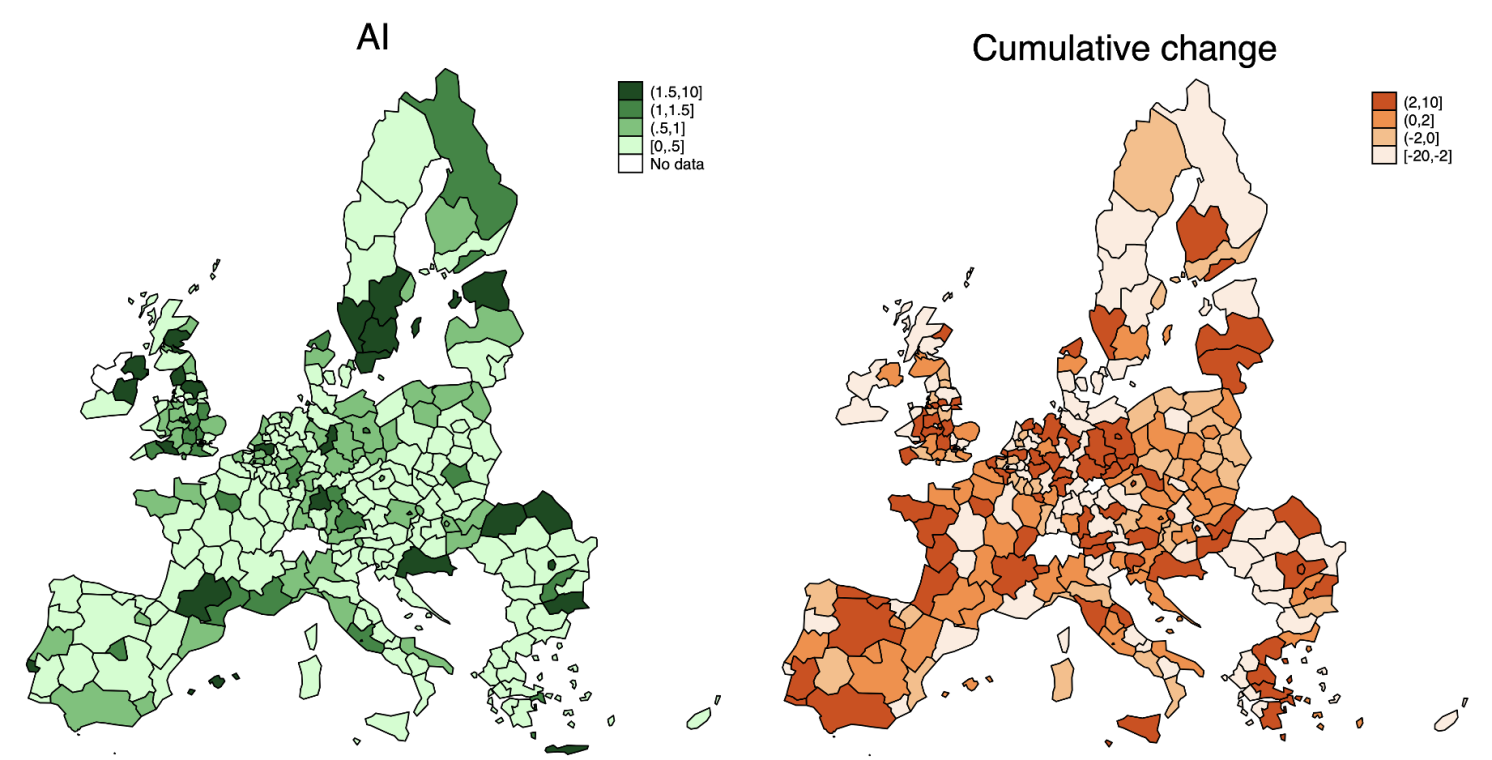 Note: The left-hand side of the graph reports regional AI patenting intensity, defined as technologically revealed comparative advantage, calculated as the average count of AI patents relative to that of other patents filed in the region between 2000 and 2017. The resulting value is then expressed as a ratio to the same measure for the other regions. If the index is greater than 1, the region is specialized in AI patenting. The right-hand side shows the cumulative change in the labour share between 2000 and 2017, expressed in percentage points. |
本稿では、2000年から2017年までの期間を対象に、欧州21カ
国・238地域からのデータを用いて、AI主導のイノベーションと労働分配率との関係を検証する。1
産業構造、教育水準、地域のイノベーションの動態における差異が技術変化の影響を強く媒介するため、こうした地域的な視点は不可欠である。 我々は、機械学習、自然言語処理、画像処理手法などの技術を含む、新たに構築したAI関連特許データセットを通じてAIイノベーションを測定する。これら のデータは、技能レベル別に細分化された雇用、賃金、付加価値に関する詳細な地域指標とリンクされている。 分析結果によると、AI特許出願密度と労働所得シェアの間には、強固かつ統計的に有意な負の相関関係が認められる。AI特許強度が2倍になると、労働所得 シェアは0.5~1.6パーセントポイント低下する。図1はこの傾向を示しており、左パネルには欧州各地域のAI強度、右パネルには2000年から 2017年までの労働所得シェアの累積変化が示されている。AI強度が高い地域では、この期間全体を通じて労働所得シェアが低下する傾向が見られた。 図1 注:グラフの左側は、地域ごとのAI特許出願の集中度を示している。これは「技術的に明らかになった比較優位」として定義され、2000年から2017年 の間に当該地域で出願された他の特許数に対するAI特許数の平均比率として算出される。得られた値は、他の地域の同指標に対する比率として表される。指数 が1を超える場合、その地域はAI特許出願に特化している。右側には、2000年から2017年までの労働分配率の累積変化が、パーセンテージポイントで 示されている。 |
| Crucially, the decline in the
labour share is not uniform across the workforce. We find that medium-
and high-skilled workers experience the strongest reductions in their
income share, primarily driven by wage compression as opposed to
changes in employment.2 By contrast, the labour share of low-skilled
workers declines less – largely because of mild employment growth in
this segment, which partly offsets stagnant or falling wages. These
patterns suggest that AI is reshaping the labour market not only
between labour and capital, but also within labor, by redistributing
returns across skill groups (see also Bloom et al. 2024 and 2025 for a
theoretical framework that is consistent with these results). Importantly, we do not observe proportional gains in labour productivity that might offset these distributional shifts. In this context, AI not only raises efficiency but also reallocates the gains from innovation, amplifying the share of income accruing to capital. |
重要な点として、労働分配率の低下は労働者全体で一様ではない。我々の
分析によれば、中・高技能労働者の所得シェアの減少が最も顕著であり、その主な要因は雇用の変化ではなく、賃金圧縮にあることが分かった²。対照的に、低
技能労働者の労働分配率の低下幅は小さい。これは主に、この層における緩やかな雇用増加が、賃金の停滞や低下を部分的に相殺しているためである。これらの
傾向は、AIが労働と資本の間だけでなく、労働者内部においても、技能グループ間で収益を再配分することで労働市場を再構築していることを示唆している
(これらの結果と整合する理論的枠組みについては、Bloom et al. 2024および2025も参照)。 重要な点として、こうした分配のシフトを相殺しうるような、労働生産性の比例的な向上は見られない。この文脈において、AIは効率性を高めるだけでなく、 イノベーションによる利益を再配分し、資本に帰属する所得の割合を増大させている。 |
| From routine substitution to
skill compression: Rethinking polarisation |
定型的な交代からスキルの集約へ:二極化の再考 |
| While the decline in the labour
share began long before the emergence of AI, the evidence suggests that
AI innovation is reinforcing and accelerating this trend. Historically,
technological progress has often complemented skilled labour while
replacing routine, low-skill tasks. By contrast, modern AI is
increasingly able to replicate cognitive work, expanding the scope of
automation into high- and medium-skill occupations. This shift is particularly visible in the service economy. AI applications are now used in law, finance, logistics, public administration, and other white-collar domains previously considered resistant to automation. As a result, the current wave of innovation does not conform to the classical narrative of low-skill job displacement followed by skill upgrading. Instead, we observe signs of wage compression at the top and middle of the skill distribution. The net effect is a new form of labour market polarisation, one that does not necessarily benefit high-skilled workers as in past waves of technological change. Rather, the evidence points to a redistribution of economic value away from labour across the board, with particularly adverse effects for those previously insulated from technological disruption. This occurs even against the backdrop that AI raises average productivity and economic growth (e.g., Acemoglu 2025). In the European context, where concerns over wage stagnation, inequality, and political discontent are mounting, this evolving dynamic demands close attention. |
労働分配率の低下はAIの登場よりずっと前から始まっていたが、AIの
革新がこの傾向を強め、加速させていることを示す証拠がある。歴史的に見て、技術の進歩は、反復的で低スキルの業務に取って代わる一方で、熟練労働を補完
することが多かった。対照的に、現代のAIは認知的業務を再現する能力を高めており、自動化の対象を中・高スキルの職種にまで拡大させている。 この変化はサービス経済において特に顕著だ。AIアプリケーションは現在、法律、金融、物流、行政、その他、従来は自動化に抵抗があると見なされていたホ ワイトカラーの分野でも利用されている。その結果、現在のイノベーションの波は、低技能職の置き換えに続いて技能の高度化がもたらされるという従来の通説 には当てはまらない。その代わりに、技能分布の上位層および中位層において賃金圧縮の兆候が見られる。 その結果として生じるのは、労働市場の新たな二極化であり、これは過去の技術革新の波のように必ずしも高スキル労働者に利益をもたらすものではない。むし ろ、証拠は、労働から経済的価値が全面的に再分配されていることを示しており、特にこれまで技術的混乱の影響を受けずに済んでいた層に対して悪影響を及ぼ している。これは、AIが平均的な生産性と経済成長を向上させているという背景(例:Acemoglu 2025)があるにもかかわらず生じている。 賃金停滞、不平等、政治的不満への懸念が高まっている欧州の文脈において、この変化する動態には細心の注意を払う必要がある。 |
| Policy implications |
政策への示唆 |
| The economic effects of AI
diffusion are not deterministic – the distributional outcomes will
depend on how policymakers respond to the deployment and increasing use
of this technology. To mitigate the adverse labour effects, investing
in human capital is crucial, particularly through the development of
lifelong learning systems and vocational programmes that equip workers
with the skills to transition into AI-complementary roles. In tandem, tax systems must adapt to the shifting balance between labour and capital. As capital increasingly captures the returns from production, fiscal frameworks could be developed to ensure equity and revenue sustainability. Potential policies could reduce labour taxation and move to a (higher) taxation of pollution, which has negative externalities that would be efficient to reduce anyway; a (higher) taxation of land, which is fixed in supply so that its taxation is non-distortionary; and a (higher) taxation of consumption, which will continue to grow in the presence of AI-driven economic growth (for a detailed discussion of such policies see Prettner and Bloom 2020, especially Chapter 7). Moreover, to avoid reinforcing geographic disparities, economic policy could actively promote the diffusion of AI technologies across regions and sectors. Broadening AI adoption can help ensure that productivity gains are not confined to a few innovation hubs but instead contribute to inclusive and regionally balanced growth. If governed effectively, AI could appreciably raise aggregate economic wellbeing. Without appropriate policy intervention, however, it may reinforce structural divides – between labour and capital and between core and peripheral regions. |
AIの普及がもたらす経済的影響は決定的ではない。その分配的な結果
は、政策立案者がこの技術の導入や利用拡大にどう対応するかによって左右される。労働市場への悪影響を緩和するためには、人的資本への投資が不可欠であ
り、特に、労働者がAIと補完的な役割へと移行するためのスキルを身につけられるよう、生涯学習システムや職業訓練プログラムの整備が重要である。 これと並行して、税制は労働と資本の間のバランス変化に適応しなければならない。生産からの収益を資本がますます独占するにつれ、公平性と歳入の持続可能 性を確保するための財政枠組みを構築することが考えられる。検討すべき政策としては、労働への課税を軽減し、汚染への(より高い)課税へと移行することが 挙げられる。汚染には負の外部性があり、その削減はいずれにせよ効率的である。供給が固定的であるため課税による歪みが生じない土地への(より高い)課 税;そして、AI主導の経済成長下で今後も拡大し続ける消費への(より高い)課税などが考えられる(こうした政策に関する詳細な議論については、 Prettner and Bloom 2020、特に第7章を参照)。さらに、地域間の格差を拡大させないため、経済政策は地域やセクターを越えたAI技術の普及を積極的に促進すべきである。 AIの導入を広げることは、生産性の向上が少数のイノベーション・ハブに限定されることなく、包摂的で地域的に均衡のとれた成長に寄与することを保証する のに役立つ。 効果的に管理されれば、AIは経済全体の福祉を著しく向上させ得る。しかし、適切な政策介入がなければ、労働と資本の間、あるいは中核地域と周辺地域の間 の構造的な格差を拡大させる恐れがある。 |
| References |
参照文献 |
| Acemoglu, D (2025), “The simple
macroeconomics of AI”, Economic Policy 40: 13–58. Bloom, D E, K Prettner, J Saadaoui and M Veruete (2024), “The expansion of AI will likely shrink earnings inequality”, VoxEU.org, 18 October. Bloom, D E, K Prettner, J Saadaoui and M Veruete (2025), “Artificial intelligence and the skill premium”, Finance Research Letters 81, 107401. Korinek, A and J E Stiglitz (2019), “Artificial intelligence and its implications for income distribution and unemployment”, in Agrawal, Gans, and Goldfarb (eds), The Economics of Artificial Intelligence: An Agenda, University of Chicago Press. Minniti, A, K Prettner and F Venturini (2025), “AI innovation and the labor share in European regions”, European Economic Review 177, 105043. Prettner, K and D Bloom (2020), Automation and Its Macroeconomic Consequences: Theory, Evidence, and Social Impacts, Academic Press. Prytkova, E, F Petit, D Li, S Chaturvedi and T Ciarli (2024), “The employment impact of emerging digital technologies”, CESifo Working Paper 10955. Webb, M (2019), “The impact of artificial intelligence on the labor market”, SSRN Working Paper 3482150. |
Acemoglu, D (2025),
「AIの単純なマクロ経済学」, 『Economic Policy』 40: 13–58.[pdf] Bloom, D E, K Prettner, J Saadaoui および M Veruete (2024), 「AIの普及は所得格差を縮小させる可能性が高い」, VoxEU.org, 10月18日. ブルーム、D・E、K・プレットナー、J・サアダウイ、M・ベルエテ(2025)、「人工知能とスキルプレミアム」、『ファイナンス・リサーチ・レター ズ』81、107401。 コリネック、A および J・E・スティグリッツ(2019)、「人工知能と所得分配および失業への影響」、アグラワル、ガンス、ゴールドファーブ(編)『人工知能の経済学:ア ジェンダ』、シカゴ大学出版局。 Minniti, A, K Prettner および F Venturini (2025), 「欧州地域におけるAIイノベーションと労働分配率」, 『European Economic Review』 177, 105043. Prettner, K および D Bloom (2020), 『自動化とそのマクロ経済的影響:理論、実証、社会的影響』, Academic Press. Prytkova, E、F Petit、D Li、S Chaturvedi、T Ciarli(2024)、「新興デジタル技術の雇用への影響」、CESifoワーキングペーパー10955。 Webb, M(2019)、「人工知能が労働市場に与える影響」、SSRNワーキングペーパー3482150。 |
| Footnotes 1. According to the Nomenclature of Territorial Units for Statistics (NUTS) of the EU, the data refer to the NUTS-2 level (basic regions). 2. The skill types are defined using the ISCED classification system, which segments educational attainment into three categories: Low (early childhood education; primary education. lower secondary education), Medium (upper secondary education. post-secondary non-tertiary education), and High (short-cycle tertiary education; bachelor’s degree or equivalent tertiary education level). |
脚注 1. EUの統計地域区分(NUTS)に基づき、データはNUTS-2レベル(基本地域)を指す。 2. 技能の種類は、ISCED分類体系を用いて定義されており、この体系では教育達成度を「低」(幼児教育、初等教育、中等教育前期)、「中」(中等教育後 期、高等教育以外の高等教育)、および「高」(短期高等教育、学士号または同等の高等教育レベル)の3つのカテゴリーに分類している。 |
| AI and the distribution of income between capital and labour | |
| Acemoglu, D (2025), “The simple macroeconomics of AI”, Economic Policy 40: 13–58.[pdf] | Acemoglu, D (2025), 「AIの単純なマクロ経済学」, 『Economic Policy』 40: 13–58.[pdf] |
| This paper evaluates claims
about the large macroeconomic implications of new advances in AI. It
starts from a task-based model of AI’s effects, working through
automation and task complementarities. It
establishes that, so long as AI’s microeconomic effects are driven by
cost savings/productivity improvements
at the task level, its macroeconomic consequences will be given by a
version of Hulten’s theorem: GDP and
aggregate productivity gains can be estimated by what fraction of tasks
are impacted and average task-level
cost savings. Using existing estimates on exposure to AI and
productivity improvements at the task level,
these macroeconomic effects appear nontrivial but modest—no more than a
0.71% increase in total factor
productivity over 10 years. The paper then argues that even these
estimates could be exaggerated, because
early evidence is from easy-to-learn tasks, whereas some of the future
effects will come from hard-to-learn
tasks, where there are many context-dependent factors affecting
decision-making and no objective outcome
measures from which to learn successful performance. Consequently,
predicted TFP gains over the next 10
years are even more modest and are predicted to be less than 0.55%. I
also explore AI’s wage and inequality
effects. I show theoretically that even when AI improves the
productivity of low-skill workers in certain tasks
(without creating new tasks for them), this may increase rather than
reduce inequality. Empirically, I find
that AI advances are unlikely to increase inequality as much as
previous automation technologies because
their impact is more equally distributed across demographic groups, but
there is also no evidence that AI
will reduce labor income inequality. AI is also predicted to widen the
gap between capital and labor income.
Finally, some of the new tasks created by AI may have negative social
value (such as design of algorithms
for online manipulation), and I discuss how to incorporate the
macroeconomic effects of new tasks that may
have negative social value. |
本稿は、AIの新たな進展がもたらす大きなマクロ経済的影響に関する主
張を検証する。まず、タスクベースのAI効果モデルを出発点とし、自動化とタスク間の補完性を分析する。本稿は、AIのミクロ経済的効果がタスクレベルで
のコスト削減・生産性向上によって駆動される限り、そのマクロ経済的影響はフルテン(Hulten)の定理の一種によって与えられることを明らかにする。
すなわち、GDPおよび総生産性の向上幅は、影響を受けるタスクの割合と、タスクレベルでの平均コスト削減額によって推定可能である。タスクレベルにおけ
るAIへの曝露度と生産性向上の既存の推計を用いると、これらのマクロ経済的影響は無視できないものの控えめであり、10年間で全要素生産性が0.71%
増加する程度にとどまる。本論文はさらに、こうした推計値でさえ過大評価されている可能性があると論じている。初期の証拠は習得が容易なタスクに基づくも
のであるのに対し、将来の影響の一部は習得が困難なタスクから生じるためだ。こうしたタスクでは、意思決定に影響を与える文脈依存的な要因が多く存在し、
成功したパフォーマンスを学習するための客観的な成果指標が存在しない。その結果、今後10年間の予測されるTFPの向上幅はさらに控えめとなり、
0.55%未満になると予測される。また、AIが賃金や不平等に及ぼす影響についても考察する。理論的に、AIが特定の業務において低技能労働者の生産性
を向上させたとしても(彼らに新たな業務を生み出さない場合)、不平等は縮小するどころか拡大する可能性があることを示す。実証的には、AIの進歩は、そ
の影響が人口統計学的グループ間でより均等に分散されるため、従来の自動化技術ほど不平等を拡大させる可能性は低いと見られるが、AIが労働所得の不平等
を縮小させるという証拠も存在しない。また、AIは資本所得と労働所得の格差を拡大すると予測されている。最後に、AIによって創出される新たな業務の中
には、社会的価値がマイナスとなるもの(オンライン操作のためのアルゴリズム設計など)も存在し、社会的価値がマイナスとなり得る新たな業務のマクロ経済
的影響をどのように組み込むべきかについて論じる。 |
| Fenglin Zhang, The labor theory of value in the era of artificial intelligence and digital platforms: challenges, innovations, and new mechanisms. Humanities and Social Sciences Communications (2026) Published: 28 March 2026 | チャン・フェンリン「人工知能とデジタルプラットフォーム時代の労働価 値理論: 課題、革新、新しいメカニズム」Humanities and Social Sciences Communications (2026) Published: 28 March 2026 |
| This research examines the
contemporary relevance and necessary extensions of Marx’s labor theory
of value in the context of artificial intelligence (AI) and digital
platforms through theoretical analysis and critical literature
synthesis. As a primarily conceptual study, it explores how AI
technologies and platform-based business models challenge traditional
understandings of labor value creation and distribution while
demonstrating the continued analytical power of Marxist political
economy. The theoretical frameworks developed here require future
empirical validation through case studies, quantitative analysis, and
ethnographic research to test and refine the propositions advanced. The
study clarifies the theoretical status of AI as constant capital rather
than labor, identifies key characteristics of value formation in
platform economies, analyzes new mechanisms of surplus value
distribution, and proposes institutional frameworks for realizing labor
value. The findings suggest that while AI and digital platforms have
fundamentally altered the organization of work and modes of value
realization, the core insights of the labor theory of value—that living
labor remains the sole source of new value—remain essential for
critiquing contemporary digital capitalism. This research contributes
to ongoing debates about the future of work, power asymmetries in
platform economies, and the development of worker-protective regulatory
frameworks, engaging with perspectives from feminist economics,
institutional theory, and surveillance capitalism studies. |
この研究は、理論分析と批判的文献の統合を通じて、人工知能
(AI) とデジタル
プラットフォームの文脈におけるマルクスの労働価値理論の現代的関連性と必要な拡張を検証します。主に概念的な研究として、マルクス主義政治経済の継続的
な分析力を実証しながら、AI テクノロジーとプラットフォームベースのビジネス
モデルが労働価値の創造と分配に関する従来の理解にどのように挑戦するかを探ります。ここで開発された理論的枠組みは、先進的な命題をテストし改良するた
めに、ケーススタディ、定量的分析、民族誌的研究を通じて将来の実証的検証を必要とします。この研究は、労働ではなく不変資本としてのAIの理論的地位を
明らかにし、プラットフォーム経済における価値形成の主要な特徴を特定し、剰余価値分配の新しいメカニズムを分析し、労働価値を実現するための制度的枠組
みを提案している。この調査結果は、AIとデジタルプラットフォームが仕事の組織化と価値実現の様式を根本的に変えた一方で、生きた労働が依然として新た
な価値の唯一の源泉であるという労働価値理論の中核となる洞察が、現代のデジタル資本主義を批判する上で依然として不可欠であることを示唆している。この
研究は、フェミニスト経済学、制度理論、監視資本主義研究の視点を交えながら、仕事の未来、プラットフォーム経済における権力の非対称性、労働者を保護す
る規制枠組みの開発に関する進行中の議論に貢献する。 |
| https://www.nature.com/articles/s41599-026-07030-4 |
☆このページは「欲望の哲学」からスピンオフしたものです。上掲と同じ内容が「欲望の哲学」のページに含まれている可能性があります。
リ ンク
文 献
そ の他の情報
CC
Copyleft,
CC, Mitzub'ixi Quq Chi'j, 1996-2099
