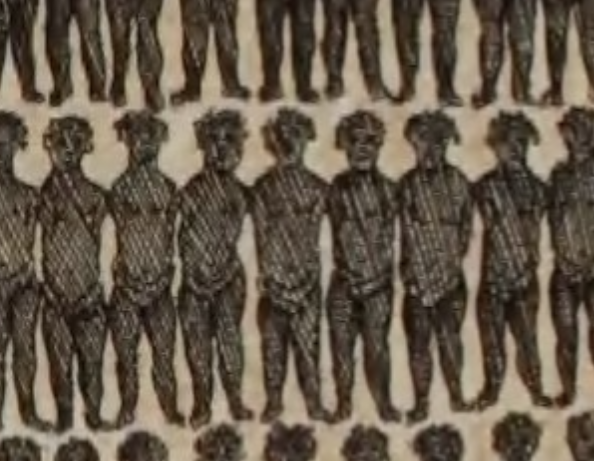

資本主義と奴隷制
Capitalism and Slavery
★「ニ
グロはニグロだ。ある状況下では、彼は奴隷になる。ラバは綿を紡ぐ機械だ。特定の状況下で初めて資本となる。これらの状況外では、それは金がお金として本
質的に価値を持つように、または砂糖が砂糖の価格であるように、資本ではない。資本は生産の社会的関係である。それは生産の歴史的関係である」——カー
ル・マルクス『労働と資本』N. Rh. Z.第266号1849年4月7日.
☆『資 本主義と奴隷制』は、1962年にトリニダード・トバゴの初代首相となったエリック・ウィリアムズの博士論文の出版のタイトルである。18世紀後半か らの奴隷制、特に大西洋奴隷貿易とイギリス領西インド諸島における奴隷制の衰退に経済的要因が与えた影響について、多くの論文を展開している。また、当時 の大英帝国の歴史学に対する批判も行っている。特に、1833年に制定された奴隷制廃止法を一種の道徳的な枢軸として用いていることについて、また、帝国 憲政史を立法による絶え間ない前進とみなす歴史学派に対する批判も行っている。経済学的な議論、特にいわゆるラガッツ=ウィリアムズの衰退理論の適用可能 性は、それがアメリカ独立戦争前後の時期に用いられる場合、今日に至るまで歴史 家の間で論争となっている。他方、奴隷制がイギリス経済に与えた影響、特に奴隷制廃止の余波や大西洋貿易の商業的後背地に関する詳細な経済学的調査は、盛 んな研究分野である。大英帝国の歴史学は、いまだに広く論争を呼んでいる。Oxford Dictionary of National Biographyに寄稿しているケネス・モーガンは、『Capitalism and Slavery』を「おそらく奴隷制の歴史に関して20世紀に書かれた本の中で最も影響力のある本」と評価している。この本は1944年にアメリカで出版 されたが、1833年にイギリスで制定された奴隷制度廃止法の人道主義的動機を損なうなどの理由から、大手出版社はイ ギリスでの出版を拒否した。1964年にアンドレ・ドイッチュが英国で出版し、1991年まで何度も再版され、2022年にペンギン・モダン・クラ シックスから英国初の大衆版として出版され、ベストセラーとなった。
| Capitalism and
Slavery is the published version of the doctoral dissertation of Eric
Williams, who was the first Prime Minister of Trinidad and Tobago in
1962. It advances a number of theses on the impact of economic factors
on the decline of slavery, specifically the Atlantic slave trade and
slavery in the British West Indies, from the second half of the 18th
century. It also makes criticisms of the historiography of the British
Empire of the period: in particular on the use of the Slavery Abolition
Act of 1833 as a sort of moral pivot; but also directed against a
historical school that saw the imperial constitutional history as a
constant advance through legislation. It uses polemical asides for some
personal attacks, notably on the Oxford historian Reginald Coupland.
Seymour Drescher, a prominent critic among historians of some of the
theses put forward in Capitalism and Slavery by Williams, wrote in
1987: "If one criterion of a classic is its ability to reorient our
most basic way of viewing an object or a concept, Eric Williams's study
supremely passes that test."[1] The applicability of the economic arguments, and specially in the form of so-called Ragatz–Williams decline theory, is a contentious matter to this day for historians, when it is used for the period around the American Revolutionary War. On the other hand detailed economic investigations of the effects of slavery on the British economy, in particular, the aftermath of abolition, and the commercial hinterland of the Atlantic trade, are a thriving research area. The historiography of the British Empire is still widely contested. Kenneth Morgan writing in the Oxford Dictionary of National Biography evaluates Capitalism and Slavery as "perhaps the most influential book written in the twentieth century on the history of slavery".[2] It was published in the United States in 1944, but major publishers refused to have it published in Britain, on grounds including that it undermined the humanitarian motivation for Britain's Slavery Abolition Act of 1833. In 1964 André Deutsch published it in Britain; it went through numerous reprintings to 1991,[3] and was published in the first UK mass-market edition by Penguin Modern Classics in 2022,[4] becoming a best-seller.[5] |
『資本主義と奴隷制』は、1962年にトリニダード・トバゴの初代首相
となったエリック・ウィリアムズの博士論文の出版のタイトルである。18世紀後半からの奴隷制、特に大西洋奴隷貿易とイギリス領西インド諸島における奴隷
制の衰退に経済的要因が与えた影響について、多くの論文を展開している。また、当時の大英帝国の歴史学に対する批判も行っている。特に、1833年に制定
された奴隷制廃止法を一種の道徳的な枢軸として用いていることについて、また、帝国憲政史を立法による絶え間ない前進とみなす歴史学派に対する批判も行っ
ている。特にオックスフォードの歴史家レジナルド・クープランドに対する個人攻撃には、極論的な余談が使われている。ウィリアムズが『資本主義と奴隷制』
で提唱したいくつかの論点を歴史家の間で著名に批判していたシーモア・ドレシャーは、1987年に次のように書いている。「古典の一つの基準が、ある対象
や概念に対する我々の最も基本的な見方を方向づける能力であるとすれば、エリック・ウィリアムズの研究はそのテストに見事に合格している」[1]。 経済学的な議論、特にいわゆるラガッツ=ウィリアムズの衰退理論の適用可能性は、それがアメリカ独立戦争前後の時期に用いられる場合、今日に至るまで歴史 家の間で論争となっている。他方、奴隷制がイギリス経済に与えた影響、特に奴隷制廃止の余波や大西洋貿易の商業的後背地に関する詳細な経済学的調査は、盛 んな研究分野である。大英帝国の歴史学は、いまだに広く論争を呼んでいる。Oxford Dictionary of National Biographyに寄稿しているケネス・モーガンは、『Capitalism and Slavery』を「おそらく奴隷制の歴史に関して20世紀に書かれた本の中で最も影響力のある本」と評価している[2]。 この本は1944年にアメリカで出版されたが、1833年にイギリスで制定された奴隷制度廃止法の人道主義的動機を損なうなどの理由から、大手出版社はイ ギリスでの出版を拒否した。1964年にアンドレ・ドイッチュが英国で出版し、1991年まで何度も再版され[3]、2022年にペンギン・モダン・クラ シックスから英国初の大衆版として出版され[4]、ベストセラーとなった[5]。 |
| Williams as an Oxford
undergraduate In 1931 Williams came to the University of Oxford from Trinidad on an Island Scholarship. He joined St Catherine's Society, not then a college (until that year the Delegacy for Non-Collegiate Students).[2][6] He obtained a first-class degree in Modern History, but found social life largely unfriendly. He made a friend of a Thai student, interacted with his tutors, and attended the Indian Majlis, a student club.[7] |
オックスフォード大学時代のウィリアムズ 1931年、ウィリアムズは島(アイランド)奨学金を得てトリニダードからオックスフォード大学に入学。当時はまだカレッジではなかったセント・キャサリンズ・ソサエ ティ(その年までは非大学生のための代議員会)に入った[2][6]。彼はタイ人の学生と友達になり、チューターと交流し、学生クラブであるインド・マ ジュリスに出席した[7]。 |
|
The Economic Aspect of the Abolition of the West Indian Slave Trade and
Slavery Williams wrote his Oxford D.Phil. dissertation under Vincent Harlow, on a topic suggested by C. L. R. James. The tone of the dissertation is judged "deferential", in comparison with the 1944 published version.[8][9] One of the D.Phil. examiners was Reginald Coupland, from 1920 second holder of the Beit Chair at Oxford for "colonial history", founded in 1905.[10][11] An emphasis on constitutional history led at Oxford, as Behm puts it, to "enthusiasm for social and moral reform [...] in an atmosphere already permeated by 'constitutional progress' as shorthand for centuries of world-historical advance".[12] Alfred Beit, the founder, was a friend of Cecil Rhodes and Alfred Milner, and the Chair came under the influence of the Round Table movement that forwarded Milner's ideas, and to which Coupland belonged.[10][13] In his later work British Historians and the West Indies (1966), Williams attacked the generality of Oxford historians who had dealt with the topic. He excepted Sydney Olivier.[14] Williams had been made aware of the potential importance of Coupland to his academic career by Joseph Oliver Cutteridge, the ex-British Army officer who was director of education in Trinidad and Tobago. This was at the point in 1936 when Williams was given funding for his doctoral work; Cutteridge had contacted Coupland on his behalf, to use influence with Claud Hollis, the Governor. Cutteridge had then advised "caution".[15] The original dissertation was published in 2014.[16] Its argument has the same basic structure of a "decline" thesis, and the negation of good intentions of abolitionists as a historical factor. Ryden identifies the three faces of decline in the first half of the 19th century as: "falling sugar planting profits"; "decline of the relative importance of the West Indian trade" in the British economy; and "a rising anti-mercantilist tide".[17] |
西インド奴隷貿易と奴隷制廃止の経済的側面 ウィリアムズは、C.L.R.ジェイムズが提案したテーマについて、ヴィンセント・ハーロウの下でオックスフォード博士論文を執筆した。この論文の論調 は、1944年に出版されたものと比べて「遜色ない」と評価されている[8][9]。 ベームが言うように、オックスフォードでは憲法史が重視され、「何世紀にもわたる世界史的進歩の略語としての『憲法の進歩』がすでに浸透していた雰囲気の 中で、社会的・道徳的改革への熱意が高まっていた」。 [創設者のアルフレッド・ベイトはセシル・ローズとアルフレッド・ミルナーの友人であり、同委員会はミルナーの思想を推し進め、クープランドも所属してい た円卓会議の影響下にあった[10][13]。ウィリアムズは後年の著作『British Historians and the West Indies』(1966年)の中で、このテーマを扱ったオックスフォードの歴史家の一般性を攻撃している。彼はシドニー・オリヴィエを除いていた [14]。 ウィリアムズは、トリニダード・トバゴの教育局長であった元イギリス陸軍将校のジョセフ・オリヴァー・カッタリッジによって、彼の学問的キャリアにとって クープランドが潜在的に重要であることを認識させられていた。カッタリッジはウィリアムズに代わってクープランドに接触し、総督のクラウド・ホリスに影響 力を行使した。カッタリッジはそのとき「注意」するよう忠告していた[15]。 論文の原文は2014年に出版された[16]。その論旨は「衰退」論文と同じ基本構造を持っており、歴史的要因として奴隷廃止論者の善意を否定している。 ライデンは、19世紀前半における衰退の3つの顔を挙げている: 「砂糖栽培の利益の低下」、イギリス経済における「西インド貿易の相対的重要性の低下」、「反重商主義の潮流の高まり」である[17]。 |
| https://en.wikipedia.org/wiki/Capitalism_and_Slavery | |
 出典:Against Necropolotics II: 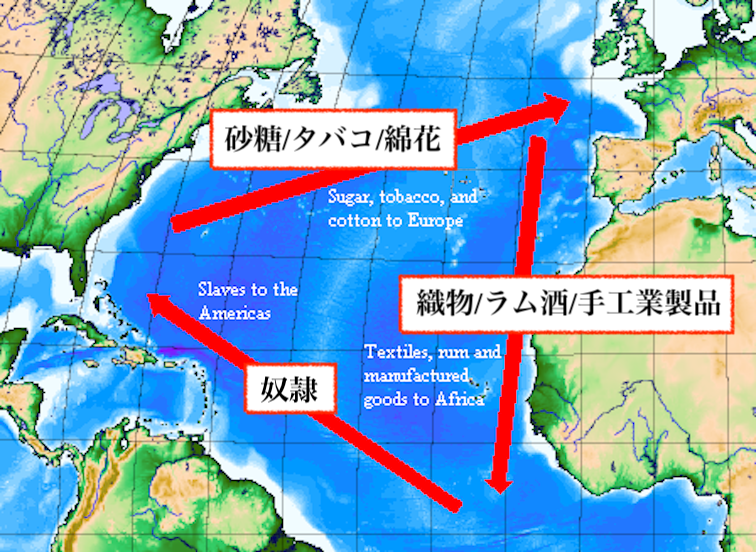 The classical model of the triangular trade 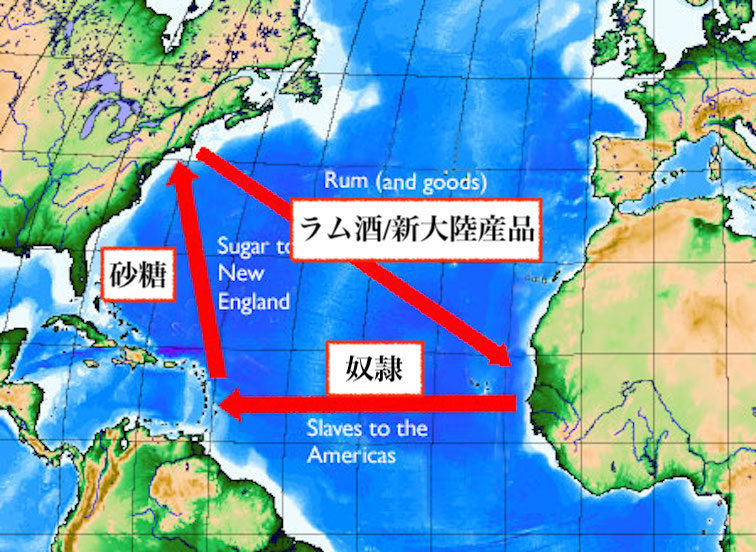 The triangular trade of slaves, sugar, and rum, with New England instead of Europe as the third corner |
序文 1. 黒人奴隷制の起源 2. 黒人奴隷貿易の起源 3. イギリスの商業と三角貿易 A 三角貿易 B 海運と造船 C イギリスにおける大海港都市の発達 D 三角貿易の取り扱い品目 1. 毛織物、2.綿織物製造業、3.製糖、4.ラム酒の蒸留、5.安ぴかもの、6.冶金工業 4. 西インド諸島勢力 5. イギリスの産業と三角貿易 A 三角貿易の利潤と投資 1.金融業、2.重工業、3.保険業 B イギリス産業の発展——1783年まで 6. アメリカ革命 7. イギリス資本主義の発展:1783-1833 8. 新産業体制 A 保護貿易か、自由放任か? B 反帝国主義の成長 C 世界における砂糖生産の増大 9. イギリス資本主義と西インド諸島 A 綿織物製造業者 B 製鉄業者 C 毛織物工業 D リバブールとグラスゴー E 製糖業者 F 海運および船員 10. 実業界と奴隷制 11. 聖人と奴隷制 12. 奴隷と奴隷制 13. 結論 |
| Triangular trade
or triangle trade is trade between three ports or regions. Triangular
trade usually evolves when a region has export commodities that are not
required in the region from which its major imports come. Such trade
has been used to offset trade imbalances between different regions. The most commonly cited example of a triangular trade is the Atlantic slave trade, but other examples existed. These include the seventeenth-century carriage of manufactured goods from England to New England and Newfoundland, then the transport of dried cod from Newfoundland and New England to the Mediterranean and the Iberian peninsula, followed by cargoes of gold, silver, olive oil, tobacco, dried fruit, and "sacks" of wine back to England. Maritime carriers referred to this Atlantic trade as the "sack trade". A 19th-century example involved general cargo shipped from Britain to Australia, Australian coal to China, then tea and silk back to Britain. The Atlantic slave trade used a system of three-way transatlantic exchanges – known historically as the triangular trade – which operated between Europe, Africa, and the Americas from the 16th to 19th centuries. European merchants outfitted slave ships, then shipped manufactured European goods owned by the trading companies[which?] to West Africa to get slaves, which they shipped to the Americas (in particular to Brazil and the Caribbean islands). First, in West Africa, merchants sold or bartered European manufactured goods to local slavers in exchange for slaves. Then crews transported the slaves and the remaining European manufactured goods to the Americas, where ship merchants sold the slaves and European manufactured goods to plantation-owners. Merchants then purchased sugar and molasses from the plantation-owners, and crews shipped them to North American colonies (such as the future states of the US), where the merchants sold the remaining supplies of European manufactured goods and slaves, as well as sugar and molasses from plantations to local buyers, and then purchased North American commodities - including tobacco, sugar, cotton, rum, rice, lumber, and animal pelts - to sell in Europe. This trade, in trade volume, was primarily with South America, where most slaves were sold, but a classic example taught in 20th-century studies is the colonial molasses trade, which involved the circuitous trading of slaves, sugar (often in liquid form, as molasses), and rum between West Africa, the West Indies and the northern colonies of British North America in the 17th and 18th centuries.[1][2] In this triangular trade, slaves grew the sugar that was used to brew rum, which in turn was traded for more slaves. In this circuit the sea-lane west from Africa to the West Indies (and later, also to Brazil) was known as the Middle Passage; its cargo consisted of abducted or recently purchased African people. During the Age of Sail, the particular routes were also shaped by the powerful influence of winds and currents. For example, from the main trading nations of Western Europe, it was much easier to sail westwards after first going south of 30° N latitude and reaching the belt of so-called "trade winds", thus arriving in the Caribbean rather than going straight west to the North American mainland. Returning from North America, it was easiest to follow the Gulf Stream in a northeasterly direction using the westerlies. (Even before the voyages of Christopher Columbus, the Portuguese had been using a similar triangle to sail to the Canary Islands and the Azores, and it was then expanded outwards.) The countries that controlled the transatlantic slave-market until the 18th century in terms of the number of enslaved people shipped were Great Britain, Portugal, and France. |
三角貿易[Triangular trade]とは、3つの港や地域間で行われる貿易のことだ。三角貿易は通常、ある地域が輸出商品を持っている一方で、その主要な輸入元となる地域ではその商品が不要である場合に成立する。このような貿易は、異なる地域間の貿易不均衡を是正するために利用されてきた。 三角貿易の最もよく引き合いに出される例は大西洋奴隷貿易だが、他にも例は存在した。これらには、17世紀にイングランドからニューイングランドやニュー ファンドランドへ製造品を輸送し、その後、ニューファンドランドやニューイングランドから地中海やイベリア半島へ干し鱈を輸送し、続いて金、銀、オリーブ オイル、タバコ、ドライフルーツ、そしてワインの「サック」をイングランドへ持ち帰るという流れが含まれる。海運業者たちは、この大西洋貿易を「サック貿 易」と呼んでいた。19世紀の例としては、英国からオーストラリアへ一般貨物を輸送し、オーストラリアの石炭を中国へ送り、その後、茶と絹を英国へ持ち帰 るという流れがあった。 大西洋奴隷貿易は、16世紀から19世紀にかけてヨーロッパ、アフリカ、アメリカ大陸の間で機能した、三者間の大西洋横断交換システム――歴史的に「三角 貿易」として知られる――を利用していた。ヨーロッパの商人たちは奴隷船を装備し、貿易会社[どの会社か?]が所有するヨーロッパ製の製品を西アフリカへ 輸送して奴隷を入手し、それらをアメリカ大陸(特にブラジルやカリブ海の島々)へ輸送した。まず西アフリカで、商人たちは現地の奴隷商人に対し、ヨーロッ パの工業製品を販売または物々交換し、その見返りとして奴隷を入手した。その後、乗組員たちは奴隷と残りのヨーロッパ製工業製品をアメリカ大陸へ輸送し、 そこで船主たちは奴隷と工業製品をプランテーション所有者に売却した。その後、商人たちはプランテーション所有者から砂糖や糖蜜を購入し、乗組員がそれら を北米植民地(後の米国各州など)へ輸送した。そこで商人たちは、残りの欧州製工業製品や奴隷、さらにはプランテーション産の砂糖や糖蜜を地元の買い手に 販売し、タバコ、砂糖、綿、ラム酒、米、木材、動物の毛皮などの北米産品を購入して欧州で販売した。 この貿易は、取引量において主に南米との間で行われ、そこで奴隷の大部分が売買されたが、20世紀の研究で教えられる典型的な例は植民地時代の糖蜜貿易で あり、これは17世紀から18世紀にかけて、西アフリカ、西インド諸島、および英領北アメリカの北部植民地の間で、奴隷、砂糖(多くの場合、糖蜜という液 状のもの)、そしてラム酒が回り道をして取引されるものであった。[1][2] この三角貿易において、奴隷たちはラム酒の醸造に用いられる砂糖を栽培し、そのラム酒はさらに多くの奴隷と交換された。この循環において、アフリカから西 インド諸島(後にブラジルへも)へと西へ向かう海路は「ミドル・パッセージ」として知られ、その積荷は拉致された、あるいは最近購入されたアフリカの人々 であった。 帆船時代において、特定の航路は風や海流の強力な影響によっても形作られていた。例えば、西ヨーロッパの主要な貿易国から出航する場合、北緯30度以南に 進み、いわゆる「貿易風」の帯に到達してから西へ航行する方が、北米大陸へ真っ直ぐ西進するよりもはるかに容易であり、こうしてカリブ海に到達できた。北 米からの帰路では、西風を利用してメキシコ湾流に沿って北東方向へ進むのが最も容易であった。(クリストファー・コロンブスの航海以前から、ポルトガル人 は同様の三角航路を用いてカナリア諸島やアゾレス諸島へ航海しており、その後、その航路は外側へと拡大していった。) 18世紀まで、輸送された奴隷の数において大西洋奴隷貿易を支配していた国は、イギリス、ポルトガル、そしてフランスであった。 |
| The Atlantic sack trade The classical model of the triangular trade The triangular trade of slaves, sugar, and rum, with New England instead of Europe as the third corner From 1620 to 1709, ships and additional maritime vessels embarked from Newfoundland and New England docks in a "sack trade."[3] Sailors from both regions carried salted cod into southern Europe, particularly from Boston and Ferryland into Mediterranean and Iberian peninsular seaports. Spanish and Portuguese Catholics welcomed these traders for manifold reasons, including church exemption of cod from the fasting and abstinence mandated for Lent, Advent, and myriad saint remembrance days. Newfoundland and New England ships then carried Iberian wine "sacks", olive oil, dried fruit, tobacco, and substantial volumes of Iberian specie, mined by indigenous captives in Cerro Rico and Cerro de Pasco, into England. After 1661, Parliament lifted a ban on bartering New England cod for Iberian material goods, as well as for bills of exchange. Oil, fruit, tobacco, New World gold and silver, "sacks" of wine, Iberian material culture, and then this paper currency were exchanged for manufactured products in England.[4] During the final leg, colonial carriers transshipped English metropolitan goods, and any "sacks" of surplus wine, across the Atlantic and back into their homeports.[5] The "sack trade" dissolved after 1709 because of changes in cod curing processes and provincial demand for sugar as well as molasses. Atlantic demand for dried cod pushed New England and Newfoundland competency thresholds for angling into transatlantic barter and exchange economies. These shifting conceptions, and scope of, provincial competency resulted in New England and Newfoundland schooners searching for more and more fishing sites along northeastern banks. Fishermen remained offshore for extended periods of time as their vessels trawled North American waters. Peter Pope argues that women often worked shorecrews and as substitutes for men.[6] In order to sustain catches within schooner holds during these protracted trips, fishermen began to "lightly salt" cod and stored the wet fish for air-drying, the latter after returning to points of departure. According to historian Christopher Magra, "invariably, the combination of a wet-salt cure and an air-dry cure produced a greater percentage of refuse-grade, dried cod." Increasing amounts of this "refuse" cod became unmarketable in southern Europe as expansion of the "sack trade" counterintuitively expedited contraction from within. But New England and Newfoundland fishermen tapped their own demand for sugar, molasses, and cheap, domestically-distilled rum, as a commercial avenue to alternate markets for "refuse" cod: sugarcane planters and their agents in Caribbean littorals. Sugarcane planters relied on cheap, low-grade fish to feed chattel slaves.[7] |
大西洋のタラ貿易 The classical model of the triangular trade The triangular trade of slaves, sugar, and rum, with New England instead of Europe as the third corner 1620年から1709年にかけて、ニューファンドランドやニューイングランドの港からは、「タラ貿易」を行う船やその他の船舶が出航した。[3] 両地域の船乗りたちは塩漬けタラを南ヨーロッパへ運んだ。特にボストンとフェリーランドからは、地中海やイベリア半島の港町へと運ばれた。スペインやポル トガルのカトリック教徒たちは、四旬節や待降節、そして数多くの聖人の記念日に義務付けられた断食や禁欲からタラが教会によって免除されていたことなど、 様々な理由からこれらの商人たちを歓迎した。その後、ニューファンドランドとニューイングランドの船は、イベリア半島のワイン「サック」、オリーブオイ ル、ドライフルーツ、タバコ、そしてセロ・リコやセロ・デ・パスコで先住民の捕虜によって採掘された大量のイベリア産金貨を、イングランドへと運んだ。 1661年以降、議会はニューイングランドのタラとイベリア半島の物資、および為替手形との物々交換禁止令を解除した。油、果物、タバコ、新世界の金銀、 「サック」のワイン、イベリアの物質文化、そしてこの紙幣は、イングランドの製造品と交換された。[4] 最終航路において、植民地の運送船は、イングランド本国の商品や余剰のワイン「サック」を積み替え、大西洋を越えて母港へと持ち帰った。[5] 「サック貿易」は、タラの塩漬け工程の変化や、各植民地における砂糖および糖蜜への需要の高まりにより、1709年以降に消滅した。大西洋における乾燥タ ラへの需要は、ニューイングランドとニューファンドランドの漁業能力の限界を押し広げ、大西洋横断的な物々交換経済へと発展させた。こうした植民地の能力 に関する概念と範囲の変化により、ニューイングランドとニューファンドランドのスクーナー船は、北東岸沿いの漁場をますます広範囲に探求するようになっ た。漁船が北米海域をトロール漁で巡る中、漁師たちは長期間にわたり沖合に留まった。ピーター・ポープは、女性たちがしばしば沿岸の作業員として、また男 性の代役として働いていたと論じている。[6] こうした長期航海中にスクーナー船の船倉内の漁獲量を維持するため、漁師たちはタラを「軽く塩漬け」し、湿ったままの魚を出発地に戻ってから風乾させるよ うになった。歴史家クリストファー・マグラによれば、「湿塩漬けと風乾の組み合わせは、例外なく、廃棄等級となる乾燥タラの割合を増加させた」という。 「袋詰め貿易」の拡大が、直感に反して内部からの縮小を加速させたため、この「廃棄」タラの量は増え続け、南ヨーロッパでは販売不能となった。しかし、 ニューイングランドとニューファンドランドの漁師たちは、砂糖、糖蜜、そして安価な国内蒸留ラム酒に対する自国の需要を活かし、この「廃棄」タラをカリブ 海沿岸のサトウキビ農園主やその代理人に供給するという、代替市場への販路を開拓した。サトウキビ農園主たちは、奴隷たちに与える食料として、安価で低品 質な魚に依存していた。[7] |
| The Atlantic triangular slave trade The most historically significant triangular trade was the transatlantic slave trade which operated among Europe, Africa, and the Americas from the 16th to 19th centuries. Slave ships would leave European ports (such as Bristol and Nantes) and sail to African ports loaded with goods manufactured in Europe. There, the slave traders would purchase enslaved Africans by exchanging the goods, then sail to the Americas via the Middle Passage to sell their enslaved cargo in European colonies. In what was referred to as a "golden triangle", the slave ship would sail back to Europe to begin the cycle again.[8] The enslaved Africans were primarily purchased for the purpose of working on plantations to work producing valuable cash crops (such as sugar, cotton, and tobacco) which were in high demand in Europe.[9][10][11][12][13] Slave traders from European colonies would occasionally travel to Africa themselves, eliminating the European portion of the voyage.[14][15]  The number of slaves embarked to America from 1450 until 1800 by country[citation needed] A classic example is the colonial molasses trade. Merchants purchased raw sugar (often in its liquid form, molasses) from plantations in the Caribbean and shipped it to New England and Europe, where it was sold to distillery companies that produced rum. Merchant capitalists used cash from the sale of sugar to purchase rum, furs, and lumber in New England which their crews shipped to Europe.[16] With the profits from the European sales, merchants purchased Europe's manufactured goods, including tools and weapons and on the next leg, shipped those manufactured goods, along with the American sugar and rum, to West Africa where they bartered the goods for slaves seized by local potentates. Crews then transported the slaves to the Caribbean and sold them to sugar plantation owners. The cash from the sale of slaves in Brazil, the Caribbean islands, and the American South was used to buy more raw materials, restarting the cycle. The full triangle trip took a calendar year on average, according to historian Clifford Shipton.[16]  The loss of the slave ship Luxborough Galley in 1727 ("I.C. 1760"), lost in the last leg of the triangular trade, between the Caribbean and Britain.  The North Atlantic Gyre The first leg of the triangle was from a European port to one in West Africa (then known as the "Slave Coast"), in which ships carried supplies for sale and trade, such as copper, cloth, trinkets, slave beads, guns and ammunition.[17] When the ship arrived, its cargo would be sold or bartered for slaves. Ports that exported these enslaved people from Africa include Ouidah, Lagos, Aného (Little Popo), Grand-Popo, Agoué, Jakin, Porto-Novo, and Badagry.[18] These ports traded slaves who were supplied from African communities, tribes and kingdoms, including the Alladah and Ouidah, which were later taken over by the Dahomey kingdom.[19] On the second leg, ships made the journey of the Middle Passage from Africa to the New World. Many slaves died of disease in the crowded holds of the slave ships, and a estimated 15 to 25% would die of disease's before completing there trip[20], which ships often carry 700 enslaved people.[21] Once the ship reached the New World, enslaved survivors were sold in the Caribbean or the American colonies. The ships were then prepared to get them thoroughly cleaned, drained, and loaded with export goods for a return voyage, the third leg, to their home port,[22] from the West Indies the main export cargoes were sugar, rum, and molasses; from Virginia, tobacco and hemp. The ship then returned to Europe to complete the triangle. The triangle route was not generally followed by individual ships. Slave ships were built to carry large numbers of people, rather than cargo, and variations in the duration of the Atlantic crossing meant that they often arrived in the Americas out-of-season. Slave ships thus often returned to their home port carrying whatever goods were readily available in the Americas but with a large part or all of their capacity with ballast.[23][24] Cash crops were transported mainly by a separate fleet which only sailed from Europe to the Americas and back.[25] In his books, Herbert S. Klein has argued that in many fields (cost of trade, ways of transport, mortality levels, earnings and benefits of trade for the Europeans and the "so-called triangular trade"), the non-scientific literature portrays a situation which the contemporary historiography refuted a long time ago.[26] Finally, even if the "triangle trade" idea is essentially incorrect, the Atlantic slave trade was one of the more complex of international trades that existed in the modern period. (…) Thus, while an actual "triangle trade" may not have existed as a significant development for ships in the trade, the economic ties between Asia, Europe, Africa, and America clearly involved a web of relationships that spanned the globe.[27] A 2017 study provides evidence for the hypothesis that the export of gunpowder to Africa increased the transatlantic slave trade: "A one percent increase in gunpowder set in motion a 5-year gun-slave cycle that increased slave exports by an average of 50%, and the impact continued to grow over time."[28] |
大西洋の奴隷の三角貿易 歴史的に最も重要な三角貿易は、16世紀から19世紀にかけてヨーロッパ、アフリカ、アメリカ大陸の間で行われた大西洋奴隷貿易である。奴隷船はヨーロッ パの港(ブリストルやナントなど)を出港し、ヨーロッパで製造された商品を積んでアフリカの港へと向かった。そこで奴隷商人たちは、その商品を交換してア フリカの奴隷を購入し、その後「ミドル・パッセージ」を経由してアメリカ大陸へ航海し、ヨーロッパの植民地で奴隷を売りさばいた。「黄金の三角貿易」と呼 ばれたこの仕組みにおいて、奴隷船はヨーロッパへ戻り、再び同じサイクルを繰り返した。[8] 奴隷化されたアフリカ人は、主にプランテーションで労働させる目的で購入された。そこで生産される砂糖、綿花、タバコといった高価値な換金作物は、ヨー ロッパで高い需要があった。[9][10][11][12][13] ヨーロッパ植民地の奴隷商人たちは、時折自らアフリカへ赴き、航海のヨーロッパ区間を省略することもあった。[14] [15] 1450年から1800年にかけてアメリカへ送り出された奴隷の数(国別)[出典必要] 典型的な例が植民地時代の糖蜜貿易である。商人たちはカリブ海のプランテーションから粗糖(多くの場合、液体の糖蜜として)を購入し、それをニューイング ランドやヨーロッパへ輸送した。そこで、ラム酒を製造する蒸留会社へ販売された。商人資本家たちは、砂糖の売却で得た現金を使ってニューイングランドでラ ム酒、毛皮、木材を購入し、船員たちがそれらをヨーロッパへ輸送した。[16] ヨーロッパでの販売益を元手に、商人たちは工具や武器を含むヨーロッパの工業製品を購入し、次の航路でそれらの工業製品を、アメリカの砂糖やラム酒と共に 西アフリカへ輸送した。そこで彼らは、現地の権力者たちが捕らえた奴隷とそれらの商品を物々交換した。その後、乗組員たちは奴隷をカリブ海へ運搬し、砂糖 プランテーションの所有者に売却した。ブラジル、カリブ海の島々、およびアメリカ南部での奴隷売却による現金は、さらなる原材料の購入に充てられ、このサ イクルが繰り返された。歴史家クリフォード・シップトンによれば、三角貿易の全行程には平均して1年を要した。[16] 1727年に沈没した奴隷船「ラックスボロー・ギャレー号」(「I.C. 1760」)は、カリブ海と英国を結ぶ三角貿易の最終区間で失われた。 北大西洋循環 三角貿易の第一区間は、ヨーロッパの港から西アフリカ(当時は「奴隷海岸」と呼ばれていた)の港への航路であり、船は銅、布、装身具、奴隷用ビーズ、銃、 弾薬など、販売や交易のための物資を積んでいた。[17] 船が到着すると、その積荷は奴隷と引き換えに売却または物々交換された。アフリカからこれらの奴隷を輸出した港には、ウィダ、ラゴス、アネホ(リトル・ポ ポ)、グラン・ポポ、アグエ、ジャキン、ポルト・ノボ、バダグリなどがある。[18] これらの港では、アラダやウィダ(後にダホメ王国に併合された)を含むアフリカのコミュニティ、部族、王国から供給された奴隷が取引された。[19] 第二の区間では、船はアフリカから新大陸へと向かう「ミドル・パッセージ」の航海を行った。多くの奴隷は奴隷船の過密な船倉で病死し、推定15~25%が 航海を終える前に病死したとされる[20]。船にはしばしば700人の奴隷が乗せられていた[21]。船が新大陸に到着すると、生き残った奴隷たちはカリ ブ海やアメリカ植民地で売られた。その後、船は徹底的な清掃と排水が行われ、母港への帰路(第三の区間)に向けた輸出品が積み込まれる準備がなされた [22]。西インド諸島からの主な輸出品は砂糖、ラム酒、糖蜜であり、バージニア州からはタバコと麻であった。船はその後、ヨーロッパへ戻り、三角貿易の ルートを完結させた。 この三角貿易ルートは、個々の船舶が常に従うものではなかった。奴隷船は貨物ではなく、多数の人間を運ぶために建造されており、大西洋横断の所要時間のば らつきにより、季節外れにアメリカ大陸に到着することが多かった。そのため、奴隷船はしばしば、アメリカ大陸で入手可能な貨物を積んで母港へ戻るものの、 積載容量の大部分あるいはすべてをバラストで埋めていた。[23] [24] 換金作物は、主にヨーロッパからアメリカ大陸へ、そして戻るだけの別の船団によって輸送された。[25] ハーバート・S・クラインは著書の中で、多くの分野(貿易コスト、輸送手段、死亡率、ヨーロッパ人にとっての貿易による収益と利益、そして「いわゆる三角 貿易」)において、非学術的な文献が描く状況は、現代の歴史学によってとっくに否定されていると論じている。[26] 最後に、たとえ「三角貿易」という概念が本質的に誤りであったとしても、大西洋奴隷貿易は近代において存在した国際貿易の中でも特に複雑なもののひとつで あった。(…)したがって、実際の「三角貿易」が貿易に従事する船舶にとって重要な発展として存在しなかったとしても、アジア、ヨーロッパ、アフリカ、そ してアメリカ間の経済的結びつきは、明らかに地球規模に広がる関係の網を伴っていた。[27] 2017年の研究は、アフリカへの火薬の輸出が大西洋奴隷貿易を増加させたという仮説を裏付ける証拠を示している。「火薬が1%増加するごとに、5年間の 『銃・奴隷』サイクルが動き出し、奴隷の輸出を平均50%増加させ、その影響は時間の経過とともに拡大し続けた。」[28] |
New England The number of slaves imported from Africa from 1501 to 1866 New England also made rum from Caribbean sugar and molasses, which it shipped to Africa as well as within the New World.[29] Yet, the "triangle trade" as considered in relation to New England was a piecemeal operation. No New England traders are known to have completed a sequential circuit of the full triangle, which took a calendar year on average, according to historian Clifford Shipton.[16] The concept of the New England Triangular trade was first suggested, inconclusively, in an 1866 book by George H. Moore, was picked up in 1872 by historian George C. Mason, and reached full consideration from a lecture in 1887 by American businessman and historian William B. Weeden.[16] In the context of an incohesive operation within a multipolar Second Atlantic System, expansive eastern seaboard "Farms" had, in earnest after 1690, not only sustained southern New England proprietorship, land banks, and currency, but also a territorial evolution of the Caribbean. This carrying trade contributed to the expansion of monocentric North American littoral zones for sugarcane cultivation into a polycentric West Indies basin and Southern Caribbean plantation complex. During the seventeenth century, colonial charters and royal commissioners precluded attempts to establish a New England carrying trade to by, for example, the Atherton Trading Company and John Hull. But proposals by Peleg Sanford provided implementation frameworks for eighteenth-century "Farms" and carriers. Historian Sean Kelley examines nineteenth-century "American slavers" because "the North American transatlantic slave trade before 1776 was, in essence, merely another branch of the carrying trade."[30][31] In response to illegal carrying as well as Rhode Island General Assembly endorsement of Aquidneck as a haven for pirates, the Lords of Trade threatened to embargo Newport until enforcement of a resumption bill for the restoration of lawful mercantile commerce. Periodic trials and executions of notorious smugglers from abroad diverted their attentions away from local privateers, such as the Wanton brothers. Pirates began to disperse from Newport between Queen Anne's War and 1723 mass executions by royal magistrates, establishing the seaport as the dominant carrying hub, with Providence coming in a distant second. British carriers continued to provision plantations outside the boundaries of empire.[32][33] Before 1780, wartime embargoes and the Atlantic hurricane season spurred carrier attempts to address deficits by circumventing mercantile restrictions, increasing New England trade with Dutch Suriname as well as the Danish, French, Spanish, and Luso Caribbean.[34] Between 1752 and 1758, southern New England carriers commissioned John Greenwood for a self-deprecating portrait as Sea Captains Carousing in Surinam. In 2012, historical archaeologists in Suriname came across two graves of eighteenth-century carriers from Connecticut (Michael Burnham and William Barbut) as well as two graves of Rhode Island carriers (Nathaniel Angel and William Gardner Wanton) interred during the same period.[35] Wartime embargoes that reduced overseas trade precipitated speculative ventures, as well as land and estuary auctions of Narragansett tribal reserves, under legislature (public) jurisdiction, by private trusts, a specific type of fiduciary relationship for subsidizing expense accounts, purveying regular annuities, or both. Bidders at vendue were frequently interior "composite"[36] yeomen and fishermen,[37] who (according to certain historians) misconceived[38] of revenue derived from the carrying trade as income "competency." Bidders included competitive carriers in secondary seaports such as Providence as well.[39] Despite the antebellum rise of "Greater Northeast" industrial agriculture,[40] the southern New England "Farms" and the carrying trade[41] in Caribbean sugar, molasses, rice, coffee, indigo, mahogany, and pre-1740 "seasoned slaves",[42] began to dissipate by the Election of 1800[43] and largely collapsed into agrarian ruins by the War of 1812.[44] Newport and Bristol, Rhode Island, were major ports involved in the colonial triangular slave trade.[45] Many significant Newport merchants and traders participated in the trade, working closely with merchants and traders in the Caribbean and Charleston, South Carolina.[46] +++++++++++++++++++++++++++++++ Notes 01. Emert, Phyllis (1995). Colonial triangular trade: an economy based on human misery. Carlisle, Massachusetts: Discovery Enterprises Ltd. ISBN 978-1-878668-48-6. OCLC 32840704. Merritt, J. E. (1960). "The Triangular Trade". Business History. 3 (1). Informa UK Limited: 1–7. doi:10.1080/00076796000000012. ISSN 0007-6791. S2CID 153930643. Pope, Peter (January 1996). "Adventures in the Sack Trade: London Merchants in the Canada and Newfoundland Trades, 1627–1648". The Northern Mariner/Le Marin du Nord. 6 (1): 1–19. doi:10.25071/2561-5467.693. Magra, Christopher P. (2009). The Fisherman's Cause: Atlantic Commerce and Maritime Dimensions of the American Revolution. Cambridge, UK: Cambridge University Press. pp. 73–126. ISBN 9780521518383. Pope, Peter E. (2004). Fish into Wine: The Newfoundland Plantation in the Seventeenth Century. Chapel Hill: The University of North Carolina Press. pp. 303–406. ISBN 0807829102. Pope, Peter E. (2004). Fish into Wine: The Newfoundland Plantation in the Seventeenth Century. Chapel Hill: The University of North Carolina Press. pp. 407–438. ISBN 0807829102. Magra, Christopher P. (2009). The Fisherman's Cause: Atlantic Commerce and Maritime Dimensions of the American Revolution. Cambridge, UK: Cambridge University Press. pp. 73–126. ISBN 9780521518383. Gold, Susan Dudley (2006). United States V. Amistad: Slave Ship Mutiny. Marshall Cavendish. p. 35. ISBN 978-0-7614-2143-6. Weber, Jacques. "La traite négrière nantaise de 1763 à 1793" (PDF). Centre national de la recherche scientifique (in French). 10. Vindt, Gérard; Consil, Jean-Michel (June 2013). "Nantes, Bordeaux et l'économie esclavagiste – Au XVIIIe siècle, les villes de Nantes et de Bordeaux profitent toutes deux de la "traite négrière" et de l'économie esclavagiste". Alternatives économiques. 325: 17–21. Morgan, Kenneth (2007). Slavery and the British Empire: From Africa to America. Oxford: Oxford University Press. p. 62. ISBN 9780191566271. Retrieved 16 October 2020. Kowaleski-Wallace, A.P.o.E.E., Elizabeth (2006). The British slave trade and public memory. New York: Columbia University Press. ISBN 9780231137140. Liverpool and the Slave Trade, by Anthony Tibbles, Director of the Merseyside Maritime Museum About.com: The Trans-Atlantic Slave Trade Archived 2008-10-14 at the Wayback Machine. Accessed 6 November 2007. "Triangular Trade". National Maritime Museum. Archived from the original on 25 November 2011. Curtis, Wayne (2006–2007). And a Bottle of Rum. New York: Three Rivers Press. pp. 117-119 ISBN 978-0-307-33862-4. Scotland and the Abolition of the Slave Trade Archived 2012-01-03 at the Wayback Machine. Accessed 28 March 2007. Mann, K (2007). "An African Family Archive: The Lawsons of Little Popo/Aneho (Togo), 1841-1938". The English Historical Review. CXXII (499): 1438–1439. doi:10.1093/ehr/cem350. ISSN 0013-8266. Lombard, J (2018). "The Kingdom of Dahomey". West African Kingdoms in the Nineteenth Century. Routledge. pp. 70–92. doi:10.4324/9780429491641-3. ISBN 978-0-429-49164-1. S2CID 204268220. 20. "Atlantic Triangular Slave Trade". www.odysseytraveller.com. Retrieved 2026-01-28. Wolfe, Brendan. "Slave Ships". Encyclopedia Virginia. Retrieved 2026-01-28. A. P. Middleton, Tobacco Coast. Duquette, Nicolas J. (June 2014). "Revealing the Relationship Between Ship Crowding and Slave Mortality". The Journal of Economic History. 74 (2): 535–552. doi:10.1017/S0022050714000357. ISSN 0022-0507. S2CID 59449310. Wolfe, Brendan (1 February 2021). "Slave Ships and the Middle Passage". In Miller, Patti (ed.). Encyclopedia Virginia. Charlottesville, VA: Virginia Humanities – Library of Virginia. Retrieved 4 March 2021. Emmer, P.C.: The Dutch in the Atlantic Economy, 1580–1880. Trade, Slavery and Emancipation. Variorum Collected Studies Series CS614, 1998. Klein, Herbert S. (1999). The Atlantic Slave Trade. Cambridge, United Kingdom: Cambridge University Press. ISBN 0-521-46020-4. Klein, Herbert S. The Atlantic Slave Trade. Cambridge University Press 1999. p. 101. Whatley, Warren C. (2017). "The Gun-Slave Hypothesis and the 18th Century British Slave Trade" (PDF). Explorations in Economic History. 67: 80–104. doi:10.1016/j.eeh.2017.07.001. "Slavery in Rhode Island". Slavery in the North. Accessed 11 September 2011. 30. Kelley, Sean M. (30 May 2023). American Slavers: Merchants, Mariners, and the Transatlantic Commerce in Captives, 1644-1865. Yale University Press. p. 81. ISBN 978-0-300-27155-3. Oakes, James (September 2023). "Ships Going Out". New York Review of Books. ISSN 0028-7504. Burgess, Douglas R. (2012). "A Crisis of Charter and Right: Piracy and Colonial Resistance in Seventeenth-Century Rhode Island". Journal of Social History. 45 (3): 605–622. doi:10.1093/jsh/shr136. ISSN 0022-4529. Hanna, Mark G. (22 October 2015). Pirate Nests and the Rise of the British Empire, 1570-1740. UNC Press Books. pp. 365–392. ISBN 978-1-4696-1795-4. Schwartz, Stuart B. (2016). Sea of Storms: A History of Hurricanes in the Greater Caribbean from Columbus to Katrina. Princeton University Press. pp. 48–49. ISBN 978-0-691-17360-3. Courant, Hartford (2 January 2012). "Graves Of Connecticut Sea Captains Discovered In South America". Hartford Courant. Bushman, Richard Lyman (1998). "Markets and Composite Farms in Early America". The William and Mary Quarterly. 55 (3): 351–374. doi:10.2307/2674528. ISSN 0043-5597. JSTOR 2674528. Kulik, Gary (1985). "Dams, Fishes, and Farmers: Defense of Public Rights in Eighteenth-Century Rhode Island". The Countryside in the Age of Capitalist Transformation: Essays in the Social History of Rural America. University of North Carolina Press (Chapel Hill): 25–50. Kulikoff, Allan (1 February 2014). From British Peasants to Colonial American Farmers. Chapel Hill: Univ of North Carolina Press. pp. 104 and 207. ISBN 978-0-8078-6078-6. Vickers, Daniel (1990). "Competency and Competition: Economic Culture in Early America". The William and Mary Quarterly. 47 (1): 3–29. doi:10.2307/2938039. ISSN 0043-5597. JSTOR 2938039. 40. Ron, Ariel (2020). Grassroots Leviathan: Agricultural Reform and the Rural North in the Slaveholding Republic. JHU Press. p. 12. ISBN 978-1-4214-3932-7. Clark-Pujara, Christy (2016). Dark Work: The Business of Slavery in Rhode Island. NYU Press. pp. 24–27. ISBN 978-1-4798-7042-4. O'Malley, Gregory E. (2014). Final Passages: The Intercolonial Slave Trade of British America, 1619-1807. UNC Press Books. p. 213. ISBN 978-1-4696-1535-6. Clark-Pujara, Christy (2016). Dark Work: The Business of Slavery in Rhode Island. NYU Press. p. 90. ISBN 978-1-4798-7042-4. Taylor, Alan (2010). The Civil War of 1812: American Citizens, British Subjects, Irish Rebels, and Indian Allies. Alfred A. Knopf. pp. 31 and 119. ISBN 978-1-4000-4265-4. "The Unrighteous Traffick". The Providence Journal. March 12, 2006. Archived from the original on September 12, 2009. Retrieved July 31, 2010. Deutsch, Sarah (1982). "The Elusive Guineamen: Newport Slavers, 1735–1774". The New England Quarterly. 55 (2): 229–253. doi:10.2307/365360. JSTOR 365360. Slave Voyages, Trans-Atlantic Slave Trade - Estimates Jones, Donald W.; Archaeological Institute of America; University of Pennsylvania. University Museum (2000). "Crete's External Relations in the Early Iron Age". External relations of early Iron Age Crete, 1100–600 B.C. Kendall/Hunt Publishing Company. p. 97. ISBN 9780924171802. Chris Evans and Göran Rydén, Baltic Iron in the Atlantic World in the Eighteenth Century : Brill, 2007 ISBN 978-90-04-16153-5, 273. 50 King, Peter (2017). The Aberdeen Line : George Thompson Jnr's incomparable shipping enterprise. Stroud: The History Press. ISBN 978-0-7509-7851-4. +++++++++++++++++++ https://en.wikipedia.org/wiki/Triangular_trade |
ニューイングランド 1501年から1866年にかけてアフリカからニューイングランドに輸入された奴隷の数 ニューイングランドでは、カリブ海の砂糖と糖蜜からラム酒も製造し、これをアフリカや新大陸内へ出荷していた。[29] しかし、ニューイングランドに関連して考えられる「三角貿易」は、断片的な活動に過ぎなかった。歴史家クリフォード・シップトンによれば、平均して1年を 要した三角貿易の全行程を完遂したニューイングランドの商人は、知られていない。[16] ニューイングランドの三角貿易という概念は、1866年にジョージ・H・ムーアが著書で初めて提唱したが、決定的な結論には至らなかった。その後、 1872年に歴史家ジョージ・C・メイソンによって取り上げられ、1887年のアメリカ人実業家兼歴史家ウィリアム・B・ウィーデンの講演によって本格的 に検討されるに至った。[16] 多極的な第二大西洋体制下におけるまとまりのない運営という文脈において、東海岸の広大な「農場」群は、1690年以降本格的に、ニューイングランド南部 の所有権、土地銀行、通貨を維持しただけでなく、カリブ海の領土的発展をも支えていた。この運送貿易は、サトウキビ栽培のための単一中心的な北米沿岸地帯 が、多中心的な西インド諸島盆地および南カリブ海プランテーション複合体へと拡大する一因となった。17世紀の間、植民地憲章や王室委員会の介入により、 例えばアサートン貿易会社やジョン・ハルによるニューイングランドの運送貿易確立の試みは阻まれた。しかし、ペレグ・サンフォードによる提案は、18世紀 の「ファーム」や運送業者にとっての実行枠組みを提供した。歴史家のショーン・ケリーは、19世紀の「アメリカの奴隷商人」について考察している。なぜな ら、「1776年以前の北米大西洋奴隷貿易は、本質的に、単なる運送貿易のもう一つの分派に過ぎなかった」からである。[30] [31] 違法な運送行為、およびロードアイランド州議会がアクイドネックを海賊の避難所として容認したことに対し、貿易評議会は、合法的な商業取引を回復するため の再開法案が施行されるまで、ニューポートへの禁輸措置を講じると脅した。海外からの悪名高い密輸業者に対する定期的な裁判と処刑は、ウォントン兄弟のよ うな地元の私掠船への注目をそらした。海賊たちは、アン女王戦争から1723年の王室治安判事による大量処刑までの間にニューポートから散り散りになり、 この港湾都市を主要な輸送拠点として確立させた。プロビデンスはそれに遠く及ばない第2位であった。英国の運送業者は、帝国の境界外にあるプランテーショ ンへの物資供給を続けた。[32][33] 1780年以前、戦時中の禁輸措置と大西洋のハリケーンシーズンは、商取引の制限を回避して不足分を補おうとする運送業者の試みを促し、ニューイングラン ドとオランダ領スリナム、およびデンマーク、フランス、スペイン、ポルトガル系カリブ諸国との貿易を増加させた。[34] 1752年から1758年の間、ニューイングランド南部の運送業者たちは、ジョン・グリーンウッドに『スリナムで酒宴を催す船長たち』という自嘲的な肖像 画の制作を依頼した。2012年、スリナムの歴史考古学者たちは、18世紀のコネチカット州出身の船主(マイケル・バーナムとウィリアム・バーバット)の 墓2基と、同時期に埋葬されたロードアイランド州出身の船主(ナサニエル・エンジェルとウィリアム・ガードナー・ワントン)の墓2基を発見した。[35] 海外貿易を縮小させた戦時中の禁輸措置は、投機的な事業を引き起こしただけでなく、立法府(公的)の管轄下にあるナラガンセット族の保留地における土地や 河口の競売も招いた。これらは、経費の補助や定期的な年金の支給、あるいはその両方を目的とした特定の受託関係である私的信託によって行われた。競売への 入札者は、しばしば内陸部の「複合的」[36]な自営農民や漁師[37]であり、彼らは(一部の歴史家によれば)運送業から得られる収益を「確固たる」収 入と誤解していた[38]。入札者には、プロビデンスのような二次的な港湾都市の競合運送業者も含まれていた[39]。「グレーター・ノースイースト」の 工業的農業が戦前に台頭したにもかかわらず[40]、ニューイングランド南部の「農場」や、カリブ海の砂糖、糖蜜、米、コーヒー、藍、マホガニー、および 1740年以前の 「熟練した奴隷」[42]を扱う輸送業は、1800年の選挙[43]までに衰退し始め、1812年の戦争[44]までに農業の廃墟へとほぼ崩壊した。 [44] ロードアイランド州のニューポートとブリストルは、植民地時代の三角奴隷貿易に関与した主要な港湾であった。[45] ニューポートの多くの有力な商人や貿易業者がこの貿易に参加し、カリブ海やサウスカロライナ州チャールストンの商人や貿易業者と緊密に連携していた。 [46] ++++++++++++++++++++++++++++ 注 01. エマート、フィリス(1995)。『植民地時代の三角貿易:人間の悲劇に基づく経済』。マサチューセッツ州カーライル:ディスカバリー・エンタープライズ社。ISBN 978-1-878668-48-6。OCLC 32840704。 メリット、J. E. (1960). 「三角貿易」. 『ビジネス・ヒストリー』. 3 (1). インフォーマUKリミテッド: 1–7. doi:10.1080/00076796000000012. ISSN 0007-6791. S2CID 153930643. ポープ、ピーター(1996年1月)。「サック貿易の冒険:カナダおよびニューファンドランド貿易におけるロンドンの商人たち、 1627–1648年」。『ザ・ノーザン・マリナー/ル・マラン・デュ・ノール』。6 (1): 1–19. doi:10.25071/2561-5467.693. マグラ、クリストファー・P.(2009年)。『漁師たちの大義:大西洋貿易とアメリカ独立革命の海洋的側面』。英国ケンブリッジ:ケンブリッジ大学出版局。73–126頁。ISBN 9780521518383。 ポープ、ピーター・E.(2004年)。『魚からワインへ:17世紀のニューファンドランド植民地』。チャペルヒル:ノースカロライナ大学出版局。pp. 303–406。ISBN 0807829102。 ポープ、ピーター・E. (2004). 『魚をワインに:17世紀のニューファンドランド植民地』。チャペルヒル:ノースカロライナ大学出版局。pp. 407–438。ISBN 0807829102。 マグラー、クリストファー・P. (2009). 『漁師たちの大義:大西洋貿易とアメリカ独立戦争の海洋的側面』. 英国ケンブリッジ:ケンブリッジ大学出版局. pp. 73–126. ISBN 9780521518383. ゴールド、スーザン・ダドリー (2006). 『合衆国対アミスタッド号:奴隷船の反乱』. マーシャル・キャベンディッシュ. p. 35. ISBN 978-0-7614-2143-6. ウェーバー、ジャック。「1763年から1793年までのナントの黒人奴隷貿易」 (PDF)。フランス国立科学研究センター(フランス語)。 10. ヴィント、ジェラール;コンシル、ジャン=ミシェル(2013年6月)。「ナント、ボルドー、そして奴隷経済――18世紀、ナントとボルドーの両都市は『黒人奴隷貿易』と奴隷経済の恩恵を受けていた」。『オルタナティヴ・エコノミク』. 325: 17–21. モーガン、ケネス(2007年)。『奴隷制と大英帝国:アフリカからアメリカへ』。オックスフォード:オックスフォード大学出版局。p. 62. ISBN 9780191566271. 2020年10月16日閲覧。 コワレスキー=ウォレス、A.P.o.E.E.、エリザベス(2006年)。『英国の奴隷貿易と公的記憶』。ニューヨーク:コロンビア大学出版局。ISBN 9780231137140。 『リヴァプールと奴隷貿易』、アンソニー・ティブルズ(マージーサイド海事博物館館長)著 About.com:大西洋横断奴隷貿易 2008年10月14日ウェイバックマシンにアーカイブ。2007年11月6日閲覧。 「三角貿易」。国立海事博物館。2011年11月25日にオリジナルからアーカイブ。 カーティス、ウェイン(2006–2007)。『そしてラム酒一瓶』。ニューヨーク:スリー・リバーズ・プレス。117–119頁 ISBN 978-0-307-33862-4。 『スコットランドと奴隷貿易の廃止』ウェイバックマシンにて2012年1月3日アーカイブ。2007年3月28日閲覧。 マン、K(2007年)。「アフリカの家族アーカイブ:リトル・ポポ/アネホ(トーゴ)のローソン家、1841-1938年」。『イングリッシュ・ヒスト リカル・レビュー』。CXXII (499): 1438–1439. doi:10.1093/ehr/cem350. ISSN 0013-8266. ロンバード, J (2018). 「ダホメ王国」. 『19世紀の西アフリカ王国』. ラウトリッジ. pp. 70–92. doi:10.4324/9780429491641-3. ISBN 978-0-429-49164-1. S2CID 204268220. 20. 「大西洋三角奴隷貿易」。www.odysseytraveller.com。2026年1月28日閲覧。 ウルフ、ブレンダン。「奴隷船」。『エンサイクロペディア・バージニア』。2026年1月28日閲覧。 A. P. ミドルトン、『タバコ・コースト』。 デュケット、ニコラス・J. (2014年6月)。「船内の過密状態と奴隷の死亡率との関係を明らかにする」。『経済史ジャーナル』。74 (2): 535–552. doi:10.1017/S0022050714000357。ISSN 0022-0507。S2CID 59449310。 ウルフ、ブレンダン(2021年2月1日)。「奴隷船とミドル・パッセージ」。ミラー、パティ(編)。『エンサイクロペディア・バージニ ア』。バージニア州シャーロッツビル:バージニア・ヒューマニティーズ – バージニア州立図書館。2021年3月4日閲覧。 エマー、P.C.:『大西洋経済におけるオランダ人、1580–1880年。貿易、奴隷制、そして解放』。ヴァリオラム・コレクテッド・スタディーズ・シリーズ CS614、1998年。 クライン、ハーバート・S.(1999年)。『大西洋奴隷貿易』。英国ケンブリッジ:ケンブリッジ大学出版局。ISBN 0-521-46020-4。 クライン、ハーバート・S. 『大西洋奴隷貿易』。ケンブリッジ大学出版局、1999年。p. 101。 ワットリー、ウォーレン・C. (2017). 「銃・奴隷仮説と18世紀の英国奴隷貿易」 (PDF)。『経済史の探求』. 67: 80–104. doi:10.1016/j.eeh.2017.07.001. 「ロードアイランド州の奴隷制」. 『北部の奴隷制』. 2011年9月11日閲覧. 30. ケリー、ショーン・M. (2023年5月30日). 『アメリカの奴隷商人:商人、船員、そして大西洋横断の捕虜貿易、1644-1865年』。イェール大学出版局。p. 81。ISBN 978-0-300-27155-3。 オークス、ジェームズ(2023年9月)。「出航する船」。『ニューヨーク・レビュー・オブ・ブックス』。ISSN 0028-7504。 バージェス、ダグラス・R.(2012年)。「特許と権利の危機:17世紀ロードアイランドにおける海賊行為と植民地抵抗」。『ジャーナル・ オブ・ソーシャル・ヒストリー』。45 (3): 605–622。doi:10.1093/jsh/shr136。ISSN 0022-4529. ハンナ、マーク・G. (2015年10月22日). 『海賊の巣窟と大英帝国の台頭、1570-1740年』. UNCプレス・ブックス. pp. 365–392. ISBN 978-1-4696-1795-4. シュワルツ、スチュアート・B.(2016年)。『嵐の海:コロンブスからカトリーナまでの大カリブ海におけるハリケーンの歴史』。プリンストン大学出版局。pp. 48–49。ISBN 978-0-691-17360-3。 クーラント、ハートフォード(2012年1月2日)。「南米でコネチカットの船長たちの墓が発見される」。ハートフォード・クーラント。 ブッシュマン、リチャード・ライマン(1998)。「初期アメリカにおける市場と複合農場」。『ウィリアム・アンド・メアリー・クォータリー』。55 (3): 351–374。doi:10.2307/2674528。ISSN 0043-5597。JSTOR 2674528。 クリク、ゲイリー(1985)。「ダム、魚、そして農民:18世紀ロードアイランドにおける公共権の擁護」。『資本主義的変革の時代の田園:アメリカ農村の社会史に関する論考』。ノースカロライナ大学出版局(チャペルヒル):25–50。 クリコフ、アラン(2014年2月1日)。『英国の農民から植民地時代のアメリカ農民へ』。チャペルヒル:ノースカロライナ大学出版局。104および207頁。ISBN 978-0-8078-6078-6。 ヴィッカーズ、ダニエル(1990年)。「能力と競争:初期アメリカの経済文化」。『ウィリアム・アンド・メアリー・クォータリー』。47 (1): 3–29。doi:10.2307/2938039。ISSN 0043-5597。JSTOR 2938039。 40. ロン、アリエル(2020年)。『草の根のレヴィアタン:奴隷制共和国における農業改革と北部の農村』。JHUプレス。p. 12。ISBN 978-1-4214-3932-7. クラーク=プジャラ、クリスティ(2016年)。『ダーク・ワーク:ロードアイランドにおける奴隷制のビジネス』。NYUプレス。pp. 24–27。ISBN 978-1-4798-7042-4。 オマリー、グレゴリー・E.(2014年)。『ファイナル・パッセージズ:英領アメリカにおける植民地間奴隷貿易、1619-1807年』。UNCプレス・ブックス。p. 213。ISBN 978-1-4696-1535-6。 クラーク=プジャラ、クリスティ(2016)。『ダーク・ワーク:ロードアイランドにおける奴隷制のビジネス』。NYUプレス。p. 90。ISBN 978-1-4798-7042-4. テイラー、アラン(2010年)。『1812年の内戦:アメリカ市民、英国臣民、アイルランドの反乱者、そしてインディアンの同盟者たち』。アルフレッド・A・クノップ。31ページおよび119ページ。ISBN 978-1-4000-4265-4。 「The Unrighteous Traffick」. 『プロビデンス・ジャーナル』. 2006年3月12日. 2009年9月12日にオリジナルからアーカイブされた。2010年7月31日閲覧。 ドイッチュ、サラ(1982年)。「捉えどころのないギニア人:ニューポートの奴隷商人、1735–1774年」。『ニュー・イングランド・クォータリー』。55巻(2号):229–253頁。doi:10.2307/365360。JSTOR 365360。 『スレーブ・ヴォイッジズ』、大西洋奴隷貿易 - 推定値 ジョーンズ、ドナルド・W.;アメリカ考古学協会;ペンシルベニア大学。大学博物館(2000年)。「鉄器時代初期のクレタ島の対外関係」。 『鉄器時代初期のクレタ島の対外関係、紀元前1100–600年』。ケンドール/ハント出版。p. 97。ISBN 9780924171802. クリス・エヴァンス、ゲラン・リデン著、『18世紀の大西洋世界におけるバルト海の鉄』:ブリル、2007年 ISBN 978-90-04-16153-5、273頁。 50 キング、ピーター(2017)。『アバディーン・ライン:ジョージ・トンプソン・ジュニアの比類なき海運事業』。ストラウド:ザ・ヒストリー・プレス。ISBN 978-0-7509-7851-4。 +++++++++++++++++++ https://en.wikipedia.org/wiki/Triangular_trade |
| Howard University, and
publication Williams left the United Kingdom for the United States in 1939. After a period of unsuccessful job applications, he had been appointed assistant professor at Howard University, an historically black college, in Washington D.C.[2] A close colleague there, who wrote a foreword to Williams's The Negro in the Caribbean (1942), was Alain LeRoy Locke. Others on the faculty were Ralph Bunche, E. Franklin Frazier, and Charles S. Johnson.[18] Williams was brought to Howard by Locke, supported by Bunche and Abram Lincoln Harris, and took on a teaching load in the Political Science department.[19] Excerpts of his thesis were published in 1939 by The Keys, the journal of the London-based League of Coloured Peoples.[20] An attempt by Williams to have his dissertation published in the United Kingdom through Fredric Warburg failed: the undermining of the humanitarian motivation for the Abolition Act 1833 was found unacceptable, culturally speaking.[7] Publication of Capitalism and Slavery happened finally in the United States, in 1944. It appeared in a British edition in 1964, with an introduction by Denis William Brogan, summarising Williams's thesis in a phrase on abolition as a cutting of losses, and illustration of the workings of self-interest. Brogan had reviewed Capitalism and Slavery in the Times Literary Supplement, and accepted its general argument on the predominance of economic forces.[21][22] |
ハワード大学と出版 ウィリアムズは1939年に英国から米国に渡った。就職活動に失敗した後、彼はワシントンD.C.にある歴史的黒人大学であるハワード大学の助教授に任命 された[2]。ウィリアムズの『カリブ海の黒人』(The Negro in the Caribbean、1942年)に序文を書いた親しい同僚がアラン・ルロイ・ロック(Alain LeRoy Locke)であった。ウィリアムズはロックによってハワード大学に引き抜かれ、バンチェとエイブラム・リンカーン・ハリスの支援を受け、政治学部で教鞭 をとることになった[19]。 彼の論文の抜粋は、1939年にロンドンを拠点とする有色人種連盟の機関誌『ザ・キーズ』によって出版された[20]。ウィリアムズがフレドリック・ウォ ルバーグを通じて彼の論文をイギリスで出版しようとした試みは失敗に終わった。この本は1964年に英国版として出版され、デニス・ウィリアム・ブローガ ンの序文が添えられ、ウィリアムズの論文を、損切りとしての奴隷廃止、利己主義の働きの例示という言葉で要約している。ブローガンは『資本主義と奴隷制』 を『タイムズ・リテラリー・サプリメント』誌で書評し、経済的な力の優位性に関するその一般的な主張を受け入れていた[21][22]。 |
|
Arguments and sources of Capitalism and Slavery Capitalism and Slavery covers the economic history of sugar and slavery into the 19th century and discusses the decline of Caribbean sugar plantations from 1823 until the emancipation of the slaves in the 1830s. It also notes the British government's use of the equalisation of the sugar duties Acts in the 1840s, to reduce protectionism for sugar from the British West Indian colonies, and promote free trade in sugar from Cuba and Brazil, where it was cheaper.[23] The work relied on economic reasoning going back to Lowell Joseph Ragatz, to whom it was dedicated.[24][25][26] The secondary sources bibliography, after commending works by Ragatz, mentioned The Development of the British West Indies, 1700–1763 (1917) by the American historian Frank Wesley Pitman. In two 1918 reviews of Pitman's book, Hugh Edward Egerton, the first holder of the Beit Chair at Oxford, picked out the baseline 1763—when the Seven Years' War ended in the Peace of Paris, and Great Britain returned to France the Caribbean island of Guadeloupe while keeping Canada—as (in Pitman's argument) the start of manipulation of the sugar trade and its regulation, by British producers, for profit. In other words artificial scarcity was created by the West India Interest, an example of client politics.[27][28] In the American context, it had been argued by William Babcock Weeden (1834–1912), and in 1942 by Lorenzo Greene, that the slave trade was integral to the economic development of New England.[29] Williams argued that slavery played a major role in developing the British economy; the high profits from slavery, he wrote, helped finance the Industrial Revolution. British capital was gained from unpaid work.[30] The bibliography also cites The Black Jacobins by C. L. R. James for its priority in giving in 1938 a statement (in English) of the major thesis of Capitalism and Slavery; and a master's dissertation from that year by Wilson Williams at Howard University. Wilson Williams and Abram Harris are taken to be the sources of the work's interest in the commercial writer Malachy Postlethwayt.[31] |
『資本主義と奴隷制』の論拠と出典 『資本主義と奴隷制』は19世紀までの砂糖と奴隷制の経済史を扱っており、1823年から1830年代の奴隷解放までのカリブ海の砂糖プランテーションの衰 退について論じている。また、イギリス政府が1840年代に砂糖関税均等法を利用し、イギリス西インド植民地からの砂糖に対する保護主義を弱め、より安価 なキューバやブラジルからの砂糖の自由貿易を促進したことにも言及している[23]。 この著作は、ローウェル・ジョセフ・ラガッツにさかのぼる経済的推論に依拠しており、ラガッツに捧げられていた[24][25][26]。二次資料の書誌 は、ラガッツの著作を称賛した後に、アメリカの歴史家フランク・ウェズリー・ピットマンの『The Development of the British West Indies, 1700-1763』(1917年)に言及していた。ピットマンの著書に対する1918年の2つの書評の中で、オックスフォード大学のベイト・チェアの初 代ホルダーであるヒュー・エドワード・エガートンは、(ピットマンの主張では)七年戦争がパリの和約で終結し、イギリスがカナダを維持したままカリブ海の グアドループ島をフランスに返還した1763年というベースラインを、イギリス人生産者による砂糖貿易の操作とその規制が利益のために開始された時期とし て取り上げている。言い換えれば、人為的な欠乏は西インド利権によって作り出されたものであり、クライアント・ポリティクスの一例であった[27] [28]。 アメリカの文脈では、ウィリアム・バブコック・ウィーデン(1834年-1912年)によって、また1942年にはロレンゾ・グリーンによって、奴隷貿易 がニューイングランドの経済発展に不可欠であったことが主張されていた[29]。この書誌はまた、1938年にC・L・R・ジェイムズによる『黒いジャコ バン』(The Black Jacobins)を引用し、資本主義と奴隷制の主要なテーゼを(英語で)述べている。ウィルソン・ウィリアムズとアブラム・ハリスは、商業作家マラ シー・ポストレスウェイトに対するこの作品の関心の源であるとされている[31]。 |
|
The book, besides dealing with a passage of economic history, was
furthermore a frontal attack on the idea that moral and humanitarian
motives were key in the victory of British abolitionism. It was also a
critique of the idea common in the 1930s, and in particular advocated
by Reginald Coupland, that the British Empire was essentially propelled
by benevolent impulses. The centenary celebration of the 1833 Act that
took place in the United Kingdom in 1933, in Kingston upon Hull, where
William Wilberforce was born, was a public event in which Coupland made
these ideas explicit, supported in The Times by G. M. Trevelyan.[32]
Williams made a number of pointed critical remarks in this direction,
including: "Professor Coupland contends that behind the legal judgement lay the moral judgement, and that the Somersett case was the beginning of the end of slavery throughout the British Empire. This is merely poetic sentimentality translated into modern history."[33] From the "Conclusion": "But historians, writing a hundred years after, have no excuse for continuing to wrap the real interests in confusion." Footnoted as: "Of this deplorable tendency Professor Coupland of Oxford University is a notable example."[34] Williams rejected moralised explanation and argued that abolition was driven by diminishing returns, after a century of sugarcane raising had exhausted the soil of the islands.[30] Beyond this aspect of the decline thesis, he argued that the slave-based Atlantic economy of the 18th century generated new pro-free trade and anti-slavery political interests. These interacted with the rise of evangelical antislavery and with the self-emancipation of slave rebels, from the Haitian Revolution of 1792–1804 to the Jamaica Christmas Rebellion of 1831, to bring the end of slavery in the 1830s.[35] |
本書は、経済史の一節を扱っただけでなく、さらに、道徳的・人道的動機がイギリスの奴隷廃止主義の勝利の鍵であったという考えに対する正面からの攻撃で
あった。また、1930年代に一般的だった、特にレジナルド・クープランドが提唱した、大英帝国は本質的に博愛的な衝動によって推進されたという考えに対
する批判でもあった。ウィリアム・ウィルバーフォースの出身地であるキングストン・アポン・ハルで1933年にイギリスで行われた1833年法の100周
年記念式典は、クープランドがこうした考えを明確にした公的なイベントであり、G.M.トレヴェリアンによって『タイムズ』紙で支持された[32]: 「クープランド教授は、法的判断の背後には道徳的判断があり、サマセット事件は大英帝国全体の奴隷制の終わりの始まりであったと主張している。これは現代 史に翻訳された詩的感傷にすぎない」[33]。 結論」より: "しかし、100年後に書く歴史家は、現実の利益を混乱に包み続ける言い訳はできない。" と脚注されている: 「この嘆かわしい傾向については、オックスフォード大学のクープランド教授が顕著な例である」[34]。 ウィリアムズは道徳化された説明を否定し、100年にわたるサトウキビ 栽培が島の土壌を疲弊させた後、収穫逓増によって奴隷廃止が推進されたと主張した[30]。これらは福音主義的な反奴隷制の台頭や、1792年から 1804年にかけてのハイチ革命から1831年のジャマイカのクリスマスの反乱に至る奴隷解放運動と相互作用し、1830年代に奴隷制の終焉をもたらした [35]。 |
| Periodisation of Capitalism and
Slavery The points raised required periodisation, by calibration to a timeline. The D.Phil. dissertation limited itself to the period 1780–1833.[36] In Chapter 4 of the book, "The West India Interest", an outline of a timeline is given, reflecting the difference of interests of planters and the sugar merchants: 1739: Planters and merchants find their interests conflicting, on the issue of free trade with continental Europe (p. 92). 1764: The West India Interest in its "heyday" (p. 97). c.1780: The American Revolution disrupts the existing system of British commerce (p. 96). At this point the interests of planters and merchants had become aligned (p. 92). 1832: The Reform Parliament at Westminster represents the Lancashire manufacturing interest, rather than the West India Interest (p. 97). Chapter 5, "British Industry and the Triangular Trade", in other words on the Atlantic slave trade as part of the triangular trade completed by sugar, begins on p. 98 with "Britain was accumulating great wealth from the triangular trade." It ends with a few pages of overview, arguing that the economic development already visible by 1783 was outgrowing the system dubbed mercantilism. The 1807 prohibition of the international slave trade, Williams argued, prevented French expansion of sugar plantations on other islands. British investment turned to Asia, where labour was plentiful and slavery was unnecessary.[30] Dividing up the period c.1780 to 1832, by the end of the triangular trade in 1807, Williams wrote that "The abolitionists for a long time eschewed and repeatedly disowned any idea of emancipation."[37] He also presented economic data to show that the triangular trade alone had generated only minor profits compared to the sugar plantations. Then from 1823 the British Caribbean sugar industry went into terminal decline, and the British parliament no longer felt they needed to protect the economic interests of the West Indian sugar planters.[38] |
資本主義と奴隷制の時代区分 指摘された論点は、年表に照らし合わせることで時代区分する必要があった。博士論文は1780年から1833年という期間に限定していた[36]。 本書の第4章「西インド利権」では、プランターと砂糖商人の利害の相違を反映した年表の概要が示されている: 1739年:ヨーロッパ大陸との自由貿易の問題で、プランターと商人の利害が対立する(p.92)。 1764: 全盛期」の西インド利権(p.97)。 c.1780: アメリカ独立戦争がイギリス商業の既存システムを崩壊させる(p. 96)。この時点で、プランターと商人の利害は一致していた(p. 92)。 1832: ウェストミンスターで改革議会が開かれ、西インド利権よりもむしろランカシャーの製造業利権が代表される(p.97)。 第5章「イギリスの産業と三角貿易」、つまり砂糖によって完成された三角貿易の一部としての大西洋奴隷貿易については、p.98の "イギリスは三角貿易から巨万の富を蓄積していた "で始まる。1783年までにすでに目に見えていた経済発展は、重商主義と呼ばれたシステムを凌駕しつつあった、と論じた数ページの概説で終わる。 1807年の国際奴隷貿易の禁止は、フランスによる他の島々での砂糖プランテーションの拡大を妨げたとウィリアムズは論じた。イギリスの投資は、労働力が 豊富で奴隷制度が不要であったアジアへと向かった[30]。 ウィリアムズは、1780年頃から1832年頃までの期間を1807年の三角貿易の終了によって分割し、「奴隷廃止論者は長い間、奴隷解放の考えを避け、 繰り返し否定していた」と書いている[37]。また、三角貿易だけでは砂糖プランテーションと比較してわずかな利益しか生んでいなかったことを示す経済 データを提示している。そして1823年以降、イギリス領カリブ海の砂糖産業は衰退の一途をたどり、イギリス議会は西インド諸島の砂糖プランターの経済的 利益を保護する必要性を感じなくなった[38]。 |
| Reception The book was published in the United States in 1944. Early American reviews by historians ranged from enthusiasm, with Henry Steele Commager, to expressed reservations from Elizabeth Donnan and Frank Tannenbaum.[22] Ryden, writing in 2012 and relying on some citation analysis, spoke of three waves of interest in Capitalism and Slavery over the previous four decades and more, the first being associated with a largely critical review article of 1968 by Roger Anstey. The background was of consistent growth in attention.[39] Writing in 1994 in A Dictionary of Nineteenth-Century World History, Tadman stated that: "A revised version of the Williams thesis (of economic and class self-interest leading to abolition) seems to have much explanatory power. Rising urban interests perceived slavery as unprofitable, backward, and a threat to liberal (and middle-class) values."[40] Hilary Beckles wrote in 2004 of "the fundamental academic respect that Capitalism and Slavery enjoys within the Caribbean", after noting the "persistent and penetrative criticisms".[41] Supporters cited were Sydney H. H. Carrington (1937–2018), an advocate of the decline thesis as originally stated, and Gordon Kenneth Lewis (1919–1991), whose view was that "it is testimony to the essential correctness of that thesis that the attempt of a later scholarship to impugn it has been unsuccessful."[42] Billy Strachan, a leading Black civil rights activist and communist in Britain, credited the book with heavily influencing his world outlook.[43] No major British publisher published the book until forty years after Williams's death, although he had sought to have it published; it had been refused on grounds including that it undermined the humanitarian motivation for Britain's Slavery Abolition Act of 1833. Publisher Fredric Warburg, who published several provocative books in 1930s Britain, considered that suggesting that the slave trade and slavery were abolished for economic and not humanitarian reasons was "contrary to the British tradition—I would never publish such a book". In 1964 André Deutsch published it in Britain, it went through numerous reprintings to 1991,[3] and was published in the first UK mass-market edition by Penguin Modern Classics in 2022,[4] becoming a best-seller.[5] |
評価と受容 本書は1944年に米国で出版された。歴史家たちによるアメリカ初期の批評は、ヘンリー・スティール・コメジャーによる熱狂的なものから、エリザベス・ド ナンやフランク・タネンバウムによる留保を表明したものまで様々であった[22]。ライデンは2012年に執筆し、いくつかの引用分析に依拠しているが、 それまでの40年以上にわたる『資本主義と奴隷制』への関心の3つの波について語っている。その背景には、一貫して関心が高まっていることがあった [39]。 1994年に『A Dictionary of Nineteenth-Century World History』の中でタッドマンは次のように述べている: 「ウィリアムズのテーゼの改訂版(経済的・階級的利己心が奴隷制廃止につながったというもの)は、多くの説明力をもっていると思われる。台頭する都市の利 害関係者は、奴隷制を不採算で後進的なものであり、リベラルな(そして中流階級の)価値観に対する脅威であると認識していた」[40]。 ヒラリー・ベックルズは2004年に、「持続的かつ浸透的な批判」を指摘した上で、「カリブ海諸国において『資本主義と奴隷制』が享受している基本的な学 問的敬意」について書いている[41]。キャリントン(Sydney H. H. Carrington、1937-2018)、衰退論の擁護者、ゴードン・ケネス・ルイス(Gordon Kenneth Lewis、1919-1991)であり、彼の見解は、「後世の学者がこの論文を非難する試みが成功しなかったことは、この論文の本質的な正しさを証明す るものである」というものであった[42]。 イギリスの代表的な黒人公民権運動家であり共産主義者であったビリー・ストラチャンは、この本が彼の世界観に大きな影響を与えたと信じている[43]。 ウィリアムズはこの本の出版を求めていたが、1833年に制定されたイギリスの奴隷制廃止法の人道主義的動機を損なうものであるなどの理由で拒否されてい た。1930年代の英国でいくつかの挑発的な本を出版していた出版社のフレデリック・ウォルバーグは、奴隷貿易と奴隷制が人道的な理由ではなく経済的な理 由で廃止されたと示唆することは「英国の伝統に反する。1964年にアンドレ・ドイッチュが英国で出版し、1991年まで何度も再版され[3]、2022 年にペンギン・モダン・クラシックスから初の英国大衆版として出版され[4]、ベストセラーとなった[5]。 |
|
Economic factors Richard Pares, in an article written before Williams's book, had dismissed the influence of wealth generated from the West Indian plantations on the financing of the Industrial Revolution, stating that whatever substantial flow of investment from West Indian profits into industry there was had occurred after emancipation, not before.[44] Heuman states: In Capitalism and Slavery, Eric Williams argued that the declining economies of the British West Indies led to the abolition of the slave trade and of slavery. More recent research has rejected this conclusion; it is now clear that the colonies of the British Caribbean profited considerably during the Revolutionary and Napoleonic Wars.[45] Stanley Engerman finds that even without subtracting the associated costs of the slave trade or reinvestment of profits, the total profits from the slave trade and of West Indian plantations amounted to less than 5% of the British economy during any year of the Industrial Revolution.[46] In support of the Williams thesis, Ryden (2009) presented evidence to show that by the early 19th century there was an emerging crisis of profitability.[47] Richardson (1998) finds Williams's claims regarding the Industrial Revolution are exaggerated, for profits from the slave trade amounted to less than 1% of domestic investment in Britain. He finds also that the "terms of trade" (how much the ship owners paid for the slave cargo) moved heavily in favour of the Africans after about 1750.[48] Ward has argued that slavery remained profitable in the 1830s, because of innovations in agriculture.[49] |
経済的要因 リチャード・パレスはウィリアムズの本より前に書かれた論文で、産業革命の資金調達に西インド諸島のプランテーションから生み出された富が影響したことを 否定し、西インド諸島の利益から産業への実質的な投資の流れがあったとしても、それは奴隷解放の前ではなく、奴隷解放の後に起こったことだと述べていた [44]: 資本主義と奴隷制』の中で、エリック・ウィリアムズは、イギリス領西インド諸島の経済が衰退したことが奴隷貿易と奴隷制の廃止につながったと主張した。よ り最近の研究ではこの結論は否定されており、イギリス領カリブ海の植民地が革命戦争とナポレオン戦争でかなりの利益を得ていたことが明らかになっている [45]。 スタンリー・エンガーマンは、奴隷貿易の関連費用や利益の再投資を差し引かなくても、奴隷貿易と西インド諸島のプランテーションからの利益の総額は、産業 革命のどの年においても、イギリス経済の5%未満であったとしている[46]。 [リチャードソン(1998)は、産業革命に関するウィリアムズの主張は誇張されており、奴隷貿易からの利益はイギリスの国内投資の1%未満であったとし ている。彼はまた、「交易条件」(船主が奴隷の積荷に対していくら支払ったか)が1750年頃以降、アフリカ人に大きく有利に動いたことを発見している [48]。ウォードは、農業における革新のために、奴隷制度は1830年代においても利益を上げていたと主張している[49]。 |
|
Abolitionist sentiment In a major attack on the propositions brought forward by Williams, Seymour Drescher in Econocide (1977) argued that the United Kingdom's abolition of the slave trade in 1807 resulted not from the diminishing value of slavery for the nation, but instead from the moral outrage of the British public which could vote.[50] Geggus in 1981 gave details of the sugar industry of the British West Indies in the 1780s, casting some doubt on the method used by Drescher for capital valuation.[51] Carrington in a reply from 1984 advocated for two "main theses" stated in Capitalism and Slavery, and subsequently attacked by "historians from the metropolises": "the rise of industrial capitalism in Britain led to the destruction of the slave trade and slavery itself", and "the slave trade and the sugar industry based on slavery led to the formation of capital in England which helped in financing the Industrial Revolution".[52] On the detail of Drescher's periodisation in arguing against the first of those theses, Carrington then says that Drescher is agreeing with what Ragatz had argued in 1928, namely that decline set in at peak prosperity for the planters, but was misplacing that peak by systematic neglect of the effects of the American Revolutionary War, and the slow subsequent recovery from those.[53] |
廃止論者の感情 ウィリアムズが提唱した命題に対する主要な攻撃として、シーモア・ドレシャーは『エコノサイド』(1977年)の中で、1807年にイギリスが奴隷貿易を 廃止したのは、国家にとっての奴隷制の価値が低下したためではなく、投票権を持つイギリス国民の道徳的憤慨からであると主張していた[50]。 キャリントンは1984年からの返信の中で、『資本主義と奴隷制』の中で述べられ、その後「大都市の歴史家たち」によって攻撃された2つの「主要なテー ゼ」を提唱していた: 「イギリスにおける産業資本主義の台頭は、奴隷貿易と奴隷制度そのものの破壊につながった」、そして「奴隷貿易と奴隷制度に基づく砂糖産業は、イギリスに おける資本の形成につながり、産業革命の資金調達に役立った」。 [キャリントンは、これらのテーゼのうち最初のものに対して反論しているドレシャーの時代区分の詳細について、ドレシャーは1928年にラガッツが主張し ていたこと、すなわち、農民の繁栄がピークに達したときに衰退が始まったということに同意しているが、アメリカ独立戦争の影響とそれからの回復の遅れを体 系的に無視することによって、そのピークを見誤っていると述べている[53]。 |
|
Later developments Robin Blackburn in The Overthrow of Colonial Slavery, 1776–1848 (1988) summarised the thesis of Capitalism and Slavery in the terms that it took slavery to be a part of colonial mercantilism, that was then overtaken by the colonial expansion and domestic wage labour of the rising European powers. Noting that Williams provided both argument and illustration, while ignoring slavery in the United States, he considers the schematic ultimately "mechanical and unsatisfactory". He finds David Brion Davis fuller on abolitionist thought, and Eugene Genovese better on the resistance ideas of the enslaved people.[54] Catherine Hall and the other authors of Legacies of British Slave-Ownership: Colonial Slavery and the Formation of Victorian Britain (2014) identified four key arguments of Capitalism and Slavery, and wrote of a schism between Anglo-American historians and those from the Caribbean on their status. The context is a series of projects run by University College London, with Web presence at www.ucl.ac.uk/lbs. The stated arguments are:[55] |
その後の展開 ロビン・ブラックバーンはThe Overthrow of Colonial Slavery, 1776-1848 (1988)において、『資本主義と奴隷制』のテーゼを、奴隷制は植民地重商主義の一部であり、それが勃興するヨーロッパ列強の植民地拡大と国内賃金労働 に追い越されたとする言葉で要約している。ウィリアムズがアメリカにおける奴隷制を無視しながら、論証と説明の両方を提供したことを指摘し、この図式は結 局のところ「機械的で満足のいくものではない」と考えている。彼は、デイヴィッド・ブリオン・デイヴィスが奴隷廃止論者の思想についてより充実しており、 ユージン・ジェノヴェーゼが奴隷にされた人々の抵抗思想についてより優れていると見なしている[54]。 キャサリン・ホールと『Legacies of British Slave-Ownership: Colonial Slavery and the Formation of Victorian Britain』(2014年)は、『資本主義と奴隷制』の4つの主要な論点を特定し、その地位について英米の歴史家とカリブ海諸国の歴史家の間に分裂が あると書いている。その背景には、ユニヴァーシティ・カレッジ・ロンドンが運営する一連のプロジェクトがあり、ウェブでは www.ucl.ac.uk/lbs。その主張は以下の通りである[55]。 |
|
Slavery as key to the Industrial Revolution. Slave-produced wealth as integral to the British economy in the 18th century. Economic decline by 1783, or even 1763. The role of the West Indian planters changed from the leading economic edge, to behind the times. These are all recognised as somewhat contentious, with #1 and #3 particularly so. All four are considered fundamental to the project work, and capable of being illuminated by the gathering of further data.[55] Gareth Austin writing in the Cambridge History of Capitalism vol. II (2014) describes the rejection of Williams's thesis about the economic impact of slavery on the Industrial Revolution as revisionist interpretation. He goes on to describe a challenge to that interpretation by Joseph E. Inikori, based on whole-Atlantic trade and (for example) the hinterland trade of British cloth destined for West Africa. He footnotes a comment "One should distinguish the issue of causality of the industrial revolution from the fact that various specific industrial investments were indeed made with profits from slave ships or slave estates, as Williams documented."[56] |
産業革命の鍵としての奴隷制度。 奴隷が生産した富は18世紀のイギリス経済に不可欠であった。 1783年、あるいは1763年までの経済衰退。 西インド諸島のプランターの役割は、経済の最先端から時代遅れへと変化した。 これらはすべて多少議論の余地があるものとして認識されており、特に1番と3番がそうである。4つともプロジェクト作業の基本であり、さらなるデータ収集 によって明らかにすることができると考えられている[55]。 Cambridge History of Capitalism vol.II』(2014年)で執筆しているガレス・オースティンは、産業革命における奴隷制の経済的影響に関するウィリアムズのテーゼの否定を修正主義 的解釈として記述している。彼はさらに、ジョセフ・E・イニコリによる、大西洋貿易全体と(例えば)西アフリカ向けの英国布の内陸貿易に基づく、この解釈 への挑戦について述べている。彼は、「産業革命の因果関係の問題は、ウィリアムズが文書化しているように、奴隷船や奴隷地からの利益によって様々な特定の 産業投資が実際に行われたという事実とは区別すべきである」というコメントを脚注している[56]。 |
| https://en.wikipedia.org/wiki/Capitalism_and_Slavery | |
 Eric Eustace Williams TC CH (25 September 1911 – 29 March 1981) was a Trinidad and Tobago politician.[6] He has been described as the "Father of the Nation",[1][2][3][4][5] having led the then British Colony of Trinidad and Tobago to majority rule on 28 October 1956, to independence on 31 August 1962, and republic status on 1 August 1976, leading an unbroken string of general elections victories with his political party, the People's National Movement, until his death in 1981. He was the first Prime Minister of Trinidad and Tobago and also a Caribbean historian, especially for his book entitled Capitalism and Slavery.[7] Early life Williams was born on 25 September in 1911. His father Thomas Henry Williams was a minor civil servant and devout Roman Catholic, and his mother Eliza Frances Boissiere (13 April 1888 – 1969) was a descendant of the mixed French Creole Mulatto elite and had African and French ancestry. She was a descendant of the notable de Boissière family in Trinidad. Eliza's paternal grandfather was John Boissiere, a married upper-middle class Frenchman who had an intimate relationship with an African slave named Ma Zu Zule. From the union, Jules Arnold Boissiere, father of Eliza, was born.[8] He saw his first school years at Tranquillity Boys' Intermediate Government School and he was later educated at Queen's Royal College in Port of Spain, where he excelled at academics and football. A football injury at QRC led to a hearing problem which he wore a hearing aid to correct. He won an island scholarship in 1932, which allowed him to attend St. Catherine's Society, Oxford (later renamed St. Catherine's College). In 1935, he received a first class honours degree, and ranked first among history graduates that year. He also represented the university at football. In 1938, he went on to obtain his doctorate (see section below). In Inward Hunger, his autobiography, he described his experience of studying at Oxford, including his frustrations with rampant racial discrimination at the institution, and his travels in Germany after the Nazis' seizure of power. Scholarly career In Inward Hunger, Williams recounts that in the period following his graduation, He was "severely handicapped in my research by my lack of money ... I was turned down everywhere I tried ... and could not ignore the racial factor involved". However, in 1936, thanks to a recommendation made by Sir Alfred Claud Hollis (Governor of Trinidad and Tobago, 1930–36), the Leathersellers' Company awarded him a £50 grant to continue his advanced research in history at Oxford.[9] He completed the D.Phil in 1938 under the supervision of Vincent Harlow. His doctoral thesis was titled The Economic Aspects of the Abolition of the Slave Trade and West Indian Slavery, and was published as Capitalism and Slavery in 1944,[10] although excerpts of his thesis were published in 1939 by The Keys, the journal of the League of Coloured Peoples. According to Williams, Fredric Warburg – a publisher of Marxist literature, who Williams asked to publish his thesis – refused to publish, saying that "such a book... would be contrary to the British tradition".[11] His thesis was both a direct attack on the idea that moral and humanitarian motives were the key facts in the success of the British abolitionist movement, and a covert critique of the established British historiography on the West Indies (as exemplified by, in Williams' view, the works of Oxford professor Reginald Coupland) as supportive of continued British colonial rule. Williams's argument owed much to the influence of C. L. R. James, whose The Black Jacobins, also completed in 1938, also offered an economic and geostrategic explanation for the rise of abolitionism in the Western world.[12] Gad Heuman states: In Capitalism and Slavery, Eric Williams argued that the declining economies of the British West Indies led to the abolition of the slave trade and of slavery. More recent research has rejected this conclusion; it is now clear that the colonies of the British Caribbean profited considerably during the Revolutionary and Napoleonic Wars.[13] However, Capitalism and Slavery covers the economic history of sugar and slavery beyond just the Revolutionary and Napoleonic Wars, and discusses the decline of sugar plantations from 1823 until the emancipation of the slaves in the 1830s. It also discusses the British government's use of the equalisation of the sugar duties Acts in the 1840s to sever their responsibilities to buy sugar from the British West Indian colonies, and to buy sugar on the open market from Cuba and Brazil, where it was cheaper.[14] In support of the Williams thesis, David Ryden presented evidence to show that by the early nineteenth century there was an emerging crisis of profitability.[15] Williams's argument about abolitionism went far beyond this decline thesis. What he argued was that the new economic and social interest created in the 18th century by the slave-based Atlantic economy generated new pro-free trade and anti-slavery political interests. These interacted with the rise of evangelical antislavery and with the self-emancipation of slave rebels, from the Haitian Revolution of 1792–1804 to the Jamaica Christmas Rebellion of 1831, to bring the end of Slavery in the 1830s.[16] In 1939, Williams joined the Political Science department at Howard University.[12] In 1943, Williams organized a conference about the "economic future of the Caribbean."[17] He argued that small islands of the West Indies would be vulnerable to domination by the former colonial powers in the event that these islands became independent states; Williams advocated for a West Indian Federation as a solution to post-colonial dependence.[17] Shift to public life In 1944, Williams was appointed to the Anglo-American Caribbean Commission. In 1948 he returned to Trinidad as the Commission's deputy chairman of the Caribbean Research Council. In Trinidad, he delivered an acclaimed series of educational lectures. In 1955, after disagreements between Williams and the Commission, the Commission elected not to renew his contract. In a speech at Woodford Square in Port of Spain, he declared that he had decided to "put down his bucket" in the land of his birth. He rechristened that enclosed park, which stood in front of the Trinidad courts and legislature, "The University of Woodford Square", and proceeded to give a series of public lectures on world history, Greek democracy and philosophy, the history of slavery, and the history of the Caribbean to large audiences drawn from every social class.[citation needed] Entry into nationalist politics in Trinidad and Tobago From that public platform on 15 January 1956, Williams inaugurated his own political party, the People's National Movement (PNM), which would take Trinidad and Tobago into independence in 1962, and dominate its post-colonial politics. Until this time his lectures had been carried out under the auspices of the Political Movement, a branch of the Teachers Education and Cultural Association, a group that had been founded in the 1940s as an alternative to the official teachers' union. The PNM's first document was its constitution. Unlike the other political parties of the time, the PNM was a highly organized, hierarchical body. Its second document was The People's Charter, in which the party strove to separate itself from the transitory political assemblages which had thus far been the norm in Trinidadian politics. In elections held eight months later, on 24 September the Peoples National Movement won 13 of the 24 elected seats in the Legislative Council, defeating 6 of the 16 incumbents running for re-election. Although the PNM did not secure a majority in the 31-member Legislative Council, he was able to convince the Secretary of State for the Colonies to allow him to name the five appointed members of the council (despite the opposition of the Governor, Sir Edward Betham Beetham). This gave him a clear majority in the Legislative Council. Williams was thus elected Chief Minister and was also able to get all seven of his ministers elected. Federation and independence After the Second World War, the Colonial Office had preferred that British colonies move towards political independence in the kind of federal systems which had appeared to succeed since the Canadian confederation, which created Canada, in the 19th century. In the British West Indies, this goal coincided with the political aims of the nationalist movements which had emerged in all the colonies of the region during the 1930s. The Montego Bay conference of 1948 had declared the common aim to be the achievement by the West Indies of "Dominion Status" (which meant constitutional independence from the British government) as a Federation. In 1958, a West Indies Federation emerged from the British Caribbean, which with British Guiana (now Guyana) and British Honduras (now Belize) choosing to opt out of the Federation, leaving Jamaica and Trinidad and Tobago as the dominant players. Most political parties in the various territories aligned themselves into one of two Federal political parties – the West Indies Federal Labour Party (led by Grantley Adams of Barbados and Norman Manley of Jamaica) and the Democratic Labour Party (DLP) led by Manley's cousin, Sir Alexander Bustamante. The PNM affiliated with the former, while several opposition parties (the People's Democratic Party, the Trinidad Labour Party and the Party of Political Progress Groups) aligned themselves with the DLP, and soon merged to form the Democratic Labour Party of Trinidad and Tobago. The DLP victory in the 1958 Federal Elections and subsequent poor showing by the PNM in the 1959 County Council Elections soured Williams on the Federation. Lord Hailes (Governor-General of the Federation) also overruled two PNM nominations to the Federal Senate in order to balance a disproportionately WIFLP-dominated Senate. When Bustamante withdrew Jamaica from the Federation, this left Trinidad and Tobago in the untenable position of having to provide 75% of the Federal budget while having less than half the seats in the Federal government. In a speech, Williams declared that "one from ten leaves nought". Following the adoption of a resolution to that effect by the PNM General Council on 15 January 1962, Williams withdrew Trinidad and Tobago from the West Indies Federation. This action led the British government to dissolve the Federation. In 1961 the PNM had introduced the Representation of the People Bill. This Bill was designed to modernise the electoral system by instituting permanent registration of voters, identification cards, voting machines and revised electoral boundaries. These changes were seen by the DLP as an attempt to disenfranchise illiterate rural voters through intimidation, to rig the elections through the use of voting machines, to allow Afro-Caribbean immigrants from other islands to vote, and to gerrymander the boundaries to ensure victory by the PNM. Opponents of the PNM saw "proof" of these allegations when A. N. R. Robinson was declared winner of the Tobago seat in 1961 with more votes than there were registered voters, and in the fact that the PNM was able to win every subsequent election until the 1980 Tobago House of Assembly Elections. The 1961 elections gave the PNM 57% of the votes and 20 of the 30 seats. This two-thirds majority allowed them to draft the Independence Constitution without input from the DLP. Although supported by the Colonial Office, independence was blocked by the DLP, until Williams was able to make a deal with DLP leader Rudranath Capildeo that strengthened the rights of the minority party and expanded the number of Opposition Senators. With Capildeo's assent, Trinidad and Tobago became independent on 31 August 1962, 25 days after Jamaica. In addition to primeministership, Williams was also Minister of Finance from 1957 to 1961 and from 1966 to 1971.[18] Black Power Main article: Black Power Revolution Between 1968 and 1970 the Black Power movement gained strength in Trinidad and Tobago. The leadership of the movement developed within the Guild of Undergraduates at the St. Augustine Campus of the University of the West Indies. Led by Geddes Granger, the National Joint Action Committee joined up with trade unionists led by George Weekes of the Oilfields Workers' Trade Union and Basdeo Panday, then a young trade-union lawyer and activist. The Black Power Revolution started during the 1970 Carnival. In response to the challenge, Williams countered with a broadcast entitled "I am for Black Power". He introduced a 5% levy to fund unemployment reduction and established the first locally owned commercial bank. However, this intervention had little impact on the protests. On 3 April 1970, a protester was killed by the police. This was followed on 13 April by the resignation of A. N. R. Robinson, Member of Parliament for Tobago East. On 18 April sugar workers went on strike, and there was the talk of a general strike. In response to this, Williams proclaimed a State of Emergency on 21 April and arrested 15 Black Power leaders. In response to this, a portion of the Trinidad and Tobago Defence Force, led by Raffique Shah and Rex Lassalle, mutinied and took hostages at the army barracks at Teteron. Through the action of the Trinidad and Tobago Coast Guard the mutiny was contained and the mutineers surrendered on 25 April. Williams made three additional speeches in which he sought to identify himself with the aims of the Black Power movement. He reshuffled his cabinet and removed three ministers (including two White members) and three senators. He also proposed a Public Order Bill which would have curtailed civil liberties in an effort to control protest marches. After public opposition, led by A. N. R. Robinson and his newly created Action Committee of Democratic Citizens (which later became the Democratic Action Congress), the Bill was withdrawn. Attorney General Karl Hudson-Phillips offered to resign over the failure of the Bill, but Williams refused his resignation. Death Prime Minister Eric Eustace Williams of Trinidad and Tobago, died on 29 March 1981 due to throat cancer at his official house in St. Anne, a Port of Spain neighborhood in Trinidad and Tobago. He was 69 years old at the time of his death.[19][20] Personal life Eric Williams had married Elsie Ribeiro, a music studies student born to a mother from Saint Vincent and the Grenadines and a Portuguese Trinidadian father, on 30 January 1937, while he was a postgraduate student at Oxford University. He had known Ribeiro from Trinidad before he left for the United Kingdom and she was the sister of his roommate in England. The ceremony was private out of fear that the terms of his scholarship could have prohibited marriage and he did not want it to be terminated. After he graduated, they moved to Washington, D.C. in the United States where he obtained a position at Howard University. They had a son, Alistair Williams, in 1943 and a daughter, Elsie Pamela Williams, in 1947. However, Williams questioned the paternity of Elsie Pamela, thus leading to problems in the marriage. In May 1948, Williams left Washington, D.C. to go back to Trinidad, abandoning his wife and children. His reason for not financially supporting them after leaving was because Ribeiro refused to send their children to Oxford University in the future.[21][22] After returning to Trinidad in 1948, he met Evelyn Siulan Soy Moyou, a typist 13 years his junior of Chinese descent on her father's side and Chinese, African, and Portuguese descent on her mother's side, and she was a niece of Solomon Hochoy, the future Governor and Governor-General of Trinidad and Tobago during Williams's premiership. She worked at the Caribbean Commission where Williams had taken up a position. They began a relationship and he initiated divorce proceedings from Ribeiro in January 1950 on a Caribbean Commission trip to the U.S. Virgin Islands.[21][22] Ribeiro responded with an injunction restraining him from proceeding with his petition. After dropping the proceedings, in a letter of April 1950 submitted to the jurisdiction of the District of Columbia court, he agreed to abide by its decision and be bound by an order regarding alimony. However, a few months later while on a research holiday in the United States he reinitiated divorce proceedings in Reno, Nevada, known for its quick divorces, due to the fact that Moyou was pregnant with his child. However, Ribeiro obtained an injunction preventing Williams from making any attempt at divorce, on the grounds that he had earlier subjected himself to the jurisdiction of the District of Columbia court. Williams filed formal proceedings for a divorce on 24 November 1950. On 13 December 1950, Williams was ordered to appear in court, most likely because he had filed for a divorce in Reno, even though he had earlier submitted himself to the jurisdiction of the District of Columbia. Even though a lawyer had been assigned to him, he did not appear and on 22 December 1950 he was ordered to be taken into custody by a US Marshal. His lawyer in Reno pointed out that his divorce had been granted, though a search of the court records showed no entry for a final decree. Williams eventually met the six-week residential requirement to obtain a Nevada divorce and on 2 January 1951, he married Moyou in Reno, in a ceremony performed by The Rev. Munroe Warner of First Christian Church. Their daughter, Erica Williams, was born on 12 February 1951, in Reno. After his second marriage, Ribeiro obtained a divorce from him on 20 January 1951, on grounds of desertion. It was made effective on 21 July 1951 and he was ordered to pay a monthly alimony of US$250 for the maintenance of his first wife and two children. On 26 May 1953, Mayou died from Tuberculosis.[21][22] He later married Mayleen Mook Sang, his daughter's dentist.[23] She was of Chinese Guyanese origin.[24] They were married on Caledonia Island on 13 November 1957 by Rev. Andrew McKean, of Greyfriars Presbyterian Church on Frederick Street in Port of Spain.[25] However, the couple never lived together and the marriage was kept hidden by Williams. The marriage was exposed 18 months later when Mook Sang sent a copy of their marriage certificate to the Chronicle newspaper following rumors of Williams having an affair with a local beauty queen. They remained married till his death. After his death she filed to receive Willaims's benefits and pension from his premiership, however it was given to his daughter, Erica, who was named his heir in his will.[26] Legacy Academic contributions Williams specialised in the study of slavery. Many Western academics focused on his chapter on the abolition of the slave trade, but that is just a small part of his work. In his 1944 book, Capitalism and Slavery, Williams argued that the British government's passage of the Slave Trade Act in 1807 was motivated primarily by economic concerns rather than by humanitarian ones. Williams also argued that by extension, so was the emancipation of the slaves and the blockade of Africa, and that as industrial capitalism and wage labour began to expand, eliminating the competition from wage-free slavery became economically advantageous. Williams' impact on that field of study has proved of lasting significance. As Barbara Solow and Stanley Engerman put it in the preface to a compilation of essays on Williams that was based on a commemorative symposium held in Italy in 1984, Williams "defined the study of Caribbean history, and its writing affected the course of Caribbean history.... Scholars may disagree on his ideas, but they remain the starting point of discussion.... Any conference on British capitalism and Caribbean slavery is a conference on Eric Williams." In an open letter to Solow, Yale Professor of History David Brion Davis refers to Williams' thesis of the declining economic viability of slave labor as "undermined by a vast mountain of empirical evidence and has been repudiated by the world’s leading authorities on New World slavery, the transatlantic slave trade, and the British abolition movement".[27] A major work which was written to refute Eric Williams' thesis was Seymour Drescher's Econocide, which argued that when the slave trade was abolished in 1807, Britain's sugar economy was thriving. However, other historians have noted that Drescher ended his study of the economic history of the British West Indies in 1822, and did not address the decline of the British sugar industry (something which was highlighted by Williams) which began in the mid-1820s, and continued until the passage of the Slavery Abolition Act in 1833.[28] The majority of Eric William's thesis, which addressed the decline of the sugar industry in the 1820s, the passage of the Slavery Abolition Act in 1833, and the sugar equalisation acts of the 1840s, has continued to influence the historiography of the 19th-century West Indies and it's connection to the wider Atlantic world as a whole.[29][30] In addition to Capitalism and Slavery, Williams produced a number of other scholarly works focused on the Caribbean. Of particular significance are two published long after he had abandoned his academic career for public life: British Historians and the West Indies and From Columbus to Castro. The former, based on research done in the 1940s and initially presented at a symposium at Clark Atlanta University, sought to challenge established British historiography on the West Indies. Williams was particularly scathing in his criticism of the work of Scottish historian Thomas Carlyle. The latter work is a general history of the Caribbean from the 15th to the mid-20th centuries. The work appeared at the same time as a similarly titled book (De Cristóbal Colón a Fidel Castro) by another Caribbean scholar-statesman, Juan Bosch of the Dominican Republic. Williams sent one of 73 Apollo 11 Goodwill Messages to NASA for the historic first lunar landing in 1969. The message still rests on the lunar surface today. He wrote, in part: "It is our earnest hope for mankind that while we gain the moon, we shall not lose the world."[31] The Eric Williams Memorial Collection Main article: Eric Williams Memorial Collection The Eric Williams Memorial Collection (EWMC) at the University of the West Indies in Trinidad and Tobago was inaugurated in 1998 by former US Secretary of State Colin Powell. In 1999, it was named to UNESCO's prestigious Memory of the World Register. Secretary Powell heralded Williams as a tireless warrior in the battle against colonialism, and for his many other achievements as a scholar, politician and international statesman. The Collection consists of the late Dr. Williams' Library and Archives. Available for consultation by researchers, the Collection amply reflects its owner's eclectic interests, comprising some 7,000 volumes, as well as correspondence, speeches, manuscripts, historical writings, research notes, conference documents and a miscellany of reports. The Museum contains a wealth of emotive memorabilia of the period and copies of the seven translations of Williams' major work, Capitalism and Slavery (into Russian, Chinese and Japanese [1968, 2004] among them, and a Korean translation was released in 2006). Photographs depicting various aspects of his life and contribution to the development of Trinidad and Tobago complete this extraordinarily rich archive, as does a three-dimensional re-creation of Williams' study. Dr Colin Palmer, Dodge Professor of History at Princeton University, has said: "as a model for similar archival collections in the Caribbean...I remain very impressed by its breadth.... [It] is a national treasure." Palmer's biography of Williams up to 1970, Eric Williams and the Making of the Modern Caribbean (University of North Carolina Press, 2008), is dedicated to the Collection. Film In 2011, to mark the centenary of Williams' birth, Mariel Brown directed the documentary film Inward Hunger: the Story of Eric Williams, scripted by Alake Pilgrim.[32] Selected bibliography Capitalism and Slavery, 1944. Documents of West Indian History: 1492–1655 from the Spanish discovery to the British conquest of Jamaica, Volume 1, 1963. History of the People of Trinidad and Tobago, 1964. British Historians and the West Indies, 1964. The Negro In The Caribbean, 1970. Inward Hunger: The Education of a Prime Minister, 1971. From Columbus to Castro: The History of the Caribbean 1492–1969, 1971. Forged from the Love of Liberty: Selected Speeches of Dr. Eric Williams, 1981. |
エ リック・ユースタス・ウィリアムズ TC CH(1911年9月25日 - 1981年3月29日)はトリニダード・トバゴの政治家である。[6] 彼は「国家の父」と評されており、[1][2][3][4][5] 1956年10月28日に多数派支配、1962年8月31日に独立、1976年8月1日に共和制へと導き、1981年に死去するまで、自身の政党である人 民国民運動とともに、総選挙での勝利を途切れることなく続けた。彼はトリニダード・トバゴの初代首相であり、またカリブ海地域の歴史家でもあり、特に著書 『資本主義と奴隷制』で知られている。 幼少期 ウィリアムズは1911年9月25日に生まれた。父親のトーマス・ヘンリー・ウィリアムズは下級公務員で敬虔なローマ・カトリック信者であり、母親のイラ イザ・フランシス・ボワシエ(1888年4月13日 - 1969年)はフランス系混血エリートの子孫で、アフリカとフランスの血筋を引いていた。彼女はトリニダードの著名なド・ボワシエール家の末裔であった。 イライザの父方の祖父はジョン・ボワシエールで、既婚の上流中流階級のフランス人であり、マ・ズー・ズーレという名の奴隷の女性と親密な関係にあった。こ の関係から、イライザの父ジュールズ・アーノルド・ボワシエールが生まれた。 彼はトランキリティ・ボーイズ・インターミディエイト・ガバメント・スクールで最初の学校生活を送り、その後ポート・オブ・スペインのクイーンズ・ロイヤル・カレッジで学んだ。QRCでサッカーの負傷を機に聴力障害を患い、補聴器を着用して聴力を補っていた。 1932年には島嶼奨学金を獲得し、オックスフォードのセント・キャサリン・ソサエティ(後にセント・キャサリン・カレッジと改称)に入学した。1935 年には優等学位を取得し、その年の歴史学部の卒業生の中で第1位となった。また、サッカーでは大学代表選手として活躍した。1938年には博士号を取得し た(下記参照)。自伝『Inward Hunger』では、オックスフォード大学での経験について、大学内での人種差別の横行に対するフラストレーションや、ナチスが政権を握った後のドイツで の旅行などを含めて記述している。 学術的な経歴 ウィリアムズは『Inward Hunger』の中で、卒業後の時期について次のように述べている。「私は金銭的な問題で研究に著しく支障をきたしていた。どこに行っても断られ、人種的 な要因を無視することはできなかった」と述懐しています。しかし、1936年には、アルフレッド・クロード・ホリス卿(1930年から1936年までトリ ニダード・トバゴ総督)の推薦により、オックスフォード大学で歴史学の高度な研究を継続するための助成金50ポンドがレザーセラーズ・カンパニーから授与 されました。 彼はヴィンセント・ハーロウの指導の下、1938年に博士号を取得した。彼の博士論文のタイトルは『奴隷貿易廃止と西インド諸島における奴隷制の経済的側 面』であり、1944年に『資本主義と奴隷制』として出版されたが、論文の抜粋は1939年に有色人種連盟の機関誌『ザ・キーズ』に掲載されていた。ウィ リアムズによると、マルクス主義の文献の出版者であるフレデリック・ウォーバーグは、ウィリアムズが自身の論文の出版を依頼した人物であるが、彼は「その ような本は...英国の伝統に反する」として出版を拒否したという。[11] 彼 の論文は、道徳的および また、英国の奴隷制度廃止運動の成功の鍵となる要因は道徳的・人道的な動機であるという考えに対する直接的な攻撃であり、また、英国の西インド諸島に関す る定説の歴史学(ウィリアムズの見解では、オックスフォード大学のレジナルド・クープランド教授の著作に代表される)が英国の植民地支配の継続を支持して いるという隠れた批判でもあった。ウィリアムズの主張は、C. L. R. ジェームズの影響を強く受けており、ジェームズの著書『黒人ジャコバン人』(1938年完成)もまた、西洋世界における奴隷制度廃止論の高まりを経済的お よび地政学的に説明している。 ガッド・ヒューマンは次のように述べている。 『資本主義と奴隷制』において、エリック・ウィリア ムズは、イギリス領西インド諸島の経済衰退が奴隷貿易と奴隷制度の廃止につながったと主張した。より最近の研究では、この結論は否定されている。英領カリ ブ海の植民地が、アメリカ独立戦争およびナポレオン戦争の間に多大な利益を得ていたことは明らかである。 しかし、『資本主義と奴隷制』は、アメリカ独立戦争およびナポレオン戦争の時代を超えて砂糖と奴隷の経済史をカバーしており、1823年から1830年代の奴隷解放までの砂糖プランテーションの衰退についても論じている。また、1840年代に英国政府が砂糖関税均等化法を利用して、西インド諸島植民地から砂糖を買う責任を放棄し、より安価なキューバやブラジルから市場で砂糖を買うようになったことについても論じている。[14] ウィリアムズの論文を裏付けるものとして、デイヴィッド・ライデンは19世紀初頭には収益性の危機が迫っていたことを示す証拠を提示した。[15] ウィリアムズの(奴隷)廃止論に関する主張は、この(経済)衰退論をはるかに超えるものであった。彼が主張したことは、18世紀に奴隷制に基づく大西洋経済によって生み出された新しい経済的・社会的利益が、自由貿易推進派と奴隷制廃止派という新しい政治的利益を生み出したということである。これらは、1792年から1804年のハイチ革命から1831年のジャマイカのクリスマス蜂起までの、福音主義的奴隷廃止運動の高まりや、奴隷反乱者の自己解放と相互作用し、1830年代に奴隷制度の終焉をもたらした。[16] 1939年、ウィリアムズはハワード大学の政治学部に入学した。[12] 1943年、ウィリアムズは「カリブ海地域の経済的未来」に関する会議を主催した。[17] 彼は、西インド諸島が独立国家となった場合、これらの島々はかつての宗主国による支配を受けやすいと主張した。ウィリアムズは、植民地独立後の依存関係の 解決策として西インド諸島連邦を提唱した。[17] 公的生活への転身 1944年、ウィリアムズは英米カリブ委員会に任命された。1948年、カリブ研究協議会の副議長としてトリニダードに戻った。トリニダードでは、彼は教 育的な講演シリーズを行い、高い評価を得た。1955年、ウィリアムズと委員会との意見の相違により、委員会は彼の契約を更新しないことを決定した。ポー ト・オブ・スペインのウッドフォード・スクエアでの演説で、彼は「生まれ故郷の地に身を置く」ことを決意したと宣言した。トリニダードの裁判所と立法府の 前にあった囲い込み公園を「ウッドフォード・スクエア大学」と改名し、世界史、ギリシャの民主主義と哲学、奴隷制の歴史、カリブ海の歴史などについて、あ らゆる階層から集まった大勢の聴衆を対象に一連の公開講座を開講した。 トリニダード・トバゴのナショナリスト政治への参入 1956年1月15日、ウィリアムズは、その公の演説の壇上から、自身の政党である人民国民運動(People's National Movement、PNM)を結成した。この政党は、1962年にトリニダード・トバゴを独立に導き、その後の植民地後の政治を支配することになる。それ までは、彼の講義は政治運動(Political Movement)の後援の下で行われていた。政治運動は、1940年代に公式の教員組合の代替組織として設立された教員教育文化協会(Teachers Education and Cultural Association)の一部門である。 PNMの最初の文書は党の憲法であった。当時の他の政党とは異なり、PNMは高度に組織化された階層的な組織であった。その第二の文書は『人民憲章』であ り、この党はそれまでのトリニダードの政治の常識であった一過性の政治結集から自らを切り離そうと努力した。 その8か月後の9月24日に行われた選挙では、人民国民運動は立法議会の24議席中13議席を獲得し、再選を目指した現職議員16名のうち6名を破った。 PNMは31議席からなる立法議会の過半数を占めることはできなかったが、植民地大臣を説得して、任命された5人の議員を指名することを認めさせた(総督 のエドワード・ベサム・ビータム卿の反対にもかかわらず)。これにより、立法議会でPNMは明確な多数派となった。ウィリアムズはこうして首席大臣に選出 され、7人の閣僚全員を当選させることもできた。 連邦化と独立 第二次世界大戦後、イギリス植民地省は、19世紀にカナダを建国したカナダ連邦以来、成功を収めていると思われた連邦制のような政治的独立に向けて、イギ リス植民地が歩み寄ることを望んでいた。イギリス領西インド諸島では、この目標は1930年代にこの地域のすべての植民地で勃興した民族主義運動の政治的 目標と一致していた。1948年のモンテゴベイ会議では、西インド諸島が連邦として「ドミニオン・ステータス」(英国政府からの憲法上の独立を意味する) を達成することが共通の目標として宣言された。1958年、ジャマイカとトリニダード・トバゴが主導権を握る中、西インド諸島連邦が英国領カリブ地域から 誕生した。このとき、英領ガイアナ(現ガイアナ)と英領ホンジュラス(現ベリーズ)は連邦からの離脱を選択した。各領内のほとんどの政党は、西インド諸島 連邦労働党(バルバドスのグラントリー・アダムスとジャマイカのノーマン・マンリーが指導)と、マンリーの従兄弟であるアレクサンダー・バスタマンテ卿が 指導する民主労働党(DLP)の2つの連邦政党のどちらかに合流した。PNMは前者の政党と提携し、複数の野党(人民民主党、トリニダード労働党、政治進 歩グループ党)はDLPと提携し、その後まもなく合併してトリニダード・トバゴ民主労働党を結成した。 1958年の連邦議会選挙でのDLPの勝利と、それに続く1959年のカウンティ議会選挙でのPNMの不振により、ウィリアムズは連邦に幻滅した。また、 ヘイルズ卿(連邦総督)は、WIFLPが過半数を占める上院のバランスを取るために、PNMが指名した上院議員2名を却下した。 ブスタマンテがジャマイカを連邦から脱退させたことで、トリニダード・トバゴは連邦予算の75%を負担しなければならない立場に置かれながら、連邦政府の 議席数は半分以下という、耐え難い立場に置かれることとなった。 ウィリアムズは演説で「10人中1人が去っても、残りはゼロにはならない」と宣言した。1962年1月15日にPNMの一般評議会が同様の決議を採択した ことを受け、ウィリアムズはトリニダード・トバゴを西インド諸島連邦から脱退させた。この行動により、英国政府は連邦を解散した。 1961年、PNMは人民代表法案を提出した。この法案は、有権者の恒久的な登録、身分証明書、投票機、選挙区の境界の見直しなどを導入することで、選挙 制度を近代化することを目的としていた。これらの変更は、DLP(人民党)から、脅迫によって文盲の農村部の有権者の選挙権を剥奪し、投票機を使用して選 挙を不正に操作し、他の島々からのアフリカ系カリブ移民に投票を認め、PNM(トリニダードトバゴ労働党)の勝利を確実にするために選挙区の境界を細工す る試みであると見なされた。PNMの反対派は、1961年にA. N. R. ロビンソンがトバゴの議席で、有権者登録者数よりも多い票を獲得して当選したこと、および1980年のトバゴ議会選挙までPNMがその後のすべての選挙で 勝利を収めたという事実を、これらの主張の「証拠」と見なした。 1961年の選挙では、PNMは57%の票を獲得し、30議席中20議席を獲得した。この3分の2の多数派により、DLPの意見を聞かずに独立憲法を起草 することが可能となった。植民地省の支援を受けていたものの、独立はDLPによって阻止されていたが、ウィリアムズがDLP党首のルドラナート・カピル ディオと取引を成立させ、少数派の政党の権利を強化し、野党の上院議員の数を増やすことで、独立は実現した。カピルデオの同意を得て、トリニダード・トバ ゴはジャマイカから25日遅れの1962年8月31日に独立した。ウィリアムズは1957年から1961年、および1966年から1971年まで、首相職 に加えて財務大臣も務めた。 ブラックパワー 詳細は「ブラックパワー革命」を参照 1968年から1970年にかけて、トリニダード・トバゴではブラックパワー運動が勢いを増した。この運動の指導部は、西インド諸島大学セントオーガス ティン・キャンパスの学部生組合内で形成された。ゲデス・グランジャーが率いる全国合同行動委員会は、石油労働者組合のジョージ・ウィークスや、当時若手 の労働組合弁護士兼活動家であったバスディオ・パンデイが率いる労働組合主義者たちと合流した。1970年のカーニバルの期間中にブラックパワー革命が始 まった。この挑戦を受けて、ウィリアムズ首相は「私はブラックパワーを支持する」と題する放送で反論した。失業率の低下を目的とした5%の課税を導入し、 初の地元資本による商業銀行を設立した。しかし、この介入は抗議活動にほとんど影響を及ぼさなかった。 1970年4月3日、抗議活動家が警察に射殺された。これを受けて、4月13日にはトバゴ東地区選出の国会議員A. N. R. ロビンソンが辞任した。4月18日には砂糖労働者がストライキに入り、ゼネストの噂も流れた。これを受けて、ウィリアムズは4月21日に非常事態を宣言 し、ブラックパワーの指導者15名を逮捕した。これに対して、ラフィーク・シャーとレックス・ラサールが率いるトリニダード・トバゴ防衛軍の一部が反乱を 起こし、テテロンにある軍の兵舎で人質をとった。トリニダード・トバゴ沿岸警備隊の活動により、反乱は鎮圧され、反乱軍は4月25日に降伏した。 ウィリアムズはさらに3度演説を行い、ブラックパワー運動の目標に自らを同調させようとした。彼は内閣を改造し、3人の大臣(うち2人は白人)と3人の上 院議員を解任した。また、デモ行進を規制するために市民の自由を制限する公共秩序法案を提出した。A. N. R. ロビンソンと彼が新たに結成した民主市民行動委員会(後に民主行動会議となる)が主導した世論の反対を受け、この法案は撤回された。法案の失敗の責任を取 り、カール・ハドソン=フィリップス司法長官は辞任を申し出たが、ウィリアムズ首相は辞任を拒否した。 死 トリニダード・トバゴの首相エリック・ユースタス・ウィリアムズは、1981年3月29日、ポート・オブ・スペイン近郊のセント・アンにある公邸で、喉頭癌のため死去した。享年69歳であった。[19][20] 私生活 エリック・ウィリアムズは、セントビンセント・グレナディーン出身の母親とトリニダード・トバゴ出身のポルトガル人の父親を持つ音楽専攻の学生、エル シー・リベイロと1937年1月30日に結婚した。彼は英国に留学する前からトリニダードでリベイロと知り合っており、彼女は英国での彼のルームメイトの 姉妹であった。奨学金の規定が結婚を禁じており、それを理由に奨学金を打ち切られることを望まなかったため、式は内輪で執り行われた。卒業後、2人はワシ ントンD.C.に移り、そこでウィリアムズはハワード大学で職を得た。1943年に息子のアリスター・ウィリアムズ、1947年に娘のエルシー・パメラ・ ウィリアムズが誕生した。しかし、ウィリアムズはエルシー・パメラの父親が自分であるかどうか疑い、それが結婚生活に問題を引き起こした。1948年5 月、ウィリアムズは妻と子供たちを捨ててワシントンD.C.を離れ、トリニダードに戻った。彼が家族を経済的に支援しなかった理由は、リベイロが将来子供 たちをオックスフォード大学に入学させないことを拒否したためだった。 1948年にトリニダードに戻った後、彼は13歳年下のタイピスト、イヴリン・シウラン・ソイ・モイヨと出会った。彼女は父親が中国人、母親が中国人、ア フリカ人、ポルトガル人の混血であり、ウィリアムズが首相在任中にトリニダード・トバゴの総督および総督となったソロモン・ホチョイの姪であった。彼女 は、ウィリアムズが職を得たカリブ共同体で働いていた。2人は関係を持ち、1950年1月、カリブ共同体による米領ヴァージン諸島への出張中に、ウィリア ムズはリベイロとの離婚手続きを開始した。[21][22] リベイロは、彼が離婚の申し立てを進めることを差し止める命令を出した。訴訟を取り下げた後、1950年4月にコロンビア特別区裁判所に提出した書簡で、 彼はその判決に従うこと、扶養料に関する命令に従うことに同意した。しかし、数ヵ月後、休暇で米国に滞在中に、モユーが彼の子供を身籠もっていたことを理 由に、離婚手続きを迅速な離婚で知られるネバダ州リノで再開した。しかし、リベイロは、以前コロンビア特別区裁判所の管轄権に自らを服従させたことを理由 に、ウィリアムズが離婚を試みることを禁じる命令を得た。ウィリアムズは1950年11月24日に正式に離婚手続きを行った。1950年12月13日、 ウィリアムズは裁判所への出頭を命じられた。おそらく、それ以前にコロンビア特別区の管轄権に身を委ねていたにもかかわらず、リノで離婚を申請したことが 原因だったと思われる。弁護士が割り当てられたにもかかわらず、彼は出頭せず、1950年12月22日、連邦保安官によって身柄を拘束されるよう命じられ た。リノの弁護士は、離婚が成立したと指摘したが、裁判記録の検索では最終判決の記載は見つからなかった。最終的に、ウィリアムズはネバダ州での離婚に必 要な6週間の居住要件を満たし、1951年1月2日、リノでモヨと結婚した。結婚式は、ファースト・クリスチャン教会のモンロー・ワーナー牧師によって執 り行われた。二人の娘、エリカ・ウィリアムズは、1951年2月12日にリノで生まれた。二度目の結婚後、リベイロは1951年1月20日に彼から離婚を 言い渡された。理由は「遺棄」であった。1951年7月21日に成立し、彼は最初の妻と2人の子供たちの生活費として毎月250ドルの扶養料を支払うよう 命じられた。1953年5月26日、マヨウは結核により死亡した。[21][22] その後、娘の歯科医であるメイリーン・ムック・サンと結婚した。彼女は中国系ガイアナ人であった。[24] 1957年11月13日、ポート・オブ・スペインのフレデリック・ストリートにあるグレイフライアーズ・プレズビテリアン教会の牧師アンドリュー・マッ キーンによって、カリドニア島で結婚式を挙げた。[25] しかし、夫婦は同居することはなく、ウィリアムズは結婚を隠し続けた。結婚が暴露されたのは、それから18ヶ月後、ウィリアムズが地元のミスコン優勝者と 不倫関係にあるという噂が流れた後、ムック・サンが結婚証明書のコピーを新聞『クロニクル』に送ったときだった。 2人はウィリアムズの死まで結婚生活を続けた。 彼の死後、彼女はウィリアムズの首相としての給付金と年金を受け取るよう申請したが、それは彼の遺言で後継者に指名された娘のエリカに与えられた。 遺産 学術的貢献 ウィリアムズは奴隷制の研究を専門としていた。多くの西洋の学者は奴隷貿易廃止に関する彼の章に注目したが、それは彼の研究のごく一部に過ぎない。 1944年に出版された著書『資本主義と奴隷制』の中で、ウィリアムズは1807年に英国政府が奴隷貿易法を可決した動機は、人道的なものではなく、主に 経済的な懸念であったと主張した。また、ウィリアムズは、奴隷解放やアフリカの封鎖も同様であり、産業資本主義と賃金労働が拡大し始めると、賃金が発生し ない奴隷制による競争を排除することが経済的に有利になるとも主張した。 ウィリアムズの研究分野への影響は、今なお重要な意味を持ち続けている。1984年にイタリアで開催された記念シンポジウムに基づくウィリアムズの論文集 の序文で、バーバラ・ソローとスタンリー・エンゲルマンは次のように述べている。「ウィリアムズはカリブ海地域の歴史研究を定義づけ、その著作はカリブ海 地域の歴史の流れに影響を与えた。学者たちは彼の考えに反対するかもしれないが、議論の出発点には変わりない。英国資本主義とカリブ海奴隷制に関する会議 は、すべてエリック・ウィリアムズに関する会議である」 ソロー教授宛ての公開書簡で、イェール大学の歴史学教授デビッド・ブライアン・デイビスは、奴隷労働の経済的持続可能性の低下に関するウィリアムズの論文 を「膨大な量の経験的証拠によって損なわれ、新世界における奴隷制、大西洋奴隷貿易、英国の奴隷廃止運動の分野における世界的な権威者たちによって否定さ れた」と述べている 大西洋奴隷貿易、および英国の奴隷廃止運動に関する世界的な権威者たちによって否定されている」と述べている。[27] エリック・ウィリアムズの論文に反論するために書かれた主要な著作に、シーモア・ドレシャーの『エコノサイド』がある。同書は、1807年に奴隷貿易が廃 止されたとき、英国の砂糖経済は繁栄していたと主張している。しかし、他の歴史家は、ドレシャーが1822年に英領西インド諸島の経済史の研究を終えてお り、1820年代半ばに始まり、1833年の奴隷制度廃止法成立まで続いた英領西インド諸島の砂糖産業の衰退(これはウィリアムズが強調した点である)に ついては取り上げていないことを指摘している。[28] エリック・ウィリアムズの 1820年代の砂糖産業の衰退、1833年の奴隷制度廃止法の成立、1840年代の砂糖平価法について論じたウィリアムズの論文の大半は、19世紀の西イ ンド諸島の歴史学に影響を与え続け、大西洋世界全体とのつながりにも影響を与えている。 資本主義と奴隷制』に加え、ウィリアムズはカリブ海地域に焦点を当てた学術的な著作を数多く発表した。特に重要なのは、学術的なキャリアを捨てて公人とし ての生活を始めた後に発表された2つの著作、『イギリスの歴史家と西インド諸島』と『コロンブスからカストロまで』である。前者は1940年代の研究を基 にしており、当初はクラーク・アトランタ大学でのシンポジウムで発表された。この著作は、西インド諸島に関するイギリスの定説的な歴史学に異議を唱えるこ とを目的としていた。ウィリアムズは特にスコットランドの歴史家トーマス・カーライルの業績に対する批判を痛烈に展開した。後者の著作は15世紀から20 世紀半ばまでのカリブ海地域の通史である。この著作は、同じカリブ海地域の学者であり政治家であるドミニカ共和国のフアン・ボッシュによる同タイトルの著 作(『クリストバル・コロンからフィデル・カストロへ』)と同時期に発表された。 ウィリアムズは、1969年の人類初の月面着陸を記念してNASAに送られた73通の「アポロ11号親善メッセージ」のうちの1通を書いた。そのメッセー ジは今もなお月の表面に残っている。彼は次のように書いた。「月を手に入れる一方で、世界を失わないことが人類にとっての切なる願いである」[31]。 エリック・ウィリアムズ記念コレクション 詳細は「エリック・ウィリアムズ記念コレクション」を参照 トリニダード・トバゴの西インド諸島大学にあるエリック・ウィリアムズ記念コレクション(EWMC)は、1998年にコリン・パウエル元米国務長官によっ て設立された。1999年には、ユネスコの世界記憶遺産に登録された。パウエル長官は、ウィリアムズを植民地主義との戦いにおける不屈の戦士であり、学 者、政治家、国際政治家として数々の功績を残した人物と称賛した。 コレクションは、故ウィリアムズ博士の図書館と文書館から構成されている。研究者の閲覧に供されているコレクションは、その所有者の幅広い関心を十分に反 映しており、7,000冊の書籍、書簡、スピーチ原稿、歴史的文献、研究ノート、会議資料、各種報告書などから構成されている。この博物館には、当時の感 動的な記念品や、ウィリアムズの主要著作『資本主義と奴隷制』の7言語(ロシア語、中国語、日本語[1968年、2004年]、2006年には韓国語版も 出版)への翻訳版が収められている。 彼の生涯とトリニダード・トバゴの発展への貢献をさまざまな側面から描いた写真や、ウィリアムズの書斎を再現した3D模型も、この非常に貴重なアーカイブ を完成させている。 プリンストン大学の歴史学教授であるコリン・パーマー博士は、「カリブ海地域における同様のアーカイブコレクションの模範として...私はその広さに非常 に感銘を受けている。...これは国の宝である」と述べている。パーマーの著書『1970年までのエリック・ウィリアムズと近代カリブ海地域の形成』 (University of North Carolina Press、2008年)は、このコレクションに捧げられている。 映画 2011年、ウィリアムズ生誕100周年を記念して、マリエル・ブラウンが監督したドキュメンタリー映画『Inward Hunger: the Story of Eric Williams』が公開された。脚本はアラケ・ピルグリムが担当した。 主な著書 資本主義と奴隷制、1944年。 西インド諸島史の資料:1492年~1655年、スペインによる発見からイギリスによるジャマイカ征服まで、第1巻、1963年。 トリニダード・トバゴの人々の歴史、1964年。 イギリスの歴史家と西インド諸島、1964年。 カリブ海の黒人、1970年。 内なる飢え:首相の教育、1971年。 コロンブスからカストロまで:カリブ海の歴史1492年~1969年、1971年。 自由への愛から鍛えられた:エリック・ウィリアムズ博士の講演集、1981年。 |
リ ンク
文 献
そ の他の情報
Copyleft, CC, Mitzub'ixi Quq Chi'j, 1996-2099

