
カーチス・ルメイ(Curtis
LeMay, 1906-1990)
カーチス・エマーソン・ルメイ
Curtis Emerson LeMay (November 15, 1906 – October 1, 1990)
カーチス・ルメイ(Curtis
LeMay, 1906-1990)
| Curtis Emerson LeMay
(November 15, 1906 – October 1, 1990) was a US Air Force general who
was a key American military commander during World War II and the Cold
War. He served as Chief of Staff of the United States Air Force from
1961 to 1965. LeMay joined the United States Army Air Corps, the precursor to the United States Air Force, in 1929 while studying civil engineering at Ohio State University. He had risen to the rank of major by the time of Japan's attack on Pearl Harbor in December 1941 and the United States's entry into World War II. He commanded the 305th Bombardment Group from October 1942 until September 1943, and the 3rd Air Division in the European theatre of World War II until August 1944, when he was transferred to the China Burma India Theater. He was then placed in command of strategic bombing operations against Japan, planning and executing a massive fire bombing campaign against Japanese cities, and Operation Starvation, a crippling minelaying campaign in Japan's internal waterways. After the war, he was assigned to command USAF Europe and coordinated the Berlin Airlift. He served as commander of the Strategic Air Command (SAC) from 1948 to 1957, where he presided over the transition to an all–jet aircraft force that had a strong emphasis on the delivery of nuclear weapons in the event of war. As Chief of Staff of the Air Force, he called for the bombing of Cuban missile sites during the Cuban Missile Crisis and sought a sustained bombing campaign against North Vietnam during the Vietnam War. After retiring from the Air Force in 1965, LeMay agreed to serve as pro-segregation Alabama Governor George Wallace's running mate on the far-right American Independent Party ticket in the 1968 United States presidential election. The ticket won 46 electoral votes, 5 states, and 13.5% of the popular vote, a strong tally for a third party campaign, but the Wallace campaign came to see LeMay as a liability due to his controversial stance promoting the use of nuclear weapons.[2] After the election, LeMay retired to Newport Beach, California, and he died in 1990 at age 83. |
カーティス・エマーソン・ルメイ[Curtis Emerson LeMay](1906年11月15日
–
1990年10月1日)は、第二次世界大戦および冷戦期における米軍の主要な指揮官の一人であった米空軍の将軍である。1961年から1965年まで、米
空軍参謀総長を務めた。 ルメイは1929年、オハイオ州立大学で土木工学を学んでいた際に、米国空軍の前身である米国陸軍航空隊に入隊した。1941年12月の日本軍による真珠 湾攻撃および米国の第二次世界大戦参戦時点では、すでに少佐の階級に達していた。1942年10月から1943年9月まで第305爆撃群を指揮し、第二次 世界大戦欧州戦線では第3航空師団を指揮したが、1944年8月に中国・ビルマ・インド戦線へ転属となった。その後、対日戦略爆撃作戦の指揮を任され、日 本の都市に対する大規模な焼夷爆撃作戦や、日本の内水域における致命的な機雷敷設作戦「スターベーション作戦」を計画・実行した。 戦後、彼は在欧米空軍(USAF Europe)の司令官に任命され、ベルリン空輸作戦を指揮した。1948年から1957年まで戦略空軍司令部(SAC)の司令官を務め、戦争発生時の核 兵器投下能力を重視した全ジェット機部隊への移行を主導した。空軍参謀総長として、キューバ危機の際にはキューバのミサイル基地への爆撃を主張し、ベトナ ム戦争中は北ベトナムに対する持続的な爆撃作戦を求めた。 1965年に空軍を退役した後、ルメイは1968年のアメリカ大統領選挙において、人種隔離を支持するアラバマ州知事ジョージ・ウォレスの副大統領候補と して、極右のアメリカ独立党の公認を受けることに同意した。この候補ペアは46の選挙人票、5つの州、および得票率13.5%を獲得し、第三政党の選挙戦 としては健闘したが、ウォレス陣営は、核兵器の使用を推進するというルメイの物議を醸す姿勢を足かせとみなすようになった。[2] 選挙後、ルメイはカリフォルニア州ニューポートビーチに引退し、1990年に83歳で死去した。 |
Early life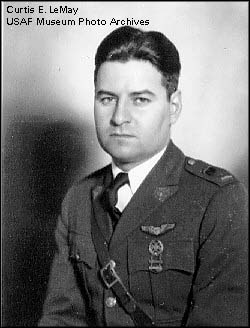 Lieutenant Curtis LeMay in 1929 LeMay was born in Columbus, Ohio, on November 15, 1906. LeMay was of English and distant French Huguenot heritage.[3] His father, Erving Edwin LeMay, was at times an ironworker and general handyman, but he never held a job longer than a few months. His mother, Arizona Dove (née Carpenter) LeMay,[4] did her best to hold her family together. With very limited income, his family moved around the country as his father looked for work, going as far as Montana and California. Eventually they returned to his native city of Columbus. LeMay attended Columbus public schools, graduating from Columbus South High School, and studied civil engineering at Ohio State University. Working his way through college, he graduated with a bachelor's degree in civil engineering. While at Ohio State he was a member of the National Society of Pershing Rifles and the Professional Engineering Fraternity Theta Tau.[citation needed] |
幼少期 1929年のカーティス・ルメイ中尉 ルメイは1906年11月15日、オハイオ州コロンバスで生まれた。ルメイには、イギリス系および遠い祖先にフランス系ユグノーの血筋があった。[3] 父のアーヴィング・エドウィン・ルメイは、鉄工や雑用係として働いたこともあったが、数ヶ月以上同じ職に就いたことはなかった。母のアリゾナ・ダヴ(旧姓 カーペンター)・ルメイ[4]は、家族をまとめようと懸命に努力した。収入が極めて限られていたため、父が仕事を探すにつれて家族は国内を転々とし、モン タナ州やカリフォルニア州まで足を延ばした。やがて一家は彼の生まれ故郷であるコロンバスに戻った。ルメイはコロンバスの公立学校に通い、コロンバス・サ ウス高校を卒業した後、オハイオ州立大学で土木工学を学んだ。大学在学中は働きながら学費を稼ぎ、土木工学の学士号を取得して卒業した。オハイオ州立大学 在学中は、全米パーシング・ライフル協会および専門技術系友愛会シータ・タウの会員であった。[出典必要] |
| Career LeMay was commissioned a second lieutenant in the Air Corps Reserve in October 1929. He received a regular commission in the United States Army Air Corps in January 1930. While finishing at Ohio State, he took flight training at Norton Field in Columbus, in 1931–32.[5] On June 9, 1934, he married Helen Maitland.[citation needed]  In 1938, three B-17s (one navigated by Lt. LeMay) intercept the Italian liner SS Rex 620 nm at sea LeMay became a pursuit pilot with his first duty station at Selfridge Field with the 27th Pursuit Squadron. After having served in various assignments in fighter operations, LeMay transferred to bomber aircraft in 1937.[6] While stationed in Hawaii, he became one of the first members of the Air Corps to receive specialized training in aerial navigation. In August 1937, as navigator under pilot and commander Caleb V. Haynes on a Boeing B-17 Flying Fortress, he helped locate the battleship Utah despite being given the wrong coordinates by Navy personnel, in exercises held in misty conditions off California, after which the group of B-17s bombed it with water bombs. In March 1938, LeMay as a member of the 2nd Bombardment Group participated in a good will flight to Buenos Aires. For this flight, the 2nd Bombardment Group was awarded the Mackay Trophy in 1939.[6] For Haynes again, in May 1938 he navigated three B-17s 620 nmi (710 mi; 1,150 km) over the Atlantic Ocean to intercept the Italian liner SS Rex to illustrate the ability of land-based airpower to defend the American coasts. In 1940 he was navigator for Haynes on the prototype Boeing XB-15 heavy bomber, flying a survey from Panama over the Galapagos islands.[7] By the end of 1940, he was stationed at Westover Air Reserve Base, as the operations officer of the 34th Bombardment Group.[8]: 8 War brought rapid promotion and increased responsibility. When his crews were not flying missions, they were subjected to relentless training, as LeMay believed that training was the key to saving their lives. "You fight as you train" was one of his cardinal rules. It expressed his belief that, in the chaos, stress, and confusion of combat (aerial or otherwise), troops or airmen would perform successfully only if their individual acts were second nature, performed nearly instinctively due to repetitive training. Throughout his career, LeMay was widely and fondly known among his troops as "Old Iron Pants", and the "Big Cigar".[1][9] |
経歴 ルメイは1929年10月、空軍予備隊の少尉に任官した。1930年1月、米国陸軍航空隊の正規将校となった。オハイオ州立大学を卒業する間、1931年 から32年にかけてコロンバスのノートン・フィールドで飛行訓練を受けた。[5] 1934年6月9日、ヘレン・メイトランドと結婚した。[出典必要] 1938年、3機のB-17(うち1機はルメイ中尉が航法士を務めた)が、海上620海里の地点でイタリアの客船SSレックスを阻止した ルメイは戦闘機パイロットとなり、最初の配属先はセルフリッジ飛行場の第27戦闘飛行隊であった。戦闘機部隊で様々な任務に従事した後、ルメイは1937 年に爆撃機部隊へ転属した。[6] ハワイ駐留中、彼は航空隊において航空航法に関する専門訓練を受けた最初の隊員の一人となった。1937年8月、パイロット兼指揮官のケイレブ・V・ヘイ ンズ率いるボーイングB-17「フライング・フォートレス」の航法士として、カリフォルニア沖の霧の中行われた演習において、海軍関係者から誤った座標を 与えられたにもかかわらず、戦艦ユタ号の位置特定に貢献し、その後、B-17の編隊は同艦を水爆弾で爆撃した。1938年3月、ルメイは第2爆撃群の一員 として、ブエノスアイレスへの善い意志飛行に参加した。この飛行により、第2爆撃群は1939年にマッケイ・トロフィーを授与された。[6] 再びヘインズの下で、1938年5月には、陸上航空戦力がアメリカ沿岸を防衛できる能力を実証するため、大西洋上を620海里(710マイル、1,150 キロメートル)飛行し、イタリアの客船SSレックスを阻止するために3機のB-17の航法を担当した。1940年、彼はヘインズの副操縦士としてボーイン グXB-15重爆撃機のプロトタイプに搭乗し、パナマからガラパゴス諸島上空までの偵察飛行を行った。[7] 1940年末までに、彼は第34爆撃群の作戦担当将校としてウェストオーバー空軍予備基地に配属された。[8]: 8 戦争は急速な昇進と責任の増大をもたらした。 乗組員が任務で飛行していない時は、容赦ない訓練にさらされていた。ルメイは、訓練こそが彼らの命を救う鍵だと信じていたからだ。「訓練通りに戦う」は彼 の鉄則の一つだった。これは、戦闘(空中戦に限らず)の混沌、ストレス、混乱の中で、兵士や航空兵が成功を収めるためには、繰り返しの訓練によって個々の 行動が身について、ほぼ本能的に行えるようになっていなければならないという彼の信念を表していた。その軍歴を通じて、ルメイは部下たちの間で「オール ド・アイアン・パンツ」や「ビッグ・シガー」として広く親しまれていた。[1][9] |
| World War II European Theater  Colonel Curtis LeMay officially congratulates a bomber crew of the 306th Bomb Group in front of their B-17 Flying Fortress at Chelveston Airfield, England, June 2, 1943. When the U.S. entered World War II in December 1941 after the Japanese attack on Pearl Harbor, LeMay was a major in the United States Army Air Forces (he had been a first lieutenant as recently as 1940), and the commander of a newly created B-17 Flying Fortress unit, the 305th Bomb Group. He took this unit to England in October 1942 as part of the Eighth Air Force, and led it in combat until May 1943, notably helping to develop the combat box formation.[8][10] In September 1943, he became the first commander of the newly formed 3rd Air Division. He personally led several dangerous missions, including the Regensburg section of the Schweinfurt–Regensburg mission of August 17, 1943. In that mission, he led 146 B-17s to Regensburg, Germany, beyond the range of escorting fighters, and, after bombing, continued on to bases in North Africa, losing 24 bombers in the process.[8][10] The heavy losses in veteran crews on this and subsequent deep penetration missions in the autumn of 1943 led the Eighth Air Force to limit missions to targets within escort range. With the deployment in the European theater of the P-51 Mustang in January 1944, the Eighth Air Force gained an escort fighter with range to match the bombers.[11] In a discussion of a report into high abort rates in bomber missions during World War II, which Robert McNamara suspected was because of pilot cowardice, McNamara described LeMay's character: One of the commanders was Curtis LeMay—Colonel in command of a B-24 [sic] group. He was the finest combat commander of any service I came across in war. But he was extraordinarily belligerent, many thought brutal. He got the report. He issued an order. He said, 'I will be in the lead plane on every mission. Any plane that takes off will go over the target, or the crew will be court-martialed.' The abort rate dropped overnight. Now that's the kind of commander he was.[12][Note 1] |
第二次世界大戦 欧州戦線 1943年6月2日、イングランドのチェルベストン飛行場にて、カーティス・ルメイ大佐がB-17「フライング・フォートレス」の前で、第306爆撃群の 爆撃機搭乗員らを公式に祝賀している。 1941年12月、日本軍による真珠湾攻撃を受けて米国が第二次世界大戦に参戦した際、ルメイは米国陸軍航空隊の少佐(1940年時点ではまだ中尉であっ た)であり、新設されたB-17フライング・フォートレス部隊である第305爆撃群の指揮官を務めていた。彼は1942年10月、第8航空軍の一員として この部隊をイギリスへ率い、1943年5月まで戦闘指揮を執り、特に「コンバット・ボックス」編隊の確立に貢献した。[8][10] 1943年9月、彼は新設された第3航空師団の初代司令官に就任した。彼は1943年8月17日のシュヴァインフルト・レーゲンスブルク作戦におけるレー ゲンスブルク区間を含む、いくつかの危険な任務を個人的に指揮した。その任務では、護衛戦闘機の射程外であるドイツのレーゲンスブルクへ146機のB- 17を率いて進撃し、爆撃後、北アフリカの基地へと進路を続けたが、その過程で24機の爆撃機を失った。[8] [10] この作戦および1943年秋に行われたその後の深部侵入作戦におけるベテラン乗組員の多大な損失を受け、第8空軍は作戦範囲を護衛機の行動範囲内にある目 標に限定することとした。1944年1月にP-51マスタングが欧州戦線に配備されると、第8空軍は爆撃機と同等の航続距離を持つ護衛戦闘機を手にするこ とになった。[11] 第二次世界大戦中の爆撃任務における高い中止率に関する報告書について議論した際、ロバート・マクナマラは、その原因をパイロットの臆病さにあると疑って いたが、マクナマラはルメイの性格について次のように述べた: 指揮官の一人はカーティス・ルメイだった――B-24 [原文ママ] グループを指揮する大佐である。彼は、私が戦争中に出会ったどの軍種においても、最も優れた戦闘指揮官だった。しかし彼は並外れて好戦的で、多くの者は彼 を残忍だと考えていた。彼は報告書を受け取ると、命令を下した。「私はすべての任務で先頭機に乗る。離陸した機体はすべて目標上空へ到達する。さもなけれ ば、乗組員は軍法会議にかけられる」と。任務中止率は一夜にして低下した。これこそが、彼という指揮官の真骨頂だった。[12][注1] |
Bombing of Japan LeMay made massive incendiary attacks on Japanese cities with hundreds of planes at low altitudes. Here B-29 bombers drop hundreds of incendiary bombs (cluster bombs, magnesium bombs, white phosphorus bombs, and napalm) on Yokohama in a raid on May 29, 1945. In August 1944, LeMay transferred to the China-Burma-India theater and directed first the XX Bomber Command in China and then the XXI Bomber Command in the Pacific. LeMay was later placed in charge of all strategic air operations against the Japanese home islands.[8][10] LeMay soon concluded that the techniques and tactics developed for use in Europe against the Luftwaffe were unsuitable against Japan. His Boeing B-29 Superfortress bombers flying from China were dropping their bombs near their targets only 5% of the time. Operational losses of aircraft and crews were unacceptably high owing to Japanese daylight air defenses and continuing mechanical problems with the B-29. In January 1945, LeMay was transferred from China to relieve Brigadier General Haywood S. Hansell as commander of the XXI Bomber Command in the Marianas.[8][10]  LeMay with General Joseph W. Stilwell He became convinced that high-altitude precision bombing would be ineffective, given the usually cloudy weather over Japan. Furthermore, bombs dropped from the B-29s at high altitude (above 20,000 feet (6,100 m)) were often blown off their trajectories by a consistently powerful jet stream over the Japanese home islands, which dramatically reduced the effectiveness of the high-altitude raids. Because Japanese air defenses made daytime bombing below jet stream-affected altitudes too perilous, LeMay finally switched to low-altitude nighttime incendiary attacks on Japanese targets, a tactic senior commanders had been preparing for some time, manufacturing and stockpiling incendiary bombs for this purpose.[8][10] Japanese cities were largely constructed of combustible materials such as wood and paper. Precision high-altitude daylight bombing was ordered to proceed only when weather permitted or when specific critical targets were not vulnerable to area bombing. LeMay commanded subsequent B-29 Superfortress combat operations against Japan, including massive incendiary attacks on 67 Japanese cities and the atomic bombings of Hiroshima and Nagasaki. This included the firebombing of Tokyo—known in official documents as the "Operation Meetinghouse" air raid on the night of March 9–10, 1945—which proved to be the single most destructive bombing raid of the war.[13] For this first attack, LeMay ordered the defensive guns removed from 325 B-29s, loaded each plane with Model M-47 incendiary clusters, magnesium bombs, white phosphorus bombs, and napalm, and ordered the bombers to fly in streams at 5,000 to 9,000 feet (1,500 to 2,700 m) over Tokyo.[8][10][14] LeMay described Operation Meetinghouse by saying "the US had finally stopped swatting at flies and gone after the manure pile".[15] The first pathfinder airplanes arrived over Tokyo just after midnight on March 10 and marked the target area with a flaming "X". In a three-hour period, the main bombing force dropped 1,665 tons of incendiary bombs, killing 100,000 civilians, destroying 250,000 buildings, and incinerating 16 square miles (41 km2) of the city. Aircrews at the tail end of the bomber stream reported that the stench of burned human flesh permeated the aircraft over the target.[16] Precise figures are not available, but the strategic bombing campaign against Japan, directed by LeMay between March 1945 and the Japanese surrender in August 1945, may have killed more than 500,000 Japanese civilians and left five million homeless.[17] Official estimates from the United States Strategic Bombing Survey put the figures at 220,000 people killed.[13] Some 40% of the built-up areas of 66 cities were destroyed, including much of Japan's war industry.[13][18] |
日本への爆撃 ルメイは数百機の航空機を低空飛行させ、日本の都市に対して大規模な焼夷弾攻撃を行った。ここでは、1945年5月29日の空襲において、B-29爆撃機 が横浜に数百発の焼夷弾(クラスター爆弾、マグネシウム爆弾、白リン爆弾、ナパーム弾)を投下している。 1944年8月、ルメイは中国・ビルマ・インド戦線に転属し、まず中国における第20爆撃軍団を指揮し、その後太平洋における第21爆撃軍団を指揮した。 ルメイは後に、日本本土に対するすべての戦略航空作戦の指揮を任された。[8][10] ルメイは間もなく、ヨーロッパでドイツ空軍(ルフトヴァッフェ)に対抗するために開発された技術や戦術は、日本に対しては不適切であると結論付けた。中国 から出撃する彼のボーイングB-29スーパーフォートレス爆撃機は、目標付近に爆弾を投下できたのはわずか5%に過ぎなかった。日本の昼間の防空網と、B -29の継続的な機械的トラブルにより、航空機と乗員の作戦損失は許容できないほど高かった。1945年1月、ルメイは中国から転属し、マリアナ諸島の第 21爆撃軍団司令官としてヘイウッド・S・ハンセル准将の後任に就いた。[8][10] ルメイとジョセフ・W・スティルウェル将軍 彼は、日本上空は通常曇天であるため、高高度精密爆撃は効果がないと確信するようになった。さらに、B-29から高高度(20,000フィート (6,100メートル)以上)で投下された爆弾は、日本本土上空に常に吹き荒れる強力なジェット気流によって軌道から外されることが多く、高高度空襲の有 効性を著しく低下させていた。日本の防空網により、ジェット気流の影響を受ける高度以下の昼間の爆撃は危険すぎるため、ルメイは最終的に、日本の目標に対 する低高度の夜間焼夷攻撃に切り替えた。これは上級指揮官たちが以前から準備を進めていた戦術であり、この目的のために焼夷弾を製造・備蓄していたもので ある。[8][10] 日本の都市は、木材や紙などの可燃性材料で主に構築されていた。精密な高高度昼間爆撃は、天候が許す場合、あるいは特定の重要目標が広域爆撃に対して脆弱 でない場合にのみ実施するよう命じられた。 ルメイはその後、日本に対するB-29スーパーフォートレスの戦闘作戦を指揮し、67の日本都市への大規模な焼夷攻撃や、広島・長崎への原子爆弾投下を含 んでいた。これには、1945年3月9日から10日にかけての夜に行われた、公式文書では「オペレーション・ミーティングハウス」として知られる東京大空 襲も含まれており、これは戦争中最も破壊的な単一の爆撃作戦となった。[13] この最初の攻撃において、ルメイは325機のB-29から対空砲を撤去し、各機にM-47型焼夷弾クラスター、マグネシウム爆弾、白リン爆弾、ナパーム弾 を積載させ、爆撃機に対し東京上空5,000~9,000フィート(1,500~2,700メートル)を編隊飛行するよう命じた。[8][10][14] ルメイは「ミーティングハウス作戦」について、「米国はついにハエを叩くのをやめ、糞の山を攻撃し始めた」と述べた。[15] 3月10日深夜0時過ぎ、先導機が東京上空に到着し、燃え盛る「X」の印で目標地域をマークした。3時間にわたり、主爆撃部隊は1,665トンの焼夷弾を 投下し、10万人の民間人を殺害、25万棟の建物を破壊し、市街地の16平方マイル(41平方キロメートル)を焼き尽くした。爆撃機編隊の最後尾にいた乗 組員たちは、目標上空で焼けた人間の肉の悪臭が機内に充満したと報告している。[16] 正確な数字は不明だが、1945年3月から同年8月の日本の降伏に至るまでルメイが指揮した対日戦略爆撃作戦により、50万人以上の日本の民間人が死亡 し、500万人が家を失った可能性がある。[17] 米国戦略爆撃調査団の公式推計では、死者数は22万人とされている。[13] 66都市の市街地の約40%が破壊され、日本の戦争産業の多くも含まれていた。[13][18] |
 A "LeMay Bombing Leaflet" in Japanese: "Unfortunately, bombs have no eyes. So, in accordance with America's humanitarian policies, the American Air Force, which does not wish to injure innocent people, now gives you warning to evacuate the cities named and save your lives". LeMay was aware of the implication of his orders. The New York Times reported at the time, "Maj. Gen. Curtis E. LeMay, commander of the B-29s of the entire Marianas area, declared that if the war is shortened by a single day, the attack will have served its purpose".[8][10] The argument was that it was his duty to carry out the attacks in order to end the war as quickly as possible, sparing further loss of life. He also remarked regarding the morality of the air effort against Japan, "I suppose if I had lost the war, I would have been tried as a war criminal."[19][20] This opinion was also reported by Robert McNamara in the 2003 documentary The Fog of War.[21][22]  LeMay with generals Henry H. Arnold, Barney M. Giles and Emmett O. Donnell Presidents Roosevelt and Truman supported LeMay's strategy, referring to an estimate of one million Allied casualties if Japan had to be invaded. Japan had intentionally decentralized 90% of its war-related production into small subcontractor workshops in civilian districts, making remaining Japanese war industry largely immune to conventional precision bombing with high explosives.[23] As the firebombing campaign took effect, Japanese war planners were forced to expend significant resources to relocate vital war industries to remote caves and mountain bunkers, reducing production of war materiel. LeMay also oversaw Operation Starvation, an aerial mining operation against Japanese waterways and ports that disrupted Japanese shipping and logistics. Although his superiors were unsupportive of this naval objective, LeMay gave it a high priority by assigning the entire 313th Bombardment Wing (four groups, about 160 airplanes) to the task. Aerial mining supplemented a tight Allied submarine blockade of the home islands, drastically reducing Japan's ability to supply its overseas forces to the point that postwar analysis concluded that it could have defeated Japan on its own had it begun earlier.[8][10] |
日本語で書かれた「ルメイ爆撃ビラ」:「残念ながら、爆弾には目がない。そこで、アメリカの人道主義的な方針に基づき、無実の人々を傷つけたくないアメリ カ空軍は、ここに、記載された都市から避難し、命を救うよう警告する」。 ルメイは自身の命令が持つ意味を認識していた。当時のニューヨーク・タイムズ紙は、「マリアナ諸島全域のB-29部隊を指揮するカーティス・E・ルメイ少 将は、戦争がたった1日でも短縮されれば、この攻撃はその目的を果たしたことになる、と宣言した」と報じた。[8][10] その論拠は、さらなる人命の損失を避けるため、戦争をできるだけ早く終結させるべく攻撃を実行することが彼の義務であるというものだった。彼はまた、日本 に対する空爆作戦の道義性について、「もし私が戦争に負けていたら、戦争犯罪人として裁かれていただろう」と述べている。[19][20] この見解は、2003年のドキュメンタリー映画『フォグ・オブ・ウォー』でもロバート・マクナマラによって報告されている。[21][22] ルメイとヘンリー・H・アーノルド、バーニー・M・ジャイルズ、エメット・O・ドネルの各将軍 ルーズベルト大統領とトルーマン大統領は、日本への上陸作戦が行われた場合、連合軍の死傷者が100万人に達するという推計を根拠に、ルメイの戦略を支持 した。日本は戦争関連生産の90%を意図的に民間地区の小規模な下請け工場へと分散させており、残された日本の軍需産業は、高爆発性爆弾を用いた従来の精 密爆撃に対してほぼ無敵の状態にあった。[23] 焼夷弾攻撃が効果を上げると、日本の戦争計画担当者は、重要な軍需産業を人里離れた洞窟や山岳の掩蔽壕へ移転させるために多大な資源を費やすことを余儀な くされ、軍需物資の生産は減少した。 また、ルメイは日本の水路や港湾に対する空中機雷敷設作戦「オペレーション・スターベーション」を指揮し、日本の海上輸送と兵站を混乱させた。彼の上司は この海軍作戦を支持しなかったが、ルメイは第313爆撃航空団(4個グループ、約160機)の全機をこの任務に割り当てることで、これに高い優先順位を与 えた。空中機雷敷設は、本土に対する連合軍の厳重な潜水艦封鎖を補完するものであり、日本の海外部隊への補給能力を劇的に低下させた。戦後の分析によれ ば、もしこの作戦がもっと早く開始されていれば、それだけで日本を敗北させることができた可能性があったと結論づけられている。[8][10] |
| Japan–Washington flight LeMay piloted one of three specially modified B-29s flying from Japan to the U.S. in September 1945, in the process breaking several aviation records, including the greatest USAAF takeoff weight, the longest USAAF non-stop flight, and the first ever non-stop Japan–Chicago flight. One of the pilots was of higher rank: Lieutenant General Barney M. Giles. The other two aircraft used up more fuel than LeMay's in fighting headwinds, and they could not fly to Washington, D.C., the original goal.[24] Their pilots landed in Chicago to refuel. LeMay's aircraft had sufficient fuel to reach Washington, but he was directed by the War Department to join the others by refueling at Chicago.[25] |
日本~ワシントン間飛行 1945年9月、日本から米国へ向けて飛行した3機の特別改造B-29のうち1機を、ルメイが操縦した。その過程で、米陸軍航空軍(USAAF)の最大離 陸重量、最長無着陸飛行、そして史上初の日本~シカゴ間無着陸飛行を含む、いくつかの航空記録を更新した。パイロットのうち1人は、より上位の階級である バーニー・M・ジャイルズ中将であった。他の2機は向かい風と戦い、ルメイの機よりも多くの燃料を消費したため、当初の目的地であるワシントンD.C.ま で飛行することができなかった。[24] それらのパイロットは給油のためシカゴに着陸した。ルメイの機にはワシントンまで到達するのに十分な燃料があったが、彼は陸軍省からシカゴで給油し、他の 機と合流するよう指示を受けた。[25] |
| Cold War Berlin Airlift General Curtis E. LeMay After World War II, LeMay was already thinking about deterrence theory and how the next war would be fought.[26] He was briefly transferred to The Pentagon as deputy chief of Air Staff for Research & Development. In 1947, LeMay returned to Europe as commander of USAF Europe,[27] heading operations for the Berlin Airlift in 1948 in the face of a blockade by the Soviet Union and its satellite states that threatened to starve the civilian population of the Western occupation zones of Berlin. Under his direction, Douglas C-54 Skymasters that could each carry 10 tons of cargo began supplying the city on July 1. By late 1948, the airlift was bringing in an average of 5,000 tons of supplies a day with 500 daily flights. The airlift continued for 11 months, with 213,000 flights operated by six countries bringing in 1.7 million tons of food and fuel to Berlin. Faced with the failure of its blockade, the Soviet Union relented and reopened land corridors to the West. Though LeMay is sometimes publicly credited with the success of the Berlin Airlift, it was, in fact, instigated by General Lucius D. Clay when Clay called LeMay about the problem. LeMay initially started flying supplies into Berlin, but then decided that it was a job for a logistics expert and he found that person in Lt. General William H. Tunner,[28] who took over the operational aspects of the Berlin Airlift. |
冷戦 ベルリン空輸作戦 カーティス・E・ルメイ将軍 第二次世界大戦後、ルメイはすでに抑止力理論や、次の戦争がどのように行われるかについて考えていた。[26] 彼は一時的に国防総省(ペンタゴン)に異動し、空軍参謀次長(研究開発担当)を務めた。1947年、ルメイは在欧州米空軍司令官として欧州に戻り [27]、1948年には、ベルリンの西側占領地区の民間人を飢餓に陥れようとするソ連とその衛星国による封鎖に直面し、ベルリン空輸作戦の指揮を執っ た。彼の指揮の下、1機あたり10トンの物資を輸送可能なダグラスC-54スカイマスターが、7月1日から同市への物資供給を開始した。1948年後半に は、空輸作戦は1日平均500便を飛ばし、1日あたり5,000トンの物資を運び込んでいた。空輸作戦は11ヶ月間続き、6カ国による21万3,000便 の運航により、170万トンの食料と燃料がベルリンに届けられた。封鎖の失敗に直面したソ連は態度を軟化させ、西側への陸路を再開した。ベルリン空輸作戦 の成功は、時にルメイの功績として公に称えられることがあるが、実際には、ルシウス・D・クレイ将軍がルメイにこの問題について連絡したことがきっかけで 始まったものである。ルメイは当初、ベルリンへの物資輸送を開始したが、その後、これは兵站の専門家の仕事であると判断し、ウィリアム・H・タナー中将 [28]をその適任者と見出した。タナー中将は、ベルリン空輸作戦の運用面を引き継いだ。 |
Strategic Air Command General LeMay flying a Boeing KC-135 Stratotanker during his tenure as Commander-in-Chief of the Strategic Air Command In 1948, he returned to the U.S. to head the Strategic Air Command (SAC) at Offutt Air Force Base, replacing Gen George Kenney. When LeMay took over command of SAC, it consisted of little more than a few understaffed B-29 bombardment groups left over from World War II. Less than half of the available aircraft were operational, and the crews were undertrained. Base and aircraft security standards were minimal. Upon inspecting a SAC hangar full of US nuclear strategic bombers, LeMay found a single Air Force sentry on duty, unarmed.[29] After ordering a mock bombing exercise on Dayton, Ohio, LeMay was shocked to learn that most of the strategic bombers assigned to the mission missed their targets by one mile or more. "We didn't have one crew, not one crew, in the entire command who could do a professional job", noted LeMay.[30] A meeting in November 1948, with Air Force Chief of Staff Hoyt Vandenberg, found the two men agreeing the primary mission of SAC should be the capability of delivering 80% of the nation's atomic bombs in one mission. At the Dualism Conference in December 1948, the Air Force leadership rallied behind LeMay's position that the service's highest priority was to deliver the SAC atomic offensive "in one fell swoop telescoping mass and time".[31] "To LeMay, demolishing everything was how you win a war."[32] Towards this aim, LeMay delivered the first SAC Emergency War Plan in March 1949 which called for dropping 133 atomic bombs on 70 cities in the USSR within 30 days. LeMay predicted that World War III would last no longer than 30 days.[33] Air power strategists called this type of pre-emptive strike "killing a nation".[26] However, the Harmon committee released their unanimous report two months later stating such an attack would not end a war with the Soviets and their industry would quickly recover. This committee had been specifically created by the Joint Chiefs of Staff to study the effects of a massive nuclear strike against the Soviet Union. Nevertheless, within weeks, an ad hoc Joint Chiefs committee recommended tripling America's nuclear arsenal, and Air Force Chief of Staff Vandenberg called for enough bombs to attack 220 targets, up from the previous 70.[34] Upon receiving his fourth star in 1951 at age 44, LeMay became the youngest American four-star general since Ulysses S. Grant. He would also become the longest serving person in that rank in American military history.[35] In 1954 LeMay remarked to pilot Hal Austin, whose plane had been damaged by a MiG-17 while on a reconnaissance mission over the Soviet Union, "Well, maybe if we do this overflight right, we can get World War III started". Hal Austin assumed that LeMay was joking, but years later, after LeMay retired, Austin saw him again and "brought up the subject of the mission we had flown. And he remembered it like it was yesterday. We chatted about it a little bit. His comment again was, 'Well, we'd have been a hell of a lot better off if we'd got World War III started in those days'".[26] In 1956 and 1957 LeMay implemented tests of 24-hour bomber and tanker alerts, keeping some bomber forces ready at all times. LeMay headed SAC until 1957, overseeing its transformation into a modern, efficient, all-jet force. LeMay's tenure was the longest over an American military command in nearly 100 years.[36] |
戦略航空軍団 戦略航空軍団総司令官在任中にボーイングKC-135ストラトタンカーを操縦するルメイ将軍 1948年、彼は米国に戻り、オファット空軍基地でジョージ・ケニー将軍の後任として戦略航空軍団(SAC)の指揮を執った。ルメイがSACの指揮を引き 継いだ当時、同司令部は第二次世界大戦からの名残である、人員不足のB-29爆撃群が数個あるに過ぎなかった。運用可能な航空機は半数にも満たず、乗組員 の訓練も不十分だった。基地および航空機の警備基準は最低限のものだった。米国の核戦略爆撃機で満たされたSACの格納庫を視察した際、ルメイは武装して いない空軍の衛兵がたった1人、勤務しているのを発見した。[29] オハイオ州デイトンへの模擬爆撃演習を命じた後、ルメイは、任務に割り当てられた戦略爆撃機のほとんどが目標から1マイル以上外れていたことを知り、衝撃 を受けた。「この司令部全体で、プロとしての仕事をこなせる乗組員は一人もいなかった。たった一人もだ」とルメイは述べた。[30] 1948年11月、空軍参謀総長ホイト・ヴァンデンバーグとの会談で、両者はSACの主要任務は、国内の原子爆弾の80%を1回の作戦で投下できる能力を 持つべきであるという点で合意した。1948年12月の「デュアリズム会議」において、空軍指導部は、空軍の最優先事項はSACの原子爆弾攻撃を「一挙 に、規模と時間を圧縮して」実行することであるというルメイの立場を支持した。[31] 「ルメイにとって、すべてを破壊することこそが戦争に勝つ方法だった。」[32] この目標に向け、ルメイは1949年3月に最初のSAC緊急戦争計画を発表し、30日以内にソ連の70都市に133発の原子爆弾を投下することを求めた。 ルメイは、第三次世界大戦は30日以上は続かないと予測していた。[33] 空軍戦略家たちは、この種の先制攻撃を「国家の抹殺」と呼んだ。[26] しかし、ハーモン委員会は2か月後に全会一致の報告書を発表し、そのような攻撃ではソ連との戦争を終結させることはできず、ソ連の産業は急速に回復すると 述べた。この委員会は、ソ連に対する大規模な核攻撃の影響を調査するために統合参謀本部によって特別に設置されたものだった。それにもかかわらず、数週間 以内に、統合参謀本部による臨時委員会は米国の核兵器保有量を3倍に増やすことを推奨し、空軍参謀総長のヴァンデンバーグは、従来の70か所から220か 所の標的を攻撃できるだけの爆弾を要求した。[34] 1951年、44歳で4つ目の星(大将)を授与されたルメイは、ユリシーズ・S・グラント以来、米国史上最年少の4つ星大将となった。また、彼は米軍史 上、その階級で最も長く在任した人物となる[35]。 1954年、ルメイは、ソ連上空での偵察任務中にMiG-17によって機体を損傷したパイロット、ハル・オースティンに対し、「まあ、もしこの上空通過を うまくやれば、第三次世界大戦を始められるかもしれないな」と述べた。ハル・オースティンはルメイが冗談を言っているのだと思ったが、数年後、ルメイが退 役した後、オースティンは彼と再会し、「あの時の任務の話を持ち出した。すると彼は昨日のことのように覚えていた。私たちはそれについて少し話した。彼の コメントは再びこうだった。『まあ、あの頃に第三次世界大戦を始動させていれば、我々ははるかに良い状況になっていただろうに』」[26] 1956年と1957年、ルメイは24時間体制の爆撃機および給油機の警戒態勢の試験を実施し、一部の爆撃機部隊を常に待機状態に置いた。ルメイは 1957年までSACを指揮し、同部隊を近代的で効率的な全ジェット機部隊へと変革させた。ルメイの在任期間は、過去100年近くにおける米軍の指揮官と しては最長であった。[36] |
| The "Airpower Battle" USAF airpower development and LeMay's style  Air Force Vice Chief of Staff General Curtis LeMay greeted by Secretary of the Air Force James H. Douglas Jr. and Chairman of The Joint Chiefs of Staff General Nathan F. Twining at Washington National Airport, upon LeMay's return from Boeing KC-135 StratoTanker non-stop flight from Buenos Aires, Argentina in November 15, 1957 LeMay was instrumental in SAC's acquisition of a large fleet of new strategic bombers, establishment of a vast aerial refueling system, the formation of many new units and bases, development of a strategic ballistic missile force, and establishment of a strict command and control system with an unprecedented readiness capability. All of this was protected by a greatly enhanced and modernized security force, the Strategic Air Command Elite Guard. LeMay insisted on rigorous training and very high standards of performance for all SAC personnel, be they officers, enlisted men, aircrews, mechanics, or administrative staff, and reportedly commented, "I have neither the time nor the inclination to differentiate between the incompetent and the merely unfortunate."[37] Life magazine reported that LeMay once took the co-pilot's seat of a SAC bomber to observe the mission, complete with lit cigar.[38] When asked by the pilot to put out the cigar, LeMay asked why. When the pilot explained that fumes inside the fuselage could explode, LeMay growled, "It wouldn't dare".[38] The incident was used as the basis for a fictional scene in the 1955 film Strategic Air Command. In his controversial and factually disputed[39][40] memoir War's End, Major General Charles Sweeney related an alleged 1944 incident that may have been the basis for the "It wouldn't dare" comment.[41] Sweeney stated that a similar incident occurred in 1944 when a B-29 crew chief reminded General LeMay of his lit cigar while LeMay was undergoing B-29 familiarization with (then-Colonel) Paul Tibbets' 509th Composite Group. Despite his uncompromising attitude regarding performance of duty, LeMay was also known for his concern for the physical well-being and comfort of his men.[42] LeMay found ways to encourage morale, individual performance, and the reenlistment rate through a number of means: encouraging off-duty group recreational activities,[43][44] instituting spot promotions based on performance, and authorizing special uniforms, training, equipment, and allowances for ground personnel[45] as well as flight crews. On LeMay's departure, SAC was composed of 224,000 airmen, close to 2,000 heavy bombers, and nearly 800 tanker aircraft.[36] LeMay was appointed Vice Chief of Staff of the United States Air Force in July 1957, serving until 1961. |
「空軍力の戦い」 米空軍の空軍力開発とルメイのスタイル 1957年11月15日、アルゼンチンのブエノスアイレスからボーイングKC-135ストラトタンカーによるノンストップ飛行で帰国した空軍副参謀総長 カーティス・ルメイ将軍が、ワシントン・ナショナル空港にて、ジェームズ・H・ダグラス・ジュニア空軍長官およびネイサン・F・トゥイニング統合参謀本部 議長に出迎えられた ルメイは、SACによる新型戦略爆撃機の大規模な導入、広範な空中給油システムの確立、多数の新規部隊および基地の編成、戦略弾道ミサイル部隊の開発、そ して前例のない即応能力を備えた厳格な指揮統制システムの確立において、主導的な役割を果たした。これらすべては、大幅に強化・近代化された警備部隊、す なわち戦略空軍司令部エリートガードによって守られていた。ルメイは、将校、下士官、乗組員、整備士、事務職員を問わず、すべてのSAC要員に対して厳格 な訓練と極めて高い業務水準を要求し、伝えられるところによれば、「無能な者と単に不運な者を区別する時間も気力もない」と述べたという。[37] 『ライフ』誌は、ルメイがかつてSACの爆撃機の副操縦席に座り、火のついた葉巻をくわえたまま任務を視察したと報じている。[38] パイロットから葉巻を消すよう求められた際、ルメイは理由を尋ねた。機体内部の煙が爆発する恐れがあるとパイロットが説明すると、ルメイは「そんなことあ るわけがない」と唸った。[38] この出来事は、1955年の映画『戦略空軍司令部』の架空のシーンの題材として用いられた。物議を醸し、事実関係に異論もある[39][40]回顧録 『War's End』の中で、チャールズ・スウィーニー少将は、1944年に起きたとされるある出来事を記しており、これが「そんなことできるはずがない」という発言 の根拠となった可能性がある。[41] スウィーニーによれば、1944年に同様の出来事があったという。当時、ルメイが(当時大佐だった)ポール・ティベッツ率いる第509複合飛行団のB- 29に慣れるための訓練を受けていた際、あるB-29の整備主任が、ルメイが口に咥えた葉巻について注意を促したのである。 職務遂行に関しては妥協を許さない態度をとっていたにもかかわらず、ルメイは部下の健康や快適さを気遣うことでも知られていた。[42] ルメイは、勤務外の集団レクリエーション活動の奨励[43][44]、実績に基づく即席昇進制度の導入、そして地上要員[45]および搭乗員に対する特別 な制服、訓練、装備、手当の承認など、様々な手段を通じて士気、個人のパフォーマンス、再入隊率を高める方法を見出した。 ルメイの退任時、SACは22万4,000人の航空兵、2,000機近い重爆撃機、そして800機近くの給油機で構成されていた。[36] ルメイは1957年7月に米国空軍副参謀長に任命され、1961年までその職を務めた。 |
Chief of Staff of the United
States Air Force, 1961–1965 Air Force Chief of Staff General Curtis E. LeMay with U.S. President John F. Kennedy and Strategic Air Command's Commander General Thomas S. Power at Offutt Air Force Base, Nebraska. Following service as USAF Vice Chief of Staff (1957–1961), LeMay was made the fifth chief of staff of the United States Air Force on the retirement of Gen Thomas White. His belief in the efficacy of strategic air campaigns over tactical strikes and ground support operations became Air Force policy during his tenure as chief of staff. As chief of staff, LeMay clashed repeatedly with Secretary of Defense Robert McNamara, Air Force Secretary Eugene Zuckert, and the chairman of the Joint Chiefs of Staff, Army General Maxwell Taylor. At the time, budget constraints and successive nuclear war fighting strategies had left the armed forces in a state of flux. Each of the armed forces had gradually jettisoned realistic appraisals of future conflicts in favor of developing its own separate nuclear and nonnuclear capabilities. At the height of this struggle, the U.S. Army had even reorganized its combat divisions to fight land wars on irradiated nuclear battlefields, developing short-range atomic cannon and mortars in order to win appropriations. The United States Navy in turn proposed delivering strategic nuclear weapons from supercarriers intended to sail into range of the Soviet air defense forces. Of all these various schemes, only LeMay's command structure of SAC survived complete reorganization in the changing reality of Cold War-era conflicts. LeMay was not an enthusiast of the ICBM program, considering ballistic missiles to be little more than toys and no substitute for the strategic nuclear bomber force. Though LeMay lost significant appropriation battles for the Skybolt ALBM and the proposed Boeing B-52 Stratofortress replacement, the North American XB-70 Valkyrie, he was largely successful at expanding Air Force budgets. Despite LeMay's disdain for missiles, he did strongly support the use of military space programs to perform satellite reconnaissance and gather electronic intelligence. For comparison, the US Army and Navy frequently suffered budgetary cutbacks and program cancellations by Congress and Secretary McNamara. |
1961年~1965年、米国空軍参謀総長 ネブラスカ州オフット空軍基地にて、ジョン・F・ケネディ米大統領、戦略空軍司令部司令官トーマス・S・パワー将軍と共に写る空軍参謀総長カーティス・ E・ルメイ将軍。 米空軍副参謀総長(1957年–1961年)を務めた後、トーマス・ホワイト大将の退任に伴い、ルメイは第5代米空軍参謀総長に就任した。戦術的攻撃や地 上支援作戦よりも戦略的空爆作戦の有効性を信じる彼の考えは、参謀総長在任中に空軍の政策となった。 参謀総長として、ルメイはロバート・マクナマラ国防長官、ユージン・ザッカー空軍長官、そして統合参謀本部議長である陸軍のマクスウェル・テイラー大将と 繰り返し対立した。当時、予算の制約と相次ぐ核戦争戦略により、軍は混乱状態に陥っていた。各軍は、将来の紛争に対する現実的な評価を徐々に放棄し、独自 の核・非核能力の開発に注力していた。この対立が頂点に達した際、米陸軍は放射能汚染された核戦場での地上戦を想定して戦闘師団を再編し、予算を獲得する ために短距離原子砲や迫撃砲を開発していた。これに対し、米海軍は、ソ連の防空部隊の射程圏内まで進入することを目的とした超大型空母から戦略核兵器を投 下する案を提案した。これら様々な構想の中で、冷戦時代の紛争という変化する現実における全面的な再編を生き残ったのは、SACのルメイによる指揮体制だ けだった。 ルメイはICBM計画の熱心な支持者ではなかった。彼は弾道ミサイルを単なるおもちゃに過ぎないと見なし、戦略核爆撃機部隊の代わりにはならないと考えて いた。 ルメイは、スカイボルトALBMや、ボーイングB-52ストラトフォートレスの後継機として提案されたノースアメリカンXB-70ヴァルキリーをめぐる重 要な予算争いで敗北したものの、空軍の予算拡大には概ね成功した。ルメイはミサイルを軽蔑していたにもかかわらず、衛星偵察や電子情報収集を行うための軍 事宇宙計画の利用を強く支持していた。対照的に、米陸軍と海軍は、議会やマクナマラ国防長官によって頻繁に予算削減や計画中止の苦悩を強いられていた。 |
| Kennedy years General LeMay conversed with President Kennedy at the Oval Office, White House in October 1962. LeMay was bitterly critical of the Kennedy administration. He described the so-called "Whiz Kids" in the Department of Defense as "the most egotistical people that I have ever seen in my whole life. They had no faith in the military at all. They felt that the Harvard Business School method of solving problems would solve any problem in the world".[46] During the Cuban Missile Crisis in 1962, LeMay clashed again with U.S. President John F. Kennedy and Defense Secretary McNamara, arguing that he should be allowed to bomb nuclear missile sites in Cuba. He opposed the naval blockade and, after the end of the crisis, suggested that Cuba be invaded anyway, even after the Soviets agreed to withdraw their missiles. Kennedy refused LeMay's requests, and the naval blockade was successful.[47] LeMay told Kennedy that his refusal to invade Cuba was "almost as bad as the appeasement at Munich"[48] and the "greatest defeat in our history".[49] Twenty-five years later, LeMay still believed that "We could have gotten not only the missiles out of Cuba, we could have gotten the Communists out of Cuba at that time."[50] |
ケネディ政権時代 1962年10月、ホワイトハウスの大統領執務室で、ルメイ将軍はケネディ大統領と会談した。 ルメイはケネディ政権を激しく批判していた。彼は国防総省のいわゆる「ウィズ・キッズ」について、「私がこれまでの人生で出会った中で最も自己中心的な連 中だ。彼らは軍を全く信用していなかった。ハーバード・ビジネス・スクールの問題解決法さえあれば、世界中のどんな問題も解決できると信じていた」と述べ た。[46] 1962年のキューバ危機の際、ルメイは再びジョン・F・ケネディ大統領およびマクナマラ国防長官と対立し、キューバの核ミサイル基地を爆撃することを許 可すべきだと主張した。彼は海上封鎖に反対し、危機終結後も、ソ連がミサイルの撤去に合意した後であっても、とにかくキューバに侵攻すべきだと提案した。 ケネディはルメイの要求を拒否し、海上封鎖は成功した。[47] ルメイはケネディに対し、キューバ侵攻を拒否したことは「ミュンヘンでの宥和政策とほぼ同程度に悪い」[48]ものであり、「わが国の歴史上最大の敗北」 [49]であると述べた。25年後になっても、ルメイは依然として「当時、我々はキューバからミサイルを撤去できただけでなく、共産主義者たちをも追い出 すことができたはずだ」[50]と信じていた。 |
| Strategic philosophy The memorandum from LeMay, chief of staff, USAF, to the Joint Chiefs of Staff, January 4, 1964, illustrates LeMay's reasons for keeping bomber forces alongside ballistic missiles: "It is important to recognize, however, that ballistic missile forces represent both the U.S. and Soviet potential for strategic nuclear warfare at the highest, most indiscriminate level, and at a level least susceptible to control. The employment of these weapons in lower level conflict would be likely to escalate the situation, uncontrollably, to an intensity which could be vastly disproportionate to the original aggravation. The use of ICBMs and SLBMs is not, therefore, a rational or credible response to provocations which, although serious, are still less than an immediate threat to national survival. For this reason, among others, I consider that the national security will continue to require the flexibility, responsiveness, and discrimination of manned strategic weapon systems throughout the range of cold, limited, and general war".[51] |
戦略的理念 1964年1月4日、米空軍参謀総長ルメイから統合参謀本部宛てに送られた覚書は、弾道ミサイルと並行して爆撃機部隊を維持すべきとするルメイの理由を次 のように示している。「しかし、弾道ミサイル部隊は、米国とソ連双方にとって、最高かつ最も無差別なレベルで、かつ制御が最も困難なレベルにおける戦略核 戦争の潜在能力を表しているということを認識することが重要である。低強度紛争においてこれらの兵器を使用すれば、状況は制御不能なまでにエスカレート し、当初の紛争の激化とは著しく不釣り合いな激しさに至る可能性が高い。したがって、ICBMやSLBMの使用は、深刻ではあるものの、国家の存亡に対す る差し迫った脅威には至らない挑発に対する、合理的かつ信頼できる対応とは言えない。こうした理由をはじめとして、私は、国家安全保障においては、冷戦、 限定戦争、全面戦争のあらゆる局面において、有人戦略兵器システムが持つ柔軟性、即応性、および選択性が今後も必要とされるものと考えている。[51] |
| Vietnam War LeMay's dislike for tactical aircraft and training foreshadowed events in the low-intensity conflict of Vietnam, where existing Air Force fighter aircraft and standard attack profiles proved incapable of carrying out sustained tactical bombing campaigns in the face of hostile North Vietnamese antiaircraft defenses. LeMay said, "Flying fighters is fun. Flying bombers is important".[52] Aircraft losses on tactical attack missions soared, and Air Force commanders soon realized that their large, missile-armed jet fighters were exceedingly vulnerable not only to antiaircraft shells and missiles but also to cannon-armed, maneuverable Soviet fighters. LeMay advocated a sustained strategic bombing campaign against North Vietnamese cities, harbors, ports, shipping, and other strategic targets. His advice was ignored. Instead, an incremental policy, Operation Rolling Thunder, was implemented that focused on limited interdiction bombing of fluid enemy supply corridors in Vietnam; two similar incremental policies, Operation Barrel Roll and Operation Steel Tiger, focused on Laos. This limited campaign failed to destroy significant quantities of enemy war supplies or diminish enemy ambitions. Bombing limitations were imposed by President Lyndon Johnson for geopolitical reasons, as he surmised that bombing Soviet and Chinese ships in port and killing Soviet advisers would bring the Soviets and Chinese more directly into the war.[citation needed] In his 1965 autobiography (co-written with MacKinlay Kantor), LeMay is quoted as saying his response to North Vietnam would be to demand that "they've got to draw in their horns and stop their aggression, or we're going to bomb them back into the Stone Age. And we would shove them back into the Stone Age with Air power or Naval power—not with ground forces".[53] LeMay subsequently rejected misquotes of the famous "Stone Age" quote. Later, in a Washington Post interview LeMay said that "I never said we should bomb them back to the Stone Age. I said we had the capability to do it. I want to save lives on both sides".[54] Some military historians have argued that LeMay's theories were eventually proven correct. Near the war's end in December 1972, President Richard Nixon ordered Operation Linebacker II, a high-intensity Air Force, Navy, and Marine Corps aerial bombing campaign, which included hundreds of B-52 bombers that struck previously untouched North Vietnamese strategic targets, including heavily populated areas in Hanoi and Haiphong. Linebacker II was followed by renewed negotiations that led to the Paris Peace Agreement, appearing to support the claim. However, consideration must be given to significant differences in terms of both military objectives and geopolitical realities between 1968 and 1972, including the impact of Nixon's recognition and exploitation of the Sino-Soviet split to gain a "free hand" in Vietnam and the shift of Communist opposition from an organic insurgency (the Viet Cong) to a conventional mechanized offensive that was by its nature more reliant on industrial output and traditional logistics.[55] In effect, Johnson and Nixon were waging two different wars. |
ベトナム戦争 ルメイが戦術航空機や訓練を嫌っていたことは、ベトナムにおける低強度紛争での事態を予兆していた。そこでは、既存の空軍戦闘機や標準的な攻撃パターンで は、敵対的な北ベトナムの対空防衛網を前にして、持続的な戦術爆撃作戦を遂行することが不可能であることが明らかになった。ルメイはこう述べた。「戦闘機 を飛ばすのは楽しい。「爆撃機を飛ばすことは重要だ」[52]。戦術攻撃任務における航空機の損失は急増し、空軍司令官たちは、ミサイルを装備した大型 ジェット戦闘機が、対空砲弾やミサイルだけでなく、機関砲を装備した機動性の高いソ連製戦闘機に対しても極めて脆弱であることをすぐに悟った。 ルメイは、北ベトナムの都市、港湾、港、船舶、その他の戦略的目標に対する持続的な戦略爆撃作戦を提唱した。彼の助言は無視された。その代わりに、ベトナ ム国内の流動的な敵の補給路に対する限定的な遮断爆撃に焦点を当てた段階的作戦「ローリング・サンダー作戦」が実施された。ラオスを対象とした同様の段階 的作戦として、「バレル・ロール作戦」と「スティール・タイガー作戦」の2つがあった。この限定的な作戦は、敵の戦時物資を大量に破壊することも、敵の野 心を挫くこともできなかった。リンドン・ジョンソン大統領は地政学的な理由から爆撃に制限を課した。彼は、港に停泊中のソ連や中国の船舶を爆撃し、ソ連の 軍事顧問を殺害すれば、ソ連と中国がより直接的に戦争に巻き込まれると推測していたからである。[出典必要] 1965年の自伝(マッキンレイ・カントールとの共著)の中で、ルメイは北ベトナムに対する自身の対応として、「彼らは尻尾を巻いて侵略を止めなければな らない。さもなければ、我々は彼らを石器時代まで爆撃してやる。そして我々は、地上部隊ではなく、空軍力や海軍力で彼らを石器時代へと押し戻すのだ」と述 べたと引用されている。[53] その後、ルメイは有名な「石器時代」発言の誤引用を否定した。後に『ワシントン・ポスト』紙のインタビューで、ルメイは「彼らを石器時代まで爆撃すべきだ とは決して言っていない。そうする能力があると言ったのだ。私は双方の命を救いたいのだ」と語った。[54] 一部の軍事史家は、ルメイの理論は最終的に正しかったと主張している。1972年12月、戦争終結間近に、リチャード・ニクソン大統領は「ラインバッカー II作戦」を発動した。これは空軍、海軍、海兵隊による高強度の空爆作戦であり、数百機のB-52爆撃機が、ハノイやハイフォンの人口密集地を含む、これ まで攻撃されていなかった北ベトナムの戦略的目標を攻撃した。ラインバッカーII作戦の後、交渉が再開され、パリ和平協定が締結されたことは、この主張を 裏付けるように見える。しかし、1968年と1972年との間には、軍事目標と地政学的現実の両面で重大な異なる点があったことを考慮しなければならな い。これには、ベトナムで「自由な裁量権」を得るためにニクソンが中ソ分裂を認識し利用したことの影響や、共産主義勢力の抵抗が、有機的なゲリラ戦(ベト コン)から、その性質上、工業生産や伝統的な兵站により依存する通常の機械化攻勢へと移行したことが含まれる。[55] 実質的に、ジョンソンとニクソンは二つの異なる戦争を戦っていたのである。 |
| Post-military career Early political life and developments  LeMay in 1987 Because of his unrelenting opposition to the Johnson administration's Vietnam policy and what was widely perceived as his hostility to McNamara, LeMay was essentially forced into retirement in February 1965. Moving to California, he was approached by conservatives to challenge moderate Republican Thomas Kuchel for his seat in the United States Senate in 1968, but he declined.[56] Vice presidential candidacy, 1968 Main article: George Wallace 1968 presidential campaign For the 1968 presidential election, LeMay originally supported former Republican Vice President Richard Nixon; he turned down two requests by former Alabama Governor George Wallace to join his newly formed American Independent Party, that year, on the grounds that a third-party candidacy might hurt Nixon's chances at the polls. (By coincidence, Wallace had served as a sergeant in a unit commanded by LeMay during World War II before LeMay had Wallace transferred to the 477th Bombardment Group.) In 1968 LeMay threw his support to Wallace and became his vice-presidential running mate on the American Independent Party ticket. The campaign saw Wallace's record on racial segregation heavily scrutinized.[57] Wallace's staff began to consider LeMay to be "politically tone-deaf" as LeMay made several comments at campaign events speculating about the possibility of nuclear war,[58] including the press conference where Wallace introduced LeMay as his running mate, where LeMay voiced his belief that there were many situations where the use of nuclear weapons would be efficient and that dropping nuclear bombs would result in positive outcomes for the environment. LeMay's arguments that the American public had a "phobia" of atomic weapons failed to change the perception that some American voters had of the Wallace-LeMay ticket.[59] The Wallace-LeMay AIP ticket received 13.5% of the popular vote, higher than most third party candidacies in the US, and carried five states for a total of 46 electoral votes.[60] Honors LeMay was honored by several countries for his military service. His U.S. military decorations included the Distinguished Service Cross, the Distinguished Service Medal with two oak leaf clusters, the Silver Star, the Distinguished Flying Cross with two oak leaf clusters, and the Air Medal with three oak leaf clusters. He was also a recipient of the French Légion d'honneur and on December 7, 1964 the Japanese government conferred on him the First Order of Merit with the Grand Cordon of the Order of the Rising Sun. He was elected to the Alfalfa Club in 1957 and served as a general officer for 21 years. In 1977, LeMay was inducted into the International Air & Space Hall of Fame at the San Diego Air & Space Museum.[61] The Air Force has the General Curtis E. LeMay Award named in his honor. The award recognizes the best large installation-level Force Support Squadron. |
退役後の経歴 初期の政治活動と経緯 1987年のルメイ ジョンソン政権のベトナム政策に対する執拗な反対と、マクナマラに対する敵意と広く見なされていた態度のため、ルメイは1965年2月に事実上、引退を余 儀なくされた。カリフォルニアに移住した彼は、1968年の米国上院議員選挙で穏健派の共和党員トーマス・クーチェルに挑戦するよう保守派から打診を受け たが、これを断った。[56] 1968年の副大統領候補指名 本記事:ジョージ・ウォレス1968年大統領選挙運動 1968年の大統領選挙において、ルメイは当初、元共和党副大統領のリチャード・ニクソンを支持していた。同年、アラバマ州元知事ジョージ・ウォレスか ら、彼が新たに結成したアメリカ独立党への参加を2度要請されたが、第三党からの出馬がニクソンの当選の可能性を損なう恐れがあるとして、これを断った。 (偶然にも、ウォレスは第二次世界大戦中、ルメイが指揮する部隊で軍曹を務めていたが、後にルメイによって第477爆撃群へ転属させられていた。) 1968年、ルメイはウォレスへの支持を表明し、アメリカ独立党の副大統領候補となった。選挙戦では、人種隔離に関するウォレスの経歴が厳しく追及され た。[57] ウォレスのスタッフは、ルメイが選挙運動の場で核戦争の可能性について推測する発言を度々行ったことから、彼を「政治的に感覚が鈍い」と見なし始めた。 [58] これには、ウォレスがルメイを副大統領候補として紹介した記者会見も含まれており、そこでルメイは、核兵器の使用が効率的となる状況は多く存在し、核爆弾 の投下は環境にとって好ましい結果をもたらすとの見解を表明した。アメリカ国民が原子兵器に対して「恐怖症」を抱いているというルメイの主張は、一部の有 権者が抱いていたウォレス・ルメイ票に対する印象を変えることはできなかった。[59] ウォレス・ルメイのAIP票は、全米での得票率13.5%を獲得し、これは米国の第三政党候補の多くを上回るものであった。また、5つの州で勝利し、計 46の選挙人票を獲得した。[60] 栄誉 ルメイは、その軍務に対して複数の国から表彰を受けた。米国の軍事勲章には、殊勲十字章、オークリーフクラスター2個付殊勲章、銀星章、オークリーフクラ スター2個付殊勲飛行十字章、およびオークリーフクラスター3個付航空章が含まれる。また、フランスのレジオンドヌール勲章を受章し、1964年12月7 日には日本政府から旭日大綬章を授与された。1957年にアルファルファ・クラブの会員に選出され、21年間にわたり役員を務めた。 1977年、ルメイはサンディエゴ航空宇宙博物館の国際航空宇宙殿堂に殿堂入りした。[61] 空軍には、彼にちなんで名付けられた「カーティス・E・ルメイ将軍賞」がある。この賞は、大規模な基地レベルにおいて最も優れた部隊支援中隊を表彰するも のである。 |
| Personal life On June 9, 1934, LeMay married Helen Estelle Maitland (died 1992), with whom he had one child, Patricia Jane LeMay Lodge, known as Janie.[62][63] Curtis LeMay was also initiated to the York Rite Freemasonry[64][65] in the Lakewood Lodge No. 601, Lakewood, Ohio.[66] Death LeMay resided in Newport Beach, California, starting in 1969. In 1989, he moved to Air Force Village West, a retirement community for former Air Force officers near March Air Force Base in Riverside. He died on October 1, 1990, of complications from a heart attack, in the 22nd Strategic Hospital on the grounds of March AFB.[62][63] He is buried in the United States Air Force Academy Cemetery[67] at Colorado Springs, Colorado. |
個人的な生活 1934年6月9日、ルメイはヘレン・エステル・メイトランド(1992年没)と結婚し、その間にはパトリシア・ジェーン・ルメイ・ロッジ(通称ジャ ニー)という1人の子供が生まれた。[62] [63] カーティス・ルメイはまた、オハイオ州レイクウッドのレイクウッド・ロッジ第601号において、ヨーク・ライト・フリーメイソンリー[64][65]に入 会した。[66] 死 ルメイは1969年からカリフォルニア州ニューポートビーチに居住していた。1989年、彼はリバーサイドのマーチ空軍基地近くにある元空軍将校向けの退 職者コミュニティ「エア・フォース・ヴィレッジ・ウェスト」に移った。1990年10月1日、マーチ空軍基地敷地内の第22戦略病院にて、心臓発作による 合併症のため死去した。[62][63] 彼はコロラド州コロラドスプリングスにあるアメリカ空軍士官学校墓地に埋葬されている。[67] |
| Miscellaneous Amateur radio operator LeMay was a Heathkit customer[68] and active amateur radio operator and held a succession of call signs; K0GRL, K4FRA, and W6EZV. He held these calls respectively while stationed at Offutt AFB, Washington, D.C., and when he retired in California. K0GRL is still the call sign of the Strategic Air Command Memorial Amateur Radio Club.[69] He was famous for being on the air on amateur bands while flying on board SAC bombers. LeMay became aware that the new single sideband (SSB) technology offered a big advantage over amplitude modulation (AM) for SAC aircraft operating long distances from their bases. In conjunction with Heath engineers and Art Collins (W0CXX) of Collins Radio, he established SSB as the radio standard for SAC bombers in 1957.[70][68] Sports car racing LeMay was also a sports car owner and enthusiast who owned an Allard J2. As the "SAC era" began to wind down, LeMay loaned out facilities of SAC bases for use by the Sports Car Club of America,[71] as the era of early street races began to die out. Turner Air Force Base hosted the first SCCA race on a military installation in 1952, while SAC's operating base at Offutt welcomed the SCCA National Sports Car Championship the following year.[72] LeMay was not permitted to race himself, so he allowed those like SCCA president Fred Wacker and Roy Scott to drive his Allard when the association raced at Offutt.[73] Revenue from the races were used to improve living quarters at the bases or donated to the Air Force Aid Society and local charities.[74] Racing at SAC installations ended in 1954 after a Congressional investigation over using public funding to organize the events.[75] He was awarded the Woolf Barnato Award, SCCA's highest award, for contributions to the Club, in 1954.[71] LeMay was inducted into the Nebraska Auto Racing Hall of Fame in 2004 and the SCCA Hall of Fame in 2007.[71][72] Air Force Academy exemplar On March 13, 2010, LeMay was named the class exemplar for the United States Air Force Academy class of 2013.[76] Executive Jet Aviation pioneer In 1964, LeMay became one of the founding board members of Executive Jet Aviation (EJA) (now called NetJets), along with fellow USAF generals Paul Tibbets and Olbert Lassiter, Washington lawyer and former military pilot Bruce Sundlun, and entertainers James Stewart (who was also an Air Force general in the reserves) and Arthur Godfrey. It was the first private business jet charter and aircraft management company in the world. Judo Judo's resurgence after the war was due primarily to two individuals, Kyuzo Mifune and LeMay. The pre-war death of Jigorō Kanō ("the father of judo"), wartime demands on the Japanese, their surrender, postwar occupation, and the martial-arts ban[77] all contributed to a time of uncertainty for judo. As assistant to General Douglas MacArthur during the occupation of Japan, LeMay made practicing judo a routine part of Air Force tours of duty in Japan. Many Americans brought home stories of a "tiny old man" (Mifune) throwing down healthy, young men without any apparent effort. LeMay became a promoter of judo training and provided political support for judo in the early years after the war. For this, he was awarded the license of Shihan. In addition, LeMay promoted judo within the armed forces of the United States.[78] |
雑記 アマチュア無線家 ルメイはヒースキット社の顧客[68]であり、熱心なアマチュア無線家でもあった。彼はK0GRL、K4FRA、W6EZVというコールサインを順次使用 した。これらのコールサインは、それぞれオファット空軍基地やワシントンD.C.に駐留していた時期、そしてカリフォルニアで引退した際に使用していたも のだ。K0GRLは現在も、戦略空軍司令部記念アマチュア無線クラブのコールサインとして使われている。[69] 彼は、SACの爆撃機に搭乗しながらアマチュア無線バンドで交信していたことで有名だった。ルメイは、基地から長距離を飛行するSACの航空機にとって、 新しい単側波帯(SSB)技術が振幅変調(AM)に比べて大きな利点をもたらすことに気づいた。ヒース社の技術者やコリンズ・ラジオ社のアート・コリンズ (W0CXX)と協力し、1957年にSACの爆撃機における無線規格としてSSBを確立した。[70][68] スポーツカーレース ルメイはまた、アラードJ2を所有するスポーツカーのオーナー兼愛好家でもあった。「SAC時代」が終わりに近づくにつれ、初期のストリートレースの時代 が衰退し始めたため、ルメイはSAC基地の施設をアメリカスポーツカークラブ(SCCA)に貸し出した。[71] 1952年、ターナー空軍基地では軍事施設内での初のSCCAレースが開催され、翌年にはSACの運用拠点であるオフット基地でSCCA全米スポーツカー 選手権が行われた。[72] ルメイ自身はレースへの出場が許可されていなかったため、SCCA会長のフレッド・ワッカーやロイ・スコットらに、オフットでのレースの際、自身のアラー ダを運転させることを許可した。[73] レースの収益は、基地内の居住施設の改善に充てられたり、空軍援助協会や地元の慈善団体に寄付されたりした。[74] 公的資金をイベントの運営に充てたことに対する議会の調査を受け、SAC施設でのレースは1954年に終了した。[75] 彼は1954年、クラブへの貢献が認められ、SCCAの最高賞であるウルフ・バーナート賞を受賞した。[71] ルメイは2004年にネブラスカ・オートレーシング・ホール・オブ・フェイムに、2007年にはSCCAの殿堂入りを果たした。[71][72] 空軍士官学校の模範生 2010年3月13日、ルメイは2013年卒業予定の米国空軍士官学校のクラス模範生に指名された。[76] エグゼクティブ・ジェット・アビエーションの先駆者 1964年、ルメイは、米空軍の同僚であるポール・ティベッツ将軍やオルバート・ラシター将軍、ワシントンの弁護士で元軍パイロットのブルース・サンドラ ン、そして芸能人のジェームズ・スチュワート(彼は予備役の空軍将軍でもあった)やアーサー・ゴッドフリーと共に、エグゼクティブ・ジェット・アビエー ション(EJA)(現ネットジェッツ)の創設理事の一人となった。 これは世界初の民間ビジネスジェットチャーターおよび航空機管理会社であった。 柔道 戦後の柔道の復興は、主に三船久蔵とルメイという二人の人物によるものであった。戦前の「柔道の父」嘉納治五郎の死、「日本への戦時中の要求」、日本の降 伏、戦後の占領、そして武道禁止令[77]が相まって、柔道は不確実な時代を迎えた。日本占領期にダグラス・マッカーサー将軍の補佐官を務めたルメイは、 日本における空軍の任務期間中、柔道の練習を日常的なものにした。多くのアメリカ人が、「小柄な老人」(三船)が、一見何の労力も費やすことなく、健康な 若者たちを投げ飛ばすという話を持ち帰った。ルメイは柔道の普及者となり、戦後初期の柔道に対して政治的な支援を行った。この功績により、彼は師範の資格 を授与された。さらに、ルメイは米軍内でも柔道を推進した[78]。 |
| Rank history Training and cadet ranks LeMay held the following ranks over the course of his Air Force career.[79] LeMay's first contact with military service occurred in September 1924 when he enrolled as a student in the Army ROTC program at Ohio State University. By his senior year, LeMay was listed on the ROTC rolls as a "cadet lieutenant colonel". On June 14, 1928, the summer before the start of his senior year, LeMay accepted a commission as a second lieutenant in the Field Artillery Reserve of the U.S. Army. In September 1928, LeMay was approached by the Ohio National Guard and asked to accept a state commission, also as a second lieutenant, which LeMay accepted. On September 29, 1928, LeMay enlisted in the Army Air Corps as an aviation cadet. For the next 13 months, he was on the enlisted rolls of the Regular Army as a cadet and he held commissions in the National Guard and Army Reserve. His status changed on October 2, 1929, when LeMay's Guard and Reserve commissions were terminated. These commissions were revoked after an Army personnel officer, realizing that LeMay was holding officer and enlisted status simultaneously, called him to discuss the matter and LeMay verbally resigned these commissioned ranks over the telephone.[80] Local insignia Army ROTC cadet: September 1924 Second lieutenant, Field Artillery Reserve: June 14, 1928 Second lieutenant, Ohio National Guard: September 22, 1928 No insignia Flight cadet, Army Air Corps: September 28, 1928 All officer commissions were terminated on October 2, 1929, pending completion of flight training and commissioning as an officer in the Army Air Corps. Commissioned ranks On October 12, 1929, LeMay finished his flight training and was commissioned a second lieutenant in the Army Air Corps Reserve. This was the third time he had been appointed a second lieutenant in just under two years. He held this reserve commission until June 1930, when he was appointed as a Regular Army officer in the Army Air Corps. LeMay experienced slow advancement throughout the 1930s, as did most officers of the seniority-driven Regular Army. At the start of 1940 he was promoted to captain after serving nearly eleven years in the lieutenant grades. Beginning in 1941, LeMay began to receive temporary advancements in grade in the expanding Army Air Forces and advanced from captain to brigadier general in less than four years; by 1944, he was a major general in the Army Air Forces. When World War II ended, he was appointed to the permanent rank of brigadier general in the Regular Army and then promoted to permanent major general rank (two star) when the Air Force became its own separate branch of service. LeMay was simultaneously appointed to temporary three star general rank in the Air Force and promoted to the full rank of general, permanent in the Air Force, in 1951. LeMay held this rank until his retirement in 1965. He was the youngest ever to achieve the rank of 4 stars (age 44).[citation needed] He was noted for this quote (when firing a subordinate): "I can't tell if you are inept or unfortunate - but I don't have time for either one."[citation needed] Second lieutenant, Air Corps Reserve: October 12, 1929 Second lieutenant, Army Air Corps: February 1, 1930 First lieutenant, Army Air Corps: March 12, 1935 Captain, Army Air Corps: January 26, 1940 Major, Army Air Corps: March 21, 1941 Lieutenant colonel, Army of the United States: January 23, 1942 Colonel, Army of the United States: June 17, 1942 Brigadier general, Army of the United States: September 28, 1943 Major general, Army of the United States: March 3, 1944 Brigadier general, Regular Army: June 22, 1946 Major general, Air Forces of the United States: September 18, 1947 Lieutenant general, Air Forces of the United States: January 26, 1948 Major general, United States Air Force: February 19, 1948 General, United States Air Force: October 29, 1951[81] Curtis LeMay retired from the United States Air Force on February 1, 1965, with the rank of full (four star) general.[82] Further promotions According to letters in LeMay's service record, while he was in command of SAC during the 1950s several petitions were made by Air Force service members to have LeMay promoted to the rank of General of the Air Force (five stars). The Air Force leadership, however, felt that such a promotion would lessen the prestige of this rank, which was seen as a wartime rank to be held only in times of extreme national emergency. Per the chief of the Air Force General Officers Branch, in a letter dated February 28, 1962: It is clear that a grateful nation, recognizing the tremendous contributions of the key military and naval leaders in World War II, created these supreme grades as an attempt to accord to these leaders the prestige, the clear-cut leadership, and the emolument of office befitting their service to their country in war. It is the conviction of the Department of the Air Force that this recognition was and is appropriate. Moreover, appointments to this grade during periods other than war would carry the unavoidable connotation of downgrading of those officers so honored in World War II. Thus, no serious effort was ever made to promote LeMay to the rank of General of the Air Force, and the matter was eventually dropped after his retirement from active service in 1965. |
経歴 訓練および士官候補生の階級 ルメイは空軍でのキャリアを通じて、以下の階級を歴任した。[79] ルメイが初めて軍務に関わったのは1924年9月、オハイオ州立大学の陸軍ROTC(予備役将校訓練課程)に学生として入隊した時である。4年生になる頃 には、ルメイはROTCの名簿に「士官候補生中佐」として記載されていた。1928年6月14日、大学4年生になる前の夏、ルメイは米陸軍野戦砲兵予備隊 の少尉としての任官を受け入れた。1928年9月、オハイオ州兵から接触があり、同じく少尉としての州任官を受けるよう要請され、ルメイはこれを受け入れ た。 1928年9月29日、ルメイは陸軍航空隊に航空士官候補生として入隊した。その後13ヶ月間、彼は正規軍の兵籍名簿に士官候補生として登録され、同時に 州兵および陸軍予備役の将校任官も保持していた。1929年10月2日、ルメイの州兵および予備役の将校任官が解除されたことで、彼の身分は変更された。 これらの任官は、陸軍人事将校がルメイが将校と下士官の身分を同時に保持していることに気づき、本件について話し合うために彼を呼び出した後、ルメイが電 話でこれらの将官階級を口頭で辞任したことで取り消された。[80] 所属部隊の記章 陸軍ROTC士官候補生:1924年9月 野戦砲兵予備役少尉:1928年6月14日 オハイオ州兵少尉:1928年9月22日 階級章なし 陸軍航空隊飛行士候補生:1928年9月28日 飛行訓練の修了および陸軍航空隊将校への任官を待つ間、すべての将校任官は1929年10月2日に解除された。 任官階級 1929年10月12日、ルメイは飛行訓練を修了し、陸軍航空隊予備役の少尉に任官した。これは、2年足らずの間に彼が3度目の少尉任官となったものであ る。彼はこの予備役の任官を1930年6月まで保持し、その後、陸軍航空隊の正規軍将校に任命された。 1930年代を通じて、ルメイの昇進は緩やかなものだった。これは、年功序列を重んじる正規軍の将校の大半がそうであったのと同様である。1940年の初 め、中尉階級で11年近く勤務した後、彼は大尉に昇進した。1941年以降、拡大する陸軍航空軍においてルメイは一時的な階級昇進を受け始め、4年足らず で大尉から准将へと昇進した。1944年までに、彼は陸軍航空軍の少将となっていた。第二次世界大戦終結時、彼は陸軍正規軍において准将の常任階級に任命 され、その後、空軍が独立した軍種となった際に少将(二ツ星)の常任階級に昇進した。ルメイは同時に空軍において三ツ星大将の臨時階級に任命され、 1951年には空軍における大将(四ツ星)の常任階級に昇進した。ルメイはこの階級を1965年の退役まで保持した。彼は4つ星の階級に就いた史上最年少 (44歳)であった。[出典必要] 彼は(部下を解任する際の発言として)次の言葉で知られている。「お前が無能なのか不運なのかは分からないが、どちらにせよ、俺にはそんなことに構ってい る暇はない。」[出典必要] 空軍予備役少尉:1929年10月12日 陸軍航空隊少尉:1930年2月1日 陸軍航空隊中尉:1935年3月12日 陸軍航空隊大尉:1940年1月26日 陸軍航空隊少佐:1941年3月21日 アメリカ陸軍中佐:1942年1月23日 アメリカ陸軍大佐:1942年6月17日 アメリカ陸軍准将:1943年9月28日 アメリカ陸軍少将:1944年3月3日 准将、正規陸軍:1946年6月22日 少将、米国空軍:1947年9月18日 中将、米国空軍:1948年1月26日 少将、米国空軍:1948年2月19日 大将、米国空軍:1951年10月29日 [81] カーティス・ルメイは1965年2月1日、大将(四つ星)の階級でアメリカ空軍を退役した。[82] さらなる昇進 ルメイの服務記録にある書簡によると、1950年代に彼が戦略空軍司令部(SAC)の司令官を務めていた際、空軍将兵からルメイを空軍大将(五つ星)に昇 進させるよう求める請願が数件提出された。しかし、空軍指導部は、そのような昇進は、極度の国家緊急事態の際にのみ保持されるべき戦時階級と見なされてい たこの階級の名声を損なうものだと考えていた。 1962年2月28日付の空軍将官部部長による書簡によれば: 第二次世界大戦における主要な陸軍・海軍指導者たちの多大な貢献を認識した、感謝の念に満ちた国民が、これらの最高位を創設したのは、戦争における祖国へ の奉仕にふさわしい威信、明確な指導力、および職務上の報酬を、これらの指導者たちに与える試みであったことは明らかである。空軍省は、この評価が当時も 現在も適切であるとの確信を持っている。さらに、戦時以外の時期にこの階級に任命することは、第二次世界大戦中にその栄誉を受けた将官たちの地位を格下げ するという避けがたい含意を伴うことになるだろう。 したがって、ルメイを空軍大将に昇進させるための真剣な取り組みは一切行われず、1965年に彼が現役を退いた後、この件は最終的に取り下げられた。 |
Awards and decorations Official portrait of United States Air Force Chief of Staff General LeMay by Sandor Klein LeMay received recognition for his work from thirteen countries, receiving two badges and thirty-two different medals and decorations.  United States Command pilot Distinguished Service Cross Distinguished Service Medal plus 2 oak leaf clusters Silver Star Distinguished Flying Cross plus 2 oak leaf clusters Air Medal plus 4 oak leaf clusters Presidential Unit Citation plus oak leaf cluster American Defense Service Medal American Campaign Medal European-African-Middle Eastern Campaign Medal plus 3 bronze campaign stars Asiatic-Pacific Campaign Medal plus 4 bronze campaign stars World War II Victory Medal Army of Occupation Medal with Berlin Airlift Device Medal for Humane Action National Defense Service Medal with one service star Armed Forces Expeditionary Medal Vietnam Service Medal Air Force Longevity Service Award, 8 oak leaf clusters Other countries United Kingdom Distinguished Flying Cross Order of the Patriotic War First Class (Union of Soviet Socialist Republics)[83] Legion of Honour (Commandeur) (France) French Croix de Guerre with silver Palm Belgian Croix de Guerre, with silver Palm Ecuador – Order of Aeronautical Merit (Knight Commander) Brazilian Order of Aeronautical Merit, Commander Moroccan Order of Ouissam Alaouite, Commander Argentina – Order of May of Aeronautical Merit – Grades of Grand Cross and Grand Commander Brazilian Order of the Southern Cross, Grand Cross Japanese Order of the Rising Sun, Grand Cordon Swedish Commander Grand Cross of the Royal Order of the Sword Chile – Order of Merit (degree unknown) Chile – Medalla Militar de Primera Clase Uruguay – Aviador Militar Honoris Causa (Piloto Comandante) In 1972, LeMay was inducted into the National Aviation Hall of Fame in Dayton, Ohio.[84] Distinguished Service Cross citation LeMay, Curtis E. Brigadier General (then Colonel), U.S. Army Air Forces 4th Bomb Wing, Eighth Air Force Date of Action: August 17, 1943 Citation: The President of the United States of America, authorized by Act of Congress July 9, 1918, takes pleasure in presenting the Distinguished Service Cross to Brigadier General [then Colonel (Air Corps)] Curtis Emerson LeMay, United States Army Air Forces, for extraordinary heroism in connection with military operations against an armed enemy while serving as Pilot of a B-17 Heavy Bomber and Commander of the 4th Bomb Wing, Eighth Air Force, while participating in a bombing mission on 17 August 1943, against enemy ground targets in the European Theater of Operations. General LeMay, fully realizing the extent of the hazards involved, although not required to participate through obligation or reason of duty, undertook the responsibility of directing this mission. In spite of heavy enemy fighter attack and antiaircraft fire, General LeMay led the formation to target, accomplished his mission, and led the return to a friendly base. His courage, coolness, and skill on this occasion were an inspiration to his men and reflect great credit upon himself, the 8th Air Force, and the United St |
勲章および表彰 サンドール・クライン作、米国空軍参謀総長ルメイ将軍の公式肖像画 ルメイは、その功績に対し13カ国から表彰を受け、2つのバッジと32種類の異なる勲章・表彰を受けた。 アメリカ合衆国 指揮官パイロット 殊勲十字章 殊勲章(オークリーフクラスター2個付) 銀星章 殊勲飛行十字章(オークリーフクラスター2個付) 航空メダル(オークリーフクラスター4個付) 大統領部隊表彰(オークリーフクラスター1個付) アメリカ防衛従軍章 アメリカ従軍章 欧州・アフリカ・中東従軍章(ブロンズ・キャンペーン・スター3個付) アジア・太平洋従軍章(ブロンズ・キャンペーン・スター4個付) 第二次世界大戦勝利メダル 占領軍メダル(ベルリン空輸記章付) 人道行動メダル 国防従軍メダル(従軍星1個付) 軍遠征従軍メダル ベトナム従軍メダル 空軍長期勤続表彰、オークリーフクラスター8個 その他の国 イギリス 殊勲飛行十字章 愛国戦争勲章一等(ソビエト社会主義共和国連邦)[83] レジオンドヌール勲章(コマンドゥール)(フランス) フランス戦争十字章(銀棕櫚章付) ベルギー戦争十字章(銀棕櫚章付) エクアドル – 航空功労勲章(ナイト・コマンダー) ブラジル航空功労勲章、コマンダー モロッコ・ウィッサム・アラウィーテ勲章、コマンダー アルゼンチン – 5月航空功労勲章 – 大十字章および大コマンダー章 ブラジル南十字勲章、大十字章 日本旭日大綬章 スウェーデン王立剣勲章、コマンダー大十字章 チリ – 功労勲章 (等級不明) チリ – 第一級軍事勲章 ウルグアイ – 名誉軍用飛行士(パイロット・コマンダンテ) 1972年、ルメイはオハイオ州デイトンにある全米航空殿堂に選出された。[84] 殊勲十字章の叙勲理由 ルメイ、カーティス・E. 准将(当時大佐)、米国陸軍航空軍 第8航空軍第4爆撃航空団 行動日:1943年8月17日 叙勲理由: アメリカ合衆国大統領は、1918年7月9日の連邦議会法に基づき、准将[当時大佐(航空隊)] カーティス・エマーソン・ルメイ(米国陸軍航空軍)に対し、1943年8月17日、欧州戦域における敵地上目標への爆撃任務に参加し、第8航空軍第4爆撃 航空団の司令官兼B-17重爆撃機のパイロットとして、武装した敵に対する軍事作戦において示した並外れた英雄的行為に対し、本勲章を授与する。ルメイ将 軍は、伴う危険の大きさを十分に認識していたにもかかわらず、義務や職務上の理由による参加が求められていたわけではなかったにもかかわらず、この任務を 指揮する責任を引き受けた。激しい敵戦闘機の攻撃と対空砲火にもかかわらず、ルメイ将軍は編隊を率いて目標へ到達し、任務を完遂し、味方の基地への帰還を 指揮した。この際の彼の勇気、冷静さ、そして技能は部下たちに勇気を与え、彼自身、第8航空軍、そして合衆国に多大な栄誉をもたらした。 |
| Works Books LeMay, Curtis; Kantor, MacKinlay (1965), Mission with LeMay: My Story, Doubleday, B00005WGR2. LeMay, Curtis; Smith, Dale O (1968), America is in Danger, Funk & Wagnalls, B00005VCVX. LeMay, Curtis; Yenne, William 'Bill' (1988), Superfortress: The Story of the B-29 and American Air Power, McGraw-Hill, ISBN 0-07-037160-1. Film and television appearances The Last Bomb (documentary, 1945) In the Year of the Pig (documentary, 1968) The World at War (documentary TV series, 1974) Reaching for the Skies (documentary TV series, 1988) Race for the Superbomb (documentary, 1999) JFK (film, 1991; featured in archival footage) Roots of the Cuban Missile Crisis (documentary, 2001) The Fog of War: Eleven Lessons from the Life of Robert S. McNamara (documentary, 2003) DC3:ans Sista Resa (Swedish documentary, 2004) |
著作 書籍 ルメイ、カーティス;カントール、マッキンレイ(1965)、『ルメイとの任務:私の物語』、ダブルデイ、B00005WGR2。 ルメイ、カーティス;スミス、デール・O(1968)、『アメリカは危機に瀕している』、ファンク&ワグネルズ、B00005VCVX。 ルメイ、カーティス;イェン、ウィリアム・“ビル”(1988)、『スーパーフォートレス:B-29とアメリカ空軍の物語』、マグロウヒル、ISBN 0-07-037160-1。 映画・テレビ出演 『最後の爆弾』(ドキュメンタリー、1945年) 『猪の年』(ドキュメンタリー、1968年) 『世界大戦』(ドキュメンタリーTVシリーズ、1974年) 『空への挑戦』(ドキュメンタリーTVシリーズ、1988年) 『スーパーボム争奪戦』(ドキュメンタリー、1999年) JFK(映画、1991年、アーカイブ映像に登場) キューバ危機の根源(ドキュメンタリー、2001年) 『フォグ・オブ・ウォー:ロバート・S・マクナマラの生涯から学ぶ11の教訓』(ドキュメンタリー、2003年) DC3:ans Sista Resa(スウェーデン製ドキュメンタリー、2004年) |
| Cultural legacy According to Michael S. Sherry, "Few American military officers of this century have been more feared, reviled, and ridiculed than Curtis E. LeMay."[86] According to Fred Kaplan: Dr. Strangelove, Stanley Kubrick's 1964 film about nuclear-war plans run amok, is widely heralded as one of the greatest satires in American political or movie history. ... It was no secret—it would have been obvious to many viewers in 1964—that General Ripper looked a lot like Curtis LeMay, the cigar-chomping, gruff-talking general."[87] University of Notre Dame Professor Dan Lindley points out parallels between LeMay and the characters of Buck Turgidson and Jack D. Ripper in Stanley Kubrick's Dr. Strangelove, including close paraphrasing of statements by LeMay.[88] Fletcher Knebel and Charles W. Bailey II, authors of the novel Seven Days in May (later to be a 1964 film starring Kirk Douglas), conducted interviews with LeMay who was angry with Kennedy for refusing to provide air support for the Cuban rebels in the Bay of Pigs Invasion.[89][90] The character of General James Mattoon Scott was believed to have been inspired by both LeMay and General Edwin Walker.[91] John Milius wrote a script about Le May's life for Robert Zemeckis but as of 2025 it has not been filmed.[92] Public buildings  Gen. Curtis E. LeMay Building, U.S. Strategic Command Headquarters The headquarters building of U.S. Strategic Command at Offutt AFB in Nebraska is named for the general. It was erected in the late 1950s and was the headquarters of the Strategic Air Command until its disbandment in 1992. LeMay Elementary School opened in 1968 in the Capehart housing area of Offutt AFB and is operated by the Bellevue Public Schools.[93] |
文化的遺産 マイケル・S・シェリーによれば、「今世紀のアメリカ軍将校の中で、カーティス・E・ルメイほど恐れられ、罵られ、嘲笑された人物はほとんどいない」 [86]。フレッド・カプランによれば: スタンリー・キューブリックが1964年に制作した、核戦争計画が暴走する様子を描いた映画『博士の異常な愛情』は、アメリカの政治史あるいは映画史にお ける最高の風刺作品の一つとして広く称賛されている。…… 「それは公然の秘密だった――1964年の多くの観客には明らかだったはずだが――リッパー将軍は、葉巻をくわえ、ぶっきらぼうな口調のカーティス・ルメ イ将軍にそっくりだった」[87] ノートルダム大学のダン・リンドリー教授は、スタンリー・キューブリック監督の『博士の異常な愛情』に登場するバック・ターギドソンとジャック・D・リッ パーというキャラクターと、ルメイとの類似点を指摘している。これには、ルメイの発言をほぼそのまま引用した部分も含まれている。[88] 小説『5月の7日間』(後にカーク・ダグラス主演の1964年の映画化作品となる)の著者であるフレッチャー・ネーベルとチャールズ・W・ベイリー2世 は、ピッグス湾侵攻においてキューバの反乱軍への航空支援を拒否したケネディに怒りを抱いていたルメイへのインタビューを行った。[89][90] ジェームズ・マトゥーン・スコット将軍というキャラクターは、ルメイとエドウィン・ウォーカー将軍の両方から着想を得たものとされている。[91] ジョン・ミリアスはロバート・ゼメキス監督のためにルメイの生涯を描いた脚本を書いたが、2025年現在、映画化はされていない。[92] 公共建築物 カーティス・E・ルメイ将軍ビル、米国戦略軍司令部 ネブラスカ州オフット空軍基地にある米国戦略軍司令部の本部ビルは、同将軍にちなんで名付けられている。1950年代後半に建設され、1992年に戦略空 軍司令部が解散するまで、同司令部の本部として使用されていた。 ルメイ小学校は1968年にオフット空軍基地のケープハート住宅地区に開校し、ベルビュー公立学校区によって運営されている。[93] |
| References Footnotes 01. See Robert McNamara § World War II for more details on the wartime relationship between LeMay and McNamara Notes 01. Boot, Max (2006). "Chapter 9—Superfortresses and Firebombs: Tokyo March 9–10, 1945". War Made New: Technology, Warfare, And the Course of History, 1500 to Today. New York: Gotham Books. p. 268. ISBN 978-1-59240-222-9. LCCN 2006015518. Retrieved January 16, 2013. ..."Big Cigar"—their nickname for Major General Curtis E. Lemay, commander of the 21st Bomber Command, who always had a fat stogie stuffed in his mouth ... Kilgore, Ed (December 4, 2013). "The Ghost of Curtis LeMay". Washington Monthly. Retrieved June 21, 2024. Kozak, Warren (October 17, 2011). The Life and Wars of General Curtis LeMay. Regnery Publishing, Inc. ISBN 978-1-59698-769-2. Current Biography. H. W. Wilson. 1954. p. 403. Ohio History Central "General Curtis Emerson LeMay". Air Force. United States Air Force. Retrieved June 22, 2021. Boniface, Patrick (January–February 1999), "Boeing's Forgotten Monster: XB-15, a Giant in Search of a Cause", Air Enthusiast, pp. 64–7 Coffey, Iron Eagle Harper, CB (Red). "March 1944 and Berlin". With The Mighty Eighth and the Fifteenth Air Forces in Action Over Europe in World War II. Archived from the original on August 22, 2007. 10. Tillman, LeMay Parker, Dana T. Building Victory: Aircraft Manufacturing in the Los Angeles Area in World War II. pp. 77, 90–2, Cypress, CA, 2013. ISBN 978-0-9897906-0-4. Errol Morris (2003). The Fog of War: Eleven Lessons from the Life of Robert S. McNamara (documentary film). United States Strategic Bombing Survey. Summary Report (Pacific War). Washington DC, July 1, 1946. Herman, Arthur. Freedom's Forge: How American Business Produced Victory in World War II, pp. 326–32, Random House, New York, NY. ISBN 978-1-4000-6964-4. Archived at Ghostarchive and the Wayback Machine: "Peter Jennings – Hiroshima: Why the Bomb was Dropped (1995)". YouTube.com. January 4, 2013. Event occurs at 19:30/108:58. Retrieved October 29, 2018. Buckley, John (2001) [1998]. Air Power in the Age of Total War. London: Taylor & Francis. p. 193. ISBN 0-203-00722-0. Bradley, F. J. No Strategic Targets Left. "Contribution of Major Fire Raids Toward Ending WWII", Turner Publishing Company, limited edition. ISBN 1-56311-483-6. p. 38. Herman, Arthur. Freedom's Forge: How American Business Produced Victory in World War II, pp. 326–29, 331–32, Random House, New York, NY. ISBN 978-1-4000-6964-4. PBS. American Experience. Race for the Superbomb. General Curtis E. Lemay, (1906–1990). 2009. (accessed April 18, 2013) 20. Gideon Rachman (April 11, 2024). "Transcript: How do you define a war crime?". Financial Times. Errol Morris, The Fog of War, Documentary Film, 2003 (accessed October 8, 2016) Terror from the Sky: The Bombing of German Cities in World War II. Berghahn Books. 2010. p. 167. ISBN 978-1-8454-5844-7. John Toland, The Rising Sun: The Decline and Fall of the Japanese Empire 1936–1945, Random House, 1970, p. 671. 40th Bombardment Group (VH) history. Turner Publishing. 1989. pp. 45–47. ISBN 0-938021-28-1. Potts, J. Ivan Jr. "The Japan to Washington Flight: September 18–19, 1945" (PDF). 40th Bomb Group. Retrieved October 19, 2010. Rhodes, Richard (June 11, 1995). "The General and World War III". The New Yorker. ISSN 0028-792X. Retrieved November 30, 2023. Snyder, Thomas; Shaw, Shelia (January 28, 1992). "Profiles In Leadership 1942–1992". Air Force Historical Research Agency. pp. 86–95. Archived from the original on November 30, 2021. Retrieved October 18, 2021. Cherny, Andrei, The Candy Bombers: The Untold Story of the Berlin Airlift and America's Finest Hour, Putnam Press, ISBN 978-0-399-15496-6 (2008) Watson, George M., Secretaries and Chiefs of Staff of the United States Air Force, Washington, D.C.: Air Force History and Museums Program, USAF (2001) p. 132: LeMay recorded the incident in a memo to staff the same day, stating "this afternoon I found a man guarding a hangar with a ham sandwich. There will be no more of that". 30. Ford, Daniel (April 1, 1996). "History of Flight – B-36: Bomber at the Crossroads". Air & Space. David Alan Rosenberg, "The Origins of Overkill: Nuclear Weapons and American Strategy, 1945–1960", International Security, 7/4, (1983): p 19. Fred Kaplan, The Wizards of Armageddon, (Stanford, Stanford University Press, 1991), p 97. Michio Kaku, & Daniel Axelrod, To Win a Nuclear War: The Pentagon Secret War Plans, (Boston: South End Press, 1987), p 97. Steven T. Ross, "American War Plans 1945–1950" Frank Cass & Co., 1996, pg. 106–107 Kozak, Warren. "LeMay: The Life And Wars of General Curtis LeMay". Archived from the original on June 26, 2009. Retrieved May 8, 2009. "LeMay and the "Airpower Battle"" (PDF). Air & Space Forces Magazine. Vol. 91, no. 10. October 2008. p. 78. Archived from the original on January 24, 2026. Retrieved January 26, 2009. Life, June 14, 1954, p. 136 Havemann, p. 136 Puttré, Michael, Nagasaki Revisited, retrieved April 8, 2011 40. Coster-Mullen, John, Atom Bombs: The Top Secret Inside Story of Little Boy and Fat Man, publ. J. Coster-Mullen, End Notes (2004): Gen. Paul Tibbets, Major Dutch Van Kirk (Enola Gay's navigator), and other surviving members of the 509th Composite Group were reportedly outraged at many of the assertions by Sweeney in War's End. Sweeney, Charles (Maj. Gen., ret.), Antonucci, James A., and Antonucci, Marion K., War's End: an Eyewitness Account of America's Last Atomic Mission, New York: Avon Books, ISBN 0-380-97349-9 (1997), p. 75: Watson, George M., Secretaries and Chiefs of Staff of the United States Air Force, Washington, DC: Air Force History and Museums Program, USAF (2001) p. 132. "Sport: Red for Ferrari", Time, April 20, 1953. "Judo in SAC Air Force", Black Belt, April 1962, pp. 37–38: These ranged from basketball courts and pool tables to judo tournaments and even assembling and tuning engines in SAC workshops for sports car races on SAC air bases. "Armed Forces: The Finish Flag", Time, August 2, 1954: This included new innerspring mattresses, fans, pool tables, and TV sets for enlisted men's quarters. Goduti Jr., Philip A. (2009). Kennedy's Kitchen Cabinet and the Pursuit of Peace The Shaping of American Foreign Policy, 1961-1963. McFarland. p. 150. Rhodes, 1995 Freedman, Lawrence (2000). Kennedy's Wars Berlin, Cuba, Laos, and Vietnam. Oxford University Press. p. 186. Stern, Sheldon M. (2003). Averting 'the Final Failure' John F. Kennedy and the Secret Cuban Missile Crisis Meetings. Stanford University Press. p. 385. 50. Kohn, R. H.; Harahan, J. P. (1988). "U.S. Strategic Air Power, 1948–1962: Excerpts from an Interview with Generals Curtis E. LeMay, Leon W. Johnson, David A. Burchinal, and Jack J. Catton". International Security. 12 (4): 78–95. doi:10.2307/2538995. JSTOR 2538995. S2CID 154782339. National Archives and Records Administration, RG 200, Defense Programs and Operations, LeMay's Memo to President and JCS Views, Box 83. Secret. Robert Coram, Boyd. Back Bay Books/Little, Brown, and Company, 2002, p. 59. LeMay, Gen. Curtis Emerson, with MacKinley Kantor, Mission With LeMay: My Story, (Doubleday, 1965) p.565, as quoted (quote #127) in Respectfully Quoted A Dictionary of Quotations by James H. Billington, Library of Congress, as reproduced online by Google Books (click here for quote), and as reproduced online by Bartleby.com (click here for quote). LeMay, Gen. Curtis Emerson, in Washington Post interview published October 4, 1968, as quoted (quote #127) in Respectfully Quoted A Dictionary of Quotations by James H. Billington, Library of Congress, as reproduced online by Google Books (click here for quote), and as reproduced online by Bartleby.com (click here for quote). Stephan Budianksy, Air Power: The Men, Machines, and Ideas that Revolutionized War from Kitty Hawk to Iraq. The Penguin Group, 2005, p. 382. Hickman, Kennedy (2016). "General Curtis E. LeMay: Father of the Strategic Air Command". ThoughtCo. Archived from the original on June 26, 2017. Retrieved October 6, 2017. Turner, Robert F., Chapter 10: "How Political Warfare Caused America to Snatch Defeat from the Jaws of Victory in Vietnam" Archived April 19, 2015, at the Wayback Machine, from John Norton Moore and Robert F. Turner, editors, The Real Lessons of the Vietnam War: Reflections Twenty-Five Years After the Fall of Saigon, 2002, Carolina Academic Press, Durham, N.Car. Archived at Ghostarchive and the Wayback Machine: "VP candidate LeMay puts foot in it, 1968. Film 90672". YouTube. November 14, 2013. Carter, Dan T. (1995). The Politics of Rage: George Wallace, the Origins of the New Conservatism, and the Transformation of American Politics. New York: Simon & Schuster. pp. 357–360. ISBN 0-8071-2597-0. 60. "1968 Presidential General Elections Results". U.S. Election Atlas.org. Retrieved July 13, 2016. Sprekelmeyer, Linda, editor. These We Honor: The International Aerospace Hall of Fame. Donning Co. Publishers, 2006. ISBN 978-1-57864-397-4. "Curtis LeMay, 83, Bomber General of WW II, Dies". Los Angeles Times. staff writer. October 2, 1990. Retrieved March 1, 2014. Narvaez, Alfonso A. (October 2, 1990). "Gen. Curtis LeMay, an Architect of Strategic Air Power, Dies at 83". The New York Times. Retrieved March 1, 2014. "Famous men members of Masonic Lodges". American Canadian Grand Lodge ACGL. Archived from the original on November 17, 2018. "Famous members of Masonic Lodges". Bavaria Lodge No. 935 A.F. & A. M. Archived from the original on October 13, 2018. "Famous members in the history of Freemasonry". Archived from the original on May 24, 2016. The Gazette Shea, Tom (September 13, 1982). "Buckley finds word processing on Z-89 'liberating'". InfoWorld. p. 26. "Surfin': More Hamming at 1600 Pennsylvania Avenue". National Association for Amateur Radio. 70. McElroy, Gil (January 2003). "Amateur Radio and the Rise of SSB" (PDF). National Association for Amateur Radio. Retrieved June 25, 2025. "SCCA Announces 2007 Hall of Fame Class". Sports Car Club of America. November 22, 2006. Archived from the original on December 5, 2006. "Class of 2004 – General Curtis LeMay". Nebraska Auto Racing Hall of Fame. Retrieved July 11, 2024. "Honoring American Veterans: General Curtis E. LeMay". Sports Car Club of America. November 11, 2015. Retrieved July 11, 2024. "Cars, Celebrities, Cuties Bow at Bergstrom Today". Austin American-Statesman. March 28, 1954. Retrieved July 11, 2024 – via Newspapers.com. Considine, Bob (August 5, 1954). "Trained Airmen Leaving Service". Miami Herald. INS. Retrieved July 11, 2024 – via Newspapers.com. Class exemplar, archived from the original on August 19, 2011 "With the end of the war in August 1945, the Ministry of Education regained control of Japan's physical education curriculum, and this ended the bayonet and grenade throwing in the Japanese public schools. On October 22, 1945, the Supreme Commander Allied Powers (SCAP) notified the Ministry of Education that "dissemination of militaristic and ultra-nationalistic ideology will be prohibited and all military education and drill will be discontinued." Two months later, on January 4, 1946, SCAP issued Directive 550, which, with its companion Directive 548, required "the removal and exclusion from public life of militaristic and ultra nationalistic persons." One result of these orders was that the Ministry of Education eliminated martial arts from school curricula.": from Documentation Regarding the Budo Ban in Japan, 1945–1950, Journal of Combative Sport, December 2002 "General Curtis E. LeMay", 456th Fighter-Interceptor Squadron, February 10, 2014 National Archives and Records Administration, Archival service record of Curtis LeMay, Archival Records Branch (Released 2007) 80. Records of the War Department Militia Bureau, Adjutant General Form 22, "Telephone resignation of Curtis LeMay", October 2, 1929 (Filed October 14, 1929) White, Robert (October 29, 1951). "Appointment to General Officer Grades". Air Force Historical Research Agency. p. 4. Retrieved October 20, 2021. United States National Archives, Archival service record of Curtis LeMay, Air Force Retirement Order (Released Nov 2007) Empric, Bruce E. (2024), Uncommon Allies: U.S. Army Recipients of Soviet Military Decorations in World War II, Teufelsberg Press, p. 102, ISBN 979-8-3444-6807-5 "Enshrinee Curtis LeMay". nationalaviation.org. National Aviation Hall of Fame. Retrieved February 13, 2023. "Valor awards for Curits LeMay". Military Times. Retrieved October 24, 2023. Michael S. Sherry, "Review," Journal of American History (March, 1987) 73#4 p. 1071. Fred Kaplan, "Truth Stranger Than 'Strangelove' " The New York Times Oct. 10, 2004. Dan Lindley (September 8, 2009). "A Teaching Guide to Stanley Kubrick's Dr. Strangelove". www3.nd.edu. Retrieved December 2, 2018. Ripper: 'He said war was too important to be left to the Generals. When he said that, fifty years ago, he might have been right. But today, war is too important to be left to politicians. They have neither the time, the training, nor the inclination for strategic thought'. Air Force Lieutenant General David Burchinal (U.S.A.F. Chief of Staff LeMay's deputy for operations), speaks about the Cuban Missile Crisis and the value of strategic superiority: 'They did not understand what had been created and handed to them'. To which LeMay confirmed: 'That was the mood prevalent with the top civilian leadership you are quite correct'. 90. Stoddard, Brooke C. "Seven Days in May: Remembrance of Books Past" (Washington Independent Review of Books, November 27, 2012) Steed, Mark S. "Seven Days in May by Knebel and Bailey - Book Review" (An Independent Head, October 26, 2013) Quart, Leonard. "Seven Days in May (Web Exclusive)". Cineaste. XLII (4). Retrieved December 26, 2024. Vagg, Stephen (May 15, 2025). "Great Unfilmed Screenplays: M.A.D. The Life and Times of Curtis LeMay by John Milius". Filmink. Retrieved May 15, 2025. 93 "LeMay Elementary". Bellevue Public Schools. Archived from the original on March 30, 2014. Retrieved March 1, 2014. |
参考文献 脚注 01. ルメイとマクナマラの戦時中の関係に関する詳細は、ロバート・マクナマラの項(第二次世界大戦)を参照のこと。 注 01. マックス・ブート(2006年)。「第9章――スーパーフォートレスと焼夷弾:1945年3月9日~10日の東京」。『War Made New: Technology, Warfare, And the Course of History, 1500 to Today』. ニューヨーク:ゴッサム・ブックス. p. 268. ISBN 978-1-59240-222-9. LCCN 2006015518. 2013年1月16日閲覧。...「ビッグ・シガー」—第21爆撃軍団司令官カーティス・E・ルメイ少将のあだ名で、彼は常に太い葉巻を口にくわえてい た... キルゴア、エド(2013年12月4日)。「カーティス・ルメイの亡霊」。『ワシントン・マンスリー』。2024年6月21日閲覧。 コザック、ウォーレン(2011年10月17日)。『カーティス・ルメイ将軍の生涯と戦争』。レグナリー・パブリッシング社。ISBN 978-1-59698-769-2。 『カレント・バイオグラフィー』。H. W. ウィルソン。1954年。p. 403。 オハイオ・ヒストリー・セントラル 「カーティス・エマーソン・ルメイ将軍」。空軍。アメリカ空軍。2021年6月22日閲覧。 ボニフェイス、パトリック(1999年1月–2月)、「ボーイングの忘れられた怪物:XB-15、使命を求める巨人」、『エア・エンサージアスト』、 pp. 64–7 コフィー、『アイアン・イーグル』 ハーパー、C・B(レッド)。「1944年3月とベルリン」。『第二次世界大戦におけるヨーロッパ上空での第8航空軍および第15航空軍の活 躍』所収。2007年8月22日にオリジナルからアーカイブされた。 10. ティルマン、ルメイ パーカー、ダナ・T. 『勝利の構築:第二次世界大戦中のロサンゼルス地域における航空機製造』。pp. 77, 90–2, サイプレス、カリフォルニア州、2013年。ISBN 978-0-9897906-0-4。 エロール・モリス (2003)。『戦争の霧:ロバート・S・マクナマラの生涯から学ぶ11の教訓』(ドキュメンタリー映画)。 米国戦略爆撃調査団。要約報告書(太平洋戦争)。ワシントンD.C.、1946年7月1日。 ハーマン、アーサー。『自由の鍛冶場:第二次世界大戦におけるアメリカ企業の勝利への貢献』、pp. 326–32、ランダムハウス、ニューヨーク州ニューヨーク。ISBN 978-1-4000-6964-4。 GhostarchiveおよびWayback Machineにアーカイブ:「ピーター・ジェニングス – 広島:なぜ原爆が投下されたのか(1995年)」。YouTube.com。2013年1月4日。19:30/108:58の時点。2018年10月29 日閲覧。 バックリー、ジョン(2001年)[1998年]。『総力戦時代の空軍力』。ロンドン:テイラー&フランシス。193頁。ISBN 0-203-00722-0。 ブラッドリー、F. J. 『戦略的目標は残されていない』。「第二次世界大戦終結に向けた大規模空襲の貢献」、ターナー・パブリッシング・カンパニー、限定版。ISBN 1-56311-483-6。p. 38。 ハーマン、アーサー。『自由の鍛冶場:第二次世界大戦におけるアメリカの産業が勝利をもたらした方法』、pp. 326–29, 331–32、ランダムハウス、ニューヨーク州ニューヨーク。ISBN 978-1-4000-6964-4。 PBS. 『アメリカン・エクスペリエンス』。「超爆弾をめぐる競争」。カーティス・E・ルメイ将軍(1906–1990)。2009年。(2013年4月18日閲 覧) 20. ギデオン・ラクマン(2024年4月11日)。「トランスクリプト:戦争犯罪とはどう定義されるのか?」。『フィナンシャル・タイムズ』。 エロール・モリス、『フォグ・オブ・ウォー』、ドキュメンタリー映画、2003年(2016年10月8日閲覧) 『空からの恐怖:第二次世界大戦におけるドイツ都市への爆撃』。バーグハーン・ブックス。2010年。p. 167。ISBN 978-1-8454-5844-7。 ジョン・トーランド、『昇る太陽:日本帝国の衰退と崩壊 1936–1945』、ランダムハウス、1970年、671頁。 第40爆撃群(VH)の歴史。ターナー・パブリッシング。1989年。45–47頁。ISBN 0-938021-28-1。 ポッツ、J・アイヴァン・ジュニア。「日本からワシントンへの飛行:1945年9月18日~19日」(PDF)。第40爆撃群。2010年10月19日閲 覧。 ローズ、リチャード(1995年6月11日)。「将軍と第三次世界大戦」。『ニューヨーカー』。ISSN 0028-792X。2023年11月30日閲覧。 スナイダー、トーマス;ショー、シェリア(1992年1月28日)。「リーダーシップの肖像 1942–1992」。空軍歴史研究局。pp. 86–95。2021年11月30日にオリジナルからアーカイブ。2021年10月18日閲覧。 チェルニー、アンドレイ、『キャンディ・ボンバーズ:ベルリン空輸とアメリカの最盛期の知られざる物語』、パトナム・プレス、ISBN 978-0-399-15496-6 (2008) ワトソン、ジョージ・M.、『米国空軍の長官および参謀総長』、ワシントンD.C.:空軍歴史・博物館プログラム、米空軍(2001年)p. 132:ルメイは同日、スタッフ宛てのメモにこの出来事を記録し、「今日の午後、ハムサンドイッチを片手に格納庫の警備をしている男を見つけた。もう二度 とそんなことは許さない」と記した。 30. フォード、ダニエル(1996年4月1日)。「飛行の歴史 – B-36:岐路に立つ爆撃機」。『Air & Space』。 デビッド・アラン・ローゼンバーグ、「過剰殺傷の起源:核兵器とアメリカの戦略、1945–1960年」、『International Security』、7巻4号、(1983年):p. 19。 フレッド・カプラン、『アルマゲドンの魔術師たち』(スタンフォード:スタンフォード大学出版局、1991年)、97頁。 ミチオ・カク、ダニエル・アクセルロッド共著、『核戦争に勝つために:ペンタゴンの秘密戦争計画』(ボストン:サウス・エンド・プレス、 1987年)、97頁。 スティーブン・T・ロス、「American War Plans 1945–1950」フランク・キャス社、1996年、106–107頁 コザック、ウォーレン。「LeMay: The Life And Wars of General Curtis LeMay」。2009年6月26日にオリジナルからアーカイブされた。2009年5月8日に取得。 「ルメイと『空軍力の戦い』」(PDF)。『Air & Space Forces Magazine』。第91巻第10号。2008年10月。78頁。2026年1月24日にオリジナルからアーカイブされた。2009年1月26日に閲 覧。 『ライフ』誌、1954年6月14日号、136ページ ハーヴェマン、136ページ プトレ、マイケル、『ナガサキ再訪』、2011年4月8日閲覧 40. コスター=マレン、ジョン、『Atom Bombs: The Top Secret Inside Story of Little Boy and Fat Man』、J. コスター=マレン刊、End Notes(2004年):ポール・ティベッツ将軍、ダッチ・ヴァン・カーク少佐(エノラ・ゲイ号の航法士)、および第509複合グループの他の生存者た ちは、『War's End』におけるスウィーニーの主張の多くに激怒したと報じられている。 スウィーニー、チャールズ(退役少将)、アントヌッチ、ジェームズ・A.、およびアントヌッチ、マリオン・K.、『戦争の終焉:アメリカの最後の原子爆弾 作戦の目撃者記録』、ニューヨーク:エイボン・ブックス、ISBN 0-380-97349-9(1997年)、75ページ: ワトソン、ジョージ・M.、『米国空軍の長官および参謀総長』、ワシントンD.C.:空軍歴史・博物館プログラム、米空軍(2001年)p. 132. 「スポーツ:フェラーリの赤」、タイム誌、1953年4月20日号。 「SAC空軍における柔道」、『ブラック・ベルト』誌、1962年4月号、pp. 37–38: これらは、バスケットボールコートやビリヤード台から、柔道大会、さらにはSACの航空基地で行われるスポーツカーレースに向けたSACの作業場でのエン ジンの組み立てやチューニングにまで及んだ。 「軍隊:フィニッシュフラッグ」、『タイム』誌、1954年8月2日号:これには、下士官宿舎向けの新しいスプリングマットレス、扇風機、ビリヤード台、 テレビなどが含まれていた。 ゴドゥティ・ジュニア、フィリップ・A. (2009)。『ケネディのキッチン・キャビネットと平和の追求:1961-1963年のアメリカ外交政策の形成』。マクファーランド。p. 150。 ローズ、1995年 フリードマン、ローレンス(2000年)。『ケネディの戦争:ベルリン、キューバ、ラオス、そしてベトナム』。オックスフォード大学出版局。 p. 186。 スターン、シェルドン・M. (2003). 『「最終的な失敗」の回避:ジョン・F・ケネディとキューバ・ミサイル危機の秘密会合』. スタンフォード大学出版局. p. 385. 50. コーン, R. H.; ハラハン, J. P. (1988). 「米国の戦略航空戦力、1948–1962年: カーティス・E・ルメイ、レオン・W・ジョンソン、デビッド・A・バーチナル、ジャック・J・キャットン各将軍へのインタビューからの抜粋」。『インター ナショナル・セキュリティ』。12 (4): 78–95. doi:10.2307/2538995. JSTOR 2538995. S2CID 154782339. 国立公文書記録管理局、RG 200、防衛計画・作戦、ルメイから大統領および統合参謀本部への覚書、Box 83。秘密。 ロバート・コーラム、ボイド。『Back Bay Books/Little, Brown, and Company』、2002年、59ページ。 カーティス・エマーソン・ルメイ将軍、マッキンリー・カントール共著、『Mission With LeMay: マイ・ストーリー』(ダブルデイ、1965年)565頁。ジェームズ・H・ビリングトン著『リスペクタブリー・クォート:引用辞典』(米国議会図書館)に おける引用(引用番号#127)として、またGoogleブックス(引用はこちらをクリック)およびBartleby.com(引用はこちらをクリック) にてオンラインで再現されている。 カーティス・エマーソン・ルメイ将軍、1968年10月4日付『ワシントン・ポスト』紙のインタビューより、ジェームズ・H・ビリングトン著 『Respectfully Quoted A Dictionary of Quotations』(米国議会図書館)の引用(引用番号127)として、Google Books(引用はこちらをクリック)およびBartleby.com(引用はこちらをクリック)にてオンラインで転載されている。 ステファン・ブディアンスキー、『エア・パワー:キティホークからイラクまで、戦争に革命をもたらした人々、機械、そして思想』。ペンギン・グループ、 2005年、382ページ。 ヒックマン、ケネディ(2016年)。「カーティス・E・ルメイ将軍:戦略空軍司令部の父」。ThoughtCo。2017年6月26日にオリジナルから アーカイブ。2017年10月6日に閲覧。 ターナー、ロバート・F.、第10章:「 政治的戦争がいかにしてアメリカをベトナムで勝利の目前から敗北へと追い込んだか」2015年4月19日、ウェイバックマシンにアーカイブ。ジョン・ノー トン・ムーア、ロバート・F・ターナー編『ベトナム戦争の真の教訓:サイゴン陥落から25年後の省察』、2002年、カロライナ・アカデミック・プレス、 ノースカロライナ州ダーラム。 GhostarchiveおよびWayback Machineにアーカイブ:「副大統領候補ルメイが失言、1968年。フィルム90672」。YouTube。2013年11月14日。 カーター、ダン・T.(1995年)。『怒りの政治:ジョージ・ウォレス、新保守主義の起源、そしてアメリカ政治の変容』。ニューヨーク:サイモン&シュ スター。357–360頁。ISBN 0-8071-2597-0。 60. 「1968年大統領選挙一般選挙結果」。U.S. Election Atlas.org。2016年7月13日閲覧。 スプレケルマイヤー、リンダ(編)。『These We Honor: The International Aerospace Hall of Fame』。ドニング社、2006年。ISBN 978-1-57864-397-4。 「第二次世界大戦の爆撃機将軍、カーティス・ルメイ氏(83)死去」。ロサンゼルス・タイムズ。スタッフライター。1990年10月2日。2014年3月 1日閲覧。 ナルバエス、アルフォンソ・A.(1990年10月2日)。「戦略航空戦力の設計者、カーティス・ルメイ将軍、83歳で死去」。ニューヨー ク・タイムズ。2014年3月1日閲覧。 「フリーメイソン・ロッジの著名な男性会員」。アメリカ・カナダ・グランドロッジ(ACGL)。2018年11月17日にオリジナルからアーカイブ。 「フリーメイソン・ロッジの著名な会員」。バイエルン・ロッジ第935号 A.F. & A. M. 2018年10月13日にオリジナルからアーカイブ。 「フリーメイソンリーの歴史における著名な会員」。2016年5月24日にオリジナルからアーカイブされた。 ザ・ガゼット シェイ、トム(1982年9月13日)。「バックリー、Z-89でのワードプロセッシングを『解放的』と評する」。『インフォワールド』。 p. 26。 「サーフィン:ペンシルベニア・アベニュー1600番地でのさらなるハミング」。全米アマチュア無線協会。 70. マクエルロイ、ギル(2003年1月)。「アマチュア無線とSSBの台頭」(PDF)。全米アマチュア無線協会。2025年6月25日閲覧。 「SCCA、2007年殿堂入りメンバーを発表」。スポーツ・カー・クラブ・オブ・アメリカ。2006年11月22日。2006年12月5日にオリジナル からアーカイブされた。 「2004年殿堂入りメンバー – カーティス・ルメイ将軍」。ネブラスカ・オートレーシング・ホール・オブ・フェイム。2024年7月11日閲覧。 「アメリカの退役軍人を称えて:カーティス・E・ルメイ将軍」。スポーツ・カー・クラブ・オブ・アメリカ。2015年11月11日。2024年7月11日 閲覧。 「今日、バーグストロムで車、有名人、美女たちが集結」。オースティン・アメリカン・ステーツマン。1954年3月28日。2024年7月11日閲覧 – Newspapers.com経由。 コンシディン、ボブ(1954年8月5日)。「訓練を受けた航空兵が退役」。マイアミ・ヘラルド。INS。2024年7月11日閲覧 – Newspapers.com経由。 クラスの模範生、2011年8月19日にオリジナルからアーカイブ 「 1945年8月の終戦に伴い、文部省が日本の体育カリキュラムの管理権を取り戻し、これにより日本の公立学校における銃剣術や手榴弾投げの指導は終了し た。1945年10月22日、連合国軍最高司令官(SCAP)は文部省に対し、「軍国主義的および過激なナショナリスト的イデオロギーの普及は禁止され、 すべての軍事教育および訓練は中止される」と通告した。その2ヶ月後の1946年1月4日、SCAPは指令550号を発令した。これは、付随する指令 548号と共に、「軍国主義的および過激なナショナリストの人格の排除と公的生活からの追放」を要求するものであった。これらの命令の結果の一つとして、 文部省は学校のカリキュラムから武道を排除した。」:『日本における武道禁止に関する資料、1945–1950年』、『Journal of Combative Sport』、2002年12月 「カーティス・E・ルメイ将軍」、第456戦闘迎撃飛行隊、2014年2月10日 国立公文書記録管理局、カーティス・ルメイの公文書記録、公文書記録課(2007年公開) 80. 陸軍省民兵局の記録、参謀総長様式22、「カーティス・ルメイの電話による辞任」、1929年10月2日(1929年10月14日提出) ホワイト、ロバート(1951年10月29日)。「将官階級への任命」。空軍歴史研究局。p. 4。2021年10月20日閲覧。 米国国立公文書館、カーティス・ルメイの公文書記録、空軍退役命令(2007年11月公開) エムプリック、ブルース・E.(2024年)、『Uncommon Allies: U.S. Army Recipients of Soviet Military Decorations in World War II』、テウフェルスベルク・プレス、p. 102、 ISBN 979-8-3444-6807-5 「殿堂入り者 カーティス・ルメイ」。nationalaviation.org。全米航空殿堂。2023年2月13日閲覧。 「カーティス・ルメイの勲章」。ミリタリー・タイムズ。2023年10月24日閲覧。 マイケル・S・シェリー、「書評」、『アメリカ歴史ジャーナル』(1987年3月)73巻4号、1071頁。 フレッド・カプラン、「『博士の異常な愛情』よりも奇妙な真実」、『ニューヨーク・タイムズ』2004年10月10日。 ダン・リンドリー(2009年9月8日)。「スタンリー・キューブリック監督『博士の異常な愛情』の教育ガイド」。www3.nd.edu。2018年 12月2日閲覧。リッパー:「彼は、戦争は重要すぎるため将軍たちに任せてはならないと言った。50年前に彼がそう言った時、彼は正しかったかもしれな い。しかし今日、戦争は重要すぎるため政治家たちに任せてはならない。彼らには、戦略的思考を行うための時間も、訓練も、意欲もない」。空軍中将デビッ ド・バーチナル(米空軍参謀総長ルメイの作戦担当副官)は、キューバ危機と戦略的優位性の価値について次のように語っている。「彼らは、自分たちに何が生 み出され、手渡されたのかを理解していなかった」。これに対しルメイは次のように確認した。「それは当時の最高文民指導部に蔓延していた雰囲気だ。君の言 う通りだ」。 90. ストッダード、ブルック・C. 「『5月の7日間』:過去の書籍を偲んで」(『ワシントン・インディペンデント・レビュー・オブ・ブックス』、2012年11月27日) スティード、マーク・S. 「クネベルとベイリー著『5月の7日間』-書評」(『アン・インディペンデント・ヘッド』、2013年10月26日) クォート、レナード。「『5月の7日間』(ウェブ限定記事)」。『シネアスト』。XLII (4)。2024年12月26日閲覧。 ヴァッグ、スティーブン(2025年5月15日)。「未映画化の名脚本:M.A.D. ジョン・ミリアス著『カーティス・ルメイの生涯と時代』」。『フィルムインク』。2025年5月15日閲覧。 93 「ルメイ小学校」。ベルビュー公立学校。2014年3月30日にオリジナルからアーカイブされた。2014年3月1日閲覧。 |
| Further reading Albertson, Trevor, "A Strategy for Victory: Curtis LeMay and His Public Relations Machine", New England Journal of History 72 (Spring 2016), 33–61. Atkins, Albert Air Marshall Sir Arthur Harris and General Curtis E. Lemay: A Comparative Analytical Biography. AuthorHouse, 2001. ISBN 0-7596-5940-0. Craig, William The Fall of Japan. The Dial Press, 1967. Coffey, Thomas M. Iron Eagle: The Turbulent Life of General Curtis LeMay. Random House, 1986. ISBN 0-517-55188-8. Kozak, Warren LeMay: The Life and Wars of Curtis LeMay. Regnery, 2009. plus Author Interview at the Pritzker Military Library on June 4, 2009 Moscow, Warren "City's Heart Gone". The New York Times. March 11, 1945: 1, 13. Narvez, Alfonso A. "Gen. Curtis LeMay, an Architect of Strategic Air Power, Dies at 83". The New York Times. October 2, 1990. Allison, Graham. Essence of Decision: Explaining the Cuban Missile Crisis (1971 – updated 2nd edition, 1999). Longman. ISBN 0-321-01349-2. Rhodes, Richard Dark Sun: The Making of the Hydrogen Bomb. Simon & Schuster, 1995. ISBN 0-684-80400-X Tillman, Barrett. LeMay. Palgrave's Great Generals Series, 2007. ISBN 1-4039-7135-8 LeMay in popular culture Albertson, Trevor. "A Strategy for Victory: Curtis LeMay and His Public Relations Machine." New England Journal of History 72.2 (2016): 33–61. Maloney, Sean M. Deconstructing Dr. Strangelove: The Secret History of Nuclear War Films (U of Nebraska Press, 2020) at https://doi.org/10.2307/j.ctv10sm8sx.9 Kaplan, Fred. "Truth Stranger Than 'Strangelove' " The New York Times Oct. 10, 2004 Schlosser, Eric. "Almost Everything in 'Dr. Strangelove' Was True," The New Yorker (January 17, 2014) online Primary sources LeMay, Curtis E. "Mission with LeMay: My Story". Doubleday, 1965 LeMay, Curtis E., Yenne, Bill Superfortress: The Boeing B-29 and American Airpower in World War II. Westholme Publishing 2006, originally published by Berkley, 1988 McNamara, Robert S. In Retrospect: The Tragedy and Lessons of Vietnam. Vintage Press, 1995. ISBN 0-679-76749-5. Historiography Crane, Conrad C. "LeMay, Curtis" in Charles Messenger, ed. Reader's Guide to Military History (Routledge, 2001), pp 324–5 online USAF National Museum, "Gen. Curtis E. LeMay, Awards and Decorations" USAF Service Record of Curtis LeMay, Military Personnel Records Center, St. Louis, MO. "Curtis E LeMay", 456 Fighter Interceptor Squadron, archived from the original on July 24, 2011. |
追加文献(さらに読む) アルバーツン、トレバー、「勝利への戦略:カーティス・ルメイとその広報戦略」、『ニューイングランド歴史ジャーナル』72号(2016年春)、 33–61頁。 アトキンス、アルバート『空軍元帥サー・アーサー・ハリスとカーティス・E・ルメイ将軍:比較分析的伝記』。オーサーハウス、2001年。ISBN 0-7596-5940-0。 クレイグ、ウィリアム『日本の崩壊』。ダイアル・プレス、1967年。 コフィー、トーマス・M. 『アイアン・イーグル:カーティス・ルメイ将軍の波乱に満ちた生涯』。ランダムハウス、1986年。ISBN 0-517-55188-8。 コザック、ウォーレン 『ルメイ:カーティス・ルメイの生涯と戦争』。レグナリー、2009年。および2009年6月4日、プリツカー軍事図書館での著者インタビュー モスクワ、ウォーレン「都市の心臓は失われた」。『ニューヨーク・タイムズ』。1945年3月11日:1、13。 ナルベス、アルフォンソ・A. 「戦略航空戦力の設計者、カーティス・ルメイ将軍、83歳で死去」。『ニューヨーク・タイムズ』。1990年10月2日。 アリソン、グラハム。『決断の本質:キューバ危機の解説』(1971年 – 改訂第2版、1999年)。ロングマン。ISBN 0-321-01349-2。 ローズ、リチャード。『ダーク・サン:水素爆弾の誕生』。サイモン&シュスター、1995年。ISBN 0-684-80400-X ティルマン、バレット。『ルメイ』。パルグレイヴ・グレート・ジェネラルズ・シリーズ、2007年。ISBN 1-4039-7135-8 ポピュラー・カルチャーにおけるルメイ アルバーソン、トレバー。「勝利のための戦略:カーティス・ルメイと彼の広報マシン」。『ニューイングランド歴史ジャーナル』72巻2号(2016年): 33–61頁。 マロニー、ショーン・M。『ドクター・ストレンジラブの脱構築:核戦争映画の秘められた歴史』(ネブラスカ大学出版局、2020年) https://doi.org/10.2307/j.ctv10sm8sx.9 カプラン、フレッド。「『博士の異常な愛情』よりも奇妙な真実」『ニューヨーク・タイムズ』2004年10月10日 シュロッサー、エリック。「『博士の異常な愛情』のほぼすべてが真実だった」『ニューヨーカー』(2014年1月17日)オンライン版 一次資料 ルメイ、カーティス・E. 『ミッション・ウィズ・ルメイ:マイ・ストーリー』。ダブルデイ、1965年 ルメイ、カーティス・E、イェン、ビル『スーパーフォートレス:ボーイングB-29と第二次世界大戦におけるアメリカの空軍力』。ウェストホーム・パブ リッシング、2006年、初版はバークレー社、1988年 マクナマラ、ロバート・S『回顧:ベトナムの悲劇と教訓』。ヴィンテージ・プレス、1995年。ISBN 0-679-76749-5。 歴史学 クレーン、コンラッド・C. 「ルメイ、カーティス」チャールズ・メッセンジャー編『軍事史読本』(ラウトリッジ、2001年)、324–5頁(オンライン版) 米空軍国立博物館、「カーティス・E・ルメイ将軍、勲章および表彰」 カーティス・ルメイの米空軍服務記録、軍事人事記録センター(ミズーリ州セントルイス)。 「カーティス・E・ルメイ」、第456戦闘迎撃飛行隊、2011年7月24日にオリジナルからアーカイブされた。 |
| https://en.wikipedia.org/wiki/Curtis_LeMay |
sa
☆The Fog of War: Eleven Lessons from the Life of Robert S. McNamara 授業資料
"Robert Strange McNamara (June 9, 1916 -- July 6, 2009) was an American business executive and the eighth Secretary of Defense, serving under Presidents John F. Kennedy and Lyndon B. Johnson from 1961 to 1968. Following that he served as President of the World Bank from 1968 until 1981. McNamara was responsible for the institution of systems analysis in public policy, which developed into the discipline known today as policy analysis."
"The Fog of War: Eleven Lessons from the Life of Robert S. McNamara is a 2003 American documentary film about the life and times of former U.S. Secretary of Defense, Robert S. McNamara. The film was directed by Errol Morris and the original score is by Philip Glass."
"The title is a reference to the military phrase fog of war, a concept of battlefield uncertainty during the fighting. It won the Academy Award for Best Documentary Feature and the Independent Spirit Award for Best Documentary Feature. It was screened out of competition at the 2003 Cannes Film Festival."
Keywords:
United States Cabinet conversation, the eighty-five-year-old Robert McNamara, fog of war, the First World War, WWII, Whiz Kid military officer, Ford Motor Company, Secretary of Defense, Cuban Missile Crisis, the American Vietnam War, J.F. Kennedy, L..B. Johnson, Wilson's Ghost (with James G. Blight; his book, 2001)
授 業開設時 のキーワード
内 閣、大統領制、首相、上院/下院、衆議 院/参議院、三権分立、軍隊=合法的な国家の暴力装 置、戦争の霧、第一次大戦、戦争を止めさせる戦い(=参戦)、民族[国民]自決権、ウッドロー・ウィルソン、正戦[論]、戦争の神童将校たち、戦争後の 「戦争状態」あるいは経済という戦争、国務長官、キューバミサイル危機、ベトナム戦争、ジョン・エフ・ケネディ、リンドン・ジョンソン、『ウィルソンの亡 霊』
マクナマラの11のレッスン
R.S. McNamara's eleven lessons of war
1. Empathize with your enemy 相手の身になって考えよ
2. Rationality will not save us 合理性は我が身を助けない
3. There's something beyond one's self 個我を超えた何かがある
4. Maximize efficiency 効率性の最大化
5. Proportionality should be a guideline in war 戦いのガイドラインを身の丈に合ったものにすべきだ
6. Get the data データを得よ
7. Belief and seeing are often both wrong 信条と目撃はしばしば当てにならない
8. Be prepared to re-examine your reasoning 君の理由づけをいつも再検討できるようにせよ
9. In order to do good, you may have to engage in evil 良いことを為すために、悪いことをしでかすこともある
10. Never say never 決してしないと決して言うべきではない
11. You can't change human nature 人間の本性を変えることはできない
ロバート・ストレンジ・マクナマラの年譜(1916-2009)
1850: His father's family was Irish and in about 1850, following the Great Irish Famine, had emigrated to Massachusetts and later to California.
1916: Born in San Francisco, California
1933: Graduated from Piedmont High School in Piedmont, California
1937: University of California, Berkeley, with a Bachelor of Arts in economics with minors in mathematics and philosophy.
1939: MBA from the Harvard Business School (the accounting firm Price Waterhouse in San Francisco)
1940: Teaches accounting in the Business School and became the highest paid and youngest Assistant Professor
1943: Teaches analytical approaches used in business to officers of the Army Air Forces (AAF): the Armed Forces as a captain: analysis of U.S. bombers' efficiency and effectiveness, especially the B-29 forces commanded by Major General Curtis LeMay in China and the Mariana Islands.
1946: Left active duty: Joined Ford Motor Company owing to the influence of Charles "Tex" Thornton Mid-1950s: opposed Ford's planned Edsel automobile and worked to stop the program
1959-1960: Ford Falcon sedan
1961: terminating the Lincoln after the very large 1958 through 1960 models, and made the smaller Lincoln Continental
1960: November 9, became the first president of Ford from outside the family of Henry Ford
1960: Secretary of Defense to former secretary Robert A. Lovett
1961: March 28, reorientation of the defense program. Kennedy rejected the concept of first-strike attack to flexible response strategy:
December 1961 he established the United States Strike Command (STRICOM)
1962: In October, Cuban Missile Crisis.
1963: In November 22, John F. Kennedy was assassinated in Dallas, Texas. Lyndon B. Johnson succeed to 36th President & 37th (1963-1969)
1964: In August, the Gulf of Tonkin Incident
1967: November 29: Announced that he would become President of the World Bank.
1968: February 29, Resignation: President of the World Bank (-1981)
1993: Deborah Shapley published a biography entitled Promise and Power: the Life and Times of Robert McNamara.
2003: The Fog of War: Eleven Lessons from the Life of Robert S. McNamara
2009: Died at 93
Source:
http://en.wikipedia.org/wiki/The_Fog_of_War (May 18, 2010)
http://en.wikipedia.org/wiki/Robert_McNamara (May 18, 2010)
sa
Copyleft, CC, Mitzub'ixi Quq Chi'j, 1996-209
Copyleft,
CC, Mitzub'ixi Quq Chi'j, 1996-2099
