サイバネティクス
cybernetics

Louis Carlos Bernal
American, 1941–1993
"Dos mujeres (Two women)", 1978
Douglas, Arizona
サイバネティクス
cybernetics
Louis Carlos Bernal
American, 1941–1993
"Dos mujeres (Two women)", 1978
Douglas, Arizona
解説:池 田光穂
サイバネティクス
(cybernetics)は、制御システムおよび目的
システムに関する広範な研究分野である。
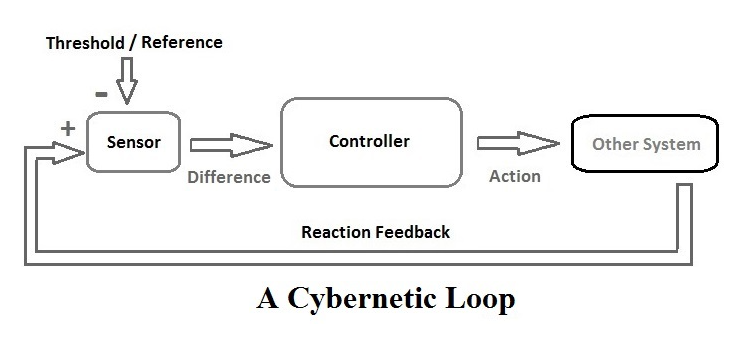
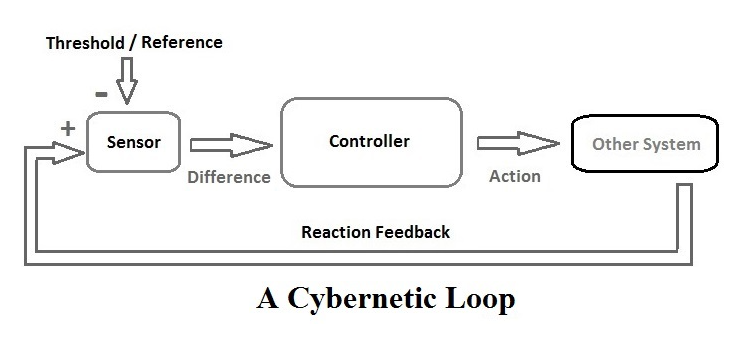
サイバネティックスの核となる概念は、循環的因果関係またはフィードバックであり、そこでは、特定の状態の追求と維持、またはその崩壊を支援する方法で、
行動の観察結果がさらなる行動のための入力として取り込まれる。サイバネティクスは、循環的な因果関係の例である船の操舵にちなんで名付けられた。操舵者
(サイバーノーツ)は、それがもたらすと観察される効果に絶えず応答して操舵を調整することにより、変化する環境の中で安定したコースを維持する。循環的
な因果関係フィードバックの他の例としては、サーモスタットなどの技術的装置(ヒーターの動作が温度の測定変化に反応し、部屋の温度を設定範囲内に調節す
る)、神経系を介した自発的な運動の調整などの生物学的例、会話などの社会的相互作用のプロセスなどが挙げられる。サイバネティクスは、生態系、技術系、
生物系、認知系、社会系など、どのような形であれ、また設計、学習、管理、会話、そしてサイバネティクスそのものの実践といった実践活動の中で、操舵術と
してのフィードバックプロセスに関心を寄せている。サイバネティクスは学際的あるいはトランスディシプリナリー的で「反領域的
(ntidisciplinary)」であるため、他の多くの分野と交差し、広い影響力と多様な解釈を持つに至っている。
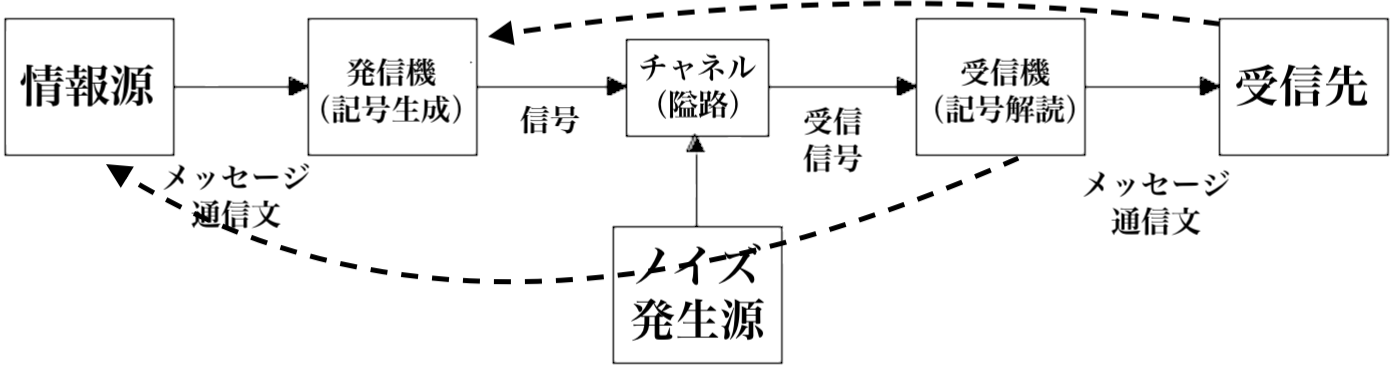
さてサ イバーパンクと いう用語における、サイバー(cyber)が接頭辞となって英語に流布するようになったのは言うまでもなくN・ ウィーナー(Norbert Wiener, 1894-1964)のサイバネティクス(cybernetics)であり、これは通 信と制御についての学問を彼が提唱した際に用いられた言葉だった(ウィーナー 1957)。サイバーの語源はギリシャ語の操舵手あるいは統治者(kuberne-te-s)に求められる。ウィーナーがなぜこのような造語をおこなった かというと、それは彼の「情報」の定義と密接に関係しているからである(→「サイバネティク ス:動物とマシーンにおける制御とコミュニケーション」)。
ウィーナーによる「情報」の定義とは、個体が外界に適応しようと行動し たり、行動の結果を外界か らえる際に、個体が外界と交換するものの内容のことをさす。サイバーという用語が、後にcyberspace や cyberphobia(コンピュタ恐怖症)のようにインターネットやそれに繋がるコンピュータを明示するようになったのは、サイバーに行為主体(=操舵 手)としての意味を持たせようとしたウィーナーからみれば不本意であっただろう。
その意味で、奥出直人がサイバーパンクを「頭脳の構造を探るような高度 なテクノロジーをマスター し、それを自分のためだけに使う連中」と説明した時、それは言葉が最初にもっていた意味を復活させたと言える(奥出 1990:158)。サイバーパンクはテクノロジーの発達(正確には変化)と切り離せない。つまり、サイバーパンクの定義は、テクノロジーと人間主体との 関係の変化により変容しうるということである。変容が終わった時、この言葉は廃語になる。
文学作品ではサイバースペースの中に自我が侵入するとまで表現される。 そのためウィリアム・ギブ ソン(1948-)『ニューロマンサー』(1984)などのサイバーパンク小説が「技術的に増強された(technologically- enhanced)文化的諸体系において周縁化した人々※」を取り扱うと定義されていることは、サイバーパンクという概念が、人間のある種のカテゴリーを さすと同時に、そのような人びとが担ったり拘束されもする社会性=文化をも包摂する概念であることがわかる(Frank 1998)。フランクの解説にしたがうと、社会的に周辺化されている人々つまり弱者は、サイバースペースにおいては、現実社会における強者(=経済的、社 会的、権力的にパワーのある人のみならず、警察や司法、あるいはマフィア組織など裏社会の実力者を含む)に比肩するだけの力と機会をもちうるというレジス タンス小説としても、『ニューロマンサー』を理解することも可能である。
※原文は、Cyberpunk literature, in general, deals with marginalized people in technologically-enhanced cultural "systems".です(http://www.non.com/news.answers/cyberpunk-faq.html, March 7,2004)。
解説者による註釈
この文章における人間主体という用語は、近代合理主義が前提にする、一 枚岩で合理的で主体と客体 の二分法をよく理解しそれを行動に反映させることができるような行為主体をモデルしている部分と、その自己意識はともかくとして、肌で境界づけられた身体 をもつ、単なる行為主体という意味をごっちゃにしています。サイバーパンクの定義は、マン=マシン・インターフェース(→ユーザーインターフェイス)の発達により、いかようにも変化しま すので、このような軟弱な定義づけの限界は目に見えてわかると思いますが、むしろ議論のたたき台としてご利用ください。
ちなみに、かつて、私がウィリアム・ギブスン(ギブソン)のインタ ビュー映像をみたときに彼がこ んなことをいっていたのを鮮烈に覚えている:「予防注射というのは、人類にとっての最初のサイ ボーグ化経験だったのさ」
★サイバネティクス(wiki 英語版)https://en.wikipedia.org/wiki/Cybernetics
| Cybernetics
is the transdisciplinary study of circular processes such as feedback
systems where outputs are also inputs. It is concerned with general
principles that are relevant across multiple contexts,[1] including in
ecological, technological, biological, cognitive and social systems and
also in practical activities such as designing,[2] learning, and
managing. The field is named after an example of circular causal feedback—that of steering a ship (the ancient Greek κυβερνήτης (kybernḗtēs) means "helmsperson"). In steering a ship, the helmsperson adjusts their steering in continual response to the effect it is observed as having, forming a feedback loop through which a steady course can be maintained in a changing environment, responding to disturbances from cross winds and tide.[3][4] Cybernetics' transdisciplinary[5] character has meant that it intersects with a number of other fields, leading to it having both wide influence and diverse interpretations. |
サイバネティクスは、出力が入力でもあるフィードバックシステムなどの
循環プロセスに関する学際的な研究である。サイバネティクスは、生態系、技術系、生物系、認知系、社会系、さらには設計、学習、管理などの実践的な活動を
含む、複数の文脈[1]に関連する一般的な原理を研究している。 この分野は、循環的な因果的フィードバックの例、すなわち船の操舵(古代ギリシア語のκυβερνήτης(kybernḗtēs)は「舵取り役」を意味 する)にちなんで命名された。船の操舵において、操舵者は、それがもたらすと観察される効果に絶えず応答して操舵を調整し、横風や潮の満ち引きによる外乱 に応答しながら、変化する環境において安定した航路を維持することができるフィードバックループを形成する[3][4]。 サイバネティクスの学際横断的な性格[5]は、それが他の多くの分野と交わることを意味し、幅広い影響力と多様な解釈の両方を持つことにつながっている。 |
| Definitions Cybernetics has been defined in a variety of ways, reflecting "the richness of its conceptual base."[6] One of the best known definitions is that of the American scientist Norbert Wiener, who characterised cybernetics as concerned with "control and communication in the animal and the machine."[7] Another early definition is that of the Macy cybernetics conferences, where cybernetics was understood as the study of "circular causal and feedback mechanisms in biological and social systems."[8] Margaret Mead emphasised the role of cybernetics as "a form of cross-disciplinary thought which made it possible for members of many disciplines to communicate with each other easily in a language which all could understand."[9] Other definitions include:[10] "the art of governing or the science of government" (André-Marie Ampère); "the art of steersmanship" (Ross Ashby); "the study of systems of any nature which are capable of receiving, storing, and processing information so as to use it for control" (Andrey Kolmogorov); and "a branch of mathematics dealing with problems of control, recursiveness, and information, focuses on forms and the patterns that connect" (Gregory Bateson). |
定義[編集] サイバネティクスは、「その概念的基盤の豊かさ」を反映して、様々な方法で定義されてきた。最もよく知られている定義のひとつは、アメリカの科学者ノー バート・ウィーナーによるもので、彼はサイバネティクスを「動物や機械における制御とコミュニケーション」に関わるものだとした。もうひとつの初期の定義 は、メイシー・サイバネティクス会議によるもので、そこではサイバネティクスは「生物学的・社会的システムにおける循環的な因果関係とフィードバックのメ カニズム」の研究と理解されていた。マーガレット・ミードは、サイバネティックスの役割を、「多くの学問分野のメンバーが、誰もが理解できる言語で簡単に 互いにコミュニケーションできるようにする、学際的な思考の一形態」として強調した。 他の定義としては、[10]「統治術または統治科学」(アンドレ=マリー・アンペール)、「操舵術」(ロス・アシュビー)、「制御のために情報を使用する ように情報を受信、保存、処理することができるあらゆる性質のシステムの研究」(アンドレイ・コルモゴロフ)、「制御、再帰性、情報の問題を扱う数学の一 分野であり、形態とそれをつなぐパターンに焦点を当てている」(グレゴリー・ベイトソン)などがある。 |
Etymology Simple feedback model. AB < 0 for negative feedback. The Ancient Greek term κυβερνητικός (kubernētikos, '(good at) steering') appears in Plato's Republic[11] and Alcibiades, where the metaphor of a steersman is used to signify the governance of people.[12] The French word cybernétique was also used in 1834 by the physicist André-Marie Ampère to denote the sciences of government in his classification system of human knowledge. According to Norbert Wiener, the word cybernetics was coined by a research group involving himself and Arturo Rosenblueth in the summer of 1947.[7] It has been attested in print since at least 1948 through Wiener's book Cybernetics: Or Control and Communication in the Animal and the Machine.[note 1] In the book, Wiener states: After much consideration, we have come to the conclusion that all the existing terminology has too heavy a bias to one side or another to serve the future development of the field as well as it should; and as happens so often to scientists, we have been forced to coin at least one artificial neo-Greek expression to fill the gap. We have decided to call the entire field of control and communication theory, whether in the machine or in the animal, by the name Cybernetics, which we form from the Greek κυβερνήτης or steersman. Moreover, Wiener explains, the term was chosen to recognize James Clerk Maxwell's 1868 publication on feedback mechanisms involving governors, noting that the term governor is also derived from κυβερνήτης (kubernḗtēs) via a Latin corruption gubernator. Finally, Wiener motivates the choice by steering engines of a ship being "one of the earliest and best-developed forms of feedback mechanisms".[7] |
語源[編集] 単純なフィードバックモデル。AB<0で負帰還となる。 古代ギリシャ語のκυβερνητικός(kubernētikos、「(操舵が)うまい」)は、プラトンの『共和国』[11]や『アルキビアデス』に 登場し、操舵手の比喩が人々の統治を意味するのに使われている[12]。フランス語のcybernétiqueという単語も、1834年に物理学者のアン ドレ=マリー・アンペールによって、彼の人智の分類体系における統治学を示すのに使われた。 ノルベルト・ウィーナーによれば、サイバネティクスという言葉は、1947年の夏、彼とアルトゥーロ・ローゼンブルースの研究グループによって作られた: あるいは動物と機械における制御とコミュニケーション』である[注釈 1]: 科学者にはよくあることだが、我々はそのギャップを埋めるために、少なくとも一つの人工的な新ギリシャ語の表現を作らざるを得なかった。私たちは、機械で あれ動物であれ、制御とコミュニケーションの理論分野全体を、ギリシャ語の κυβερνήτης(操舵者)に由来するサイバネティクスという名前で呼ぶことにした。 さらにウィーナーは、この言葉は1868年にジェームズ・クラーク・マクスウェルが発表したガバナーを含むフィードバック機構を認識するために選ばれたと 説明し、ガバナーという言葉もまたラテン語のgubernatorを経由してκυβερνήτης(kubernḗtēs)に由来することを指摘してい る。最後に、ウィーナーは、船の操舵エンジンが「フィードバック機構の最も初期に開発され、最もよく開発された形態の一つ」であることを選択の動機として いる[7]。 |
| History First wave See also: Macy conferences and Ratio Club 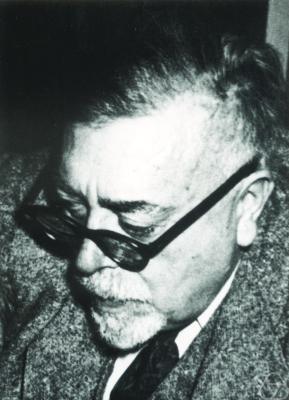 Norbert Wiener The initial focus of cybernetics was on parallels between regulatory feedback processes in biological and technological systems. Two foundational articles were published in 1943: "Behavior, Purpose and Teleology" by Arturo Rosenblueth, Norbert Wiener, and Julian Bigelow – based on the research on living organisms that Rosenblueth did in Mexico – and the paper "A Logical Calculus of the Ideas Immanent in Nervous Activity" by Warren McCulloch and Walter Pitts. The foundations of cybernetics were then developed through a series of transdisciplinary conferences funded by the Josiah Macy, Jr. Foundation, between 1946 and 1953. The conferences were chaired by McCulloch and had participants included Ross Ashby, Gregory Bateson, Heinz von Foerster, Margaret Mead, John von Neumann, and Norbert Wiener. In the UK, similar focuses were explored by the Ratio Club, an informal dining club of young psychiatrists, psychologists, physiologists, mathematicians and engineers that met between 1949 and 1958. Wiener introduced the neologism cybernetics to denote the study of "teleological mechanisms" and popularized it through the book Cybernetics: Or Control and Communication in the Animal and the Machine.[7] During the 1950s, cybernetics was developed as a primarily technical discipline, such as in Qian Xuesen's 1954 "Engineering Cybernetics". In the Soviet Union, Cybernetics was initially considered with suspicion[14] but became accepted from the mid to late 1950s. By the 1960s and 1970s, however, cybernetics' transdisciplinarity fragmented, with technical focuses separating into separate fields. Artificial intelligence (AI) was founded as a distinct discipline at the Dartmouth workshop in 1956, differentiating itself from the broader cybernetics field. After some uneasy coexistence, AI gained funding and prominence. Consequently, cybernetic sciences such as the study of artificial neural networks were downplayed.[15] Similarly, computer science became defined as a distinct academic discipline in the 1950s and early 1960s.[16] Second wave The second wave of cybernetics came to prominence from the 1960s onwards, with its focus inflecting away from technology toward social, ecological, and philosophical concerns. It was still grounded in biology, notably Maturana and Varela's autopoiesis, and built on earlier work on self-organising systems and the presence of anthropologists Mead and Bateson in the Macy meetings. The Biological Computer Laboratory, founded in 1958 and active until the mid-1970s under the direction of Heinz von Foerster at the University of Illinois at Urbana–Champaign, was a major incubator of this trend in cybernetics research.[17] Focuses of the second wave of cybernetics included management cybernetics, such as Stafford Beer's biologically inspired viable system model; work in family therapy, drawing on Bateson; social systems, such as in the work of Niklas Luhmann; epistemology and pedagogy, such as in the development of radical constructivism.[18] Cybernetics' core theme of circular causality was developed beyond goal-oriented processes to concerns with reflexivity and recursion. This was especially so in the development of second-order cybernetics (or the cybernetics of cybernetics), developed and promoted by Heinz von Foerster, which focused on questions of observation, cognition, epistemology, and ethics. The 1960s onwards also saw cybernetics begin to develop exchanges with the creative arts, design, and architecture, notably with the Cybernetic Serendipity exhibition (ICA, London, 1968), curated by Jasia Reichardt,[19][20] and the unrealised Fun Palace project (London, unrealised, 1964 onwards), where Gordon Pask was consultant to architect Cedric Price and theatre director Joan Littlewood.[21] Third wave From the 1990s onwards, there has been a renewed interest in cybernetics from a number of directions. Early cybernetic work on artificial neural networks has been returned to as a paradigm in machine learning and artificial intelligence. The entanglements of society with emerging technologies has led to exchanges with feminist technoscience and posthumanism. Re-examinations of cybernetics' history have seen science studies scholars emphasising cybernetics' unusual qualities as a science, such as its "performative ontology".[22] Practical design disciplines have drawn on cybernetics for theoretical underpinning and transdisciplinary connections. Emerging topics include how cybernetics' engagements with social, human, and ecological contexts might come together with its earlier technological focus, whether as a critical discourse[23][24] or a "new branch of engineering".[25] |
歴史[編集] 第一波[編集] 以下も参照のこと: メイシー会議と レシオクラブ ノルベルト・ウィーナー サイバネティクスの最初の焦点は、生物学的システムと技術的システムにおける調節フィードバックプロセスの類似性であった。1943年に2つの基礎となる 論文が発表された: アルトゥーロ・ローゼンブルース、ノーバート・ウィーナー、ジュリアン・ビゲローによる「行動、目的、テレオロジー(Behavior, Purpose and Teleology)」(ローゼンブルースがメキシコで行った生物に関する研究に基づく)と、ウォーレン・マッカロクと ウォルター・ピッツによる論文「神経活動に内在する観念の論理的計算(A Logical Calculus of the Ideas Immanent in Nervous Activity)」である。その後、サイバネティックスの基礎は、1946年から1953年にかけてジョサイア・メイシー・ジュニア財団が資金を提供し た一連の学際的な会議を通じて培われた。1946年から1953年にかけて、ジョサイア・メイシー・ジュニア財団が資金を提供した一連の学際会議を通じ て、サイバネティックスの基礎が築かれた。会議の議長はマッカロックが務め、ロス・アシュビー、グレゴリー・ベイトソン、ハインツ・フォン・フェルス ター、マーガレット・ミード、ジョン・フォン・ノイマン、ノルベルト・ウィーナーらが参加した。イギリスでは、1949年から1958年にかけて開かれ た、若い精神科医、心理学者、生理学者、数学者、エンジニアによる非公式のダイニングクラブ「レシオ・クラブ」によって、同様のテーマが探求された。 ウィーナーは、「目的論的メカニズム」の研究を示すためにサイバネティクスという新語を導入し、著書『サイバネティクス』を通じてそれを普及させた: あるいは動物と機械における制御とコミュニケーション』(Cybernetics: Or Control and Communication in the Animal and the Machine)という本を通じて広めた[7]。 1950年代には、サイバネティクスは、銭雪仙の1954年の『工学サイバネティクス』のように、主に技術的な学問として発展した。ソビエト連邦では、サ イバネティクスは当初疑いの目で見られていたが[14]、1950年代半ばから後半にかけて受け入れられるようになった。 しかし1960年代から1970年代にかけて、サイバネティクスの学際性は分断され、技術的な焦点は別々の分野に分かれていった。人工知能(AI)は、 1956年にダートマス大学で開催されたワークショップで、より広範なサイバネティクス分野とは一線を画す学問分野として創設された。不穏な共存関係の 後、AIは資金を獲得し、脚光を浴びるようになった。その結果、人工ニューラルネットワークの研究のようなサイバネティックな科学は軽視されるようになっ た[15]。同様に、コンピュータサイエンスも1950年代から1960年代初頭にかけて、別個の学問分野として定義されるようになった[16]。 第二の波[編集] サイバネティクスの第二の波は1960年代以降に顕著になり、その焦点はテクノロジーから社会的、生態学的、哲学的な関心へと向かっていった。サイバネ ティックスは依然として生物学、特にマトゥラナと ヴァレラの オートポイエーシスに立脚しており、自己組織化システムに関するそれ以前の研究や、メーシー会議における人類学者ミードとベイトソンの存在を基盤としてい た。1958年に設立され、イリノイ大学アーバナ・シャンペーン校のハインツ・フォン・フェルスターの指揮の下、1970年代半ばまで活動していた生物コ ンピュータ研究所は、サイバネティクス研究におけるこの傾向の主要なインキュベーターであった[17]。 サイバネティクスの第二の波の焦点には、スタッフォード・ビールの生物学的な着想を得た実行可能システムモデルなどの経営サイバネティクス、ベイトソンを 活用した家族療法の研究、ニクラス・ルーマンの研究などの社会システム、急進的構成主義の発展などの認識論や教育学などが含まれていた[18]。サイバネ ティクスの中心的なテーマである循環的因果性は、目標志向のプロセスを超えて、再帰性や再帰性への関心へと発展した。これは特に、ハインツ・フォン・フェ ルスターによって開発・推進された、観察、認知、認識論、倫理の問題に焦点を当てた二次サイバネティクス(あるいはサイバネティクスのサイバネティクス) の発展においてそうであった。 1960年代以降、サイバネティクスは創造的な芸術、デザイン、建築との交流も展開し始め、特にジャシア・ライヒャルトのキュレーションによる「サイバネ ティック・セレンディピティ」展(ICA、ロンドン、1968年)や[19][20]、ゴードン・パスクが建築家セドリック・プライスと演劇監督ジョー ン・リトルウッドのコンサルタントを務めた「ファン・パレス」プロジェクト(ロンドン、未実現、1964年以降)などが挙げられる[21]。 第三の波[編集] 1990年代以降、様々な方向からサイバネティクスへの関心が再燃している。人工ニューラルネットワークに関する初期のサイバネティクスの研究は、機械学 習や人工知能におけるパラダイムとして回帰している。社会と新興テクノロジーとの絡み合いは、フェミニスト・テクノサイエンスやポストヒューマニズムとの 交流につながっている。サイバネティクスの歴史を再検討することで、科学研究の学者たちは、その「パフォーマティブな存在論」など、サイバネティクスの科 学としての特異な特質を強調している[22]。新たなトピックとしては、批評的言説[23][24]であれ「工学の新たな一分野」[25]であれ、サイバ ネティクスの社会的、人間的、生態学的な文脈への関与が、その以前の技術的な焦点とどのように結びつくかも含まれる。 |
| Key concepts and theories The central theme in cybernetics is feedback. Feedback is a process where the observed outcomes of actions are taken as inputs for further action in ways that support the pursuit, maintenance, or disruption of particular conditions, forming a circular causal relationship. In steering a ship, the helmsperson maintains a steady course in a changing environment by adjusting their steering in continual response to the effect it is observed as having.[3] Other examples of circular causal feedback include: technological devices such as the thermostat, where the action of a heater responds to measured changes in temperature regulating the temperature of the room within a set range, and the centrifugal governor of a steam engine, which regulates the engine speed; biological examples such as the coordination of volitional movement through the nervous system and the homeostatic processes that regulate variables such as blood sugar; and processes of social interaction such as conversation.[26] Negative feedback processes are those that maintain particular conditions by reducing (hence 'negative') the difference from a desired state, such as where a thermostat turns on a heater when it is too cold and turns a heater off when it is too hot. Positive feedback processes increase (hence 'positive') the difference from a desired state. An example of positive feedback is when a microphone picks up the sound that it is producing through a speaker, which is then played through the speaker, and so on. In addition to feedback, cybernetics is concerned with other forms of circular processes including: feedforward, recursion, and reflexivity. Other key concepts and theories in cybernetics include: Autopoiesis Black box Conversation theory Double bind theory: Double binds are patterns created in interaction between two or more parties in ongoing relationships where there is a contradiction between messages at different logical levels that creates a situation with emotional threat but no possibility of withdrawal from the situation and no way to articulate the problem.[27] The theory was first described by Gregory Bateson and colleagues in the 1950s with regard to the origins of schizophrenia,[28] but it is also characteristic of many other social contexts.[27] Experimental epistemology[29] Good regulator theorem Perceptual control theory: A model of behavior based on the properties of negative feedback (cybernetic) control loops. A key insight of PCT is that the controlled variable is not the output of the system (the behavioral actions), but its input, "perception". The theory came to be known as "perceptual control theory" to distinguish from those control theorists that assert or assume that it is the system's output that is controlled. Method of levels is an approach to psychotherapy based on perceptual control theory where the therapist aims to help the patient shift their awareness to higher levels of perception in order to resolve conflicts and allow reorganization to take place. Radical constructivism Second-order cybernetics: Also known as the cybernetics of cybernetics, second-order cybernetics is the recursive application of cybernetics to itself and the practice of cybernetics according to such a critique. Self-organisation Social systems theory Variety and Requisite Variety Viable system model |
主要概念と理論[編集] サイバネティックスの中心テーマはフィードバックである。フィードバックとは、観察された行動の結果が、特定の状態の追求、維持、破壊を支援するような形 で、さらなる行動のための入力として取り込まれ、循環的な因果関係を形成するプロセスである。船の操舵において、操舵者は、それがもたらすと観察される効 果に絶えず応答して操舵を調整することによって、変化する環境において安定した航路を維持する[3]。 循環的因果関係フィードバックの他の例としては、サーモスタットのような技術的装置、ヒーターの動作が温度の測定された変化に応答して部屋の温度を設定さ れた範囲内に調節する、蒸気機関の遠心ガバナー、神経系を介した自発的運動の調整、血糖値のような変数を調節する恒常性プロセスのような生物学的例、会話 のような社会的相互作用のプロセスなどがある[26]。 負のフィードバック過程は、サーモスタットが寒すぎるとヒーターをオンにし、暑すぎるとヒーターをオフにする場合のように、望ましい状態からの差を減少さ せる(したがって「負」)ことによって特定の状態を維持するものである。正帰還過程は、望ましい状態からの差を増大させる(したがって「正」)。正帰還の 例としては、マイクロホンがスピーカーから発している音を拾い、それがスピーカーから再生されるような場合がある。 フィードバックに加え、サイバネティクスは、フィードフォワード、再帰性、反射性など、他の形態の循環プロセスにも関係している。 サイバネティクスの他の重要な概念と理論には、以下のものがある: オートポイエーシス ブラックボックス 会話理論 ダブルバインド理論: ダブルバインドとは、継続的な関係における2つ以上の当事者間の相互作用において、異なる論理レベルにおけるメッセージの間に矛盾が生じ、感情的な脅威が あるにもかかわらず、その状況から撤退する可能性がなく、問題を明確にする方法がない状況を作り出すパターンのことである[27]。この理論は、1950 年代にグレゴリー・ベイトソンらによって統合失調症の起源に関して初めて説明されたが[28]、他の多くの社会的文脈においても特徴的である[27]。 実験的認識論[29] 善き調整者の定理 知覚制御理論: 負のフィードバック(サイバネティック)制御ループの特性に基づく行動モデル。PCTの重要な洞察は、制御される変数はシステムの出力(行動行為)ではな く、その入力である「知覚」であるということである。この理論は、制御されるのはシステムの出力であると主張または仮定する制御理論家と区別するために、 「知覚制御理論」として知られるようになった。レベル・メソッドは、知覚制御理論に基づく心理療法のアプローチであり、セラピストは、葛藤を解決し、再編 成が行われるようにするために、患者の意識をより高いレベルの知覚へとシフトさせる手助けをすることを目的としている。 急進的構成主義 二次サイバネティクス: サイバネティクスのサイバネティクスとしても知られる2次サイバネティクスは、サイバネティクスの再帰的適用であり、そのような批判に従ったサイバネティ クスの実践である。 自己組織化 社会システム理論 多様性と必要な多様性 生存可能なシステムモデル |
| Related fields and applications Cybernetics' central concept of circular causality is of wide applicability, leading to diverse applications and relations with other fields. Many of the initial applications of cybernetics focused on engineering, biology, and exchanges between the two, such as medical cybernetics and robotics and topics such as neural networks, heterarchy.[30] In the social and behavioral sciences, cybernetics has included and influenced work in anthropology, sociology, economics, family therapy,[31] cognitive science, and psychology.[32][33] As cybernetics has developed, it broadened in scope to include work in management, design,[34] pedagogy, and the creative arts,[35] while also developing exchanges with constructivist philosophies, counter-cultural movements,[36] and media studies.[37] The development of management cybernetics has led to a variety of applications, notably to the national economy of Chile under the Allende government in Project Cybersyn. In design, cybernetics has been influential on interactive architecture, human-computer interaction,[38] design research,[39] and the development of systemic design and metadesign practices.  Project Cybersyn was an early form of cybernetic economic planning Cybernetics is often understood within the context of systems science, systems theory, and systems thinking.[40][41] Systems approaches influenced by cybernetics include critical systems thinking, which incorporates the viable system model; systemic design; and system dynamics, which is based on the concept of causal feedback loops. Many fields trace their origins in whole or part to work carried out in cybernetics, or were partially absorbed into cybernetics when it was developed. These include artificial intelligence, bionics, cognitive science, control theory, complexity science, computer science, information theory and robotics. Some aspects of modern artificial intelligence, particularly the social machine, are often described in cybernetic terms.[42] |
関連分野と応用[編集] サイバネティックスの中心概念である「循環的因果性」は応用範囲が広く、多様な応用や他分野との関係につながっている。サイバネティクスの初期の応用の多 くは、医療サイバネティクスや ロボット工学、神経ネットワーク、ヘテラルキーなどのトピックのような、工学、生物学、および両者の間の交流に焦点を当てていた[30]。社会科学および 行動科学において、サイバネティクスは人類学、社会学、経済学、家族療法、[31]認知科学、心理学の仕事を含み、影響を与えた[32][33]。 サイバネティクスの発展とともに、経営、デザイン[34]、教育学、創造的芸術[35]における仕事を含むように範囲を広げ、同時に構成主義哲学、反文化 運動[36]、メディア研究[37]との交流を発展させてきた。経営サイバネティクスの発展は様々な応用につながり、特にアジェンデ政権下のチリの国家経 済におけるプロジェクト・サイバシンへの応用が顕著である。デザインにおいては、サイバネティクスはインタラクティブ・アーキテクチャー、ヒューマン・コ ンピュータ・インタラクション[38]、デザイン・リサーチ[39]、システミック・デザインや メタデザインの実践の発展に影響を及ぼしてきた。 プロジェクト・サイバシンは、サイバネティック経済計画の初期の形態であった。 サイバネティックスの影響を受けたシステム・アプローチには、実行可能システム・モデルを取り入れたクリティカル・システム・シンキング、システミック・ デザイン、因果的フィードバック・ループの概念に基づくシステム・ダイナミクスなどがある[40][41]。 サイバネティクスの研究の一部または全部を起源とする分野や、サイバネティクスが発展したときに部分的に吸収された分野も多い。人工知能、バイオニクス、 認知科学、制御理論、複雑性科学、コンピュータ科学、情報理論、ロボット工学などがそれである。現代の人工知能のいくつかの側面、特に社会的機械は、しば しばサイバネティックの用語で説明されている[42]。 |
| Journals and societies See also: List of systems sciences organizations and List of systems science journals Academic journals with focuses in cybernetics include: Constructivist Foundations Cybernetics and Human Knowing Cybernetics and Systems Enacting Cybernetics. An open access journal published by the Cybernetics Society and hosted by Ubiquity Press.[43] Biological Cybernetics IEEE Transactions on Systems, Man, and Cybernetics: Systems IEEE Transactions on Human-Machine Systems IEEE Transactions on Cybernetics IEEE Transactions on Computational Social Systems Kybernetes Academic societies primarily concerned with cybernetics or aspects of it include: American Society for Cybernetics Cybernetics Society IEEE Systems, Man, and Cybernetics Society Metaphorum [d]: The Metaphorum group was set up in 2003 to develop Stafford Beer's legacy in Organizational Cybernetics. The Metaphorum Group was born in a Syntegration in 2003 and have every year after developed a Conference on issues related to Organizational Cybernetics' theory and practice. RC51 Sociocybernetics: RC51 is a research committee of the International Sociological Association promoting the development of (socio)cybernetic theory and research within the social sciences.[44] SCiO (Systems and Complexity in Organisation) is a community of systems practitioners who believe that traditional approaches to running organisations are no longer capable of dealing with the complexity and turbulence faced by organisations today and are responsible for many of the problems we see today. SCiO delivers an apprenticeship on masters level and a certification in systems practice.[45] |
ジャーナルと学会[編集] 以下も参照のこと: システム科学団体の一覧と システム科学ジャーナルの一覧 サイバネティクスに焦点を当てた学術誌には以下のものがある: 構築主義的基礎 サイバネティクスと人間の知 サイバネティクスとシステム サイバネティックスを実践する。Cybernetics Societyが発行し、Ubiquity Pressが主催するオープンアクセスジャーナル[43]。 生物サイバネティクス IEEE Transactions on Systems, Man, and Cybernetics: システム 人間-機械システムに関するIEEE論文誌 IEEEサイバネティクス論文誌 IEEE計算社会システム論文集 サイバネテス 主にサイバネティクスまたはその側面に関係する学会には、以下のものがある: 米国サイバネティックス学会 サイバネティックス学会 IEEEシステム・人間・サイバネティクス学会 Metaphorum [d]: Metaphorumグループは、組織サイバネティクスにおけるスタッフォード・ビールの遺産を発展させるために2003年に設立された。 Metaphorumグループは、2003年のSyntegrationで誕生し、以後毎年、組織サイバネティックスの理論と実践に関連する問題について の会議を発展させてきた。 RC51 ソシオサイバネティクス RC51は、社会科学における(ソシオ)サイバネティックの理論と研究の発展を促進する国際社会学会の研究委員会である[44]。 SCiO(Systems and Complexity in Organisation)は、組織を運営するための伝統的なアプローチは、今日組織が直面している複雑性や乱気流に対処することがもはや不可能であり、 今日私たちが目にしている多くの問題の原因となっていると考えるシステム実践者のコミュニティである。SCiOは、修士レベルの見習い制度とシステム実践 の認定資格を提供している[45]。 |
| Autonomous agency theory Complex systems Gaia hypothesis The Human Use of Human Beings Industrial ecology Principia Cybernetica Superorganism Synergetics (Haken) Tektology Viable system theory Macy conferences |
自律エージェンシー理論 複雑系 ガイア仮説 人間の人間利用 産業エコロジー プリンキピアサイバネティカ スーパーオーガニズム シナジェティクス(ハーケン) テクトロジー 生存可能システム理論 メイシー会議 |
| https://en.wikipedia.org/wiki/Cybernetics |
|
| Notes 01. While Wiener's book presents cybernetics in a scientific context, its subtitle does not use the term science[19] and Wiener refers to cybernetics as a "field" when defining it.[13] Ashby, however, refers to Wiener as defining cybernetics as "the science of communication and control"[4] and many subsequent authors follow Ashby. |
注 01. ウィーナーの著書はサイバネティクスを科学的な文脈で提示しているが、その副題には「科学」という用語は用いられておらず[19]、ウィーナーはサイバネ ティクスを定義する際にこれを「分野」と呼んでいる[13]。しかし、アシュビーは、ウィーナーがサイバネティクスを「通信と制御の科学」と定義したと述 べている[4]。その後の多くの著者はアシュビーの見解に従っている。 |
| References 01. Von Foerster, H. (Ed) (1952). Cybernetics; circular causal and feedback mechanisms in biological and social systems. Josiah Macy, Jr. Foundation. "The earliest cybernetics discussions addressed the way in which the behavior of a systemic entity was best explained in terms of how the effects of its actions (i.e., 'outputs') circled back (i.e., as 'inputs') to influence that entity's state and its subsequent actions. It was this 'circular causality' which would come to be called 'feedback' – the cybernetics group's original self-ascribed topic and the single concept most frequently cited as illustrative of cybernetics thinking." American Society for Cybernetics. Foundations: Pre-History of Cybernetics. https://asc-cybernetics.org/foundations/history/prehistory7.htm Section: Circular Causality "The analogies developed in cybernetics are constructed in terms of circular causal processes—that is, processes where the observed outcomes of action are taken as input for new action, such as in feedback, conversation, and indeed in designing and researching." Sweeting, B., & Sutherland, S. (2023). Design's secret partner in research: Cybernetic practices for design research pedagogy. Systems Research and Behavioral Science, 40(5), 765–771. https://doi.org/10.1002/sres.2974 Ashby, W. R. (1956). An introduction to cybernetics. London: Chapman & Hall. "Design Cybernetics". Design Research Foundations. Cham: Springer International Publishing. 2019. doi:10.1007/978-3-030-18557-2. ISBN 978-3-030-18556-5. ISSN 2366-4622. S2CID 239279379. Müller, Albert (2000). "A Brief History of the BCL". Österreichische Zeitschrift für Geschichtswissenschaften. 11 (1): 9–30. Archived from the original on 22 July 2012. Retrieved 6 June 2012. Gage, Stephen (1 January 2007). "The boat/helmsman". Technoetic Arts. 5 (1). Intellect: 15–24. doi:10.1386/tear.5.1.15_1. ISSN 1477-965X. "What is cybernetics - NTNU". www.ntnu.edu. Retrieved 27 April 2023. Rosenblueth, Arturo, Norbert Wiener, and Julian Bigelow. "Behavior, Purpose and Teleology". Philosophy of Science 10, no. 1 (1943): 18–24. www.jstor.org/stable/184878 von Foerster, Heinz. "On Self-Organizing Systems and Their Environments". In Understanding Understanding: Essays on Cybernetics and Cognition, 1–19. New York, NY: Springer, 2003. Originally published in Self-Organizing Systems. M.C. Yovits and S. Cameron (eds.), Pergamon Press, London, pp. 31–50 (1960). Dubberly, Hugh, and Paul Pangaro. "How cybernetics connects computing, counterculture, and design". In Hippie Modernism: The Struggle for Utopia. Minneapolis, MN: Walker Art Center, 2015. http://www.dubberly.com/articles/cybernetics-and-counterculture.html von Foerster, Heinz (2003). "Ethics and Second-Order Cybernetics". Understanding Understanding. New York, NY: Springer New York. pp. 287–304. doi:10.1007/0-387-21722-3_14. ISBN 978-0-387-95392-2. It seems that cybernetics is many different things to many different people. But this is because of the richness of its conceptual base; and I believe that this is very good, otherwise cybernetics would become a somewhat boring exercise. However, all of those perspectives arise from one central theme; that of circularity Wiener, Norbert (1948). Cybernetics: Or Control and Communication in the Animal and the Machine. Cambridge, Massachusetts: MIT Press. von Foerster, H.; Mead, M.; Teuber, H. L., eds. (1951). Cybernetics: Circular causal and feedback mechanisms in biological and social systems. Transactions of the seventh conference. New York: Josiah Macy, Jr. Foundation. Mead, M. (1968). "The cybernetics of cybernetics". In H. von Foerster; J. D. White; L. J. Peterson; J. K. Russell (eds.). Purposive Systems (PDF). Spartan Books. pp. 1–11. "Definitions". American Society for Cybernetics. Book VI, The philosophy of government Johnson, Barnabas. "The Cybernetics of Society". Retrieved 8 January 2012. Glanville, R. (2007). Try again. Fail again. Fail Better. The cybernetics in design and the design in cybernetics". Kybernetes, 36(9/10), 1173–1206. Wang, Hongzhe (2025). "Five Moments in the History of Chinese Cybernetics". In Bratton, Benjamin; Greenspan, Anna; Ireland, Amy; Konior, Bogna (eds.). Machine Decision is Not Final: China and the History and Future of Artificial Intelligence. Translated by Young, Allen. Urbanomic, MIT Press. ISBN 9781913029999. As a "pseudoscience" and "ideological weapon" of "imperialist reactionaries" (Soviet Philosophical Dictionary, 1954) Cariani, Peter (15 March 2010). "On the importance of being emergent". Constructivist Foundations. 5 (2): 89. Retrieved 13 August 2012. artificial intelligence was born at a conference at Dartmouth in 1956 that was organized by McCarthy, Minsky, rochester, and shannon, three years after the Macy conferences on cybernetics had ended (Boden 2006; McCorduck 1972). The two movements coexisted for roughly a de- cade, but by the mid-1960s, the proponents of symbolic ai gained control of national funding conduits and ruthlessly defunded cybernetics research. This effectively liquidated the subfields of self-organizing systems, neural networks and adaptive machines, evolutionary programming, biological computation, and bionics for several decades, leaving the workers in management, therapy and the social sciences to carry the torch. i think some of the polemical pushing-and-shoving between first-order control theorists and second-order crowds that i witnessed in subsequent decades was the cumulative result of a shift of funding, membership, and research from the "hard" natural sciences to "soft" socio-psychological interventions. Denning, Peter J. (2000). "Computer Science: The Discipline". Encyclopedia of Computer Science. Muller, A., and Muller, K. (eds). An Unfinished Revolution?: Heinz von Foerster and the Biological Computer Laboratory / BCL 1958–1976, Edition Echoraum, 2007. Glanville, R. (2002). "Second order cybernetics". In F. Parra-Luna (ed.), Systems science and cybernetics. In Encyclopaedia of Life Support Systems (EOLSS). Oxford: EoLSS Sweeting B. (2025) Planning organizations in relation to their purposes. Proceedings of the International Society for the Systems Sciences. 69(1). https://journals.isss.org/index.php/jisss/article/view/4427 Reichardt, J. (Ed.). Cybernetic serendipity: The computer and the arts. Studio International [Special issue] Fernandez, M. (2009). "Aesthetically-Potent Environments" or How Pask Detourned Instrumental Cybernetics. In P. Brown, C. Gere, N. Lambert, & C. Mason (Eds.), White Heat Cold Logic: British Computer Art 1960–1980 MIT Press. Mathews, Stanley (1 September 2005). "The Fun Palace: Cedric Price's experiment in architecture and technology". Technoetic Arts. 3 (2). Intellect: 73–92. doi:10.1386/tear.3.2.73/1. ISSN 1477-965X. Wang, Hongzhe (2025). "Five Moments in the History of Chinese Cybernetics". In Bratton, Benjamin; Greenspan, Anna; Ireland, Amy; Konior, Bogna (eds.). Machine Decision is Not Final: China and the History and Future of Artificial Intelligence. Translated by Young, Allen. Urbanomic, MIT Press. ISBN 9781913029999. Bratton, Benjamin (2025). "Afterword: Apology for Western Theory of AI". In Bratton, Benjamin; Greenspan, Anna; Ireland, Amy; Konior, Bogna (eds.). Machine Decision Is Not Final: China and the History and Future of Artificial Intelligence. Urbanomic, MIT Press. ISBN 9781913029999. Pickering, A. (2010). The cybernetic brain: Sketches of another future. University of Chicago Press. Scholte, Tom; Sweeting, Ben (5 August 2022). "Possibilities for a critical cybernetics". Systems Research and Behavioral Science. 39 (5). Wiley: 986–989. doi:10.1002/sres.2891. ISSN 1092-7026. S2CID 251432252. Krippendorff K. (2023) A critical cybernetics. Constructivist Foundations 19(1): 82–93. https://constructivist.info/19/1/082 Genevieve Bell (7 January 2020). "Anthropology, cybernetics, and establishing a new branch of engineering at ANU". EthnoPod with Jay Hasbrouck. Dubberly, Hugh; Pangaro, Paul (2019). "Cybernetics and Design: Conversations for Action". Design Cybernetics. Design Research Foundations. Cham: Springer International Publishing. pp. 85–99. doi:10.1007/978-3-030-18557-2_4. ISBN 978-3-030-18556-5. ISSN 2366-4622. S2CID 33895017. Mary Catherine Bateson. (2005). The double bind: Pathology and creativity. Cybernetics and Human Knowing. 12(1–2) Bateson, G., Jackson, D. D., Haley, J. & Weakland, J., 1956, Toward a theory of schizophrenia.Behavioral Science, Vol. 1, 251–264. McCulloch, W.S., 1965b (1964), A Historical Introduction to the Postulational Foundations of Experimental Epistemology, in Embodiments of Mind, The MIT Press, Cambridge, Massachusetts, pp. 359–373. McCulloch, Warren (1945). "A Heterarchy of Values Determined by the Topology of Nervous Nets". In: Bulletin of Mathematical Biophysics, 7, 1945, 89–93. Smith, Miranda; Karam, Eli (2018). "Second-Order Cybernetics in Family Systems Theory". Encyclopedia of Couple and Family Therapy. Cham: Springer International Publishing. pp. 1–2. doi:10.1007/978-3-319-15877-8_308-1. ISBN 978-3-319-15877-8. Scott, Bernard (15 July 2016). "Cybernetic Foundations for Psychology". Constructivist Foundations. 11 (3). Alexander Riegler: 509–517. ISSN 1782-348X. Retrieved 14 November 2023. Tilak, Shantanu; Glassman, Michael; Kuznetcova, Irina; Pelfrey, G. Logan (28 October 2021). "Applications of cybernetics to psychological theory: Historical and conceptual explorations". Theory & Psychology. 32 (2). SAGE Publications: 298–325. doi:10.1177/09593543211053804. ISSN 0959-3543. S2CID 240187814. Shantanu Tilak, Shayan Doroudi, Thomas Manning, Paul Pangaro, Michael Glassman, Ziye Wen, Marvin Evans, and Bernard Scott. The Potential of Second-Order Cybernetics in the College Classroom. Proceedings of Relating Systems Thinking and Design, RSD12. https://rsdsymposium.org/cybernetics-in-the-college-classroom/ Tilak, Shantanu. "Cybernetics, Education, and Psychology:Discovering Potentials (yet) Unearthed". Cybernetics & Human Knowing 30, no. 1-2 (2023): 23–44. Scholte, Tom (2 May 2020). "A proposal for the role of the arts in a new phase of second-order cybernetics". Kybernetes. 49 (8). Emerald: 2153–2170. doi:10.1108/k-03-2019-0172. ISSN 0368-492X. S2CID 219051224. Dubberly, H., & Pangaro, P. (2015). How cybernetics connects computing, counterculture, and design. In Hippie Modernism: The Struggle for Utopia. Walker Art Center. http://www.dubberly.com/articles/cybernetics-and-counterculture.html Logan, Robert K. (2015) Feedforward, I. A. Richards, cybernetics and Marshall McLuhan. Systema: Connecting Catter, Life, Culture and Technology, 3 (1). pp. 177–185. http://openresearch.ocadu.ca/id/eprint/650/ Mariátegui, José-Carlos (19 May 2025). "Beyond Project Cybersyn: Tracing the Influence of Stafford Beer Projects and Ideas in Latin America". Systemic Practice and Action Research. 38 (2): 9. doi:10.1007/s11213-025-09717-2. ISSN 1573-9295. Andres, Josh; Zafiroglu, Alexandra; Daniell, Katherine; Wong, Paul; Henein, Mina; Zhu, Xuanying; Sweeting, Ben; Arnold, Michael; Macnamara, Delia Pembrey; Helfgott, Ariella (29 November 2022). "Cybernetic Lenses for Designing and Living in a Complex World". Proceedings of the 34th Australian Conference on Human-Computer Interaction. New York, NY, USA: ACM. pp. 348–351. doi:10.1145/3572921.3576209. ISBN 9798400700248. Sweeting, Ben (14 September 2017). "Design Research as a Variety of Second-Order Cybernetic Practice" (PDF). New Horizons for Second-Order Cybernetics. Series on Knots and Everything. Vol. 60. WORLD SCIENTIFIC. pp. 227–238. doi:10.1142/9789813226265_0035. ISBN 978-981-322-625-8. ISSN 0219-9769. e.g. by Ray Ison: Ison, R. (2012). A cybersystemic framework for practical action. In: Murray, Joy; Cawthorne, Glenn; Dey, Christopher and Andrew, Chris eds. Enough for All Forever. A Handbook for Learning about Sustainability. Champaign, Illinois: Common Ground Publishing, pp. 269–284. Checkland, P. (1981). Systems thinking, systems practice. Wiley, Chichester. Cristianini, Nello (2023). The shortcut : why intelligent machines do not think like us (First ed.). Boca Raton. ISBN 978-1-003-33581-8. OCLC 1352480147. Enacting Cybernetics "RC51 Sociocybernetics". www.isa-sociology.org. 07. "Home". systemspractice.org. |
参考文献 01. フォン・フォアスター, H. (編) (1952). 『サイバネティクス:生物学的・社会的システムにおける循環的因果関係とフィードバック機構』. ジョサイア・メイシー・ジュニア財団. 「サイバネティクスに関する初期の議論は、あるシステム的実体の行動を、その行動の結果(すなわち『出力』)がどのように循環して(すなわち 『入力』として)その実体の状態やその後の行動に影響を与えるかという観点から、いかにして最も適切に説明できるかという点を扱っていた。この『循環的因 果関係』こそが、後に『フィードバック』と呼ばれるようになったものである。これはサイバネティクス研究グループが当初自ら定めたテーマであり、サイバネ ティクスの思考を例示するものとして最も頻繁に引用される単一の概念である。」 アメリカ・サイバネティクス学会。『基礎:サイバネティクスの先史』 https://asc-cybernetics.org/foundations/history/prehistory7.htm セクション:循環的因果関係 「サイバネティクスで展開される類推は、循環的因果プロセス、すなわち、フィードバックや会話、そして実際に設計や研究において見られるよう に、行動の観察された結果が新たな行動の入力として扱われるプロセスに基づいて構築されている。」Sweeting, B., & Sutherland, S. (2023). 「研究におけるデザインの秘密のパートナー:デザイン研究教育のためのサイバネティクス的実践」。『Systems Research and Behavioral Science』, 40(5), 765–771. https://doi.org/10.1002/sres.2974 アシュビー, W. R. (1956). 『サイバネティクス入門』。ロンドン:チャップマン・アンド・ホール。 「デザイン・サイバネティクス」。『デザイン研究の基礎』。チャム:スプリンガー・インターナショナル・パブリッシング。2019年。doi: 10.1007/978-3-030-18557-2。ISBN 978-3-030-18556-5。ISSN 2366-4622。S2CID 239279379。 ミュラー、アルベルト(2000)。「BCLの略史」。『Österreichische Zeitschrift für Geschichtswissenschaften』。11 (1): 9–30。2012年7月22日にオリジナルからアーカイブされた。2012年6月6日に閲覧。 ゲージ、スティーブン(2007年1月1日)。「The boat/helmsman」。『Technoetic Arts』. 5 (1). Intellect: 15–24. doi:10.1386/tear.5.1.15_1. ISSN 1477-965X. 「サイバネティクスとは何か - NTNU」。www.ntnu.edu。2023年4月27日に閲覧。 ローゼンブルース、アルトゥーロ、ノーバート・ウィーナー、ジュリアン・ビゲロー。「行動、目的、および目的論」。『Philosophy of Science』10巻1号(1943年):18–24頁。www.jstor.org/stable/184878 フォン・フォアスター、ハインツ。「自己組織化システムとその環境について」。『Understanding Understanding: Essays on Cybernetics and Cognition』所収、1–19頁。ニューヨーク州ニューヨーク:スプリンガー、2003年。元々は『Self-Organizing Systems』(M.C. ヨヴィッツ、S. キャメロン編、パーガモン・プレス、ロンドン、31–50頁、1960年)に掲載された。 ダバーリー、ヒュー、およびポール・パンガロ。「サイバネティクスがコンピューティング、カウンターカルチャー、そしてデザインをどのように結びつける か」。『ヒッピー・モダニズム:ユートピアをめぐる闘い』所収。ミネアポリス、MN:ウォーカー・アート・センター、2015年。http: //www.dubberly.com/articles/cybernetics-and-counterculture.html フォン・フォアスター、ハインツ(2003年)。「倫理と第二階サイバネティクス」。『Understanding Understanding』。ニューヨーク州ニューヨーク:スプリンガー・ニューヨーク。pp. 287–304。doi:10.1007/0-387-21722-3_14。ISBN 978-0-387-95392-2。サイバネティクスとは、人によってさまざまな意味を持つようだ。しかし、これはその概念的基盤が豊かであるからに他 ならない。そして私は、これは非常に良いことだと考えている。そうでなければ、サイバネティクスは少々退屈な学問になってしまっていたはずだからだ。とは いえ、それらの視点はすべて、一つの中心的なテーマ、すなわち循環性という概念から生じている ウィーナー、ノーバート(1948)。『サイバネティクス:あるいは動物と機械における制御と通信』。マサチューセッツ州ケンブリッジ:MITプレス。 フォン・フォアスター、H.;ミード、M.;テューバー、H. L.(編)(1951)。『サイバネティクス:生物学的および社会的システムにおける循環的因果関係とフィードバック機構』。第7回会議論文集。ニューヨーク:ジョサイア・メイシー・ジュニア財団。 ミード, M. (1968). 「サイバネティクスのサイバネティクス」. H. フォン・フォアスター、J. D. ホワイト、L. J. ピーターソン、J. K. ラッセル(編)『目的志向システム』(PDF). スパルタン・ブックス. pp. 1–11. 「定義」. アメリカ・サイバネティクス学会. 第6巻、『政府の哲学』 ジョンソン、バーナバス。「社会のサイバネティクス」。2012年1月8日閲覧。 グランヴィル、R. (2007). 「再挑戦。再失敗。より良く失敗する。デザインにおけるサイバネティクスとサイバネティクスにおけるデザイン」。『Kybernetes』、36(9/10)、1173–1206。 王洪哲(2025年)。「中国サイバネティクス史における5つの瞬間」。ブラットン、ベンジャミン;グリーンスパン、アンナ;アイルランド、エイミー;コ ニオール、ボグナ(編)。『機械の決定は最終的なものではない:中国と人工知能の歴史と未来』。翻訳:アレン・ヤング。アーバノミック、MITプレス。 ISBN 9781913029999。 「帝国主義的反動派」の「疑似科学」および「イデオロギー的武器」として(『ソビエト哲学辞典』、1954年) カリアーニ、ピーター(2010年3月15日)。「創発的であることの重要性について」。『Constructivist Foundations』。5 (2): 89。2012年8月13日閲覧。人工知能は、サイバネティクスに関するメイシー会議が終了してから3年後の1956年、マッカーシー、ミンスキー、ロ チェスター、シャノンが主催したダートマスでの会議で誕生した(ボーデン 2006;マッコーダック 1972)。この二つの潮流はおよそ10年間共存したが、1960年代半ばまでに、記号論的AIの支持者たちが国の資金供給ルートを掌握し、サイバネティ クス研究への資金提供を容赦なく打ち切った。これにより、自己組織化システム、ニューラルネットワークおよび適応機械、進化プログラミング、生物学的計 算、バイオニクスといったサブフィールドは、事実上数十年にわたり消滅させられ、その火を灯し続けたのは、経営学、療法、社会科学の分野の研究者たちだけ となった。私がその後の数十年間に目撃した、第一階制御理論家と第二階の集団との間の論争的な押し問答の一部は、「ハード」な自然科学から「ソフト」な社 会心理学的介入へと、資金、構成員、研究がシフトしたことの累積的な結果であったと思う。 デニング、ピーター・J. (2000). 「コンピュータサイエンス:学問分野」. 『コンピュータサイエンス百科事典』. ミュラー、A.、およびミュラー、K.(編)。『未完の革命か?:ハインツ・フォン・フォアスターと生物コンピュータ研究所/BCL 1958–1976』、エディション・エコーラウム、2007年。 グランヴィル、R. (2002). 「第二階サイバネティクス」。F. パラ=ルナ(編)、『システム科学とサイバネティクス』所収。『生命維持システム百科事典(EOLSS)』所収。オックスフォード:EoLSS スウィーティング、B. (2025) 「その目的に関する組織の計画」。『国際システム科学学会論文集』。69(1)。https://journals.isss.org/index.php/jisss/article/view/4427 ライチャート, J. (編). 『サイバネティック・セレンディピティ:コンピュータと芸術』. 『スタジオ・インターナショナル』[特別号] フェルナンデス, M. (2009). 「美的潜在力を持つ環境」、あるいはパスクがいかにして道具的サイバネティクスをデトゥルネしたか. P. ブラウン、C. ゲレ、N. ランバート、C. メイソン(編)『ホワイト・ヒート・コールド・ロジック:1960–1980年の英国コンピュータ・アート』MITプレス. マシューズ、スタンリー(2005年9月1日)。「ファン・パレス:セドリック・プライスの建築と技術における実験」。『テクノエティック・アーツ』。3 (2)。インテレクト:73–92。doi:10.1386/tear.3.2.73/1。ISSN 1477-965X。 ワン、ホンジェ(2025)。「中国サイバネティクスの歴史における5つの瞬間」。ブラットン、ベンジャミン;グリーンスパン、アンナ;アイ ルランド、エイミー;コニオール、ボグナ(編)。『機械の決定は最終的なものではない:中国と人工知能の歴史と未来』。ヤング、アレン訳。アーバノミッ ク、MITプレス。ISBN 9781913029999。 ブラットン、ベンジャミン(2025年)。「あとがき:西洋のAI理論への謝罪」。ブラットン、ベンジャミン;グリーンスパン、アンナ;アイ ルランド、エイミー;コニオール、ボグナ(編)。『機械の決定は最終的なものではない:中国と人工知能の歴史と未来』。アーバノミック、MITプレス。 ISBN 9781913029999。 ピッカリング、A.(2010)。『サイバネティック・ブレイン:もうひとつの未来のスケッチ』. シカゴ大学出版局. ショルテ、トム;スウィーティング、ベン(2022年8月5日)。「批判的サイバネティクスの可能性」。『システム研究と行動科学』. 39 (5). ワイリー:986–989. doi:10.1002/sres.2891. ISSN 1092-7026. S2CID 251432252. クリッペンドルフ, K. (2023) 『批判的サイバネティクス』. 『コンストラクティビスト・ファウンデーションズ』 19(1): 82–93. https://constructivist.info/19/1/082 ジュヌヴィエーヴ・ベル (2020年1月7日). 「人類学、サイバネティクス、そしてANUにおける工学の新分野の確立」。EthnoPod with Jay Hasbrouck。 ダバーリー、ヒュー;パンガロ、ポール(2019)。「サイバネティクスとデザイン:行動に向けた対話」。『Design Cybernetics』。Design Research Foundations。チャム:Springer International Publishing。pp. 85–99。doi:10.1007/978-3-030-18557-2_4。ISBN 978-3-030-18556-5。ISSN 2366-4622。S2CID 33895017。 メアリー・キャサリン・ベイトソン。(2005)。『ダブル・バインド:病理と創造性』。サイバネティクス・アンド・ヒューマン・ノウイング。12(1–2) ベイトソン, G., ジャクソン, D. D., ヘイリー, J. & ウィークランド, J., 1956, 「統合失調症の理論に向けて」。行動科学, 第1巻, 251–264頁。 マッカロック, W.S., 1965b (1964), 「実験的認識論の仮説的基礎に関する歴史的序説」, 『心の具現化』所収, MITプレス, マサチューセッツ州ケンブリッジ, pp. 359–373. マッカロック、ウォーレン(1945)。「神経ネットワークの位相によって決定される価値のヘテロアーキ」。『Bulletin of Mathematical Biophysics』第7号、1945年、89–93頁。 スミス、ミランダ;カラム、イーライ(2018)。「家族システム理論における第二階サイバネティクス」。『カップル・家族療法百科事典』. チャム:スプリンガー・インターナショナル・パブリッシング. pp. 1–2. doi:10.1007/978-3-319-15877-8_308-1. ISBN 978-3-319-15877-8. スコット、バーナード(2016年7月15日)。「 心理学のためのサイバネティクスの基礎」。『Constructivist Foundations』。11 (3)。アレクサンダー・リーグラー:509–517。ISSN 1782-348X。2023年11月14日閲覧。 ティラク、シャンタヌ;グラスマン、マイケル;クズネツォワ、イリーナ;ペルフリー、G. ローガン(2021年10月28日)。「心理学理論へのサイバネティクスの応用:歴史的・概念的探求」。『Theory & Psychology』。32 (2)。SAGE Publications:298–325。doi:10.1177/09593543211053804。ISSN 0959-3543。S2CID 240187814。 シャンタヌ・ティラク、シャヤン・ドロウディ、トーマス・マニング、ポール・パンガロ、マイケル・グラスマン、ジーイェ・ウェン、マーヴィン・エヴァン ス、バーナード・スコット。「大学教室における第二階サイバネティクスの可能性」。『Relating Systems Thinking and Design, RSD12』論文集。https://rsdsymposium.org/cybernetics-in-the-college-classroom/ ティラク、シャンタヌ。「サイバネティクス、教育、そして心理学:まだ掘り起こされていない可能性の発見」。『Cybernetics & Human Knowing』30巻、第1-2号(2023年):23–44。 ショルテ、トム(2020年5月2日)。「第二階サイバネティクスの新たな段階における芸術の役割に関する提案」。『Kybernetes』 49巻8号。Emerald:2153–2170頁。doi:10.1108/k-03-2019-0172。ISSN 0368-492X。S2CID 219051224。 ダバーリー, H., & パンガロ, P. (2015). サイバネティクスがコンピューティング、カウンターカルチャー、デザインをどのように結びつけるか。『ヒッピー・モダニズム:ユートピアをめぐる闘い』所 収。ウォーカー・アート・センター。http://www.dubberly.com/articles/cybernetics-and- counterculture.html ローガン, ロバート・K. (2015) 「フィードフォワード、I. A. リチャーズ、サイバネティクス、そしてマーシャル・マクルーハン」。『Systema: Connecting Culture, Life, Culture and Technology』, 3 (1). pp. 177–185. http://openresearch.ocadu.ca/id/eprint/650/ マリアテギ, ホセ=カルロス (2025年5月19日)。「プロジェクト・サイバーシンを超えて:ラテンアメリカにおけるスタッフォード・ビアのプロジェクトと思想の影響をたどる」。 『Systemic Practice and Action Research』38巻2号:9頁。doi:10.1007/s11213-025-09717-2。ISSN 1573-9295。 アンドレス、ジョシュ;ザフィログル、アレクサンドラ;ダニエル、キャサリン;ウォン、ポール;ヘネイン、ミナ;朱、玄英;スウィーティング、ベン;アー ノルド、マイケル;マクナマラ、デリア・ペンブレイ;ヘルフゴット、アリエラ(2022年11月29日)。「複雑な世界におけるデザインと生活のためのサ イバネティック・レンズ」。第34回オーストラリア人間・コンピュータ相互作用会議論文集。米国ニューヨーク州ニューヨーク:ACM。pp. 348–351。doi:10.1145/3572921.3576209。ISBN 9798400700248。 スウィーティング、ベン(2017年9月14日)。「第二階サイバネティクス実践の一形態としてのデザイン研究」(PDF)。『第二階サイバネティクスの 新たな地平』。シリーズ『Knots and Everything』。第60巻。WORLD SCIENTIFIC。pp. 227–238。doi:10.1142/9789813226265_0035。ISBN 978-981-322-625-8。ISSN 0219-9769。 例:レイ・アイソン著:アイソン, R. (2012). 実践的行動のためのサイバーシステム的枠組み。Murray, Joy; Cawthorne, Glenn; Dey, Christopher; Andrew, Chris 編『Enough for All Forever. A Handbook for Learning about Sustainability』所収。イリノイ州シャンペーン:Common Ground Publishing、pp. 269–284。 チェックランド, P. (1981). 『システム思考、システム実践』. ワイリー, チチェスター. クリスティアニーニ, ネッロ (2023). 『ショートカット:なぜ知能を持つ機械は私たちのように考えないのか』(初版). ボカラトン. ISBN 978-1-003-33581-8. OCLC 1352480147. 『サイバネティクスの実践』「RC51 社会サイバネティクス」。www.isa-sociology.org。07. 「ホーム」。systemspractice.org。 |
| Further reading Ascott, Roy (1967). Behaviourist Art and the Cybernetic Vision. Cybernetica, Journal of the International Association for Cybernetics (Namur), 10, pp. 25–56 Ashby, William Ross (1956). An introduction to cybernetics (PDF). Chapman & Hall. Retrieved 3 June 2012. Beer, Stafford (1974). Designing freedom. Chichester, West Sussex, England: Wiley. ISBN 978-0471951650. François, Charles (1999). "Systemics and cybernetics in a historical perspective". In: Systems Research and Behavioral Science. Vol 16, pp. 203–219 (1999) George, F. H. (1971). Cybernetics. Teach Yourself Books. ISBN 978-0-340-05941-8. Gerovitch, Slava (2002). From newspeak to cyberspeak : a history of Soviet cybernetics. Cambridge, Massachusetts [u.a.]: MIT Press. ISBN 978-0262-07232-8. Hayles, N. Katherine (1999). How We Became Posthuman: Virtual Bodies in Cybernetics, Literature and Informatics, Chicago: The University of Chicago Press. ISBN 9780226321462 Heims, Steve Joshua (1993). Constructing a social science for postwar America : the cybernetics group, 1946–1953 (1st ed.). Cambridge, Massachusetts u.a.: MIT Press. ISBN 9780262581233. Heylighen, Francis, and Cliff Joslyn (2002). "Cybernetics and Second Order Cybernetics", in: R.A. Meyers (ed.), Encyclopedia of Physical Science & Technology (3rd ed.), Vol. 4, (Academic Press, San Diego), p. 155–169. Ilgauds, Hans Joachim (1980), Norbert Wiener, Leipzig. Mariátegui, José-Carlos / Maulen, D. (eds.) Special issue on “Cybernetics in Latin America: Contexts Developments, Perceptions and Impacts[1]", AI & Society, 37, 2022. Medina, Eden (2011). Cybernetic revolutionaries : technology and politics in Allende's Chile. Cambridge, Massachusetts: MIT Press. ISBN 978-0-262-01649-0. Pangaro, Paul. "Cybernetics — A Definition". Pask, Gordon (1972). "Cybernetics". Encyclopædia Britannica. Archived from the original on 28 September 2011. Retrieved 26 September 2007. Pickering, Andrew (2010). The cybernetic brain : sketches of another future ([Online-Ausg.] ed.). Chicago: University of Chicago Press. ISBN 978-0226667898. von Foerster, Heinz, (1995), Ethics and Second-Order Cybernetics Archived 28 January 2014 at the Wayback Machine. Wiener, Norbert (1948). Hermann & Cie (ed.). Cybernetics; or, Control and communication in the animal and the machine. Paris: Technology Press. Retrieved 3 June 2012. Wiener, Norbert (1950). Cybernetics and Society: The Human Use of Human Beings. Houghton Mifflin. |
参考文献 アスコット、ロイ(1967)。『行動主義芸術とサイバネティックのビジョン』。『Cybernetica』、国際サイバネティクス協会誌(ナミュール)、10、25–56頁 アシュビー、ウィリアム・ロス(1956)。『サイバネティクス入門』(PDF)。チャップマン&ホール。2012年6月3日閲覧。 ビア、スタッフォード(1974)。『自由の設計』。イングランド、ウェスト・サセックス州チチェスター:ワイリー。ISBN 978-0471951650。 フランソワ、シャルル(1999)。「歴史的観点からのシステム論とサイバネティクス」。『Systems Research and Behavioral Science』第16巻、pp. 203–219 (1999) ジョージ, F. H. (1971). 『サイバネティクス』. ティーチ・ユアセルフ・ブックス. ISBN 978-0-340-05941-8. ゲロヴィッチ, スラヴァ (2002). 『ニュースピークからサイバースピークへ:ソビエト・サイバネティクスの歴史』. マサチューセッツ州ケンブリッジ [他]:MITプレス. ISBN 978-0262-07232-8。 ヘイルズ、N・キャサリン(1999)。『我々はどのようにポストヒューマンになったか:サイバネティクス、文学、情報学における仮想的身体』、シカゴ:シカゴ大学出版局。ISBN 9780226321462 ハイムズ、スティーブ・ジョシュア(1993)。『戦後アメリカのための社会科学の構築:サイバネティクス・グループ、1946–1953』(第1版)。マサチューセッツ州ケンブリッジほか:MITプレス。ISBN 9780262581233。 ヘイリゲン、フランシス、およびクリフ・ジョスリン(2002)。「サイバネティクスと第二階層サイバネティクス」、R.A. マイヤーズ(編)、『物理科学・技術百科事典』(第3版)、第4巻、(アカデミック・プレス、サンディエゴ)、155–169頁。 イルガウズ、ハンス・ヨアヒム(1980)、『ノーバート・ウィーナー』、ライプツィヒ。 マリアテギ、ホセ=カルロス/マウレン、D.(編)『「ラテンアメリカにおけるサイバネティクス:文脈、発展、認識、および影響[1]」』特集号、『AI & Society』、37、2022年。 メディナ、エデン(2011)。『サイバネティック革命家たち:アジェンデ政権下のチリにおける技術と政治』。マサチューセッツ州ケンブリッジ:MITプレス。ISBN 978-0-262-01649-0. パンガロ、ポール。「サイバネティクス――定義」。 パスク、ゴードン(1972)。「サイバネティクス」。『ブリタニカ百科事典』。2011年9月28日にオリジナルからアーカイブされた。2007年9月26日閲覧。 ピッカリング、アンドルー(2010)。『サイバネティック・ブレイン:もうひとつの未来のスケッチ』([オンライン版])。シカゴ:シカゴ大学出版局。ISBN 978-0226667898。 フォン・フォアスター、ハインツ(1995)、『倫理と第二階サイバネティクス』 2014年1月28日、ウェイバックマシンにアーカイブ済み。 ウィーナー、ノーバート(1948)。ヘルマン&シー(編)。『サイバネティクス、あるいは動物と機械における制御と通信』。パリ:テクノロジー・プレス。2012年6月3日閲覧。 ウィーナー、ノーバート(1950)。『サイバネティクスと社会:人間による人間の利用』。ホートン・ミフリン。 |
リンク
文献
その他の情報




Copyleft, CC, Mitzub'ixi Quq Chi'j, 1996-2099

☆
 ☆
☆
