Cyberpunk
refers to guerrilla activists who oppose nations, corporations, and
cybercriminals wielding power known as “[their own] network
sovereignty” across the network. [サイバーパンクとはネットワーク上で「ネットワーク主権」という権力を振り回す国家・企業・ネット盗賊に対する者に対するゲリラ活動家のことである]- 垂水源之介
Well, I
don't think there was much to
Cyberpunk as a literary phenomenon except the form, that was sort of
deliberate.- William Gibson, "Conversations with William
Gibson."
Patrick A. Smith ed., Univ. Press of Mississippi,
2014.(「そうだね、形式のことを除いたら文芸的現象としてのサイバーパンクに
ついていっぱい何かあるとは思えないんだ、だってある意味で[サイバー
パン
クは]意図的につくられたもの
だから」ウィリアム・ギブソン:1993年のアンディ・ディジルとのインタビューにて)
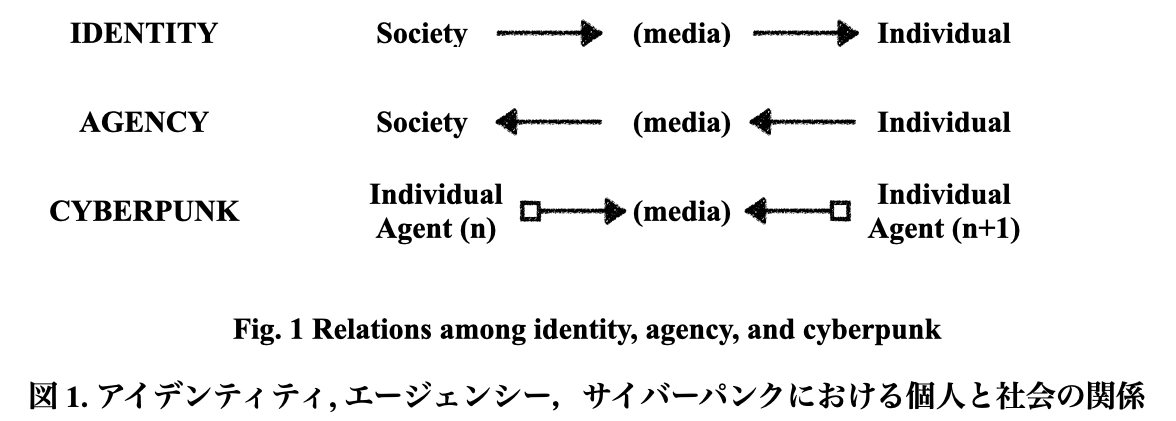
This paper analyzes the ethical and
unethical group-share characteristic (ethos) of Cyberpunk as a concept
of outlaw mutineer in cyberspace. The paper confirms the
characteristics of Cyberpunk as a way of resisting society, but argues
that rather than this being rooted in a concept of identity as a form
of social constraint, this has more to do with agency and a form of
social practice.
El ciberpunk (del original en
inglés cyberpunk y cuya pronunciación es /'saɪbəʳpʌŋk/) es
un subgénero de la ciencia ficción, conocido por reflejar visiones
distópicas del futuro en las cuales se combinan la tecnología avanzada
con un bajo nivel de vida en Cyberespacio.
Originalmente el término cyberpunk fue utilizado para referirse al
movimiento literario encabezado por Bruce Sterling, William Gibson y
John Shirley que surgió durante la década de 1980 en el seno de la
literatura de ciencia ficción,2 siendo empleado por primera vez en ese
sentido por Gardner Dozois en 1984. Dozois probablemente se inspiró en
el título de un relato de Bruce Bethke.2 El ciberpunk recibe su nombre
de la adjunción del prefijo ciber- (relacionado con redes
informáticas)4 al vocablo punk (en referencia a su carácter rebelde).
En él, la ciencia (y sobre todo la informática y la cibernética) suele
generar o interaccionar con algún tipo de cambio de paradigma social o
cultural. - El ciberpunk
- Abercrombie, Nicholas., Stephen Hill and Bryan S. Turner
eds.(1996) The Penguin dictionary of sociology. New York: Penguin.
=丸山哲央(監訳)『社会学中辞典』ミネルヴァ書房.
- Berger, Peter L. and Thomas Luckman (1967) The social construction of
reality: a treatise in the sociology of knowledge.
=(1977)山口節郎(訳)『日常世界の構成:アイデンティティと社会の弁証法』新曜社.
- Bourdieu, Pierre (1980) Le sens pratique. Paris: Éditions de Minuit.
=(1988, 1990)今村仁司・港道隆(訳)『実践感覚 1,2』みすず書房.
- Dawkins, Richard (1976)The Selfish Gene. Oxford: Oxford University
Press. =(2018)日高敏隆ほか(訳)『利己的な遺伝子』紀伊國屋書店.
- Durkheim, Émile (1919) Les règles de la méthode sociologique.
=(1978)宮島喬(訳)『社会学的方法の基準』岩波書店.
- Erikson, Erik (1959) Identity and the life cycle: selected papers.
New York International Universities
Press.=(1973)小此木啓吾(訳編)『自
我同一性―アイデンティティとライフ・サイクル』誠信書房.
- Escobar, Arturo. (1994) Welcome to Siberia: Notes on the Anthropology
of Cyberculture. Current Anthropology 35(3):211-231.
- Foucault, Michel (1966) Les Mots et les Choses. Paris:
Gallimard.=(1974)渡辺一民・佐々木明(訳)『言葉と物:人文科学の考古学』新潮社.
- Gibson, William. (1986) Neuromancer. New York: Ace
Book.=(1986)黒丸尚(訳)『ニューロマンサー』早川書房.
- ____________ (1987) Burning Chrome. New York: Ace
Book.=(1987)浅倉久志ほか(訳)『クローム襲撃』早川書房.
- ____________ (2014) Conversations with William Gibson.(Patrick A.
Smith ed).: Jackson: University Press of Mississippi.
- Giddens, Anthony (1995) Politics, sociology and social theory:
encounters with classical and contemporary social thought. Oxford:
Polity Press.
- Hall, Stuart and Paul du Gay eds. (1996) Questions of Cultural
Identity. London: SAGE.=(2000)
宇波彰(訳)『カルチュラル・アイデンティティの諸問題:誰がアイデンティティを必要とするのか?』大村書店.
- Halbwachs, Maurice (1968) La mémoire collective. Paris: Presses
universitaires de France.=(1989)小関藤一郎(訳)『集合的記憶』行路社.
- Hofstadter, Douglas R. and Daniel C. Dennett eds. (1981) The mind's I
: fantasies and reflections on self and soul. New York: Basic
Books.=(1992)坂本百大(監訳)『マインズ・アイ』TBSブリタニカ.
- Keniston, Kenneth (1971) Youth and dissent: the rise of a new
opposition. New York: Harcourt Brace Jovanovich.
=(1977)高田昭彦ほか(訳)『青年の異議申し立て』東京創元社.
- Kuhn, Thomas (1962) The structure of scientific revolutions. Chicago:
University of Chicago Press. =(1971)中山茂(訳)『科学革命の構造』みすず書房.
- Leary, Timothy (1977) Neuropolitics: the sociobiology of human
metamorphosis. Los Angeles: Starseed.
=(1989)山形浩生(訳)『神経政治学:人類変異の社会生物学』トレヴィル.
- Leech, Kenneth (1973) Youthquake: the growth of a counter-culture
through two decades. London : Sheldon Press.
- Lévi-Strauss, Claude(1958)Anthropologie structurale. Paris:
Plon.=(1972)荒川幾男ほか(訳)『構造人類学』みすず書房.
- McLuhan, Marshall (1962) The Gutenberg galaxy: the making of
typographic man. Toronto: University of Toronto Press.
=(1968)高儀進(訳)『グーテンベルクの銀河系』竹内書店.
- __________________ (1964) Understanding media: the extensions of man.
New York: McGraw-Hill. =(1967)後藤和彦・高儀進(訳)『人間拡張の原理:メディアの理解』竹内書店.
- Pietarinen, Juhani (Online) Hobbes, Conatus and the Prisoner's
Dilemma http://web.bu.edu/wcp/Papers/Mode/ModePiet.htm (Retrieved on
August 15, 2020)
- Spivak, Gayatri Chakravorty (1996) The Spivak reader : selected works
of Gayatri Spivak (Donna Landry and Gerald MacLean, eds.). London:
Routledge.
- Sterling, Bruce (1986) Preface, In Gibson, William "Neuromancer." New
York: Ace Book.
- _______________ (1993) Hacker crackdown : law and disorder on the
electronic frontier. New York: Penguin. =(1993)今岡清(訳)『ハッカーを追え!』アスキー.
- Wiener, Norbert (1947) Cybernetics : or control and communication in
the animal and the machine. New York: Wiley. =(1957),
池原止戈夫ほか(訳)『サイバネティックス:動物と機械における制御と通信』岩波書店.
- Wikipedia (online) Cyberspace.
https://en.wikipedia.org/wiki/Cyberspace (Retrieved on August 15, 2020)
- Wilson, Edward (1998) Consilience: The Unity of Knowledge. New York:
Knopf.=(2002) 山下篤子(訳)『知の挑戦:科学的知性と文化的知性の統合』角川書店.
 How Does Cyberpunk act [Un]-ethically ? [pdf]