Ethics of Care, gender free

ケアの倫理
Ethics of Care, gender free
解説:池田光穂
ケアの倫理(ethics of
care, care ethics)とは、ケアという実践活動の社会的属性(=社
会的性格)が、ジェンダーにより不均等配分されているのではないかという議論
から出発する、ケア
する役割の政治に関する議論のことである。したがって、ケアの倫理は、ケアする人は(ジェンダーへの着目を抜きにして)ケアをする人の倫理や道徳はこうである、ああであるとい
う議論ではない、ことに注意しなければならない。
そのなかで出発点となる重要な著作が、ギ リガン、キャロル, 1986『もうひとつの声』生田久美子・並木美智子訳、東京:川島書店(Gilligan, Carol., 1983. In a Different Voice. Cambridge, Mass.: Harverd University Press.)である。
キャロル・ギリガンは、ローレンス・コー ルバーグのジレンマに対する態度のジェンダー差から、これまで「道徳的ジレンマに関する」発達心理的態 度は、男性の発達プロセスを標準にして考えられているために、ギリガンがいうところの「ケアの倫理」とは、より劣った社会的に未熟な態度であるとみなされ る傾向があったと指摘する。コールバーグのジレンマとは次のようなものである。
「ハインツ氏は、妻が特殊ながんに罹患し、現在瀕死の状態である。彼女の主治医はある薬店で製造販売している非常に高価な薬(100万円) を摂るしかないという。その薬の原価(製造コスト)は販売価の1/10にすぎない。ハインツは、友人たちからお金を借りるなどして半分まで集めたが、購入 することができない。そのためハインツは薬店にかけこみ半額に値切るように依頼をした。しかし、薬店主は自分の努力によりこの製造方法を会得したので、半 額で売ることできないと断った。ハインツは悩んだ末に、その夜、薬屋に忍び込むことを決心した」、というものである。
コールバーグは、道徳性の発達の基準は、 以下のようなプロセスを経るという。まず自己中心主義(例:妻を見殺 しにすると社会的制裁をうけるので 盗むべきだ/盗むと警察に捕まってしまうので盗むべきではない)。つぎに社会的視点の 獲得(例:妻は薬を必要としているから盗みは正当化される/薬を盗ま ずに妻が死んでもお金が集まらなかったことは非難されるべきじゃない、従って、盗むという手段に訴える必要はない)。そして原理的な考察にいたるような視 点に至る(例:薬を盗むことと「生命(一般)を救うこと」は直結しているので、命を救うためには盗みはやむ終えない/ものを盗むことは一般的に反道徳的な 行為なので盗んではならない)。
コールバーグの結論は、最終的に女性は自
分の行動を正当化できないが、男性は行動の理由を説明できると結論づけているのである。これは、ジャ
ン・ピアジェの、女性は抽象的思考ができず、道徳の完成という規範化には至らないという断定と類似のような判断であると言える(ブルジェール
2014:28)。
ギリガンは、このような道徳性の発達性が 男性(男の子)を中心的モデルにしているために、ジレンマに直面した女性(女の子)の意見、すなわち, モデル形成から抜け落ちた「もうひとつの声(原題:a Different Voice)」に耳を傾け、そこから導きだせる、ジェンダーと結びついた(あるいはそのように訓育される)倫理観を「ケアの倫理」という形で定式化した。
ギリガンの被験者である、ジャックという
男の子は、刑務所に入ってもハインツは奥さんを救うために薬を盗むべきだと答える。他方、エイミーとい
う女の子は、盗むべきか/断念すべきかという問いの立て方に対して、薬剤師に話して緊急の事態であり、説得すべきだという問いが前提にする判断とは別のア
プローチを考案する(端的に言えば、それこそが関係性の倫理すなわち「ケアの倫理」だということができる)。ギリガンは、コールバーグの論理だと、エイ
ミーの判断は「社会的視点」から「原理的な考察」に至る段階で止まっているとするところが(コールバーグ自身の)
問題だとするのである。
ケアの倫理は、正義の倫理とは対極的な位 置にある。正義の倫理とは、裁判のようにさまざまな行動のタイプと、それに対する正当性を検討し、行動 とその行動に価値付けれたものに優先順位をつけるべきだと考えるものである。
したがって、ケアの倫理学とは、「ケアという実践活動の社 会的属性(=社会的性格)が、ジェンダーにより不均等配分されているのではないかという議論の学問」のことである。
それに対して、ケアの倫理は、ジレンマに ある複数の人たちの責任とそれらの関連性(ネットワーク)に着目し、状況(文脈)を踏まえたナラティブ な(contextual and narrative)思考様式で説明するものである。
この倫理は、ギリガンは女性(女の子)か らの資料収集からモデル化されたが、ジェンダー区分に必ず帰着するわけではなく、男性(男の子)もまた ケアの倫理を共有している——この意義を取り違えるとギリガンはセクシストと誤った理解を誘導することになる。そのため、正義の倫理とケアの倫理は、もち ろん共存可能だとギリガンは主張する(cf. 川本 2005:2-3)(→より詳しくは「ケア倫理の人類学」へ)。
だ が、ケアの倫理を中性化して男性にも分有できるようになると考えるのは早計である。社会(近代西洋社会)は、ジャックとエイミーにそれぞれ、そのように振 る舞うように社会化してきた可能性がある。そして、普遍的・合理的と思われるようなジャックの倫理的判断を、エイミーのような他者の幸福や相互扶助を導き だすような倫理よりも、より高度な位置に置いて、〈男性に都合のよい女性の道徳的行動を強いる支配〉を貫徹してきたのではないかという、これまでのジェン ダーの政治に関する歴史への反省を促してると、ギリガンの主張を受け止めることは重要である。これは「フェ ミニスト」アプローチへの第一歩である。
「フェミニストであることは、聞かれな
かった声を聞こえるようにする必要から始まる」——ファビエンヌ・ブルジェール(1913)Fabienne Brugère (1964- ).
Carol Gilligan on 'In A Different Voice'(2分14秒)
Carol Gilligan on Women and Moral Development(6分30秒)
■In a Different Voiceの章立て
ギ リガンは、また、女性の中絶の問題を分析して、彼女達がおかれた困難な状況のなかでどのようにして「他者への責任」をやりとげるのが、配慮としてのケアの 実現について考察する(ブルジェール 2014:32/Gilligan 1983:112-115[2008年の仏訳のページの可能性])。
ギリガンにとって「異なる/もうひとつの 声」とは、これまで押し殺されてきた女性の声である。「フェミニストであることは、聞かれなかった声を 聞こえるようにする必要から始まる」という(ブルジェール 2014:28)ということは、このような実践のことを差している。
+++++++++++++++++++++
★ウィキペディア(英語)におけるケアの倫理[ethics of care]
+++++++++++++++++++++☆ケアの倫理[ethics of care] (ケア・エシックス、またはEoCとも呼ばれる)は、道徳的行動の中心が対人関係と、美徳としてのケアや慈愛にあるとする規範的倫理学の理論である。 EoCは、1980年代以降、一部のフェミニストや環境保護活動家によって展開されてきた一連の規範的倫理学理論の一つである。[1] 結果主義や義務論的な倫理理論が一般化可能な基準や公平性を重視するのに対し、ケアの倫理は個人への対応の重要性を強調する。一般と個人の区別は、それぞ れの異なる道徳的問い、「何が正義か?」対「どう応答すべきか?」に反映されている[2]: 469。ケア倫理の創始者とされるキャロル・ギリガンは、一 般化された基準の適用を「道徳的盲目や無関心を助長するため、道徳的に問題がある」と批判した[2]: 471.この枠組みの前提には、以下の点が含まれる。すなわち、人は様々な程度の依存関係や相互依存関係にあると理解されること、自身の選択の結果に影響を受ける 他者は、その脆弱性に比例して配慮に値すること、そして状況の詳細が、個人の利益をいかに保護し促進するかを決定することである。[3]
1. Sander-Staudt, Maureen. "Care Ethics". The Internet Encyclopedia of Philosophy.
2. Gilligan,
Carol. "Moral Orientation and Moral Development". In Alison Bailey and
Chris J. Cuomo (eds.). The Feminist Philosophy Reader. Boston:
McGraw-Hill, 2008.
3. Sevenhuijsen, Selma (2003). "The Place of Care: The Relevance of the Feminist Ethic of Care for Social Policy". Feminist Theory. 4 (2): 179–197. doi:10.1177/14647001030042006
| The ethics of care
(alternatively care ethics or EoC) is a normative ethical theory that
holds that moral action centers on interpersonal relationships and care
or benevolence as a virtue. EoC is one of a cluster of normative
ethical theories that were developed by some feminists and
environmentalists since the 1980s.[1] While consequentialist and
deontological ethical theories emphasize generalizable standards and
impartiality, ethics of care emphasize the importance of response to
the individual. The distinction between the general and the individual
is reflected in their different moral questions: "what is just?" versus
"how to respond?"[2]: 469 Carol Gilligan, who is considered the
originator of the ethics of care, criticized the application of
generalized standards as "morally problematic, since it breeds moral
blindness or indifference".[2]: 471 Assumptions of the framework include: persons are understood to have varying degrees of dependence and interdependence; other individuals affected by the consequences of one's choices deserve consideration in proportion to their vulnerability; and situational details determine how to safeguard and promote the interests of individuals.[3] |
ケアの倫理[ethics of care]
(ケア・エシックス、またはEoCとも呼ばれる)は、道徳的行動の中心が対人関係と、美徳としてのケアや慈愛にあるとする規範的倫理学の理論である。
EoCは、1980年代以降、一部のフェミニストや環境保護活動家によって展開されてきた一連の規範的倫理学理論の一つである。[1]
結果主義や義務論的な倫理理論が一般化可能な基準や公平性を重視するのに対し、ケアの倫理は個人への対応の重要性を強調する。一般と個人の区別は、それぞ
れの異なる道徳的問い、「何が正義か?」対「どう応答すべきか?」に反映されている[2]: 469。ケア倫理の創始者とされるキャロル・ギリガンは、一
般化された基準の適用を「道徳的盲目や無関心を助長するため、道徳的に問題がある」と批判した[2]: 471 この枠組みの前提には、以下の点が含まれる。すなわち、人は様々な程度の依存関係や相互依存関係にあると理解されること、自身の選択の結果に影響を受ける 他者は、その脆弱性に比例して配慮に値すること、そして状況の詳細が、個人の利益をいかに保護し促進するかを決定することである。[3] |
| Historical background The originator of the ethics of care was Carol Gilligan, an American ethicist and psychologist. Gilligan created this model as a critique of her mentor, developmental psychologist Lawrence Kohlberg's model of moral development. Gilligan observed that measuring moral development by Kohlberg's stages of moral development found boys to be more morally mature than girls, and this result held for adults as well (although when education is controlled for there are no gender differences).[4] Gilligan argued that Kohlberg's model was not objective, but rather a masculine perspective on morality, founded on principles of justice and rights. In her 1982 book In a Different Voice, she further posited that men and women have tendencies to view morality in different terms. Her theory claimed women tended to emphasize empathy and compassion over the notions of morality in terms of abstract duties or obligations that are privileged in Kohlberg's scale.[5] Dana Ward stated, in an unpublished paper, that Kohlberg's scale is psychometrically sound.[6] Subsequent research suggests that the differences in care-based or justice-based ethical approaches may be due to gender differences, or differences in life situations of genders.[7][8][9] Gilligan's summarizing of gender differences provided feminists with a voice to question moral values and practices of the society as masculine. |
歴史的背景 ケアの倫理の提唱者は、アメリカの倫理学者であり心理学者であるキャロル・ギリガンである。ギリガンは、師である発達心理学者ローレンス・コールバーグの 道徳的発達段階論に対する批判として、このモデルを構築した。ギリガンは、コールバーグの道徳的発達段階論に基づいて道徳的発達を測定すると、男子の方が 女子よりも道徳的に成熟しているという結果が得られ、この傾向は成人においても同様であることが観察された(ただし、教育水準を調整した場合には、性差は 見られない)。[4] ギリガンは、コールバーグのモデルは客観的なものではなく、正義や権利の原則に基づいた、道徳に対する男性的な視点に過ぎないと主張した。1982年の著 書『異なる声』において、彼女はさらに、男性と女性では道徳を異なる観点から捉える傾向があると提唱した。彼女の理論によれば、女性は、コールバーグの尺 度で重視される抽象的な義務や責務といった道徳観念よりも、共感や思いやりを重視する傾向があるという。[5] ダナ・ウォードは未発表の論文において、コールバーグの尺度は心理測定学的に妥当であると述べた。[6] その後の研究では、ケアに基づく倫理的アプローチと正義に基づく倫理的アプローチの違いは、性差、あるいは男女の生活状況の違いに起因する可能性があるこ とが示唆されている。[7][8][9] ギリガンによる性差の総括は、フェミニストたちに、社会の道徳的価値観や慣行を「男性的」なものとして問い直すための発言権を与えた。 |
| Relationship to traditional ethical positions Care ethics is different from other ethical models, such as consequentialist theories (e.g. utilitarianism) and deontological theories (e.g. Kantian ethics), in that it seeks to incorporate traditionally feminine virtues and values which, proponents of care ethics contend, are absent in traditional models of ethics.[10] One of these values is the placement of caring and relationship over logic and reason. In care ethics, reason and logic are subservient to natural care, that is, care that is done out of inclination. This is in contrast to deontology, where actions taken out of inclination are unethical.[11] Virginia Held has noted the similarities between care ethics and virtue ethics but distinguished it from the virtue ethics of British moralists such as Hume in that people are seen as fundamentally relational rather than independent individuals.[12]: 221 Other philosophers have argued about the relation between care ethics and virtue ethics, taking various positions on the question of how closely the two are related.[1][13][14] Jason Josephson Storm argued for close parallels between the ethics of care and traditional Buddhist virtue ethics, especially the prioritization of compassion by Śāntideva and others.[15] Other scholars had also previously connected ethics of care with Buddhist ethics.[16][17] |
伝統的な倫理的立場との関係 ケア倫理は、結果主義的理論(例:功利主義)や義務論的理論(例:カント倫理学)といった他の倫理モデルとは異なり、ケア倫理の提唱者たちが、従来の倫理 モデルには欠けていると主張する、伝統的に女性的な美徳や価値観を取り入れようとする点で異なる。[10] こうした価値観の一つに、論理や理性よりも、思いやりや人間関係を重視するという点がある。ケア倫理学において、理性と論理は自然なケア、すなわち自発的 な気遣いに従属する。これは、自発的な行動を非倫理的とみなす義務論とは対照的である。[11] バージニア・ヘルドは、ケア倫理と徳倫理の類似点に言及しつつも、人間を独立した個人ではなく、根本的に関係性を持つ存在と見なす点において、ヒュームな どの英国の道徳家による徳倫理とは区別している。[12]: 221 他の哲学者たちも、ケア倫理と徳倫理の関係について議論し、両者がどれほど密接に関連しているかという問題について様々な立場をとっている。[1] [13][14] ジェイソン・ジョセフソン・ストームは、ケア倫理と伝統的な仏教の徳倫理、特にシャンティデーヴァらによる慈悲の優先順位付けとの間に密接な類似性がある と論じた。[15] 他の学者たちも以前から、ケア倫理と仏教倫理を結びつけていた。[16][17] |
| Care ethics as feminist ethics See also: Difference feminism While some feminists have criticized care-based ethics for reinforcing traditional gender stereotypes,[18] others have embraced parts of the paradigm under the theoretical concept of care-focused feminism.[19] Care-focused feminism, alternatively called gender feminism,[20] is a branch of feminist thought informed primarily by the ethics of care as developed by Carol Gilligan and Nel Noddings.[19] This theory is critical of how caring is socially engendered, being assigned to women and consequently devalued. "Care-focused feminists regard women's capacity for care as a human strength"[19] which can and should be taught to and expected of men as well as women. Noddings proposes that ethical caring could be a more concrete evaluative model of moral dilemma, than an ethic of justice.[21] Noddings' care-focused feminism requires practical application of relational ethics, predicated on an ethic of care.[22] Ethics of care is a basis for care-focused feminist theorizing on maternal ethics. These theories recognize caring as an ethically relevant issue.[23] Critical of how society engenders caring labor, theorists Sara Ruddick, Virginia Held, and Eva Feder Kittay suggest caring should be performed and care givers valued in both public and private spheres.[24] This proposed paradigm shift in ethics encourages the view that an ethic of caring be the social responsibility of both men and women. Joan Tronto argues that the definition of "ethic of care" is ambiguous due in part to it not playing a central role in moral theory.[25] She argues that considering moral philosophy is engaged with human goodness, then care would appear to assume a significant role in this type of philosophy.[25] However, this is not the case and Tronto further stresses the association between care and "naturalness". The latter term refers to the socially and culturally constructed gender roles where care is mainly assumed to be the role of the woman.[25] As a result, care loses the power to take a central role in moral theory. Tronto states there are four ethical qualities of care: 1. Attentiveness: Attentiveness is crucial to the ethics of care because care requires a recognition of others' needs in order to respond to them.[25] The question which arises is the distinction between ignorance and inattentiveness.[25] Tronto poses this question as follows: "But when is ignorance simply ignorance, and when is it inattentiveness?"[25] 2. Responsibility: In order to care, we must take responsibility ourselves. The problem associated with this second ethical element of responsibility is the question of obligation. Obligation is often tied to pre-established societal and cultural norms and roles. Tronto makes the effort to differentiate the terms "responsibility" and "obligation" concerning the ethic of care. Responsibility is ambiguous, whereas obligation refers to situations where action or reaction is due, such as the case of a legal contract.[25] This ambiguity allows for ebb and flow in and between class structures and gender roles, and to other socially constructed roles that would bind responsibility to those in such roles. 3. Competence: To provide care also requires competence. If one acknowledges the need to care and accepts responsibility but does not follow through adequately, the care needs will not be met.[25] 4. Responsiveness: This refers to the "responsiveness of the care receiver to the care".[25] Tronto states, "Responsiveness signals an important moral problem within care: by its nature, care is concerned with conditions of vulnerability and inequality."[25] She further argues that responsiveness does not equal reciprocity.[25] Rather, it is another method to understand vulnerability and inequality by understanding what has been expressed by those in the vulnerable position, as opposed to re-imagining oneself in a similar situation.[25] In 2013, Tronto added a fifth ethical quality: 5. Plurality, communication, trust and respect; solidarity or caring with: Together, these are the qualities necessary for people to come together in order to take collective responsibility, to understand their citizenship as always imbricated in relations of care, and to take seriously the nature of caring needs in society.[26] |
ケア倫理としてのフェミニスト倫理 関連項目:差異フェミニズム 一部のフェミニストは、ケアに基づく倫理が伝統的なジェンダーの固定観念を強化すると批判しているが[18]、一方で、ケア重視のフェミニズムという理論的概念の下で、このパラダイムの一部を受け入れている者もいる。[19] ケア重視フェミニズムは、ジェンダー・フェミニズムとも呼ばれ[20]、主にキャロル・ギリガンとネル・ノディングスが展開したケアの倫理に立脚したフェ ミニスト思想の一派である[19]。この理論は、ケアが社会的に性別に結びつけられ、女性に割り当てられ、その結果として軽視されている現状を批判してい る。「ケア重視フェミニストたちは、女性のケア能力を人間の強みと見なしている」[19]。これは、女性だけでなく男性に対しても教え、期待されるべきも のである。ノディングスは、倫理的ケアが、正義の倫理よりも、道徳的ジレンマに対するより具体的な評価モデルとなり得ると提唱している。[21] ノディングスのケア重視フェミニズムは、ケアの倫理を前提とした関係性倫理の実践的適用を必要とする。[22] ケアの倫理は、母性倫理に関するケア重視のフェミニスト理論の基盤である。これらの理論は、ケアを倫理的に重要な問題として認識している。[23] 社会がケア労働をどのように性役割化しているかを批判し、理論家のサラ・ラディック、バージニア・ヘルド、エヴァ・フェダー・キッタイは、ケアは公的領域 と私的領域の両方で行われ、ケア提供者は双方で評価されるべきであると提言している。[24] 倫理におけるこの提唱されたパラダイムシフトは、ケアの倫理が男女双方の社会的責任であるという見解を後押しする。 ジョーン・トロントは、「ケアの倫理」の定義が曖昧である理由の一つとして、それが道徳理論において中心的な役割を果たしていないことを挙げている。 [25] 彼女は、道徳哲学が人間の善性に関わるものであるとすれば、ケアはこの種の哲学において重要な役割を担うことになるはずだと論じている。[25] しかし、実際にはそうではなく、トロントはさらにケアと「自然性」との関連性を強調する。後者の用語は、ケアが主に女性の役割であると想定される、社会 的・文化的に構築されたジェンダー役割を指す。[25] その結果、ケアは道徳理論において中心的な役割を果たす力を失ってしまう。 トロントは、ケアには4つの倫理的資質があると述べている: 1. 注意深さ:ケアの倫理において注意深さは極めて重要である。なぜなら、ケアとは他者のニーズを認識し、それに応えることを必要とするからである。[25] ここで生じる疑問は、無知と不注意の区別である。[25] トロントはこの問いを次のように提示する。「しかし、無知はいつ単なる無知であり、いつ不注意となるのか?」[25] 2. 責任:ケアを行うためには、自ら責任を負わなければならない。この第二の倫理的要素である「責任」に関連する問題は、義務の問題である。義務はしばしば、 あらかじめ確立された社会的・文化的規範や役割と結びついている。トロントは、ケアの倫理に関して「責任」と「義務」という用語を区別しようと試みてい る。責任は曖昧であるのに対し、義務とは、法的契約の場合のように、行動や反応が求められる状況を指す。[25] この曖昧さにより、階級構造やジェンダーの役割、あるいは責任をその役割を担う者に結びつけるようなその他の社会的に構築された役割の間で、流動性が生ま れる。 3. 能力:ケアを提供するには、能力も必要だ。ケアの必要性を認め、責任を受け入れたとしても、それを十分に遂行できなければ、ケアのニーズは満たされない。[25] 4. 応答性:これは「ケアを受ける側のケアに対する応答性」を指す。[25] トロントは次のように述べている。「応答性は、ケアにおける重要な道徳的問題を示唆している。その性質上、ケアは脆弱性と不平等の状況に関わるものである。」[25] 彼女はさらに、応答性は相互性とは等しくないとも論じている。[25] むしろ、それは、自分が同様の状況に置かれたと想像し直すのではなく、脆弱な立場にある人々が何を表現しているかを理解することで、脆弱性と不平等を理解 するための別の方法である。[25] 2013年、トロントは5つ目の倫理的資質を追加した: 5. 多様性、コミュニケーション、信頼、尊重;連帯、あるいは「共にケアすること」:これらはすべて、人々が集い、集団的責任を担い、自らの市民性を常にケア の関係と密接に絡み合ったものとして理解し、社会におけるケアのニーズの本質を真剣に受け止めるために必要な資質である。[26] |
| In politics It is often suggested that the ethics of care is only applicable within families and groups of friends, but many feminist theorists have argued against this suggestion, including Ruddick, Manning, Held, and Tronto.[12]: 226 Attempts have been made to apply principles from the ethics of care more generally, by identifying values in one particular caring relationship and applying these values to other situations. Moral values are seen as embedded in acts of care.[12]: 220 The ethics of care is contrasted with theories based on the "liberal individual" and a social contract, following Locke and Hobbes. Ethics-of-care theorists note that in many situations, such as childhood, there are very large power imbalances between individuals, and so these relationships are based on care rather than any form of contract. Noting the power imbalances that can exist in society, it is argued that care may be a better basis to understand society than freedom and social contracts.[12]: 219–221 |
政治において ケアの倫理は家族や友人グループ内でのみ適用可能であるという見方がしばしば示されるが、ラディック、マニング、ヘルド、トロントをはじめとする多くの フェミニスト理論家は、この見解に異議を唱えてきた。[12]: 226 特定のケア関係における価値観を抽出し、それを他の状況に適用することで、ケアの倫理の原則をより一般的に適用しようとする試みがなされてきた。道徳的価 値は、ケアの行為の中に内在していると見なされている。[12]: 220 ケアの倫理は、ロックやホッブズに続く「自由主義的個人」や社会契約に基づく理論とは対照的である。ケア倫理の理論家たちは、幼少期など多くの状況におい て、個人間の力関係の不均衡が非常に大きいため、こうした関係は契約という形ではなく、ケアに基づいていると指摘する。社会に存在し得る力関係の不均衡に 留意し、自由や社会契約よりも、ケアの方が社会を理解するためのより良い基盤となり得ると論じられている。[12]: 219–221 |
| In Contemporary Art Care ethics has been applied to artistic practice, methodology, and institutional culture under the framework of Ethics of care in contemporary art. Rooted in the foundational work of Mierle Laderman Ukeles, whose Manifesto for Maintenance Art (1969) elevated everyday acts of maintenance, as cleaning, repairing, sustaining, to the status of artistic practice, ethics of care in the contemporary art foregrounds process over product, collective maintenance over individual authorship, and interdependence over creative autonomy[27][28]. These principles have since expanded into socially engaged art, participatory practice, community-based creation, and feminist institutional critique. [29][30] Texts and Critical Perspectives Visible: art as policies for care: socially engaged art 2010-ongoing : Book (2024, NERO Editions), edited by Martina Angelotti, Matteo Lucchetti and Judith Wielander, on socially engaged art (2010–ongoing), featuring projects by Tania Bruguera, Forensic Architecture, and Zanele Muholi, exploring art as a form of care policy in relation to social, political, and ecological issues.[29] From cultural feminism to the ethics of care : Call for papers (2023, Grenoble, France: Université Grenoble Alpes) for a conference on ecofeminist art, examining its development from the 1970s to the present, with a focus on cultural feminism and care ethics.[31] Radicalizing Care : Feminist and Queer Activism in Curating : Book (2021, Berlin, Germany: Sternberg Press) by Lesia Prokopenko, Nataša Petrešin-Bachelez, Edna Bonhomme and others, exploring how feminist and queer care ethics inform curatorial practices through essays, case studies, and manifestos.[32] What’s Love (or Care, Intimacy, Warmth, Affection) Got to Do with It? : Book (2017, Berlin, Germany: Sternberg Press & e-flux Books), with contributions by Paul Chan, Martha Rosler, Fred Moten and others, examining how care, intimacy, and desire have been addressed and theorized in socially engaged practices and writings since 2009.[33] |
現代美術において 「ケアの倫理」は、「現代美術におけるケアの倫理」という枠組みの下で、芸術的実践、方法論、そして制度的文化に応用されてきた。ミールレ・ラダーマン・ ウケレスの基礎的な業績に根ざしており、彼女の『メンテナンス・アートのマニフェスト』(1969年)は、清掃、修理、維持といった日常的なメンテナンス 行為を芸術的実践の地位にまで高めた。現代美術におけるケアの倫理は、作品よりもプロセスを、個人の作者性よりも集団的なメンテナンスを、創造的自律性よ りも相互依存性を前面に押し出している[27][28]。これらの原則はその後、社会参加型アート、参加型実践、コミュニティベースの創作、そしてフェミ ニスト的制度批判へと広がっていった。[29][30] テキストと批評的視点 『Visible: art as policies for care: socially engaged art 2010-ongoing』: 書籍(2024年、NERO Editions)、マルティナ・アンジェロッティ、マッテオ・ルケッティ、ジュディス・ヴィーランダー編。社会関与型アート(2010年~現在)に関す るもので、タニア・ブルゲラ、フォレンジック・アーキテクチャー、ザネレ・ムホリによるプロジェクトを特集し、社会的、政治的、生態学的問題に関連して、 ケア政策の一形態としてのアートを考察している。[29] 文化的フェミニズムからケアの倫理へ:論文募集(2023年、フランス・グルノーブル:グルノーブル・アルプ大学)。1970年代から現在に至るエコフェミニスト・アートの展開を、文化的フェミニズムとケアの倫理に焦点を当てて検証する会議に向けたもの。[31] 『ケアのラディカリゼーション:キュレーションにおけるフェミニスト・クィア・アクティビズム』:書籍(2021年、ドイツ・ベルリン: Sternberg Press)。レシア・プロコペンコ、ナターシャ・ペトレシン=バチェレズ、エドナ・ボンホームらによる。エッセイ、事例研究、マニフェストを通じて、 フェミニストおよびクィアのケア倫理がキュレーションの実践にどのように影響を与えているかを探求する。[32] 『愛(あるいはケア、親密さ、温もり、愛情)はそれと何の関係があるのか?』(2017年、ドイツ・ベルリン:Sternberg Press & e-flux Books)。ポール・チャン、マーサ・ロスラー、フレッド・モーテンらが寄稿し、2009年以降の社会関与型の実践や著作において、ケア、親密さ、欲望 がどのように扱われ、理論化されてきたかを検証している。[33] |
| In mental health Psychiatrist Kaila Rudolph noted that care ethics aligns with a trauma-informed care framework in psychiatry.[34] |
メンタルヘルスにおいて 精神科医のカイラ・ルドルフは、ケア倫理が精神医学におけるトラウマに配慮したケアの枠組みと一致していると指摘した。[34] |
| Criticism In the field of nursing, the ethics of care has been criticized by Peter Allmark, Helga Kuhse, and John Paley.[35] Allmark criticized its focus on the mental state of the carer, on the grounds that subjectively caring does not prevent an individual's care from being harmful.[35] Allmark also criticized the theory for conflicting with the idea of treating everyone with unbiased consideration, which he considered necessary in certain situations.[35] Care ethics has been criticised for failing to protect the individual from paternalism, noting there is a risk of caregivers mistaking their needs for those of the people they care for. Individuals may need to cultivate the ability to distinguish their own needs from those that they care for, with Ruddick arguing for a need to respect the "embodied willfulness" of those who are cared for.[12]: 226 |
批判 看護の分野において、ケアの倫理はピーター・オールマーク、ヘルガ・クーゼ、ジョン・ペイリーらによって批判されてきた。[35] オールマークは、主観的にケアを行っても、そのケアが個人に害を及ぼすことを防げないという理由から、ケアを行う者の精神状態に焦点を当てている点を批判 した。[35] またオールマークは、特定の状況下で必要不可欠であると彼が考える「すべての人を偏見なく配慮して扱う」という考え方と、この理論が矛盾している点につい ても批判した。[35] ケア倫理は、個人を父権主義から保護できていないとして批判されてきた。これは、介護者が自身のニーズを、介護対象者のニーズと混同してしまうリスクがあ ることを指摘したものである。個人は、自身のニーズと介護対象者のニーズを区別する能力を養う必要があるかもしれない。ラディックは、介護対象者の「身体 化された意志」を尊重する必要性を主張している。[12]: 226 |
| Altruism Ecofeminism Ethical relationship Feminist epistemology Feminist ethics Feminist justice ethics I and Thou Intersubjectivity Maternal-fetal conflict § Ethics of care and relational ethics Theorists Annette Baier Sandra Bartky Joan Callahan Carol Gilligan Virginia Held Sarah Hoagland Eva Feder Kittay Christine Koggel Nel Noddings Tove Pettersen Sara Ruddick Mary Lyndon Shanley Michael Slote Joan Tronto Margaret Urban Walker Robin West |
利他主義 エコフェミニズム 倫理的関係 フェミニスト認識論 フェミニスト倫理学 フェミニスト正義倫理学 「私」と「汝」 相互主観性 母体と胎児の葛藤 § ケアの倫理と関係性倫理 理論家 アネット・バイアー サンドラ・バーキー ジョーン・キャラハン キャロル・ギリガン バージニア・ヘルド サラ・ホアグランド エヴァ・フェダー・キッタイ クリスティン・コッゲル ネル・ノディングス トーヴェ・ペッテルセン サラ・ラディック メアリー・リンドン・シャンリー マイケル・スロート ジョーン・トロント マーガレット・アーバン・ウォーカー ロビン・ウェスト |
| References 01. Sander-Staudt, Maureen. "Care Ethics". The Internet Encyclopedia of Philosophy. ISSN 2161-0002. Retrieved June 4, 2022. Gilligan, Carol. "Moral Orientation and Moral Development". In Alison Bailey and Chris J. Cuomo (eds.). The Feminist Philosophy Reader. Boston: McGraw-Hill, 2008. Sevenhuijsen, Selma (2003). "The Place of Care: The Relevance of the Feminist Ethic of Care for Social Policy". Feminist Theory. 4 (2): 179–197. doi:10.1177/14647001030042006. ISSN 1464-7001. Walker, L.J. (1991). "Sex differences in moral reasoning". In W.M. Kurtines and J. L. Gewirtz (eds.) Handbook of moral behavior and development: Vol, 2. Research. Hillsdale, NJ: Erlbaum. Gilligan, Carol (1982). In a different voice: psychological theory and women's development. Cambridge, Massachusetts: Harvard University Press. ISBN 9780674445444. Ward, Dana (2000). "Still Hearing Voice: The Persistent Myth of Gendered Judgment". Keynote address presented at the VIIIth Biennial conference of the International Society for Justice Research, Rishon LeZion, Israel. Ford, M. R.; Lowery, C. R. (1986). "Gender Differences in Moral Reasoning: A Comparison of the Use of Justice and Care Orientations". Journal of Personality and Social Psychology. 50(4), 777–783. doi:10.1037/0022-3514.50.4.777 Rothbart, M. K.; et al. (1986). "Gender Differences in Moral Reasoning". Sex Roles. 15 (11&12), 645–653. doi:10.1007/BF00288220 Krebs, D.L.; Vermeulen, S.C.; Denton, K.; and Carpendale, J. I. (1994). "Gender and perspective differences in moral judgment and moral orientation". Journal of Moral Education. 23, 17–26. doi:10.1080/0305724940230102 10. Tong, Rosemarie; Williams, Nancy (May 4, 2009). "Feminist Ethics". Stanford Encyclopedia of Philosophy. The Metaphysics Research Lab. Retrieved January 6, 2017. Noddings, Nel (2013-09-14). Caring: a relational approach to ethics & moral education. Univ of California Press. ISBN 9780520957343. OCLC 859158671. Held, Virginia (2018). "The ethics of care". In Olsaretti, Serena (ed.). The Oxford handbook of distributive justice. Oxford, UK; New York, NY: Oxford University Press. pp. 213–234. doi:10.1093/oxfordhb/9780199645121.013.12. ISBN 978-0-19-964512-1. OCLC 1013820392. Sander-Staudt, Maureen (Fall 2006). "The unhappy marriage of care ethics and virtue ethics". Hypatia. 21 (4): 21–39. doi:10.1353/hyp.2006.0050. JSTOR 4640020. Steyl, Steven (Summer 2019). "The virtue of care". Hypatia. 34 (3): 507–526. doi:10.1111/hypa.12481. Storm, Jason Josephson (2021). Metamodernism: The Future of Theory. Chicago: University of Chicago Press. pp. 263–64. doi:10.7208/chicago/9780226786797.001.0001. ISBN 978-0-226-78665-0. OCLC 1200579878. White, Judith (May 1999). "Ethical comportment in organizations: a synthesis of the feminist ethic of care and the Buddhist ethic of compassion". International Journal of Value-Based Management. 12 (2): 109–128. doi:10.1023/A:1007779604630. Chang, Dave; Bai, Heesoon (January 2016). "Self-with-other in teacher practice: a case study through care, Aristotelian virtue, and Buddhist ethics". Ethics and Education. 11 (1): 17–28. doi:10.1080/17449642.2016.1145491. Bartky, Sandra Lee (1990). Femininity and domination: studies in the phenomenology of oppression. New York: Routledge. pp. 104–105. ISBN 9780415901864. 20. Tong, Rosemarie (2009). Feminist Thought: A More Comprehensive Introduction (3rd ed.). Boulder, Colo.: Westview Press. pp. 162–65. ISBN 978-0-81-334375-4. Tong, Rosemarie (2018). Feminist Thought: A More Comprehensive Introduction (Student economy edition, 4th ed.). Routledge. ISBN 978-0-81-335023-3. Noddings, Nel (1984). Caring: A Feminine Approach to Ethics and Moral Education. Berkeley: University of California Press. pp. 3–4. ISBN 9780520275706. Noddings, Nel (1989). Women and Evil. Berkeley: University of California Press. p. 222. ISBN 9780520074132. Held, Virginia. Ethics of Care, page 64. Oxford University Press, Oxford, 2006. Kittay, Eva Feder: Love's Labor: Essays on Women, Equality and Dependency, page 20. Routledge, New York, 1999. Tronto, Joan C. (2005), "An ethic of care", in Cudd, Ann E.; Andreasen, Robin O. (eds.), Feminist theory: a philosophical anthology, Oxford, UK Malden, Massachusetts: Blackwell Publishing, pp. 251–263, ISBN 9781405116619. Tronto, Joan (2013). Caring Democracy: Markets, Equality, and Justice. New York: New York University Press. ISBN 9780814782781. Johnson , Allison. 2022. Radical Care as Social Action: Mierle Laderman Ukeles' Manifesto and Maintenance Art. Master's thesis, Harvard University Division of Continuing Education. "High Maintenance: The Sanitation Aesthetics of Mierle Laderman Ukeles", Social Works, Routledge, pp. 85–113, 2011-02-21, ISBN 978-0-429-23946-5, retrieved 2026-02-25 Angelotti, Martina; Lucchetti, Matteo; Wielander, Judith, eds. (2024). Visible: art as policies for care: socially engaged art 2010-ongoing. Rome: Nero. ISBN 978-88-8056-281-8. 30. Fokianaki, iLiana (2020). "The Bureau of Care: introductory notes on the care-less and care-full". e-flux journal (113): 55–62. "From cultural feminism to the ethics of care". calenda.org. April 12, 2023. doi:10.58079/1axi. Retrieved 2026-03-24. Krasny, Elke; Lingg, Sophie; Fritsch, Lena; Bosold, Birgit; Hofmann, Vera, eds. (2021). Radicalizing care: feminist and queer activism in curating. Publication series of the Academy of Fine Arts Vienna. Berlin] : [Vienna: Sternberg Press ; Akademie der bildenden Künste Wien. ISBN 978-3-95679-590-9. Chan, Paul; Čuchrov, Keti; Engel, Antke (2017). What's love (or care, intimacy, warmth, affection) got to do with it?. e-flux journal. Berlin: Sternberg Press. ISBN 978-3-95679-267-0. Rudolph, Kaila (2021). "Ethical Considerations in Trauma-Informed Care". Psychiatric Clinics of North America. 44 (4): 521–535. doi:10.1016/j.psc.2021.07.001. PMID 34763786. 35. Edwards, Steven D. (2009). "Three versions of an ethics of care". Nursing Philosophy. 10 (4): 231–240. doi:10.1111/j.1466-769X.2009.00415.x. PMID 19743967. |
参考文献 01. モーリーン・サンダー=シュタウト。「ケア倫理」。『インターネット哲学百科事典』。ISSN 2161-0002。2022年6月4日閲覧。 キャロル・ギリガン。「道徳的志向と道徳的発達」。アリソン・ベイリー、クリス・J・クオモ(編)。『フェミニスト哲学読本』。ボストン:マグロウヒル、2008年。 セブンホイセン、セルマ(2003)。「ケアの場所:社会政策におけるフェミニスト的ケア倫理の意義」。『フェミニスト・セオリー』。4 (2): 179–197。doi:10.1177/14647001030042006. ISSN 1464-7001. ウォーカー、L.J. (1991). 「道徳的推論における性差」。W.M. カーティネスおよびJ. L. ゲウィルツ(編)『道徳的行動と発達ハンドブック:第2巻。研究』所収。ニュージャージー州ヒルズデール:Erlbaum. ギリガン、キャロル (1982). 『異なる声:心理学理論と女性の発達』. マサチューセッツ州ケンブリッジ:ハーバード大学出版局. ISBN 9780674445444. ウォード、ダナ (2000). 「依然として聞こえる声:ジェンダーに基づく判断という根強い神話」. イスラエル、リション・レツィオンで開催された国際正義研究学会第8回隔年会議における基調講演。 フォード、M. R.;ロウリー、C. R. (1986). 「道徳的推論における性差:正義志向とケア志向の活用の比較」。『パーソナリティ・アンド・ソーシャル・サイコロジー・ジャーナル』。50(4)、 777–783。doi:10.1037/0022-3514.50.4.777 ロスバート, M. K.; 他 (1986). 「道徳的推論における性差」. 『セックス・ロール』. 15 (11&12), 645–653. doi:10.1007/BF00288220 クレブス, D.L.; ヴェルムールン, S.C.; デントン, K.; カーペンデール, J. I. (1994). 「道徳的判断と道徳的志向における性差および視点の差異」. 『道徳教育ジャーナル』. 23, 17–26. doi:10.1080/0305724940230102 10. Tong, Rosemarie; Williams, Nancy (2009年5月4日). 「フェミニスト倫理学」. 『スタンフォード哲学百科事典』. The Metaphysics Research Lab. 2017年1月6日閲覧。 ノディングス、ネル(2013年9月14日)。『ケアリング:倫理と道徳教育への関係的アプローチ』。カリフォルニア大学出版局。ISBN 9780520957343。OCLC 859158671。 ヘルド、バージニア(2018年)。「ケアの倫理」。オルサレッティ、セレナ(編)。『分配的正義のオックスフォード・ハンドブック』. オックスフォード(英国);ニューヨーク(NY):オックスフォード大学出版局. pp. 213–234. doi:10.1093/oxfordhb/9780199645121.013.12. ISBN 978-0-19-964512-1. OCLC 1013820392. サンダー=シュタウト、モーリーン(2006年秋)。「ケア倫理と徳倫理の不幸な結婚」。『ヒュパティア』。21巻4号:21–39頁。doi:10.1353/hyp.2006.0050。JSTOR 4640020。 ステイル、スティーブン(2019年夏)。「ケアの美徳」。『ヒパティア』。34 (3): 507–526. doi:10.1111/hypa.12481. ストーム、ジェイソン・ジョセフソン(2021年)。『メタモダニズム:理論の未来』. シカゴ:シカゴ大学出版局. pp. 263–64. doi:10.7208/chicago/9780226786797.001.0001. ISBN 978-0-226-78665-0. OCLC 1200579878. ホワイト、ジュディス(1999年5月)。「組織における倫理的行動:フェミニストのケア倫理と仏教の慈悲倫理の統合」。 『International Journal of Value-Based Management』。12 (2): 109–128. doi:10.1023/A:1007779604630. チャン、デイブ;ペイ、ヒスン(2016年1月)。「教師の実践における『他者と共に在る自己』:ケア、アリストテレス的徳、および仏教倫理 を通じた事例研究」。『Ethics and Education』。11 (1): 17–28. doi:10.1080/17449642.2016.1145491. バートキー、サンドラ・リー(1990年)。『女性性と支配:抑圧の現象学に関する研究』。ニューヨーク:ラウトリッジ。pp. 104–105。ISBN 9780415901864。 20. トン、ローズマリー(2009年)。『フェミニスト思想:より包括的な入門』(第3版)。コロラド州ボルダー:ウェストビュー・プレス。pp. 162–65。ISBN 978-0-81-334375-4。 トン、ローズマリー(2018)。『フェミニスト思想:より包括的な入門』(学生向け廉価版、第4版)。ラウトリッジ。ISBN 978-0-81-335023-3。 ノディングス、ネル(1984)。『ケアリング:倫理と道徳教育への女性的アプローチ』。バークレー:カリフォルニア大学出版局。pp. 3–4。ISBN 9780520275706。 ノディングス、ネル(1989)。『女性と悪』。バークレー:カリフォルニア大学出版局。p. 222。ISBN 9780520074132. ヘルド、バージニア。『ケアの倫理』、64ページ。オックスフォード大学出版局、オックスフォード、2006年。 キッタイ、エヴァ・フェダー:『愛の労働:女性、平等、依存に関するエッセイ』、20ページ。ラウトリッジ、ニューヨーク、1999年。 トロント、ジョアン・C. (2005)、「ケアの倫理」、カッド、アン・E.;アンドレアセン、ロビン・O.(編)、『フェミニスト理論:哲学アンソロジー』、オックスフォード (英国)、マールデン(マサチューセッツ州):ブラックウェル・パブリッシング、pp. 251–263、ISBN 9781405116619。 トロント、ジョアン(2013)。『ケアリング・デモクラシー:市場、平等、そして正義』。ニューヨーク:ニューヨーク大学出版局。ISBN 9780814782781。 ジョンソン、アリソン。2022。「社会行動としてのラディカル・ケア:ミール・ラダーマン・ウケレスのマニフェストとメンテナンス・アート」。修士論文、ハーバード大学継続教育学部。 「ハイ・メンテナンス:ミアール・ラダーマン・ウケレスの衛生美学」、『Social Works』、Routledge、pp. 85–113、2011年2月21日、ISBN 978-0-429-23946-5、2026年2月25日閲覧 アンジェロッティ、マルティナ;ルケッティ、マッテオ;ヴィーランダー、ジュディス編(2024)。『Visible: art as policies for care: socially engaged art 2010-ongoing』。ローマ:ネロ。ISBN 978-88-8056-281-8。 30. フォキアナキ、イリアナ(2020)。「ケア局:ケアレスとケアフルに関する序説」。e-flux journal (113): 55–62. 「文化的フェミニズムからケアの倫理へ」。calenda.org。2023年4月12日。doi:10.58079/1axi。2026年3月24日閲覧。 クラスニー、エルケ;リング、ソフィー;フリッチュ、レナ;ボゾルト、ビルギット;ホフマン、ヴェラ、編(2021)。『ケアのラディカリゼーション: キュレーションにおけるフェミニストおよびクィア・アクティビズム』。ウィーン美術アカデミー出版シリーズ。ベルリン]:[ウィーン:スターンバーグ・プ レス;アカデミー・デア・ビルデンデン・クンスト・ヴィーン。ISBN 978-3-95679-590-9. チャン、ポール;チュクロフ、ケティ;エンゲル、アントケ(2017年)。『愛(あるいはケア、親密さ、温かさ、愛情)はそれと何の関係があ るのか?』。e-flux journal。ベルリン:Sternberg Press。ISBN 978-3-95679-267-0。 ルドルフ、カイラ(2021)。「トラウマに配慮したケアにおける倫理的考察」。『Psychiatric Clinics of North America』。44 (4): 521–535. doi:10.1016/j.psc.2021.07.001. PMID 34763786. 35. エドワーズ、スティーブン・D. (2009). 「ケアの倫理の3つの形態」. 『Nursing Philosophy』. 10 (4): 231–240. doi:10.1111/j.1466-769X.2009.00415.x. PMID 19743967. |
| Further reading Fieser, James; Dowden, Bradley (eds.). "Care Ethics". Internet Encyclopedia of Philosophy. ISSN 2161-0002. OCLC 37741658. Gilligan, Carol (1982). In a different voice: psychological theory and women's development. Cambridge, Massachusetts: Harvard University Press. ISBN 9780674445444. Held, Virginia (2005). The ethics of care. Oxford: Oxford University Press. doi:10.1093/0195180992.001.0001. ISBN 9780195180992. Held, Virginia (1993). Feminist morality: transforming culture, society, and politics. Chicago: University of Chicago Press. ISBN 9780226325934. Jagger, Alison (1995), "Caring as a feminist practice of moral reason", in Virginia, Held (ed.), Justice and care: essential readings in feminist ethics, Boulder, Colorado: Westview Press, ISBN 9780813321622. Noddings, Nel (2005). Educating citizens for global awareness. New York: Teachers College Press. ISBN 9780807745342. Slote, Michael A. (2007). The ethics of care and empathy. London; New York: Routledge. ISBN 978-0-415-77200-6. Tronto, Joan C. (September 2012). "Partiality based on relational responsibilities: another approach to global ethics". Ethics and Social Welfare. 6 (3): 303–316. doi:10.1080/17496535.2012.704058. S2CID 143230526. |
参考文献 Fieser, James; Dowden, Bradley (編). 「ケア倫理」. 『インターネット哲学百科事典』. ISSN 2161-0002. OCLC 37741658. ギリガン、キャロル(1982)。『異なる声:心理学理論と女性の発達』。マサチューセッツ州ケンブリッジ:ハーバード大学出版局。ISBN 9780674445444。 ヘルド、バージニア(2005)。『ケアの倫理』。オックスフォード:オックスフォード大学出版局。doi:10.1093/0195180992.001.0001. ISBN 9780195180992. ヘルド、バージニア(1993)。『フェミニスト道徳:文化、社会、政治の変革』。シカゴ:シカゴ大学出版局。ISBN 9780226325934。 ジャガー、アリソン(1995)、「道徳的理性のフェミニスト的実践としてのケア」、バージニア・ヘルド(編)、『正義とケア:フェミニスト倫理学の必読文献』所収、コロラド州ボルダー:ウェストビュー・プレス、ISBN 9780813321622。 ノディングス、ネル(2005)。『グローバルな意識を持つ市民の育成』。ニューヨーク:ティーチャーズ・カレッジ・プレス。ISBN 9780807745342. スロート、マイケル・A. (2007). 『ケアと共感の倫理』. ロンドン; ニューヨーク: ラウトリッジ. ISBN 978-0-415-77200-6. トロント、ジョアン・C. (2012年9月). 「関係的責任に基づく偏り:グローバル倫理へのもう一つのアプローチ」。『Ethics and Social Welfare』6巻3号:303–316頁。doi:10.1080/17496535.2012.704058. S2CID 143230526. |
| https://en.wikipedia.org/wiki/Ethics_of_care |
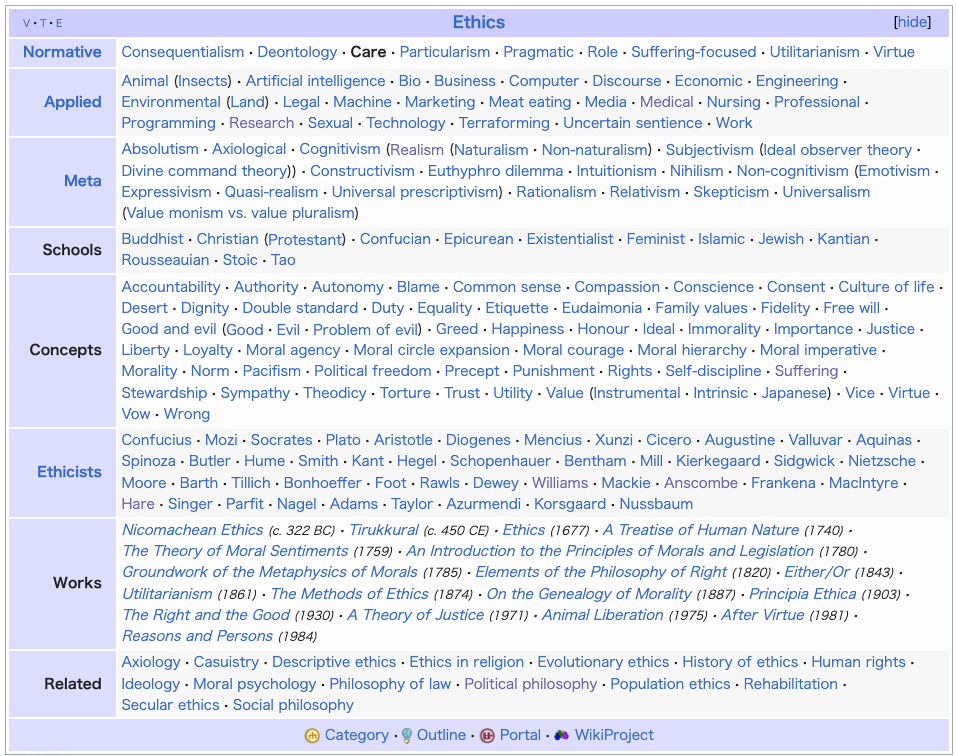
☆ウィキペディア「倫理」の項目エントリー一覧
■クレジット:池田光穂「ケアの倫理」
「ケアの倫理学」(これは「医療人類学辞典」)
の項目のひとつでもある。
★ギリガンさんはこんなひと
★キャロル・ギリガン(/ˈɡɡən/、1936年11月28日生まれ)は、アメリカのフェ
ミニスト、倫理学者、心理学者であり、倫理的共同体と倫理的人間関係についての研究で最もよく知られている。
ギリガンはニューヨーク大学の人文科学と応用心理学の教授であり、2009年までケンブリッジ大学のジェンダー研究センターとジーザス・カレッジの客員教
授を務めた。ローレンス・コールバーグの道徳的発達段階を批判した著書『異なる声で』(1982年)で知られる。
1996年、『タイム』誌は彼女をアメリカで最も影響力のある25人の人々に選んだ[1]。 彼女はケアの倫理学の創始者とみなされている。
| Carol Gilligan
(/ˈɡɪlɪɡən/; born November 28, 1936) is an American feminist, ethicist,
and psychologist best known for her work on ethical community and
ethical relationships. Gilligan is a professor of Humanities and Applied Psychology at New York University and was a visiting professor at the Centre for Gender Studies and Jesus College at the University of Cambridge until 2009. She is known for her book In a Different Voice (1982), which criticized Lawrence Kohlberg's stages of moral development. In 1996, Time magazine listed her among America's 25 most influential people.[1] She is considered the originator of the ethics of care. |
キャロル・ギリガン(/ˈɡɡən/、1936年11月28日生まれ)
は、アメリカのフェミニスト、倫理学者、心理学者であり、倫理的共同体と倫理的人間関係についての研究で最もよく知られている。 ギリガンはニューヨーク大学の人文科学と応用心理学の教授であり、2009年までケンブリッジ大学のジェンダー研究センターとジーザス・カレッジの客員教 授を務めた。ローレンス・コールバーグの道徳的発達段階を批判した著書『異なる声で』(1982年)で知られる。 1996年、『タイム』誌は彼女をアメリカで最も影響力のある25人の人々に選んだ[1]。 彼女はケアの倫理学の創始者とみなされている。 |
| Background and family life Carol Gilligan was raised in a Jewish family in New York City.[2] She was the only child of a lawyer, William Friedman, and nursery school teacher, Mabel Caminez. She attended the public Hunter Model School and the Walden School,[3] a progressive private school on Manhattan's Upper West Side and played piano. Gilligan received her B.A. summa cum laude in English literature from Swarthmore College, a master's degree in clinical psychology from Radcliffe College, and a Ph.D. in social psychology from Harvard University[4] where she wrote her doctoral dissertation "Responses to Temptation: An Analysis of Motives".[5] Disillusioned by academia, Gilligan left academia to pursue a career in modern dance.[3] She is married to James Gilligan, M.D., who directed the Center for the Study of Violence at Harvard Medical School.[6] Together, James and Carol had three children: Jonathan, Timothy, and Christopher. Jonathan Gilligan is a professor of Earth and Environmental Sciences and professor of Civil and Environmental Engineering at Vanderbilt University. Jonathan has also collaborated with his mother, to write the play The Scarlet Letter (a feminist adaptation of Hawthorne's novel) and the libretto for the opera Pearl.[7] Timothy Gilligan is the vice-chair for Education and associate professor of medicine at the Cleveland Clinic Taussig Cancer Institute.[8] Christopher Gilligan is the Associate Chief Medical Officer of Brigham and Women's Hospital and Director of the Brigham and Women's Spine Center. |
生い立ちと家庭生活 キャロル・ギリガンは、ニューヨークのユダヤ人家庭で育った[2]。 弁護士のウィリアム・フリードマンと保育士のメイベル・カミネスの間の一人っ子だった。公立のハンター・モデル・スクールとマンハッタンのアッパー・ウエ スト・サイドにある進歩的な私立学校ウォルデン・スクール[3]に通い、ピアノを弾いていた。 ギリガンはスワースモア大学で英文学の学士号を首席で取得し、ラドクリフ大学で臨床心理学の修士号を、ハーバード大学で社会心理学の博士号を取得した [4]: 学問の世界に幻滅したギリガンは、モダンダンスのキャリアを追求するために学問の世界を去った[3]。 彼女は、ハーバード大学医学部で暴力研究センターを指揮したジェームズ・ギリガン医学博士と結婚した[6]。 ジェームズとキャロルの間には3人の子供がいる: ジョナサン、ティモシー、クリストファーである。ジョナサン・ギリガンはヴァンダービルト大学の地球環境科学および土木環境工学の教授である。ジョナサン は母親と共同で、ホーソーンの小説をフェミニスト的に脚色した戯曲『緋文字』やオペラ『パール』の台本も執筆している[7]。ティモシー・ギリガンはク リーブランド・クリニックのタウシッグ癌研究所で教育担当副委員長兼医学部准教授を務めている[8]。クリストファー・ギリガンはブリガム・アンド・ウィ メンズ病院の副医長兼ブリガム・アンド・ウィメンズ脊椎センター長。 |
| Career She began her teaching career as a lecturer at the University of Chicago (where her husband was a medical intern) from 1965 to 1966, teaching the Introduction to Modern Social Science. She then became a lecturer at Harvard University in 1967, lecturing on General Education. After becoming an assistant professor in the Harvard Graduate School of Education in 1971, she received tenure there in 1988 as a full professor. Gilligan taught for two years at the University of Cambridge (from 1992 to 1994) as the Pitt Professor of American History and Institutions and as a visiting professorial fellow in the Social and Political Sciences. In 1997, she became Patricia Albjerg Graham Chair in Gender Studies at Harvard.[4] From 1998 until 2001, she was a Visiting Meyer Professor and later visiting professor at New York University School of Law. Gilligan eventually left Harvard in 2002 to join New York University as a full professor with the School of Education and the School of Law. She was also a visiting professor at the University of Cambridge in the Centre for Gender Studies[9] from 2003 until 2009. Gilligan studied women's psychology and girls' development and co-authored or edited a number of texts with her students.[9] She contributed the piece "Sisterhood Is Pleasurable: A Quiet Revolution in Psychology" to the 2003 anthology Sisterhood Is Forever: The Women's Anthology for a New Millennium, edited by Robin Morgan.[10] She published her first novel, Kyra, in 2008.[11][12] In 2015, Gilligan taught for a semester at New York University in Abu Dhabi.[13] |
経歴 1965年から1966年までシカゴ大学(夫が研修医だった)で講師を務め、「現代社会科学入門」を教えた。その後、1967年にハーバード大学の講師と なり、一般教養を教えた。1971年にハーバード大学教育大学院の助教授となった後、1988年に同大学で終身教授となった。1992年から1994年ま での2年間、ケンブリッジ大学でアメリカ史・制度学のピット教授および社会・政治科学の客員教授として教鞭をとった。1998年から2001年までニュー ヨーク大学法学部の客員マイヤー教授、後に客員教授を務めた。 最終的にギリガンは2002年にハーバードを去り、ニューヨーク大学の教育学部と法学部の正教授となった。また、2003年から2009年までケンブリッ ジ大学ジェンダー研究センター[9]の客員教授を務めた。 ギリガンは女性心理学と女児の発達を研究し、学生たちと多くのテキストを共著または編集した[9]: 2003年のアンソロジー『Sisterhood Is Forever』に「A Quiet Revolution in Psychology」を寄稿している: 10]2008年に処女小説『Kyra』を出版した[11][12]。2015年、ギリガンはアブダビのニューヨーク大学で1学期教えた[13]。 |
| Psychology Gilligan is known for her work with Lawrence Kohlberg on his stages of moral development as well as her criticism of his approach to the stages. As his research assistant, Gilligan argued that Kohlberg's stages were male-oriented, which limited their ability to be generalized to females. In an article where Gilligan revisited In a Different Voice, she commented: I entered the conversation about women and morality in the late 1960s, a time in the U.S. that witnessed a convergence of the civil rights movement, the anti-war movement, the movement to stop atmospheric testing of nuclear weapons, the movement to end poverty, the women's movement, and the gay liberation movement. I was teaching at Harvard with Erik Erikson, a psychoanalyst working in the Freudian tradition, and Lawrence Kohlberg, a cognitive-developmental psychologist working in the tradition of Piaget. To all these men—Freud and Erikson, Piaget and Kohlberg—women appeared deficient in development.[14] Gilligan proposed her theory of stages of female moral development based on her idea of moral voices. According to Gilligan, there are two kinds of moral voices: that of the masculine and the feminine. The masculine voice is "logical and individualistic",[15] meaning that the emphasis in moral decisions is protecting the rights of people and making sure justice is upheld. The feminine voice places more emphasis on protecting interpersonal relationships and taking care of other people. This voice focuses on the "care perspective",[16] which means focusing on the needs of the individual in order to make an ethical decision. For Gilligan, Kohlberg's stages of moral development were emphasizing the masculine voice, making it difficult to accurately gauge a woman's moral development because of this incongruity in voices. Gilligan argues that androgyny, or integrating the masculine and the feminine, is the best way to realize one's potential as a human. Gilligan's stages of female moral development has been shown in business settings as an explanation to the different ways men and women handle ethical issues in the workplace as well.[17] Gilligan developed her own stages of moral development with the idea that women make moral and ethical decision based on how they will affect others in mind. She followed Kohlberg's stages of preconventional, conventional, and postconventional morality, but she based these upon her research with women rather than men, a major advance in psychological theory.[16] These three stages also have two transitions between the three steps of morality. The first stage is pre-conventional morality. This stage revolves around self-interest and survival. When a conflict arises between the needs of oneself and the needs of others, a woman will choose her own needs first. Transition number one states that during this transition, a woman realizes her responsibility for others and that she could have previously been thinking selfishly. The second stage of three is conventional morality. This stage revolves around being selfless and prioritizing care for others. A woman realizes the needs of others and cares for them over herself, leading to self-sacrifice. After the second stage is the second of the two transitions. Transition two states that during the second transition, a woman realizes her needs are just as important as the needs of others. She realizes she must balance the needs of herself and the needs of others. This is a shift from "goodness" to "truth" as she honestly assesses the needs of each, not just as a responsibility. Finally, the third stage is post-conventional morality. This stage involves women paying attention to how their actions affect others, and taking responsibility for those consequences, good and bad. Women also take control of their own lives and show strong care for others. Here, a woman realizes the needs of herself are just as important as the needs of others, thus leading to the universal ethic of care and concern. In a Different Voice by Gilligan goes deeper into her criticism of Kohlberg and the moral development stages of women, and was one of the accomplishments that put her at the forefront of the feminist movement.[18] |
心理学 ギリガンは、ローレンス・コールバーグとともに道徳性の発達段階を研究したことで知られている。彼の研究助手だったギリガンは、コールバーグの段階は男性 中心であり、女性に一般化するには限界があると主張した。ギリガンは『異なる声の中で』を再考した記事の中で、次のようにコメントしている: 公民権運動、反戦運動、核兵器の大気圏実験を止める運動、貧困をなくす運動、女性運動、同性愛者の解放運動が収束した時期である。私はハーバード大学で、 フロイトの伝統を受け継ぐ精神分析学者エリック・エリクソンと、ピアジェの伝統を受け継ぐ認知発達心理学者ローレンス・コールバーグとともに教鞭をとって いた。フロイトとエリクソン、ピアジェとコールバーグ、これらすべての男性にとって、女性は発達において欠落しているように見えた[14]。 ギリガンは、道徳的な声という考えに基づいて、女性の道徳的発達の段階についての理論を提唱した。ギリガンによれば、道徳的な声には男性的な声と女性的な 声の2種類がある。男性的な声は「論理的で個人主義的」であり[15]、道徳的な決定において重視されるのは、人々の権利を守り、正義が守られるようにす ることである。女性的な声は、対人関係を守り、人々の世話をすることに重きを置く。この声は「ケアの視点」[16]に重点を置いており、倫理的決定を下す ために個人のニーズに焦点を当てることを意味する。ギリガンにとって、コールバーグの道徳的発達段階は男性的な声を強調しており、この声の不調和のために 女性の道徳的発達を正確に測定することを困難にしていた。ギリガンは、アンドロジニー、つまり男性性と女性性を統合することが、人間としての可能性を実現 する最善の方法であると主張している。ギリガンの女性の道徳的発達段階は、男女が職場で倫理的問題に対処する方法が異なることの説明として、ビジネスの場 面でも示されている[17]。 ギリガンは、女性は他者にどのような影響を与えるかを念頭において道徳的・倫理的決定を下すという考えに基づいて、独自の道徳的発達段階を開発した。彼女 はコールバーグの前伝統的道徳性、慣習的道徳性、後伝統的道徳性の段階を踏襲したが、男性ではなく女性を対象とした研究に基づいており、心理学理論におけ る大きな進歩である[16]。これらの3つの段階には、道徳性の3つの段階の間に2つの移行期もある。 最初の段階は、前伝統的道徳である。この段階は自己利益と生存を中心に展開する。自分の欲求と他者の欲求の間で葛藤が生じたとき、女性はまず自分の欲求を 選択する。第1移行期では、この移行期に女性は他者への責任を自覚し、以前は利己的に考えていたかもしれないと述べている。番目の段階は、従来の道徳であ る。この段階は、無私であること、他人への配慮を優先することを中心に展開する。女性は他人の必要性に気づき、自分よりも他人を気遣い、自己犠牲に至る。 第2段階の後は、2つの移行期のうちの2つ目である。第2移行期では、女性は自分のニーズが他人のニーズと同じくらい重要であることに気づく。自分のニー ズと他者のニーズのバランスを取らなければならないことに気づくのだ。これは、彼女が責任としてだけでなく、それぞれのニーズを正直に評価することで、 「善 」から 「真実 」への転換である。最後に、第3段階はポスト型道徳である。この段階では、女性は自分の行動が他人にどのような影響を与えるかに注意を払い、善悪を問わず その結果に責任を持つ。また、女性は自分自身の人生をコントロールし、他者への強い配慮を示す。ここで女性は、自分自身のニーズが他人のニーズと同じくら い重要であることに気づき、その結果、気遣いと心配りという普遍的な倫理に至るのである。 ギリガンの『異なる声の中で』は、コールバーグと女性の道徳的発達段階に対する批判をより深く掘り下げたもので、彼女をフェミニズム運動の最前線に立たせ た功績のひとつである[18]。 |
| Selected works Writing As a feminist, Gilligan has many works on women, especially girls during the time of adolescence.[19] The following works are a few of her most notable pieces. In a Different Voice Main article: In a Different Voice After entering the dialogue regarding women and morality in the 1960s, Gilligan published what is considered one of her most influential works in 1982. Before she conducted her research Gilligan knew that "psychologists had assumed a culture in which men were the measure of humanity, and autonomy and rationality ('masculine' qualities) were the markers of maturity. It was a culture that counted on women not speaking for themselves".[14] She wanted there to be an opportunity for women to speak up since the nature of psychology led people to believe women had inferior qualities.[20] To explore this theory further, Gilligan conducted her research using an interview method. Her questions centered around the self, morality and how women handle issues of conflict and choice. Her three studies that she references throughout the work were the college student study (moral development), the abortion decision study (experience of conflict), and the rights and responsibilities study (concepts of self and morality across men and women of different ages).[21] From these studies Gilligan formed the framework for her ethics of care. Gilligan also makes commentary on how current theory did not apply as easily when looking at a woman's perspective. She uses Freud as her first example, as he relied on "the imagery of men's lives in charting the course of human growth." Yet in doing so, Freud struggled to apply his work to the experiences of women as well. Gilligan continues to target this absence of the feminist perspective by look at a scenario involving two adolescent children. By using Kohlberg's six stages of moral development, Gilligan attempts to analyze both the boy and girl's answers to the question of whether a man should steal medicine to save his wife. Gilligan realizes that the girl's responses seem to place her a whole stage lower in maturity than the boy. However, Gilligan argues that this is a result of the children seeing two different moral problems. The boy sees this as a problem of logic whereas the girl seems to see this as a problem of human relationships. Gilligan points out that Kohlberg's explanation gives reason for why the boy's perspective is more mature, but gives no reason why the girl's perspective may be just as mature in other ways, suggesting the Kohlberg's system does not apply to all. In conducting a second interview between two new participants of the opposite gender, she finds similar results where the girl sees the situation less in terms of logic, but more in terms of a web of human relationships. Gilligan concludes this section saying how Freud is not necessarily correct in saying that girls have an intensification of narcissism during puberty, but that they develop a deeper perspective of care and "a new responsiveness to the self".[21] Furthermore, Gilligan introduces In a Different Voice by explaining that "the different voice I describe is characterized not by gender but theme. Its association with women is an empirical observation, and is primarily through women's voices that I trace its development. But this association is not absolute and the contrasts between male and female voices are presented here to highlight a distinction between two modes of thought and to focus on a problem of interpretation rather than to represent a generalization about either sex."[21] Regardless of the findings Gilligan made from her study, her ethics of care and the fuel for her study have called future researchers to broaden the scope of studies and consider intersectionality more as well. As of 2022, In a Different Voice had been translated into 20 different languages and sold over 700,000 copies.[20] |
主な作品 執筆 フェミニストであるギリガンは、女性、特に思春期の少女たちに関する著作が多い[19]。 以下の著作は、彼女の代表作の一部である。 異なる声で 主な記事 異なる声の中で 1960年代に女性と道徳に関する対話に参加した後、ギリガンは1982年に最も影響力のある作品のひとつとされるものを発表した。ギリガンは研究を行う 前に、「心理学者たちは、男性が人間性の尺度であり、自律性と合理性(「男性的」資質)が成熟の指標であるという文化を想定していた」ことを知っていた。 心理学の性質上、女性には劣った資質があると人々から信じられていたため、彼女は女性が発言する機会があることを望んでいた。彼女の質問の中心は、自己、 道徳、そして女性が葛藤や選択の問題をどう扱うかということであった。作品を通して彼女が参照した3つの研究は、大学生の研究(道徳性の発達)、中絶の決 断の研究(葛藤の経験)、権利と責任の研究(異なる年齢の男女間の自己と道徳の概念)であった。 ギリガンはまた、現在の理論が女性の視点に立ったとき、いかに簡単に当てはまらなかったかについても解説している。彼女はフロイトを最初の例として挙げ、 彼は「人間の成長の道筋を描く上で、男性の人生のイメージ」に依存していたからである。しかし、そうすることで、フロイトは自分の仕事を女性の経験にも適 用することに苦労した。ギリガンは、二人の思春期の子どもをめぐるシナリオを見ることで、このフェミニズムの視点の不在を狙い続けている。コールバーグの 道徳的発達の6段階を利用して、ギリガンは、男が妻を救うために薬を盗むべきかどうかという問いに対する少年と少女の答えを分析しようと試みる。ギリガン は、少女の回答が少年よりも成熟度が一段階低いように見えることに気づく。しかしギリガンは、これは子供たちが2つの異なる道徳的問題を見た結果だと主張 する。男の子はこれを論理の問題としてとらえているのに対し、女の子は人間関係の問題としてとらえているようだ。ギリガンは、コールバーグの説明は、男の 子の視点がより成熟している理由にはなるが、女の子の視点が他の点で同じように成熟している理由にはならないと指摘し、コールバーグのシステムがすべてに 当てはまるわけではないことを示唆している。ギリガンは、異性である2人の新たな参加者の間で2回目のインタビューを行ったところ、少女の方が状況を論理 的な観点ではなく、人間関係の網の目という観点で見ているという同様の結果を発見した。ギリガンはこのセクションの最後に、少女が思春期にナルシシズムを 強めるというフロイトの言葉が必ずしも正しいわけではなく、より深いケアの視点と「自己に対する新しい反応性」を発達させるのだと述べている[21]。 さらにギリガンは、『異なる声の中で』の冒頭で、「私が説明する異なる声は、性別ではなくテーマによって特徴づけられる。女性との関連は経験的な観察であ り、私がその発展をたどるのは、主として女性の声を通してである。しかし、この関連性は絶対的なものではなく、男性と女性の声の対比は、2つの思考様式の 区別を強調し、どちらかの性についての一般化を表すというよりは、解釈の問題に焦点を当てるために、ここで提示されている」[21]。ギリガンの研究から 得られた知見にかかわらず、彼女のケアの倫理観と研究の燃料は、将来の研究者たちに、研究の範囲を広げ、交差性をより考慮するよう呼びかけている。 2022年現在、『異なる声の中で』は20カ国語に翻訳され、70万部以上売れている[20]。 |
| The Birth of Pleasure: A New Map
of Love In The Birth of Pleasure,[19] Gilligan tests her concepts of what the best way is to find love through the historical stories of Adam and Eve, Cupid, Anne Frank, and the doomed love of Almasy and Katherine in the English Patient.[22] Gilligan writes about why humans experience so much pain before finding pleasure in love. Gilligan considers the power of love and how it upsets the order of things. Throughout her book she wonders, what is the best way to find love? In Marilyn N. Metzl's book review on The Birth of Pleasure, she says: Gilligan's book traces love's path as she studies children's communication and couples in crisis, and argues persuasively that a child's inborn ability to love freely and live authentically becomes inhibited by patriarchal structure. Gilligan demonstrates how parents and patriarchal culture reinforces the loss of voice in girls while simultaneously forcing and shaming sons into masculine behavior characterized by assertion and aggression. Girls or boys who challenge this system and assume the role of the opposite sex are severely punished by the culture.[23] Meeting at the Crossroads: Women's Psychology and Girls' Development Gilligan co-wrote Meeting at Crossroads[19] with Mikel Brown to discuss the path for girls during adolescence. In their book, they conduct research on 100 girls who were going through adolescence. They studied the feelings and thoughts of the girls who enter adolescence and offer insights into girls' development and women's psychology.[24] Gilligan and Brown explore the heightened psychological risks of girls going through adolescence. By conducting a five-year study of girls, starting at age 12, Gilligan and Brown observe the psychological development of these girls. These problems have been seen as central to the psychology of women and their development.[25] Women, Girls and Psychotherapy: Reframing Resistance Gilligan, Annie G. Rogers, and Deborah L. Tolman worked together to produce Women, Girls, and Psychotherapy: Reframing Resistance.[19] In the book, Gilligan, Rogers, and Tolman examine the needs of adolescent teenage girls. This book looks at the behavior of girls, especially their resistance, to find it used as a political strategy and a health-sustaining process.[26] Making Connections: The Relational Worlds of Adolescent Girls at Emma Willard School Gilligan, Nona P. Lyons, and Trudy J. Hanmer wrote Making Connections: The Relational Worlds at Emma Willard School.[19] Lyons is a director of the Teacher Education Program at Brown University. Hanmer is the associate principal at Emma Willard School. The three women put together their different expertise to write about how adolescence is a critical time in girls lives — a time when "girls are in danger of losing their voices and thus losing connection with others".[27] Girls connections with others links to the psychology of women and the nature of relationships. This book discusses girls connections and relationships, while simultaneously examining women's silences. This book includes the voices of girls in adolescence to further examine their ideas of self, relationship, and morality, which are all crucial to the psychology of human development. Each story helps illuminate the questions that arose during the research.[28] Mapping the Moral Domain: A Contribution of Women's Thinking to Psychological Theory Gilligan, Janie Victoria Ward, Betty Bardige, and Jill McLean Taylor write Mapping the Moral Domain[19] to expand the theoretical base of Gilligan's novel In a Different Voice.[29] The authors contrast the different way men and women speak about their relationship with evidence that suggests the different meanings of connection, dependence, autonomy, responsibility, loyalty, peer pressure, and violence. The authors map moral domain with the emphasis of including women's voices for developmental psychology and education for both men and women.[30] This book is a contribution of women's thinking to psychology theory and education. In Gilligan's previous book, In a Different Voice, Gilligan called the two different perspectives "gender specific". With her three colleagues in this book, they soften the term to "gender related". They say that each sex can answer moral dilemmas through the other gender's perspective.[31] |
快楽の誕生: 新しい愛の地図 快楽の誕生』[19]の中でギリガンは、アダムとイヴ、キューピッド、アンネ・フランク、そして『イングリッシュ・ペイシェント』のアルマシーとキャサリ ンの運命的な愛という歴史的な物語を通して、愛を見つける最善の方法とは何かという概念を試している。ギリガンは愛の力と、それがいかに物事の秩序を乱す かを考察している。著書の中で彼女は、愛を見つける最良の方法とは何だろうか、と考えている。 マリリン・N.Metzlの『快楽の誕生』の書評では、彼女はこう言っている: ギリガンの本は、子どものコミュニケーションや危機的状況にあるカップルを研究しながら、愛の道筋をたどり、子どもが先天的に持っている、自由に愛し、真 正に生きる能力が、家父長制の構造によって阻害されることを説得力を持って論じている。ギリガンは、親や家父長制文化がいかに女児の発言力の喪失を強化 し、同時に息子を自己主張と攻撃性を特徴とする男性的行動に強制し、辱めるかを実証している。このシステムに挑戦し、異性の役割を引き受ける少女や少年 は、文化によって厳しく罰せられる[23]。 岐路での出会い: 女性心理学と少女の発達 ギリガンはミケル・ブラウンと『十字路での出会い』[19]を共著し、思春期の少女たちの進路について論じている。この本の中で、二人は思春期を迎えた 100人の少女を対象に調査を行った。彼らは思春期を迎えた少女たちの感情や思考を研究し、少女たちの発達や女性心理についての洞察を提供している [24]。 ギリガンとブラウンは、思春期を迎える少女たちの心理的リスクの高まりを探る。ギリガンとブラウンは、12歳から5年間、少女たちの心理的発達を観察して いる。これらの問題は、女性の心理とその発達の中心的な問題とみなされている[25]。 女性、少女、そして心理療法 抵抗のリフレーミング ギリガン、アニー・G・ロジャース、デボラ・L・トルマンが協力して、『女性、少女、そして心理療法』を作成した: この本の中で、ギリガン、ロジャーズ、トルマンは、思春期の10代の少女たちのニーズについて考察している[19]。本書は、少女たちの行動、特にその抵 抗に注目し、それが政治的戦略として、また保健を維持するプロセスとして用いられていることを見出している[26]。 つながりをつくる: エマ・ウィラード・スクールにおける思春期の少女たちの関係世界 ギリガン、ノナ・P. ギリガン、ノナ・P・ライオンズ、トゥルーディ・J・ハンマーは、『つながりをつくる』を書いた: ライオンはブラウン大学の教師教育プログラムのディレクターである。ハンマーはエマ・ウィラード・スクールの副校長である。この3人の女性は、思春期が女 の子の人生においていかに重要な時期であるか、つまり「女の子は自分の声を失い、その結果、他者とのつながりを失う危険にさらされている」時期であること について書くために、異なる専門知識を結集した[27]。本書は、女子のつながりや関係性について論じると同時に、女性の沈黙についても考察している。 本書には思春期の少女たちの声が収録されており、人間の発達心理学にとって重要な、自己、人間関係、道徳についての考え方をさらに検証している。それぞれ のストーリーは、調査中に生じた疑問を明らかにするのに役立っている[28]。 道徳領域をマッピングする: 心理学理論への女性の思考の貢献 ギリガン、ジャニー・ヴィクトリア・ウォード、ベティ・バーディゲ、ジル・マクリーン・テイラーは、ギリガンの小説『異なる声の中で』の理論的基盤を拡大 するために、『道徳領域のマッピング』[19]を執筆している[29]。著者らは、男女の関係についての話し方の違いを、つながり、依存、自律、責任、忠 誠、仲間からの圧力、暴力の意味の違いを示唆する証拠と対比させている。著者は、発達心理学と男女双方の教育のために、女性の声を含めることに重点を置い て道徳的領域をマッピングしている[30]。本書は、心理学の理論と教育に対する女性の思考の貢献である。 ギリガンの前著『異なる声の中で』では、ギリガンは2つの異なる視点を「ジェンダー固有」と呼んでいた。本書では、3人の同僚とともに、この言葉を「ジェ ンダー関連」に和らげた。彼らは、それぞれの性別が、もう一方の性別の視点を通して道徳的ジレンマに答えることができると言う[31]。 |
| Theater Gilligan and Kristin Linklater co-founded an all-female theater group called the Company of Women in 1991. For the group, Linklater was the voice instructor. Around this time, Gilligan attended a Shakespeare & Company workshop on acting. Gilligan's theater work and gained knowledge on what "voice" really is led Tina Packer to ask Gilligan to draft a script for The Scarlet Letter. [32] In early fall of 2002, Gilligan released a theater adaptation of The Scarlet Letter, originally written by Nathaniel Hawthorne. Gilligan's son, Jonathan Gilligan, worked on writing the play with her.[7] The play first opened on September 14, 2002, at Shakespeare & Company in Lenox, Massachusetts. While most of the story's content remained the same, Gilligan used the play as a vehicle to present many of the concepts on which she had been working. She related how the patriarchy not only maintains strict gender roles, but also how it prevents true pleasure in relationships between people. Gilligan said that Hawthorne was demonstrating that "you could overthrow kings, and still the tension between puritanical society and love and passion would continue". In Gilligan's adaption, she suggested that we have inherited Pearl's world where women do not necessarily have to worry about having an "A" on their breasts.[32] |
演劇 ギリガンとクリスティン・リンクレイターは、1991年に「カンパニー・オブ・ウーマン」という女性だけの演劇グループを共同で設立した。このグループ で、リンクレイターは声の講師を務めた。この頃、ギリガンはシェイクスピア&カンパニーの演技ワークショップに参加した。ギリガンの演劇活動と、「声」の 本当の意味についての知識を得たことで、ティナ・パッカーはギリガンに『緋文字』の脚本の草稿を依頼した。[32] 2002年初秋、ギリガンはナサニエル・ホーソーン原作の『緋文字』を舞台化した作品を発表した。ギリガンの息子であるジョナサン・ギリガンが彼女と一緒 に脚本に取り組んだ[7]。ストーリーの内容はほとんど変わらなかったが、ギリガンはこの戯曲を、彼女が取り組んできたコンセプトの多くを提示する手段と して使った。彼女は、家父長制がいかに厳格な性別役割分担を維持するかだけでなく、人々との関係における真の喜びをいかに妨げているかについて述べた。ギ リガンは、ホーソーンは「王を打倒しても、清教徒的な社会と愛と情熱の間の緊張は続く」ことを示したのだと語った。ギリガンの脚色では、女性が必ずしも胸 の「A」を気にする必要がないパールの世界を私たちが受け継いでいることを示唆している[32]。 |
| Theories In her book In a Different Voice Gilligan presented her ethics of care theory as an alternative to Lawrence Kohlberg's hierarchal and principled approach to ethics. In contrast to Kohlberg, who claimed that girls, and therefore also women, did not in general develop their moral abilities to the highest levels, Gilligan argued that women approached ethical problems differently from men.[33] According to Gilligan, women's moral viewpoints center around the understanding of responsibilities and relationship whilst men's moral viewpoints instead center around the understanding of moral fairness, which is tied to rights and rules. Women also tend to see moral issues as a problem of conflicting responsibilities rather than competing rights. So whilst women perceive the situation as more contextual and narrative, men define the situation as more formal and abstract. In her 2011 article about In a Different Voice, Gilligan says she has made "a distinction [she] ha[s] come to see as pivotal to understanding care ethics. Within a patriarchal framework, care is a feminine ethic. Within a democratic framework, care is a human ethic. A feminist ethic of care is a different voice within a patriarchal culture because it joins reason with emotion, mind with body, self with relationships, men with women, resisting the divisions that maintain a patriarchal order".[14] She calls the different moral approaches "ethics of care" and "ethics of justice" and recognizes them as fundamentally incompatible.[34] |
理論 ギリガンは著書『異なる声の中で』の中で、ローレンス・コールバーグの階層的で原理的な倫理学へのアプローチに代わるものとして、ケアの倫理学理論を提示 した。ギリガンによれば、女性の道徳的視点は責任と関係の理解を中心とするのに対し、男性の道徳的視点は権利と規則に結びついた道徳的公平性の理解を中心 とする。また、女性は道徳的な問題を、権利の衝突ではなく、責任の衝突の問題として捉える傾向がある。つまり、女性が状況をより文脈的で物語的なものとし て認識するのに対し、男性は状況をより形式的で抽象的なものとして定義するのである。ギリガンは2011年に発表した『In a Different Voice』の中で、「ケア倫理を理解する上で極めて重要であると考えるようになった(ある)区別」をしたと述べている。家父長制の枠組みの中では、ケア は女性的な倫理である。民主主義の枠組みの中では、ケアは人間の倫理である。フェミニスト的なケアの倫理は、家父長制的な文化の中で、理性と感情、心と身 体、自己と関係、男性と女性を結びつけ、家父長制的な秩序を維持する分断に抵抗するものであるため、異なる声となる」[14]。彼女はこの異なる道徳的ア プローチを「ケアの倫理」と「正義の倫理」と呼び、根本的に相容れないものとして認識している[34]。 |
| Criticism Her ethics of care have been criticized by other feminist scholars such as Jaclyn Friedman, who argues that the different ethics of women and men are in fact a result of societal expectations. Since society expects women and men to think differently about ethics, women and men as a result do present differences. The different modes of reasoning are therefore a socially constructed dichotomy simply reproducing itself through our expectations of how women and men act.[34] Christina Hoff Sommers argued that Gilligan's research is ill-founded and that no evidence exists to support her conclusion.[35][page needed] Dennis M. Senchuk makes a different critique of Gilligan's work, saying she uses hypothetical dilemmas in her theory. Senchuk thinks that Gilligan is unwilling to agree to Kohlberg's ideas because she does not agree with the reasoning on males, resulting in the exaggeration of the differences between males and females. Senchuk also notes the similarities between Gilligan's theory and Schopenhauer's misogyny. He recommends that her theory should be "extended - by the imagination - beyond the here and now" and not be restricted to the current network of personal relationships.[citation needed] |
批判 彼女のケアの倫理観は、ジャクリン・フリードマンのような他のフェミニスト学者からも批判されている。彼は、女性と男性の異なる倫理観は、実際には社会の 期待の結果であると主張している。社会は女性と男性が倫理について異なる考え方をすることを期待しているため、結果として女性と男性には違いが生じる。し たがって、異なる推論様式は社会的に構築された二分法であり、女性と男性がどのように行動するかという私たちの期待を通じて、単にそれ自体を再生産してい るのである[34]。クリスティーナ・ホフ・ソマーズは、ギリガンの研究は根拠がなく、彼女の結論を支持する証拠は存在しないと主張した[35][要ペー ジ]。 デニス・M・センチュックはギリガンの研究に対して異なる批評を行っており、彼女は理論において仮定のジレンマを使用していると述べている。センチュック は、ギリガンがコールバーグの考えに同意したがらないのは、男性に関する推論に同意しないからであり、その結果、男性と女性の違いを誇張していると考えて いる。センチャックはまた、ギリガンの理論とショーペンハウアーのミソジニーとの類似点にも注目している。彼は、ギリガンの理論は「想像力によって-今こ こにあるものを超えて-拡張」されるべきであり、現在の人格関係のネットワークに限定されるべきではないと提言している[要出典]。 |
| Awards and honors 1984: Ms. Woman of the Year[3] 1992: Grawemeyer Award for contributions to education[3] 1996: Time magazine 25 most influential people in the United States[3] 1998: Heinz Award for contributions to understanding the human condition[3] Senior Research Scholar Award from the Spencer Foundation[36] 2025: Kyoto Prize in the category "Arts and Philosohpy".[37] |
受賞歴 1984: ウーマン・オブ・ザ・イヤー[3] 1992: 教育への貢献に対してグロウエマイヤー賞を受賞[3]。 1996: タイム誌「米国で最も影響力のある25人」[3] 。 1998年:ハインツ賞(人間理解への貢献に対して)[3 スペンサー財団よりシニア・リサーチ・スカラー賞[36]。 2025: 京都賞「芸術・哲学部門」受賞[37]。 |
| Honorary degrees Gilligan has received the following honorary degrees:[38] Regis College, 1983 Swarthmore College, 1985 Haverford College, 1987 Fitchburg State College, 1989 Wesleyan University, 1992 Massachusetts School of Professional Psychology, 1996 Northeastern University, 1997 Smith College, 1999 University of Haifa, 2006 John Jay College, 2006 Mount Holyoke, 2008 |
名誉学位 ギリガンは以下の名誉学位を授与されている[38]。 レジス・カレッジ(1983年 スワースモア大学(1985年 ハヴァフォード・カレッジ(1987年 1989年 フィッチバーグ州立大学 ウェズリアン大学(1992年 1996年 マサチューセッツ専門心理学校 ノースイースタン大学(1997年 スミス・カレッジ(1999年 2006年 ハイファ大学 2006年 ジョン・ジェイ・カレッジ 2008年 マウント・ホリヨーク |
| Selected bibliography Books Gilligan, Carol (1982). In a Different Voice: Psychological Theory and Women's Development. Cambridge, Massachusetts: Harvard University Press. ISBN 9780674445444. Gilligan, Carol (1989). Mapping the moral domain: a contribution of women's thinking to psychological theory and education. Cambridge, Massachusetts: Harvard University Press. ISBN 9780674548312. Gilligan, Carol; et al. (1990). Making connections: the relational worlds of adolescent girls at Emma Willard School. Cambridge, Massachusetts: Harvard University Press. ISBN 9780674540415. Gilligan, Carol; Brown, Lyn M. (1992). Meeting at the crossroads: women's psychology and girls' development. Cambridge, Massachusetts: Harvard University Press. ISBN 9780674564640. Gilligan, Carol; McLean Taylor, Jill; Sullivan, Amy M. (1997). Between voice and silence: women and girls, race and relationships. Cambridge, Massachusetts: Harvard University Press. ISBN 9780674068797. Gilligan, Carol (2002). The birth of pleasure. New York: Knopf. ISBN 9780679440376. Gilligan, Carol (2008). Kyra: a novel. New York: Random House. ISBN 9781400061754. Gilligan, Carol; Richards, David A.J. (2009). The deepening darkness: patriarchy, resistance, & democracy's future. Cambridge New York: Cambridge University Press. ISBN 9780521898980. Gilligan, Carol (2011). Joining the resistance. Cambridge, UK Malden, Massachusetts: Polity Press. ISBN 9780745651705. Gilligan, Carol; Gilligan, John (2011). The Scarlet Letter. Prime Stage Theatre. From the novel The Scarlet Letter by Nathaniel Hawthorne. Co-written with her son Jonathan and produced by Prime Stage Theatre in November 2011. Educational fact sheet about the play. Gilligan, Carol; Hochschild, Arlie; Tronto, Joan (2013). Contre l'indifférence des privilégiés: à quoi sert le care (in French). Paris: Payot. ISBN 9782228908771. Details. Archived September 29, 2017, at the Wayback Machine Gilligan, Carol; Rogers, Annie G; Tolman, Deborah L (2014–02–04). "Women, Girls & Psychotherapy". doi:10.4324/9781315801346. Gilligan, Carol; Richards, David A.J. (2018) Darkness now visible: patriarchy's resurgence and feminist resistance. Cambridge: Cambridge University Press. ISBN 9781108470650. Gilligan, Carol; Snider, Naomi. (2018). Why does patriarchy persist? Cambridge: Polity Press. ISBN 9781509529131. Gilligan, Carol; (2023).In a Human Voice. Cambridge: Polity Press ISBN 9781509556809. Book chapters Gilligan, Carol (1997), "Woman's place in man's life cycle", in Nicholson, Linda (ed.), The second wave: a reader in feminist theory, New York: Routledge, pp. 198–215, ISBN 9780415917612. Articles Gilligan, Carol (2006). "When the mind leaves the body... and returns". Daedalus (Cambridge, Mass.). 135: 55. ISSN 0011-5266.[39] Gilligan, Carol. "From In a Different Voice to The Birth of Pleasure: An Intellectual Journey". North Dakota Law Review. 81: 729. ISSN 0029-2745.[39] Gilligan, Carol (2004–06). "Knowing and not knowing: reflections on manhood". Psychotherapy and Politics International. 2 (2): 99–114. doi:10.1002/ppi.76. ISSN 1476-9263.[39] |
参考文献 書籍 ギリガン キャロル (1982). 異なる声で: Psychological Theory and Women's Development. マサチューセッツ州ケンブリッジ: ハーバード大学出版局。ISBN 9780674445444. Gilligan, Carol (1989). Mapping the moral domain: a contribution of women's thinking to psychological theory and education. マサチューセッツ州ケンブリッジ: ハーバード大学出版局。ISBN 9780674548312. Gilligan, Carol; et al. エマ・ウィラード・スクールにおける思春期の少女たちの関係世界。マサチューセッツ州ケンブリッジ: ハーバード大学出版局。ISBN 9780674540415。 Gilligan, Carol; Brown, Lyn M. (1992). 岐路での出会い:女性心理学と女児の発達。マサチューセッツ州ケンブリッジ: ハーバード大学出版局。ISBN 9780674564640. Gilligan, Carol; McLean Taylor, Jill; Sullivan, Amy M. (1997). 声と沈黙の間:女性と少女、人種と人間関係。マサチューセッツ州ケンブリッジ: ハーバード大学出版局。ISBN 9780674068797. Gilligan, Carol (2002). 快楽の誕生. ニューヨーク: Knopf. ISBN 9780679440376。 ギリガン キャロル (2008). Kyra: a novel. ニューヨーク: ランダムハウス。ISBN 97841400061754。 Gilligan, Carol; Richards, David A.J. (2009). The deepening darkness: patriarchy, resistance, & democracy's future. ケンブリッジ・ニューヨーク: ケンブリッジ大学出版局. ISBN 9780521898980. Gilligan, Carol (2011). Joining the resistance. Cambridge, UK Malden, Massachusetts: Polity Press. ISBN 9780745651705. Gilligan, Carol; Gilligan, John (2011). The Scarlet Letter. プライムステージシアター。 ナサニエル・ホーソーンの小説『緋文字』より。息子のジョナサンとの共作で、2011年11月にプライム・ステージ・シアターによって上演された。 戯曲に関する教育用ファクトシート。 Gilligan, Carol; Hochschild, Arlie; Tronto, Joan (2013). Contre l'indifférence des privilégiés: à quoi sert le care (in French). Paris: Payot. ISBN 9782228908771. 詳細。Archived 9月 29, 2017, at the Wayback Machine ギリガン キャロル; ロジャース アニー G; トルマン デボラ L (2014-02-04). 「Women, Girls & Psychotherapy」. doi:10.4324/9781315801346. Gilligan, Carol; Richards, David A.J. (2018) Darkness now visible: patriarchy's resurgence and feminist resistance. ケンブリッジ: Cambridge University Press. ISBN 9781108470650. Gilligan, Carol; Snider, Naomi. 家父長制はなぜ続くのか?ケンブリッジ: Polity Press. ISBN 9781509529131. Gilligan, Carol; (2023).In a Human Voice. ケンブリッジ: Polity Press ISBN 9781509556809. 書籍の章立て Gilligan, Carol (1997), 「Woman『s place in man』s life cycle」, in Nicholson, Linda (ed.), The second wave: a reader in feminist theory, New York: Routledge, pp.198-215, ISBN 9780415917612. 論文 Gilligan, Carol (2006). 「心が肉体を離れ...そして戻ってくるとき」. Daedalus (Cambridge, Mass.). 135: 55. issn 0011-5266.[39]. Gilligan, Carol. 異なる声で』から『快楽の誕生』へ: An Intellectual Journey". North Dakota Law Review. 81: 729. issn 0029-2745.[39]. Gilligan, Carol (2004-06). 「知ることと知らないこと:男らしさについての考察」. Psychotherapy and Politics International. 2 (2): doi:10.1002/ppi.76. issn 1476-9263.[39]. |
| https://en.wikipedia.org/wiki/Carol_Gilligan |
☆
リンク
文献
その他の情報

Copyleft, CC, Mitzub'ixi Quq Chi'j, 1996-2099
Copyleft, CC, Mitzub'ixi Quq Chi'j, 1996-2099

☆
 ☆
☆